强预期弱现实

Search documents
十年国债ETF(511260)近20日净流入超10亿元,强预期弱现实助推债市利好
Sou Hu Cai Jing· 2025-12-29 03:25
Group 1 - The core viewpoint is that the ten-year treasury ETF (511260) has seen a net inflow of over 1 billion yuan in the past 20 days, driven by strong expectations but weak realities, which supports the bond market [1] - The fundamental economic performance remains at a low level, with insufficient effective demand putting pressure on the production side, despite strong market expectations for improvement [1] - Historical trends indicate that rising equity markets are typically associated with significant improvements in fundamentals, but since the onset of Trump's anti-globalization policies in 2025, downward pressure on fundamentals has persisted while equity market momentum remains strong [1] Group 2 - The ten-year treasury ETF (511260) tracks the Shanghai Stock Exchange 10-year treasury index, selecting bonds with a remaining maturity of 7 to 10 years listed on the exchange, maintaining a constant duration [2] - Since its inception, the ten-year treasury ETF has consistently achieved new net asset value highs, with a one-year return of 4.17%, a three-year return of 14.04%, a five-year return of 23.39%, and a cumulative return of 35.77% [2] - The fund has maintained positive annual returns for seven complete natural years from 2018 to 2024, positioning it as a potential asset allocation tool across market cycles [2]
碳酸锂期货主力合约连续5个交易日飘红
Zheng Quan Ri Bao· 2025-12-25 16:10
Core Viewpoint - The lithium carbonate futures market has seen a significant price increase, reaching a new high since March 2022, with trading volume and market participation rising sharply, prompting regulatory adjustments by the Guangzhou Futures Exchange [1][2][3] Group 1: Market Performance - On December 25, the main lithium carbonate futures contract 2605 reached a peak of 127,880 yuan/ton, marking a continuous five-day increase [1] - The total funds in the lithium carbonate futures market approached 30 billion yuan, ranking fourth among commodity futures [1][3] - Trading volume for the top twenty main positions increased significantly, with December 25 seeing a volume of 1,061,500 contracts, up from below 900,000 contracts prior to December 23 [2] Group 2: Regulatory Adjustments - The Guangzhou Futures Exchange adjusted trading instructions for lithium carbonate futures, increasing the minimum opening order size from 1 to 5 contracts and setting daily opening limits for non-futures company members [1] - Daily opening limits for non-futures company members are capped at 400 contracts or 800 contracts, while hedging and market-making transactions are exempt from these limits [1] Group 3: Market Sentiment and Participation - Analysts express optimism regarding future demand in the lithium carbonate spot market, contributing to a bullish sentiment that has driven prices higher [1][2] - The market has seen increased participation from various investors, with a notable rise in funds exceeding 100,000 yuan entering the market [2] - The current market structure includes both long-term industrial capital and short-term speculative funds, driven by expectations of sustained demand from the energy storage and electric vehicle sectors [2]
玻璃期价再走弱,为何市场显得犹豫?
Xin Lang Cai Jing· 2025-12-19 12:49
Core Viewpoint - Glass futures experienced a rebound this week, but the sustainability of this rebound appears weak, with prices likely to continue to decline [1][14]. Market Dynamics - The glass market is primarily constrained by seasonal contraction and persistent weakness in downstream real estate demand. Despite a reduction in supply, with daily melting capacity of float glass decreasing from approximately 160,000 tons in October to around 155,000 tons in December, this adjustment has not fully matched the pace of demand decline [3][16]. - As of December 18, total inventory of glass in sample enterprises reached 58.558 million heavy boxes, an increase of 0.57 million heavy boxes from the previous week, indicating a slow inventory digestion process despite ongoing price reductions by enterprises [3][16]. Supply and Demand Analysis - The high inventory levels continue to exert pressure on prices, as inventory is merely being transferred rather than reflecting an improvement in end-user demand [3][16]. - The market sentiment remains cautious, with many operators hesitant due to pessimistic outlooks on future demand, leading to a lack of enthusiasm for buying [8][21]. Macroeconomic and Policy Context - Recent policy expectations from the Central Economic Work Conference emphasize "seeking progress while maintaining stability," with hopes for support in the real estate sector. However, the transition from policy expectations to actual demand will take time, as current mid-term data on real estate sales and investment remains weak [7][20]. - The dichotomy between strong expectations and weak realities is a fundamental reason for the hesitancy and brevity of each price rebound [7][20]. Market Sentiment and Behavior - The overall market sentiment is leaning towards pessimism and caution, with operators showing a strong willingness to reduce inventory. This cautious mindset has resulted in a lack of sustained buying power [8][21]. - The fluctuations in glass futures prices are also influenced by the sentiment in the broader black and building materials sectors, which can either support or hinder glass prices [8][21]. Trend Outlook - In the short term, glass futures prices are unlikely to exhibit a clear trend and may enter a complex "oscillation and bottoming" phase, with the lower boundary still under pressure [9][22]. - The market will focus on the speed of inventory reduction and the extent of supply contraction. Seasonal pressures from the upcoming Spring Festival may further reduce demand, while expectations of production line shutdowns could lead to accelerated inventory reduction, potentially stabilizing or boosting prices [9][22]. - The key to mid-term market trends will shift from recent realities to demand expectations for the second quarter of 2025, with attention on spring demand and the effectiveness of policy implementations in stabilizing the market [9][22].


强预期弱现实,煤焦区间震荡
Bao Cheng Qi Huo· 2025-10-24 10:43
Report Summary 1. Report Industry Investment Rating No information provided. 2. Core Views - **Coke**: This week, coke continued its pattern of declining supply and demand. As of the week ending October 24, the combined coke production of independent coking plants and steel - mill coking plants was 1107200 tons, a weekly decrease of 5100 tons. The daily average hot - metal production of 247 steel mills was 239900 tons, a weekly decrease of 10500 tons. In terms of inventory, coke accumulated in the upstream and mid - stream. Independent coking plants saw a stock increase of 13500 tons, and the four major ports had a stock increase of 49400 tons, while the coke inventory of downstream steel mills decreased by 62800 tons week - on - week. Overall, the game between upstream and downstream of coke intensified, with insufficient fundamental support. The relative positives were the cost support from coking coal and the sentiment support from the warming of domestic and international macro - environments [6][35]. - **Coking Coal**: As of the week ending October 24, the daily average clean coal production of 523 coking coal mines nationwide was 76100 tons, a decrease of 1800 tons compared to the previous week and 1700 tons compared to the same period last year. In terms of imports, from the 13th to the 18th, the total number of vehicles passing through the Ganqimao Port was 7220. Political unrest in Mongolia in the middle and late October temporarily disrupted port clearance efficiency, and it was expected to basically recover by next week. The combined coke production of independent coking plants and steel - mill coking plants decreased by 5100 tons week - on - week. In terms of inventory, the upstream coal mine inventory decreased by 15900 tons, while the coking coal inventory of downstream independent coking plants increased significantly by 323300 tons to 1029700 tons. The economic and trade consultations between China and the United States from October 24th to 27th in Malaysia boosted the overall sentiment of the commodity market. Coking coal, as one of the leading varieties since the anti - involution, remained a key variety favored by long - position funds. Overall, there were no obvious short - term changes in the fundamentals of coking coal. Strong expectations supported the main coking coal contract to fluctuate strongly. Future attention should be paid to the results of Sino - US trade measures and supply changes in major production areas [7][36]. 3. Summary by Directory Industry News - **Steel Inventory**: In mid - October 2025, the steel inventory of key steel enterprises was 1658000 tons, a 70000 - ton increase from the previous ten - day period, a 4.4% increase; 421000 tons more than at the beginning of the year, a 34.0% increase; 129000 tons more than the same ten - day period last month, an 8.4% increase; 115000 tons more than the same ten - day period last year, a 7.5% increase; and 7000 tons more than the same ten - day period the year before last, a 0.4% increase [8]. - **Coking Coal Price**: On October 24, the coking coal prices in the Xingtai market remained stable. The price of low - sulfur primary coking coal was 1490 yuan/ton, and the price of 1/3 coking coal was 1200 yuan/ton, both being ex - factory cash prices including tax [9]. Spot Market - **Coke**: The current price of Rizhao Port's quasi - first - grade coke was 1520 yuan/ton, with no change from last weekend; it increased by 3.40% from the end of last month, decreased by 10.06% from the end of last year, and decreased by 19.58% compared to the same period. The current price of Qingdao Port's quasi - first - grade coke was 1470 yuan/ton, a 1.38% increase from last weekend, a 0.68% increase from the end of last month, a 9.26% decrease from the end of last year, and a 16.95% decrease compared to the same period [10]. - **Coking Coal**: The current price of Mongolian coking coal at the Ganqimao Port was 1310 yuan/ton, a 3.97% increase from last weekend, a 2.34% increase from the end of last month, an 11.02% increase from the end of last year, and an 11.49% decrease compared to the same period. The current price of Australian - produced coking coal at Jingtang Port was 1580 yuan/ton, a 0.64% increase from last weekend, a 1.86% decrease from the end of last month, a 6.04% increase from the end of last year, and a 9.20% decrease compared to the same period. The current price of Shanxi - produced coking coal at Jingtang Port was 1690 yuan/ton, with no change from last weekend, a 1.17% decrease from the end of last month, a 10.46% increase from the end of last year, and a 5.06% decrease compared to the same period [10]. Related Charts - **Coke Inventory**: The report provides charts of 230 independent coking plants' coke inventory, port coke total inventory, 247 steel - mill coking plants' coke inventory, and total coke inventory over different years [13][14][16]. - **Coking Coal Inventory**: Charts of mine - mouth coking coal inventory, port coking coal inventory, 247 sample steel mills' coking coal inventory, and all - sample independent coking plants' coking coal inventory over different years are presented [21][24][26]. - **Other Charts**: There are charts showing domestic steel - mill production (including blast furnace start - up rate and steel - mill profitability rate), Shanghai terminal wire - rod procurement volume, coal - washing plant production (including clean coal inventory and start - up rate), and coking plant start - up (including coke - per - ton profit and coke - oven capacity utilization rate) [27][28][30]. 4. Market Outlook - **Coke**: The situation of coke in the future will continue to be affected by the pattern of declining supply and demand. Pay attention to the cost support from coking coal and the impact of macro - environment changes [35]. - **Coking Coal**: The short - term fundamentals of coking coal have no obvious changes. The main contract is expected to fluctuate strongly under the support of strong expectations. Future attention should be paid to the results of Sino - US trade measures and supply changes in major production areas [36].
强预期弱现实,煤焦震荡整理:煤焦日报-20251010
Bao Cheng Qi Huo· 2025-10-10 08:51
1. Report's Industry Investment Rating - No relevant content provided. 2. Core Viewpoints of the Report - For coke, as of the week of October 10th, the combined daily average coke output of independent coking plants and steel - mill coking plants was 1.125 million tons, a slight weekly decrease of 1200 tons. The daily average pig iron output of 247 steel mills was 2.4154 million tons, a weekly decrease of 2700 tons, and the steel - mill profitability rate was 56.28%, a 0.43 - percentage - point decrease. With insufficient upward drivers in its fundamentals and limited new positives since October, the coke futures are expected to trade in a range [5][31]. - For coking coal, as of the week of October 10th, the daily average output of clean coal from 523 coking coal mines nationwide was 752,000 tons, a decrease of 22,000 tons from the previous week and 14,000 tons from the same period last year. During the National Day and Mid - Autumn Festival, 10 road ports such as Erenhot and Ganqimaodu between China and Mongolia were closed for 7 days and resumed operations after the holidays. The combined daily average coke output of sample coking plants and steel mills was 1.125 million tons, a slight weekly decrease of 1200 tons. After the holidays, the coking coal inventories of downstream enterprises decreased significantly. As of the week of October 10th, the coal inventory of independent coking plants was 9.5906 million tons, a decrease of 786,500 tons from the previous week, and that of 247 steel mills was 7.8113 million tons, a decrease of 69,300 tons. The coking coal fundamentals have insufficient support, but there are still strong expectations for industry and economic policies in the market, and with frequent recent coal - mine accidents, the coking coal futures' main contract is expected to trade in a range [6][32]. 3. Summary by Relevant Catalog 3.1 Industry News - The National Development and Reform Commission and the State Administration for Market Regulation will guide localities to govern enterprises' disorderly competition according to regulations. Measures include policy publicity, promoting industry self - regulation, strengthening market monitoring, and enhancing supervision and law enforcement [7]. - On October 10th, the coking coal auction prices in Linfen's Anze market were mostly up. Among the 10 reported transaction results with a total listed volume of 172,000 tons and only 1000 tons unsold, 4 saw price increases and 2 saw decreases, with an average increase of about 16.1 yuan/ton. The average transaction price of low - sulfur main - coking coal (A10.5, S1, G90) was 1451 yuan/ton, and the price of high - sulfur main - coking coal (A11, S3, G92) increased by 44 yuan/ton to 974 yuan/ton [8]. 3.2 Spot Market | Variety | Current Value | Weekly Change | Monthly Change | Annual Change | Year - on - Year Change | | --- | --- | --- | --- | --- | --- | | Coke (Rizhao Port quasi - first - grade flat - price) | 1520 yuan | +3.40% | +3.40% | - 10.06% | - 19.58% | | Coke (Qingdao Port quasi - first - grade out - warehouse) | 1420 yuan | - 2.74% | - 2.74% | - 12.35% | - 24.47% | | Coking coal (Ganqimaodu Port Mongolian coal) | 1280 yuan | 0.00% | 0.00% | +8.47% | - 9.86% | | Coking coal (Jingtang Port Australian - produced) | 1520 yuan | 0.00% | - 5.59% | +2.01% | - 18.28% | | Coking coal (Jingtang Port Shanxi - produced) | 1660 yuan | 0.00% | - 2.92% | +8.50% | - 14.87% | [9] 3.3 Futures Market | Futures | Active Contract | Closing Price | Change Rate (%) | Highest Price | Lowest Price | Trading Volume | Volume Difference | Open Interest | Open Interest Difference | | --- | --- | --- | --- | --- | --- | --- | --- | --- | --- | | Coke | | 1666.5 | 1.86 | 1674.0 | 1645.5 | 16,954 | 1,727 | 41,385 | - 499 | | Coking coal | | 1161.0 | 1.22 | 1179.0 | 1151.5 | 700,936 | 205,403 | 596,453 | 27,482 | [13] 3.4 Relevant Charts - The report presents multiple charts on coke and coking coal inventories, domestic steel - mill production, Shanghai terminal wire - rod procurement, coal - washing plant production, and coking - plant operation, but specific data trends are not described in text [13][14][25]. 3.5 Market Outlook - The outlook for coke and coking coal is consistent with the core viewpoints, with both expected to trade in a range due to their respective fundamental situations and market expectations [31][32].
聚烯烃日报:强预期弱现实,聚烯烃弱势整理-20250912
Hua Tai Qi Huo· 2025-09-12 05:27
Report Industry Investment Rating - Unilateral: Neutral; Inter - period: 01 - 05 reverse spread; Inter - variety: Long L - P [3] Core Viewpoints - The fundamental situation of strong expectations and weak reality continues, and polyolefins are in weak consolidation. Multiple PE units are under maintenance, leading to a slight decline in the overall operating rate and a projected slight relief in supply pressure, while new PP production capacity is ramping up. Downstream demand is in the transitional period between the seasonal peak and off - peak seasons of "Golden September and Silver October". The operating rates of downstream sectors such as agricultural films and packaging films show a slight upward trend, while those of plastic weaving and BOPP films are flat compared to the previous period. Upstream production inventory has slightly increased, mid - stream inventory has decreased, and downstream rigid - demand procurement has increased. With the arrival of the peak demand season in mid - to late September, the downstream operating rate is expected to rise, and the short - term supply - demand margin may improve. Crude oil is in weak consolidation, the profit of PDH - based PP is slightly in the red, and the maintenance volume of PDH units has increased [2] Summary by Related Catalogs I. Polyolefin Basis Structure - The report presents the trends of plastic and polypropylene futures main contracts, as well as the basis between LL in East China and the main contract, and PP in East China and the main contract [8][11] II. Production Profit and Operating Rate - It shows the production profits of LL (crude - oil - based), PP (crude - oil - based and PDH - based), and the operating rates of PE and PP, along with the weekly production and maintenance losses of PE and PP, and the capacity utilization rate of PDH - based PP [22][23][29] III. Polyolefin Non - standard Price Difference - The differences between HD injection molding, HD blow molding, HD film, LD in East China and LL, and the differences between PP low - melt copolymer, PP homopolymer injection molding and PP drawing in East China are presented [28][36][37] IV. Polyolefin Import and Export Profits - The import profits of LL and PP, the export profit of PP to Southeast Asia, and the price differences between LL in different regions (US Gulf FOB - China CFR, Southeast Asia CFR - China CFR, Europe FD - China CFR) and PP in different regions (PP homopolymer injection molding in US Gulf FOB - China CFR, Southeast Asia CFR - China CFR, Northwest Europe FOB - China CFR) are shown [44][51][54] V. Polyolefin Downstream Operating Rate and Downstream Profit - The operating rates of PE downstream agricultural films, packaging films, winding films, and PP downstream plastic weaving, BOPP, injection molding, as well as the production profits of PP downstream plastic weaving and BOPP are presented [63][64][73] VI. Polyolefin Inventory - The inventories of PE and PP in oil - based enterprises, coal - chemical enterprises, traders, and ports are shown [75][79][81]
【纯碱】高库存压制反弹,强预期弱现实博弈延续
Sou Hu Cai Jing· 2025-08-18 06:56
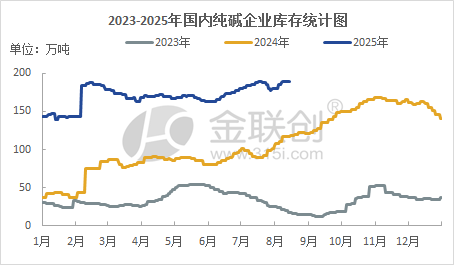
Group 1 - The core viewpoint of the article highlights that recent price rebounds in glass and soda ash futures are driven by expectations of supply reductions in the lithium carbonate industry and stricter environmental inspections in Qinghai, despite stable operational status of local soda ash producers [1][4] - The fundamental data indicates that the soda ash market is under pressure due to oversupply, with domestic production reaching 765,200 tons this week, a 2.31% increase from the previous week, and inventories rising to 1.897 million tons, reflecting a 1.21% week-on-week increase [3][4] - The overall market sentiment remains subdued, with downstream demand primarily focused on maintaining essential purchases, and while exports have been decent, they do not significantly alleviate domestic oversupply pressures [4][8] Group 2 - The soda ash market is expected to continue in a volatile pattern, influenced by policy expectations and high inventory levels, which are likely to suppress price increases [8] - The cost pressures from rising coal prices provide some support for soda ash prices, but this is insufficient to reverse the oversupply situation [4][8] - Investors are advised to closely monitor the speed of inventory digestion and any substantial policy changes regarding production capacity [8]
欧美关税协议达成,国内强预期弱现实
Tong Guan Jin Yuan Qi Huo· 2025-07-28 09:10
Report Industry Investment Rating No relevant content provided. Core Views - Overseas: The US and the EU reached an agreement, with the US imposing a 15% import tariff on most EU goods, half of the previously threatened rate, avoiding an escalation of the trade war. The EU promised to invest about $600 billion in the US and significantly increase purchases of US energy and military products. Sino-US high-level meetings will be held in Stockholm on Monday to extend the August 12 tariff "ceasefire" agreement by 90 days. With the tariff paths of many countries becoming clearer, market risk appetite has slightly increased [2]. - Domestic: The current market is in a stage of "strong expectation, weak reality". The positive sentiment brought by supply - side optimization policies is still evolving. A - shares once broke through the 3600 - point mark, and trading volume and margin trading balances increased. In June, the year - on - year decline in industrial enterprise profits narrowed to - 4.3%, mainly driven by the automotive industry. Short - term attention should be paid to market sentiment, policy outcomes, and tariff negotiations [3]. Summary by Directory Overseas Macro - US 7 - month Manufacturing and Services PMI Differentiation: The US 7 - month Markit manufacturing PMI was 49.5, weaker than expected and below the boom - bust line. The services PMI reached a new high this year at 55.2. Tariffs and high prices were reported to suppress demand [5]. - ECB's July Decision: On July 24, the ECB announced a pause in interest rate cuts after eight consecutive cuts, maintaining the main interest rate at 2.00%. The market's expectation of a September rate cut dropped below 30% [7]. Asset Performance - Equity: Most equity indices showed positive performance. For example, the Shanghai Composite Index rose 4.33% last week, and the Hang Seng Index rose 5.47% [9]. - Bond: Yields of domestic and overseas bonds showed different trends. For example, the 1 - year domestic treasury bond yield rose 3.38 BP last week, while the 5 - year US treasury bond yield fell 1.00 BP [12]. - Commodity: The performance of commodities was mixed. The Nanhua Commodity Index rose 2.73% last week, while WTI crude oil fell 1.48% [14]. - Foreign Exchange: The US dollar index fell 0.80% last week, and the euro - to - RMB exchange rate rose 0.73% [16]. High - Frequency Data Tracking - Domestic: High - frequency data such as the congestion index, subway passenger volume, and real - estate transaction volume are presented through charts [18]. - Overseas: Data on red - book retail sales, unemployment claims, and US treasury bond spreads are shown [22]. This Week's Important Economic Data and Events - A series of economic data and events are scheduled this week, including US GDP, employment data, and euro - zone economic sentiment indices [31].
碳酸锂产业链周度数据报告:陪跑“反内卷”或使锂价高估,关注后续产业资金入场动作-20250723
Tong Hui Qi Huo· 2025-07-23 13:42
Group 1: Report Summary - The current market shows a pattern of "strong expectation, weak reality". The anti - involution theme has a deeper negative impact on lithium carbonate, but recent rectification requirements in Jiangxi and Qinghai have tightened supply expectations, pushing up the bullish sentiment. The basis has widened, creating a certain delivery profit space for the LC2509 contract, and a further rise in futures prices may attract industrial hedging positions [3][4]. Group 2: Supply - Demand Balance Sheet 2.1 Lithium Carbonate Balance Sheet - The lithium carbonate balance sheet generally shows inventory accumulation. For example, on June 30, 2025, the supply was 78,090 tons, demand was 93,815 tons, imports were 22,500 tons, exports were 700 tons, and inventory change was 6,075 tons [6][8]. 2.2 Lithium Hydroxide Balance Sheet - Data on the lithium hydroxide balance sheet is presented, including supply, demand, imports, exports, inventory changes, and cumulative balances. For instance, on June 30, 2025, supply was 24,450 tons, demand was 21,825 tons, imports were 800 tons, exports were 4,700 tons, and inventory change was - 1,275 tons [9][11]. Group 3: Upstream Ore Supply, Demand, and Price 3.1 Lithium Spodumene Imports - Import volume and average import price data for lithium concentrate from different countries are provided. In June 2025, the total import volume was 427,626 tons, with 255,506 tons from Australia and 39,811 tons from Brazil. The average import price was $639 per ton [13][17]. 3.2 Chinese Lithium Mines - Information on domestic lithium ore production, market prices, and weekly inventory is given, including data on sample lithium mica mines and lithium pyroxene mines [18][20]. Group 4: Lithium Salt Supply, Demand, and Price 4.1 Lithium Salt Spot and Futures Prices - Spot prices of battery - grade and industrial - grade lithium carbonate, and lithium hydroxide are presented, along with their price differences and futures prices and basis. For example, on July 22, 2025, the battery - grade lithium carbonate price was 69,000 yuan per ton [22][26]. 4.2 Production Cost and Profit - Production costs and profits of lithium carbonate from different raw materials (lithium spodumene, low - grade mica, high - grade mica) are provided. On July 22, 2025, the production cost of lithium spodumene - produced lithium carbonate was 49,455 yuan per ton, with a profit of 18,495 yuan per ton [34][38]. 4.3 Lithium Carbonate Production - Weekly and monthly production data of lithium carbonate are given, including production by grade (battery - grade and industrial - grade) and raw material (lithium spodumene, lithium mica, salt lake, recycling). In June 2025, battery - grade lithium carbonate production was 57,630 tons [39][49]. 4.4 Operating Rate - The operating rate of the concentrate end is continuously increasing, and data on the operating rates of lithium salt (carbonate and hydroxide) and by raw material are provided [50][54]. 4.5 Lithium Carbonate Monthly Imports - Import volume data of lithium carbonate from different countries are provided, including Argentina and Chile. In May 2025, the total import volume was 21,146 tons [55][59]. 4.6 Lithium Carbonate Inventory - Inventory data of lithium carbonate at downstream and smelting plants, weekly inventory, and futures registered warehouse receipt quantity are presented [60][65]. Group 5: Lithium Salt Downstream Production and Demand 5.1 Lithium Iron Phosphate - Production and operating rate data of lithium iron phosphate are provided. In June 2025, the production was 285,400 tons, and the operating rate was 57% [67][71]. 5.2 Ternary Materials - Production, operating rate, and import - export volume data of ternary materials are given. In June 2025, the production was 64,615 tons [73][82]. 5.3 Ternary Material Import - Export Volume - Import, export, and net import volume data of ternary materials are presented. In May 2025, the net import was - 4,874 tons [78][82]. 5.4 New Energy Vehicle Production and Sales - Production data of pure - electric and plug - in hybrid vehicles, battery production, and dealer inventory warning index are provided. In June 2025, the dealer inventory warning index was 56.6 [83][87]. 5.5 Lithium Battery Import - Export Volume - Import, export, net export volume, and net export growth rate data of lithium - ion batteries are presented. In March 2025, the net export was 280.2 million units, with a growth rate of 28.17% [88][91].
铁矿石定价、西芒杜进展以及近期矛盾梳理
2025-07-16 06:13
Summary of Conference Call on Iron Ore Industry Industry Overview - The focus of the conference call is on the iron ore industry, particularly the recent trends in the black commodities market, with a specific emphasis on coking coal and iron ore prices [1][26]. Key Points and Arguments - **Iron Ore Price Trends**: Recent market movements show that coking coal prices have surged, impacting the overall black commodities market. Iron ore prices are also expected to fluctuate based on macroeconomic factors and seasonal demand [1][26]. - **Iron Ore Classification**: Iron ore can be categorized based on its physical properties and usage, including lump ore, sinter, and pelletized forms. The quality of iron ore is determined by its iron content and the presence of harmful substances [2][3][4]. - **Supply and Demand Dynamics**: China's iron ore resources are relatively scarce, with low average iron content, leading to high extraction costs. In contrast, countries like Australia and Brazil have higher-grade iron ore, making their extraction more economically viable [6][8]. - **Domestic Production Challenges**: Domestic iron ore production faces challenges due to low quality and high costs, resulting in a low self-sufficiency rate for Chinese steel companies, which rely heavily on imports [8][10]. - **International Relations Impact**: The relationship between China and Australia has fluctuated, affecting iron ore supply dynamics. Recent acquisitions of overseas mines by Chinese steel companies aim to improve supply stability [9][10]. - **New Mining Projects**: The Simandou iron ore project in Guinea is highlighted as a significant development, with expectations of low extraction costs and substantial output, potentially altering the global supply landscape [16][24][25]. - **Cost Competitiveness**: The Simandou project is projected to have an extraction cost of only $6 per ton, making it highly competitive compared to existing major producers [24][25]. - **Market Sentiment and Speculation**: Current market sentiment is driven by macroeconomic factors, including geopolitical tensions and monetary policy changes, which influence iron ore pricing and trading strategies [26][27][28]. Additional Important Content - **Inventory Levels**: Port inventories of iron ore are currently around 140 million tons, reflecting supply-demand dynamics and seasonal variations in shipping and production [12]. - **Steel Production Metrics**: China's crude steel production is approximately 1 billion tons, with a corresponding iron ore demand of about 210 million tons, indicating a strong correlation between steel output and iron ore consumption [13][14]. - **Pricing Mechanisms**: The pricing of iron ore is influenced by various factors, including spot market transactions, long-term contracts, and the impact of international pricing indices [15][26]. - **Future Projections**: The Simandou project is expected to produce 120 million tons of iron ore annually by 2026, which could represent a 10% increase in global supply, significantly impacting market dynamics [25][26]. This summary encapsulates the key insights and developments discussed during the conference call, providing a comprehensive overview of the current state and future outlook of the iron ore industry.