中央经济工作会议

Search documents
陈果:关注人民币升值预期下的机会
Sou Hu Cai Jing· 2025-11-30 11:08
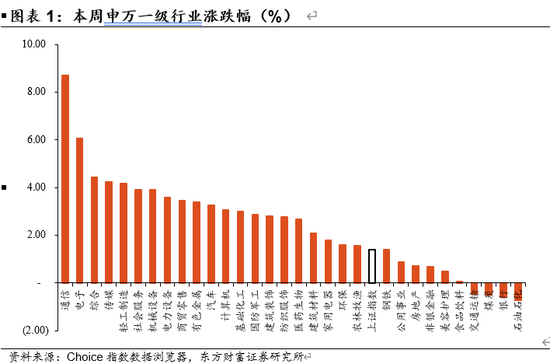
Core Viewpoint - The market is currently experiencing a recovery phase, led by technology growth sectors, but with low trading volumes indicating high investor caution. Key macro events in December, including the Federal Reserve's interest rate decision and the Central Economic Work Conference, are expected to be the main focus for the market [1][3][5]. Market Performance and Trends - The market has shown a rapid rotation among sectors in November, with technology and defensive sectors alternating in performance. The leading sectors for the month included banking, light industry, telecommunications, and media, while computing, automotive, electronics, non-banking financials, and pharmaceuticals lagged [5][6]. - Historical patterns suggest that accelerated sector rotation does not necessarily lead to systemic market adjustments, as market performance is more influenced by valuation levels and the ability of leading sectors to maintain momentum [6][8]. Currency and Foreign Investment - The Chinese yuan has shown a stable and slightly strong trend against the US dollar since November, driven by expectations of a Federal Reserve rate cut, stable China-US relations, and increased demand for currency settlement from export companies. This appreciation is expected to lower costs for import-dependent industries and improve conditions for companies with dollar-denominated debt [2][16]. - The appreciation of the yuan enhances the relative attractiveness of RMB-denominated assets, potentially accelerating foreign capital inflows into the A-share market. Recent data indicates a significant increase in foreign investment in technology growth sectors, reflecting a growing recognition of China's technological capabilities [2][18]. Policy and Economic Outlook - The upcoming Central Economic Work Conference in December is anticipated to provide critical guidance for the market, particularly if it introduces new policy directions related to specific industries. The last five years of cross-year market trends indicate that macro policy is a key driver of market movements, often leading to a shift from value to growth styles [3][15]. - The market is currently positioned for a potential cross-year/spring rally, with expectations of policy support for economic growth. However, the timing of this rally may be delayed due to the need for consensus building among investors [12][15]. Sector Focus - Key sectors to watch include semiconductors, energy storage, robotics, AI applications, and pharmaceuticals, as these areas are likely to benefit from policy support and market interest [3][15].

12月十大金股:十二月策略和十大金股
Huaxin Securities· 2025-11-30 07:01
Group 1: Overall Market Insights - The report highlights the focus on the Federal Reserve's potential interest rate cuts, liquidity recovery, and AI chip competition in December, predicting a volatile recovery in the US stock market with opportunities for low-cost investments [4][14][15] - Domestic PMI shows slight improvement, with attention on policy signals from the Political Bureau and Central Economic Work Conference, indicating a cautious but positive outlook for the A-share market [4][19][21] - The report anticipates a range-bound movement in the A-share market, with a focus on low-consumption sectors, price recovery cycles, and technology themes driven by industrial catalysts [4][22] Group 2: Key Stock Recommendations - The report lists ten key stocks, including Luxshare Precision (002475.SZ) in electronics, Rui Ming Technology (002970.SZ) in new energy, and Zhongmin Resources (002738.SZ) in non-ferrous metals, among others, with no specific ranking [5][12] - Luxshare Precision is expected to benefit from AI-enabled consumer electronics, with a projected revenue growth from 265.32 billion to 358.63 billion RMB from 2024 to 2026 [23][26] - Rui Ming Technology is positioned as a leader in commercial vehicle AI solutions, with revenue forecasts of 26.7 billion to 41.5 billion RMB from 2025 to 2027, driven by policy support and safety requirements [30][34] Group 3: Industry-Specific Insights - The electronics sector, particularly Luxshare Precision, is experiencing growth due to AI integration in consumer electronics, with significant revenue increases expected [23][24] - The storage market is recovering, with companies like Zhaoyi Innovation (603986.SH) benefiting from rising demand and prices for niche DRAM products, projecting revenues of 73.83 million to 107.37 million RMB from 2024 to 2026 [27][28] - The new energy sector, represented by Rui Ming Technology, is set for high growth due to increasing demand for intelligent driving solutions and supportive regulations, with revenue forecasts indicating substantial growth [30][34] Group 4: Financial Performance and Projections - Luxshare Precision reported a revenue of 177.18 billion RMB for the first three quarters of 2024, with a year-on-year growth of 13.67% [23] - Zhaoyi Innovation's revenue for Q1 2024 showed a year-on-year increase of 21.32%, reflecting a recovery in the consumer market [27] - Zhongmin Resources is enhancing its lithium salt self-sufficiency and expanding its copper mining projects, with projected revenues of 56.91 billion to 97.27 billion RMB from 2024 to 2026 [49][50]





沪指11月收跌1.67%结束月线六连涨 国晟科技涨超155%成当月“股王”
Xin Hua Cai Jing· 2025-11-28 09:01
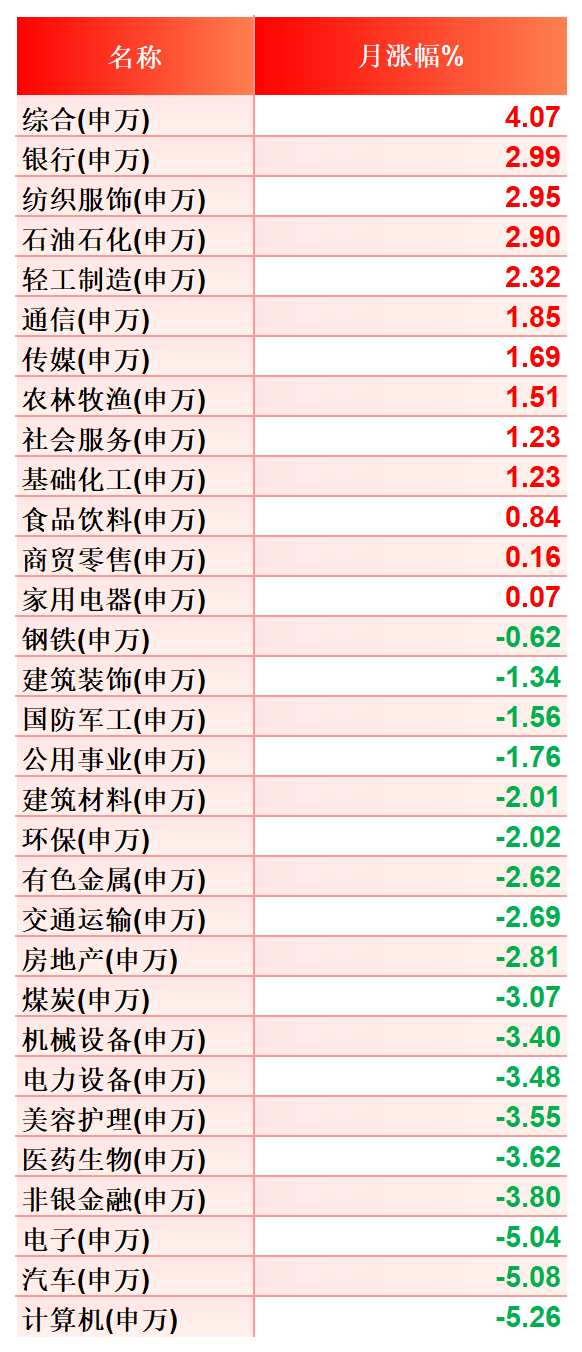
Market Overview - A-shares ended November with a slight increase, with the Shanghai Composite Index closing at 3888.6 points, up 0.34%, but down 1.67% for the month, ending a six-month consecutive rise [1] - The index experienced fluctuations, peaking at 4034.08 points early in the month and dropping to a low of 3856.25 points later, resulting in a monthly volatility of 5.5% [1] - Total trading volume for the month reached 16.1 trillion yuan, remaining stable compared to October, while the total trading volume for both Shanghai and Shenzhen markets was approximately 37.9 trillion yuan, an increase of 1.5 trillion yuan from October [1] Industry Performance - In November, the top-performing sectors included Comprehensive, Banking, Textile & Apparel, Oil & Petrochemicals, and Light Industry Manufacturing, with respective monthly gains of 4.07%, 2.99%, 2.95%, 2.90%, and 2.32% [2] - Conversely, sectors such as Computer, Automotive, Electronics, Non-bank Financials, and Pharmaceutical & Biological industries saw significant declines, with losses ranging from 3.62% to 5.26% [3] Individual Stock Performance - Guosheng Technology led individual stock gains in November, surging over 155%, primarily driven by a strategic acquisition of a lithium battery shell material producer [5] - Other notable gainers included Hefei China and Huasheng Lithium Battery, with increases of over 143% and 132%, respectively [6] Future Outlook - Analysts predict December will be a critical period for global financial markets, influenced by the Federal Reserve's final meeting of the year and key decisions from important domestic meetings [6] - The market is expected to experience a rhythm of "preliminary expectation game, mid-term policy implementation, and late-stage adjustment," providing a favorable environment for year-end positioning [6] - Key events in December include the Central Economic Work Conference and the clarification of the Federal Reserve's interest rate path, which are seen as pivotal for market direction [6]

第一创业晨会纪要-20251127
First Capital Securities· 2025-11-27 03:44
Group 1: Industry Overview - The A-share communication equipment industry index saw a significant increase, with a peak rise of over 8%, primarily driven by the surge in stock prices of optical module companies like Zhongji Xuchuang. This increase is attributed to reports of Google placing a large number of urgent orders for optical modules in the supply chain, particularly focusing on 800G/1.6T high-speed optical modules [2] - Dell's Q3 FY2026 earnings call indicated a notable acceleration in AI growth, with a record backlog of $18.4 billion and a continuous increase in project reserves over the next five quarters, suggesting robust demand growth in the industry [2] - The upcoming Central Economic Work Conference and the Federal Reserve's December meeting are expected to create a favorable market environment, with an 85% probability of interest rate cuts, which could support a sustained rebound in the A-share market [2] Group 2: Consumer Sector Insights - Sanya City launched the sixth phase of duty-free consumption vouchers on November 19, 2025, which will run until December 31, 2025. The vouchers offer discounts ranging from "6000 minus 300" to "50000 minus 4000," aimed at stimulating consumer spending among eligible travelers and residents [6] - Historical data indicates that duty-free consumption vouchers have a significant leverage effect, often leading to multiple times increase in consumption and a notable rise in average transaction value. The vouchers can be combined with in-store promotions, further enhancing consumer spending potential [6] - The issuance of consumption vouchers and the resulting increase in foot traffic are expected to strengthen the price rebound logic post-price hikes, making local retail and service enterprises in Hainan well-positioned to benefit from this trend [6]
食品饮料周报(25年第43周):白酒板块红利属性凸显,关注大众品消费场景恢复-20251125
Guoxin Securities· 2025-11-25 13:55
Investment Rating - The report maintains an "Outperform the Market" rating for the food and beverage sector [4][5][15]. Core Views - The food and beverage sector is expected to benefit from a recovery in consumer spending, particularly in the context of the upcoming 2026 fiscal year, with a focus on health innovation and digital supply chains [3][10]. - The report highlights the differentiation in performance across categories, with beverages outperforming food and alcoholic beverages [2][10]. - Key investment opportunities are identified in premium liquor brands, dairy products, and innovative snack foods, with specific recommendations for companies like Guizhou Moutai, Yili, and Eastroc Beverage [2][3][15]. Summary by Relevant Sections Market Overview - The food and beverage sector saw a cumulative decline of 1.52% this week, with A-shares down 1.36% and H-shares down 3.69% [1]. - Notable performers included Nanchao Food (+11.91%) and Yili (+2.65%) [1]. Alcoholic Beverages - The liquor sector is entering a left-side layout phase, with premium brands expected to gain market share [2][10]. - Recommendations include Luzhou Laojiao, Shanxi Fenjiu, and Guizhou Moutai, with a focus on companies that can leverage pricing power and regional advantages [2][10]. Beer - The beer industry is experiencing healthy inventory levels, with expectations for demand recovery [2][11]. - Yanjing Beer is recommended for its strong growth potential and ongoing internal reforms [2][11]. Dairy Products - The dairy sector is seeing a steady recovery in demand, with Yili recommended for its valuation safety margin [2][13]. - The report anticipates improvements in supply-demand dynamics by 2026 [2][13]. Snacks - The report emphasizes the growth potential of konjac snacks, with leading companies like Weilong and Yanjinpuzi showing strong competitive advantages [2][12]. - The snack industry is shifting towards a category-driven growth model, necessitating strong product differentiation [2][12]. Investment Recommendations - The recommended investment portfolio includes Guizhou Moutai, Babi Food, Eastroc Beverage, Weilong, and Luzhou Laojiao, with an average decline of 4.94% this week [3][15]. - The report suggests that the current pricing environment for Moutai presents a favorable investment opportunity, with expectations for revenue growth in the coming years [15][16].




长城基金汪立:新兴科技仍有望成为主线
Sou Hu Cai Jing· 2025-11-25 09:08
Group 1 - The overall market is expected to enter a sentiment recovery phase as various risk factors approach resolution, with a rebalancing of industry allocations anticipated [1] - The Federal Reserve's dovish stance and the potential for interest rate cuts in December may improve global liquidity expectations [1][2] - Current adjustments in A-share popular sectors and broad indices are nearing historical average levels for emotional corrections, indicating potential short-term reversal signals [1] Group 2 - Emerging technology is expected to remain a key investment theme, with attention also on undervalued consumer stocks and brokerage firms [2] - The improvement in global industrial competitiveness is opening new growth opportunities for Chinese companies, particularly in sectors like internet, semiconductors, media, power equipment, and innovative pharmaceuticals [2] - The financial sector is seen as a crucial mechanism for stabilizing the market, with potential benefits from surging asset management demand and active market trading, focusing on brokerage, insurance, and banking [2]
长城基金汪立:从再平衡到再配置,回调或是再次布局机会
Xin Lang Ji Jin· 2025-11-25 08:10
Group 1 - The A-share market experienced a significant pullback last week, with major indices generally declining. Sectors such as banking and consumer goods showed relatively smaller declines, while media and military industries, which had previously corrected, remained stable. This indicates a continued structural differentiation in the market, with small-cap growth styles under pressure and value and dividend sectors performing relatively well, reflecting intensified competition for funds amid declining risk appetite [1] Group 2 - Domestic economic indicators such as industrial production, consumption, and investment growth rates slowed down in October compared to September. This was influenced by holiday timing and high base effects from last year's policy stimulus, leading to short-term fluctuations in data. The pressure on domestic and external demand still requires policy support, with the need for further implementation of existing policies and timely introduction of new measures [2] - Credit performance from both enterprises and households has been relatively weak, with social financing growth continuing to decline due to reduced government bond issuance. However, new policy financial tools are gradually showing effects, which may support corporate loans. The Ministry of Finance announced the allocation of 500 billion yuan from local government debt limits, which may help stabilize social financing data in the last two months of the year [2] Group 3 - The debate over the AI valuation bubble is intensifying, causing fluctuations in the US stock market. However, data shows that the current Nasdaq index growth and valuation levels are significantly lower than during the tech bubble period from 1995 to 2000. Core companies are also showing accelerated profit releases, with stronger valuation and profit quality compared to that period [3] Group 4 - Following the market pullback in October, the overall financing and trading volume has significantly decreased. However, as various risk factors begin to stabilize, the market is expected to enter a phase of emotional recovery, with increased demand for industry rebalancing and fund reallocation. Factors supporting this include the dovish stance from the Federal Reserve, the necessity for policy intervention to boost growth in light of weak real estate and consumption data, and the current A-share market's adjustment levels approaching historical averages [4] - Emerging technology is expected to remain a key investment theme, with a focus on undervalued consumer sectors and brokerage firms. Specific areas of interest include internet, semiconductor, media, power equipment, and innovative pharmaceuticals in the technology sector, as well as consumer goods, hotels, airlines, and retail in the consumer sector. The financial sector is also highlighted as a crucial area for stabilizing the market and benefiting from increased asset management demand [4]
需要AI给答案!市场静待转机,慢牛预期不变
Zheng Quan Shi Bao Wang· 2025-11-24 10:28
Group 1 - The core viewpoint is that the volatility of global risk assets is primarily due to liquidity issues and an over-reliance on AI narratives, leading to necessary valuation corrections when industrial development lags behind market expectations [2] - The recent adjustments in the US non-farm employment data and the downshift in interest rate cut expectations from the Federal Reserve have triggered corrections in high asset valuations, amplifying concerns about the sustainability of AI infrastructure in North America [2] - The market is expected to experience a "sharp drop and slow rise" pattern similar to the US market, with opportunities for investors to reallocate to A-shares and Hong Kong stocks as risks are released ahead of year-end [2][3] Group 2 - The Chinese stock market is currently experiencing weakness due to year-end profit-taking, reduced positions, and a lack of internal policy support, but there is a strong belief in the market's future potential [3] - The upcoming period from December to February is anticipated to bring a convergence of policy, liquidity, and fundamentals, which could stabilize the market and lead to an upward trend [3][4] - Key sectors to focus on include AI applications, domestic consumption, and infrastructure projects in Xinjiang [3] Group 3 - The market is in a "three-phase overlap" characterized by a mid-bull market consolidation, critical economic verification, and a policy vacuum, leading to increased volatility and profit-taking [4] - The recent fluctuations in the overseas environment, including the Federal Reserve's interest rate expectations, have impacted global liquidity and investor sentiment [4][5] - Long-term bullish factors remain intact, with a focus on strategic positioning ahead of key meetings in December [4] Group 4 - The current market adjustment is seen as a necessary phase, with expectations for improved conditions as liquidity pressures ease and market sentiment stabilizes [6] - Investment strategies should focus on sectors with strong safety margins, including traditional manufacturing, food and beverage, and communication services [6] - The emphasis is on maintaining a cautious approach while identifying opportunities in undervalued sectors [6] Group 5 - The recent decline in A-shares is attributed to weak domestic economic data, a strong dollar, and year-end performance pressures, with expectations for a stabilization following key policy meetings in December [7] - The market is likely to return to an upward cycle in the first quarter of the following year, with a focus on large-cap blue chips and cyclical stocks [7] Group 6 - Concerns about the sustainability of AI capital expenditures have contributed to market corrections, but the current downturn should not be viewed as a definitive turning point [8] - The focus should be on sectors benefiting from physical asset consumption and the recovery of domestic demand, particularly in upstream resources and traditional manufacturing [8] Group 7 - The recent market fluctuations are viewed as "clear sky turbulence," with expectations for limited severe volatility moving forward [9] - The transition from a liquidity-driven bull market to a fundamentals-driven bull market is anticipated, with a focus on cyclical stocks and overseas opportunities [9] Group 8 - The current market adjustment is expected to provide a foundation for future upward momentum, with a focus on strategic positioning in key sectors [10] Group 9 - The market is currently experiencing a phase of increased volatility, with trading activity declining from previous highs, indicating a potential consolidation period [11] - Investment themes are expected to revolve around technology, economic recovery, and undervalued dividend stocks [11] Group 10 - The recent adjustments in the A-share market are seen as a necessary phase, with expectations for a rebound following key policy announcements in December [12] - The focus should be on high-dividend large-cap stocks and sectors related to new consumption and AI applications [12] Group 11 - The crowded nature of certain sectors, particularly in new energy and AI, suggests a potential for short-term adjustments, with a focus on identifying optimal entry points [13] - The outlook for industrial metals and AI-related sectors remains positive, driven by global economic recovery and supply constraints [13]
朝闻国盛:当前债市关键在银行
GOLDEN SUN SECURITIES· 2025-11-24 06:18
Group 1: Fixed Income Market Insights - The current bond market is heavily influenced by banks, with expectations of gradual recovery as year-end approaches, leading to increased allocation by banks due to easing pressure on indicators [16] - The 10-year government bond yield is expected to recover to a range of 1.6%-1.65% by year-end, reflecting a potential stabilization in the market [16] - Recent data indicates a significant net repayment of certificates of deposit, with a net financing of -373.2 billion yuan, suggesting a tightening liquidity environment [17][18] Group 2: Biotechnology Sector Analysis - The innovation drug sector is experiencing a resurgence driven by supportive policies and a favorable pricing mechanism, with a focus on global expansion opportunities [10][11] - The China Biotechnology Index, which includes companies involved in gene diagnostics and biopharmaceuticals, is showing strong market liquidity and institutional recognition, indicating a robust investment environment [13] - The projected revenue growth for the innovative drug company is significant, with forecasts of 5.43 billion yuan, 8.62 billion yuan, and 11.42 billion yuan for 2025-2027, respectively [23] Group 3: Coal Market Dynamics - Current coal prices are primarily driven by real demand, particularly as the heating season begins, leading to increased consumption by power plants [30][31] - The supply constraints and regulatory pressures are expected to keep coal prices on an upward trajectory, with predictions of prices exceeding market expectations by year-end [31] - The focus on high-quality coal and the impact of steel production on coal demand are critical factors influencing market sentiment [32] Group 4: Renewable Energy and AIDC - The demand for AIDC (Artificial Intelligence Data Centers) is projected to increase significantly, with electricity needs expected to grow 2-3 times by 2028, highlighting a critical gap in the current power supply [37] - SOFC (Solid Oxide Fuel Cells) is identified as a leading technology for onsite power solutions, with advantages in deployment speed and power density, making it a key player in the AIDC market [38] - The materials used in SOFC technology are crucial for its performance, with ceramic support structures currently dominating the market, indicating a strong competitive landscape [39]
中航资本:沪指跌0.34%,煤炭、有色等板块走低,军工板块逆市拉升
Sou Hu Cai Jing· 2025-11-24 05:42
Market Overview - The major stock indices in the market experienced fluctuations and retreated, with the ChiNext index dropping approximately 1% and falling below 2900 points, while around 3200 stocks were in the green [1] - As of the midday close, the Shanghai Composite Index fell by 0.34% to 3821.68 points, the Shenzhen Component Index decreased by 0.59%, and the ChiNext index declined by 0.77%, with a total transaction volume of 1,032.6 billion yuan across the Shanghai and Shenzhen markets [3] Sector Performance - Sectors such as coal, gas, non-ferrous metals, electricity, and stability saw declines, while military and pharmaceutical sectors rose against the trend, with military trade and AI application concepts being particularly active [3] Market Sentiment and Analysis - The current market is characterized by a "three-phase overlap": a consolidation phase in the middle of a bull market, a critical period for verifying economic conditions, and a performance policy gap, leading to market fluctuations and profit-taking as the year-end approaches [3] - Recent disturbances in the overseas environment, including repeated expectations of a Federal Reserve rate cut in December, have shaken global market liquidity expectations; despite Nvidia's earnings exceeding expectations, its stock price experienced volatility, raising concerns about the sustainability of AI spending, which has affected sentiment in the A-share market [3] - Long-term factors supporting a slow bull market remain unchanged; however, in the short term, the strategy should focus on opportunistic positioning, awaiting the Federal Reserve's monetary policy meeting and the central economic work conference in mid-December, with potential for increased buying if adjustments are sufficient, while monitoring support levels at the 60-day and half-year moving averages and market volume conditions [3]