
纺织服装服饰

Search documents
国泰海通|宏观:假期扰动:PMI季节性回落——2026年2月PMI数据点评
国泰海通证券研究· 2026-03-05 14:13
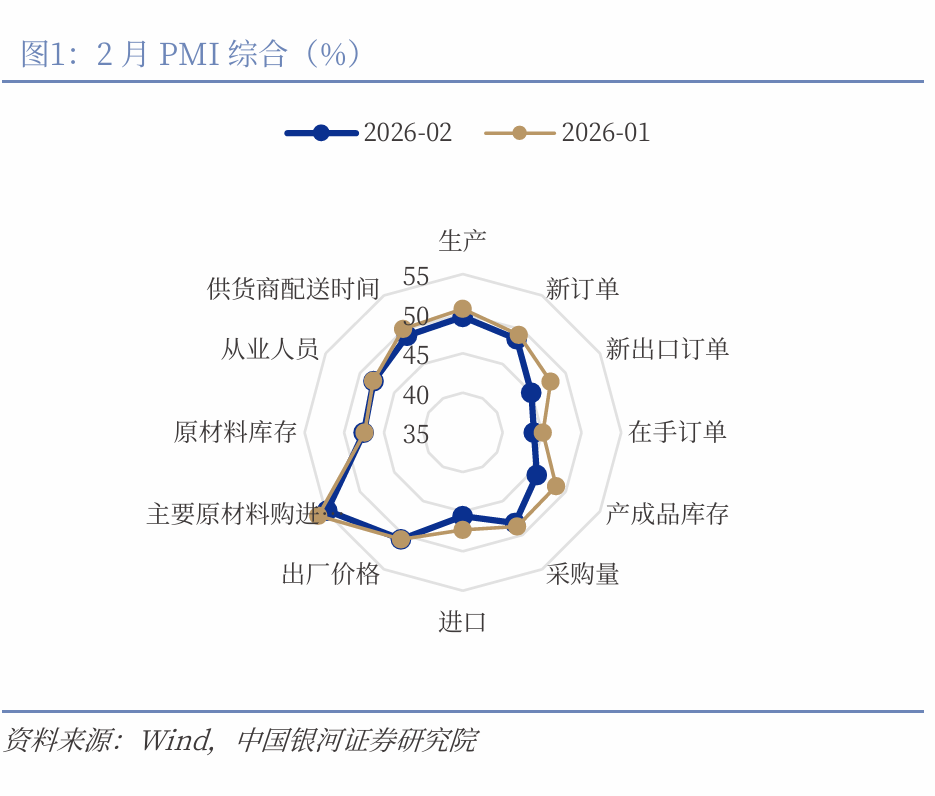
报告导读: 本月制造业 PMI 边际回落,供需指数季节性下滑,主因"史上最长春节假 期"的扰动。价格指数暂稳,接下来需关注输入性通胀的影响。在服务业,景气平稳,结构 分化。此外,建筑业活跃度还需政策呵护。 2026 年 2 月份,制造业 PMI 为 49.0% ,比上月下降 0.3 个百分点。建筑业商务活动指数为 48.2% ,比上月下降 0.6 个百分点;服务业商务活动指数为 49.7% ,比上月上升 0.2 个百分点。 本订阅号所载内容仅面向国泰海通证券研究服务签约客户。因本资料暂时无法设置访问限制,根据《证 券期货投资者适当性管理办法》的要求,若您并非国泰海通证券研究服务签约客户,为保证服务质量、 控制投资风险,还请取消关注,请勿订阅、接收或使用本订阅号中的任何信息。我们对由此给您造成的 不便表示诚挚歉意,非常感谢您的理解与配合!如有任何疑问,敬请按照文末联系方式与我们联系。 非制造业景气度:服务平稳,建筑低位。 在服务业, 2 月商务活动指数略微回升,但结构分化明显。一方面,居民出行消费相关行业业务总量增长较快。住 宿、餐饮、文化体育娱乐等行业活跃度偏高,零售、航空运输等行业商务活动指数升至高位。另一 ...


2026年2月PMI点评:经济“开门红”仍较温和
Orient Securities· 2026-03-05 06:42
宏观经济 | 动态跟踪 经济"开门红"仍较温和 2026 年 2 月 PMI 点评 研究结论 风险提示 ⚫ 逆周期政策传导速度不及预期的风险;其他国家贸易政策具有不确定性的风险;地 缘冲突频发对大宗商品价格的影响超预期。 图 1:春节是 PMI 进一步回落的主要原因,实际表现并不弱 (%) 数据来源:同花顺,东方证券研究所 数据来源:同花顺,东方证券研究所 48 48.5 49 49.5 50 50.5 51 图 3:中小型型企业 PMI 压力明显更大(%) 图 4:建筑业 PMI 进一步回落(%) 40 42 44 46 48 50 52 54 2024/9 2024/10 2024/11 2024/12 2025/1 2025/2 2025/3 2025/4 2025/5 2025/6 2025/7 2025/8 2025/9 2025/10 2025/11 2025/12 2026/1 2026/2 大型企业 中型企业 小型企业 报告发布日期 2026 年 03 月 05 日 | 孙国翔 | 执业证书编号:S0860523080009 | | --- | --- | | | sunguoxiang@or ...
兼评2月PMI数据:春节效应拖累PMI,复工略快于往年
KAIYUAN SECURITIES· 2026-03-05 03:14
2026 年 03 月 05 日 宏观研究团队 春节效应拖累 PMI,复工略快于往年 ——兼评 2 月 PMI 数据 何宁(分析师) 陈策(分析师) hening@kysec.cn 证书编号:S0790522110002 chence@kysec.cn 证书编号:S0790524020002 制造业:春节效应下 PMI 延续偏弱 1、受春节假期等因素影响,制造业景气度延续偏弱运行。2 月制造业 PMI 为 49.0%、环比下行了 0.3 个百分点,弱于季节性规律,供需分项均下行。分行业 来看,农副食品加工、计算机通信电子设备等行业的产需指数保持扩张,纺织 服装服饰、汽车等行业相对承压。 2、工业原材料价格环比回落,预计 2 月 PPI 同比延续回升。2 月 PMI 原材料购 进价格为 54.8%,较前值下降了 1.3 个百分点,PMI 出厂价格为 50.6%,持平于 前值。从高频指标来看,预计 2 月 PPI 环比可能在 0.3%左右,同比为-1.0%左右。 3、分类型来看,大型企业景气向好但中小型走弱。2 月大型、中型、小型企业 PMI 分别较前值变动了+1.2、-1.2、-2.6 个百分点。表征民企景气度 ...
【权威解读】2月份制造业采购经理指数有所回落 非制造业商务活动指数小幅回升
中汽协会数据· 2026-03-04 07:53
2 月份制造业采购经理指数有所回落 一、制造业采购经理指数有所回落 2 月份,制造业 PMI 为 49.0% ,景气水平较上月下降。从历史数据看,春节所在月份 的 PMI 大多会出现一些波动,尤其今年春节假期有所延长且全部落在 2 月中下旬,企业生产 经营受到一定影响,制造业市场活跃度总体有所下降。 (一)产需两端均有放缓。 生产指数和新订单指数分别为 49.6% 和 48.6% ,比上月下 降 1.0 个和 0.6 个百分点,制造业生产和市场需求有所回落。从行业看,农副食品加工、计 算机通信电子设备等行业生产指数和新订单指数均位于临界点以上,产需景气水平保持扩 张;纺织服装服饰、汽车等行业两个指数继续低于临界点,市场活跃度偏弱。 (二)大型企业 PMI 继续扩张。 大型企业 PMI 为 51.5% ,比上月上升 1.2 个百分 点,大型企业生产经营保持扩张;中、小型企业受春节假期影响较大,本月 PMI 分别为 47.5% 和 44.8% ,比上月下降 1.2 个和 2.6 个百分点,景气水平回落。 (三)高技术制造业增长动能持续显现。 高技术制造业 PMI 为 51.5% ,继续位于扩张 区间,明显高于制造 ...

2026年2月PMI分析:PMI季节性回落,一季度力争开门稳
Yin He Zheng Quan· 2026-03-04 07:37
PMI 季节性回落,一季度力争开门稳 ——2026 年 2 月 PMI 分析 2026 年 3 月 4 日 国家统计局 3 月 4 日发布数据:2026 年 2 月份,制造业采购经理指数(PMI)为 49.0%,比上月下降 0.3 个百分点。建筑业商务活动指数为 48.2%(前值 48.8%); 服务业商务活动指数为 49.7%(前值 49.5%)。 核心观点:整体来看,2 月 PMI 回落主要受春节假期等季节性因素扰动,供需两 端均出现阶段性放缓,生产活动与订单指标同步回落,但幅度基本符合历史季节性 规律。从结构上看,电子通信等新动能行业仍保持较强景气度,而纺织服装、汽车 等传统行业需求仍偏弱,制造业内部呈现一定分化。价格方面,上游原材料价格指 数边际回落,出厂价格保持稳定,成本与售价之间的缺口有所收敛,若该趋势延续, 将对工业企业利润修复形成一定支撑。库存方面,产成品库存下降而原材料库存小 幅回升,整体库存仍处于波动状态,企业普遍采取"以销定产"的谨慎策略,库存 维持在相对紧平衡区间。展望未来,随着春节因素逐步消退,3 月制造业生产活动 预计会修复,生产指数和新订单指数预计将有所回升。外需方面,OECD ...
【中国银河宏观】PMI季节性回落,一季度力争开门稳——2026年2月PMI分析
Xin Lang Cai Jing· 2026-03-04 06:33
(来源:中国银河宏观) 国家统计局3月4日发布数据:2026年2月份,制造业采购经理指数(PMI)为49.0%,比上月下降0.3个百分点。建筑业商务活动指数为48.2%(前值 48.8%);服务业商务活动指数为49.7%(前值49.5%)。 核心观点:整体来看,2月PMI回落主要受春节假期等季节性因素扰动,供需两端均出现阶段性放缓,生产活动与订单指标同步回落,但幅度基本符合历 史季节性规律。从结构上看,电子通信等新动能行业仍保持较强景气度,而纺织服装、汽车等传统行业需求仍偏弱,制造业内部呈现一定分化。价格方 面,上游原材料价格指数边际回落,出厂价格保持稳定,成本与售价之间的缺口有所收敛,若该趋势延续,将对工业企业利润修复形成一定支撑。库存方 面,产成品库存下降而原材料库存小幅回升,整体库存仍处于波动状态,企业普遍采取"以销定产"的谨慎策略,库存维持在相对紧平衡区间。展望未来, 随着春节因素逐步消退,3月制造业生产活动预计会修复,生产指数和新订单指数预计将有所回升。外需方面,OECD综合领先目前指向到6月份我国出口 累计同比延续温和上行,意味着外需仍具有韧性;内需则仍有赖于政策进一步发力以及终端消费和投资需求的 ...

复刻2009年大牛市?PMI回升吹响春季行情进攻号角
Xin Lang Cai Jing· 2026-01-14 05:31
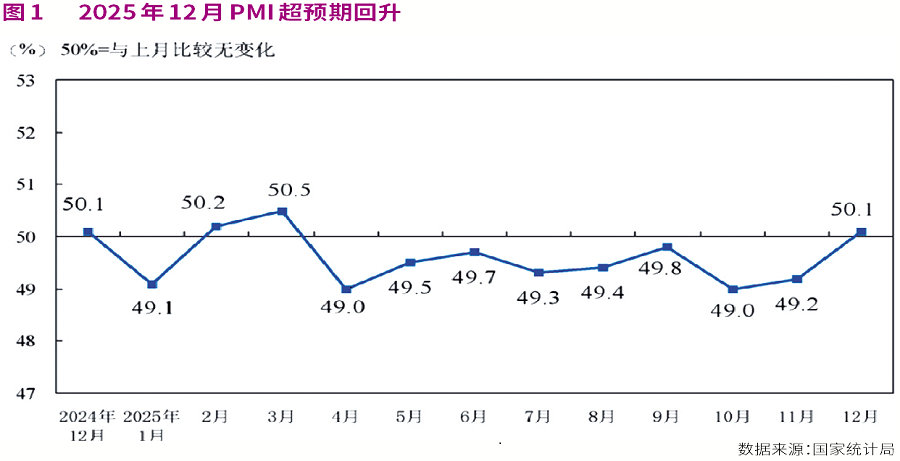
Core Viewpoint - The significant rebound in the Manufacturing Purchasing Managers' Index (PMI) for December 2025, which exceeded expectations, signals a potential bullish market trend for 2026, reminiscent of the 2008-2009 market recovery [1][6][26]. Economic Indicators - The December 2025 manufacturing PMI reached 50.1%, an increase of 0.9 percentage points from the previous month, marking a return to the expansion zone after eight months [5][16]. - The non-manufacturing PMI was 50.2%, up 0.7 percentage points, while the composite PMI rose to 50.7%, an increase of 1.0 percentage points [5][16]. - Historical trends show that PMIs typically experience seasonal declines at year-end, but the current data reflects a significant "reverse seasonal" increase, indicating stronger economic potential for Q1 2026 [5][16]. Sector Performance - The production index and new orders index for December were 51.7% and 50.8%, respectively, both showing substantial increases, particularly the new orders index, which rose above the critical point for the first time since the second half of 2025 [9][20]. - Industries such as food processing, textiles, and electronics showed production and new orders indices above 53.0%, indicating robust demand, while sectors like non-metallic minerals and black metal processing faced challenges with indices below the critical point [9][20]. Market Sentiment - The current economic environment is characterized by a strong willingness for production expansion, as indicated by rising PMI indices for production activities and procurement [17][20]. - The upcoming Spring Festival in 2026, occurring later than usual, has prompted companies to adjust production schedules to avoid disruptions, contributing to increased production activity [21]. Price Trends - The raw material purchase price index decreased by 0.5 percentage points, while the factory price index increased by 0.7 percentage points, suggesting improved pricing dynamics and potential profit margins for mid- and downstream industries [21]. - The new export orders index rose by 1.4 percentage points, reflecting enhanced resilience in Chinese exports and reduced dependency on specific markets [21]. Construction Sector - The construction business activity index surged to 52.8%, a significant increase of 3.2 percentage points, indicating a recovery in the construction sector after four months below the critical threshold [22][23]. - Factors contributing to this increase include favorable weather conditions in southern provinces and proactive measures by companies to accelerate construction progress [22][23]. Conclusion - The December 2025 PMI's unexpected rise suggests renewed policy momentum, with expectations for a strong economic start in Q1 2026, supporting a bullish outlook for the upcoming "spring market rally" [24][26].
“月度前瞻”系列专题之六:再议宏微观温差?-20260112
Shenwan Hongyuan Securities· 2026-01-12 12:48
Group 1: Economic Discrepancies - By the end of 2025, production indicators such as high furnace operation and PTA operation weakened, while manufacturing PMI rose by 0.9 percentage points to 50.1%[3] - Consumer retail volume for automobiles and home appliances showed a downward trend, but the overall consumer goods PMI increased by 1 percentage point to 50.4% in December[3] - Cement shipment rates and rebar apparent consumption remained low, with December year-on-year changes of -1.8% and -10% respectively, yet the construction PMI rose by 3.2 percentage points to 52.8%[4] Group 2: Factors Behind Economic Discrepancies - The shift in economic growth momentum has led to new sectors lacking high-frequency indicators contributing more to the economy, with AI-related industries boosting GDP by approximately 1.5 percentage points[5] - Consumer sectors face "demand overdraw risks," while service consumption, which lacks tracking indicators, has shown resilience, with service retail growth rising since September[5] - Previous debt management affected investment rhythms, with industrial product improvements reflecting raw material purchases rather than actual investments[5] Group 3: Economic Outlook for Early 2026 - The "old-for-new" policy is expected to face downward pressure, but service consumption may benefit from increased policy support, with domestic travel and spending during the New Year holiday exceeding 2019 levels[6] - Infrastructure investment is anticipated to rebound in early 2026 due to reduced special refinancing bond issuance and new infrastructure policies, focusing on digital infrastructure and carbon reduction investments[6] - The delayed Spring Festival in 2026 may extend the "export rush" window, potentially boosting January export figures compared to the previous year[6]
经济景气水平总体回升
Xin Lang Cai Jing· 2026-01-01 16:40
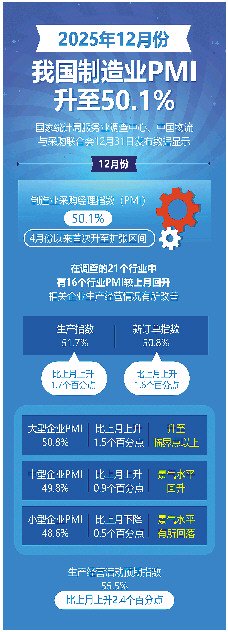
Core Viewpoint - The manufacturing and non-manufacturing sectors in China showed signs of recovery in December 2025, with key indices rising above the expansion threshold, indicating improved economic conditions [1][4]. Manufacturing Sector - In December 2025, the Manufacturing Purchasing Managers' Index (PMI) reached 50.1%, marking the first time it entered the expansion zone since April [1]. - Among the 21 surveyed industries, 16 reported an increase in PMI compared to the previous month, indicating improved production and operational conditions [1]. - The production index and new orders index were 51.7% and 50.8%, respectively, both showing significant increases of 1.7 and 1.6 percentage points from the previous month [1]. - High-tech manufacturing PMI was 52.5%, up 2.4 percentage points, indicating positive growth trends [3]. - Equipment manufacturing and consumer goods industries both recorded PMIs of 50.4%, rising by 0.6 and 1.0 percentage points, respectively [3]. - The procurement activity accelerated with a procurement volume index of 51.1%, entering the expansion zone [2]. Non-Manufacturing Sector - The Non-Manufacturing Business Activity Index was 50.2%, an increase of 0.7 percentage points, indicating an improvement in the non-manufacturing sector's economic conditions [4]. - The new orders index for non-manufacturing rose to 47.3%, up 1.6 percentage points, reaching the highest level this year [4]. - The business activity expectation index for non-manufacturing was 56.5%, reflecting a continuous increase for three months, indicating rising market confidence [4]. - The construction industry saw a significant improvement, with the business activity index at 52.8%, up 3.2 percentage points from the previous month [4]. Composite Index - The Composite PMI Output Index reached 50.7%, an increase of 1.0 percentage point, indicating overall expansion in production and operational activities [5].
数据点评 | 12月PMI回升的四大支撑(申万宏观·赵伟团队)
Xin Lang Cai Jing· 2025-12-31 19:00
Core Viewpoint - The December PMI indices show a significant rebound in manufacturing and non-manufacturing sectors, driven by new economic momentum and consumer goods industries, while the effects of debt reduction are easing and export resilience is supporting growth [2][3][25]. Group 1: Manufacturing Sector - The manufacturing PMI increased by 0.9 percentage points to 50.1%, marking a return to the growth threshold after nine months [2][6]. - The production and new orders indices rose by 1.7 and 1.6 percentage points to 51.7% and 50.8%, respectively [6][28]. - High-tech and equipment manufacturing sectors saw improvements, with PMIs rising by 2.4 and 0.6 percentage points to 52.5% and 50.4% [12][18]. Group 2: Consumer Goods Sector - The overall consumer goods PMI rose by 1 percentage point to 50.4%, despite a significant decline in the automotive sector PMI, which fell by 5.8 percentage points [15][25]. - The textile and apparel industry PMI increased by 4.5 percentage points to 57.5%, reflecting improvements in travel-related demand [15][25]. Group 3: Construction Sector - The construction PMI rose by 3.2 percentage points to 52.8%, indicating a recovery in building activities due to easing debt reduction pressures and the implementation of new policies [3][18]. - The new orders index in the construction sector increased by 1.3 percentage points, while the employment index slightly declined [50]. Group 4: Export and Domestic Demand - The domestic orders index rose by 1.6 percentage points to 51.1%, while the new export orders index improved by 1.4 percentage points to 49% [22][25]. - Port trade volumes increased by 0.6 percentage points year-on-year, maintaining a high level of activity [22][25].
