
机械

Search documents
月度报告(2026/2):2月行业配置推荐顺周期行业——行业配置策略-20260203
Huafu Securities· 2026-02-03 07:52
Core Insights - The report emphasizes a dynamic balance strategy that has achieved an annualized absolute return of 18.85% and a relative return of 12.26% from January 2015 to January 30, 2026, with a maximum drawdown of 10.18% [3] - Recommended industries for February 2026 include non-ferrous metals, basic chemicals, electric equipment and new energy, communication, light manufacturing, and steel [3][25] - The macro-driven strategy has generated an annualized excess return of 4.77% since January 2016, with a maximum drawdown of 9.51% [4][45] - The multi-strategy approach has yielded an annualized relative return of 6.32% since May 2011, with a maximum drawdown of 13.24% [5][66] - The extreme style high beta strategy has achieved an annualized relative return of 9.93% since July 2013, but has underperformed in 2026 with a relative excess return of -4.02% [5][80] Industry Performance Summary - In January 2026, the A-share market saw the CSI 300 index rise by 1.65%, while the CSI 500 index increased by 12.12% [16] - The top-performing sectors in January were non-ferrous metals, media, oil and petrochemicals, building materials, and electronics [16] - The dynamic balance strategy outperformed its benchmark in January with an absolute return of 9.18% and an excess return of 4.05% [22][55] - The macro-driven strategy achieved an absolute return of 6.76% in January, with an excess return of 1.20% [4][48] - The multi-strategy approach recorded an absolute return of 4.65% in January, but underperformed its benchmark with an excess return of -0.42% [5][69] Recommended Industries - The dynamic balance strategy recommends non-ferrous metals, basic chemicals, electric equipment and new energy, communication, light manufacturing, and steel for February 2026 [3][25] - The macro-driven strategy suggests food and beverage, defense and military, pharmaceuticals, non-ferrous metals, communication, and basic chemicals for February 2026 [4][24] - The multi-strategy approach recommends real estate, construction, banking, communication, textiles and apparel, pharmaceuticals, basic chemicals, and non-ferrous metals for February 2026 [5][56] - The extreme style high beta strategy recommends transportation, electric utilities, basic chemicals, machinery, banking, and oil and petrochemicals for February 2026 [5][74]
【策略快评】:调整或已到位,把握配置区间
Huachuang Securities· 2026-02-03 04:11
Group 1 - The report indicates that the recent market pullback is primarily due to external events, particularly the appointment of the Federal Reserve Chairman and the tendency to reduce the balance sheet, which has led to a rebound in the US dollar and a significant drop in gold and silver prices, adversely affecting emerging markets [1][6] - The report highlights that the mid-term trend remains positive, with clear evidence of performance recovery in the domestic market, as indicated by a 37% earnings forecast positive rate for 2025, surpassing the 33.5% rate of 2024 [2][6] - Analysts have been increasingly revising upward their earnings forecasts for 2026, with a maintained neutral (optimistic) profit growth estimate of 11% (17%) for non-financial sectors [2][6] Group 2 - The report emphasizes the importance of identifying the right allocation range, suggesting that the upcoming National People's Congress in early March could act as a catalyst for improving risk appetite [3][7] - It is recommended to focus on sectors with growth potential, particularly in technology and cyclical industries, as the report notes that the transition to a slow bull market makes it easier to price risks through rapid pullbacks [3][7] - The report identifies key sectors to watch, including materials, chemicals, machinery, steel, and construction, which are expected to benefit from supply advantages [3][7]
华创策略姚佩:调整或已到位,把握配置区间
Xin Lang Cai Jing· 2026-02-03 03:58
Group 1 - The recent market pullback is primarily driven by the appointment of the Federal Reserve Chairman and the tendency to reduce the balance sheet, leading to a rebound in the US dollar and a significant drop in gold and silver, which has suppressed risk appetite in emerging markets [1][4] - The number of companies hitting the daily limit down reached 130 on February 2, surpassing the previous high of 107 on November 21, marking a six-month low [1][4] - The net outflow from margin trading over two consecutive days reached 29.5 billion, setting a new six-month high [1][4] Group 2 - Evidence of performance recovery for 2025-2026 is becoming clearer, with a 37% earnings forecast positive rate for 2025, exceeding the 33.5% rate of 2024 [1][4] - Analysts have been increasingly revising upward their earnings forecasts for 2026, maintaining a neutral (optimistic) profit growth estimate of 11% (17%) for non-financial sectors in 2026 [1][5] - Recent trends show that over 1 trillion has flowed out of broad-based ETFs in the past two weeks, but there is a noticeable trend of residents moving their deposits after the maturity of long-term savings [5] Group 3 - The investment strategy emphasizes the importance of capturing the current allocation range, with expectations that the upcoming National People's Congress in early March will act as a catalyst for improving risk appetite [2][5] - The anticipated recovery in PPI is expected to support EPS, highlighting the ongoing value in technology innovation and cyclical sectors, particularly in areas such as computing power, energy storage, AI applications, and smart driving [2][5] - The cyclical sectors, referred to as the "five flowers," are expected to benefit from supply advantages, with a focus on non-ferrous metals, chemicals, machinery, steel, and building materials [2][5]
美联储官员首现2026年不降息论调,美国1月PMI达52.6!远超预期!
Sou Hu Cai Jing· 2026-02-03 02:07
美国现在最有优势的是什么?在我看来,除了守着贸易卡点的美军,就是美元及其体系下的交易所,因此其才可以像揉面团一样,不断的拉扯市场,导致无 论是品种、市场、预期、抑或定价逻辑,基本都要靠大家去了几年的"美元"去最后呈现,万一跟不上了,还得修改规则,从后往前算去对齐,因此,大家一 定要明白,2026年和2025年可能会有很大的不同,其中的关键就是美元的方向! 这种区别,在其实在前面的文章就已经详细解说了,比如BIS谈金银泡沫风险、特朗普谈房产价值、泰国抑制金银交易不得做空、水贝市场白银暴雷、最后 是沃什上任!无数的事情都是和大家在说:流动性方向要变,因为市场资产增值的方向逻辑要变! 而沃什的"缩表怎么同步降息"很多人看不懂,实际上,要抛开利率本身去看,特朗普的房地产就可以对冲,配方我们也熟悉,简单说就是靠炒房拉经济,靠 利率压投机! 并且,沃什认为扩表具有"等效降息"作用,每扩表一万亿美元相当于降息约50个基点,当前美联储资产负债表规模仍处于高位,缩表可剥离多余流动性,重 建货币政策可信度,进而锚定通胀预期,为后续降息铺路,说白了,就是要紧缩美元,但从房地产等地方去定向QE,做紧缩性宽松! 那么,这些假设能完成, ...


国泰海通:价值股有望出现重要拐点 重视非银、电池、电子等盈利预期上修的低拥挤滞涨板块
智通财经网· 2026-02-02 22:44
智通财经APP获悉,国泰海通发布研报称,无风险收益下沉、资本市场改革与中国经济转型,"转型 牛"还有很大空间,远望又新峰,看好细分龙头。在经历累年下行与估值收缩后,价值股有望出现重要 拐点。该行从盈利-股价匹配度和盈利-拥挤度匹配度两个维度衡量股价尚未充分计入当前盈利预期上修 预期的赛道,建议重视非银/电池/电子/机械/两轮车/商用车等盈利预期上修的低拥挤滞涨板块。 国泰海通主要观点如下: 新经济景气中枢上移,盈利改善范围扩散。2025年四季度经济转型加快,新经济景气中枢明显上移,并 由AI向出海、资源品、服务消费等更多领域扩散。新兴科技产业链呈现出供需两旺的特征,内部细分 涨价赛道明显增多。把握四季度盈利增长的四个结构特征:1)新兴经济仍是四季度业绩主要高增领域。 科技服务业等第三产业用电量在25Q4高增,并带动全社会用电增速在9月后明显上行,这与工业增加值 下行趋势背离明显,新经济主导并拉动经济复苏;2)中下游制造盈利占比提升。通胀整体改善且新经济 成本传导顺畅,CPI-PPI剪刀差扩张,PPI内部中下游价格更强,工业企业利润向TMT、装备制造与有色 化工等行业集中;3)大中盘业绩增长弹性更大。PMI结构 ...

印度股指直线拉升!特朗普宣布:降低关税
Zhong Guo Ji Jin Bao· 2026-02-02 22:40
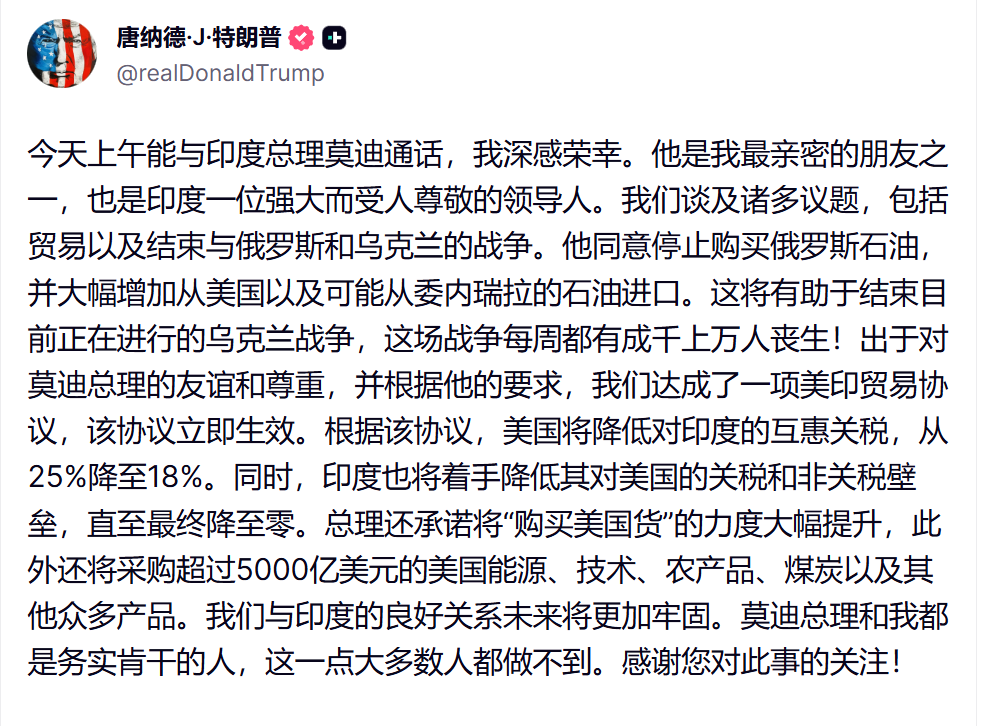
Group 1 - The core point of the news is the trade agreement between the United States and India, which involves reducing tariffs on Indian goods from 25% to 18%, easing tensions between the two countries [1][2][3] - The agreement will significantly lower the overall tax burden on many Indian products from 50% to 18%, particularly benefiting textiles and machinery [1][11] - India is expected to purchase over $500 billion worth of American energy, technology, agricultural products, coal, and other goods as part of the agreement [1] Group 2 - The announcement led to a surge in India's benchmark stock index Nifty 50 futures and a nearly 3% increase in the iShares MSCI India ETF listed in the U.S. [7] - The Indian rupee strengthened against the dollar, rising by 1% in offshore markets following the news [7] - High tariffs had previously impacted approximately 55% of India's exports to the U.S., affecting its ambition to become a manufacturing powerhouse [11]
2月度金股:蓄势再出发-20260202
Soochow Securities· 2026-02-02 12:11
Core Insights - The report indicates that after a period of volatility, the market is expected to regain momentum in February, supported by a decrease in the volatility index from a peak of 102 to around 32, which is historically low [2][3] - The report emphasizes the importance of focusing on two main investment themes: technology growth and cyclical recovery, as funds are likely to rotate towards underperforming sectors [3][4] Investment Themes - **Technology Growth**: The AI industry is experiencing significant positive changes, with expectations for OAI listings and advancements in storage, CPU, and packaging sectors. The report highlights the importance of monitoring policy catalysts and industry developments, particularly in emerging sectors like aerospace, new materials, and quantum technology [6][6] - **Cyclical Recovery**: The report suggests that sectors such as chemicals, real estate, and core consumer assets are expected to see a rebound as market sentiment improves. The report notes that these sectors are currently at low points in their economic cycles, with potential for recovery as institutional positions are historically low [6][6] Recommended Stocks - **Jingsheng Electromechanical (300316.SZ)**: The company is positioned to benefit from increasing demand in space and overseas photovoltaic equipment, with a market cap of 58.3 billion and projected EPS growth from 0.95 in 2026 to 1.17 in 2027 [7][7] - **Nuwai Co., Ltd. (603699.SH)**: As a leading industrial valve manufacturer, the company is expected to see growth driven by LNG and marine vessel demand, with a projected EPS increase from 2.51 in 2026 to 3.00 in 2027 [7][7] - **Longjing Environmental Protection (600388.SH)**: The company is focusing on green electricity and energy storage, with a projected EPS growth from 1.20 in 2026 to 1.37 in 2027 [7][7] - **Chip Microelectronics (688630.SH)**: The company anticipates significant profit growth, with EPS expected to rise from 4.18 in 2026 to 6.08 in 2027 [7][7] - **AVIC High-Tech (600862.SH)**: The company is expected to benefit from the increasing demand for aerospace materials, with projected EPS growth from 1.17 in 2026 to 1.29 in 2027 [7][7] - **Ping An Insurance (601318.SH)**: The company is projected to maintain strong growth in new business value (NBV), with EPS expected to rise from 8.59 in 2026 to 9.74 in 2027 [7][7] - **Rabbit Baby (002043.SZ)**: The company is expected to see steady growth in the decorative board industry, with projected EPS growth from 1.05 in 2026 to 1.15 in 2027 [7][7] - **Wanhua Chemical (600309.SH)**: The company is expected to benefit from improving MDI and TDI market conditions, with projected EPS growth from 5.13 in 2026 to 5.79 in 2027 [7][7] - **Tianfu Communication (300394.SZ)**: The company is positioned to benefit from the demand for optical modules, with projected EPS growth from 4.10 in 2026 to 5.38 in 2027 [7][7] - **Shaanxi Tourism (603402.SH)**: The company is expected to see growth driven by its core tourism operations, with projected EPS growth from 6.65 in 2026 to 7.61 in 2027 [7][7]




资金跟踪系列之三十一:机构ETF延续大幅净赎回,北上转向净流出
SINOLINK SECURITIES· 2026-02-02 08:56
Macroeconomic Liquidity - The US dollar index continued to decline, and the degree of "inversion" in the China-US interest rate spread deepened. The nominal and real interest rates of 10Y US Treasuries rose and fell respectively, indicating a rebound in inflation expectations [1][15]. - Offshore dollar liquidity tightened marginally, while the domestic interbank funding remained balanced. The yield spread between 10Y and 1Y bonds narrowed [1][22]. Market Trading Activity, Volatility, and Liquidity - Market trading activity has rebounded, with trading heat in sectors such as non-ferrous metals, media, military industry, chemicals, and steel exceeding the 90th percentile [2][26]. - The volatility of major indices has increased, with the military sector's volatility reaching above the 80th percentile [2][33]. - Market liquidity indicators have improved, although all sectors remain below the 60th historical percentile [2][37]. Institutional Research - The banking, electronics, machinery, computing, and automotive sectors are leading in research activity, with a rising trend in research heat for banking, petrochemicals, machinery, non-ferrous metals, and building materials [3][44]. Analyst Forecasts - Analysts have raised net profit forecasts for the entire A-share market for 2026/2027. The proportion of stocks with upward revisions in net profit forecasts has continued to increase [4][17]. - Specific sectors such as non-ferrous metals, telecommunications, retail, home appliances, and real estate have also seen upward adjustments in their 2026/2027 net profit forecasts [4][21]. - Major indices including the ChiNext Index, CSI 300, and SSE 50 have had their 2026/2027 net profit forecasts raised, while the CSI 500 saw a decrease in its forecasts [4][23]. Northbound Trading Activity - Northbound trading activity has increased, although there has been a continued net sell-off of A-shares. The ratio of buy/sell totals in sectors like non-bank financials, non-ferrous metals, and food and beverage has risen [5][31]. - For stocks with northbound holdings of less than 30 million shares, there were significant net purchases in sectors such as food and beverage, electricity, and public utilities, while net sales were observed in computing, pharmaceuticals, and machinery [5][33]. Margin Financing Activity - Margin financing activity has continued to decline, reaching its lowest level since mid-July 2025. The net purchases were mainly in non-ferrous metals, finance, and food and beverage sectors, while net sales were seen in electronics, military, and computing sectors [6][35]. Long-Short Trading Activity - Long-short trading activity has continued to rise, with sectors like non-ferrous metals, agriculture, forestry, animal husbandry, and food and beverage showing relatively high trading volumes [7][41]. Active Equity Fund Positions - Active equity funds have increased their positions in sectors such as non-ferrous metals, petrochemicals, and electronics, while reducing positions in pharmaceuticals, media, and food and beverage sectors [8][46]. - The correlation between active equity funds and small-cap growth, as well as large/mid-cap value, has increased, while the correlation with large/mid-cap growth and small-cap value has decreased [8][48].
金融工程月报:券商金股2026年2月投资月报-20260202
Guoxin Securities· 2026-02-02 07:59
- The quantitative factors that performed well in the broker gold stock pool over the past month include total market capitalization, single-quarter net profit growth rate, and analyst net upgrade ratio[3][30] - The quantitative factors that performed poorly in the broker gold stock pool over the past month include post-earnings announcement gap excess, single-quarter ROE, and intraday return rate[3][30] - The broker gold stock performance enhancement portfolio achieved an absolute return of 11.47% and an excess return of 4.15% relative to the partial equity hybrid fund index for the period from January 5, 2026, to January 30, 2026[5][43] - The broker gold stock performance enhancement portfolio ranked in the 16.69th percentile among active equity funds for the period from January 5, 2026, to January 30, 2026[5][43] - The broker gold stock index achieved a return of 7.60% for the period from January 5, 2026, to January 30, 2026, compared to a return of 7.32% for the partial equity hybrid fund index over the same period[24]


大行评级|美银:卡特彼勒2025年业绩表现强劲,目标价上调至735美元
Ge Long Hui· 2026-02-02 07:57
美银证券发表研报指,卡特彼勒2025年业绩表现强劲,管理层对2026年给予较保守指引,投资者普遍认 为其2026年指引审慎,主要由于关税政策对利润率的潜在打击。该行表示对卡特彼勒今年前景变得更为 正面,认为7%的收入增长指引保守,加上积压订单额达到创新高的510亿美元且仍在增加,重申对 其"买入"评级,基于盈利能见度提升,将目标价从708美元上调至735美元。该行指,公司下一阶段增长 建基于机械业务周期的复苏步伐,而目前机械行业已见利好迹象,包括经销商库存过低、矿业订单向好 及建筑设备业务市场份额提升。 ...
