银行业

Search documents
信用利差周度跟踪20260320:利率曲线延续陡峭化,中短端弱资质利差压缩-20260321
Huafu Securities· 2026-03-21 12:51
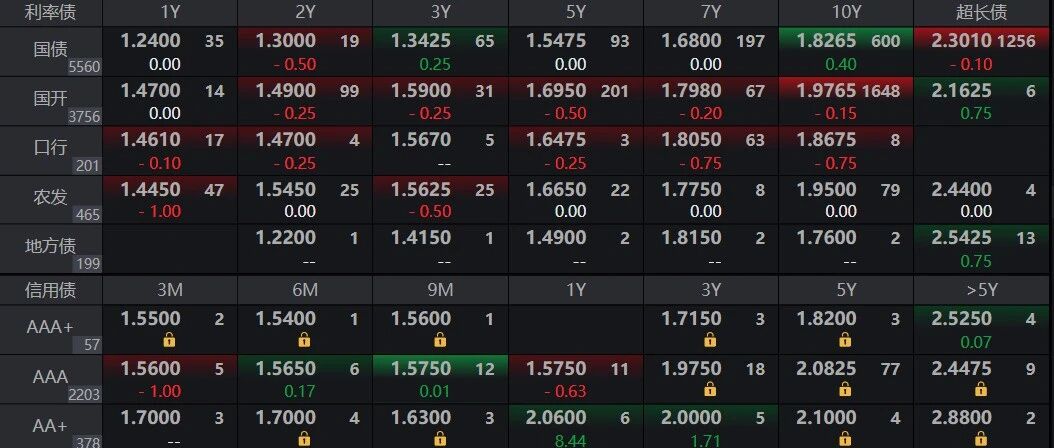
Report Industry Investment Rating No information provided in the report. Core Viewpoint The interest rate curve continues to steepen, with the spreads of short - and medium - term low - quality bonds compressing. The spreads of most urban investment bonds decline slightly, the spreads of industrial bonds generally decline slightly, but the spreads of mixed - ownership real estate bonds rebound. The yields of secondary and perpetual bonds decline across the board, and the spreads of 10Y bonds converge significantly. The excess spreads of 3Y industrial perpetual bonds converge, while the excess spreads of urban investment bonds widen [3][4][5]. Summary by Directory 1. Interest rate curve continues to steepen, short - and medium - term low - quality spreads compress - From March 16th to March 20th, short - and medium - term interest - rate bonds generally oscillated downward, long - term bonds remained weak, and the interest rate curve further steepened. The yields of 1Y, 3Y, 5Y, and 7Y China Development Bank bonds decreased by 2BP, while the yield of 10Y bonds increased by 1BP [10]. - Credit bonds also showed the characteristics of strong short - end and weak long - end. The yields of AA and above - grade 1Y credit bonds decreased by 2 - 3BP, and the yield of AA - grade bonds decreased by 5BP; the yields of AA+ and above - grade 3Y credit bonds decreased by 2BP, and the yields of AA and below - grade bonds decreased by 4BP; the yields of all grades of 5Y bonds remained flat; the yields of AA+ and above - grade 7Y bonds decreased by 1BP, and the AA - grade yield remained flat; the yields of all grades of 10Y bonds increased by 1BP [10]. - The spreads of short - and medium - duration low - quality varieties compressed. The spread of 1Y AAA - grade bonds remained flat, the spreads of AA+ and AA grades converged by 1BP, and the AA - grade spread compressed by 3BP; the spreads of AA+ and above - grade 3Y bonds remained flat, and the spreads of AA and AA - grades converged by 2BP; the spreads of all grades of 5Y bonds widened by 2BP; the spreads of all grades of 7Y bonds widened by 1 - 2BP; the spreads of 10Y bonds widened by 1BP [10]. 2. The spreads of most urban investment bonds decline slightly by 1BP - The spreads of external - rated AAA, AA+, and AA urban investment platforms generally decreased by 1BP compared with last week. In different regions, most spreads decreased by 0 - 1BP. Among AAA platforms, Inner Mongolia's spread decreased by 3BP; among AA+ platforms, Hainan's spread remained flat, Inner Mongolia's spread increased by 1BP, Tianjin, Gansu, and Ningxia's spreads decreased by 2BP, and Yunnan's spread decreased by 4BP; among AA platforms, the spreads of Shanghai and Shaanxi decreased by 2 - 3BP [15]. - In terms of administrative levels, the spreads of provincial, municipal, and district - county platforms generally decreased by 1BP. Specifically, among provincial platforms, Shandong's spread decreased by 2BP, and Inner Mongolia's spread decreased by 4BP; among municipal platforms, the spreads of Shaanxi, Ningxia, and Yunnan decreased by 2 - 3BP; among district - county platforms, Guizhou's spread decreased by 3BP [19]. 3. The spreads of industrial bonds generally decline slightly, and the spreads of mixed - ownership real estate bonds rebound - This week, the spreads of industrial bonds generally declined slightly, while the spreads of mixed - ownership real estate bonds rebounded. The spreads of central and state - owned enterprise real estate bonds converged by 1BP, the spreads of private real estate bonds converged by 2BP, and the spreads of mixed - ownership real estate bonds widened by 20BP. The spreads of Longhu converged by 2BP, Midea Real Estate converged by 3BP, Vanke's spread widened by 221BP, Huafa's spread widened by 9BP, and Poly's spread converged by 1BP [25]. - The spreads of AA+ - grade coal bonds converged by 4BP, and the spreads of other grades converged by 1BP; the spreads of AAA - grade steel bonds converged by 1BP, and the spreads of AA+ - grade steel bonds converged by 4BP; the spreads of AAA and AA+ - grade chemical bonds both converged by 1BP. The spreads of Shaanxi Coal and HBIS converged by 1BP, and the spread of Jinneng Coal Industry converged by 2BP [25]. 4. The yields of secondary and perpetual bonds decline across the board, and the spreads of 10Y bonds converge significantly - The yields of secondary and perpetual bonds declined across the board, and the spreads of 10Y bonds converged significantly. Specifically, the yields of all grades of 1Y secondary capital bonds decreased by 1 - 2BP, and the spreads widened by 0 - 1BP; the yields of all grades of perpetual bonds decreased by 2BP, and the spreads remained flat. The yields of all grades of 3Y secondary and perpetual bonds decreased by 3BP, and the spreads converged by 1BP; the yields of all grades of 5Y secondary capital bonds and AAA - grade perpetual bonds decreased by 1 - 2BP, and the spreads widened by 1 - 2BP, while the yields of AA+ and AA - grade perpetual bonds decreased by 3 - 4BP, and the spreads converged by 1 - 2BP; the yields of all grades of 10Y secondary and perpetual bonds decreased by 2 - 3BP, and the spreads converged by 2 - 3BP [32]. 5. The excess spreads of 3Y industrial perpetual bonds converge, and the excess spreads of urban investment bonds widen - This week, the excess spreads of 3Y industrial AAA - grade perpetual bonds converged by 1.01BP to 8.96BP, reaching the 10.86% quantile since 2015. The excess spreads of 5Y industrial perpetual bonds remained the same as last week at 13.20BP, reaching the 33.02% quantile since 2015. The excess spreads of 3Y urban investment AAA - grade perpetual bonds widened by 1.00BP to 7.06BP, reaching the 15.92% quantile; the excess spreads of 5Y urban investment perpetual bonds widened by 0.56BP to 10.64BP, reaching the 18.71% quantile [35]. 6. Credit spread database compilation instructions - The overall market credit spreads, commercial bank secondary and perpetual spreads, and urban investment/industrial perpetual bond credit spreads are calculated based on ChinaBond medium - and short - term notes and ChinaBond perpetual bonds data, with historical quantiles starting from the beginning of 2015. The credit spreads related to urban investment and industrial bonds are sorted and counted by Huafu Securities Research Institute, with historical quantiles starting from the beginning of 2015 [37]. - The credit spreads of industrial and urban investment individual bonds = the ChinaBond valuation (exercise) of individual bonds - the yield to maturity of the same - term China Development Bank bonds (calculated by linear interpolation method), and finally the credit spreads of the industry or regional urban investment are obtained by the arithmetic average method. The excess spreads of bank secondary capital bonds/perpetual bonds = the credit spreads of bank secondary capital bonds/perpetual bonds - the credit spreads of bank ordinary bonds of the same grade and term. The excess spreads of industrial/urban investment perpetual bonds = the credit spreads of industrial/urban investment perpetual bonds - the credit spreads of medium - and short - term notes of the same grade and term [39]. - Sample screening criteria: Both industrial and urban investment bonds select medium - term notes and public - offering corporate bonds as samples, and exclude guaranteed bonds and perpetual bonds. If the remaining term of an individual bond is less than 0.5 years or more than 5 years, it will be excluded from the statistical sample. Industrial and urban investment bonds are all externally - rated by the issuer, while commercial banks use ChinaBond implicit bond ratings [39].
霍尔木兹海峡,突传大消息!韩国加入七国联合声明,日本相关船只或可通行
证券时报· 2026-03-21 08:57
Core Viewpoint - The ongoing tensions in the Strait of Hormuz have severely disrupted shipping and global energy supplies, leading to significant increases in oil prices and economic implications for various countries [5][6][7]. Group 1: Shipping and Navigation - A Greek bulk carrier, the "Giacometti," is the first ship since March 2 to pass through the Strait of Hormuz in a traceable state, carrying food supplies to Iran [2][3]. - The ship's route aligns with a "safe corridor" designated by the Iranian Revolutionary Guard, indicating a potential shift in shipping patterns in the region [3]. - At least nine other vessels are reported to be using similar routes near the Iranian coast, suggesting a coordinated effort to navigate the Strait safely [3]. Group 2: International Responses - South Korea has joined a joint statement from seven countries, including the UK, France, and Germany, condemning Iran's actions in the Strait of Hormuz [4]. - Iran's Foreign Minister indicated a willingness to allow Japanese-related vessels to pass through the Strait, highlighting the importance of this route for Japan's energy imports [4]. Group 3: Economic Impact - Oil prices have surged over 40% since the outbreak of hostilities, with Brent crude reaching $100 per barrel [5][7]. - The Federal Reserve has warned that prolonged conflict could lead to a more significant economic slowdown in the U.S., with a 32% chance of recession within a year if oil prices remain high [7]. - European countries have faced additional costs exceeding €6 billion due to rising fuel prices since the conflict began, raising concerns about a potential oil crisis [7]. Group 4: Industry Adjustments - Airlines, including United Airlines and Air New Zealand, have begun reducing flight schedules in response to soaring fuel prices, which have nearly doubled since late February [9]. - The aluminum market has also been affected, with prices reaching a four-year high due to disruptions in supply chains caused by the conflict [9].


32G内存条涨至3800元,周五沪指跌破4000点 | 财经日日评
吴晓波频道· 2026-03-21 02:48
Monetary Policy - The People's Bank of China has kept the one-year Loan Prime Rate (LPR) at 3% and the five-year LPR at 3.5% for ten consecutive months, indicating a stable monetary policy stance amid economic fluctuations [2][3] - The average corporate loan interest rate is approximately 3.2%, down 2.4 percentage points from the peak in late 2018, reflecting a low financing cost environment [2] Oil Prices - Domestic gasoline prices are expected to rise to the "9 yuan era" due to an increase in international oil prices, with a projected increase of about 2000 yuan per ton [4] - The rise in oil prices could lead to higher costs for various industrial products, potentially causing widespread inflation [5] Memory Prices - The price of 32GB memory modules has surged from 800 yuan to 3800 yuan due to increased demand from AI applications, impacting the prices of storage devices and leading to higher costs for consumer electronics [6][7] - The memory price increase is driven by a significant demand from AI data centers, with supply constraints expected to persist in the short term [7] Tesla's Procurement - Tesla plans to procure approximately 29 billion USD (around 200 billion yuan) worth of photovoltaic manufacturing equipment from Chinese suppliers to support its goal of adding 100GW of solar manufacturing capacity in the U.S. [8][9] - This procurement highlights the competitive advantage of China's photovoltaic supply chain and its ability to meet large-scale demands efficiently [8] Alibaba's Financial Performance - Alibaba reported a 2% year-on-year revenue growth in Q4, with total revenue reaching 284.84 billion yuan, while net profit fell by 67% to 16.32 billion yuan [10][11] - The growth in revenue was primarily driven by Alibaba Cloud, which saw a 36% increase in revenue, and AI-related products that have maintained triple-digit growth for ten consecutive quarters [10][11] Pig Farming Industry - The average price of live pigs has dropped below 10 yuan per kilogram, indicating a significant decline in profitability for pig farmers, with many facing losses [14][15] - The industry is experiencing overproduction despite regulatory efforts to control pig production capacity, leading to a challenging market environment for pig farming [14][15] Stock Market Trends - The Shanghai Composite Index fell below the 4000-point mark, reflecting a weak market sentiment with significant declines in small and mid-cap stocks [16][17] - The market has shown low trading enthusiasm, with most sectors experiencing adjustments, while the energy sector, particularly related to Tesla's procurement, showed some resilience [16][17]

通胀警报拉响,加息潮要来了?
第一财经· 2026-03-21 01:44
Central Banks' Response - Central banks globally are on high alert due to escalating tensions in the Middle East, which have led to soaring oil prices and potential inflationary pressures [3][5] - The Federal Reserve decided to maintain interest rates in the range of 3.50% to 3.75%, with inflation expectations revised upwards, indicating concerns over short-term energy price impacts [5][6] - The European Central Bank has signaled readiness to raise rates if high energy prices continue to drive inflation, with 2026 inflation expectations raised to 2.6% [6][7] - The Bank of England is also cautious, acknowledging that monetary policy cannot reverse supply shocks but must respond to persistent inflation risks [6][7] - The Bank of Japan is considering short-term rate hikes if oil price surges are deemed temporary and do not hinder inflation targets [7] Inflation and Economic Growth Concerns - The risk of stagflation is increasing, characterized by high inflation and weak economic growth, which could compress corporate profits and limit monetary policy options [8][9] - The U.S. Treasury market is showing concerning trading patterns, with a flattening yield curve indicating heightened worries about economic growth and inflation [9][10] - The ongoing conflict has escalated, impacting global energy systems and raising concerns about stagflation risks [10]

陆家嘴财经早餐2026年3月21日星期六
Wind万得· 2026-03-20 23:49
Group 1 - The draft of the Financial Law of the People's Republic of China has been publicly solicited for opinions, aiming to clarify the functions of the central bank and enhance financial regulation, including strict measures against financial fraud [2][3] - The draft proposes to build a safe, transparent, and resilient capital market, promoting the coordinated development of investment and financing, and supporting long-term capital market participation [2][3] - The LPR (Loan Prime Rate) has remained unchanged for 10 consecutive months, with expectations of a potential rate cut of 10-20 basis points by mid-year [5][6] Group 2 - Tesla is seeking to procure $2.9 billion worth of photovoltaic manufacturing equipment from China to support its solar manufacturing capacity goals in the U.S. [4][6] - Yushutech is officially pursuing an IPO on the A-share market, aiming to raise over 4.2 billion yuan, with projected revenue growth of 335% year-on-year by 2025 [4][6] - The international precious metals futures market has seen significant declines, with gold and silver prices dropping over 10% this week [3][4] Group 3 - The South Korean government has decided to join a joint statement with several countries condemning Iran's actions in the Strait of Hormuz [4][6] - The U.S. Department of Defense is reportedly preparing for the deployment of ground troops to Iran amid rising tensions [3][4] - The global oil market is facing supply concerns due to disruptions in the Strait of Hormuz, with predictions that prolonged interruptions could push oil prices to $200 per barrel [24][26]

开车加油要涨价了,下周或重回“9元时代”!
证券时报· 2026-03-20 13:57
Core Viewpoint - The article highlights a significant increase in fuel prices in China, which will lead to higher costs for household travel and logistics industries, driven by ongoing geopolitical tensions and supply chain disruptions [1][2][3]. Group 1: Fuel Price Adjustments - As of March 23, domestic fuel prices will increase by approximately 2000 yuan per ton, marking the largest adjustment of the year [1]. - The price increases for 92 octane gasoline, 95 octane gasoline, and 0 diesel will be 1.73 yuan/liter, 1.83 yuan/liter, and 1.87 yuan/liter, respectively [1]. - The cost for a full tank (50 liters) of 92 octane gasoline will rise by about 87 yuan for private car owners [1]. Group 2: Impact on Household and Logistics Costs - For households, the monthly fuel cost for a car driving 2000 kilometers with an average fuel consumption of 8 liters per 100 kilometers will increase by approximately 138 yuan before the next price adjustment [2]. - In the logistics sector, the fuel cost for heavy trucks driving 10,000 kilometers with a fuel consumption of 38 liters per 100 kilometers will rise by about 3553 yuan [2]. Group 3: Geopolitical and Economic Context - Brent crude oil futures have seen a monthly increase of over 40%, with prices nearing 120 USD per barrel, as market participants anticipate continued geopolitical tensions [3]. - The ongoing conflict in the Middle East is expected to have a prolonged impact on energy prices and market confidence, potentially increasing costs for high-energy-consuming industries such as manufacturing, chemicals, and steel [3]. - Central banks globally are maintaining cautious monetary policies in response to rising energy prices and economic uncertainties, with the U.S. Federal Reserve keeping interest rates unchanged at 3.5% to 3.75% [3][4].

大类资产配置双周观点:油价冲击下的滞胀交易-20260320
Guoxin Securities· 2026-03-20 13:27
Group 1: Core Insights - The core conclusion indicates a shift in global asset pricing from "growth-driven" to "safety-driven" due to energy shocks from geopolitical conflicts, raising stagflation expectations[2] - The Chinese bond market is currently weak, with the 10-year government bond yield slightly rising, reflecting a passive transmission of global interest rate increases[2] - The U.S. Treasury market is constrained by stagflation pricing, with core PCE rising to 3.1%, leading to a delay in interest rate cut expectations[2] Group 2: Asset Allocation Recommendations - For A-shares, the focus should be on technology (AI), safety (resources), and domestic demand, with an emphasis on undervalued sectors like non-bank financials and utilities in the short term[2] - The report suggests a defensive stance in U.S. Treasuries, recommending a focus on 2-5 year maturities to mitigate interest rate volatility[2] - The energy shock is reshaping global asset dynamics, with China showing resilience due to diversified energy sources and sufficient reserves[2] Group 3: Risks and Market Dynamics - Risks include potential escalation of geopolitical conflicts, inflation transmission not meeting expectations, and continued tightening of market liquidity[2] - The PPI-CPI spread has rebounded, indicating rising input cost pressures, while weak domestic demand limits price transmission to end consumers[2] - The report highlights that European and Japanese markets are particularly sensitive to geopolitical shocks due to their high energy dependency, facing significant inflationary pressures[2]
今年1-2月财政收入同比增长0.7%,资金面平稳宽松,债市走势分化
Dong Fang Jin Cheng· 2026-03-20 12:26
1. Report Industry Investment Rating - No relevant content provided 2. Core Viewpoints of the Report - On March 19, the capital market showed a mixed performance. The capital market was stable and loose, the bond market had a differentiated trend with short - term bonds remaining strong and long - term bonds weakening. The convertible bond market followed the decline of the equity market, and most convertible bond individual securities fell. The yields of U.S. Treasury bonds of different maturities were also differentiated, and the 10 - year Treasury bond yields of major European economies generally increased [1]. 3. Summary by Directory 3.1 Bond Market News 3.1.1 Domestic News - From January to February this year, the national general public budget revenue was 4.4154 trillion yuan, a year - on - year increase of 0.7%. Among them, national tax revenue was 3.6393 trillion yuan, a year - on - year increase of 0.1%, and non - tax revenue was 776.1 billion yuan, a year - on - year increase of 3.4%. Central general public budget revenue decreased by 1.7% year - on - year, while local general public budget revenue increased by 2.6% year - on - year [3]. - The central bank will continue to implement a moderately loose monetary policy, firmly maintain the stable operation of financial markets such as stocks, bonds, and foreign exchange, and study the establishment of a liquidity support mechanism for non - bank financial institutions in specific scenarios [4]. - The CSRC held a symposium on the "15th Five - Year Plan" of the capital market with investment institutions, and participants put forward suggestions on deepening investment - side reform and enhancing the internal stability of the capital market [5]. - The State Administration of Foreign Exchange will further improve the expectation management mechanism, maintain the stable operation of the foreign exchange market, deepen foreign exchange reform and innovation, and promote high - level opening - up in the foreign exchange field [6]. - The Ministry of Commerce stated that China and the U.S. will continue to play the role of the Sino - U.S. economic and trade consultation mechanism, strengthen dialogue and communication, and promote the stable and positive development of bilateral economic and trade relations [7]. 3.1.2 International News - On March 19, the European Central Bank kept the deposit rate unchanged at 2% for the sixth consecutive time. It warned that the Middle East conflict has significantly increased the uncertainty of the euro - zone economic outlook, with upward inflation risks and downward economic growth pressure [8]. 3.1.3 Commodities - On March 19, WTI April crude oil futures fell 0.18% to $96.14 per barrel, Brent May crude oil futures rose 1.18% to $108.65 per barrel, spot gold fell 3.42% to $4,653.01 per ounce, and NYMEX April natural gas futures fell 2.31% to $3.128 per million British thermal units [9]. 3.2 Capital Market 3.2.1 Open Market Operations - On March 19, the central bank conducted 13 billion yuan of 7 - day reverse repurchase operations at a fixed - rate and quantity - tender basis, with an operating rate of 1.40%. The net withdrawal of funds on the day was 1.15 billion yuan due to the maturity of 24.5 billion yuan of reverse repurchases [10]. 3.2.2 Capital Interest Rates - On March 19, the capital market was stable and loose. DR001 rose 0.03bp to 1.320%, and DR007 fell 0.61bp to 1.427%. Other capital interest rates also showed different changes [11][12]. 3.3 Bond Market Dynamics 3.3.1 Interest - Bearing Bonds - **Spot Bond Yield Trends**: On March 19, the yields of major inter - bank interest - bearing bonds showed a differentiated trend. Short - term bonds were strong due to the loose capital market, while long - term bonds weakened due to profit - taking. For example, the yield of the 10 - year Treasury bond active bond 250022 rose 0.80bp to 1.8360%, and the yield of the 10 - year CDB bond active bond 250220 rose 0.65bp to 1.9780% [14]. - **Bond Tendering Situations**: Multiple bonds were tendered on March 19, with different issuance scales, winning yields, full - field multiples, and marginal multiples [16]. 3.3.2 Credit Bonds - **Secondary Market Transaction Abnormalities**: On March 19, the transaction prices of two industrial bonds deviated by more than 10%. "H2 Vanke 02" fell by more than 10%, and "H1 Vanke 06" rose by more than 11% [17]. - **Credit Bond Events**: Multiple companies announced events such as loan defaults, bill payment defaults, redemption option decisions, and bond issuance cancellations [20]. 3.3.3 Convertible Bonds - **Equity and Convertible Bond Indexes**: On March 19, the three major A - share indexes fell, and the convertible bond market also weakened. The CSI Convertible Bond Index, Shanghai Stock Exchange Convertible Bond Index, and Shenzhen Stock Exchange Convertible Bond Index fell 1.64%, 1.53%, and 1.84% respectively. Most convertible bond individual securities fell [19]. - **Convertible Bond Tracking**: On March 20, Tonglian Convertible Bond was listed. On March 19, Huaxiang Co., Ltd.'s convertible bond issuance was approved by the exchange, and Hongtu Convertible Bond announced a downward revision of the conversion price [26]. 3.3.4 Overseas Bond Markets - **U.S. Bond Market**: On March 19, the yields of U.S. Treasury bonds of different maturities showed a differentiated trend. The 2 - year U.S. Treasury bond yield rose 3bp to 3.79%, and the 10 - year U.S. Treasury bond yield fell 1bp to 4.25%. The yield spreads of 2/10 - year and 5/30 - year U.S. Treasury bonds narrowed [23][24]. - **European Bond Market**: On March 19, the 10 - year Treasury bond yield of Spain remained unchanged, while the 10 - year Treasury bond yields of other major European economies generally increased [27]. - **Daily Price Changes of Chinese - funded U.S. Dollar Bonds**: As of the close on March 19, the prices of Chinese - funded U.S. dollar bonds showed different changes, with some rising and some falling [29].
【笔记20260320— 加油吧,赶在下周一前】
债券笔记· 2026-03-20 10:49
Core Viewpoint - The article discusses the current financial market conditions, highlighting the mixed performance of the stock market and the impact of central bank policies on interest rates and liquidity [3][5]. Group 1: Market Conditions - The stock market experienced a significant decline, with major indices dropping below 4000 points, erasing all gains made in the year [6]. - The central bank is reportedly conducting research to cancel the lower limit on the reserve requirement ratio, which has implications for liquidity in the market [5][6]. - The bond market showed volatility, with the 10-year government bond yield fluctuating around 1.8365% [5][8]. Group 2: Interest Rates and Liquidity - The central bank conducted a 205 billion yuan reverse repurchase operation, with a net withdrawal of 170 billion yuan due to 375 billion yuan of reverse repos maturing [3]. - The funding rates remained stable, with DR001 around 1.32% and DR007 at approximately 1.42% [3]. - The weighted rates for various funding instruments showed slight changes, with R001 at 1.40% and R007 at 1.48%, indicating a mixed trend in the interbank funding market [4].
【广发宏观陈礼清】全球资产短期类滞胀交易特征的宏观线索
郭磊宏观茶座· 2026-03-20 07:51
Core Viewpoint - The article discusses the current global market dynamics characterized by a "quasi-stagflation" trading environment due to escalating geopolitical tensions in the Middle East and a hawkish stance from the FOMC, leading to rising oil prices, higher U.S. Treasury yields, a stronger dollar, and a decline in gold prices [1][6]. Group 1: Historical Context of Stagflation - Historical stagflation periods occurred during 1973-1974, 1979-1980, and 2021-2022, marked by wars or conflicts that drove oil prices significantly higher, with inflation preceding economic downturns [2][8]. - In these periods, oil prices saw substantial increases: from $2.48 to $11.58 per barrel (367% increase) in 1973-1974, from $14.02 to $36.83 (163% increase) in 1979-1980, and from $41.84 to $101.32 (142% increase) in 2021-2022 [11][19][23]. Group 2: Asset Impact Analysis - The quasi-stagflation trading process has three phases: 1. In the first phase, inflation expectations rise, favoring assets sensitive to supply and demand, such as commodities and energy stocks, while long-duration equities and emerging market indices underperform [26][27]. 2. The second phase sees a shift to defensive assets as inflation pressures corporate profits, leading to broad adjustments in risk assets [26][30]. 3. In the third phase, the market seeks new growth narratives, with asset performance depending on the extent of commodity price corrections and supply-demand dynamics [29][30]. Group 3: Current Market Characteristics - The current asset landscape is more complex, with U.S. Treasury yields rising rapidly in response to geopolitical tensions, reflecting a "growth" phase, while the stock market remains in a "quasi-stagflation" phase, which may alleviate valuation pressures on tech stocks [36][39]. - China's asset market is influenced by its low inflation baseline, which is expected to support corporate profitability and investment activity, with significant improvements in fixed asset investment and infrastructure spending [39].