
钢铁

Search documents
生态环境部发布《关于做好2026年全国碳排放权交易市场有关工作的通知》
Xin Lang Cai Jing· 2026-02-13 04:07
Core Viewpoint - The Ministry of Ecology and Environment of China has issued a notification regarding the management of the national carbon emission trading market for 2026, focusing on key emission units in the power generation, steel, cement, and aluminum smelting industries, with specific guidelines for data management, quota allocation, and compliance [1][19]. Group 1: Key Emission Unit Management - Provincial ecological environment departments are required to establish a list of key emission units for 2027, including those with annual direct emissions of 26,000 tons of CO2 equivalent [20][21]. - The list of key emission units must be published by October 31, 2026, through the national carbon market management platform and provincial websites [21][2]. Group 2: Data Quality Management - Provincial departments must implement data quality management for greenhouse gas emissions in the specified industries, following the technical specifications set by the Ministry [3][21]. - By December 31, 2026, a data quality control plan must be developed for the key emission units [4][21]. - Monthly carbon emission data must be stored electronically within 40 days after each month ends [5][22]. Group 3: Reporting and Verification - Key emission units must submit their 2025 greenhouse gas emission reports by March 31, 2026 [6][23]. - Technical audits of these reports must be completed by June 30, 2026, for the power generation sector, and by July 31, 2026, for the steel, cement, and aluminum sectors [7][23]. Group 4: Quota Allocation and Compliance - Quotas for carbon emissions will be pre-allocated to key emission units in the steel, cement, and aluminum sectors by April 10, 2026, and to the power generation sector by June 30, 2026 [8][25]. - By September 20, 2026, the final allocation of quotas based on verification results must be completed [9][26]. - Compliance with the quota must be fulfilled by December 31, 2026 [10][27]. Group 5: Management of Other Key Industries - Other industries such as petrochemicals, chemicals, construction materials, non-ferrous metals, paper, and civil aviation with emissions of 26,000 tons of CO2 equivalent must also report their emissions [11][28]. - Reports from these industries must be submitted by March 31, 2026, and verified by December 31, 2026 [12][28]. Group 6: Strengthening Implementation - Local ecological environment departments are urged to enhance their management capabilities and training related to carbon emission data quality and quota compliance [30][31]. - Strict enforcement of regulations regarding carbon market data quality and compliance is emphasized to prevent fraudulent activities [31].
中证商品期货指数1月大幅上涨
Qi Huo Ri Bao· 2026-02-13 03:46
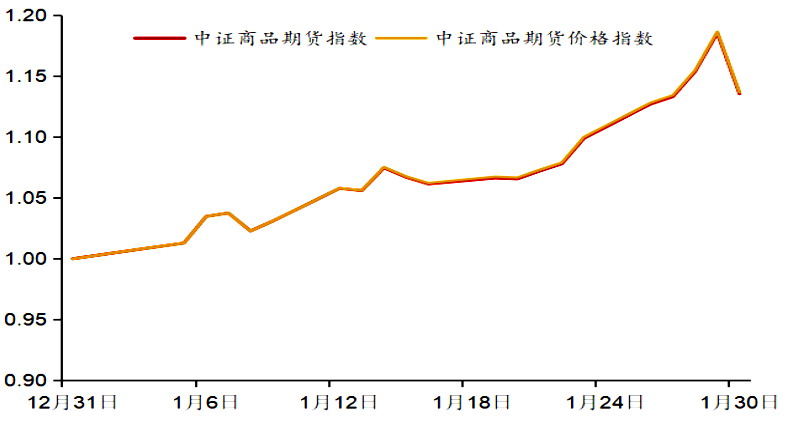
Core Viewpoint - In January, domestic policies aimed at stabilizing demand were implemented intensively, leading to significant support for market demand and a strong performance in the commodity market, as evidenced by the rise in the China Securities Commodity Futures Index and the China Securities Commodity Futures Price Index [1][5]. Index Performance Analysis - In January, the China Securities Commodity Futures Index rose by 13.57%, while the China Securities Commodity Futures Price Index increased by 13.64%, indicating a strong upward trend in the commodity indices with a volatility of 19.71% throughout the month [2]. - The commodity market's strong performance was influenced by international factors, including the Federal Reserve's monetary policy stance and geopolitical risks, which heightened market sentiment towards commodities [4]. Domestic Policy Impact - The implementation of a series of fiscal and financial policies aimed at boosting domestic demand has led to a significant improvement in the commodity market, with a broad-based increase replacing the previous differentiated performance [5]. - The People's Bank of China lowered the re-lending and rediscount rates by 0.25 percentage points, which has positively impacted the industrial sector [5]. Sector-Specific Analysis Energy and Chemical Sector - The energy and chemical sector showed a strong performance in January, with the China Securities Energy Chemical Industry Futures Index rising by 7.54%, driven by improved demand and cost support [8][10]. - The demand for energy products, such as gasoline and diesel, improved due to the implementation of domestic policies and international geopolitical tensions affecting oil prices [10]. Steel Sector - The China Securities Steel Futures Index increased by 0.64%, supported by high demand and inventory reduction, with hot-rolled coil export orders rising by 12% year-on-year [12]. - The supply side faced tightening due to disruptions in Brazilian iron ore shipments, which provided additional cost support for the steel sector [12]. Construction Materials Sector - The China Securities Construction Materials Futures Index rose by 1.87%, reflecting a recovery in demand driven by accelerated infrastructure projects and supply-side adjustments [13]. - The market sentiment improved as the issuance of long-term special government bonds directed funds towards construction material projects [13]. Agricultural Products Sector - The China Securities Agricultural Products Index increased by 1.72%, with notable performance in oilseeds and soft commodities, driven by supply constraints and recovering demand [14]. - Palm oil prices rose due to adverse weather conditions in Malaysia, while cotton prices were supported by rising domestic purchase prices and weakening dollar index [14]. Contribution to Index Returns - The top contributors to the China Securities Commodity Futures Index in January were silver (4.09%), gold (1.47%), and crude oil (1.01%), while the only negative contributor was soda ash (-0.01%) [15][17]. - The strong performance of precious metals was attributed to increased safe-haven buying amid Federal Reserve policy uncertainties and geopolitical tensions [17].

商务预报:2月2日至8日生产资料价格略有下降
Shang Wu Bu Wang Zhan· 2026-02-13 03:31
Group 1 - The national production material market prices decreased by 0.3% from February 2 to February 8 compared to the previous week [1] Group 2 - Non-ferrous metal prices slightly declined, with aluminum, zinc, and copper decreasing by 3.8%, 1.4%, and 0.4% respectively [2] - Steel prices continued to fall, with rebar, hot-rolled strip steel, and ordinary medium plate priced at 3350 yuan, 3510 yuan, and 3627 yuan per ton, decreasing by 0.3%, 0.2%, and 0.2% respectively [2] - Coal prices showed a slight decrease, with anthracite, thermal coal, and coking coal priced at 1134 yuan, 776 yuan, and 1048 yuan per ton, decreasing by 0.4%, 0.1%, and 0.1% respectively [2] Group 3 - Rubber prices experienced a slight decline, with synthetic rubber and natural rubber both decreasing by 0.1% [3] - Basic chemical raw material prices showed minor fluctuations, with sulfuric acid increasing by 1.1%, while soda ash, polypropylene, and methanol decreased by 1.2%, 0.8%, and 0.6% respectively [3] - Fertilizer prices saw a slight increase, with compound fertilizer and urea rising by 0.2% and 0.1% respectively [3] Group 4 - Wholesale prices of finished oil slightly increased, with 95-octane gasoline, 92-octane gasoline, and 0-octane diesel rising by 1.8%, 1.7%, and 1.0% respectively [4]
综合晨报-20260213
Guo Tou Qi Huo· 2026-02-13 02:52
国投期货研究院 gtaxinstitute@essence.com.cn 综合晨报 2026年02月13日 (原油) 隔夜原油大幅走低,布伦特原油跌破68美元/桶。特朗普表示谈判可能持续一个月,缓解了市场对近 期军事行动的担忧。IEA月报将今年全球石油需求增长预期从93万桶/日下调至85万桶/日。 供应 端,1月美国受风暴天气干扰,原油产量明显下滑;同时,停产与出口受限亦削弱了啥萨克斯坦、俄 罗斯及委内瑞拉的供应。IEA预计2026年原油供应过剩将超过370万桶/日,创年度平均水平的历史 新高。我们此前提示,油价在70美元/桶附近涨势明显松动,次日在地缘溢价回撤与库存累积的双重 压制下,原油遭遇大幅回调。鉴于奉节假期较长、美伊谈判前景仍不明朗,建议投资者注意规避风 险。 (贵金属) 隔夜贵金属震荡。本周美国非农就业超预期,降息预期受到压制,市场等待今晚CPI数据。她缘前景 仍存不确定性,短期责金属波动率逐渐下降,震荡等待驱动,保持观望。 【铜】 隔夜伦铜转跌,贵金属与美国股市联动下滑,金银关注非农就业指标超预期;而美股担忧Al发展影 响传统行业营收,且不确定就业潜力强弱。沪铜持仓缩减至55万手,价格跌破MA4 ...
螺纹钢周度数据(20260213)-20260213
Bao Cheng Qi Huo· 2026-02-13 02:44
Report Title - The report is titled "Weekly Data of Rebar (20260213) - Futures Research Report" [1] Report Core View - The supply and demand of rebar continue to weaken, inventory has increased significantly, short - process steel mills have significantly reduced production, and the weekly rebar output has decreased by 225,200 tons month - on - month. The supply continues to shrink, but the high inventory level limits the positive effects. Attention should be paid to the resumption of production after the Spring Festival. The demand for rebar is also weakening, with high - frequency demand indicators at the lowest in the same lunar period in recent years, and the downstream industries are sluggish. The weak demand pattern remains unchanged, dragging down steel prices. The relative positive factors are the policy expectations after the Spring Festival. Currently, the situation of weak supply and demand before the festival remains unchanged, the fundamental contradictions of rebar continue to accumulate, inventory has increased significantly, and steel prices continue to be under pressure. The relatively positive factors are policy expectations and cost support. It is expected that the trend will continue the weak bottom - seeking situation, and focus should be on the inventory accumulation during the holiday and the resumption of production rhythm of short - process steel mills after the festival [14] Report Data Summary Supply - Weekly production is 1.6916 million tons, a month - on - month decrease of 225,200 tons, a decrease of 306,700 tons from the end of last month, and a decrease of 49,700 tons compared with the same period in the lunar calendar. The blast furnace capacity utilization rate is 86.41%, a month - on - month increase of 0.72 percentage points, an increase of 0.94 percentage points from the end of last month, and an increase of 1.77 percentage points compared with the same period in the lunar calendar [3] Demand - The apparent demand is 1.0191 million tons, a month - on - month decrease of 457,300 tons, a decrease of 744,900 tons from the end of last month, and a decrease of 150,000 tons compared with the same period in the lunar calendar. The weekly average of steel union building materials transactions is 34,900 tons, with no month - on - month change, a decrease of 32,500 tons from the end of last month, and a decrease of 31,400 tons compared with the same period in the lunar calendar [3] Inventory - The total inventory is 5.8682 million tons, a month - on - month increase of 672,500 tons, an increase of 1.1129 million tons from the end of last month, and an increase of 1.0361 million tons compared with the same period in the lunar calendar. The in - plant inventory is 1.6359 million tons, a month - on - month increase of 99,400 tons, an increase of 144,600 tons from the end of last month, and an increase of 268,700 tons compared with the same period in the lunar calendar. The social inventory is 4.2323 million tons, a month - on - month increase of 573,100 tons, an increase of 968,300 tons from the end of last month, and an increase of 767,400 tons compared with the same period in the lunar calendar [3]
五矿期货黑色建材日报-20260213
Wu Kuang Qi Huo· 2026-02-13 02:09
1. Report Industry Investment Rating No relevant information provided. 2. Core Viewpoints of the Report - The black - building materials market is currently in a bottom - game stage with a mix of long and short factors. In the short term, the black - building materials are likely to continue the weak - range oscillation pattern, and the trend opportunity is not clear. Attention should be paid to inventory inflection points around the Spring Festival, the recovery strength of plate demand, and marginal changes in "dual - carbon" policies [2]. - For the whole year of 2026, it is still believed that the long - position trend of commodities will continue, but in the short term, the sharp adjustment of precious metals after a sharp rise has dragged down the sentiment of non - ferrous metals and commodity long - positions, which may still suppress the overall market atmosphere [8][15]. 3. Summary by Related Catalogs Steel Products Market Quotes - The closing price of the rebar main contract was 3050 yuan/ton, down 4 yuan/ton (- 0.13%) from the previous trading day. The registered warehouse receipts on that day were 16,903 tons, with a net decrease of 0 tons compared to the previous day. The position of the main contract was 2.0295 million lots, a decrease of 34,123 lots. In the spot market, the aggregated price of rebar in Tianjin was 3150 yuan/ton, and that in Shanghai was 3220 yuan/ton, both unchanged from the previous day [1]. - The closing price of the hot - rolled coil main contract was 3218 yuan/ton, down 10 yuan/ton (- 0.30%) from the previous trading day. The registered warehouse receipts on that day were 297,854 tons, an increase of 21,435 tons. The position of the main contract was 1.5337 million lots, a decrease of 18,682 lots. In the spot market, the aggregated price of hot - rolled coils in Lecong was 3250 yuan/ton, and that in Shanghai was 3240 yuan/ton, both unchanged from the previous day [1]. Strategy Views - The short - term impact of the "dual - carbon" policy on the steel supply - demand pattern is relatively limited, but it helps to raise the cost center and restrict the downward space of steel prices. Near the Spring Festival, the supply and demand of rebar have a seasonal decline, and the inventory is in the accumulation stage, but the overall inventory - accumulation rhythm is still controllable. The demand for hot - rolled coils has declined, the production decline is relatively slow, and the inventory has also increased slightly. The supply - demand structure is generally neutral [2]. Iron Ore Market Quotes - The main contract of iron ore (I2605) closed at 762.00 yuan/ton, with a change of - 0.07% (- 0.50). The position changed by - 9039 lots to 497,900 lots. The weighted position of iron ore was 854,500 lots. The spot price of PB fines at Qingdao Port was 767 yuan/wet ton, with a basis of 52.20 yuan/ton and a basis rate of 6.41% [3]. Strategy Views - In terms of supply, the overseas iron ore shipments in the latest period have declined significantly. Affected by cyclones, the shipments from Australia have dropped sharply, and the shipments of three major Australian mines have decreased significantly. The shipments from Brazil have decreased slightly, and the shipments from non - mainstream countries have remained stable. The near - end arrivals have decreased month - on - month. In terms of demand, the daily average pig iron output according to the Steel Union's statistics has increased to 2.3049 million tons. The resumption of blast furnaces is mainly due to the planned resumption after the previous blast furnace overhauls, and at the same time, some blast furnaces in certain regions have started annual overhauls. The profitability rate of steel mills has declined slightly. In terms of inventory, the port inventory is at the highest level in the same period of the past five years and has decreased month - on - month. Near the Spring Festival, the inventory has accelerated the transfer to the factories, driving up the port clearance volume. The steel mills' procurement rhythm has accelerated, and the imported ore inventory has increased significantly. Overall, overseas shipments are gradually entering the off - season and are declining month - on - month, while pig iron production is in a recovery trend, and there is no obvious marginal contradiction in supply and demand. Before the Spring Festival, there is a certain risk - aversion sentiment among funds, and it is expected that the iron ore price will oscillate weakly. Attention should be paid to overseas ore shipments, the start - up situation of domestic terminal demand after the Spring Festival, and the pig iron production rhythm [4]. Manganese Silicon and Ferrosilicon Market Quotes - On February 12, the main contract of manganese silicon (SM605) closed down 0.41% at 5800 yuan/ton. In the spot market, the price of 6517 manganese silicon in Tianjin was 5720 yuan/ton, equivalent to 5910 yuan/ton on the futures market, unchanged from the previous day, with a premium of 110 yuan/ton over the futures price. The main contract of ferrosilicon (SF605) closed down 1.36% at 5500 yuan/ton. In the spot market, the price of 72 ferrosilicon in Tianjin was 5700 yuan/ton, unchanged from the previous day, with a premium of 200 yuan/ton over the futures price [7]. Strategy Views - In the medium - to - long - term, it is still believed that the long - position trend of commodities will continue. In the short term, the sharp adjustment of precious metals has dragged down the market sentiment. From the perspective of the fundamentals of the varieties themselves, the supply - demand pattern of manganese silicon is still not ideal, with a loose structure, high inventory, and weak downstream demand in the building materials industry. However, these factors have mostly been reflected in the price. The supply - demand structure of ferrosilicon remains basically balanced, and there is marginal improvement with the overhaul and production conversion of some factories. The future market trends of manganese silicon and ferrosilicon are mainly affected by the direction of the black - building materials sector and the overall market sentiment, as well as the cost - push from manganese ore in the manganese - silicon segment and the supply contraction (or contraction expectation) in the ferrosilicon segment due to losses or "dual - carbon" policies. Particular attention should be paid to possible sudden situations in the manganese - ore segment and the progress of "dual - carbon" policies [9]. Coking Coal and Coke Market Quotes - On February 12, the main contract of coking coal (JM2605) closed down 0.31% at 1120.0 yuan/ton. In the spot market, the price of low - sulfur main coking coal in Shanxi was 1547.1 yuan/ton, a decrease of 3.5 yuan/ton from the previous day. The spot price converted to the delivery - warehouse price was 1356.5 yuan/ton, with a premium of 236.5 yuan/ton over the futures price. The price of medium - sulfur main coking coal in Shanxi was 1270 yuan/ton, unchanged from the previous day. The spot price converted to the delivery - warehouse price was 1253.0 yuan/ton, with a premium of 133 yuan/ton over the futures price. The price of Mongolian No. 5 clean coal in Wubulangjinquan Industrial Park was 1227 yuan/ton, unchanged from the previous day. The spot price converted to the delivery - warehouse price was 1202 yuan/ton, with a premium of 82 yuan/ton over the futures price. The main contract of coke (J2605) closed down 0.18% at 1664.0 yuan/ton. In the spot market, the price of quasi - first - grade wet - quenched coke at Rizhao Port was 1470 yuan/ton, unchanged from the previous day. The spot price converted to the delivery - warehouse price was 1725.5 yuan/ton, with a premium of 61.5 yuan/ton over the futures price. The price of quasi - first - grade dry - quenched coke in Lvliang was 1550 yuan/ton, unchanged from the previous day. The spot price converted to the delivery - warehouse price was 1766 yuan/ton, with a premium of 102 yuan/ton over the futures price [11]. Strategy Views - In the short term, although there are many overseas coal - related disturbances with a bullish atmosphere, they have no direct and substantial impact on the domestic coking - coal fundamentals. The sharp rise and fall of precious metals have magnified the overall volatility of the coking - coal futures price and put pressure on the market sentiment. In terms of the supply - demand structure, coking coal and coke are gradually becoming more relaxed. Although there is still some restocking by downstream enterprises, as the Spring Festival is approaching, the restocking is coming to an end, and the restocking willingness of downstream steel mills is significantly low. Therefore, the restocking is not expected to form a strong price - driving force. In addition, although the coking - coal futures price often shows abnormal fluctuations, the short - term upward driving force is not strong due to insufficient fundamental support and an unfavorable market - sentiment environment. Considering the current time node, there is a risk of a phased price correction after the Spring Festival. However, coking coal is expected to have a relatively smooth upward trend in 2026, especially from June to October [14][15][16]. Industrial Silicon and Polysilicon Market Quotes - Industrial silicon: The closing price of the main contract of industrial silicon (SI2605) was 8335 yuan/ton, with a change of - 0.42% (- 35). The weighted contract position changed by - 7100 lots to 417,094 lots. In the spot market, the price of non - oxygen - blown 553 industrial silicon in East China was 9200 yuan/ton, unchanged from the previous day, with a basis of 865 yuan/ton for the main contract. The price of 421 industrial silicon was 9650 yuan/ton, unchanged from the previous day, with a basis of 515 yuan/ton for the main contract after conversion [18]. - Polysilicon: The closing price of the main contract of polysilicon (PS2605) was 49015 yuan/ton, with a change of - 0.34% (- 165). The weighted contract position changed by - 808 lots to 64,320 lots. In the spot market, the average price of N - type granular silicon according to the SMM standard was 50 yuan/kg, unchanged from the previous day. The average price of N - type dense material was 52.25 yuan/kg, a decrease of 0.5 yuan/kg from the previous day. The average price of N - type re - feeding material was 53.25 yuan/kg, a decrease of 0.4 yuan/kg from the previous day. The basis of the main contract was 4235 yuan/ton [21]. Strategy Views - Industrial silicon: In February, the supply and demand of industrial silicon are both weak. The supply may contract significantly, and the demand is also weak. Although the supply - demand balance sheet is expected to improve to some extent, the upward driving force is insufficient in the weak commodity - market atmosphere. It is expected that the price of industrial silicon will oscillate weakly before the Spring Festival, and attention should be paid to the price adjustment caused by market - sentiment fluctuations [20]. - Polysilicon: In February, the supply of polysilicon continues to decrease, and the silicon - wafer production is expected to remain stable. The high inventory in the silicon - material segment is expected to be slightly reduced. The spot - price game continues, and the market is in a wait - and - see state before the Spring Festival. The polysilicon futures is expected to oscillate, and attention should be paid to the post - festival demand feedback and spot prices [22]. Glass and Soda Ash Market Quotes - Glass: On Thursday at 15:00, the main contract of glass closed at 1065 yuan/ton, down 0.56% (- 6). The price of large - size glass in North China was 1030 yuan, unchanged from the previous day, and that in Central China was 1110 yuan, also unchanged. On February 12, the weekly inventory of float - glass sample enterprises was 55.352 million cases, an increase of 2.288 million cases (+ 4.31%) from the previous week. In terms of positions, the top 20 long - position holders increased their long positions by 16,548 lots, and the top 20 short - position holders decreased their short positions by 7627 lots [24]. - Soda ash: On Thursday at 15:00, the main contract of soda ash closed at 1162 yuan/ton, down 1.36% (- 16). The price of heavy soda ash in Shahe was 1128 yuan, unchanged from the previous day. On February 12, the weekly inventory of soda - ash sample enterprises was 1.588 million tons, an increase of 0.0096 million tons (+ 0.961%). Among them, the inventory of heavy soda ash was 756,400 tons, an increase of 10,400 tons, and the inventory of light soda ash was 831,600 tons, a decrease of 800 tons. In terms of positions, the top 20 long - position holders decreased their long positions by 16,540 lots, and the top 20 short - position holders decreased their short positions by 8571 lots [26]. Strategy Views - Glass: Downstream processing enterprises are in the final stage of production, mainly making rigid - demand purchases, and their inventory is generally at a low level. The daily melting volume of glass is at a historical low, and there are still plans for cold - repair and transformation of production lines. However, due to the lack of substantial demand recovery or policy support, the market has insufficient upward momentum. It is expected that the market will continue to oscillate in the short term, with the main - contract reference range of 1030 - 1120 yuan/ton [25]. - Soda ash: The demand for heavy soda ash remains weak, and the daily melting volumes of float glass and photovoltaic glass are at a low level. In the relatively loose supply - demand structure, the market shows a weak and stable oscillation trend. Although the glass demand is expected to remain stable during the Spring Festival, there is no clear upward driving force, and it is expected that the soda - ash price will continue to run weakly. The main - contract reference range is 1140 - 1230 yuan/ton [27].
中金:维持天工国际 跑赢行业评级 上调目标价至5.29港元
Zhi Tong Cai Jing· 2026-02-13 02:07
Core Viewpoint - CICC reports that from 2026, Tiangong International (00826) is expected to continue increasing its high-end materials production, facilitating the company's transition from a leader in tool steel to a high-end new materials supplier. The firm has adjusted the company's valuation to 2026, maintaining an outperform rating and raising the target price by 76% to HKD 5.29, corresponding to an 18.4x P/E for 2026, implying a 50% upside potential. The current stock price corresponds to a 12.3x P/E for 2026 and a 9.5x P/E for 2027 [1]. Group 1 - Revenue and net profit are projected to grow year-on-year in 2025, with revenue expected to increase by 11.1% to CNY 5.366 billion and net profit expected to rise by 15.5% to CNY 414 million. The firm has raised revenue forecasts for 2025 and 2026 by 2.8% and 3.5% to CNY 5.366 billion and CNY 6.639 billion, respectively, and introduced a revenue forecast of CNY 7.376 billion for 2027. Net profit forecasts for 2025 and 2026 have been raised by 13.3% and 29.6% to CNY 414 million and CNY 697 million, respectively, with a new net profit forecast of CNY 894 million for 2027 [2]. Group 2 - The 3C titanium material business has significant growth potential and is expected to become a key profit growth engine for the company. Since Apple first used aerospace-grade titanium alloy frames in its iPhone series, the penetration of titanium alloys in consumer electronics has been steadily increasing, indicating a strong demand outlook. The company currently has the capability to produce various titanium alloy grades using green "return materials" and supplies frame and mid-frame materials to several well-known consumer electronics manufacturers, establishing itself as a leading supplier in the domestic 3C titanium material market. The company is also strategically developing titanium alloy powder production lines to solidify its long-term competitive advantage in 3C titanium materials, with expected sales growth rates of 183% and 24% for high-end 3C titanium materials in 2026 and 2027, respectively [3]. Group 3 - The powder metallurgy platform technology is entering a harvest period, with three major application scenarios expected to create a second growth curve. The company is focusing on specialized materials for nuclear fusion core components, such as high-boron stainless steel and RAFM low-activity steel, with the former already achieving small-scale trial production. The company is likely to benefit from the global wave of nuclear fusion experimental facility construction. Additionally, the integrated die-casting molds in powder metallurgy can significantly extend mold lifespan, allowing the company to penetrate the new energy vehicle supply chain. The products have differentiated advantages and are expected to continue increasing in volume. The company has also overcome challenges in nitrogen content control for high-nitrogen alloy materials using unique domestic smelting technology, with high-nitrogen steel already applied in high-end bearings, planetary roller screws, and marine fields, indicating further growth potential [4].
宏观金融类:文字早评2026/02/13星期五-20260213
Wu Kuang Qi Huo· 2026-02-13 01:49
Report Industry Investment Rating No information provided in the report. Core Views - In the medium to long term, the policy's supportive attitude towards the capital market remains unchanged. The strategy is to buy on dips. For the bond market, it is expected to be in a strong and volatile trend. For precious metals, they are in a high - level volatile pattern, and the market focus has shifted to the upcoming US CPI data. For various commodities, their price trends are affected by factors such as supply - demand relationships, seasonal factors, and policy impacts, and corresponding trading strategies are proposed for each commodity [4][7][9]. Summary by Directory Macro - Financial Category Index - **Market Information**: On February 13, the central bank conducted 100 billion yuan of outright reverse repurchase operations; the European Central Bank Executive Committee will expand the scope of application of the euro back - up financing mechanism; many car companies disclosed their solid - state battery technology paths and industrial plans; some companies made progress in 3D printing technology and PCB production [2]. - **Basis Annualized Ratio**: Presented the basis annualized ratios of IF, IC, IM, and IH for different contract periods [3]. - **Strategy View**: Due to the intensifying divergence in US monetary policy expectations, the risk appetite of the capital market is suppressed, and the US stocks and precious metals are highly volatile. Domestically, the liquidity is tightened seasonally approaching the Spring Festival. The strategy is to buy on dips [4]. Treasury Bonds - **Market Information**: On February 13, the central bank conducted 100 billion yuan of 6 - month outright reverse repurchase operations, with an incremental scale of 50 billion yuan compared to the maturity amount. In 2025, commercial banks' net profit was 2.4 trillion yuan, and the average capital profit rate and average asset profit rate were 7.78% and 0.60% respectively. The central bank's net injection on Thursday was 44.8 billion yuan [5][6]. - **Strategy View**: The central bank emphasizes the coordination of monetary and fiscal policies, and the capital market is expected to remain loose. The economic recovery foundation is not solid, and the bond market is expected to be in a strong and volatile trend [7]. Precious Metals - **Market Information**: On Thursday, precious metals tumbled. The decline was due to the decline of US technology stocks, investors' forced liquidation, and profit - taking. The US initial jobless claims and continuing jobless claims data were released, and the US existing home sales in January decreased by 8.4% month - on - month [8]. - **Strategy View**: Although short - term monetary policy expectations suppress precious metals, they are still in a high - level volatile pattern. The market is waiting for the US CPI data. The strategy is to wait and see, with the reference ranges of 950 - 1100 yuan/gram for Shanghai gold and 18500 - 21000 yuan/kilogram for Shanghai silver [9][10]. Non - Ferrous Metals Category Copper - **Market Information**: Before the domestic long holiday, funds were cautious. Overnight silver and US stocks declined, and copper prices fell after rising. LME copper inventory increased, and the domestic electrolytic copper social inventory also increased [12][13]. - **Strategy View**: Although the market sentiment is affected by the decline of precious metals, the strong manufacturing in Europe and the US provides support. The copper price is expected to be in a high - level volatile pattern during the long holiday, with reference ranges of 99000 - 103000 yuan/ton for Shanghai copper and 12500 - 13200 US dollars/ton for LME copper [14]. Aluminum - **Market Information**: The Mozambique aluminum smelter is expected to shut down for maintenance in March. Aluminum prices rose and then fell. The domestic aluminum ingot and aluminum rod inventories increased, and the LME aluminum inventory decreased [15]. - **Strategy View**: The domestic demand is weak, but the low LME inventory and high US aluminum spot premium support the price. The aluminum price is expected to be in a volatile and upward trend during the long holiday, with reference ranges of 23200 - 23600 yuan/ton for Shanghai aluminum and 3050 - 3140 US dollars/ton for LME aluminum [16]. Zinc - **Market Information**: The zinc index rose slightly. The domestic zinc ingot social inventory started to accumulate, and the downstream enterprise operation was average [17]. - **Strategy View**: The zinc mine inventory accumulation slowed down, and the zinc concentrate TC stabilized. Although the domestic zinc industry is weak, the strong US PMI may drive the zinc price to rise, and there is still a risk of price fluctuations during the Spring Festival [17][18]. Lead - **Market Information**: The lead index fell slightly. The lead ingot social inventory increased, and the waste battery inventory was higher than that in 2025 [19]. - **Strategy View**: The lead ore inventory is still higher than the same period in previous years, and the lead concentrate processing fee is low. The lead price is near the lower edge of the long - term shock range, and whether it can stabilize depends on the post - holiday restocking willingness of downstream enterprises [19]. Nickel - **Market Information**: The nickel price fluctuated. The spot premium of nickel was stable, and the nickel ore price was stable. The price of nickel iron rose slightly [20]. - **Strategy View**: After the second decline of precious metals and risk assets, there is a short - term rebound demand, but the nickel price is expected to be in a wide - range volatile pattern due to fundamental pressure. The approved nickel ore production quota has little impact on the price, with reference ranges of 120,000 - 150,000 yuan/ton for Shanghai nickel and 16,000 - 18,000 US dollars/ton for LME nickel [20]. Tin - **Market Information**: The tin price fluctuated. The smelter's production in Yunnan was stable, and that in Jiangxi was low due to the shortage of waste tin raw materials. The downstream demand was weak [21]. - **Strategy View**: The tin price may rebound with the stabilization of precious metals, but it is expected to be in a wide - range volatile pattern in the short term due to the marginal relaxation of supply - demand and the increase in inventory. It is recommended to wait and see, with reference ranges of 350,000 - 410,000 yuan/ton for the domestic main contract and 46,000 - 50,000 US dollars/ton for LME tin [23]. Lithium Carbonate - **Market Information**: The lithium carbonate spot index rose, and the futures price fell slightly. The inventory decreased [24]. - **Strategy View**: The supply has decreased, and the demand is expected to be strong. The short - term supply - demand pattern is tight. The upstream has more bargaining power after the holiday. The reference range for the Guangzhou Futures Exchange's lithium carbonate 2605 contract is 143,000 - 157,000 yuan/ton [25]. Alumina - **Market Information**: The alumina index fell slightly, and the trading volume decreased. The spot price in Shandong was at a discount to the main contract [26]. - **Strategy View**: There is a strike in the Guinea bauxite mine area, and the alumina smelting capacity is in excess. It is recommended to wait and see, with the reference range of 2750 - 3000 yuan/ton for the main contract AO2605 [27]. Stainless Steel - **Market Information**: The stainless steel main contract fell. The spot price was stable, and the inventory increased [29]. - **Strategy View**: The supply pressure is controllable, and the demand is weak before the Spring Festival. It is recommended to buy on dips, with the reference range of 13,500 - 14,500 yuan/ton for the main contract [29]. Cast Aluminum Alloy - **Market Information**: The cast aluminum alloy price rebounded slightly, and the trading volume increased. The inventory increased [30]. - **Strategy View**: Although the demand is average, the price is supported by supply - side disturbances and seasonal raw material shortages [31]. Black Building Materials Category Steel - **Market Information**: The prices of rebar and hot - rolled coil decreased slightly. The rebar inventory started to accumulate, and the hot - rolled coil inventory increased slightly [33]. - **Strategy View**: The carbon emission trading policy may increase the cost of the steel industry. The steel market is in a bottom - game stage, and it is expected to be in a weak and volatile pattern in the short term. Attention should be paid to inventory inflection points and policy changes [35]. Iron Ore - **Market Information**: The iron ore main contract fell slightly. The overseas iron ore shipment decreased, and the port inventory decreased [36]. - **Strategy View**: The overseas iron ore shipment is in the off - season, and the iron water production is in a recovery trend. The ore price is expected to be in a weak and volatile pattern before the festival. Attention should be paid to overseas shipments and domestic terminal demand after the festival [37]. Coking Coal and Coke - **Market Information**: The prices of coking coal and coke fell slightly. The spot prices of coking coal and coke were at a premium to the futures prices [38]. - **Strategy View**: Overseas coal - related disturbances have a positive impact on sentiment, but the short - term upward drive of coking coal is not strong. The downstream replenishment is coming to an end, and there is a risk of price correction after the festival. Coking coal may have a better performance from June to October [40][42]. Glass and Soda Ash - **Glass** - **Market Information**: The glass main contract fell. The inventory increased, and the downstream demand was weak [44]. - **Strategy View**: The glass market is expected to be in a volatile and sorted pattern, with the reference range of 1030 - 1120 yuan/ton for the main contract [45]. - **Soda Ash** - **Market Information**: The soda ash main contract fell. The inventory increased, and the demand for heavy soda ash was weak [46]. - **Strategy View**: The soda ash market is in a weak and stable volatile pattern, with the reference range of 1140 - 1230 yuan/ton for the main contract [46]. Manganese Silicon and Ferrosilicon - **Market Information**: The prices of manganese silicon and ferrosilicon fell. The spot prices were at a premium to the futures prices [47]. - **Strategy View**: The long - term commodity market is expected to be bullish, but the short - term market sentiment is affected by precious metals. The supply - demand pattern of manganese silicon is loose, and that of ferrosilicon is balanced. Attention should be paid to the cost push of manganese ore and the supply contraction of ferrosilicon [48][49]. Industrial Silicon and Polysilicon - **Industrial Silicon** - **Market Information**: The industrial silicon futures price fell. The supply is expected to decrease, and the demand is weak [50]. - **Strategy View**: The industrial silicon market is in a situation of weak supply and demand in February. The price is expected to be in a weak and volatile pattern, and attention should be paid to market sentiment [51]. - **Polysilicon** - **Market Information**: The polysilicon futures price fell. The supply decreased, and the inventory is expected to decrease slightly [52]. - **Strategy View**: The polysilicon market is expected to be in a volatile pattern. It is recommended to wait and see, and attention should be paid to post - holiday demand and spot prices [53]. Energy and Chemical Category Rubber - **Market Information**: The rubber price fluctuated with the commodity market. The tire enterprise operating rate decreased, and the inventory increased [56][57]. - **Strategy View**: It is recommended to reduce risks before the Spring Festival, trade short - term on the disk, and hold a hedging position during the festival [58]. Crude Oil - **Market Information**: The crude oil futures price rose slightly. The US crude oil commercial inventory increased, and the diesel and fuel oil inventories decreased [59]. - **Strategy View**: The current oil price has priced in a high geopolitical premium. It is recommended to take profits on rallies and focus on medium - term layout [61]. Methanol - **Market Information**: The methanol spot price changed slightly, and the futures price decreased [62]. - **Strategy View**: Methanol has priced in many negative factors. It is recommended to stop losses on short positions and wait and see in the short term [63]. Urea - **Market Information**: The urea spot price was stable, and the futures price rose [64]. - **Strategy View**: The import window has opened, and the fundamental outlook is negative. It is recommended to short - sell [65]. PVC - **Market Information**: The PVC futures price fell. The supply was high, and the demand was weak. The inventory increased [66]. - **Strategy View**: The PVC market has a situation of strong supply and weak demand. The short - term price is supported by electricity price expectations and export rush, and attention should be paid to capacity and operating rate changes [67]. Ethylene Glycol - **Market Information**: The ethylene glycol futures price fell. The supply was high, and the demand was weak. The inventory increased [68]. - **Strategy View**: The ethylene glycol market needs to reduce production to improve the supply - demand pattern. There is a risk of price rebound due to geopolitical factors and coal price rebound [69]. PTA - **Market Information**: The PTA futures price fell. The supply was high, and the demand was weak. The inventory increased [70]. - **Strategy View**: The PTA market is in the Spring Festival inventory - accumulation stage. The processing fee is expected to be stable at a high level, and there is an opportunity to buy on dips after the Spring Festival [71]. p - Xylene - **Market Information**: The p - xylene futures price fell. The supply was high, and the demand from downstream PTA was weak. The inventory increased [72]. - **Strategy View**: The p - xylene market is expected to accumulate inventory before the maintenance season. The valuation is expected to rise after the Spring Festival, and there is an opportunity to buy on dips following the crude oil price [73][74]. Agricultural Products Category Live Pigs - **Market Information**: The domestic pig price fluctuated. The trading volume decreased approaching the Spring Festival [76]. - **Strategy View**: The short - term pig price is under pressure due to large supply and high inventory. It is recommended to short - sell on rallies. The long - term price may be supported by seasonal factors and demand recovery [77]. Eggs - **Market Information**: The egg price was stable in most markets approaching the Spring Festival [78]. - **Strategy View**: The egg market is in the inventory - accumulation period. The short - term price is under pressure, and it is recommended to short - sell. The long - term price trend depends on capacity reduction [79]. Soybean and Rapeseed Meal - **Market Information**: The domestic soybean meal price was stable, and the rapeseed meal price rose. The global soybean supply and demand were slightly adjusted in the USDA report [80]. - **Strategy View**: The short - term protein meal price is expected to be in a volatile pattern due to the increase in US soybean procurement expectations and the rise in import costs [81]. Oils and Fats - **Market Information**: The domestic soybean oil price rose, the palm oil price fell, and the rapeseed oil price was stable. The global palm oil supply and demand data were released [82][83]. - **Strategy View**: The consumption growth of oils and fats is greater than the production growth this year. It is recommended to wait for a pull - back to go long [84]. Sugar - **Market Information**: The domestic sugar price fell. The domestic and foreign sugar production and sales data were released [85][86]. - **Strategy View**: The international sugar price may rebound after the northern hemisphere's harvest is completed. The domestic sugar price has limited downward space. It is recommended to wait and see [87]. Cotton - **Market Information**: The domestic cotton price rose. The domestic and foreign cotton supply and demand data were released in the USDA report [88][89]. - **Strategy View**: The USDA report is neutral. It is recommended to try to go long at the lower edge of the shock range after the Spring Festival, and attention should be paid to the downstream operating rate and the new cotton target price policy [90].
中泰期货晨会纪要-20260213
Zhong Tai Qi Huo· 2026-02-13 01:49
交易咨询资格号: 证监许可[2012]112 晨会纪要 2026 年 2 月 13 日 | | [Table_Finance] | | | | | | --- | --- | --- | --- | --- | --- | | 联系人:王竣冬 | 2026/2/13 | | 基于基本面研判 | | | | 期货从业资格:F3024685 | 趋势空头 | 震荡偏空 | 震 荡 | 震荡偏多 | 趋势多头 | | 交易咨询从业证书号:Z0013759 | | 合成橡胶 | 碳酸锂 | 十债 | | | 研究咨询电话: | | 橡胶 | 尿素 | 三十债 | | | | | 红枣 | 棉花 | 二债 | | | 0531-81678626 | | PVC | 棉纱 | 五债 | | | 客服电话: | | 塑料 | 多晶硅 | 烧碱 | | | | | 原油 | 白糖 | 硅铁 | | | 400-618-6767 | | 中证1000指数期货 | 工业硅 | 苹果 | | | 公司网址: | | | 胶版印刷纸 | | | | www.ztqh.com | | | 燃油 | | | | | | | 沥青 | | ...
国泰君安期货商品研究晨报-黑色系列-20260213
Guo Tai Jun An Qi Huo· 2026-02-13 01:48
1. Report Industry Investment Ratings - Iron ore: Bearish, with an expected downward trend due to weakening demand [2][4] - Rebar: Neutral, expected to trade in a wide range [2][6] - Hot - rolled coil: Neutral, expected to trade in a wide range [2][6] - Ferrosilicon: Bearish - leaning, expected to have a weakening trend [2][10] - Ferromanganese: Neutral, expected to trade in a wide range [2][10] - Coke: Neutral, expected to trade in a wide range [2][13] - Coking coal: Neutral, expected to trade in a wide range [2][13] - Logs: Neutral, expected to trade within a range [2][17] 2. Core Views - The market trends of various black - series commodities are affected by multiple factors including supply - demand relationships, production data, and macro - economic indicators. Different products have different trend outlooks based on their specific fundamentals [4][6][10]. 3. Summary by Commodity Iron Ore - **Price and Position Data**: The closing price of I2605 was 762.0 yuan/ton, down 0.5 yuan/ton (-0.07%), and the position decreased by 9,039 hands. Spot prices of various iron ore types remained unchanged. The trend intensity is - 1, indicating a bearish outlook [4]. - **Macro and Industry News**: In January, CPI rose 0.2% month - on - month and 0.2% year - on - year, core CPI rose 0.8% year - on - year, and PPI rose 0.4% month - on - month but fell 1.4% year - on - year. China's January RatingDog manufacturing PMI was 50.3 [4]. Rebar and Hot - rolled Coil - **Price and Position Data**: For RB2605, the closing price was 3,050 yuan/ton, down 7 yuan/ton (-0.23%), and the position decreased by 34,123 hands. For HC2605, the closing price was 3,218 yuan/ton, down 10 yuan/ton (-0.31%), and the position decreased by 18,682 hands. Spot prices remained stable. The trend intensity for both is 0 [6]. - **Macro and Industry News**: On February 5, steel production data showed declines in rebar and hot - rolled coil output, increases in inventory, and decreases in apparent demand. In late January 2026, key steel enterprises' production and inventory data showed mixed changes. BHP's iron ore production hit a record high, and China's steel import data in December 2025 was released. The government implemented export license management for some steel products [7][8]. Ferrosilicon and Ferromanganese - **Price and Position Data**: For silicon iron, contracts 2603 and 2605 prices decreased. For manganese silicon, contracts 2603 and 2605 prices also decreased. Spot prices of silicon iron and manganese silicon were given, along with various price differences. The trend intensity for both is 0 [10][11]. - **Macro and Industry News**: A silicon - manganese plant in Inner Mongolia had new capacity ignition, and Jupiter may not supply and quote manganese ore to China in March [10]. Coke and Coking Coal - **Price and Position Data**: The closing price of JM2605 was 1,120 yuan/ton, down 3.5 yuan/ton (-0.3%), and the closing price of J2605 was 1,664 yuan/ton, down 3 yuan/ton (-0.2%). Spot prices of coking coal and coke had different changes. The trend intensity for both is 0 [13]. - **Macro and Industry News**: On February 12, CCI metallurgical coal index data was released, and the coking coal online auction had a 33% failure rate, with an average premium of 7.67 yuan/ton [13]. Logs - **Price and Position Data**: The closing prices, trading volumes, and positions of different log contracts showed various changes, and spot prices of different types of logs in different markets remained stable. The trend intensity is 0 [17]. - **Macro and Industry News**: In January, CPI and PPI data were released, and China's January RatingDog manufacturing PMI was 50.3 [19].