机械

Search documents
中国五部门:到2027年在多个行业领域建设一批零碳工厂
Zhong Guo Xin Wen Wang· 2026-01-19 16:25
Core Viewpoint - The Chinese government has issued guidelines for the construction of zero-carbon factories, aiming to cultivate a number of such factories in various industries by 2027, with a broader expansion into traditional high-energy industries by 2030 [1][2] Group 1: Goals and Timeline - By 2026, a selection of zero-carbon factories will be identified to serve as benchmarks [1] - By 2027, zero-carbon factories will be developed in sectors such as automotive, lithium batteries, photovoltaics, electronics, light industry, machinery, and computing facilities [1] - By 2030, the initiative will expand to include industries like steel, non-ferrous metals, petrochemicals, building materials, and textiles, exploring new decarbonization pathways for traditional high-energy industries [1] Group 2: Construction Pathways - Establish a carbon emission accounting management system to enable accurate carbon calculations [2] - Accelerate the green and low-carbon transformation of energy structures to achieve source reduction of carbon emissions [2] - Significantly enhance energy efficiency to achieve process decarbonization [2] - Conduct carbon footprint analysis of key products to promote collaborative carbon reduction across the entire industry chain [2] - Improve digital and intelligent levels to enable smart carbon control [2] - Implement carbon offsetting and information disclosure to achieve zero-carbon status and continuous improvement [2]
量化观市:宽货币严监管带动下,市场风格会切换吗?
SINOLINK SECURITIES· 2026-01-19 14:36
- The report discusses a rotation model that monitors micro-cap stocks and the "Mao Index" (茅指数). The rotation model uses the relative net value of micro-cap stocks to the Mao Index and their respective 20-day closing price slopes. When the slopes diverge and one is positive, the model suggests investing in the index with the positive slope to anticipate potential style shifts[17][23][24] - Timing indicators for micro-cap stocks are based on the 10-year government bond yield (threshold: 0.3) and the volatility crowding degree (threshold: 0.55). If either indicator reaches its threshold, a closing signal is triggered[23] - The macro timing model evaluates economic growth and monetary liquidity signals. For January, the model recommends a 60% equity allocation, with economic growth and liquidity signals both at 60%. The model's year-to-date return is 14.59%, compared to 26.87% for the Wind All-A Index[44][45][46] - Eight major stock selection factors are tracked, including quality, growth, and consensus expectations, which performed well in the past week. Quality and growth factors showed IC averages of 14.07% and 8.69%, respectively, while reversal and value factors underperformed[47][48][49] - Convertible bond selection factors are constructed based on the relationship between the underlying stock and the convertible bond. Factors include parity, floor premium rate, and financial quality of the underlying stock. Among these, the financial quality of the underlying stock achieved a high IC average last week[56][57][58]
五部门发文建设零碳工厂:鼓励配置新型储能,开展绿电直连
中关村储能产业技术联盟· 2026-01-19 13:36
Core Viewpoint - The article discusses the "Guiding Opinions on the Construction of Zero Carbon Factories" issued by the Ministry of Industry and Information Technology, emphasizing the importance of reducing carbon emissions through technological innovation, structural adjustments, and management optimization in industrial settings [2][3]. Summary by Sections Phase Goals - By 2026, a selection of zero carbon factories will be identified to serve as benchmarks [3]. - By 2027, a batch of zero carbon factories will be cultivated in industries such as lithium batteries, photovoltaics, automotive, electronics, light industry, machinery, and computing facilities, establishing an industrial ecosystem for zero carbon factory construction [3]. - By 2030, the initiative will expand to include industries like steel, non-ferrous metals, petrochemicals, building materials, and textiles, exploring new decarbonization pathways for traditional high-energy industries [3]. Construction Paths - Establish a carbon emission accounting management system to accurately quantify emissions and removals, including direct and indirect emissions from production activities [4][15]. - Accelerate the transition to a green and low-carbon energy structure, encouraging factories to utilize zero carbon electricity, heat, hydrogen, and fuel supplies [4][15]. - Significantly improve energy efficiency through systematic optimization of production processes, aiming for compliance with national energy consumption standards [4][16]. Supply Chain and Digitalization - Promote zero carbon supply chain management by analyzing carbon footprints of key products and improving carbon emission reduction across the entire supply chain [5][18]. - Enhance digital and intelligent management levels by establishing digital energy and carbon management centers using technologies like IoT and big data for precise measurement and control of energy consumption and emissions [5][19]. Carbon Offsetting and Reporting - Implement carbon offsetting strategies and information disclosure to achieve and maintain near-zero carbon emissions, including participation in cross-border carbon trading [5][19]. - Encourage regular publication of sustainability reports, ESG reports, and zero carbon factory construction reports to disclose carbon emissions and construction progress [6][19]. Implementation Requirements - Strengthen organizational implementation by local industrial and information departments to develop specific plans for zero carbon factory construction [20]. - Improve the standard system to provide scientific and reasonable technical bases for zero carbon factory management and evaluation [21]. - Promote comprehensive services for energy saving and carbon reduction, facilitating technology transfer and market services for industrial enterprises [21].


五部门发布《关于开展零碳工厂建设工作的指导意见》
Zheng Quan Ri Bao Wang· 2026-01-19 11:46
Core Viewpoint - The Ministry of Industry and Information Technology, along with four other departments, has issued guidelines for the construction of zero-carbon factories, emphasizing a phased approach to prioritize industries with urgent decarbonization needs and lower decarbonization difficulties [1] Group 1: Goals and Phased Implementation - The guidelines propose a gradual cultivation of zero-carbon factories, starting with industries that primarily consume electricity and have a pressing need for decarbonization [1] - By 2026, a selection of zero-carbon factories will be identified to serve as benchmarks [1] - By 2027, zero-carbon factories will be developed in sectors such as automotive, lithium batteries, photovoltaics, electronics, light industry, machinery, and computing facilities, aiming to create a comprehensive ecosystem for zero-carbon factory construction [1] Group 2: Expansion and Long-term Vision - By 2030, the initiative will expand to include industries like steel, non-ferrous metals, petrochemicals, building materials, and textiles, exploring new pathways for decarbonization in traditional high-energy-consuming sectors [1] - The guidelines aim to promote comprehensive service models and solutions for zero-carbon factory design, financing, renovation, and management, significantly enhancing product lifecycle and supply chain management capabilities [1] - The ultimate goal is to achieve a steady decline in carbon emissions from factories [1]
利好来了,五部门联合发文
21世纪经济报道· 2026-01-19 08:02
Core Viewpoint - The article discusses the implementation of zero-carbon factory construction in China, emphasizing the government's commitment to promoting green and low-carbon development through a series of guidelines and policies aimed at reducing carbon emissions across various industries [1][2]. Group 1: Policy and Guidelines - On January 19, 2026, five government departments issued the "Guiding Opinions on Zero-Carbon Factory Construction," which outlines the selection of benchmark zero-carbon factories starting in 2026 [1]. - By 2027, the initiative aims to cultivate zero-carbon factories in sectors such as automotive, lithium batteries, photovoltaics, electronics, light industry, machinery, and computing facilities [1][5]. - The goal is to expand zero-carbon factory construction to industries like steel, non-ferrous metals, petrochemicals, building materials, and textiles by 2030, exploring new decarbonization pathways for traditional high-energy industries [1][5]. Group 2: Construction and Implementation - Zero-carbon factory construction involves continuous reduction of carbon dioxide emissions through technological innovation, structural adjustments, and management optimization [2][4]. - The construction path includes establishing a carbon emission accounting management system, transforming energy structures to be greener, enhancing energy efficiency, analyzing carbon footprints of key products, and improving digital intelligence levels for carbon control [5][6]. - The article highlights that various regions, including Tianjin, Shanghai, Jiangsu, and Guangdong, have begun pilot projects for near-zero carbon factories, with over a hundred near-zero carbon factory lists published [6]. Group 3: Challenges and Future Directions - The construction of zero-carbon factories is a complex and systematic project that involves multiple aspects such as energy structure, process technology, funding, and management services, with significant variations in implementation across different regions and industries [6]. - Challenges include inconsistent evaluation requirements, unverified key technologies, and weak foundations for carbon emission statistics, necessitating enhanced guidance and technical support [6]. - The Ministry of Industry and Information Technology plans to coordinate with other departments to promote the implementation of the guidelines and support high-quality progress in zero-carbon factory construction [6].

利好来了!五部门联合印发《关于开展零碳工厂建设工作的指导意见》
Zhong Guo Ji Jin Bao· 2026-01-19 07:54
Core Viewpoint - The release of the "Guiding Opinions on the Construction of Zero Carbon Factories" aims to enhance energy conservation and carbon reduction in the industrial sector, promoting green and low-carbon transformation while fostering new productive forces [1][2]. Group 1: Overall Requirements - The initiative is guided by Xi Jinping's thoughts on ecological civilization and aims to integrate green energy with modern manufacturing, accelerating technological and industrial innovation to significantly reduce carbon emissions and strengthen green manufacturing [5][6]. Group 2: Principles of Zero Carbon Factory Construction - The construction of zero carbon factories will follow principles such as tailored strategies based on industry needs, innovation-driven approaches, continuous improvement in carbon reduction, and ensuring transparency and standardization in carbon emissions reporting [6][7]. Group 3: Main Goals - The plan includes phased cultivation of zero carbon factories, starting with industries that have urgent decarbonization needs and gradually expanding to more challenging sectors by 2030, with specific targets set for 2026 and 2027 [8]. Group 4: Construction Pathways - Key pathways for construction include establishing a carbon emission accounting system, transitioning to green energy sources, enhancing energy efficiency, analyzing carbon footprints of key products, leveraging digital technologies for carbon management, and implementing carbon offsetting and information disclosure [9][10][11][12]. Group 5: Work Requirements - Local industrial and information departments are encouraged to develop specific implementation plans for zero carbon factory construction, emphasizing collaboration among government, enterprises, and markets, while also enhancing the standard system to support effective management and evaluation of zero carbon factories [13][14].
利好来了,五部门联合发布
Zhong Guo Ji Jin Bao· 2026-01-19 06:34
Core Viewpoint - The release of the "Guiding Opinions on the Construction of Zero Carbon Factories" aims to enhance energy conservation and carbon reduction in the industrial sector, promoting green and low-carbon transformation while fostering new productive forces [1][6]. Group 1: Principles of Zero Carbon Factory Construction - The construction of zero carbon factories follows four principles: tailored strategies based on industry needs, systematic advancement, innovation-driven and technology-enabled approaches, and a commitment to transparency and standardization [4][10]. Group 2: Goals and Phased Implementation - The initiative will prioritize industries with urgent decarbonization needs and lower decarbonization difficulties, with a phased approach starting in 2026 to select benchmark zero carbon factories [4][11]. - By 2027, a batch of zero carbon factories will be established in sectors such as automotive, lithium batteries, photovoltaics, electronics, light industry, machinery, and computing facilities [4][11]. - By 2030, the initiative aims to expand to high carbon intensity industries like steel, non-ferrous metals, petrochemicals, building materials, and textiles, exploring new decarbonization pathways [4][11]. Group 3: Construction Pathways - Key pathways for construction include establishing a carbon emission accounting management system, accelerating the transition to a green and low-carbon energy structure, and enhancing energy efficiency through technological upgrades [5][12][13]. - The initiative emphasizes the importance of carbon footprint analysis for key products to drive collaborative carbon reduction across the entire supply chain [5][14]. - Digitalization and intelligent management will be leveraged to achieve precise measurement and control of energy consumption and carbon emissions [5][15]. Group 4: Implementation Requirements - Local industrial and information authorities are encouraged to develop specific implementation plans for zero carbon factory construction, promoting collaboration among government, enterprises, and markets [16][17]. - A comprehensive standard system will be established to support the management and evaluation of zero carbon factories, ensuring alignment with international standards [16][17].
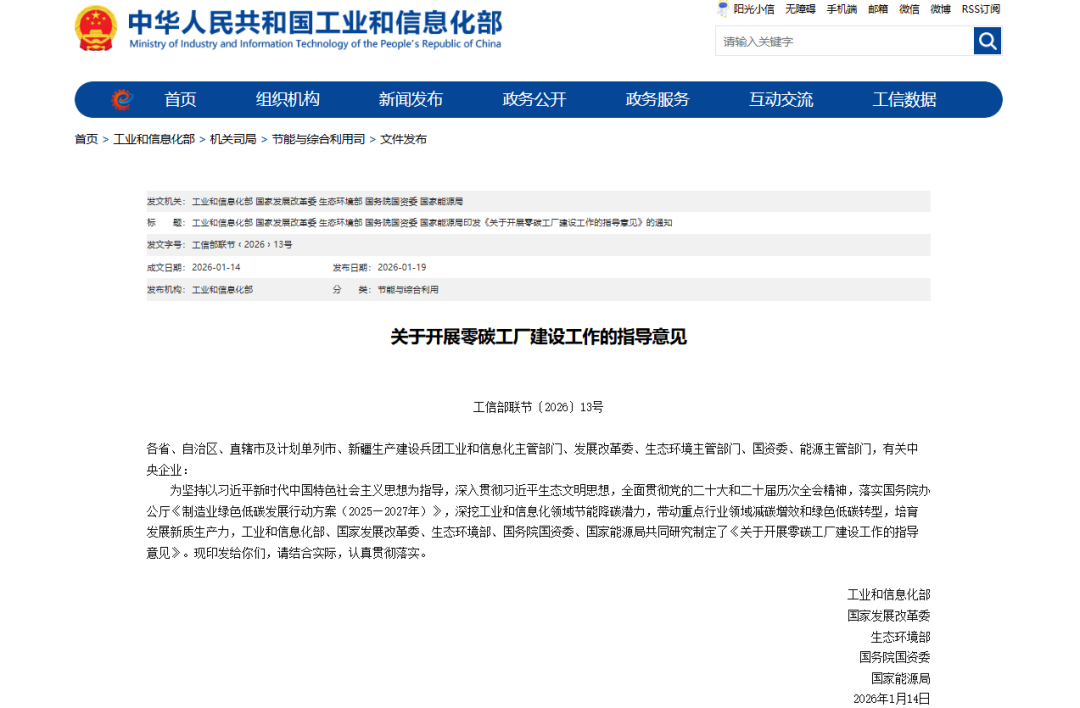
五部门发文:2027年前在汽车等重点领域培育零碳工厂
2 1 Shi Ji Jing Ji Bao Dao· 2026-01-19 06:32
Core Viewpoint - The ongoing trend towards zero-carbon initiatives is being reinforced by the implementation of policies for zero-carbon factories, which are expected to significantly contribute to the green transformation of industries in China [1][4]. Group 1: Policy and Guidelines - The Ministry of Industry and Information Technology, along with four other departments, issued the "Guiding Opinions on the Construction of Zero-Carbon Factories," which outlines the selection of zero-carbon factories starting in 2026 and aims to establish benchmarks for various industries [1][4]. - By 2027, the plan includes the cultivation of zero-carbon factories in sectors such as automotive, lithium batteries, photovoltaics, electronics, light industry, machinery, and computing facilities [1][4]. - The expansion of zero-carbon factory initiatives to traditional high-energy industries like steel, non-ferrous metals, petrochemicals, building materials, and textiles is targeted by 2030 [1][4]. Group 2: Objectives and Implementation - The guiding opinions emphasize a phased approach to nurturing zero-carbon factories, focusing on quality improvement and green transformation across the entire industrial chain [4][5]. - Key objectives include the establishment of a carbon emission accounting management system, enhancing energy efficiency, and promoting digitalization to achieve intelligent carbon control [4][5]. Group 3: Challenges and Support - The construction of zero-carbon factories faces challenges such as inconsistent evaluation standards, unverified key technologies, and weak foundations for carbon emission statistics [6]. - The Ministry of Industry and Information Technology plans to enhance coordination and policy support to facilitate the high-quality advancement of zero-carbon factory construction [6].
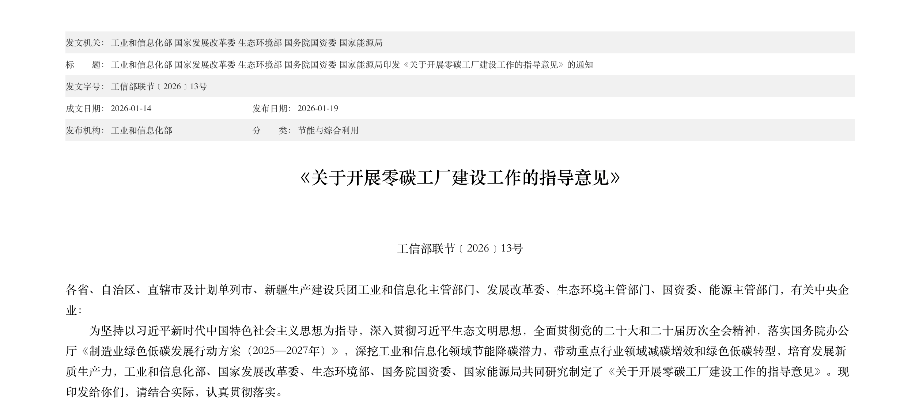
利好来了,五部门联合发布
中国基金报· 2026-01-19 06:23
Core Viewpoint - The article discusses the release of the "Guiding Opinions on the Construction of Zero Carbon Factories" by five Chinese government departments, emphasizing the importance of reducing carbon emissions in industrial sectors and promoting green transformation through zero carbon factory initiatives [2][3]. Group 1: Overall Requirements - The initiative is guided by Xi Jinping's thoughts on ecological civilization and aims to enhance industrial efficiency and promote green transformation across the entire industrial chain [7]. - The construction of zero carbon factories will follow principles such as tailored strategies for different industries, innovation-driven approaches, continuous improvement, and transparency in carbon emissions reporting [8][9]. Group 2: Main Goals - The plan includes a phased approach, starting with industries that have urgent decarbonization needs and are primarily electricity consumers, with a goal to select a batch of zero carbon factories by 2026 [10]. - By 2027, the initiative aims to establish zero carbon factories in sectors like automotive, lithium batteries, photovoltaics, electronics, light industry, machinery, and computing facilities, with further expansion to high carbon intensity industries by 2030 [10]. Group 3: Construction Pathways - Establishing a carbon emission accounting management system is crucial for accurate data support in zero carbon factory construction [11]. - Transitioning to a green and low-carbon energy structure is essential, encouraging the use of renewable energy sources and technologies such as distributed solar and wind power [12]. - Improving energy efficiency through systematic optimization of production processes and adopting advanced technologies is a key focus [13]. - Promoting zero carbon supply chain management and conducting carbon footprint analysis for key products will drive collaborative decarbonization across the industry [14]. - Enhancing digital and intelligent management capabilities will facilitate precise measurement and control of energy consumption and carbon emissions [14]. - Carbon offsetting and information disclosure are necessary to achieve and maintain near-zero carbon emissions [14]. Group 4: Work Requirements - Local industrial and information departments are encouraged to develop specific implementation plans for zero carbon factory construction, promoting collaboration among government, enterprises, and markets [15]. - A comprehensive standard system for zero carbon factories is to be established, providing scientific and practical guidelines for management and evaluation [16]. - The promotion of comprehensive services for energy saving and carbon reduction is essential, including technology transfer and international cooperation [17].

重磅!工信部、国家发改委、国家能源局等5部门发布
中国能源报· 2026-01-19 04:27
Core Viewpoint - The article discusses the guidance issued by the Ministry of Industry and Information Technology and other departments in China regarding the construction of zero-carbon factories, aiming to enhance low-carbon competitiveness and adapt to international trade rules by 2030 [1][3]. Group 1: Overall Requirements - The initiative is guided by Xi Jinping's thoughts on ecological civilization and aims to promote green and low-carbon transformation in key industries, enhancing productivity and achieving carbon peak and neutrality goals [4][5]. - The construction of zero-carbon factories will follow principles such as tailored strategies, innovation-driven approaches, and systematic promotion to ensure effective low-carbon transitions [6][7]. Group 2: Main Goals - From 2026, a selection of zero-carbon factories will be established as benchmarks, with a focus on industries like automotive, lithium batteries, photovoltaics, electronics, light industry, machinery, and computing facilities by 2027 [8][9]. - By 2030, the initiative will expand to include industries such as steel, non-ferrous metals, petrochemicals, building materials, and textiles, exploring new decarbonization pathways [9][10]. Group 3: Construction Pathways - A carbon emission accounting management system will be established to provide accurate data for zero-carbon factory construction, including direct and indirect emissions [11]. - The initiative encourages the transition to green and low-carbon energy structures, promoting the use of renewable energy sources and technologies [12]. - Energy efficiency will be significantly improved through systematic optimization of production processes and the adoption of advanced technologies [13]. - The analysis of carbon footprints for key products will be promoted to drive collaborative decarbonization across the supply chain [14]. - Digitalization and smart technologies will be leveraged to enhance carbon management and operational efficiency [15]. - Carbon offsetting and information disclosure will be implemented to maintain near-zero emissions and improve sustainability reporting [16]. Group 4: Work Requirements - Local authorities are encouraged to develop specific implementation plans for zero-carbon factory construction, promoting collaboration among government, enterprises, and markets [16][18]. - A standard system will be established to support zero-carbon factory management and evaluation, ensuring alignment with international standards [18]. - The promotion of comprehensive services for energy saving and carbon reduction will be encouraged, facilitating technology transfer and market services [18].