
金属冶炼

Search documents
8月21日LME金属库存及注销仓单数据
Wen Hua Cai Jing· 2025-08-22 08:56
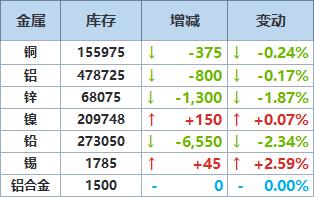
Group 1: Copper Inventory Changes - LME copper inventory decreased to 155,975 tons, a decline of 1.07% from the previous day [1][3] - Registered warehouse receipts for copper increased by 10.35% to 12,525 tons, while canceled receipts rose by 8.03% to 7,926 tons [1][3] Group 2: Aluminum Inventory Changes - LME aluminum inventory fell to 478,725 tons, a decrease of 0.00% from the previous day [1][5] - Registered warehouse receipts for aluminum decreased by 5.69% to 13,250 tons, with canceled receipts at 2.77% [1][5] Group 3: Zinc Inventory Changes - LME zinc inventory dropped to 68,075 tons, a decline of 2.56% [1][9] - Registered warehouse receipts for zinc decreased by 0.76% to 26,250 tons, while canceled receipts accounted for 38.56% [1][9] Group 4: Tin Inventory Changes - LME tin inventory increased to 1,785 tons, an increase of 2.74% [1][11] - Registered warehouse receipts for tin rose to 100 tons, with canceled receipts at 5.60% [1][11] Group 5: Nickel Inventory Changes - LME nickel inventory rose to 209,748 tons, an increase of 0.06% [1][13] - Registered warehouse receipts for nickel increased to 7,998 tons, with canceled receipts at 3.81% [1][13]

中期产业过剩剧本维持不变 锌价存较大下行风险
Jin Tou Wang· 2025-08-22 08:20
Core Viewpoint - The domestic non-ferrous metal market showed mixed performance on August 22, with zinc futures experiencing slight declines amid macroeconomic pressures and supply-demand dynamics [1] Macroeconomic Factors - The preliminary manufacturing PMI in the U.S. for August reached 53.3, unexpectedly hitting a three-year high, indicating increased inflationary pressures [1] - The labor market is showing signs of cooling, with initial jobless claims rising by 11,000 last week, which has influenced market expectations regarding interest rate cuts [1] - Comments from three regional Federal Reserve presidents have dampened expectations for a rate cut in September, leading to a stronger dollar and putting pressure on zinc prices [1] Supply Dynamics - Supply remains relatively ample, with some zinc smelting plants increasing production capacity [1] - Domestic zinc ingot supply continues to grow, contributing to the overall supply situation [1] Demand Dynamics - The downstream market is exhibiting significant seasonal weakness, with initial consumption sectors operating at low capacity despite supportive policies [1] - Short-term demand remains weak, making it difficult to offset the overall market conditions [1] Market Outlook - Overseas registered zinc ingot warehouse receipts have hit a new low for 2024, although the pace of decline has slowed [1] - The backwardation in the London Metal Exchange (LME) market is showing signs of easing, but the medium-term outlook suggests continued oversupply in the industry [1] - There remains a substantial downside risk for zinc prices moving forward [1]
锰硅月报:锰硅震荡运行-20250822
Bao Cheng Qi Huo· 2025-08-22 01:48
Report Summary 1) Report Industry Investment Rating No investment rating is provided in the report. 2) Core View of the Report The report anticipates that the price of manganese-silicon will continue its downward trend in a volatile manner, influenced by the cooling of optimistic sentiment in the commodity market and the adjustment of coking coal and coke prices. With the operating logic returning to the industrial side, the supply remains high while the demand has potential concerns, and the cost advantage is weakening. Attention should be paid to the production situation of steel mills [6]. 3) Summary by Relevant Catalogs Market Price Performance - Since mid-August, the futures and spot prices of manganese-silicon have weakened. The main futures price dropped from a high of 6,262 yuan/ton to around 5,800 yuan/ton, a cumulative decline of over 7%. The spot price also declined, with the basis strengthening [2]. Factors Affecting Price Decline - Market sentiment has shifted. The "anti-involution" trading logic has cooled down, and the leading varieties in the previous period have adjusted at high levels. The weak real - estate data and slowing infrastructure investment in July's domestic macro - data have exacerbated the shift in market sentiment. Additionally, the cost side has loosened, as the futures price of coke has fallen by over 9.7% since mid - August [3]. Supply Situation - The supply of manganese-silicon has increased significantly. As of the week ending August 15, the operating rate of 187 independent silicon-manganese enterprises was 45.75%, and the daily output was 29,580 tons, reaching a new high this year. The production in main producing areas is active, and the output in Ningxia and Yunnan has also reached new highs. However, producers are in a loss situation, which may limit the increase in future output [4]. Demand Situation - The demand for manganese-silicon is currently acceptable. Steel mills are actively replenishing stocks, and the production of steel mills is stable. As of the week ending August 15, the blast furnace operating rate and capacity utilization rate of 247 sample steel mills were 83.59% and 90.22% respectively, and the weekly demand for manganese-silicon was 125,400 tons, showing a four - week consecutive increase. However, the decline in finished product prices has squeezed the profits of short - process steel mills, which may drag down the demand for manganese-silicon [5].
五矿期货文字早评-20250822
Wu Kuang Qi Huo· 2025-08-22 01:29
Report Industry Investment Rating No relevant content provided. Core Viewpoints - The overall market shows mixed trends across different sectors. In the short - term, some markets may experience volatility, while in the long - term, the direction depends on various factors such as policy, supply - demand relationship, and macro - economic conditions. For example, in the capital market, it is generally a good idea to buy on dips; in the bond market, interest rates are expected to decline in the long - run but may fluctuate in the short - term; in the commodity market, different commodities have different outlooks based on their specific supply - demand fundamentals [3][5]. Summary by Category Macro - Financial Index Futures - News includes a 500 billion "quasi - fiscal" tool for emerging industries and infrastructure, central frozen pork reserve purchases, US - EU tariff policies, and EU's purchase of US energy products. After continuous recent increases, the market may experience increased short - term volatility, but the general strategy is to buy on dips [2][3]. - The basis ratios of IF, IC, IM, and IH for different contract periods are provided, showing different levels of premium or discount [3]. Treasury Bonds - On Thursday, the main contracts of TL, T, TF, and TS had different degrees of increase. The Ministry of Finance will issue 12.5 billion yuan of treasury bonds in Hong Kong on August 27, and the 20 - year Japanese treasury bond yield reached a new high on August 21. The central bank conducted a net injection of 12.43 billion yuan through reverse repurchase operations on Thursday [4]. - Fundamentally, the economy showed resilience in the first half of the year, but the PMI in July was lower than expected. The central bank maintains a supportive attitude towards funds, and interest rates are expected to decline in the long - run. Recently, due to the good stock market, the bond market may return to a wide - range oscillation pattern [5]. Precious Metals - The prices of Shanghai gold and silver, COMEX gold and silver, US 10 - year treasury bond yield, and US dollar index are presented. The US economic data shows resilience, and Fed officials' statements on interest rate cuts are hawkish, but the Fed is expected to enter a new interest rate cut cycle [6]. - Multiple Fed officials have made hawkish statements on interest rate cuts. Fed Chairman Powell will speak at the Jackson Hole central bank symposium. The market has priced in his hawkish remarks, and a slight loosening of his stance will be beneficial to gold and silver prices. It is recommended to buy silver on dips, with reference price ranges for Shanghai gold and silver futures contracts provided [7]. Non - Ferrous Metals Copper - Before the Fed Chairman's speech, the market was cautious, but copper prices rebounded due to the US - EU tariff framework and positive manufacturing PMI data. LME inventory was flat, and domestic social and bonded area inventories decreased. The price is expected to fluctuate, with reference price ranges for Shanghai and LME copper provided [9][10]. Aluminum - The US - EU trade framework agreement improved market sentiment, and aluminum prices rose. Domestic aluminum inventory decreased, and the market consumption sentiment improved marginally. The price is expected to be supported and may continue to be strong if the Fed Chairman's speech is dovish, with reference price ranges for domestic and LME aluminum provided [11]. Zinc - Zinc prices fell. Zinc ore inventory decreased, but zinc concentrate TC was rising. Domestic social inventory of zinc ingots increased, and downstream consumption was weak. Zinc prices still face significant downward risks [12]. Lead - Lead prices rose slightly. Lead ore inventory was tight, and processing fees were declining. Primary lead production increased, while secondary lead production decreased. Demand was weak, and lead prices are expected to be weak [13][14]. Nickel - Nickel prices were weakly volatile. Nickel ore prices were stable, and nickel iron prices were flat. There was a slight shortage of MHP supply. Nickel prices may have callback pressure in the short - term but are supported in the long - term. It is recommended to buy on significant dips, with reference price ranges for Shanghai and LME nickel provided [15]. Tin - Tin prices fluctuated narrowly. Supply was restricted by slow复产 in Myanmar and transportation issues, and demand was weak in the off - season. Tin prices are expected to oscillate, with reference price ranges for domestic and LME tin provided [16]. Lithium Carbonate - The price of lithium carbonate index decreased, but the futures contract price increased. Supply decreased, and inventory decreased slightly. The short - term support level of lithium prices has moved up, and attention should be paid to imports and industry news, with a reference price range for the futures contract provided [17]. Alumina - The alumina index decreased. The import window was closed, and futures inventory increased. Due to supply disturbances, the downward space of futures prices is limited, and it is recommended to wait and see, with a reference price range for the main contract provided [18]. Stainless Steel - Stainless steel prices fell. The decline was due to low - price selling by arbitrage institutions, and downstream demand was weak. However, steel mills intend to support prices, and stainless steel prices are expected to oscillate [19]. Cast Aluminum Alloy - Cast aluminum alloy prices rose slightly. The downstream is transitioning from the off - season to the peak season, and cost support is strong, but upward resistance is large due to the large difference between futures and spot prices [20][21]. Black Building Materials Steel - The prices of rebar and hot - rolled coil decreased. Rebar production decreased, demand was weak, and inventory continued to accumulate. Hot - rolled coil demand increased, production grew rapidly, and inventory increased for six consecutive weeks. If demand does not improve, prices may continue to decline, and attention should be paid to the impact of safety inspections and environmental protection restrictions [23][24]. Iron Ore - Iron ore prices rose. Overseas iron ore shipments and arrivals increased, and steel mill iron production was stable. Port inventory increased slightly, and steel mill inventory decreased slightly. Terminal demand was weak, and iron ore prices may continue to adjust in the short - term [25][26]. Glass and Soda Ash - Glass prices decreased, and inventory pressure increased. Soda ash prices were stable, and inventory increased. In the short - term, glass prices are expected to oscillate weakly, and soda ash prices are expected to oscillate. In the long - term, glass prices depend on policy and demand, and soda ash prices are affected by supply - side policies and market sentiment [27][28]. Manganese Silicon and Ferrosilicon - Manganese silicon and ferrosilicon prices oscillated slightly. Manganese silicon prices broke through the support level, and ferrosilicon prices are approaching the support line. It is recommended for investment positions to wait and see, while hedging positions can participate at appropriate times [29]. Industrial Silicon and Polysilicon - Industrial silicon prices rose. Supply may increase due to higher开工 rates, and demand can provide some support. Prices are expected to oscillate weakly. Polysilicon prices fell. Supply increased, and inventory decreased slowly. Prices are expected to oscillate widely, and attention should be paid to the impact of warehouse receipts on prices [33][36]. Energy and Chemicals Rubber - NR and RU prices oscillated weakly after a decline. Bulls expect price increases based on seasonal and demand factors, while bears are concerned about weak demand and uncertain macro - expectations. It is recommended to wait and see, and partial closing of the long - RU2601 and short - RU2509 position is advised [38][42][43]. Crude Oil - WTI, Brent, and INE crude oil futures prices rose. Singapore's oil product inventory data shows mixed trends. Although geopolitical premiums have disappeared and the macro - environment is bearish, oil prices are undervalued, and it is a good time for left - hand side layout [44]. Methanol - Methanol futures prices rose slightly. Coal prices increased, increasing methanol production costs, but coal - based profits are still high. Supply is expected to increase, and demand is weak currently but may improve in the peak season. It is recommended to wait and see [45]. Urea - Urea futures prices fell. Domestic production is expected to increase, and demand is average. Current prices are weak, but the downside is limited due to low corporate profits. It is recommended to pay attention to long - position opportunities on dips [46]. Styrene - Styrene prices rose. Market sentiment is good, and cost support exists. BZN spread is low and may repair. Supply is increasing, and demand is rising at the end of the off - season. Prices are expected to rise with cost [47][48]. PVC - PVC prices fell. Production increased, demand decreased, and inventory increased. The company's profit is high, and the fundamentals are weak. It is recommended to wait and see [49]. Ethylene Glycol - Ethylene glycol prices fell. Supply increased, and demand recovered slightly. Inventory decreased slightly, but it is expected to increase in the medium - term. Valuation is high, and prices may decline [50]. PTA - PTA prices rose. Supply decreased due to unexpected maintenance, and demand improved. Inventory decreased, and processing fees are expected to repair. It is recommended to buy on dips following PX [51][52]. p - Xylene - PX prices rose. PX production is high, and downstream PTA has many unexpected maintenance. PX inventory is expected to be low, and valuation has support but limited upside. It is recommended to buy on dips following crude oil [53]. Polyethylene (PE) - PE prices rose. Market expects favorable policies from the Ministry of Finance, and cost support exists. Inventory is decreasing from a high level, and demand is expected to increase in the peak season. Prices are expected to oscillate upward [54]. Polypropylene (PP) - PP prices fell. Supply may increase as refinery profits recover, and demand is weak. Inventory is still under pressure, and it is recommended to buy the LL - PP2601 contract on dips [55][57]. Agricultural Products Hogs - Hog prices were mixed. Downstream demand is weak, and supply may increase. In the short - term, it is recommended to buy on dips, pay attention to medium - term pressure, and use reverse - spread strategies for far - month contracts [59]. Eggs - Egg prices were mixed. Supply is abundant, and demand is average. In the short - term, the market may fluctuate, and in the medium - term, it is recommended to sell on rebounds [60]. Soybean and Rapeseed Meal - US soybean prices rose. US soybean production may increase, and domestic soybean meal supply is seasonally excessive. It is recommended to buy on dips at the lower end of the cost range and pay attention to supply and demand factors [61][64]. Oils and Fats - Domestic oil prices rebounded. US biodiesel policy, low inventory in Southeast Asia, and the expected B50 policy in Indonesia support oil prices. Palm oil is expected to be stable in the short - term and may rise in the fourth quarter [65][67]. Sugar - Sugar prices rose. Brazilian sugar production may decrease, and international sugar prices may not rebound significantly. Domestic sugar imports are expected to increase, and prices may decline [68][70]. Cotton - Cotton prices oscillated. The USDA report is positive, and the suspension of import tariffs in India is beneficial. However, downstream consumption is average, and prices are expected to oscillate at a high level in the short - term [71].
洛阳拾印商贸有限公司成立 注册资本10万人民币
Sou Hu Cai Jing· 2025-08-16 21:17
Company Overview - Luoyang Shiyin Trading Co., Ltd. has been recently established with a registered capital of 100,000 RMB [1] - The legal representative of the company is Han Yuqi [1] Business Scope - The company operates in various sectors including the sale of construction materials, insulation materials, and building decoration materials [1] - It is involved in the manufacturing of non-metallic mineral products and light construction materials [1] - The company also engages in the sale of metal ores and the processing of non-metallic waste and scrap [1] - Additional activities include the manufacturing and sale of furnaces and electric furnaces, as well as handling and transportation services (excluding hazardous goods) [1] Licensing - The company is authorized to conduct road cargo transportation (excluding hazardous goods), subject to approval from relevant authorities [1]
冠通每日交易策略-20250815
Guan Tong Qi Huo· 2025-08-15 11:26
Report Industry Investment Rating No relevant content provided. Core Views - **Copper**: Macroeconomic factors show the US PPI rising significantly, while the supply of copper concentrates is increasing, and the demand is weak. The copper price remains in a narrow - range fluctuation, waiting for market drivers [7]. - **Lithium Carbonate**: Due to the production reduction of CATL, the supply is expected to shrink, and the demand is in a small peak season. The price of lithium carbonate is expected to fluctuate at a high level in the short term [8][9]. - **Crude Oil**: Entering the end of the seasonal travel peak, the inventory of oil products is increasing. OPEC + plans to increase production in September, and the possibility of a cease - fire between Russia and Ukraine is rising. The medium - and long - term downward pressure on crude oil prices is increasing, and the short - term volatility is large [10]. - **Asphalt**: The supply is increasing, the demand is restricted by funds and weather, and the inventory is at a low level. It is recommended to close short positions temporarily [11][12]. - **PP**: The supply is increasing, the demand is weak, and it is about to enter the peak season. It is expected to fluctuate, and a 09 - 01 reverse spread is recommended [13]. - **Plastic**: The supply is increasing, the demand is in the off - season, and the inventory pressure is large. It is expected to fluctuate, and a 09 - 01 reverse spread is recommended [14][15]. - **PVC**: The supply is increasing, the demand is not improved, and the inventory is high. It is expected to fluctuate downward, and a 09 - 01 reverse spread is recommended [16]. - **Coking Coal**: After continuous price increases, the market sentiment cools down, and the price fluctuates at a high level [18]. - **Urea**: The demand is weak, the supply is expected to decrease, and the inventory is accumulating. The short - term trend is weak consolidation [19]. Summary by Relevant Catalogs Futures Market Overview - **Price Changes**: As of August 15, most domestic futures main contracts declined. Rapeseed meal dropped by over 3%, methanol and rapeseed oil by nearly 2%, and many others by over 1%. Polysilicon rose by over 4%, lithium carbonate by over 2%, and some others by over 1%. Stock index futures generally rose, while most treasury bond futures declined [4]. - **Fund Flows**: As of 15:07 on August 15, funds flowed into contracts such as CSI 1000 2509 and CSI 500 2509, and flowed out of contracts such as Shanghai Silver 2510 and Shanghai Gold 2510 [4]. Core Commodity Analysis Copper - **Macro**: The US PPI in July rose significantly, with a month - on - month increase of 0.9% and a year - on - year increase of 3.3%, both exceeding expectations [7]. - **Supply**: The Indonesian smelter's maintenance was extended, and China's copper concentrate imports in July increased by 18.24% year - on - year and 8.94% month - on - month. The TC/RC fees continued to rise, and the production enthusiasm of smelters was fair [7]. - **Demand**: Affected by high - temperature and rainy weather, the downstream demand was weak, and the terminal power grid performed well, while the real estate sector was a drag. The inventory in the Shanghai Futures Exchange did not show a significant increase, supporting the domestic copper price [7]. Lithium Carbonate - **Price**: The average price of battery - grade lithium carbonate was 82,700 yuan/ton, up 700 yuan/ton from the previous trading day; the average price of industrial - grade lithium carbonate was 80,400 yuan/ton, up 650 yuan/ton [8]. - **Supply**: CATL's mining end in Jianxiawo stopped production on August 10, with no short - term resumption plan. The monthly output of this mine accounted for 9% - 10% of the domestic lithium carbonate output, and the supply was expected to shrink [8]. - **Demand**: The demand in the power sector recovered with the return of subsidies, and the trading enthusiasm of traders increased [8][9]. Crude Oil - **Inventory**: The EIA data showed that the inventory of crude oil and diesel increased, and the gasoline inventory decreased slightly [10]. - **Supply**: OPEC + plans to increase production by 547,000 barrels per day in September, and the possibility of a cease - fire between Russia and Ukraine is rising, increasing the medium - and long - term downward pressure on prices [10]. - **Price**: Saudi Aramco raised the official selling price of Arab Light crude oil to Asia in September [10]. Asphalt - **Supply**: The weekly asphalt production rate increased by 1.2 percentage points to 32.9%, and the expected production in August decreased by 5.1% month - on - month and increased by 17.1% year - on - year [11]. - **Demand**: The downstream production rates mostly increased, but the demand was restricted by funds and weather. The national shipment volume decreased by 11.34% week - on - week [11][12]. - **Inventory**: The inventory - to - sales ratio of asphalt refineries increased slightly but remained at a low level in the same period in recent years [12]. PP - **Supply**: The production rate of PP enterprises decreased to about 83.5%, and the production ratio of standard - grade drawstring decreased to about 28.5%. New capacity is planned to be put into production in August, and the number of maintenance devices has increased slightly [13]. - **Demand**: The downstream demand was weak, and the new orders were limited. The downstream procurement was mainly for rigid needs, but the production rate of plastic weaving increased slightly [13]. Plastic - **Supply**: The plastic production rate dropped to about 87%, and new capacity was put into operation. The production rate decreased slightly recently [14][15]. - **Demand**: The downstream production rate increased slightly, but the agricultural film was still in the off - season, and the new orders decreased. The demand was mainly for rigid needs, and the inventory pressure was large [14][15]. PVC - **Supply**: The PVC production rate increased to 80.33%, and new capacity was put into production in August, with more planned in the future [16]. - **Demand**: The downstream production rate decreased slightly, and the demand was not improved. The real estate sector was still in the adjustment stage [16]. - **Inventory**: The social inventory continued to increase, and the inventory pressure was large [16]. Coking Coal - **Price**: The price in the Shanxi market remained unchanged, while the price of Mongolian 5 coking coal decreased by 44 yuan/ton [18]. - **Supply**: The supply data increased, the production of clean coal and raw coal increased, and the inventory of mine clean coal decreased [18]. - **Demand**: The profit of independent coking enterprises turned positive, the production of downstream coke increased, and the inventory decreased. However, the iron - making water production decreased, and the profitability of steel mills weakened [18]. Urea - **Supply**: Next week, many urea enterprises will conduct inspections, and the supply is expected to decrease [19]. - **Demand**: The production rate of compound fertilizer enterprises increased slightly, but the production rate of melamine decreased significantly, dragging down the domestic demand for urea [19]. - **Inventory**: The factory inventory increased, mainly due to the weak demand after the end of agricultural demand [19].
中原期货晨会纪要-20250813
Zhong Yuan Qi Huo· 2025-08-13 01:10
1. Report Industry Investment Rating No relevant content provided. 2. Core Viewpoints of the Report - China and the US have agreed to suspend the implementation of 24% tariffs for another 90 days starting from August 12, 2025, which may allow the risk - preference in the capital market to continue [22]. - The A - share market is currently in a slow - bull trend, and in August, during the policy window period and the concentrated disclosure period of interim reports, the market may experience local hot - spot rotation. Investors should focus on sectors with strong performance prospects [23]. - For A - shares, the main stock indexes continue the trend of oscillating upward. It is recommended to follow the trend in investment, pay attention to locking in profits during rapid rallies, and look for low - buying opportunities in IF, IM, and IC [23][25]. 3. Summary by Relevant Catalogs 3.1 Macro - news - China and the US issued a joint statement on the Stockholm economic and trade talks. Both sides will continue to suspend the implementation of 24% tariffs for 90 days starting from August 12. China will also continue to suspend relevant measures on the unreliable entity list [9]. - Three departments jointly issued a plan for fiscal interest subsidies on personal consumption loans, and nine departments including the Ministry of Finance issued a plan for fiscal interest subsidies on loans to service - industry business entities [9]. - The US CPI in July was flat year - on - year at 2.7%, lower than expected, while the core CPI rose 3.1% year - on - year, higher than expected. The market expects the Fed to cut interest rates in September with a probability of over 90% [10]. - The preliminary ruling of the Ministry of Commerce shows that there is dumping of imported rapeseed from Canada and halogenated butyl rubber from Canada and Japan. Temporary anti - dumping measures will be implemented starting from August 14, and an anti - dumping investigation will be launched on imported pea starch from Canada [10]. - The adjustment of domestic refined oil prices has been shelved this time [10]. - The Lithium Industry Branch of the China Non - Ferrous Metals Industry Association issued an initiative to resist "involution - style" malicious competition, and eight dry - process lithium battery separator enterprises reached a consensus on anti - involution [11]. 3.2 Morning Meeting Views on Main Varieties 3.2.1 Agricultural Products - Peanut market prices are basically stable, with a pattern of weak supply and demand. It is expected to be strongly oscillating in the short term but still in a downward trend [14]. - The sugar market has a situation of mixed long and short factors. It is recommended to wait and see. If it effectively breaks through the 5630 pressure level, a light - position long position can be tried [14]. - The corn market also has mixed long and short factors. It is recommended to wait and see in the short term, focusing on the competition at the 2260 key level [14]. - The national average price of live pigs is falling steadily. The futures price is expected to maintain an interval oscillation [14]. - The spot price of eggs is stabilizing. The futures market has a large selling pressure, and it is recommended to avoid long positions [14][15]. - The cotton price is oscillating upward, but it still lacks a core driving force in the short term. Attention should be paid to the USDA report and subsequent news [15]. 3.2.2 Energy and Chemicals - The domestic urea market price continues to be weak. The supply pressure is expected to increase, and the futures price may continue to oscillate and consolidate [17]. - The caustic soda market in Shandong is stable, and it is recommended to pay attention to the 9 - 11 reverse spread [17]. 3.2.3 Industrial Metals - The coking coal and coke prices are expected to remain strong in the short term due to the news of coking enterprise production restrictions [18]. - The copper price continues to oscillate and consolidate, and the aluminum price is expected to continue high - level adjustment due to factors such as increased supply and weak demand [18]. - The alumina market is in an oversupply pattern and is expected to continue interval consolidation [18]. - The steel price is expected to maintain an oscillating and upward trend due to cost increases and production - reduction expectations [18]. - The ferrosilicon and ferromanganese futures prices are oscillating, and the market is mainly affected by macro and coal industry policies, showing an interval oscillation with a rising center of gravity [21]. - The lithium carbonate futures price has risen, with strong expectations but weak reality in the fundamentals. It is recommended to operate within the range, and pay attention to the progress of mining license renewals and terminal restocking [21]. 3.2.4 Options and Finance - On August 12, the three major A - share indexes rose collectively. The futures and options markets of various indexes showed different trends. Trend investors should pay attention to the strength - based arbitrage opportunities between varieties, and volatility investors can buy straddles to bet on increased volatility [21][22].
镍与不锈钢日评:“反内卷”情绪变化快、波动大-20250812
Hong Yuan Qi Huo· 2025-08-12 05:13
1. Report Industry Investment Rating - Not provided in the given content 2. Core Views - For nickel, on August 11, the main nickel contract on the Shanghai Futures Exchange rose in volume, with the trading volume at 112,549 lots (+37,685) and the open interest at 77,193 lots (-1,762). The LME nickel rose 1.12%. The spot market trading was weak, and the basis premium narrowed. The nickel ore price remained flat, the nickel ore arrivals at ports increased last week, and port inventories accumulated. The loss of nickel - iron plants narrowed, domestic production in August decreased while Indonesian production increased, and nickel - iron inventories accumulated. Domestic electrolytic nickel production in August increased, and export profits shrank. On the demand side, ternary production increased, stainless - steel plant production increased, and alloy and electroplating demand was stable. In terms of inventory, SHFE inventory increased, LME inventory decreased, social inventory increased, and bonded - area inventory decreased. Overall, the pure nickel fundamentals are loose, but the expectation of Fed rate cuts has strengthened, so the nickel price is expected to fluctuate within a range. It is recommended to wait and see [2]. - For stainless steel, on August 11, the main stainless - steel contract fluctuated upward, with the trading volume at 202,613 lots (+115,942) and the open interest at 135,260 lots (+64,070). The spot market trading was fair, and the basis premium narrowed. The SHFE inventory increased, and the social inventory of 300 - series stainless steel last week was 629,100 tons (-15,500). On the supply side, stainless - steel production increased in August. On the demand side, terminal demand was weak. At the cost end, the price of high - nickel pig iron rose, and the price of high - carbon ferrochrome remained flat. Currently, the impact of macro sentiment is relatively large. Although the fundamentals are loose, it will take time for the price to return to the fundamentals, so the price is expected to follow macro fluctuations. It is recommended to wait and see [2]. 3. Summary by Relevant Catalogs Nickel Market Price and Volume - Shanghai nickel futures: On August 11, the closing price of the near - month contract was 121,900 yuan/ton (+950), the trading volume was 112,549 lots (+37,685), and the open interest of the active contract was 77,193 lots (-1,762). The inventory was 20,723 tons (+102) [2]. - LME nickel: On August 11, the official spot price was 15,250 US dollars/ton (+175), the electronic - disk closing price was 15,325 US dollars/ton (+210), and the trading volume was 6,315 lots (+1,371). The total inventory was 211,296 tons (-936) [2]. Spread - In Shanghai nickel, the spread between the near - month and the first - continuous contract was 0 yuan/ton (-140), and the basis between the SMM 1 electrolytic nickel average price and the active contract closing price was 720 yuan/ton (-50) [2]. - In LME nickel, the LME nickel 0 - 3 months spread was - 7.83 US dollars/ton (-199.29), and the basis between the official price and the electronic - disk closing price was - 75 US dollars/ton (-40) [2]. Raw Materials - The average price of Philippine laterite nickel ore 0.9% (CIF) was 29 US dollars/wet ton, 1.5% (CIF) was 57 US dollars/wet ton, and 1.8% (CIF) was 78.5 US dollars/wet ton. The average freight from the Philippines to Lianyungang was 11.5 US dollars/ton, and to Tianjin Port was 12 US dollars/ton [2]. Inventory - SMM China port nickel ore total inventory was 761 million wet tons (+9 million). SMM Shanghai bonded - area nickel inventory decreased by 500 tons, with nickel plate inventory at 4,100 tons (-500) and the total at 4,700 tons (-500). SMM pure nickel social inventory was 40,572 tons (+1,086) [2]. Stainless Steel Market Price and Volume - Shanghai stainless - steel futures: On August 11, the trading volume of the active contract was 202,613 lots (+115,942), and the open interest was 135,260 lots (+64,070). The inventory was 102,983 tons (+58) [2]. Spread - The spread between the near - month and the first - continuous contract of Shanghai stainless steel was 0 yuan/ton (+5), and the basis between the 304/2B coil - trimmed (Wuxi) average price and the active contract was 425 yuan/ton (-190) [2]. Inventory - Stainless - steel spot inventory: In the 200 - series, it was 209,000 tons; in the 300 - series, it was 629,100 tons (-15,500); in the 400 - series, it was 112,400 tons (-2,500); and the total inventory was 947,000 tons (+3,100) [2]. Industry News - In July, China's power battery loading volume was 55.9 GWh, a month - on - month decrease of 4.0% and a year - on - year increase of 34.9%. Among them, the loading volume of ternary batteries was 10.9 GWh, accounting for 19.6% of the total loading volume, a month - on - month increase of 1.9% and a year - on - year decrease of 3.8%; the loading volume of lithium iron phosphate batteries was 4.9 GWh, accounting for 80.4% of the total loading volume, a month - on - month decrease of 5.3% and a year - on - year increase of 49.0% [2].
中原期货晨会纪要-20250811
Zhong Yuan Qi Huo· 2025-08-11 02:25
Report Industry Investment Rating No relevant content provided. Core Viewpoints of the Report - The A-share market's upward trend is stable driven by liquidity, and with the continuous implementation of policy combinations, the supply-demand pattern will optimize, potentially leading to stable improvement in the earnings and ROE of the entire A-share market. The market style is shifting from traditional cyclical sectors to technology sectors, and high-quality technology assets may have significant excess returns in the third quarter [7]. - The prices of various commodities in the market show different trends. Some are expected to be volatile, some are expected to decline, and some are expected to rebound [4][11][12][13][14][15][16]. - The bullish trend of the stock index continues, but there may be short - term adjustments. It is advisable to focus on the low - buying opportunities of IF, IM, and IC [19][20][21]. Summary by Relevant Catalogs 1. Chemical Industry - **Price Changes**: On August 11, 2025, in the chemical industry, the prices of natural rubber, 20 - number rubber, plastic, etc. rose, while the prices of coke, styrene, and soda ash fell [4]. 2. Macro News - **Corporate Performance**: Industrial Fulin's semi - annual report in 2025 shows that its revenue and net profit attributable to the parent company have increased significantly year - on - year, with the second - quarter single - season revenue exceeding 200 billion yuan for the first time [7]. - **Stock Market Performance**: Last week, the three major A - share indexes all rose on a weekly basis. The Shanghai Composite Index hit a new high this year, and the Shenzhen Component Index and the ChiNext Index also had certain increases [7]. - **Regional Economy**: The GDP growth rates of Wenzhou, Dalian, and Xuzhou in the first half of the year exceeded 6%, and there is a possibility of entering the "trillion - yuan club" by the end of the year [8]. - **US Policies and Market**: The US government will stop providing tax credits for electric vehicles from September 30, 2025. The sales of electric vehicles in July reached a record high, but it is expected that the sales will "plummet" in the fourth quarter [8]. - **Commodity Prices**: The gold futures price on the New York Mercantile Exchange hit a new high last Friday. The "interest - rate cut trading" and "Trump 2.0" will continue to catalyze in 2025, and central bank reserves will support the gold price [9]. 3. Morning Meeting Views on Major Varieties 3.1 Agricultural Products - **Peanuts**: The peanut market is in a pattern of weak supply and demand, with prices fluctuating narrowly. In the short term, it is expected to be strongly volatile but still in a downward trend [11]. - **Oils and Fats**: The total trading volume of oils and fats decreased by 57% compared to the previous trading day. The market lacks driving forces and is expected to be weakly volatile [11]. - **Sugar**: The domestic sugar market has a different rhythm from the overseas market. If the raw sugar can stop falling and rebound, the 01 contract price may rise to repair the discount [11]. - **Pigs**: The spot price of pigs decreased last week. The supply is sufficient but the demand is weak. The futures market shows a pattern of near - term weakness and long - term strength, with a clear reverse spread trend [11]. - **Eggs**: The spot price of eggs has fallen and stabilized. The futures market has a large premium over the spot, and it is recommended to short on rebounds [12]. - **Cotton**: The cotton market is weakly volatile. The new cotton harvest is expected to be good, and the demand is under pressure. In the short term, there may be a small technical rebound [12]. 3.2 Energy and Chemicals - **Urea**: The domestic urea market price is weakly operating. Supply pressure is expected to increase, and the price may continue to be weakly volatile with support at the bottom [12]. - **Caustic Soda**: The caustic soda contract is under pressure for adjustment, and it is recommended to pay attention to the reverse spread [12][13][14]. - **Coking Coal**: The supply of coking coal is disturbed, and the downstream acceptance of high prices is decreasing. It is expected to be in a high - level volatile state [13]. 3.3 Industrial Metals - **Copper and Aluminum**: The copper price is adjusting due to policy uncertainties, and the aluminum price is expected to continue high - level adjustment due to factors such as increased supply and weak demand [13][14]. - **Alumina**: The alumina market is in an oversupply pattern. The futures price is under pressure, and the spot price is relatively stable, expected to be range - bound [14]. - **Steel Products**: The steel market is in the off - season with slight inventory accumulation. The steel price is expected to be volatile with limited downward space and potential upward driving forces [13][14][16]. - **Ferroalloys**: The ferroalloy market is in a wide - range volatile pattern. Supply is increasing, demand is weak, and it is recommended to take a range - bound trading approach in the short term [16]. - **Lithium Carbonate**: The price of lithium carbonate is expected to fluctuate more due to the uncertainty of the production status of a lithium mine. If the mine shuts down, the price center may rise [16]. 3.4 Options and Finance - **Options**: Index options show different performance in terms of volume, open interest, and implied volatility. Trend investors can focus on arbitrage opportunities between varieties, and volatility investors can buy straddles to bet on increased volatility [18]. - **Stock Index**: The bullish trend of the stock index continues. The Shanghai Composite Index may consolidate around 3600 points. It is recommended to focus on low - buying opportunities of IF, IM, and IC [19][20][21].
2025年7月通胀数据点评:CPI环比转为上涨,PPI仍在低位
Southwest Securities· 2025-08-09 13:48
Inflation Data Summary - In July 2025, the CPI year-on-year changed from a 0.1% increase to flat, outperforming the Wind consensus expectation of -0.12%[2] - The food price index saw a year-on-year decline of 1.6%, while non-food prices increased by 0.3%[2] - Month-on-month, the CPI rose by 0.4%, slightly above the ten-year average increase of 0.34%[2] Food Price Dynamics - The year-on-year decline in fresh vegetable prices expanded to 7.6%, significantly impacting the CPI[2] - Pork prices saw a year-on-year decline of 9.5%, while beef prices increased by 3.6%[2] - The average wholesale price of 28 monitored vegetables continued to decline year-on-year in early August 2025[2] Non-Food Price Trends - Non-food prices increased by 0.3% year-on-year, with durable goods prices rising due to the end of promotional activities[3] - Transportation fuel prices decreased by 9% year-on-year, influenced by international oil price fluctuations[3] - Service prices rose by 0.5% year-on-year, remaining stable compared to the previous month[3] PPI Insights - The PPI year-on-year decline remained at -3.6%, with production materials down 4.3% and living materials down 1.6%[4] - The PPI month-on-month decreased by 0.2%, with production materials showing a smaller decline than living materials[4] - The price of oil and gas extraction increased by 3.0%, while electronic equipment manufacturing prices fell by 0.4%[4] Future Outlook - CPI is expected to remain stable in August 2025, with food CPI likely to continue its downward trend due to high base effects from the previous year[5] - PPI may show a narrowing year-on-year decline in August, driven by improved supply-demand dynamics in certain industries[5] - Risks include potential delays in policy implementation and unexpected fluctuations in international commodity prices[5]