
出口

Search documents
张瑜:“存款”落谁家,春水向“中游”——华创证券年度策略会演讲实录
Xin Lang Cai Jing· 2025-12-06 05:33
Core Viewpoints - The presentation emphasizes the importance of understanding where deposits will be allocated in the future, as this will influence valuations, styles, and financial conditions for the coming year [4][5][6] - The year 2026 is anticipated to be a critical year for awakening the investment value in the Chinese stock market, breaking the stereotype of short-lived bull markets [7][8] Economic and Policy Outlook for 2026 - The nominal GDP growth rate for 2026 is projected to be around 4.5%, slightly higher than the estimated 4% for 2025 [10][11] - Fixed asset investment is expected to remain low, with a neutral forecast around 1%, while consumption is likely to align with nominal GDP growth [11][12] - Export growth is anticipated to be resilient, potentially exceeding nominal GDP growth, with a forecast of around 5% [11][12] Price Trends for 2026 - CPI growth is expected to turn positive, while PPI growth trends are uncertain, with a potential for recovery but no guarantee of turning positive [13][14][15] - The housing market's recovery signals are difficult to identify, but a key indicator is whether mortgage rates fall below rental yields [16][17][18] Structural Changes in the Economy - The middle stream of the economy is expected to show the most significant improvement, with overseas profit margins for middle stream companies surpassing domestic margins for the first time [23][24] - The supply-demand dynamics in the middle stream are changing, with policies targeting this sector leading to adjustments in market conditions [24][25] Financial Conditions and Deposit Allocation - The total amount of deposits will determine valuations and market styles, with M2 growth expected to slow down to around 7.4% to 7.5% [33][34] - The allocation of deposits between residents, enterprises, and non-bank financial institutions will significantly impact economic dynamics and stock market activity [36][38] Investment Insights and Asset Allocation - The focus for 2026 will be on stock investments, with expectations of continued market activity but with a potential slowdown in growth rates compared to 2025 [52][53] - The bond market is expected to face challenges due to increased volatility, with a cautious outlook on interest rates [59] Uncertain Factors - Key uncertainties include the performance of the US stock market, the stability of dollar liquidity, and the potential for infrastructure investments in China to rebound as expected [60]


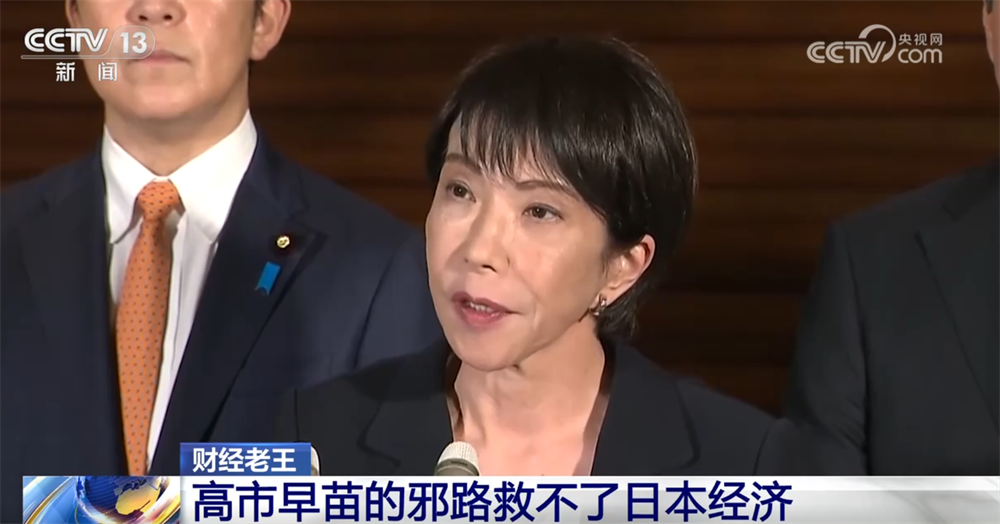
不收拾日本经济“烂摊子”走邪路 高市早苗一心只为政治私利巩固自己“位子”
Yang Shi Wang· 2025-11-22 03:17
Economic Situation - Japan's economy is facing significant challenges, including continuous export decline, weak domestic demand, and negative GDP growth [1][3] - Exports have shrunk for four consecutive months, and the GDP has decreased by 1.8% year-on-year in the third quarter, marking the first negative growth in six quarters [3] Inflation and Consumer Impact - Persistent inflation has led to weak domestic consumption, with the core Consumer Price Index (CPI) rising for 49 consecutive months [5] - Over 20,000 food items are reported to have increased in price this year, reflecting the burden on consumers [5] Public Sentiment and Political Response - A survey indicates that over 99% of respondents feel the pressure from rising prices, with 81.6% experiencing "strong" stress [7] - The new Prime Minister, Sanae Takaichi, is perceived to be neglecting these public concerns, focusing instead on political gains and potentially exacerbating the economic situation [7] Trade Relations - China is now Japan's largest trading partner, with a projected trade volume of $308.3 billion in 2024, accounting for over 7% of Japan's GDP [9] - The current political rhetoric from Takaichi may jeopardize the political foundation of Japan-China relations, raising concerns about accountability for potential economic losses [11]
德国央行预计第四季度德国经济有望增长
Sou Hu Cai Jing· 2025-11-20 12:15
Core Viewpoint - The German economy is expected to return to growth in the last quarter of this year as the turmoil caused by U.S. tariffs gradually subsides [1] Group 1: Economic Growth - The German central bank indicates that economic activity may see "slight growth" in overall output [1] - A surge in exports is anticipated at the beginning of 2025, which will later become a drag on growth in subsequent months [1] - The report suggests that the service sector will support economic activity, although not necessarily from consumption-related areas [1] Group 2: Sector Performance - Exports and industrial sectors are expected to stabilize in the fourth quarter [1]
日本经济重现收缩迹象 货币政策前景再添不确定性
Sou Hu Cai Jing· 2025-11-17 14:43
Core Insights - Japan's economy showed significant contraction in the third quarter, breaking a six-quarter growth trend, raising concerns for future policy decisions [2][3] - External demand weakened due to rising trade pressures and tariffs imposed by the US on certain Asian goods, negatively impacting Japan's export sector [2] - Domestic investment also weakened, particularly in residential investment, due to regulatory adjustments causing uncertainty in the construction industry [2] - Consumer sentiment remained cautious amid high prices and an unclear economic outlook, limiting the potential for economic rebound [2] Economic Performance - The third quarter saw a notable slowdown in actual economic activity, primarily driven by external factors [2] - Weak overseas demand and increased trade pressures were significant contributors to the overall growth decline [2] - The contraction in residential investment was particularly pronounced, reflecting structural adjustments within the industry [2] Central Bank Implications - The latest economic data complicates the Bank of Japan's decision-making regarding interest rate adjustments, which were previously anticipated by the market [3] - The unexpected economic contraction may lead policymakers to reassess the pace of tightening and potentially delay further rate hikes [3] - The interplay of external uncertainties and internal adjustments presents challenges for future policy directions [3]
透过资本市场看中国经济结构
3 6 Ke· 2025-11-17 10:56
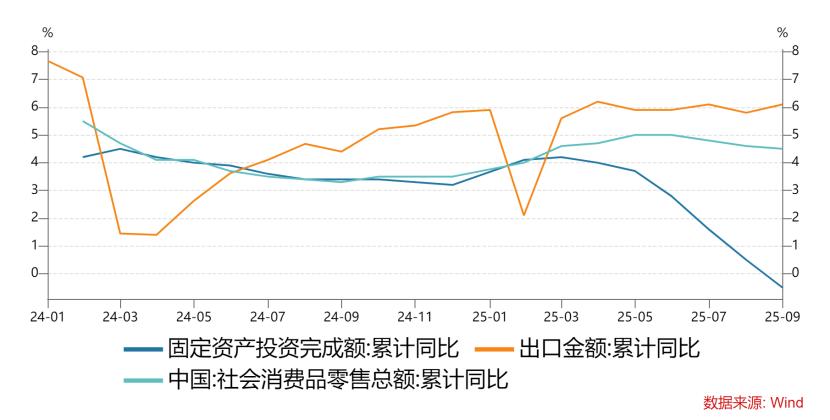
Core Viewpoint - China's economy is projected to achieve a growth target of around 5% for the year, with a 5.2% growth rate recorded in the first three quarters, despite significant structural changes and challenges such as the US-China trade tensions [1][2]. Economic Contributions - The "three drivers" of the economy—consumption, capital formation, and net exports—contributed 53.5%, 17.5%, and 29.0% respectively to economic growth, with consumption showing a notable increase of 9 percentage points compared to last year [2][3]. - Social retail sales increased by 4.5% year-on-year, while government spending saw a growth of 3.1% in general public budget and 23.9% in fund budget [2]. Investment Trends - Investment growth has declined to -0.5%, marking the first negative growth since records began, with real estate investment down by 13.9% year-on-year [5][6]. - Manufacturing investment grew by 4.0%, but showed signs of slowing down after the introduction of the "anti-involution" policy [6] - Infrastructure investment growth decreased to 3.3%, influenced by the ongoing real estate downturn and reduced land finance [6]. Export Performance - Exports grew by 6.1% in the first three quarters, surpassing last year's growth, with net exports contributing 29.0% to GDP growth [3][9]. - ASEAN has become the largest export market for China, with a 15.8% year-on-year increase, while exports to the US fell by 27% [9]. Price Levels and Market Reflection - The CPI decreased by 0.3% in September, primarily due to falling pork prices, while the core CPI rose by 1% [10]. - The PPI declined by 2.3% but is expected to improve gradually, which could enhance corporate profitability and consumer spending [10]. Capital Market Dynamics - A-share market has shown strong performance, with the Shanghai Composite Index rising from 3350 to around 4000 points, an 18% increase [11][12]. - The decline in risk-free interest rates has made equity investments more attractive, leading to increased capital inflow into the stock market [12]. - Corporate profits have rebounded, with a 5.34% year-on-year increase in net profit for listed companies in the first three quarters [12]. Sector Performance - The best-performing sectors include non-ferrous metals, communications, and electronics, driven by rising gold prices and advancements in AI and digital economy [13]. - Conversely, sectors such as consumer goods, coal, and petrochemicals have underperformed [13]. Future Outlook - The macroeconomic environment is expected to remain stable, with a focus on high-quality development and structural optimization in the upcoming phases of the 14th Five-Year Plan [14].
【招银研究】美联储降息预期收敛,国内经济逆风加大——宏观与策略周度前瞻(2025.11.17-11.21)
招商银行研究· 2025-11-17 10:00
Group 1: Overseas Macro Strategy - The end of the US government shutdown and hawkish signals from some Fed officials led to a slight increase in US Treasury yields, while gold initially rose before falling, and the US dollar slightly retreated [2] - The US stock market is expected to transition from a phase driven by both earnings and valuation to one primarily driven by corporate earnings growth, amidst increased market volatility [2] - Over 80% of S&P 500 companies exceeded earnings expectations in the third quarter, providing market support despite high valuations [2] - The narrative surrounding AI's potential to drive a fourth industrial revolution is yet to be validated, suggesting a need for cautious adjustment of annual return expectations to single-digit levels [2] - A diversified investment strategy is recommended, focusing on sectors such as industrials, utilities, energy, and healthcare, in addition to technology stocks [2] Group 2: US Treasury Bonds - Short-term market focus is on upcoming US economic data, although the validity of data during the government shutdown is limited [3] - Medium to long-term outlook suggests a downward shift in the central tendency of Treasury yields, with a continuation of a bull steepening yield curve [3] - Investors are advised to maintain positions in 2-5 year Treasury bonds, with long-term bonds recommended for purchase when the 10-year yield exceeds 4.2% [3] Group 3: Currency and Gold - The US dollar lacks fundamental support to stabilize above the 100 mark, with expectations of downward pressure due to a loose trading environment [3] - The Chinese yuan is expected to appreciate slightly, influenced by the Fed's rate cut cycle and easing US-China trade tensions [3] - Gold is in a short-term adjustment phase but remains bullish in the long term, with expectations of continued Fed rate cuts and ongoing central bank gold purchases [4] Group 4: Domestic Macro Strategy - Domestic economic pressures are increasing, with significant declines in real estate transaction volumes and prices, particularly in first-tier cities [6] - Financial growth has slowed, with a decrease in both public and private financing demand, and a drop in the growth rate of RMB loans to 6.5% [6] - Export dynamics remain stable, with a 6.3% year-on-year increase in average cargo throughput in October, indicating resilience in certain export categories [7] - Recent government meetings have focused on enhancing the adaptability of supply and demand in consumer goods, signaling a shift towards a more balanced policy approach [7] Group 5: Monetary Policy and Bonds - The central bank's monetary policy report indicates a focus on optimizing structural tools and emphasizing price-based regulation over quantity targets [8] - The bond market is expected to maintain a low-volatility, oscillating trend, with the 10-year Treasury yield stabilizing around 1.8% [9] - The outlook for the bond market suggests a steep yield curve, with a central tendency around 1.8% and potential fluctuations between 1.6% and 1.9% [10] Group 6: A-shares and Hong Kong Market - The A-share market experienced a slight decline, with the Shanghai Composite Index closing at 3990 points, influenced by weak economic data and reduced Fed rate cut expectations [10] - The Hong Kong market showed a 1.26% increase in the Hang Seng Index, with expectations of continued upward movement post-adjustment [11] - The overall outlook for both A-shares and Hong Kong stocks remains cautiously optimistic, with anticipated liquidity improvements and positive developments in US-China trade negotiations [11]
宏观经济周度高频前瞻报告:经济周周看:本周经济景气度延续回落-20251116
ZHESHANG SECURITIES· 2025-11-16 14:17
Economic Indicators - The GDP weekly high-frequency prosperity index as of November 15 is 4.7%, slightly down from the revised 4.8% of the previous week, indicating a slowdown in economic growth[1] - The industrial weekly prosperity index is at 8.1%, down from 8.2% the previous week, while the service industry index is at 3.0%, down from 3.1%[9] Production Sector - Both service and industrial high-frequency indicators have declined compared to the previous week[12] - The average daily output of key iron-making enterprises has increased, indicating some recovery in industrial production[12] Demand Side - Domestic demand remains weak, while external demand shows resilience, with container throughput for exports increasing to 680.9 thousand TEUs, up from 671.8 thousand TEUs the previous week[53] - The consumer high-frequency index has slightly risen to 2.9%, up from 2.6% the previous week, reflecting a modest recovery in consumer activity[9] Real Estate Market - The weekly sales of commercial housing in 30 major cities increased to 146 million square meters, a 7% rise from the previous week, but down 34% year-on-year[45] - The land transaction area decreased significantly, with 631 million square meters sold, down 195.3 million square meters from the previous week[45] Price Trends - Consumer goods prices remained stable, while industrial goods prices showed signs of recovery, with the agricultural wholesale price index rising by 0.37% week-on-week[57] - The average price of pork decreased by 0.19% week-on-week, while the prices of key vegetables and fruits saw slight increases of 0.14% and 0.54%, respectively[63]
基本面高频数据跟踪:地产销售再度回落
GOLDEN SUN SECURITIES· 2025-11-10 08:27
1. Report Industry Investment Rating No information about the report industry investment rating is provided in the given content. 2. Core View of the Report The report updates the high - frequency data of Guosheng bond - related fundamentals from November 3, 2025, to November 9, 2025. It shows that the Guosheng fundamental high - frequency index is stable with changes in various sub - indicators. The interest - rate bond long - short signal is adjusted downwards, and different economic aspects such as production, demand, prices, inventory, transportation, and financing present different trends [1][9]. 3. Summary According to the Directory 3.1 Total Index: Fundamental High - Frequency Index is Stable - The Guosheng fundamental high - frequency index is 128.6 points (previous value: 128.5 points), with a week - on - week increase of 0.1 point and a year - on - year increase of 6.1 points (previous value: 6.0 points), and the year - on - year increase is expanding. The interest - rate bond long - short signal factor is 4.4% (previous value: 4.6%), a decrease of 0.2 percentage points [1][9][11]. 3.2 Production: Electric Furnace Operating Rate Drops - The industrial production high - frequency index is 127.5 points (previous value: 127.4 points), with a week - on - week increase of 0.0 point and a year - on - year increase of 5.3 points (previous value: 5.4 points), and the year - on - year increase is narrowing. The electric furnace operating rate is 59.6% (previous value: 60.9%), a decrease of 1.3 percentage points [1][9][15]. 3.3 Real Estate Sales: Commercial Housing Transaction Area Drops Significantly - The commercial housing sales high - frequency index is 41.7 points (previous value: 41.9 points), with a week - on - week decrease of 0.2 point and a year - on - year decrease of 6.2 points (previous value: 6.1 points), and the year - on - year decrease is expanding. The transaction area of commercial housing in 30 large - and medium - sized cities is 18.8 million square meters (previous value: 31.7 million square meters), a decrease of 12.9 million square meters [1][9][29]. 3.4 Infrastructure Investment: Asphalt Operating Rate Drops - The infrastructure investment high - frequency index is 122.4 points (previous value: 122.3 points), with a week - on - week increase of 0.1 point and a year - on - year increase of 9.0 points (previous value: 8.8 points), and the year - on - year increase is expanding. The asphalt operating rate is 29.7% (previous value: 31.5%), a decrease of 1.8 percentage points [1][9][44]. 3.5 Exports: Export Container Freight Rate Index Continues to Rise - The export high - frequency index is 143.6 points (previous value: 143.6 points), with a week - on - week increase of 0.0 point and a year - on - year increase of 1.0 point (previous value: 1.1 points), and the year - on - year increase is narrowing. The CCFI index is 1058.2 points (previous value: 1021.4 points), an increase of 36.8 points [46]. 3.6 Consumption: Average Daily Movie Box Office Drops - The consumption high - frequency index is 120.6 points (previous value: 120.7 points), with a week - on - week decrease of 0.0 point and a year - on - year increase of 3.6 points (previous value: 3.6 points), and the year - on - year increase remains unchanged. The average daily movie box office is 29630,000 yuan (previous value: 30900,000 yuan), a decrease of 1270,000 yuan [1][9][55]. 3.7 CPI: Food Prices Rise Slightly Overall - The CPI monthly - on - monthly forecast is - 0.1% (previous value: 0.0%). The average wholesale price of pork is 18.1 yuan/kg (previous value: 18.0 yuan/kg), the average wholesale price of 28 key - monitored vegetables is 5.8 yuan/kg (previous value: 5.6 yuan/kg), the average wholesale price of 7 key - monitored fruits is 7.1 yuan/kg (previous value: 7.1 yuan/kg), and the average wholesale price of white - striped chickens is 17.6 yuan/kg (previous value: 17.5 yuan/kg) [2][61]. 3.8 PPI: Spot Prices of Copper and Aluminum Drop - The PPI monthly - on - monthly forecast is 0.0% (previous value: 0.0%). The spot settlement price of LME copper is 10704 US dollars/ton (previous value: 10964 US dollars/ton), a decrease of 261 US dollars/ton; the spot settlement price of LME aluminum is 2859 US dollars/ton (previous value: 2868 US dollars/ton), a decrease of 9 US dollars/ton [2][64]. 3.9 Transportation: Transportation High - Frequency Index Rises Steadily - The transportation high - frequency index is 132.4 points (previous value: 132.1 points), with a week - on - week increase of 0.2 point and a year - on - year increase of 10.4 points (previous value: 10.3 points), and the year - on - year increase is expanding. The subway passenger volume in first - tier cities is 39790,000 person - times (previous value: 40550,000 person - times), a decrease of 750,000 person - times; the road logistics freight rate index is 1050 points (previous value: 1049 points), an increase of 0.3 point; the number of domestic flights is 12273 (previous value: 12461), a decrease of 188 [2][76]. 3.10 Inventory: Electrolytic Aluminum Inventory Increases - The inventory high - frequency index is 162.9 points (previous value: 162.8 points), with a week - on - week increase of 0.1 point and a year - on - year increase of 8.0 points (previous value: 8.1 points), and the year - on - year increase is narrowing. The electrolytic aluminum inventory is 11.6 million tons (previous value: 8.5 million tons), an increase of 3.1 million tons; the soda ash inventory is 170.3 million tons (previous value: 169.7 million tons), an increase of 0.6 million tons [2][82]. 3.11 Financing: Net Financing of Local Bonds Drops Significantly - The financing high - frequency index is 241.6 points (previous value: 241.0 points), with a week - on - week increase of 0.6 point and a year - on - year increase of 30.4 points (previous value: 30.4 points), and the year - on - year increase remains unchanged. The net financing of local bonds is - 36 billion yuan (previous value: 178 billion yuan), a decrease of 213.9 billion yuan; the net financing of credit bonds is 92 billion yuan (previous value: - 12.6 billion yuan), an increase of 104.6 billion yuan [2][94].
华泰证券:预计中国2026年出口仍有望保持较高增长
Xin Lang Cai Jing· 2025-11-05 23:23
Core Viewpoint - China's exports have shown strong resilience in 2023, with a year-on-year growth of 6% in Q2, despite the U.S. imposing tariffs as high as 145% [1] Group 1: Export Performance - Exports accelerated in Q3, and the high base in Q4 is not expected to hinder continued high growth [1] - The resilience of Chinese exports is attributed to macroeconomic and industrial cycles, as well as structural support from seven years of industrial transformation and upgrading since 2018 [1] Group 2: Future Outlook - China's exports are expected to maintain high growth through 2026, even in a globally high inflation environment, with exceptional profitability in the export chain [1] - The successful transformation and upgrading of China's manufacturing and export industries are key factors in maintaining confidence against U.S. tariff adjustments [1]

淳厚基金陈印:力争挖掘现金流可持续增长带来的估值抬升机会
Zhong Guo Zheng Quan Bao· 2025-11-03 04:54
Core Insights - The article emphasizes the importance of identifying intrinsic commonalities in investment logic to construct portfolios amidst volatile capital markets [1] - The focus is on sustainable future cash flow, particularly in sectors like internet platforms, innovative pharmaceuticals, maritime trade, and export chains [2][5][6] Investment Philosophy - The investment principle revolves around future cash flow that balances growth potential and risk control, with a broader definition of cash flow beyond just financial statements [3] - The manager tracks the ultimate destination of funds post-central bank release, indicating a macro perspective on cash flow sustainability [3] Sector Focus - The internet sector is highlighted for its increasing reliance in daily life, providing stable and growing cash flow opportunities [5] - The innovative pharmaceutical sector is noted for its potential due to overseas companies acquiring early-stage options in China, enhancing cash flow stability [6] - The maritime sector is expected to benefit from enduring trade habits, with increased trade volumes supporting cash flow in shipping and port operations [6] - The export chain is positioned favorably due to the disparity between low actual growth and high nominal growth overseas, allowing domestic exporters to gain revenue advantages [6] Valuation and Portfolio Management - The investment approach includes a balanced industry allocation with slight tilts towards favored sectors, while also seeking undervalued reversal opportunities [4] - Valuation is a primary consideration in selecting specific stocks, with a focus on dynamic tracking to assess the reasonableness of valuations [4] - The manager is cautious about participating in high-valuation opportunities unless justified by performance growth or order matching [4]