
高技术制造业

Search documents
11月PMI数据点评:PMI数据对债市的影响中性偏多
Yong Xing Zheng Quan· 2025-12-04 07:49
1. Report's Industry Investment Rating - The report gives a neutral to positive investment rating for the bond market. It suggests that investors may increase their allocation to fixed - income assets such as bonds at the end of the year, and is optimistic about the bond market's performance in the medium term. [4][37] 2. Core Viewpoints - Manufacturing demand drives production recovery, with the November manufacturing PMI rising slightly to 49.20%, but still below the boom - bust line. The new order index and production index have both increased. The improvement in the foreign trade environment due to Sino - US economic and trade consultations has led to an overall recovery in demand, which in turn has accelerated production. [2][13] - The improvement in the international trade environment has led to a recovery in external demand, driving a phased repair of demand. The new export order index and import index have both increased in November, and the BDI index has increased by 31.28%. However, there are still uncertainties in exports that may affect the fourth - quarter economic trend. [2][23] - The manufacturing price end continues to show positive changes. The raw material purchase price index remains in the expansion range, the ex - factory price index has increased, and the inventory of finished products has decreased, which may promote the repair of the manufacturing production end. [3][27] - Non - manufacturing business has slowed down. The service industry PMI has declined due to the high - base effect of the National Day holiday, and the construction industry is still in the contraction range, but infrastructure - related activities continue to grow. [3][34] 3. Summary of Each Section 3.1 Manufacturing Production Shows Slight Repair - In November, the manufacturing PMI was 49.20%, up 0.2 percentage points from the previous value. The new order index rose 0.40 percentage points to 49.20%, and the production index rose 0.3 percentage points to 50.00%. [13] - Among different manufacturing industries, the PMI of high - tech manufacturing remains in the expansion range, while the PMI of equipment manufacturing and consumer goods industries has fallen into the contraction range, and the PMI of basic raw material industries has increased. [13] 3.2 External Environment Drives Demand Recovery - In November, the new export order index was 47.60%, up 1.70 percentage points from the previous value, and the import index was 47.00%, up 0.20 percentage points from the previous value. The BDI index increased by 31.28% in November, indicating an improvement in the external trade environment. [23] - The short - term external environment is easing, but there are still uncertainties in exports that may affect the fourth - quarter economic trend. [23] 3.3 Positive Changes in the Price End Continue - The manufacturing raw material purchase price index remains in the expansion range, and the ex - factory price index has increased. The difference between the two has widened by 0.4 percentage points to 5.40pct. [27] - The raw material purchase price index in November was 53.60%, better than the average of the past five years. The procurement volume index has increased slightly, the ex - factory price index has increased, and the inventory of finished products has decreased. [27] - The economic kinetic energy index in November was 1.90pct, up 1.20 percentage points. The positive recovery in prices may reflect the policy effect of rectifying "involution - style" competition, and the PPI data in November may also show a reaction. [27][29] 3.4 Attention Should Be Paid to Corporate Business Vitality - In November, the PMI of large enterprises was 49.30%, down 0.60 percentage points from the previous value, while the PMI of medium - sized and small enterprises increased by 0.20 and 2.00 percentage points respectively. [32] - The recovery of external demand helps to improve the prosperity of small and medium - sized enterprises, but the prosperity of large enterprises is the guarantee of the overall business vitality of domestic enterprises and needs continuous attention. [32] 3.5 Non - manufacturing Prosperity Declines - In November, the official non - manufacturing PMI was 49.50%, down 0.60 percentage points from the previous value. The service industry PMI was 49.50%, down 0.70 percentage points from the previous value due to the high - base effect of the National Day holiday. [34] - After the concentrated release of consumer demand during the National Day Golden Week, the business activity indexes of consumer - related service industries have declined to varying degrees, but the business activity index and new order index of the financial industry have increased significantly. [34] - The construction industry is still in the contraction range, with the business activity index at 49.60%, up 0.50 percentage points from the previous value. Infrastructure - related activities continue to grow, and investment is expected to strengthen at the end of the year. [35] 3.6 Investment Suggestion - The PMI data has a neutral to positive impact on the bond market. As the market sentiment adjusts, investors may increase their allocation to fixed - income assets such as bonds at the end of the year. In the short term, attention should be paid to policy expectations such as the Politburo meeting, the Central Economic Work Conference, and the Fed's interest - rate meeting. In the medium term, the bond market is expected to perform well. [4][37]
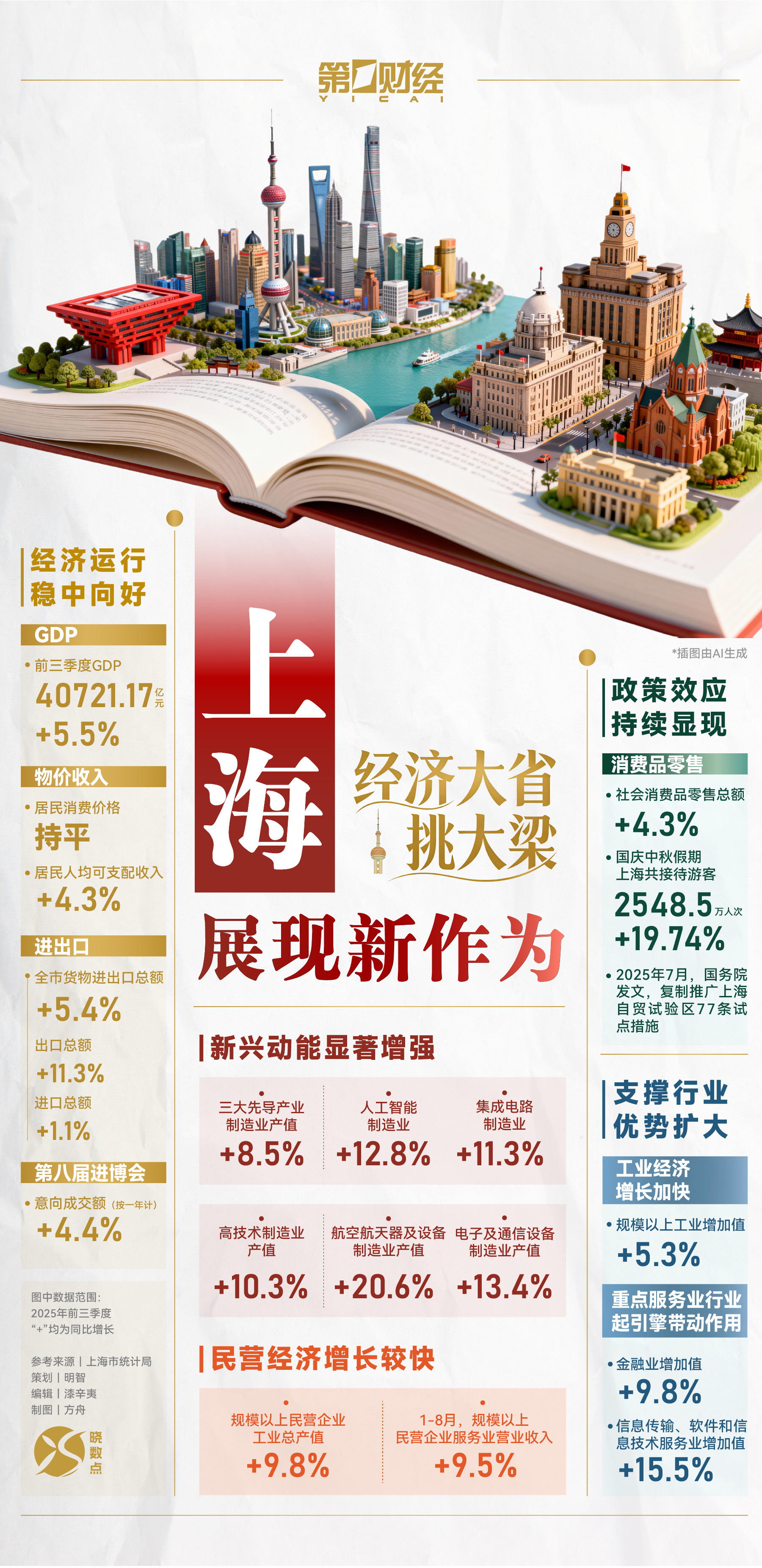
晓数点丨经济大省挑大梁,上海展现新作为
Di Yi Cai Jing· 2025-12-04 04:32
· 前三季度GDP 40721.17% +5.5% 一图看懂>> 人工智能 制造业 +12.8% 高技术制造业 产值 物价收入 进出口 全市货物进出口总额 +5.4% 出口总额 +11.3% 进口总额 +1.1% 第八届进博会 · 意向成交额(按一年计) +4.4% 图中数据范围: 2025年前三季度 "+"均为同比增长 FP/K 展现新作 | 新兴动能显著增强 三大先导产业 制造业产值 +8.5% +10.3% 航空航天器及设备 制造业产值 +20.6% ---- ----- · 居民消费价格 First · 居民人均可支配收入 +4.3% | 民营经济增长较快 参考来源|上海市统计局 策划 | 明智 编辑|漆辛夷 ● 制图|方舟 规模以上民营企业 1-8月, 民营企业服 工业总产值 nes 数 +9.8% +9 u ...

内需外需均有改善,11月制造业PMI回升至49.2%
Hua Xia Shi Bao· 2025-12-02 12:36
Core Viewpoint - The manufacturing Purchasing Managers' Index (PMI) in November shows a slight recovery to 49.2%, indicating improvements in both domestic and overseas demand, although it remains in a contraction zone for the eighth consecutive month [2][5]. Economic Indicators - The November PMI reflects improvements in 11 sub-indices, including new orders and production expectations, with a composite PMI output index at 49.7%, suggesting overall economic stability [2][5]. - The new orders index increased by 0.4 percentage points to 49.2%, while the production index rose to the critical point of 50.0%, indicating a return to expansion after a contraction [5][6]. Policy Impact - Recent government policies, including the introduction of 500 billion yuan in new policy financial tools and an additional 500 billion yuan in special bonds, are expected to stimulate domestic market demand and infrastructure investment [5][8]. - The positive outcomes from recent US-China trade talks have also contributed to a marginal increase in export orders, with the new export orders index rising by 1.7 percentage points to 47.6%, marking the largest increase in six months [5][6]. Sector Performance - High-tech manufacturing sectors continue to show strong demand, with their PMIs remaining above the critical point for ten consecutive months, while traditional energy-intensive industries are still in contraction [6]. - Specific industries such as agricultural processing and non-ferrous metal smelting are experiencing active demand, whereas sectors like petroleum and chemical manufacturing are lagging [6][7]. Price Trends - The main raw material price index rose by 1.1 percentage points to 53.6%, indicating ongoing expansion since the implementation of "anti-involution" policies [7]. - The Producer Price Index (PPI) is expected to see a slight month-on-month increase, although year-on-year comparisons may still reflect a decline due to higher base effects from the previous year [7][8]. Future Outlook - The construction PMI is anticipated to rise into the expansion zone as the effects of the new policy financial tools and special bonds materialize [8]. - The overall industrial product prices remain subdued, influenced by weak consumer demand and declining real estate investments, with the long-term effects of "anti-involution" policies on prices still under observation [8].

好评中国|聚力前行,为做好经济工作积蓄磅礴力量
Huan Qiu Wang· 2025-12-02 08:58
Group 1 - China's economy is maintaining a stable and progressive development trend, showcasing strong resilience and a bright outlook for the future [1] - In the first three quarters, the GDP grew by 5.2% year-on-year, accelerating by 0.2 and 0.4 percentage points compared to the previous year and the same period last year, respectively [1] - The urban unemployment rate averaged 5.2% in the first three quarters, remaining stable compared to the first half of the year [1] - The scale of foreign trade reached a historical high, with import and export growth rates gradually recovering, and foreign exchange reserves maintained above $3.3 trillion [1] Group 2 - The optimization of China's economic structure and the transition of growth drivers are progressing steadily, with significant advancements in high-quality development [2] - In the first three quarters, the added value of the equipment manufacturing industry and high-tech manufacturing industry accounted for 35.9% and 16.7% respectively, indicating a clear trend of industrial upgrading [2] - Investment in equipment and tools increased by 14% year-on-year, with emerging industries like lithium-ion battery manufacturing and new energy vehicles showing rapid growth [2] Group 3 - China's strong resilience is fundamental to its ability to cope with uncertainties and achieve stable long-term growth [3] - The first three quarters of stable growth laid a solid foundation, while new productive forces are being cultivated to create new growth points [3] - The macro policy space remains ample, providing continuous support for the economy, with positive factors accumulating as indicated by leading indicators and high-frequency data [3]
2025年11月PMI数据点评:制造业景气水平小幅回升,市场预期仍保持乐观
KAIYUAN SECURITIES· 2025-12-02 03:58
Group 1: Report Summary - The report is a commentary on the November 2025 PMI data, titled "Manufacturing Sentiment Improves Slightly, Market Expectations Remain Optimistic" [1] - The analysts are Chen Xi and Wang Shuaizhong, with contact information and certificate numbers provided [2] Group 2: PMI Data Overview - In November 2025, the manufacturing PMI was 49.2%, up 0.2 pct month-on-month and down 1.1 pct year-on-year; the non-manufacturing PMI was 49.5%, down 0.6 pct month-on-month; the composite PMI was 49.7%, down 0.3 pct month-on-month [2][3] Group 3: Manufacturing PMI Analysis - The manufacturing sentiment improved slightly due to export improvement, but it remained in the contraction range for eight consecutive months. New export orders rose 1.7 pct, on-hand orders rose 1.0 pct, and the production index rose 0.3 pct month-on-month [3] Group 4: Non-manufacturing PMI Analysis - The decline in the service PMI dragged the non-manufacturing PMI into the contraction range. In November, the service PMI was 49.5%, down 0.7 pct month-on-month and 0.6 pct year-on-year, the first time in 2025 to fall into the contraction range [4] - New export orders rose, but new orders fell, indicating insufficient domestic demand. Policy measures for new consumption scenarios and promoting domestic demand and consumption may be in the works [4] Group 5: Structural Highlights - High-tech manufacturing remained in expansion, with a PMI of 50.1%. Equipment manufacturing, consumer goods, and basic raw materials industries also had PMIs above the overall manufacturing level, despite some declines [5] - Price indices improved. The purchase price of major raw materials and the ex-factory price of manufacturing rose 1.1 pct and 0.7 pct respectively, and the input price and sales price of non-manufacturing rose 1.0 pct and 1.3 pct respectively [5] Group 6: Construction PMI - The construction PMI rose to 49.6%, up 0.5 pct month-on-month. The business activity expectation index was 57.9%, up 1.9 pct month-on-month, indicating improved confidence [6] Group 7: Market Expectations - Expectations for both manufacturing and non-manufacturing improved. The manufacturing production and operation activity expectation was 53.1%, up 0.3 pct, and the non-manufacturing business activity expectation was 56.2%, up 0.1 pct [6] Group 8: Bond Market View - Bond yields are expected to rise trendily as economic expectations are revised. For stock and bond allocation, the view is that economic growth may not decline significantly in H2 2025, structural issues like prices will improve, and the stock-bond allocation will continue to shift [7]
产需修复持续性有待观察——11月PMI点评
Changjiang Securities· 2025-12-01 23:30
1. Report Industry Investment Rating No relevant content provided. 2. Core View of the Report In November 2025, the manufacturing PMI showed a marginal improvement with synchronized recovery in production and demand and accelerated destocking, but the asymmetric recovery of raw material and finished product prices may still restrict corporate profit repair, and the sustainability of external demand contribution remains to be verified. The decline in service - sector sentiment indicates that the resilience of domestic demand also needs to be observed. The bond market has adjusted, and the impact of PMI data is expected to be limited. It is recommended to allocate 10 - year Treasury bonds with a taxable coupon yield above 1.8% when there are adjustments [2]. 3. Summary by Related Catalogs Manufacturing PMI - **Overall situation**: In November 2025, the manufacturing PMI was 49.2%, up 0.2 pct from the previous month, still seasonally weak but with marginal improvement. Production, procurement, and import indices on the supply - side increased, and new order and backlog order indices on the demand - side rose. Inventory destocking accelerated, and some predictive indicators showed improved supply - demand relationships [5][9]. - **External demand contribution**: The new export order index rose 1.7 pct to 47.6%, and the new export order indices of four major manufacturing industries and large, medium, and small enterprises all increased. However, the asymmetric recovery of raw material and finished product prices may pressure corporate profit repair [9]. - **Enterprise size and industry differences**: Small and medium - sized enterprises' sentiment improved, especially small enterprises which rose 2 pct to a nearly 6 - month high of 49.1%, while large enterprises' sentiment declined 0.6 pct to 49.3%. High - tech manufacturing with a high proportion of small and medium - sized enterprises remained in expansion, while the sentiment of equipment and consumer goods manufacturing declined, and their production sides may be stronger than the demand sides [9]. Non - manufacturing PMI - **Overall situation**: The non - manufacturing business activity index was 49.5% in November 2025, down 0.6 pct from the previous month, the first time below the boom - bust line since 2023. The service - sector sentiment was dragged down by factors such as the fading holiday effect, while the construction industry's sentiment improved [5][9]. - **Sub - item structure**: The inventory and new order indices of non - manufacturing declined, while the new export order index rose. The sales price and input price indices increased for two consecutive months. In the service sector, the financial industry and some new - energy industries showed good performance. The construction industry's business activity index increased, possibly boosted by financial activities and policy support [9]. Investment Suggestion The bond market has adjusted, and the impact of PMI data is expected to be limited. It is recommended to allocate 10 - year Treasury bonds with a taxable coupon yield above 1.8% when there are adjustments [2][9].
21评论丨供需两端改善 制造业内生修复动力增强
2 1 Shi Ji Jing Ji Bao Dao· 2025-12-01 22:40
Core Viewpoint - The November PMI data from the National Bureau of Statistics indicates a stabilization and recovery in the manufacturing sector, accumulation of momentum in the construction industry, and a short-term adjustment in the service sector, reflecting the resilience of the Chinese economy amid complex conditions and the effectiveness of previous growth stabilization policies [1] Group 1: Manufacturing Sector - The manufacturing PMI shows a slight recovery, with both the production index and new orders index rising, indicating positive signs of internal recovery [3] - High-tech manufacturing has remained in the expansion zone for ten consecutive months, and the recent improvement in high-energy-consuming industries is noteworthy [3] - The manufacturing production and business activity expectation index rose to 53.1%, indicating a high level of expansion and a gradual recovery in market confidence [3] - The PMI for small enterprises has seen a significant rebound, reaching a six-month high, reflecting the effectiveness of policies aimed at alleviating difficulties and supporting financing [3] Group 2: Demand Recovery - The recovery in demand is a key support for the improvement in PMI data, driven by positive changes in the external economic environment and the accumulation of domestic investment momentum [4] - Recent progress in China-U.S. trade negotiations has stabilized the external trade environment, leading to a notable increase in the new export orders index for November [4] - Domestic policies have shown positive signals for investment demand, with improvements in the construction business activity index and new orders index, particularly in infrastructure projects [4][5] Group 3: Price Indices and Profitability - Price indices have generally risen, indicating an optimization of supply-demand structure and a marginal improvement in the corporate profitability environment [5] - The increase in the purchasing price index and factory price index for manufacturing materials suggests a more balanced market supply-demand relationship [5] - The positive effects of capacity governance and structural optimization policies in key industries are beginning to alleviate excessive competition and pressure [5] Group 4: Structural Challenges - Despite positive signals, the PMI data reveals structural challenges and internal imbalances in the economic recovery process, with the service sector's business activity index falling below the critical point [6] - Sectors closely related to livelihood consumption, such as real estate and residential services, are experiencing weaker recovery in market demand [5] Group 5: Future Outlook - Future macro policies are expected to be more precise and coordinated, with continued support for manufacturing, especially small and high-tech enterprises [6] - Policies aimed at expanding domestic demand and promoting consumption are likely to intensify, focusing on integrating livelihood improvement with consumption promotion [6] - Fiscal spending is anticipated to shift further towards education, healthcare, and social security, enhancing residents' consumption capacity and willingness [6]
【权威解读】11月份制造业采购经理指数小幅回升 非制造业商务活动指数有所回落
中汽协会数据· 2025-12-01 12:41
Group 1: Manufacturing Purchasing Managers Index (PMI) - In November, the manufacturing PMI rose to 49.2%, indicating a slight improvement in economic conditions [2] - Both production index and new orders index improved, reaching 50.0% and 49.2% respectively, with production index crossing the critical point [2] - Small enterprises showed significant recovery with PMI at 49.1%, marking a 2.0 percentage point increase, the highest in six months [2][3] Group 2: Non-Manufacturing Business Activity Index - The non-manufacturing business activity index decreased to 49.5%, down 0.6 percentage points from the previous month, indicating a decline in non-manufacturing economic conditions [4] - The service industry index fell to 49.5%, influenced by the end of holiday effects, while certain sectors like railway transport and financial services remained robust [5] - The construction industry index improved to 49.6%, with a business activity expectation index of 57.9%, reflecting increased confidence in the sector [5] Group 3: Comprehensive PMI Output Index - The comprehensive PMI output index fell to 49.7%, a decrease of 0.3 percentage points, with manufacturing production index at 50.0% and non-manufacturing business activity index at 49.5% [6]

招商宏观:服务消费淡季回调明显
Sou Hu Cai Jing· 2025-12-01 08:58
Core Viewpoint - The manufacturing and construction PMIs showed slight recovery in November, yet remain below the expansion threshold, particularly the construction sector at its lowest level in five years, while the service sector experienced a notable decline during the off-peak consumption season [2][3] Manufacturing Sector - The manufacturing PMI rose by 0.2 to 49.2 in November, with most sub-indices improving, indicating a recovery in demand and stable production activities. The production index reached 50, up 0.3 from the previous month, and the new orders index increased to 49.2, up 0.4 [2] - The "two 500 billion" growth stabilization policies introduced at the end of September are expected to boost infrastructure and manufacturing investments in November. The new export orders index improved to 47.6, up 1.7, reflecting a stabilization in foreign trade due to the outcomes of US-China tariff negotiations [2] - The raw material purchasing price index rose to 53.6, up 1.1, while the factory price index increased to 48.2, up 0.7. However, the widening gap between raw material purchasing and finished product prices indicates a blockage in price transmission, which may hinder future profit recovery for enterprises [2] Service Sector - The service sector PMI fell to 49.5, down 0.7 from the previous month, marking the only decline among the three sectors. Following the concentrated release of consumer demand during the "Golden Week," various sectors such as retail, accommodation, transportation, and entertainment saw a decline due to high base effects from the previous month [3] - The financial sector's business activity index and new orders index both rose significantly, exceeding 55%, indicating strong performance. The service sector PMI expectation index remains at 55.9, suggesting potential recovery in consumer-related services in December due to year-end festivities and winter demand [3] Construction Sector - The construction PMI increased by 0.5 to 49.6, indicating some recovery in construction activities, yet it remains at the lowest level for the same period since 2019, reflecting ongoing weak demand in the industry [3] - The civil engineering business activity index remains above 52, indicating growth in civil engineering activities. The business expectation index improved by 1.9, suggesting that accelerated progress on key projects and the impact of policy financial tools may drive further growth in the construction sector [3] Future Outlook - In December, all sectors are expected to enter a year-end sprint phase, coinciding with important policy implementation and capital injection points. The anticipated demand increase from the "15th Five-Year Plan" and the backdrop of a phased US-China trade agreement may lead to a steady rise in the manufacturing PMI [4] - For the construction sector, an increase in the speed of capital injection related to infrastructure is expected in Q4, which may lay a solid foundation for growth stabilization [4] - The concentrated release of consumer-related demand during year-end festivities and winter is anticipated to boost the service sector in the coming month, with financial activities continuing to support the sector [4]
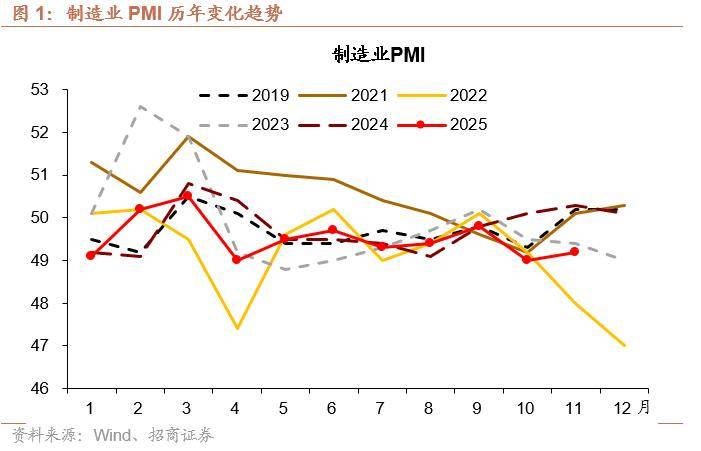
11月PMI数据点评:制造业PMI边际改善,复苏持续性仍需夯实
Mai Gao Zheng Quan· 2025-12-01 07:32
Manufacturing Sector - In November 2025, the Manufacturing PMI recorded 49.2%, a marginal increase of 0.2 percentage points from the previous month, indicating slight improvement in manufacturing activity[1] - The production index rose to 50.0%, reflecting stable production levels, with notable activity in food processing and non-ferrous metal industries[12] - New orders index increased by 0.4 percentage points to 49.2%, suggesting marginal recovery in market demand[12] - The raw material inventory index remained low at 47.3%, indicating cautious inventory strategies among enterprises[12] - Small enterprises' PMI rose to 49.1%, the highest in six months, while large enterprises' PMI fell to 49.3%, indicating greater pressure on larger firms[17] Non-Manufacturing Sector - The Non-Manufacturing PMI fell to 49.5%, a decrease of 0.6 percentage points from the previous month, reflecting a decline in service sector activity[2] - The new orders index for non-manufacturing recorded 45.7%, indicating weak demand in the sector[22] - The business activity expectation index rose to 56.2%, suggesting optimism about medium to long-term market prospects driven by policy support and seasonal factors[3] Economic Outlook - Overall, the manufacturing sector remains below the 50% threshold, indicating ongoing contraction and economic downward pressure[5] - Rising raw material prices may increase cost pressures for mid and small-sized enterprises, necessitating caution regarding rapid cost increases[5] - Future recovery in manufacturing is anticipated to be supported by year-end policy implementations and improved external trade conditions[5]