新能源车

Search documents
电车购置税补贴减半在即,这场兜底之战谁敢不打?
3 6 Ke· 2025-10-29 02:04
Core Viewpoint - The Chinese government will reduce the purchase tax exemption for new energy vehicles from full exemption to a 50% reduction starting January 1, 2026, increasing the cost for consumers by 15,000 yuan per vehicle [1] Group 1: Policy Changes - From 2026 to 2027, the purchase tax for new energy vehicles will be halved, impacting consumer costs significantly [1] - Various car manufacturers are introducing tax subsidy programs to mitigate the impact of the upcoming tax changes for consumers who place orders before the deadline [3][5] Group 2: Manufacturer Responses - Xiaomi, Li Auto, NIO, and other brands have announced cross-year purchase tax subsidy plans to ensure that customers do not incur additional costs due to policy changes [3][5] - NIO's new ES8 offers a purchase tax subsidy coupon for orders placed by December 31, 2025, to offset potential tax increases for delayed deliveries [5] Group 3: Market Dynamics - The competition among car manufacturers has intensified, leading to a "bottom-line battle" as they seek to secure orders before the tax changes take effect [2][12] - The market is experiencing a surge in demand, with a 35.4% increase in customer engagement in October compared to September, driven by the impending tax changes and other subsidies [10] Group 4: Consumer Behavior - Consumers are adjusting their purchasing decisions in light of the upcoming tax changes, leading to potential order cancellations if they perceive better options elsewhere [8][10] - The anxiety among consumers regarding tax changes is being addressed by manufacturers through various subsidy offers, aiming to maintain order volumes [8][12]


市场策略报告:AI头部加速全产业链垂直整合,资本、能源重要性凸显-20251028
Capital Securities· 2025-10-28 13:02
Core Insights - The report emphasizes the acceleration of vertical integration across the entire AI industry chain, highlighting the growing importance of capital and energy in the AI competition [1][14] - Major AI companies like OpenAI and Alibaba are rapidly integrating chips, cloud computing, data centers, large models, and downstream applications, leading to increased demand for computing power, electricity, and capital [14][15] - The report suggests a focus on the resonance between supply and demand sides to overcome market challenges and achieve a reversal from the current state of internal competition [18][19] Economic Overview - The GDP for Q3 2025 reached 35.45 trillion yuan, reflecting a year-on-year growth of 4.8%, indicating overall economic stability [10] - Industrial output in September 2025 saw a year-on-year increase of 6.5%, marking the highest growth rate for Q3 2025 [10] - Fixed asset investment showed a cumulative year-on-year decline of 0.5% as of September 2025, with real estate and infrastructure investments being significant drag factors [10] AI Industry Developments - OpenAI is establishing a full-stack AI ecosystem by synchronously advancing models, products, and computing power, including partnerships with major chip manufacturers and investments in data centers [14] - Alibaba is also positioning itself as a full-stack AI service provider, with developments in AI chips, cloud computing, and applications, including the launch of AI-powered smart glasses [15] - The report highlights the importance of domestic AI advancements in computing performance and energy efficiency, as well as the evolution of edge AI and embodied intelligence technologies [19] Investment Recommendations - The report advises focusing on emerging industries such as photovoltaics, lithium batteries, and new energy vehicles, particularly in the context of domestic substitution policies and technological advancements [19] - It suggests monitoring the AI industry chain, including chips, servers, liquid cooling, power supplies, and downstream AI applications, to identify potential investment opportunities [19] Market Performance - The North Exchange 50 Index increased by 2.74% during the week of October 20-24, 2025, indicating a rise in market activity [20][21] - The North Exchange 50 Index has shown a year-to-date increase of 41.84%, although it remains lower than other indices such as the Wind Micro Index and the ChiNext Index [22] - The report notes significant volatility in the North Exchange 50 Index compared to the overall market [23]

国信证券荀玉根:“买好的”看科技主线 “买得好”关注地产、券商、白酒消费
Zhi Tong Cai Jing· 2025-10-28 11:47
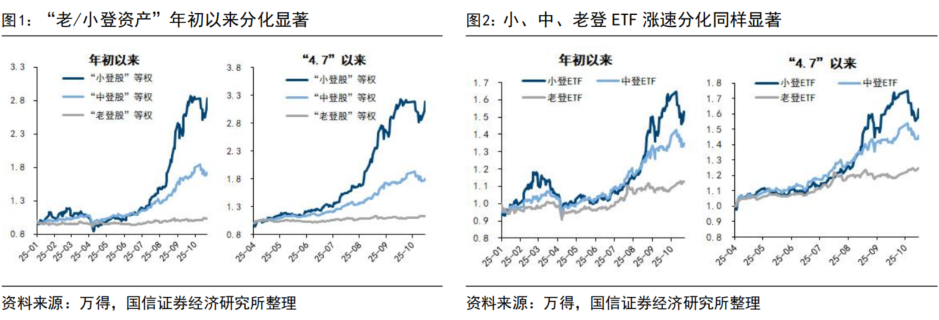
Core Viewpoint - The report by Guosen Securities highlights an extreme divergence between "old" and "new" assets in the market, emphasizing that high growth does not necessarily equate to high investment returns, and that finding fundamentally sound valuation opportunities can lead to significant returns [1][2]. Group 1: Performance Divergence - Since 2025, "small new stocks" have significantly outperformed "old stocks," with the "small new stock" portfolio rising by 183.8% compared to just 3.9% for "old stocks" [2]. - From April 7, 2025, "small new stocks" surged over 200%, while "old stocks" only increased by 13.6% [2]. - The "small new ETF" has risen by 53.1% since 2025, while the "old ETF" has only seen a 13.1% increase [2]. Group 2: Valuation and Market Activity - As of October 24, the PE ratio for "small new" sectors like electronics and computing is at the 99th percentile since 2019, while "old" sectors like real estate and liquor are at the 56th percentile [8]. - The trading volume for "small new" sectors has increased to 33%, while "old" sectors have dropped to below 2.8%, indicating a significant divergence in market activity [8]. Group 3: Investment Strategy - The report stresses the importance of not only selecting high-quality stocks ("buy good") but also ensuring they are purchased at favorable valuations ("buy well") to achieve high returns [11]. - Historical examples illustrate that higher growth does not guarantee better returns, as seen in the comparison between IBM and New Jersey Standard Oil from 1950 to 2003 [11][12]. - The banking sector has shown resilience, with a decline of only 3.9% compared to a 31.1% drop in the overall market, highlighting the potential for finding undervalued stocks with solid fundamentals [15]. Group 4: Market Trends and Seasonal Effects - The current market is characterized by a "small new stock" era, but there are seasonal opportunities for "old stocks," particularly in real estate, liquor, and brokerage sectors [20][29]. - Historical bull markets have shown that each cycle has a leading sector that aligns with prevailing economic trends, with AI and technology being the current focus [21]. - Seasonal effects suggest that value sectors may outperform in the fourth quarter, with historical data indicating a 64% success rate for value over growth during this period [23].

京东卖「国民好车」,顺手盘活汽车4S店
36氪· 2025-10-28 10:17
Core Insights - JD Auto is leveraging its strengths in traffic, technology, and supply chain to reshape the automotive industry, similar to other tech giants like Huawei and Xiaomi [1] - The launch of the "National Good Car" delivery center recruitment plan signifies JD Auto's ambition to establish a comprehensive service network across China [1][2] - JD Auto's strategy focuses on "helping car manufacturers sell good cars" without entering the vehicle manufacturing space [2][7] Group 1: Market Context and Challenges - The automotive e-commerce market has seen limited success, with the market size projected to grow from 0.86 trillion to 1.41 trillion from 2018 to 2024, but pure online sales have not disrupted traditional distribution models [4] - Key challenges include the inability to replace offline experiences such as test drives and inspections, with 56.3% of users abandoning online purchases due to lack of physical interaction [5] - Dealers face significant pressure, with inventory levels often exceeding the safety line, and e-commerce platforms struggling to manage logistics and production scheduling [5][6] Group 2: JD Auto's Strategic Positioning - JD Auto aims to fill the gap in the automotive market by providing a full-process infrastructure that integrates selection, purchase, and usage of vehicles [8] - With over 50% penetration of new energy vehicles, JD Auto sees an opportunity to expand its channel offerings, especially for new brands that require shared distribution channels [9] - JD's extensive user data and high-quality traffic allow it to negotiate exclusive sales agreements with manufacturers, enhancing its competitive edge [12][13] Group 3: Operational Model and Ecosystem - The "National Good Car" initiative includes plans to establish up to 10,000 delivery centers nationwide, creating a multi-brand automotive sales and service network [1][9] - JD Auto's model allows for a one-stop shopping experience, significantly reducing the time required for consumers to compare and purchase vehicles [15][17] - The integration of after-sales services into the purchasing process aims to alleviate consumer concerns about online car buying [24] Group 4: Industry Implications - JD Auto's approach is not merely about selling cars online but about creating a collaborative ecosystem that benefits manufacturers, dealers, and consumers alike [33] - The initiative is expected to provide a new operational model for struggling 4S dealerships, offering them a pathway to digital transformation and improved profitability [26][28] - By combining online and offline resources, JD Auto is positioned to lead the evolution of automotive sales channels, emphasizing the importance of service quality and efficiency [32][33]


特斯拉电动车销售创季度历史记录,新能源车ETF(159806)盘中涨超1.2%
Mei Ri Jing Ji Xin Wen· 2025-10-28 05:29
Core Insights - Tesla's electric vehicle sales have reached a quarterly historical record, with expectations for steady growth driven by upcoming model updates and new vehicle launches [1] - Strong overseas demand for energy storage is leading to a continuous increase in Tesla's installation capacity, supported by expanded production capacity that boosts supply chain demand [1] - As a comprehensive enterprise in the global electric vehicle and energy storage sectors, Tesla's expanding demand will benefit core domestic suppliers, enhancing their shipment volumes and profitability [1] Industry Analysis - The AIDC (Automated Identification and Data Capture) industry is experiencing high synergy in both domestic and international markets, with the entire AIDC supply chain set to benefit [1] - SST (Solid State Transformer) is highlighted as a potential end solution in NVIDIA's 800VDC white paper, showing strong growth expectations and positioning in the North American market for power equipment or energy storage companies, which have high safety margins and growth potential [1] Investment Vehicle Overview - The New Energy Vehicle ETF (159806) tracks the CS New Energy Vehicle Index (399976), which selects listed companies involved in key areas such as lithium batteries, motors, electronic controls, and vehicle manufacturing from the Shanghai and Shenzhen markets [1] - The CS New Energy Vehicle Index aims to comprehensively reflect the overall performance of listed companies related to the new energy vehicle industry chain, with a broad coverage of constituent stocks and a significant concentration in the new energy vehicle manufacturing sector, characterized by notable growth potential [1]

年轻人抄底烂尾车
投资界· 2025-10-28 03:15
Core Viewpoint - The article discusses the emerging trend of young consumers purchasing defunct electric vehicles at significantly reduced prices, highlighting a shift in perception towards the value of cars and the components that make them functional rather than brand loyalty [5][10][18]. Group 1: Market Dynamics - The market for defunct electric vehicles is evolving, with young consumers viewing these cars as opportunities to acquire high-performance vehicles at low prices, often disregarding the brand's viability [6][10]. - Vehicles like the Jiayue 07, originally priced at 229,900 yuan, are now being sold for as low as 148,000 yuan, indicating a drastic price drop and a shift in consumer interest towards value rather than brand reputation [8][13]. - The number of electric vehicle brands in China has drastically decreased from over 400 in 2018 to around 40 by 2025, with projections suggesting further consolidation in the coming years [24]. Group 2: Consumer Behavior - Young consumers are increasingly focused on the hardware and specifications of vehicles rather than the brand's longevity, often referring to their purchases as "hardware gambles" [9][15]. - The perception of cars has shifted from being a status symbol to a practical means of transportation, with consumers prioritizing essential functionalities over advanced features [18][19]. - The trend of modifying defunct vehicles for basic utility reflects a pragmatic approach to car ownership, where consumers are willing to forgo brand prestige for practical benefits [16][20]. Group 3: Industry Challenges - The article highlights the challenges faced by consumers of defunct electric vehicles, including the lack of parts and support from manufacturers, leading to the emergence of informal repair and parts markets [19][20]. - There is a call for the establishment of a "post-sale responsibility fund" to support consumers of defunct brands, indicating a need for systemic changes in the industry to protect consumers [20]. - The rapid technological advancements in the electric vehicle sector pose a risk for current defunct models becoming obsolete, as companies like CATL plan to produce solid-state batteries with significantly improved performance by 2027 [24].

31省公布出生率数据,保时捷前三季利润暴跌99% | 财经日日评
吴晓波频道· 2025-10-28 02:15
Group 1: US-China Economic Talks - The recent US-China economic talks in Kuala Lumpur led to preliminary consensus on key issues such as maritime logistics, shipbuilding, and agricultural trade, setting the stage for the upcoming leaders' meeting [2][3] - Both sides expressed a willingness to resolve differences through respectful dialogue and cooperation, indicating a potential thaw in trade tensions [2][3] Group 2: Industrial Profit Growth - In the first nine months of the year, China's industrial enterprises achieved a total profit of 53,732 billion yuan, a year-on-year increase of 3.2%, with September alone seeing a profit growth of 21.6% [4][5] - The profit growth was driven by strong export demand and a slight recovery in domestic demand, although the sustainability of this growth remains uncertain [5] Group 3: Birth Rate Statistics - In 2024, China's birth population is projected to be 9.54 million, an increase of 520,000 from the previous year, with a birth rate of 6.77‰, up by 0.38‰ [6][7] - The data indicates that western regions have higher birth rates compared to eastern regions, with Guangdong continuing to lead in total births [6][7] Group 4: New Energy Vehicle Subsidies - A competitive subsidy "war" among car manufacturers has emerged, with companies like Chery and Xiaomi offering to cover the additional purchase tax costs for consumers due to policy changes [8][9] - This trend reflects the intensifying market competition in the new energy vehicle sector, as companies aim to boost sales before the tax reduction policy takes effect [8][9] Group 5: Meituan's Bond Issuance - Meituan plans to launch its largest bond issuance to raise approximately $3 billion, primarily for refinancing existing debts and general operational needs [10][11] - The company faces significant competition in the food delivery sector, prompting the need for financial maneuvers to alleviate cash flow pressures [10][11] Group 6: Porsche's Profit Decline - Porsche reported a staggering 99% drop in profit for the first three quarters, with a loss of 9.66 billion euros in Q3, attributed to declining sales in China and Europe [12][13] - The company is undergoing organizational restructuring and plans to cut jobs as part of its strategy to cope with the challenges posed by the shift towards electric vehicles [12][13] Group 7: SoftBank's Investment in OpenAI - SoftBank has approved an additional $22.5 billion investment in OpenAI, part of a larger commitment to invest $40 billion, aiming to capitalize on OpenAI's potential IPO [14][15] - This investment comes amid SoftBank's ongoing financial challenges and highlights the risks associated with high-stakes investments in the tech sector [14][15] Group 8: Stock Market Performance - The stock market experienced a significant rise, with the Shanghai Composite Index reaching a ten-year high, driven by positive sentiment from US-China trade negotiations [16][17] - Despite the overall market uptrend, there were fluctuations, indicating cautious investor sentiment as the index approached the psychological 4000-point mark [16][17]

赛力斯打响新能源车IPO最后一枪?
Xin Lang Cai Jing· 2025-10-28 01:32
Core Viewpoint - The company Seres, previously known as Xiaokang, has transformed into a significant player in the new energy vehicle sector after becoming closely associated with Huawei, achieving profitability within a year after substantial losses [1][2]. Company Overview - Seres is set to launch its IPO in Hong Kong from October 27 to October 31, with a maximum offering price of HKD 131.50, which is lower than market expectations [2][3]. - The company has a robust backing with 23 cornerstone investors committing approximately USD 826 million (around HKD 642 million), accounting for about half of the total shares offered [9]. Financial Performance - Seres has invested nearly CNY 30 billion in R&D, aligning with national policies promoting high-end manufacturing and technology-driven growth [4]. - The company has shown a significant revenue increase of 305% year-on-year for 2024, although it experienced a slight decline in revenue in the first half of the year [6][10]. - The gross margin has improved dramatically from 7.2% to 26.5%, indicating strong profitability potential in the high-end vehicle market [6]. Market Position and Competition - The competitive landscape in the new energy vehicle sector is intense, with major players like BYD, Li Auto, and NIO posing significant challenges [5][6]. - Seres' sales have been inconsistent, and the company faces pressure to maintain growth, especially with the upcoming M8 model launch [7]. Future Prospects - The company is exploring opportunities beyond vehicles, including partnerships in robotics with ByteDance, although this segment currently has no revenue [8]. - The long-term outlook for Seres is optimistic, contingent on the overall growth of the new energy vehicle and embodied intelligence industries in China over the next five years [10].


本周很重要,向4000点冲刺
Sou Hu Cai Jing· 2025-10-27 05:37
Overall Market Trends - The Shanghai Composite Index has reached a new high for the year, approaching the 4000-point mark [1] - The Nikkei 225 Index has surpassed 50,000 points for the first time in history, and the South Korean KOSPI has also crossed 4,000 points [2] Key Influencing Factors - This week is termed a "super week," with three core themes influencing global markets: geopolitical issues, central bank decisions, and major corporate earnings [3] - The upcoming APEC summit and interactions between China and the U.S. are highly anticipated, with recent high-level economic discussions yielding positive outcomes [4][5] - The "super central bank week" is expected to see the Federal Reserve announce a rate decision, with a general market expectation of a 25 basis point rate cut [6][7] Corporate Earnings - The earnings season for major tech giants is underway, with five of the "Big Seven" tech companies set to report their results [8] - Companies like Microsoft, Meta, Google, Apple, and Amazon will focus on their AI business developments, which will significantly influence tech stock sentiment [9] Global Index Performance - Global stock indices have performed well, with many reaching new highs, particularly in the A-share market, which has rebounded strongly after previous trade tensions [11][12] - The Fear and Greed Index has rebounded to a neutral level of 66, indicating a shift in market sentiment [14] ETF Market Dynamics - The overall performance of ETFs has been positive, with many funds experiencing growth in both scale and net value, particularly in the tech sector [20] - The number of ETFs with over 20 billion in scale has increased to 47 [20] Sector and Theme Performance - The semiconductor and AI sectors have shown strength, driven by positive earnings reports and industry developments [25] - The coal sector is supported by seasonal demand and production increases, contributing to a favorable outlook [30] Fund Management Trends - Major fund companies are competing closely in ETF management scale, with notable growth from Huaxia and E Fund [31][32]
近期新能源市场信息
数说新能源· 2025-10-27 03:31
Battery - In contrast to previous years, the battery production in Q4 is expected to remain at a high level due to demand pull and raw material stocking. As of November, leading battery manufacturers are maintaining high capacity operations, while small and medium manufacturers may experience slight fluctuations. Recent cobalt price volatility has led to a slight increase in the price of ternary lithium batteries, while lithium iron phosphate batteries remain stable [1] New Energy Vehicles - In the first nine months of 2025, sales of new energy heavy trucks reached 138,714 units, representing a year-on-year increase of 183.30%. Currently, CATL has surpassed 700 chocolate battery swap stations nationwide, aiming for 1,000 stations by the end of 2025. Plans are in place to establish over 2,500 battery swap stations in more than 120 cities across the country by 2026. The Leap D19 model features an 80 kWh range extender with a pure electric range of 500 kilometers, utilizing CATL's "super hybrid battery" [2] Energy Storage - The energy storage cell market prices have remained generally stable this week. CATL announced its Q3 performance, achieving a total shipment of approximately 180 GWh for both power and energy storage batteries, with energy storage batteries accounting for about 20% and power batteries for about 80%. CATL's Jining base is expected to add over 100 GWh of energy storage capacity by 2026, utilizing 587 Ah large capacity cells. Tesla reported a record global energy storage installation of 12.5 GWh in Q3 2025, a 30% increase from 9.6 GWh in Q2. On October 21, Foxconn's energy storage brand "Fuchu Kenen" launched a 9.37 MWh container energy storage system, achieving an 87% improvement in energy density compared to conventional products [3]