
电新

Search documents
联合研究|组合推荐:长江研究2025年12月金股推荐
Changjiang Securities· 2025-11-30 09:14
Economic Outlook - Domestic policy expectations are rising in December, and the probability of a Federal Reserve rate cut is increasing, which may lead to improved external liquidity and a potential market rebound[5] - Key focus areas include the upcoming Central Economic Work Conference and the potential for a Federal Reserve rate cut, which could lead to a valuation recovery in the technology sector[5] Investment Strategy - The report emphasizes three main investment themes: 1. Technology growth sectors, particularly AI hardware like optical modules and semiconductors, as well as energy storage and lithium battery sectors[5] 2. Market hot spots such as robotics and innovative pharmaceuticals, which are expected to rebound[5] 3. Chemical industries benefiting from "anti-involution" policies that optimize supply-demand dynamics[5] Recommended Stocks - Key recommended sectors include metals, chemicals, electric new energy, machinery, banking, automotive, pharmaceuticals, electronics, communications, and media[5] - Specific stock recommendations include: - Metals: Huaxi Nonferrous (华锡有色) with an expected EPS growth from 1.04 in 2024 to 2.17 in 2027[28] - Chemicals: Yara International (亚钾国际) with an expected EPS growth from 1.02 in 2024 to 5.87 in 2027[28] - Electric New Energy: Slin (斯菱股份) with an expected EPS growth from 1.73 in 2024 to 2.21 in 2027[28] - Machinery: Hengli Hydraulic (恒立液压) with an expected EPS growth from 1.87 in 2024 to 3.18 in 2027[28] - Banking: Bank of Communications (交通银行) with a projected PB of 0.58x in 2025[18] - Automotive: Top Group (拓普集团) with an expected EPS growth from 1.78 in 2024 to 2.38 in 2027[28] - Pharmaceuticals: Junshi Biosciences (君实生物) with a projected EPS turnaround by 2027[28] - Electronics: Dongshan Precision (东山精密) with an expected EPS growth from 0.64 in 2024 to 3.72 in 2027[28] - Communications: Zhongji Xuchuang (中际旭创) with projected net profits of 105.19 billion in 2025[26] - Media: Kaiying Network (恺英网络) with a projected EPS growth from 0.76 in 2024 to 1.47 in 2027[28] Risk Factors - Economic recovery may fall short of expectations due to slow employment growth, declining corporate revenues, and reduced market demand[30] - Significant changes in individual stock fundamentals could adversely affect performance[30]





【申万宏源脱水研报】年度策略精粹
申万宏源研究· 2025-11-28 03:01
Group 1: High-end Manufacturing and Security - The defense industry is entering a new cycle driven by both domestic demand and external potential, focusing on information technology, intelligent equipment, and emerging fields like military trade and deep space economy [2] - The machinery sector is expected to undergo a value reassessment and technological empowerment, with a focus on robotics and autonomous driving, alongside a push for core technology breakthroughs [2] - The electric power and new energy sectors are witnessing a new growth cycle, with lithium battery storage demand surging and the photovoltaic market stabilizing [2] - The home appliance industry is focusing on policy subsidies, technological transformation, and overseas expansion, particularly in Southeast Asia and Latin America [2] - The automotive sector is experiencing rapid technological advancements in smart driving and hybrid technologies, with a focus on export opportunities and collaboration with tech companies [2] Group 2: Real Estate and Banking - The real estate market is stabilizing, with key cities expected to see price stabilization driven by household balance sheet recovery and supportive policies [3] - The banking sector is entering a new profit cycle, with stable interest margins supporting long-term profitability, and a focus on undervalued shares and quality city commercial banks [4] Group 3: Securities and Insurance - The securities industry is benefiting from wealth management trends, with a focus on stable earnings and international expansion as a long-term narrative [5] - The insurance sector is characterized by high elasticity, with investment-driven profit growth and a focus on regulatory compliance and risk management [6] Group 4: Construction and Chemicals - The construction industry is expected to stabilize with government debt management and new infrastructure projects, focusing on regional coordination and green development [10] - The chemical sector is entering a recovery phase, with a focus on high-quality enterprises and strategic investments in various chains [10][12] Group 5: Utilities and Environmental Protection - The utilities sector is seeing steady growth in electricity demand, with a focus on high-dividend investments in water and coal power [13] - The environmental protection sector is benefiting from policy adjustments and technological advancements, with a focus on improving profitability in water and waste management [16] Group 6: Capital Markets and Financial Innovation - The capital market is exploring new paths for empowering inclusive finance, focusing on small and micro-enterprise support and rural revitalization [21] - The green certificate market is expected to grow significantly, driven by policy support and increasing demand for renewable energy [22] Group 7: E-commerce and Retail - The retail sector is experiencing structural changes driven by AI, with a focus on rational competition and the globalization of Chinese brands [23] Group 8: Bonds and Financial Engineering - The convertible bond market is expected to see continued growth, driven by demand for fixed income and equity market expectations [25] - The quantitative investment sector is gaining traction, with a focus on unique strategies and the development of fixed income products [27]


中加基金固收周报︱国际市场压力加剧,市场继续走弱
Xin Lang Ji Jin· 2025-11-27 08:07
Market Overview - A-shares experienced a decline last week, with major indices showing reduced trading volume during the adjustment phase [2] - Among the 31 Shenwan first-level industries, banking, media, and food and beverage sectors performed relatively well [2] Macroeconomic Data Analysis - In September, the U.S. added 119,000 non-farm jobs, exceeding expectations of 51,000, although August's data was revised down from 22,000 to -4,000 [3] - The unemployment rate rose to 4.4%, slightly above expectations and previous values [3] - The strong non-farm data had already been factored into the market, leading to a slight increase in the probability of a rate cut in December to around 40% [3] - Future inflation data, such as PCE prices, will be critical for the Federal Reserve's December decision [3] Stock Market Strategy Outlook - The market showed wide fluctuations last week, with low trading volume and weak technical indicators [4] - The market's downward trend was anticipated, with several short-term negative macro factors, including geopolitical risks and concerns over AI giants' profitability [4] - Defensive dividend and cyclical sectors performed better in the short term, while the overall market is expected to remain volatile [4] - The long-term market structure is unlikely to change significantly, as the economic fundamentals and technology narratives remain stable [5] Long-term Perspective - The ongoing U.S.-China competition has established a clear baseline, with increasing skepticism about the U.S. government's governance and institutional credibility [6] - The RMB has appreciated against the USD amid uncertainties in the U.S. economic outlook and Fed rate cuts, potentially supporting China's equity market [6] - The trend towards long-term capital from public funds and insurance companies is expected to strengthen, with significant excess deposits in the market [6] - A focus on defensive dividend sectors is recommended, with attention to catalysts in certain industries [6]
固收、宏观周报:延迟的数据,推迟的降息-20251125
Shanghai Securities· 2025-11-25 10:39
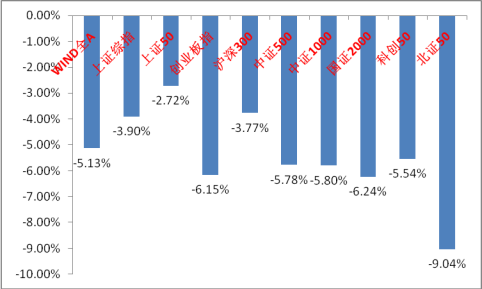
Report Summary 1. Report Industry Investment Rating No industry investment rating is provided in the report. 2. Core Viewpoints - In the past week (20251117 - 20251123), major stock indices in the US and Hong Kong, as well as A - shares in China, all declined. The Fed may turn dovish again, and there are investment opportunities in domestic equity markets and potential for gold prices to remain strong [2][3][15]. - The A - share market is likely to strengthen in subsequent oscillations, and attention can be paid to investment opportunities in sectors such as new energy, photovoltaic, coal, steel, chemical, chip, computing power, and artificial intelligence. The bond market will likely continue to oscillate within a narrow range, and gold prices are expected to maintain a strong oscillation [16]. 3. Summary by Related Content Stock Market Performance - US stock indices and the Hang Seng Index declined. The Nasdaq, S&P 500, and Dow Jones Industrial Average changed by - 2.74%, - 1.95%, and - 1.91% respectively, and the Nasdaq China Technology Index changed by - 6.06%. The Hang Seng Index changed by - 5.09% [2]. - A - shares tumbled across the board. The wind All - A Index changed by - 5.13%, and various indices such as CSI A100, CSI 300, etc., also declined [3]. - Blue - chip and growth sectors in the Shanghai and Shenzhen stock markets both dropped. The Shanghai Composite 50 and STAR Market 50 in Shanghai declined, and the Shenzhen Component 100 and ChiNext Index in Shenzhen also fell. The Beijing Stock Exchange 50 Index changed by - 9.04% [4]. - Among industries, banking, consumer goods, etc., had relatively small declines, and bond - related ETFs led the gains. All 30 CITIC industries fell, with banking, food and beverage, media, and home appliances having declines of less than 2.0% [5]. Bond Market Performance - The national debt market fluctuated within a narrow range. The 10 - year national debt futures main contract rose 0.01% compared to November 14, 2025, and the yield of the 10 - year active national debt bond increased by 0.26 BP [6]. - Fund prices mainly decreased, and the central bank made a net injection in open - market operations. As of November 21, 2025, R007 increased by 0.07 BP, and DR007 decreased by 2.65 BP. The central bank made a net injection of 554 billion yuan [7]. - The bond market leverage level decreased. The 5 - day average of inter - bank pledged repurchase volume decreased from 74.4 trillion yuan on November 14, 2025, to 72.9 trillion yuan on November 21, 2025 [9]. - US Treasury yields declined, and the yield curve shifted downward overall. As of November 21, 2025, the 10 - year US Treasury yield changed by - 8 BP to 4.06% [10]. Exchange Rate and Commodity Market Performance - The US dollar strengthened, and the RMB depreciated against the US dollar. The US dollar index rose 0.87%, and the exchange rates of the US dollar against the euro, pound, and yen all increased. The exchange rates of the US dollar against the offshore and on - shore RMB also rose [11]. - Gold prices showed a split between the international and domestic markets. The London gold spot price rose 0.04%, while the domestic Shanghai gold spot and futures prices fell by 2.49% and 2.79% respectively [12]. US Economic Data and Fed Expectations - In September, the number of new non - farm jobs in the US exceeded expectations, but the number of unemployed people increased significantly. The unemployment rate reached 4.4%, rising for the fourth consecutive month [13]. - The latest futures data shows that the probability of the Fed cutting interest rates in December is again higher than 50%. Due to the delayed release of non - farm data, the Fed's December decision will be based on September data [14].
泓德基金:受海外股市影响,近期国内股市波动加大
Xin Lang Ji Jin· 2025-11-24 09:35
Market Overview - The domestic equity market experienced a pullback due to multiple factors, with the technology sector seeing a larger decline compared to others. On November 21, significant single-day drops were noted, leading to investor divergence regarding future market trends. The Shanghai Composite Index, CSI 300, and SSE 50 fell by 3.9%, 3.8%, and 2.7% respectively, while the Hang Seng Index and Hang Seng Tech dropped by 5.1% and 7.2% respectively [1] External Factors - Following the surge of U.S. tech giants' market capitalization exceeding $5 trillion at the end of October, skepticism regarding an AI bubble has increased. Concerns focus on the substantial capital expenditures expected in AI infrastructure, which may not yield clear returns and face risks of rapid technological obsolescence. The inter-investment and high-value contracts among AI giants create a fragile business model that could collapse if any part fails. Despite positive third-quarter reports from U.S. tech giants, their stock prices showed volatility, raising investor concerns [2] Internal Factors - Recent macroeconomic data indicates that while the overall economy remains stable, there is a structural divergence with external demand outpacing internal demand. The real estate sector, which significantly impacts household assets, has been in a downward adjustment since Q4 2021, further affecting consumer confidence. Investors are questioning the sustainability of a market rally driven solely by liquidity without fundamental support. The financing balance, a key source of market growth, has fluctuated from CNY 1.8 trillion on June 20 to CNY 2.5 trillion by October 29, but has recently shown signs of decline [3] Investment Themes - The analysis suggests that AI and overseas expansion themes are central to the current market rally. AI encompasses both hardware and software dimensions, while overseas expansion includes both manufacturing and service sectors, reflecting the current macroeconomic trend of stronger external demand compared to internal demand [3] Bond Market - In the bond market, yields on government bonds showed mixed results while credit bond yields varied. Despite the central bank's net liquidity injection, the overall funding environment remains tight. Factors such as overseas influences suppressing interest rate cut expectations and domestic real estate stimulus rumors have pressured the bond market. The Shanghai Composite Index's 3.9% drop, particularly the largest since April 7, coincided with a decline in risk appetite, yet bond yields slightly increased due to limited positive factors and unclear monetary policy direction [4]
A股开盘速递 | 三大股指集体高开 CPO、光刻机、算力租赁等板块涨幅居前
智通财经网· 2025-11-24 01:44
A股三大股指集体高开,沪指涨0.36%,创业板指涨0.9%。盘面上,CPO、光刻机、算力租赁等板块涨 幅居前。 这种情况下,调仓的思路不是刻意回避AI叙事,而是尽量选择ROE底部向上趋势性抬升的品种,从这 个角度来看,适度增加对化工、有色、电新这样沉寂比较久且利润率和行业景气度在历史相对低点的行 业,是更优的选择。 另外,AI叙事只是影响了行情斜率而不是趋势。,如果未来AI叙事出现波动,的确可能会带来这些行 业剧烈的波动,但只要ROE能实现从底部开始向上的持续抬升,这种股价波动都只是短期的(相对于那 些ROE在历史高点的行业而言),不会威胁到本金安全。 招商证券:有色、钢铁、建材是当前可以考虑布局的顺周期选择 机构看后市 中信证券:适度增加化工、有色、电新的仓位,是更优的选择 10月以来市场波动加大,但择时成功率并不高,背后的原因是增量资金的底层结构在发生变化,稳健绝 对收益型资金持续入市在降低传统激进策略择时的有效性。当前真正重要的变量还是企业出海环境的稳 定性以及AI,涉及到的是中美关系以及AI基础设施的投建进程。当前不仅是TMT板块,连有色、化 工、电新的上涨直接或间接都受到AI叙事的影响,而这些板块占 ...
A股市场运行周报第68期:切勿盲目杀跌,盯券商、等待弹性重扩张-20251122
ZHESHANG SECURITIES· 2025-11-22 07:09
Core Insights - The report indicates that the A-share market has been affected by the weakened expectations of interest rate cuts by the Federal Reserve, leading to a significant decline in global stock markets, including A-shares [1][55] - It is suggested that the current market adjustment is necessary, and investors should not panic sell but rather wait for the market to stabilize, particularly focusing on the brokerage sector as a signal for potential recovery [1][5][57] - The report anticipates that the systemic "slow bull" market is not over and may enter a "second phase" after the current adjustments [1][4][56] Market Overview - Major indices in the A-share market experienced declines due to global market fluctuations, with the Shanghai Composite Index, Shanghai 50, and CSI 300 dropping by 3.90%, 2.72%, and 3.77% respectively [12][55] - The growth indices, such as the CSI 500 and CSI 1000, saw larger declines of 5.78% and 5.80%, while the ChiNext Index and STAR 50 fell by 6.15% and 5.54% respectively [12][55] - The Hong Kong market mirrored the A-share performance, with the Hang Seng Index and Hang Seng Tech Index declining by 5.09% and 7.18% [12][55] Sector Analysis - All major sectors in the market experienced declines, with the banking and food & beverage sectors showing relative resilience, falling only by 0.87% and 1.36% respectively [14][55] - Sectors that had previously performed well, such as electric new energy and basic chemicals, saw significant declines of 9.41% and 8.24% [14][55] - The report highlights that investors should differentiate between high and low-performing stocks, advising against holding onto recently broken high-position stocks while retaining positions in relatively low-position sectors like brokerage, consumption, and real estate [5][57] Market Sentiment - The average daily trading volume in the Shanghai and Shenzhen markets decreased to 1.85 trillion yuan, indicating a drop in market activity [23][55] - The main stock index futures contracts showed a negative basis, suggesting bearish sentiment among investors [23][55] Fund Flow - The margin trading balance slightly decreased to 2.48 trillion yuan, with a financing buy ratio of 10.11% [29][55] - The report notes that the medical ETF saw the highest net inflow of 2.8 billion yuan, while the banking ETF experienced the largest outflow of 13.9 billion yuan [29][55] Valuation Insights - The report indicates that the valuation levels of major indices have receded, with the current PE-TTM for the Shanghai Composite Index at 16.1, placing it at the 84.13 percentile [47][55] - The dynamic valuation model suggests that the current market indices are within a normal range, indicating potential for future recovery [50][55]
数据看盘四家实力游资激烈博弈五连板人气股 多路资金大笔抛售多氟多
Sou Hu Cai Jing· 2025-11-20 10:43
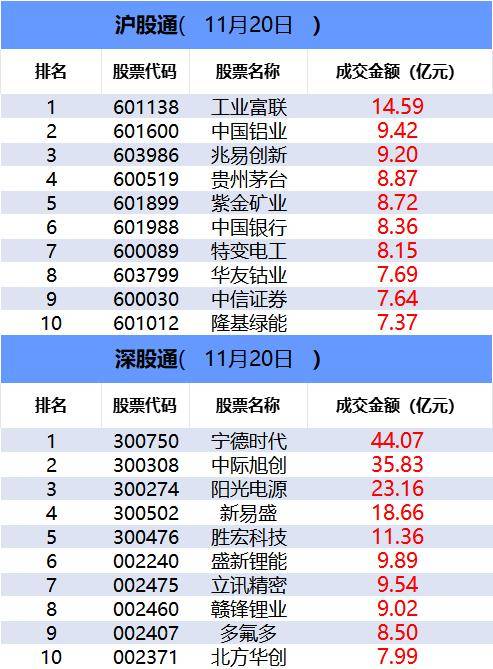
Trading Summary - The total trading volume of the Shanghai and Shenzhen Stock Connect today reached 1920.55 billion, with Industrial Fulian and CATL leading in trading volume for the Shanghai and Shenzhen markets respectively [1][2] - The banking sector saw the highest net inflow of funds, while the real estate ETF (512200) experienced a significant increase in trading volume, up 255% compared to the previous trading day [1][4][11] Top Stocks - In the Shanghai Stock Connect, the top traded stocks included Industrial Fulian (14.59 billion), China Aluminum (9.42 billion), and Zhaoyi Innovation (9.20 billion) [3] - In the Shenzhen Stock Connect, CATL topped the list with a trading volume of 44.07 billion, followed by Zhongji Xuchuang (35.83 billion) and Sunshine Power (23.16 billion) [3] Sector Performance - The banking sector led with a net inflow of 21.40 billion, followed by the communication sector with 10.34 billion [5] - The new energy sector faced the largest net outflow, totaling -93.72 billion [6] ETF Trading - The Hong Kong Securities ETF (513090) had the highest trading volume at 103.87 billion, with a 37.01% increase from the previous trading day [9][10] - The real estate ETF (512200) also saw a remarkable increase in trading volume, up 255.06% [11] Futures Positioning - In the futures market, both long and short positions increased across major contracts, with the IM contract seeing a significant increase in short positions [12] Stock Market Activity - Aerospace Development achieved a five-day consecutive rise, attracting significant buying interest from institutional investors [14] - Multi-Fluorine faced substantial selling pressure, with a net outflow of -13.65 billion [8]




中金刘刚最新研判:2026年“牛市”的下一步,是“信用扩张”的方向决定一切
Wind万得· 2025-11-18 22:52
Core Viewpoint - The core logic for global asset allocation in 2026 is to "follow the direction of credit expansion" [1] Group 1: Market Dynamics - The hidden mainline of the market is that the direction of credit expansion determines the strength of assets and the flow of funds [3] - The past couple of years in the Chinese market have been characterized by "excess liquidity" chasing "scarce return assets," with the recognized scarce assets changing over time [3] - Key factors for future market judgment include whether the liquidity environment has been damaged and whether scarce assets can expand to a broader range [3] Group 2: Credit Expansion and Investment Strategy - The investment strategy for 2026 is framed around the "credit cycle," focusing on three main subjects of credit expansion [4] - In the Chinese market, the credit cycle is expected to experience a slowdown, with structural prosperity still present despite challenges [6] - The U.S. market is seeing a gradual recovery in the credit cycle, supported by fiscal and monetary easing, with no significant signs of bubble formation in AI investments [7] Group 3: Structural Opportunities in China - The overall credit cycle in China is expected to face challenges starting from Q4, but structural prosperity remains effective [9] - The correlation between market performance and economic expectations has increased, indicating a need to focus on structural trends for excess returns [9] - Three structural directions for prosperity include AI-driven trends, capacity cycle reversals, and external demand mapping [9] Group 4: Hong Kong Market Outlook - The outlook for the Hong Kong market in 2026 suggests limited index space, with potential growth coming from structural changes or unexpected pullbacks rather than pure valuation expansion [11] - The Hang Seng Index's dynamic valuation is currently at 11.4 times, indicating a position above the historical average, suggesting that the market is not "cheap" [11] Group 5: Recommended Investment Directions - It is advisable to maintain a moderate allocation to dividend assets to counter the weakening of the overall credit cycle [13] - Key sectors to focus on include AI software and hardware, electric new energy, chemicals, home furnishings, and innovative pharmaceuticals, with careful consideration of valuation and crowding [13] - A potential rise in China's PPI towards the end of this year could provide an opportunity for market shifts towards cyclical and certain consumer sectors [14]

华泰证券:短期哑铃型配置强化,建议在成长、周期和红利中均衡配置
Mei Ri Jing Ji Xin Wen· 2025-11-18 00:30
Core Viewpoint - The overall industry prosperity index continued to decline in October, but the rate of decline has slowed down, with improvements noted in essential consumption, midstream manufacturing, and large financial sectors, while TMT (Technology, Media, and Telecommunications) shows continued differentiation [1] Group 1: Industry Insights - The essential consumption, midstream manufacturing, and large financial sectors are leading in terms of prosperity improvement [1] - The TMT sector continues to exhibit a mixed performance, indicating varying levels of recovery across different segments [1] Group 2: Investment Strategy - A short-term "barbell" strategy is recommended, suggesting a balanced allocation across growth, cyclical, and dividend stocks [1] - Focus on identifying sectors with improving prosperity that have a degree of sustainability, as well as those with relatively low valuations and chip positions [1] - Potential recovery opportunities are highlighted in sectors such as non-ferrous metals, chemicals, new energy, general automation, storage, military industry, and insurance [1] - Additionally, there is a suggestion to consider left-side positioning in certain consumer and service sectors, such as dairy products [1]
