
有色

Search documents
A股大跌!牛市根基仍在?投票预测下周一涨跌
Sou Hu Cai Jing· 2025-11-22 02:57
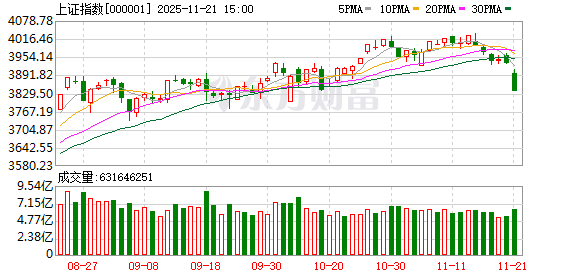
Market Overview - The A-share market experienced significant declines today, with the Shanghai Composite Index dropping by 2.45%, falling below 3900 points, and the Shenzhen Component Index down by 3.41%, while the ChiNext Index saw a decline of 4.02% [2] Reasons for the Decline - The sharp adjustment in the A-share market is attributed to a combination of overseas risk transmission and internal structural contradictions [2] - Concerns over an AI bubble have heightened global risk aversion, with Nvidia's better-than-expected earnings report failing to alleviate doubts about the sustainability of AI profits [3] - Expectations for a Federal Reserve interest rate cut have diminished, further disrupting the liquidity environment [4] - Mixed signals from U.S. non-farm payroll data and internal divisions within the Federal Reserve have reduced the probability of a rate cut in December, putting pressure on growth sector valuations [5] - Domestically, the market is in a policy and earnings vacuum, lacking new catalysts following the third-quarter report disclosures [6] Institutional Insights - Qianhai Kaiyuan Fund suggests that there may be further downside potential in the short term, possibly taking the form of a consolidation phase [7] - However, they maintain a long-term optimistic outlook, believing that the foundation for a new market high remains intact [8] - Yingda Securities echoes this sentiment, stating that while facing short-term adjustments and pressures, the logic for a mid-term positive outlook has not changed [9] - Caixin Securities shares a similar view, indicating that the recent market consolidation has been relatively sufficient, suggesting limited downside potential [10] Future Investment Opportunities - Bosera Fund recommends a balanced investment strategy, focusing on cyclical sectors benefiting from "anti-involution" policies and improved supply-demand dynamics, as well as quality tech growth stocks with sufficient valuation digestion [11][12] - They also emphasize the defensive value of dividend assets, suggesting that investors optimize their portfolio structure during market adjustments [13] - Guotai Fund highlights that technology growth will be the main driver, with new economies leading Chinese assets into a profit recovery cycle [14] - The acceleration of AI industrialization, the overseas expansion of advantageous industries, and "anti-involution" are identified as three key growth drivers [15] Recommendations for Ordinary Investors - Yongying Fund advises investors to remain calm and rational in the face of short-term volatility, avoiding overinterpretation of market adjustments [16][19] - It is recommended to adhere to a value investment philosophy, focusing on high-quality listed companies with long-term competitiveness and making investment decisions based on fundamental analysis [16] - For equity fund allocations, strategies such as diversified investments, regular contributions, and setting profit-taking and stop-loss targets are suggested to scientifically control risk exposure [17] - Investors should maintain a rational approach, adjusting asset allocation based on their circumstances and participating in the market with a long-term perspective [18]


A股大跌!火速解读
凤凰网财经· 2025-11-21 13:05
Core Viewpoint - The A-share market experienced a significant decline on November 21, with the Shanghai Composite Index dropping over 2%, attributed to multiple factors including external market pressures and internal structural contradictions [1][3][4]. Group 1: Factors Leading to A-share Adjustment - The decline in A-shares is influenced by both overseas risk transmission and internal structural issues, with concerns over the sustainability of AI profits and tightening liquidity impacting market sentiment [3][4]. - The market is currently in a policy and earnings vacuum, lacking new catalysts following the third-quarter report disclosures, leading to a shift in funds from high-growth sectors to lower-valued dividend assets [3][4]. - External market volatility, particularly from the U.S. stock market, has negatively impacted A-shares, with significant declines in major Asian indices following a drop in U.S. stocks [3][4]. Group 2: Long-term Market Outlook - Despite short-term fluctuations, the long-term outlook for A-shares remains optimistic, with expectations for new highs driven by stable domestic liquidity and confirmed earnings bottoms for listed companies [5][6]. - The fundamentals supporting a bull market have not changed, including improved confidence in handling U.S.-China risks and a shift in economic governance towards "anti-involution" strategies [6][7]. - The potential for a clearer path for U.S. interest rate cuts could alleviate external pressures on the market [5][6]. Group 3: Investment Strategy and Sector Focus - A balanced investment strategy is recommended, focusing on sectors benefiting from "anti-involution" policies, improving supply-demand dynamics, and high-quality tech growth stocks [7]. - The technology sector, particularly AI hardware, may require a period of consolidation due to high cumulative gains, while new economic drivers are expected to lead China into a profit recovery cycle [7][8]. - Investors are advised to maintain a rational approach to short-term volatility, emphasizing value investment in companies with long-term competitive advantages [6][7].

A股大跌 公募研判后市:“牛市的基础没有发生改变!”
Zhong Guo Ji Jin Bao· 2025-11-21 11:35
Core Viewpoint - A-shares experienced a significant decline on November 21, with the Shanghai Composite Index dropping over 2% and closing at a loss of 2.45% [2][3] Market Performance - The Shanghai Composite Index fell by 2.45%, the Shenzhen Component Index by 3.41%, and the ChiNext Index by 4.02% [2] - Sectors such as internet and media entertainment saw gains, while materials, chemicals, semiconductors, and electrical equipment faced declines [2] Causes of Decline - Multiple factors contributed to the adjustment in A-shares, including external risks and internal structural contradictions [3] - Concerns over an AI bubble and the impact of U.S. Federal Reserve interest rate expectations led to a decrease in global risk appetite [3][4] - The market is currently in a policy and earnings vacuum, lacking new catalysts following the third-quarter report disclosures [3] - The recent performance of the U.S. stock market, particularly the drop in major indices, negatively affected investor sentiment in the Asia-Pacific region, including A-shares [4] Future Outlook - Short-term market movements may continue to be volatile, but there is a long-term optimistic view on the potential for new highs in indices [5][6] - The domestic liquidity environment remains reasonably ample, and corporate earnings are gradually confirming a bottom [6] - The potential for a clearer path to interest rate cuts by the U.S. Federal Reserve could alleviate external pressures [6] Investment Strategy - A balanced investment strategy is recommended, focusing on sectors benefiting from "anti-involution," AI, and overseas expansion concepts [8] - Investors are advised to maintain a rational perspective on short-term fluctuations and adhere to value investment principles [7] - Emphasis on diversifying investments and setting stop-loss targets to manage risk exposure effectively [7]
日度策略参考-20251121
Guo Mao Qi Huo· 2025-11-21 06:19
Report Summary 1. Industry Investment Ratings - **Bullish**: PR, BR rubber [1] - **Bearish**: Stainless steel, asphalt, short - term corn, M05 of soybean meal, PVC, PP, some petrochemical products [1] - **Neutral (Oscillating)**: Index, Treasury bonds, copper, aluminum, zinc, nickel, stainless steel, precious metals, industrial silicon, polysilicon, lithium carbonate, rebar, iron ore, manganese silicon, silicon carbide, glass, pure alkali, coking coal, coke, cotton, pulp, logs, crude oil, fuel oil, short - term soybean oil, long - term tin [1] 2. Core Views - The current macro environment is in a relatively vacuum period. A - share lacks a clear upward trend, and trading volume remains low. Short - term market differences will be gradually digested during index fluctuations, waiting for new driving forces to push the index up [1]. - Asset shortage and weak economy are beneficial for bond futures, but the central bank's short - term interest rate risk warning restricts the upward movement [1]. - The Fed's December interest - rate cut expectation has cooled down, affecting the prices of various commodities, but different commodities have different responses based on their own fundamentals [1]. 3. Summary by Categories Equity and Bond Markets - **Index**: Short - term market differences will be digested during fluctuations, waiting for new driving forces for upward movement [1] - **Treasury Bonds**: Asset shortage and weak economy are favorable, but short - term interest rate risk warning restricts the rise [1] Commodity Markets - **Non - ferrous Metals**: The Fed's interest - rate cut expectation cooling affects prices. Copper price decline is limited; aluminum price fluctuates at a high level; zinc has support below; nickel price fluctuates downward; stainless steel needs to pay attention to production; tin is bullish in the long - term [1] - **Energy and Chemicals**: Crude oil is affected by OPEC+ production increase, geopolitical factors, and trade policies; asphalt is bearish; PR is bullish; BR rubber may rebound; PTA production declines; ethylene glycol is affected by multiple factors; PP and PVC are bearish; LPG fundamentals are stable [1] - **Agricultural Products**: New energy vehicle demand is strong, but lithium carbonate has upward pressure; cotton market is in a state of "support but no driver"; corn, soybean meal, and other grains have different price trends; pulp and logs have limited upward space; livestock products such as pigs have over - capacity issues [1] - **Building Materials and Metals**: Rebar and iron ore are affected by supply and demand and macro factors; coking coal and coke are affected by steel prices and supply - demand relationships; glass and pure alkali have limited upward space [1] - **Fuel and Oil Products**: Crude oil price fluctuates; fuel oil follows crude oil; asphalt is bearish; PR is bullish; BR rubber may rebound [1]
广发期货日评-20251121
Guang Fa Qi Huo· 2025-11-21 06:01
Report Summary 1. Report Industry Investment Rating No relevant information provided. 2. Core Viewpoints - Domestic stock index futures show resilience with volatility decreasing. After Q3 reports, A - shares are in repricing adjustment. Short - term fluctuations are common, and it's recommended to wait and see. Consider a bull spread of put options in case of a deep daily decline [2]. - Treasury bond futures had a differentiated performance yesterday. With limited driving forces, the bond market may continue to fluctuate narrowly. A range - trading strategy is recommended [2]. - Gold prices are oscillating between $4000 - $4200 due to mixed US non - farm data and cautious Fed officials. A double - selling strategy for out - of - the - money gold options can be considered. Silver follows gold's fluctuations, and short - term observation or light - position trading is advised [2]. - The EC (European line) container shipping index futures are in short - term decline. It's recommended to close short positions [2]. - Steel prices are expected to stabilize with improved apparent demand. Iron ore is oscillating, and a wait - and - see approach is recommended. For coking coal and coke, a bearish view is taken with specified price ranges [2]. - Copper prices are oscillating weakly as the probability of interest rate cuts decreases. For various non - ferrous metals, different trading strategies are recommended according to their price trends [2]. - In the new energy and chemical sectors, prices of many products such as polysilicon and PTA are oscillating. Different trading strategies are proposed based on their supply - demand situations [2]. - In the agricultural products sector, prices of products like soybean meal, palm oil, and sugar are showing different trends, and corresponding trading strategies are recommended [2]. 3. Summary by Related Catalogs Financial - **Stock Index Futures**: Domestic stock index futures are in a state of repricing adjustment. Short - term fluctuations are normal, and it's recommended to wait and see. A bull spread of put options can be considered in case of a deep daily decline [2]. - **Treasury Bond Futures**: The bond market may continue to fluctuate narrowly. A range - trading strategy is recommended [2]. - **Precious Metals**: Gold is in the $4000 - $4200 range, and a double - selling strategy for out - of - the - money options can be used. Silver follows gold, and short - term observation or light - position trading is advised [2]. Black - **Steel**: Steel prices are expected to stabilize with improved apparent demand [2]. - **Iron Ore**: Iron ore is oscillating. A wait - and - see approach is recommended with a reference range of 750 - 810 [2]. - **Coking Coal**: A bearish view is taken with a price range of 1050 - 1200 [2]. - **Coke**: A bearish view is taken with a price range of 1550 - 1700 [2]. Non - Ferrous Metals - **Copper**: Copper prices are oscillating weakly. The main reference range is 85000 - 86500 [2]. - **Other Non - Ferrous Metals**: Different trading strategies are recommended for various non - ferrous metals according to their price trends [2]. Energy and Chemical - **New Energy and Chemical Products**: Prices of products like polysilicon, PTA, and short - fiber are oscillating, and corresponding trading strategies are proposed based on supply - demand [2]. - **Other Chemical Products**: For products like LLDPE, PP, and PVC, different trading strategies are recommended according to their price trends and supply - demand situations [2]. Agricultural Products - **Soybean Meal**: Domestic soybean meal supply is abundant, and attention should be paid to the support around 3000 [2]. - **Palm Oil**: Palm oil prices are continuing to decline, and the main contract may reach 8900 in the short term [2]. - **Other Agricultural Products**: Different trading strategies are recommended for products like sugar, cotton, and eggs according to their price trends [2].
具有时间杠杆的“红利+”策略,必有一款适合你
点拾投资· 2025-11-21 02:06
Core Viewpoint - The article emphasizes the importance of dividend strategies in investment, highlighting their ability to provide stable returns and lower volatility compared to other investment options, especially in the context of changing market sentiments over the past decade [1][2]. Summary by Sections Dividend Strategy Overview - The dividend strategy has shown a cumulative increase of 150.71% over the past decade, significantly outperforming the CSI 300 total return index (41.73%) and the Wind All A index (42.88%) [1]. - The dividend strategy is considered suitable for family asset allocation as a foundational asset [1]. Value Investment Principles - Value investing focuses on long-term cash flow returns, as defined by Graham in "Security Analysis," emphasizing the importance of cash flow over the type of asset [3]. - Buffett's distinction between investors and speculators highlights the focus on cash flow generation and the quality of business models [3]. Indicators of Dividend Stocks - High dividend yield indicates a company's ability to generate consistent cash flow and suggests a strong business model with good governance [4]. - Historical data shows that companies like Philip Morris have provided substantial returns through consistent cash flow and dividends, even during industry downturns [4]. Suitable Indices for Long-term Investment - Three indices suitable for long-term investment include the National Value 100 Total Return Index, National Free Cash Flow Total Return Index, and CSI Dividend Total Return Index, all showing lower volatility and higher returns [10][18]. - The National Free Cash Flow Total Return Index has the highest annualized return of 16.8% over the past decade, while the CSI Dividend Total Return Index has the lowest volatility at 17.6% [11][12]. Investment Strategies - A balanced approach to investing in the three indices can optimize returns and reduce volatility, with a proposed "index allocation combination" yielding a 262% return over the past decade [20][22]. - Investors can customize their allocations based on the characteristics of each index, using the CSI Dividend Index for defensive positions and the National Free Cash Flow Index for growth opportunities [23][24]. ETF Recommendations - Recommended ETFs include the Value ETF tracking the National Value 100 Index, the Free Cash Flow ETF tracking the National Free Cash Flow Index, and the Dividend ETF tracking the CSI Dividend Index, all designed to align with value investing principles [27].

研究所晨会观点精萃:美国非农就业数据大超预期,全球风险偏好大幅下降-20251121
Dong Hai Qi Huo· 2025-11-21 01:24
1. Report Industry Investment Ratings - **Equities**: Short - term shock, short - term cautious and wait - and - see [2][3] - **Treasury Bonds**: Short - term shock, cautious long - position [2] - **Black Metals**: Short - term shock, short - term cautious and wait - and - see [2] - **Non - ferrous Metals**: Short - term shock, short - term cautious and wait - and - see [2] - **Energy and Chemicals**: Short - term shock, cautious and wait - and - see [2] - **Precious Metals**: Short - term shock, short - term cautious and wait - and - see, long - term buy on dips [2][3] 2. Core Views of the Report - Overseas, US employment data is better than expected, the Fed's interest - rate cut expectation further declines, and global risk appetite cools significantly. Domestically, China's October economic data slows down year - on - year and falls short of expectations, and the central bank restarts treasury bond trading operations to release liquidity. The short - term macro upward drive weakens, and the market focuses on domestic incremental stimulus policies, economic growth, and the Fed's monetary policy expectations [2]. - Different asset classes have different trends. Equities, treasury bonds, and various commodity sectors are mainly in a short - term shock state, and corresponding investment strategies are proposed [2]. 3. Summaries According to Relevant Catalogs Macro Finance - **Macro**: US September non - farm payrolls exceed expectations, the unemployment rate rises to a four - year high, and the Fed's interest - rate cut expectation further declines. China's October economic data slows down and falls short of expectations. The central bank releases liquidity, but the Fed's hawkish signals suppress global risk appetite. The short - term macro upward drive weakens, and equities are in short - term shock [2]. - **Equities**: Affected by sectors such as silicon energy, military, and coal, the domestic stock market falls. Due to weak economic data and the Fed's hawkish signals, the short - term macro upward drive weakens, and equities are in short - term shock. Short - term cautious and wait - and - see [3]. - **Precious Metals**: After the US non - farm payrolls exceed expectations, the prospect of a December interest - rate cut weakens, and precious metals prices weaken in the short term. They are in short - term shock, and the long - term upward pattern remains unchanged. Short - term cautious and wait - and - see, long - term buy on dips [3]. Black Metals - **Steel**: The steel spot and futures markets continue to weaken. Although demand improves slightly, supply increases, and the price has no room for a sharp decline or a significant rise in the short term. Treat it with an interval - shock mindset [4][5]. - **Iron Ore**: The iron ore spot and futures prices weaken slightly. The key factor determining the price is the decline process and the bottom - reaching time of hot - metal production. Short - term interval - shock [5]. - **Silicon Manganese/Silicon Iron**: The spot price of silicon iron falls, and that of silicon manganese remains flat. The futures prices are expected to continue interval - shock [6]. - **Soda Ash**: The supply decreases marginally due to some device overhauls, but the overall supply pressure remains. The demand for heavy soda is stable, and that for light soda recovers slightly. Short - term interval - shock, long - term bearish [7]. - **Glass**: The glass production remains stable, and the demand improves marginally. The downstream demand is still weak, and the inventory is high. Short - term weak operation [7]. Non - ferrous and New Energy - **Copper**: US copper inventories are at a historical high, and domestic refined - copper de - stocking is less than expected. The shutdown of an Indonesian copper mine supports the futures price. There is a risk of a downward break in the short term [8][9]. - **Aluminum**: The price of Shanghai aluminum falls slightly. Although the downstream replenishes inventory at low prices, the inventory is still high. The aluminum shortage is a false proposition, and the price may have a large correction. Short - term shock [9]. - **Tin**: The supply side recovers from overhauls, but the mine supply is tight. The demand side is weak in the peak season. The tin price is at a historical high, and the actual trading activity is insufficient. Short - and medium - term high - level interval - shock [10]. - **Lithium Carbonate**: The main contract of lithium carbonate rises. The exchange strengthens risk control. Short - term cautious long - position or wait - and - see [11]. - **Industrial Silicon**: The main contract of industrial silicon falls. Organic silicon monomer factories plan to jointly reduce emissions and support prices. Pay attention to the continuity of funds and buy on dips [12]. - **Polysilicon**: The main contract of polysilicon falls. There is a game between strong policy expectations and weak reality. Expected to be in a high - level interval - shock [13][14]. Energy and Chemicals - **Crude Oil**: If a peace agreement is reached between Ukraine and Russia and energy sanctions are lifted, Russian oil supply will return to the market. Due to better - than - expected non - farm data and a lower Fed interest - rate cut probability, oil prices are under pressure and will remain weakly volatile [15]. - **Asphalt**: Oil prices fall, and the asphalt futures price is approaching last year's low. The social and factory inventories are slightly decreasing, but the demand is in the off - season, and the over - supply pressure is high [15]. - **PX**: Crude oil falls slightly, and PX has limited upward momentum. It can still get some demand support. The short - term price is mainly driven by crude - oil cost fluctuations [16]. - **PTA**: Driven by PX, PTA rebounds, but the supply is still high, and the downstream demand is seasonally weakening. The long - term bearish pressure is large [16]. - **Ethylene Glycol**: The port inventory accumulates significantly, and the downstream demand is weakening. The price is expected to remain in low - level interval - shock [16]. - **Short - fiber**: Short - fiber rebounds slightly following the polyester sector, but the future pressure is large. The terminal orders are seasonally decreasing, and the inventory is slightly increasing [16]. Agricultural Products - **US Soybeans**: Commodity funds sell soybean futures contracts. The US faces competition from Brazilian soybeans in exports but has some support from sales to China. South American soybean planting is affected by floods [17][18]. - **Soybean and Rapeseed Meal**: The domestic soybean and soybean - meal supply and demand are loose, and the basis is weakly stable. With the weakening of US soybeans, soybean meal may have a phased correction [19]. - **Soybean and Rapeseed Oil**: US biodiesel policy disturbances increase, and the domestic soybean - oil supply is stronger than demand. The state's rapeseed - oil reserve sales are good, and the supply is becoming more abundant [19]. - **Palm Oil**: Malaysian palm - oil futures fall, and exports decline. The domestic palm - oil inventory increases, and the price is under pressure [20]. - **Corn**: The price of Northeast corn is stable. The inventory of ports, feed enterprises, and deep - processing enterprises is low, and the futures may repair the basis [20]. - **Hogs**: The live - hog price is stable and slightly strong. The market supply is in excess, and the futures price may continue to fall [20].
投顾晨报-20251120
Orient Securities· 2025-11-20 07:44
Market Strategy - The market is expected to remain in a volatile state, with a focus on defensive strategies and opportunities for low-cost positioning [2][8] - The Shanghai Composite Index is holding above 3900 points, while the Shenzhen Component and ChiNext are at the lower end of the fluctuation range since September [8] - The technology sector, particularly the STAR 50 index, has fallen below its fluctuation range, indicating a weak market sentiment [8] Industry Strategy - The food and beverage sector is anticipated to undergo a valuation recovery followed by performance-driven growth, with a focus on gradual positioning [3][8] - The sector has seen a significant improvement in capital returns, particularly in non-bank financials, steel, basic chemicals, machinery, and some consumer goods [8] - The consumer staples sector is showing signs of performance improvement, with expectations for a performance bottom in 2026 [8] Thematic Strategy - The non-ferrous metals sector is gaining a "growth" attribute due to financial characteristics and AI demand, enhancing its appeal [4][8] - Precious metals are becoming increasingly attractive as global central banks diversify reserves amid rising U.S. fiscal deficits and weakening dollar credit [8] - Industrial metals are benefiting from improved supply-demand dynamics and increased demand from AI and new energy sectors [8] - New demand drivers in small metals, particularly lithium, are expected to lead to a cyclical reversal [8]
股市防御配置,债市仍存分歧
Zhong Xin Qi Huo· 2025-11-20 06:22
1. Report Industry Investment Rating - Not provided in the content 2. Core Views of the Report - For stock index futures, adopt a defensive allocation strategy as the equity market is weak. The inflow of funds into the price - rising chain has slowed, and the market is in an observation period for sector rotation, with risk preference declining [1][7]. - For stock index options, continue to hold covered strategies for defense. The market sentiment has stabilized, but there is no clear capital main - line yet [2][8]. - For treasury bond futures, the market divergence is large. Although the bond market has been weak recently, it is expected to be oscillating with an upward bias towards the end of the year due to potential broad - money policies and strong allocation demand [3][8][9]. 3. Summary by Relevant Catalogs 3.1 Market Views 3.1.1 Stock Index Futures - **Data**: IF, IH, IC, IM's current - month contract basis points are - 4.89, - 2.35, - 6.15, 3.19 respectively, with a change of - 6.30, - 2.93, - 7.93, 5.69 points compared to the previous period. Their current - month and next - month contract spreads are 18.2, 7.0, 61.8, 92.2 points respectively, with a change of 3.6, 1.0, - 11.2, - 1.6 points. The total positions of IF, IH, IC, IM changed by - 6521, - 2454, - 5507, 2119 hands [7]. - **Logic**: The equity market was weak on Wednesday. The All - A index fell 0.3%, with over 4000 stocks declining. Only the price - rising chain and banks were resilient. The inflow of funds into the price - rising chain has slowed, and the market is in a sector rotation observation period, so a short - term cautious allocation is recommended [7]. - **Operation Suggestion**: Hold IM + Dividend [7]. 3.1.2 Stock Index Options - **Data**: The trading volume of each option variety increased slightly by 1.08%, with liquidity rising for 4 consecutive trading days but the increase rate slowing. The sentiment index (PCR of open interest) recovered, and the implied volatility decreased by an average of 1.14% [2][8]. - **Logic**: The equity index was oscillating and differentiated, with the Shanghai Composite Index rising 0.18%. Since there is no clear capital main - line, continue to hold covered strategies for defense [2][8]. - **Operation Suggestion**: Covered strategy [8]. 3.1.3 Treasury Bond Futures - **Data**: The trading volumes of T, TF, TS, TL's current - quarter contracts are 66875, 54572, 28995, 100953 hands respectively, with a 1 - day change of 3202, 2656, - 5728, 11525 hands. Their open interests are 154751, 88573, 42295, 80575 hands respectively, with a 1 - day change of - 22730, - 12266, - 7951, - 16039 hands. Other data such as spreads and basis points are also provided [8]. - **Logic**: Treasury bond futures closed down across the board. The bond market was weak but the decline was not large, mainly due to market divergence on the central bank's broad - money operations. Towards the end of the year, the bond market is expected to be oscillating with an upward bias [3][8][9]. - **Operation Suggestion**: Trend strategy: oscillating with an upward bias; Hedging strategy: pay attention to long - position substitution at high basis points; Basis strategy: pay attention to basis widening; Curve strategy: the curve may remain steep [9]. 3.2 Economic Calendar - It includes data such as the Eurozone's CPI in October (both month - on - month and year - on - year), the US retail sales and CPI in October, and the US unemployment - related data from September to November [10]. 3.3 Important Information and News Tracking - In October, the consumer market maintained a steady growth trend, with the total retail sales of consumer goods reaching 4.63 trillion yuan, a year - on - year increase of 2.9%. From January to October, the total retail sales of consumer goods were 41.2 trillion yuan, a 4.3% increase [11]. - The Ministry of Finance has pre - allocated part of the central - fiscal subsidy funds for urban affordable housing projects in 2026 [11]. 3.4 Derivatives Market Monitoring - **Stock Index Futures Data**: Not detailed in the provided content [12]. - **Stock Index Options Data**: Not detailed in the provided content [16]. - **Treasury Bond Futures Data**: Not detailed in the provided content [28].
英大证券晨会纪要-20251120
British Securities· 2025-11-20 01:42
Core Insights - The A-share market shows signs of short-term stabilization after a period of decline, with significant rebounds in sectors such as shipbuilding and precious metals, while large-cap stocks like banks and oil companies provide support [2][9][10] - The market's trading volume has decreased to below 1.8 trillion yuan, indicating reduced selling pressure and an increased holding sentiment among investors [2][9][10] - External negative factors are having a diminishing marginal effect on A-share sentiment, suggesting that the risks have been largely released [2][9][10] A-share Market Overview - On Wednesday, the A-share market experienced a collective rebound after three consecutive days of decline, with the Shanghai Composite Index closing at 3946.74 points, up 0.18% [5] - The trading volume for the day was 17,259 billion yuan, with individual stocks showing more declines than gains, reflecting a general market sentiment of caution [5][9] - Key sectors that performed well included shipbuilding, precious metals, and banking, while sectors like gas, cultural media, and automotive services saw declines [4][5] Sector Analysis - The shipbuilding and military sectors have shown strong performance, with a notable increase of 25.46% in the first half of 2025, driven by government support and geopolitical tensions [6][9] - Precious metals have also surged due to factors such as the onset of a Federal Reserve rate cut cycle, increased geopolitical tensions, and strong demand from central banks [7][8] - The report suggests that while the prices of precious metals are expected to remain high, investors should be cautious about chasing prices and consider short-term trading strategies [8] Investment Strategy - The report recommends a balanced investment approach, focusing on sectors with strong earnings support, including technology growth (semiconductors, AI themes), cyclical industries (solar, batteries, chemicals), and dividend stocks (banks, utilities) [3][9][10] - Investors are advised to adopt strategies such as high selling and low buying, or to focus on sectors that are expected to outperform in the current market environment [3][9]