有色金属

Search documents
每日投行/机构观点梳理(2026-02-25)
Jin Shi Shu Ju· 2026-02-26 01:52
Group 1: Gold Price Predictions - Morgan Stanley predicts that gold prices will reach $6,300 per ounce by the end of 2026, raising its long-term forecast to $4,500 per ounce [1] - UBS expects gold prices to touch $6,200 per ounce in the coming months, driven by persistent geopolitical risks and continued support from the Federal Reserve's easing policies [1] Group 2: Copper Price Outlook - Citigroup holds a bullish outlook on copper prices, forecasting a rise to $14,000 per ton in the next three months, citing strong demand from China and limited downside risks [1] - The bank maintains a long-term average copper price forecast of $13,000 per ton for 2026, indicating a balanced global copper market [1] Group 3: AI Impact on GDP - Goldman Sachs reports that AI contributed nearly zero to the U.S. GDP last year, as investments were offset by imports of chips and hardware [2] - A survey of executives revealed that while 70% of companies are actively using AI, about 80% believe it has not impacted employment or productivity [2] Group 4: S&P 500 Index Forecast - A Reuters survey indicates that the S&P 500 index is expected to rise nearly 10% to around 7,500 points by the end of 2026, supported by strong earnings and stable economic growth [3] - Despite a resilient market, risks remain from inflation trends, Federal Reserve policies, and geopolitical tensions [3] Group 5: Bond Market Dynamics - Societe Generale highlights that geopolitical uncertainties are supporting the safe-haven demand for bonds, leading to a dovish shift in market expectations for central bank interest rate paths [4] Group 6: UK Interest Rate Expectations - ING analysts suggest that the British pound may decline if the Bank of England's Governor hints at a potential rate cut in March [5][6] Group 7: Canadian Interest Rate Outlook - Scotiabank anticipates that the Bank of Canada will keep interest rates unchanged until the outcome of the USMCA negotiations becomes clearer [7] Group 8: Domestic AI Developments - CITIC Securities reports a surge in the usage of domestic AI models, indicating a significant expansion in AI inference demand and investment opportunities in domestic computing power [8] Group 9: Electronic Fabric Demand Cycle - CITIC Securities notes that the current electronic fabric demand cycle, driven by AI, may be more intense than previous storage cycles, with a projected 100% increase in demand for specialty fabrics by 2026 [9] Group 10: AI Industry Chain Outlook - CITIC JianTou expresses optimism about the AI industry chain, highlighting strong demand for computing power and the transition of large models towards monetization [10] Group 11: AIDC Growth and Equipment Demand - CITIC JianTou indicates that the AIDC construction phase will lead to significant demand for power capacity and related equipment, with a projected CAGR of 55% from 2025 to 2028 [11] Group 12: AIDC Sector Performance - Founder Securities anticipates continued high growth in the AIDC sector, driven by increased capital expenditures from leading internet companies and a growing demand for power equipment in the U.S. [12] Group 13: New Energy Vehicle Market Recovery - Galaxy Securities predicts a recovery in the automotive market post-Spring Festival, with several flagship new energy vehicle models set to launch, potentially boosting market demand [13]
后市A股震荡上行或是主基调,逢低关注“资源品+科技”双主线
British Securities· 2026-02-26 01:47
Market Overview - The report indicates that the A-share market is likely to maintain a fluctuating upward trend as policy guidance becomes clearer with the upcoming important meetings, particularly in the context of the "14th Five-Year Plan" [1][4][10] - The market is expected to focus on the sustainability of price increases in cyclical sectors and signs of stabilization in the technology sector [1][4][10] Sector Analysis Cyclical Sectors - The cyclical sectors, including chemicals and non-ferrous metals, have shown strong performance, driven by external factors such as geopolitical tensions and internal price increase logic [1][4][10] - The report highlights the potential for investment in cyclical sectors like oil and gas, coal, and construction materials, suggesting that economic recovery expectations could further boost these sectors [7][11] Technology Sector - The technology sector, particularly areas like AI computing and semiconductors, is noted for its long-term growth potential, with recommendations to consider investments once valuations return to reasonable levels [2][11] - Despite recent short-term profit-taking, the underlying industrial logic of the technology sector remains intact, with expectations for structural recovery opportunities as market sentiment stabilizes [1][10] Real Estate Sector - The real estate sector has seen a rebound due to supportive government policies aimed at stabilizing the market, including relaxed lending and purchasing restrictions [8] - The report suggests that the sector's recovery will continue, with a focus on companies with strong land reserves and those returning to stable growth [8] Investment Strategy - The report recommends a dual focus on "resource products + technology" as key investment themes, emphasizing the cyclical sectors benefiting from price increases and geopolitical catalysts, alongside technology sectors with long-term trends [2][11] - Investors are advised to consider opportunities in sectors like rare earths, which are critical for various industries, and to prioritize leading companies with resource advantages [6][11]
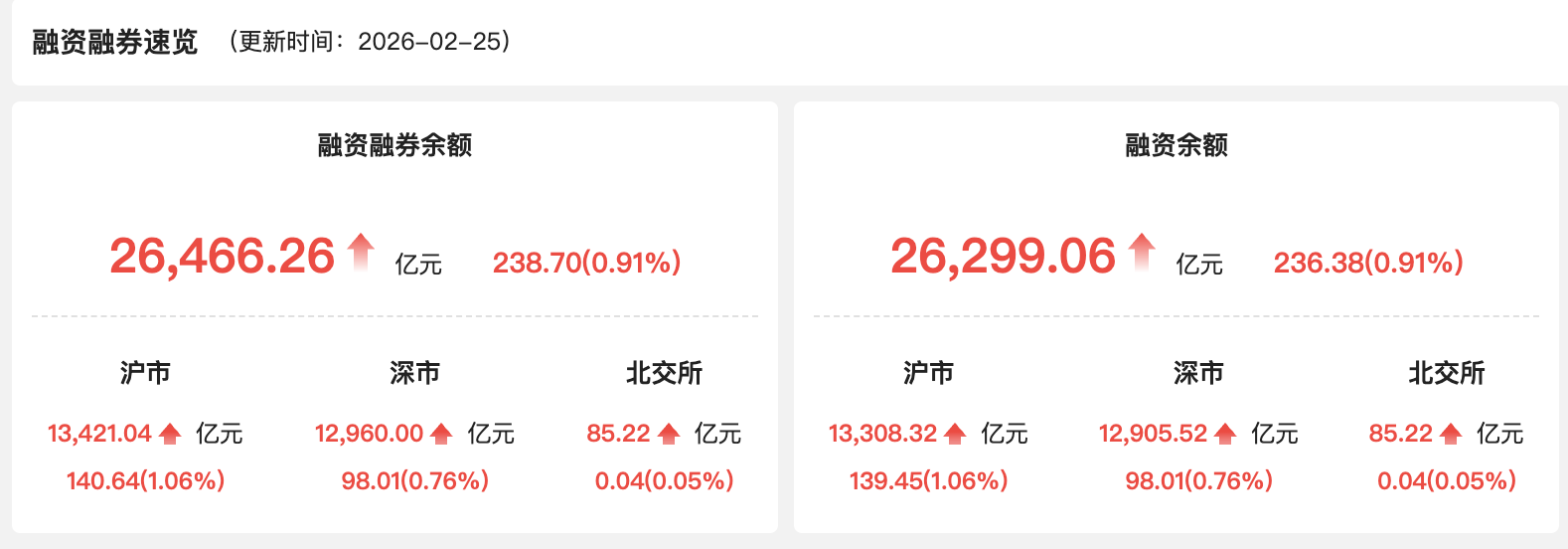
资金风向标 | 25日两融余额增加238.70亿元 电子行业获融资净买入居首
Sou Hu Cai Jing· 2026-02-26 01:45
Group 1 - The total margin balance of A-shares reached 26,466.26 billion yuan on February 25, increasing by 238.70 billion yuan from the previous trading day, accounting for 2.52% of the A-share circulating market value [1] - The margin trading volume on the same day was 2,474.56 billion yuan, an increase of 193.33 billion yuan from the previous trading day, representing 9.97% of the total A-share trading volume [1] Group 2 - Among the 31 primary industries in Shenwan, 25 industries experienced net financing inflows, with the electronics industry leading at a net inflow of 4.096 billion yuan [3] - Other industries with significant net financing inflows included non-ferrous metals, basic chemicals, defense and military industry, non-bank financials, and communications [3] Group 3 - A total of 76 stocks had net financing inflows exceeding 100 million yuan, with Northern Rare Earth leading at a net inflow of 936.31 million yuan [4] - Other notable stocks with high net financing inflows included Tongfu Microelectronics, Huagong Tech, Shenghong Technology, Feilihua, Baosteel, Yuntianhua, Zijin Mining, Yongtai Technology, and China Rare Earth [4]


有色套利早报-20260226
Yong An Qi Huo· 2026-02-26 01:44
Report Industry Investment Rating - Not provided Core Viewpoints - The report presents cross - market, cross - period, and cross - variety arbitrage tracking data for various non - ferrous metals including copper, zinc, aluminum, nickel, and lead on February 26, 2026 [1][3][4] Summary by Relevant Catalogs Cross - Market Arbitrage Tracking - **Copper**: Spot price in China is 102060, LME price is 13212, with a ratio of 7.63; March price in China is 103150, LME price is 13289, ratio 7.70. Spot import equilibrium ratio is 7.80, with a loss of - 801.62, and spot export profit is 225.88 [1] - **Zinc**: Spot price in China is 24530, LME price is 3373, ratio 7.27; March price in China is 24770, LME price is 3403, ratio 4.92. Spot import equilibrium ratio is 8.18, with a loss of - 3053.40 [1] - **Aluminum**: Spot price in China is 23380, LME price is 3109, ratio 7.52; March price in China is 23920, LME price is 3129, ratio 7.56. Spot import equilibrium ratio is 8.22, with a loss of - 2186.60 [1] - **Nickel**: Spot price in China is 139500, LME price is 17891, ratio 7.80. Spot import equilibrium ratio is 7.93, with a loss of - 1310.69 [1] - **Lead**: Spot price in China is 16550, LME price is 1921, ratio 8.60; March price in China is 16750, LME price is 1968, ratio 12.49. Spot import equilibrium ratio is 8.44, with a profit of 302.61 [3] Cross - Period Arbitrage Tracking - **Copper**: The spreads between the next month, March, April, May and the spot month are 1680, 1940, 2110, 2210 respectively, and the theoretical spreads are 608, 1114, 1629, 2144 [4] - **Zinc**: The spreads between the next month, March, April, May and the spot month are 80, 140, 170, 160 respectively, and the theoretical spreads are 226, 358, 490, 623 [4] - **Aluminum**: The spreads between the next month, March, April, May and the spot month are 385, 470, 525, 570 respectively, and the theoretical spreads are 228, 358, 487, 616 [4] - **Lead**: The spreads between the next month, March, April, May and the spot month are - 60, - 45, - 10, 10 respectively, and the theoretical spreads are 209, 314, 419, 524 [4] - **Nickel**: The spreads between the next month, March, April, May and the spot month are 4230, 4680, 4820, 4700 respectively [4] - **Tin**: The 5 - 1 spread is 820, and the theoretical spread is 8523 [4] Spot - Futures Arbitrage Tracking - **Copper**: The spreads between the current - month contract, next - month contract and the spot are - 785, 895 respectively, and the theoretical spreads are 323, 1131 [4] - **Zinc**: The spreads between the current - month contract, next - month contract and the spot are 100, 180 respectively, and the theoretical spreads are 187, 329 [4] - **Lead**: The spreads between the current - month contract, next - month contract and the spot are 245, 185 respectively, and the theoretical spreads are 182, 293 [5] Cross - Variety Arbitrage Tracking - The ratios of copper/zinc, copper/aluminum, copper/lead, aluminum/zinc, aluminum/lead, lead/zinc in Shanghai (triple - continuous) are 4.16, 4.31, 6.16, 0.97, 1.43, 0.68 respectively; in London (triple - continuous) are 3.93, 4.20, 6.69, 0.94, 1.59, 0.59 respectively [5]
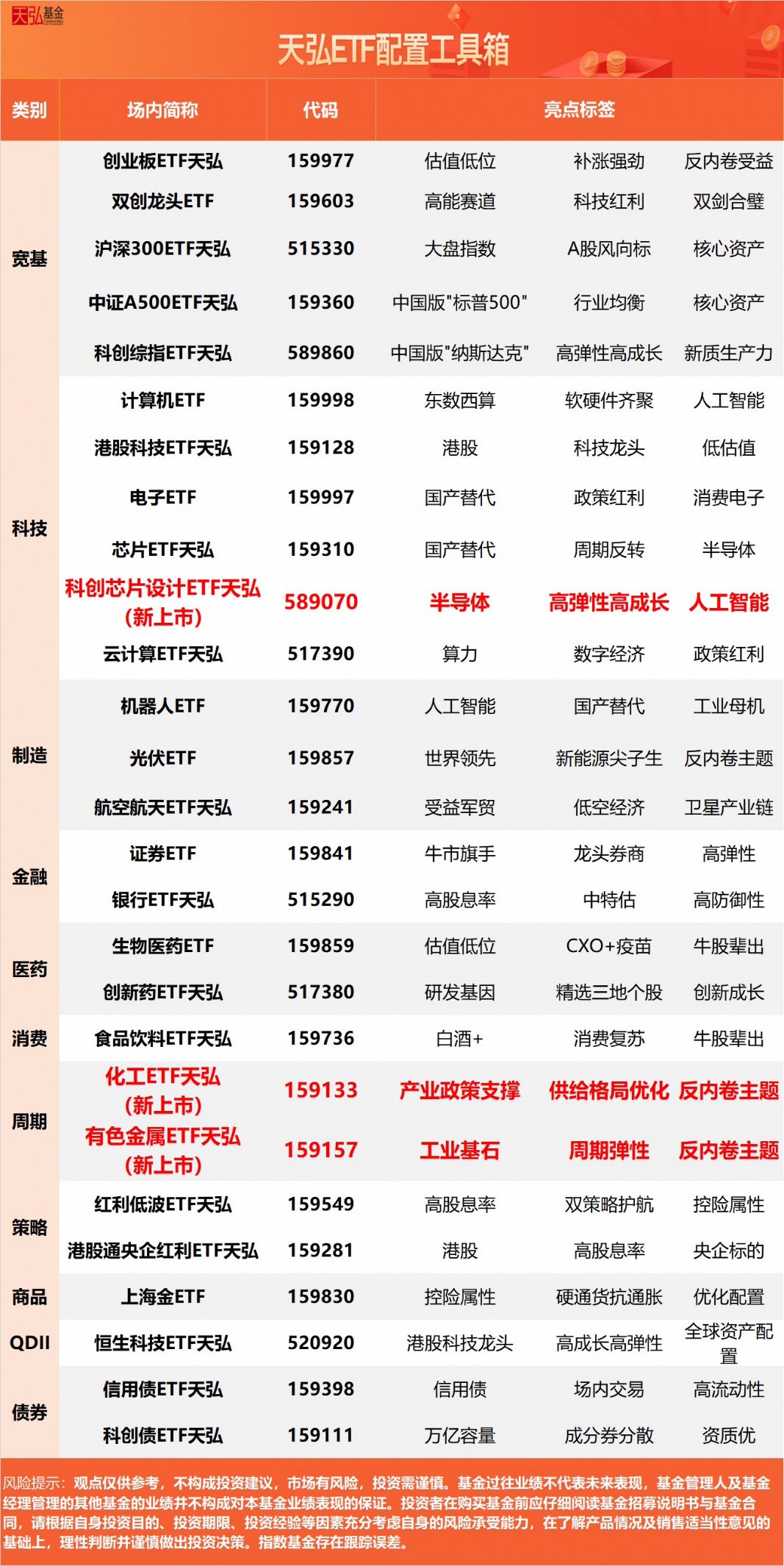
节后稀土价格普涨!有色金属ETF天弘(159157)连续8日“吸金”10.75亿元,标的指数今年涨幅超25%
Xin Lang Cai Jing· 2026-02-26 01:37
Core Viewpoint - The non-ferrous metal ETF Tianhong (159157) has shown strong market activity with a turnover of 14.43% and a transaction volume of 323 million yuan, reflecting a robust performance in the sector [1] Group 1: ETF Performance - As of February 25, the non-ferrous metal ETF Tianhong (159157) reached a new high with a total size of 2.265 billion yuan and 2.180 billion shares outstanding [2] - The ETF has experienced continuous net inflows over the past eight days, totaling 1.075 billion yuan, with a peak single-day inflow of 269 million yuan [2] Group 2: Product Highlights - Investors interested in the non-ferrous metal sector can consider the Tianhong non-ferrous metal ETF (159157), which closely tracks the industrial non-ferrous index (H11059.CSI) and selects 30 large-cap companies involved in copper, aluminum, rare earths, lead-zinc, and tungsten-molybdenum [3] - The combined weight of the copper and aluminum sectors exceeds 50%, emphasizing the core focus of the industrial non-ferrous index [3] Group 3: Market Trends - On February 25, the rare earth sector saw significant gains, with Northern Rare Earth hitting the daily limit. Prices for various rare earth products have increased post-holiday, with notable price rises for praseodymium-neodymium oxide and other metals [4]
研究所日报-20260226
Yintai Securities· 2026-02-26 01:34
Market Overview - Year-to-date, stock ETFs have shown a net outflow of 187.3 billion yuan as of February 24, 2026[2] - The total return of the Wind All A-Share Index is 6.53% year-to-date, despite significant ETF outflows, indicating a shift in market sentiment[2] International Developments - German Chancellor Friedrich Merz visited China from February 25 to 26, accompanied by a high-level delegation of 30 representatives from the German business sector[3] - The U.S. Trade Representative, Katherine Tai, indicated ongoing investigations into China's compliance with the Phase One trade agreement, suggesting potential tariff measures[3] Stock Market Performance - On February 25, the Shanghai Composite Index rose by 0.72%, while the Shenzhen Component Index increased by 1.29%, with total trading volume reaching 24,625.48 billion yuan, an increase of 2,604.86 billion yuan from the previous trading day[4] - The ChiNext Index rose by 1.41%, and the STAR 50 Index increased by 0.54%[4] Bond Market Insights - The yield on the 10-year government bond is 1.8195%, with a change of +1.42 basis points[5] - The average rates for R001 and R007 in the interbank market were 1.4652% and 1.5869%, respectively[5] Sector Performance - The top-performing sectors included steel (4.69%), non-ferrous metals (3.48%), and building materials (2.75%), while banking and media sectors saw declines of 0.46% and 1.15%, respectively[5]
铜冠金源期货商品日报-20260226
Tong Guan Jin Yuan Qi Huo· 2026-02-26 01:34
1. Report Industry Investment Rating No relevant content provided. 2. Core Views of the Report - Overseas, on February 20, the US Supreme Court ruled that Trump's practice of imposing tariffs globally under the IEEPA was invalid. Trump then imposed a 10% tariff under Section 122 and raised it to 15%, while launching multiple trade investigations. The US Q4 2025 real GDP initial annualized growth was 1.4%, significantly lower than the market expectation of 2.8% and the previous value of 4.4%. The market risk appetite was weak, with precious metals strong, industrial metals and US stocks under pressure, and the 10Y US Treasury yield falling to 4.04%. [2] - Domestically, during the Spring Festival, the passenger flow and consumption data were generally positive. The national Spring Festival travel cross - regional passenger transport reached a record high, and holiday consumption increased steadily. In February, it was an economic data and policy vacuum period, and the market focus might shift to the economic situation at the beginning of the year and the policy expectations of the Two Sessions in early March. [3] - For precious metals, the uncertainty of US tariffs increased, and gold and silver prices strengthened. The inflation in the US showed sticky characteristics, and the Fed's internal policy differences were significant, suppressing the market's rapid interest - rate cut expectations. Trump's confrontation with the Supreme Court added uncertainty, and it was expected that gold prices would continue to be volatile and strong, while silver prices would maintain high volatility. [4][5] - For copper, although the US Supreme Court's ruling on tariffs did not directly affect copper, Trump's tariff increase and geopolitical factors led to an increase in market risk aversion. The reduction of future production expectations of key mines and the potential mismatch of global inventories were expected to limit the adjustment space of copper prices, and copper prices might continue to rebound in the short term. [6][7] - For aluminum, the LME aluminum price fluctuated narrowly during the Spring Festival. The macro - environment was neutral to positive. In the short term, the weak supply - demand seasonality might suppress the aluminum price, but the medium - to - long - term outlook was positive due to factors such as expected Fed easing, potential production cuts in Mozambique, and consumption growth. [8][9] - For zinc, the macro - environment was uncertain, and the re - emergence of AI concerns put pressure on the market. The unclear situation in the Middle East might affect raw material supply, but the Spring Festival inventory accumulation was a pressure. It was expected that the Shanghai zinc would be under pressure. [10][11] - For lead, the increase in LME inventory, the rebound of the US dollar, and the lack of demand during the Spring Festival put pressure on the lead price. It was expected that the Shanghai lead would be under pressure and volatile after opening. [12] - For tin, the US tariff policy and the uncertainty of the US - Iran nuclear negotiation added macro - variables. The Spring Festival inventory accumulation and slow recovery of downstream demand were pressures, but the slow recovery of tin ore supply in Myanmar and Indonesia's resource protection policy supported the price. It was expected that the Shanghai tin would fluctuate after the holiday. [13][14] - For steel products, during the holiday, the steel mills maintained production, and the inventory accumulated. The daily inventory accumulation rate of rebar during the Spring Festival was the lowest in the past five years. It was expected that the inventory inflection point would appear in about 4 weeks, and the steel prices would oscillate at a low level in the short term. [15] - For iron ore, during the holiday, the overseas iron ore supply increased, while the demand was weak. It was expected that the iron ore price would oscillate weakly in the short term. [16] - For coking coal and coke, during the Spring Festival, the coking coal market was in a "rest period" with weak supply and demand, and the prices were expected to oscillate in the short term. [17] - For soybean meal and rapeseed meal, during the Spring Festival, the CBOT US soybeans oscillated. The new - season US soybean planting area was expected to increase, and the soybean crushing demand was good. It was expected that the Dalian soybean meal would oscillate in the short term. [18][20] - For palm oil, during the Spring Festival, the BMD Malaysian palm oil and CBOT US soybean oil prices rose. The production of Malaysian palm oil decreased in mid - and early February, and the export demand decline narrowed slightly. It was expected that the palm oil would stop falling and oscillate in the short term. [21][22] 3. Summary by Relevant Catalogs 3.1 Metal Main Varieties Yesterday's Trading Data - The trading data of various metal futures contracts are provided, including closing prices, price changes, price change percentages, trading volumes, and open interests. For example, SHFE copper closed at 100380 yuan/ton with no change, LME copper closed at 12901 dollars/ton with a 0.76% decline. [23] 3.2 Industry Data Perspective - Copper: The SHFE copper main contract price decreased from 101560 yuan/ton on February 10 to 100380 yuan/ton on February 13. The LME copper price decreased from 13000 dollars/ton to 12901 dollars/ton. The LME copper inventory increased by 6675 tons. [24] - Nickel: The LME nickel 3 - month contract price decreased from 17435 dollars/ton on February 10 to 17285 dollars/ton on February 13. The SHFE nickel warehouse receipts increased by 431. [24] - Zinc: The LME zinc price decreased from 3378 dollars/ton on February 10 to 3345.5 dollars/ton on February 13. The LME zinc inventory decreased by 25 tons. [27] - Lead: The LME lead price decreased from 1966.5 dollars/ton on February 10 to 1952 dollars/ton on February 13. The LME lead inventory decreased by 800 tons. [27] - Aluminum: The LME aluminum 3 - month contract price decreased from 3105.5 dollars/ton on February 10 to 3091 dollars/ton on February 13. The LME aluminum inventory decreased by 2000 tons. [27] - Alumina: The SHFE alumina main contract price increased from 2808 yuan/ton on February 10 to 2841 yuan/ton on February 13. [27] - Tin: The LME tin price increased from 46740 dollars/ton on February 10 to 47370 dollars/ton on February 13. The LME tin inventory increased by 15 tons. [27] - Precious metals: The COMEX gold price increased by 2.30% to 5247.90 dollars/ounce, and the COMEX silver price increased by 4.06% to 88.00 dollars/ounce. [23] - Steel products: The SHFE rebar and hot - rolled coil prices remained unchanged. The DCE iron ore price remained unchanged at 746.0 yuan/ton. [23] - Coking coal and coke: The DCE coking coal and coke prices remained unchanged at 1121.0 yuan/ton and 1682.0 yuan/ton respectively. [23] - Agricultural products: The CBOT soybean price decreased by 0.30% to 1150.3 dollars/ton. The DCE soybean meal and CZCE rapeseed meal data were not available. [23]
避险情绪持续发酵,铂钯?幅
Zhong Xin Qi Huo· 2026-02-26 00:39
Report Summary 1. Report Industry Investment Rating No information provided. 2. Core Views - On February 25, 2026, the platinum and palladium prices on the Guangzhou Futures Exchange rose significantly. The platinum main contract rose 7.03% to 586.0 yuan/gram, and the palladium main contract rose 4.50% to 457.95 yuan/gram. The uncertainty of US tariffs and the unclear situation in the US-Iran relationship led to the continuous fermentation of market risk - aversion sentiment, driving up the prices of platinum and palladium [3]. 3. Summary by Related Contents Platinum - **Main Logic**: The US Supreme Court's ruling on February 20 that the US President has no authority to impose large - scale tariffs under the International Emergency Economic Powers Act, along with the escalating US - Iran tensions, has increased market risk - aversion sentiment. Zimbabwe's suspension of all raw ore and lithium concentrate exports may increase short - term supply concerns, further boosting platinum prices. However, since Zimbabwe mainly exports platinum and palladium in unforged or semi - manufactured forms rather than raw ore, the policy is expected to have little impact on the actual supply of platinum - group metals. In the long run, the US is still in an interest - rate cutting cycle, and the weakening of the US dollar's credit due to the damage to the Fed's independence and the loosening of the global political and economic order is conducive to the long - term release of platinum price elasticity [4]. - **Outlook**: The price of platinum is expected to be volatile and strong in the medium and long term, considering the healthy supply - demand fundamentals and positive macro expectations [4]. Palladium - **Main Logic**: There is continuous uncertainty on the supply side of palladium. On February 10, the US Department of Commerce issued a preliminary anti - dumping ruling on unforged palladium imported from Russia, with a tariff rate of 132.83%. The market's expectation of palladium tariffs has resurfaced, and Europe is also considering a new round of sanctions on Russian - produced palladium. The supply disruption continues, and the tight spot market supports the price. On the demand side, palladium still faces structural pressure. In general, although the long - term supply and demand is expected to be loose, the short - term spot shortage and the Fed's interest - rate cutting expectation provide clear support for the price [5]. - **Outlook**: The price of palladium is expected to be volatile and strong in the medium and long term, due to the spot shortage and the improvement of the macro - environment [5]. Index Information - **Special Indexes**: On February 25, 2026, the commodity index was 2431.43, up 0.56%; the commodity 20 index was 2783.62, up 0.64%; the industrial products index was 2314.55, up 0.63% [52]. - **Sector Index - Non - ferrous Metals Index**: On February 25, 2026, the non - ferrous metals index was 2710.08. The daily increase was 0.54%, the increase in the past 5 days was 0.57%, the decrease in the past month was 2.99%, and the increase since the beginning of the year was 0.90% [54].
市场全天高开高走,创业板指、深成指均涨超1%
Dongguan Securities· 2026-02-25 23:38
Market Overview - The market opened high and closed strong, with the ChiNext Index and Shenzhen Component Index both rising over 1% [2][3] - Major indices showed positive performance, with the Shanghai Composite Index closing at 4147.23, up 0.72%, and the Shenzhen Component Index at 14475.87, up 1.29% [2] Sector Performance - The top-performing sectors included Steel (up 4.69%), Non-ferrous Metals (up 3.48%), and Building Materials (up 2.75%) [2] - Conversely, sectors such as Media (down 1.15%) and Banking (down 0.46%) lagged behind [2] Concept Indices - Concept indices that performed well included Zinc Metals, Titanium Dioxide, and Phosphate Chemicals, with gains of 4.94%, 4.85%, and 4.51% respectively [2][3] - Underperforming concepts included Sora Concept (down 0.91%) and Military Restructuring Concept (down 0.89%) [2] Future Outlook - The market is expected to enter a high-probability window for upward movement post-holiday, supported by macro policies and industry catalysts [4] - The anticipated return of capital from pre-holiday cashing out is expected to provide ongoing momentum for future increases [4] - Key sectors to focus on include Dividends, TMT (Technology, Media, and Telecommunications), and Power Equipment [4]
中金 | 2026年两会前瞻:五大看点
中金点睛· 2026-02-25 23:35
Core Viewpoint - The article emphasizes the key focus areas for the upcoming 2026 Two Sessions, highlighting the importance of economic growth, consumption stimulation, and the establishment of a unified national market as critical components for China's development strategy [2][5][6]. Group 1: Economic Growth and Policy Focus - The 2026 Two Sessions will review the draft of the 15th Five-Year Plan, which aims to achieve basic socialist modernization by 2035, marking a crucial transitional phase for the economy [3]. - The focus will be on building a modern industrial system and fostering new growth drivers, particularly in strategic emerging industries such as new energy, aerospace, and quantum technology [3]. - The GDP growth target for 2026 is set at 5.1%, slightly lower than the 5.3% target for 2025, with various provinces adjusting their targets accordingly [5][10]. Group 2: Consumption and Green Transition - Consumption is expected to become a more significant driver of economic growth, with policies aimed at enhancing consumer confidence and improving living standards [4]. - The article discusses the push for green transformation, noting that China leads globally in green investment, which is expected to continue supporting the manufacturing sector during the energy transition [4]. Group 3: Market Integration and Risk Management - The establishment of a unified national market is highlighted as a means to eliminate local protectionism and market segmentation, thereby enhancing resource allocation efficiency [6]. - The article mentions the need to stabilize the real estate market and manage local government debt risks, indicating a focus on sustainable development in these sectors [6]. Group 4: Anticipated Events and Market Performance - The article outlines the expected agenda for the Two Sessions, including government work reports and discussions on economic policies, which are likely to influence market sentiment [7][11]. - Historical data shows that the A-share market tends to perform positively around the time of the Two Sessions, with an average increase of 2.6% in the 20 trading days before and after the sessions [9].