
石油石化

Search documents
港股25日涨0.66% 收报26765.72点
Xin Hua Wang· 2026-02-25 11:14
新华社香港2月25日电 香港恒生指数25日涨175.4点,涨幅0.66%,收报26765.72点。全日主板成交 2367.65亿港元。 国企指数涨26.89点,收报9034.75点,涨幅0.3%。恒生科技指数跌10.2点,收报5260.5点,跌幅 0.19%。 蓝筹股方面,腾讯控股涨0.48%,收报522.5港元;香港交易所跌0.34%,收报412.2港元;中国移动 涨0.32%,收报79.3港元;汇丰控股涨5.47%,收报142.7港元。 香港本地股方面,长实集团跌1.85%,收报46.64港元;新鸿基地产跌2.08%,收报136.4港元;恒基 地产跌2.1%,收报34.58港元。 中资金融股方面,中国银行跌0.21%,收报4.68港元;建设银行涨0.87%,收报8.13港元;工商银行 涨0.16%,收报6.46港元;中国平安涨1.93%,收报71.15港元;中国人寿涨0.74%,收报32.72港元。 石油石化股方面,中国石油化工股份无升跌,收报5.52港元;中国石油股份涨0.42%,收报9.6港 元;中国海洋石油跌0.39%,收报25.48港元。 【纠错】 【责任编辑:邱丽芳】 ...
连续2日百股涨停!周期成资金“扫货”重点,融资余额节后回升,这些方向热度也大增
Xin Lang Cai Jing· 2026-02-25 09:37
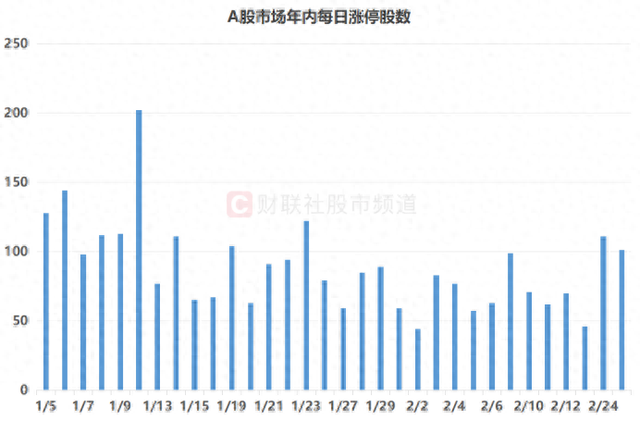
Core Viewpoint - The A-share market has shown significant activity post-holiday, achieving consecutive "limit-up" days, with 26 stocks experiencing continuous gains, indicating a strong bullish sentiment in the market [1][3]. Group 1: Market Performance - The A-share market has seen a continuous rise, with 100 stocks hitting the daily limit-up, a phenomenon not observed since early January [1]. - A total of 26 stocks have achieved consecutive limit-up days, accounting for nearly 14% of the total limit-up stocks [1]. Group 2: Sector Analysis - The basic chemical sector led the market with 32 limit-up stocks, representing 17% of the total limit-up stocks, followed by non-ferrous metals and petroleum sectors, which together contributed to one-third of the limit-up stocks [3]. - In terms of consecutive limit-up stocks, the basic chemical and construction decoration sectors were the primary contributors, with 7 and 5 stocks respectively, indicating a strong focus on cyclical sectors [5]. Group 3: Individual Stock Highlights - Notable stocks among the limit-up performers include Northern Rare Earth, Changfei Fiber, and China Railway, with significant market capitalizations exceeding 1 billion [7]. - China Merchants Energy recorded a continuous limit-up trend, reaching a historical high of 14.75 yuan, with a trading volume of 3.087 billion yuan, marking the highest level in nearly a decade [7]. Group 4: Financing Activity - Post-holiday, the financing balance in the A-share market increased significantly, with a net financing amount of 33.889 billion yuan on February 24, marking the second-highest record this year [10]. - Among the 31 sectors, 26 experienced an increase in financing balance, with electronics and computers being the primary focus for investors [10]. Group 5: Individual Stock Financing - A total of 19 stocks saw net financing exceeding 1 billion yuan, with Zhongji Xuchuang leading at 1 billion yuan, followed by Kingsoft and China Glass [11]. - The financing balance for key sectors such as electronics, power equipment, and non-bank financials remains robust, with several stocks showing significant net buying activity [11].

新春开工领涨!鹏华周期类ETF矩阵解锁石油化工复苏新机遇
Zhong Jin Zai Xian· 2026-02-25 08:55
Core Viewpoint - The A-share market experienced a strong start to the new year, particularly in the cyclical sectors, with the oil and petrochemical sector leading the gains at 5.53% [1] Group 1: Market Performance - The oil and petrochemical sector topped the Shenwan first-level industry rankings with a 5.53% increase, while the basic chemical sector ranked third with a 3.45% increase [1] - Institutional consensus indicates a positive outlook for cyclical assets post-holiday, with expectations of a market rebound supported by policy expectations and liquidity [1] Group 2: Investment Opportunities - Key investment themes include the "anti-involution" concept driven by improved supply-demand dynamics and industry profit recovery, with a focus on sectors benefiting from price increases such as precious metals, oil and petrochemicals, and basic chemicals [1] - The global landscape shows increased macro risks due to geopolitical tensions and tariff policies, prompting a focus on "weak dollar assets" like precious metals, non-ferrous metals, and oil and gas [1] Group 3: ETF Performance - Penghua Fund's oil ETF (159697) is the first in the market to track the National Oil and Gas Index, covering key companies in the oil and gas industry, with a one-year increase of 31.43% compared to the 19.34% rise of the CSI 300 index [2] - The chemical ETF (159870) tracks a refined chemical industry index, achieving a one-year growth of 51.79%, effectively capturing structural opportunities in the transition from traditional capacity to high-end and new energy materials [2] Group 4: Liquidity and Market Acceptance - As of February 13, 2026, the oil ETF (159697) and chemical ETF (159870) ranked first in their respective categories with sizes of 1.828 billion and 35.533 billion, indicating strong liquidity and market recognition [3] - These ETFs provide investors with low-cost, high-transparency, and risk-diversified investment tools, addressing the complexities and risks associated with direct investments in cyclical stocks [3]
化工新周期开启,石化ETF(159731)布局机会凸显
Mei Ri Jing Ji Xin Wen· 2026-02-25 05:50
石化ETF(159731)及其联接基金(017855/017856)紧密跟踪中证石化产业指数,从申万一级行业分 布来看,基础化工行业占比为60.02%,石油石化行业占比为32.43%,能够分享下游化工品的利润修 复。伴随行业格局优化和供需结构调整,行业中长期叙事改善。 (文章来源:每日经济新闻) 截至2月25日13:35,石化ETF(159731)涨1.80%,持仓股川发龙蟒、云天化、和邦生物等涨幅居前。 从资金净流入方面来看,石化ETF(159731)近20个交易日资金净流入总计12.39亿元。石化ETF最新份 额达17.62亿份,最新规模18.58亿元。 受到原油春节期间上涨的提振,化工价格普遍出现了开门红。从景气度最高的聚酯产业链来看,终端企 业2026年春节后普遍开工比往年更早,CCF报道,绍兴中国轻纺城和广州国际轻纺城市场分别于正月初 八和正月初十开市,往年通常是正月十五才会开工。 据中信期货分析,春节期间化工品普遍出现了累库,例如聚烯烃两油库存较节前攀升104%;纯苯、苯 乙烯、乙二醇等品种也均出现累库。然而即使累库,在节后下游和终端复工复产的预期下,化工仍可能 延续震荡格局,等待需求格局的明朗化 ...
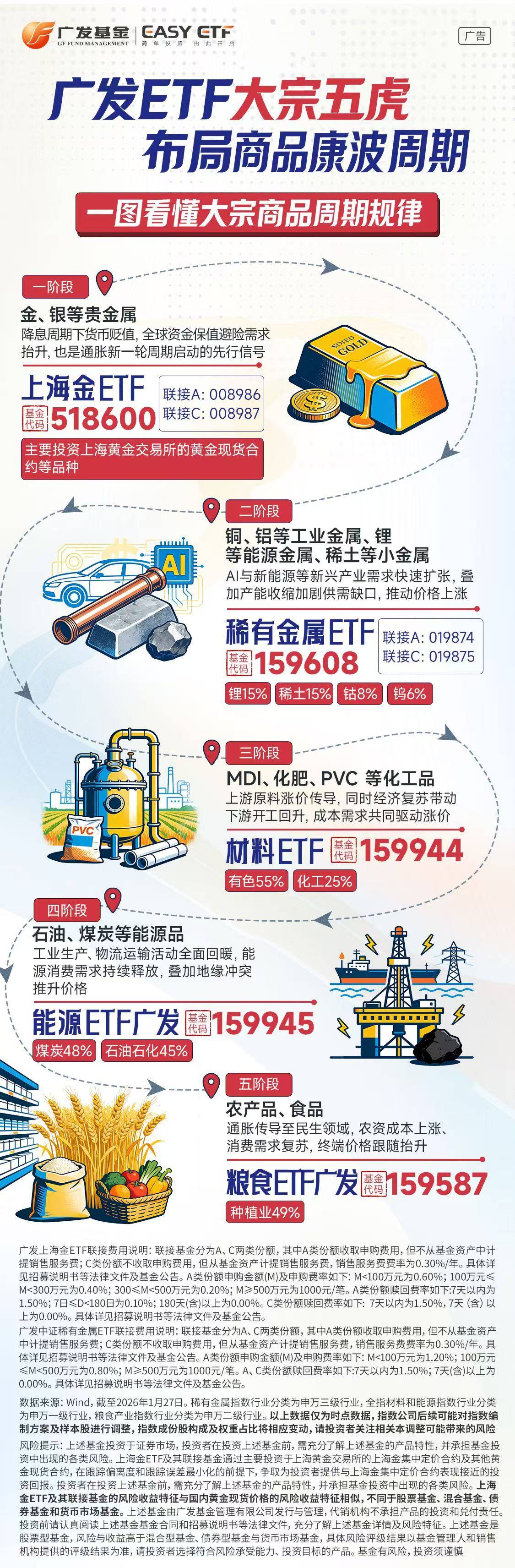
AI带动上游关键战略金属涨价,锂钴钨合计占比约30%居同类第一的稀有金属ETF(159608)涨超6%,广发大宗五虎一键布局大宗康波周期
Sou Hu Cai Jing· 2026-02-25 05:29
2026年2月25日,A股三大股指小幅高开,磷化工、锂矿概念、小金属概念股、稀土永磁等涨幅居前。2月24日,百川盈孚数据显示,稀土产品价格加速上 涨。氧化镨钕等主要稀土产品价格近期持续走高,现货供应紧张,下游磁材企业存在备货采购需求,共同推动价格上涨。 海外消息,近日特朗普官员初步将OPEN的AI定价模型聚焦于锗、镓、锑和钨四种关键矿产,随后将逐步扩大覆盖范围,此举揭示了特朗普政府试图主动介 入关键矿产定价的路径,消息公布后,外盘有色金属出现明显涨幅。现货方面,当前市场仍处于节后恢复初期,锡锭库存季节性累增中,预计短期锡价仍以 高位震荡偏强为主。 锗方面,作为光纤的关键材料,海外锗价突破4000美元/kg。锗目前已被多个国家列为战略性保护矿产资源。展望未来,供给端,中国作为最大的锗生产 国,近年来持续加强对锗的出口管制,全球范围内的锗供应量或继续受限。需求端,随着军事红外、低轨卫星、通信、光伏等领域的景气提升,对锗的需求 量预计将持续增长。东莞证券认为,尽管目前高位的锗价使得下游企业的购买热情有所退却,但供弱需强的局面奠定了锗价上行的基础,预计未来锗价将再 度开启上升通道。 此外,全球能源转型正从政策驱动迈向 ...
周期板块点评:周期资源品配置正当时
Bank of China Securities· 2026-02-25 03:18
Core Insights - The report emphasizes that the current environment is favorable for allocating resources in cyclical sectors, particularly in the first quarter of 2026, due to rising overseas uncertainties and the expected resumption of domestic activities after the Spring Festival [1][2]. Group 1: Market Performance - The cyclical sector performed well, with significant gains in industries such as oil and petrochemicals, construction materials, basic chemicals, non-ferrous metals, and coal, driven by geopolitical tensions, U.S. tariff policy uncertainties, and domestic supply-demand expectations [2]. - The escalation of the U.S.-Iran situation has led to rising oil prices, with global crude oil prices reaching a six-month high during the Spring Festival, positively impacting the domestic oil and petrochemical sector [2]. - Uncertainties surrounding tariffs have provided strong support for precious metal prices, with international gold prices continuing to rise amid renewed global trade uncertainties [2]. Group 2: Supply Constraints and Price Expectations - Coal prices are expected to recover due to supply constraints, with domestic coal inventories at major ports dropping to low levels and signals of reduced coal supply from Indonesia, which may create price space for domestic coal [2]. - The resumption of work after the Spring Festival is anticipated to boost demand expectations, further supporting coal prices [2]. Group 3: Strategic Outlook - The report reiterates that the first quarter is a critical time for resource allocation, with the recent rise in overseas uncertainties likely to catalyze a new round of resource price movements [2]. - The evolution of the U.S.-Iran situation will be a significant factor influencing oil and precious metal prices, while the restart of U.S. trade policy uncertainties may provide strong support for precious metals [2]. - Domestic construction activity and macroeconomic policy developments ahead of the Two Sessions will significantly impact the sustainability of the coal sector and other domestic resource prices [2].
券商把脉节后投资主线
Jin Rong Shi Bao· 2026-02-25 02:52
华泰证券认为,主题投资和景气策略仍优于高股息,主题投资关注出口链、服务型消费、机器人应 用等,景气投资关注通信设备、小金属、稀有金属、电池、建材等。 国盛证券表示,有四大变量或成影响节后市场走势的关键。一是美国关税政策仍存不确定性,意味 着贸易摩擦将长期化,短期内将对市场风险偏好形成压制,但出口链企业的韧性已经显现;二是国内人 工智能(AI)大模型与机器人借春晚实现全民出圈,京东等平台销量数据更是提供了业绩验证,上周 五港股相关板块大涨,A股智能机器人、算力设备、AI应用等板块有望迎来资金追捧;三是以人民币计 价资产的吸引力将提升,尤其是权益市场,外资净流入中国资产已成为大趋势;四是地缘政治不确定性 加剧,推升全球避险情绪。 刚刚结束的马年春节假期可谓"马力十足"。交通运输部发布的数据显示,2026年春节前20天,全社 会跨区域人员流动量超50亿人次,创下了新的历史纪录。同时,国家移民管理局预计今年春节假期全国 口岸日均出入境人员同比增长14.1%,日均超205万人次,比2023年春节增长近5倍。此外,消费也迎来 了"开门红"。今年春节首批以旧换新补贴提前下达,叠加地方政府的消费补贴资金共同为假期消费注入 动 ...
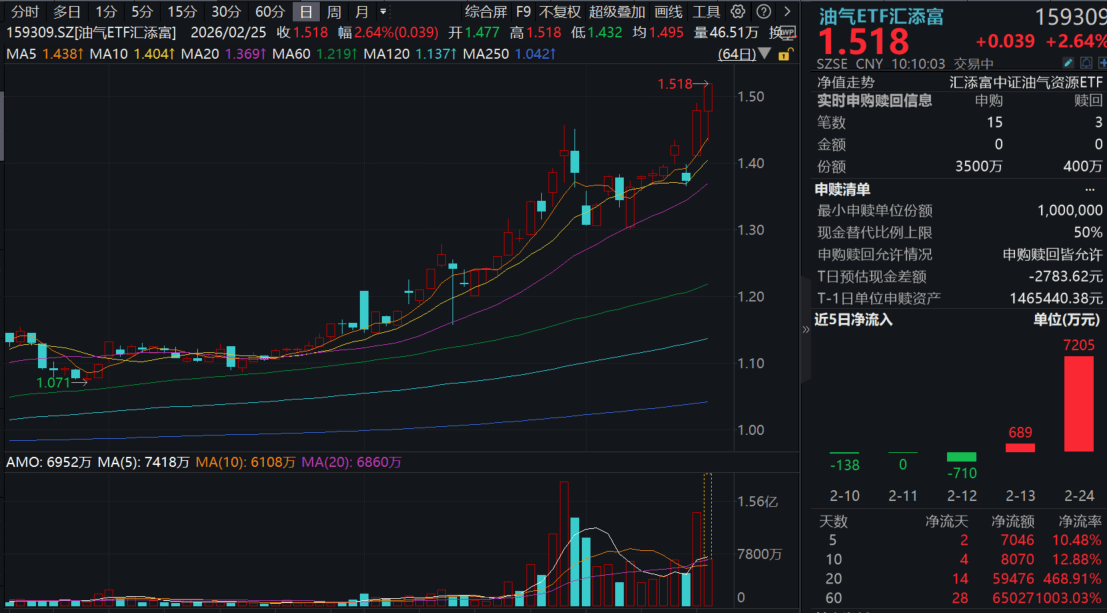
油气继续冲高!招商轮船、招商南油等涨停,油气ETF汇添富(159309)涨超2.5%,盘中强势吸金近5000万元!油价冲高,短中期逻辑全面解析!
Sou Hu Cai Jing· 2026-02-25 02:35
截至10:19,成分股仅做展示使用,不构成投资建议。 2月25日,A股市场震荡上行,油气板块再度冲高!截至10:09,高纯度的油气ETF汇添富(159309)涨超2.5%,续创历史新高,盘中强势吸金近5000万元, 延续前两日吸金势头! 油气ETF汇添富(159309)标的指数成分股多数冲高,通源石油涨超14%,潜能恒信涨超11%,招商轮船、中远海能、洲际油气、招商南油等涨停,杰瑞股 份、中国石油等微涨,中国海油略有回调。 | 序号 | 代码 | 名称 | 甲万一级行业 | 涨跌幅 | 估算权重 | | --- | --- | --- | --- | --- | --- | | 1 | 002353 | 态瑞股份 | 机械设备 | 0.24% | 11.30% | | 2 | 600938 | 中国海油 | 石油石化 | -0.32% | 9.89% | | 3 | 601857 | 中国石油 | 石油石化 | 0.72% | 8.54% | | 4 | 600028 | 中国石化 | 石油石化 | 1.06% | 8.34% | | 5 | 601872 | 招商轮船 | 交通运输 | 9.99% | 7. ...





华泰期货:市场小幅放量,股指收红
Xin Lang Cai Jing· 2026-02-25 02:10
热点栏目 自选股 数据中心 行情中心 资金流向 模拟交易 客户端 来源:华泰期货 作者: 汪雅航 市场分析 关注贸易问题。宏观方面,国务院常务会议部署做好春节假期后政府工作,要求着力抓好重点任务落 实,支持地方和企业积极探索打造新增长点。会议研究推进银发经济和养老服务发展有关工作,指出要 进一步释放银发消费需求,发挥消费补贴等政策牵引作用,推动普惠养老服务供给提质扩面。经文化和 旅游部数据中心测算,春节假日9天,全国国内出游5.96亿人次,较2025年春节假日8天增加0.95亿人 次;国内出游总花费8034.83亿元,较2025年春节假日8天增加1264.81亿元,假日游客人数和花费均创历 史新高。海外方面,美国正式开始征收10%全球关税,白宫正在准备把税率提高到15%的正式命令。美 国白宫就伊朗问题表示,特朗普总统的首选方案永远是外交手段,但必要时也愿意使用致命武力。 指数收涨。现货市场,A股三大指数收红,上证指数涨0.87%收于4117.41点,创业板指涨0.99%。行业 方面,板块指数涨多跌少,石油石化、建筑材料、基础化工、有色金属行业领涨,传媒、计算机、商贸 零售行业跌幅居前。成交小幅放量,当日沪深两 ...

研究所日报-20260225
Yintai Securities· 2026-02-25 01:51
Monetary Policy - The central bank will conduct a 600 billion MLF operation today, with 300 billion MLF maturing this month, marking the 12th consecutive month of increased operations, though the scale is smaller than last month's 700 billion[3] - The February LPR is set at 3.0% for 1-year and 3.5% for 5-year loans, remaining unchanged for 9 months[3] - The capital market is stable, with short-term monetary policy in an observation phase, and the central bank is leaning towards using OMO to adjust market liquidity[3] Global Trade and Tariffs - The U.S. has officially begun imposing a 10% global tariff, with plans to increase it to 15%, affecting various industries including large batteries and industrial chemicals[3] - China is closely monitoring the situation and may adjust its countermeasures regarding tariffs on U.S. products, including fentanyl[3] Market Performance - On February 24, the Shanghai Composite Index rose by 0.87%, and the Shenzhen Component Index increased by 1.36%, with total trading volume reaching 22,020.62 billion, an increase of 2,193.82 billion from the previous trading day[4] - The U.S. stock market saw gains, with the Dow Jones up 0.76%, S&P 500 up 0.77%, and Nasdaq up 1.04%[4] Bond and Interest Rates - The yield on the 10-year government bond is at 1.8053%, with a change of +0.92 BP[4] - The average rates for R001 and R007 are 1.4518% and 1.6102%, respectively[4] Sector Performance - The top-performing sectors include petroleum and petrochemicals (+5.53%), building materials (+3.71%), and basic chemicals (+3.45%), while media, computers, and retail sectors saw declines[4]