
Qi Huo Ri Bao

Search documents
基本面偏弱 原油价格难以止跌
Qi Huo Ri Bao· 2025-12-04 07:09
11月以来,市场担忧俄罗斯原油供应回归加剧全球过剩压力,原油价格震荡回落。从需求来看,今年冬 季全球主要经济体原油需求普遍偏弱,这导致原油库存出现累积。 石油输出国组织及其盟友(OPEC+)决定明年一季度暂停增产,在一定程度上缓和了市场对原油供应 过剩加剧的担忧,但受俄罗斯原油供应可能回归、美国等非OPEC+产油国原油产量增长等因素影响, 原油供应过剩格局很难逆转。原油价格要想止跌,还需要等待需求改善或产油国减产。 俄罗斯原油供应可能回归 8个OPEC+核心成员国今年4月决定恢复产量之后,沙特已成功夺回部分市场份额,但随之而来的油价 下滑给该国财政带来挑战,使其预算赤字扩大,并迫使其缩减一些旗舰经济项目规模。 从实际产量来看,OPEC原油产量环比继续增长,但增长势头有所放缓。根据OPEC月报,2025年10 月,OPEC原油产量升至2846万桶/日,环比增长0.12%,低于9月1.8%的增速;同比增长7.2%,低于9 月8.9%的增速。 不过,美国等非OPEC+产油国原油产量将继续增长,使得全球原油供应增长继续超过需求增长,过剩 压力很难逆转。根据美国能源信息署(EIA)发布的月报,9月,美国原油产量攀升至逾 ...
东北产区农民惜售 玉米价格稳中有升
Qi Huo Ri Bao· 2025-12-04 07:09
齐凯认为,11月下旬以来玉米价格持续上涨,与库存小麦竞价拍卖预期落空也有一定关系。此前,市场 预期河南等地2017年产库存小麦将大量出库,但考虑到保证种粮农民收益、稳定小麦和玉米市场价格, 库存小麦竞价拍卖目前尚未落地。这一方面使小麦价格居高不下,难以进入饲料原料领域;另一方面也 缓解了玉米市场的现货抛售压力,增强了市场持货待涨的信心。 国内高品质玉米价格近期呈现上行态势,特别是11月20日以来,玉米期现货价格稳中有升。截至12月3 日收盘,大连玉米期货主力2601合约价格已累计上涨约100元/吨。 "当前国内新季玉米大量上市,市场价格却出现大幅上涨,主要是由于河南等地新季玉米质量低、产量 降。另外,前期市场预期的库存小麦竞价拍卖也未能兑现。"黑龙江省五大连池市盈峰粮食贸易有限公 司总经理柴印峰表示,当前东北产区农民、小商贩、烘干企业、贸易商普遍存在较强的看涨和惜售心 理。气温下降后"地趴粮"存放难度降低,以及东北产区玉米外运费用增加等因素,也支撑了玉米价格。 河南省滑县粮油经销商齐凯告诉记者,河南当地新季玉米小商贩收购价在2200元/吨左右,制粉企业的 小麦到厂价为2570元/吨。受前旱后涝天气影响,今年河 ...
河北、山东地区调研:蛋鸡养殖行业处于产能出清阶段
Qi Huo Ri Bao· 2025-12-04 07:09
目前蛋鸡养殖行业面临供给充裕、需求乏力,成本竞争加剧的格局,利润对产能的传导是周期性波动的 关键所在。我们基于在产存栏量和养殖利润,辅以价格、社融、利率等指标,将鸡蛋市场基本面周期定 性地划分为景气、压力、出清、回暖四个阶段。 基于周期推演,2025年下半年蛋鸡养殖行业由压力期过渡至出清期,针对市场是否会出现超淘现象、整 体补栏下行拐点何时发生、春节前冷库蛋能否全部出库、资本投机行为是否会改变市场长期趋势、疫病 风险是否具有持续性,以及未来行情如何判断等问题,正信期货调研团队于11月底深入辛集、衡水、聊 城、曲周、馆陶、邯郸等蛋鸡产业一线,携手当地具有代表性的养殖企业、贸易商、种鸡企业及大型屠 宰企业,通过实地考察了解行业发展现状,寻找供需矛盾,为后市行情提供参考。 问题1: 市场是否会出现超淘现象 "超淘"需综合考量存栏总量、鸡龄结构、淘汰鸡价格及养殖户情绪等多重因素,而非简单的提前淘汰行 为。当前河北淘鸡价格为3.2元/斤,湖北为3.6元/斤,尽管养殖户面临亏损,但由于有前4年盈利积累 的资金缓冲,暂未出现无抵抗式集中抛售。 从淘鸡日龄看,当前淘鸡500天以上占比超80%,450~500天淘鸡占比持续增加 ...
港口库存偏高 铁矿石偏弱震荡
Qi Huo Ri Bao· 2025-12-04 07:09
Group 1 - The northern region is experiencing frequent low temperatures and rain, significantly limiting real estate and infrastructure construction [1] - December to February is traditionally a low consumption season for construction steel, leading to a decrease in high furnace iron output as steel mills enter maintenance periods [1] - High furnace iron output has remained at a high level this year, resulting in increased demand for iron ore, but steel mills are facing significant profit squeezes [1] Group 2 - From January to October, China imported 1.03 billion tons of iron ore, a year-on-year increase of 0.79% [2] - The import of iron ore from India decreased by 43% year-on-year due to increased domestic steel production in India [2] - Iron ore imports from major mining companies have gradually recovered in the second half of the year, with significant month-on-month increases in imports from June to October [2] Group 3 - Environmental inspections and the seasonal decline in steel consumption are expected to increase the number of steel mills entering maintenance, leading to a probable decrease in high furnace iron output and a decline in iron ore demand [3] - Iron ore imports are continuously increasing, and port inventories are accumulating, indicating a potential weak fluctuation in short-term futures prices [3]
美股三大指数集体收涨,美联储降息预期增强
Qi Huo Ri Bao· 2025-12-04 03:12
Core Points - On December 3rd, US stock indices closed higher, with the Dow Jones up by 408.44 points (0.86%) at 47,882.90, the Nasdaq up by 40.42 points (0.17%) at 23,454.09, and the S&P 500 up by 20.35 points (0.30%) at 6,849.72 [1] Group 1: Market Performance - The majority of popular Chinese concept stocks declined, with the Nasdaq Golden Dragon China Index falling by 1.38% [1] - Notable declines included NIO and Xpeng Motors, both down over 4%, while Li Auto and New Oriental fell over 3% [1] - Other companies like Bilibili and Miniso dropped over 2%, and Alibaba, Baidu, and Pinduoduo decreased by over 1%, while Century Internet rose by over 1% [1] Group 2: Economic Indicators - The ADP report indicated a surprising decrease of 32,000 jobs in the private sector for November, suggesting a contraction in the labor market [1] - This data has led traders to increase expectations for a Federal Reserve interest rate cut in the upcoming monetary policy meeting [1] - Current market expectations for a rate cut by the Federal Reserve next Wednesday stand at 89%, significantly higher than predictions made in mid-November [1]
中国人民银行行长潘功胜:强化金融稳定的法治保障
Qi Huo Ri Bao· 2025-12-04 03:07
Core Viewpoint - The article emphasizes the need to construct a scientific and robust monetary policy system and a comprehensive macro-prudential management system in China, aligning with the spirit of the 20th National Congress of the Communist Party of China [1] Group 1: Monetary Policy System - The construction of a scientific and robust monetary policy system requires optimizing the mechanism for basic currency issuance and monetary policy intermediaries to maintain reasonable growth in total financial volume [1] - It is essential to improve the market-oriented interest rate formation, regulation, and transmission mechanisms [1] - A structural monetary policy tool system needs to be enhanced continuously [1] - The mechanism for the formation of the Renminbi exchange rate should be improved [1] - Continuous efforts are needed to ensure the smooth transmission of monetary policy [1] Group 2: Macro-Prudential Management System - Key tasks for building a comprehensive macro-prudential management system include strengthening the monitoring and assessment of systemic financial risks [1] - Comprehensive risk prevention measures in key areas must be effectively implemented [1] - The toolbox for macro-prudential management policies should be enriched [1] - A financial stability guarantee system needs to be established [1] - Financial security capabilities should be enhanced in line with the level of openness [1] Group 3: Financial Stability Guarantee System - Strengthening corporate governance and risk management of financial institutions is crucial, along with enhancing daily supervision to build a solid first line of defense against financial risks [2] - Coordination among macro-prudential management, micro-prudential regulation, and behavioral supervision is necessary to form a synergistic effect [2] - A mechanism for early correction of financial risks with hard constraints should be reinforced, along with the specialized risk disposal functions of deposit insurance [2] - The roles of industry guarantee funds, financial stability guarantee funds, and the central bank as the lender of last resort should be effectively utilized, with a focus on preventing moral hazards [2] - Legal safeguards for financial stability should be strengthened, and the drafting and revision of financial laws, the People's Bank of China Law, and financial stability laws should be accelerated [2]
全球需求爆发式增长 白银价格创出新高
Qi Huo Ri Bao· 2025-12-04 02:29
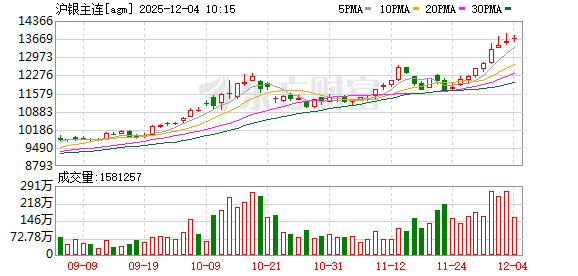
Core Insights - The recent surge in silver prices is attributed to a significant imbalance in physical supply and demand, a shift in the Federal Reserve's monetary policy, and a substantial influx of capital into the market [5][6] Group 1: Price Movements - On December 3, London spot gold prices remained above $4200 per ounce, with a slight decline of 0.6% from the previous trading day, while international silver prices reached new historical highs, with London spot silver peaking at $58.945 per ounce and New York COMEX silver futures exceeding $59 per ounce [2] - The Shanghai Futures Exchange reported that the main silver futures contract closed at 13582 yuan per kilogram, reflecting a cumulative increase of 9% from December 1 to 3 [2] Group 2: Market Characteristics - Silver prices have outperformed gold this year, making silver the standout commodity in the domestic futures market [3] - The correlation between domestic and international silver markets is exceptionally high, with a correlation coefficient above 0.96, indicating active participation from various domestic investors [3] - The volatility of silver futures has surged to 60%, significantly exceeding historical averages, with multiple instances of daily price fluctuations exceeding 5% since October [3] Group 3: Supply and Demand Dynamics - The core driver of the current silver bull market is the expanding supply-demand gap, with global silver production projected to decline to 820 million ounces (approximately 2580 tons) by 2025, a 12% decrease from the 2020 peak [5] - The photovoltaic industry is expected to become the largest consumer of silver, with demand projected to reach 7560 tons by 2025, doubling from 2022 and accounting for 55% of total global silver demand [5] - Global silver inventory is projected to cover only 1.2 months of consumption by 2025, significantly below the safety margin of 3-6 months [6] Group 4: Investment Strategies - As of December 2, 2025, the annual increase in silver futures on the Shanghai Futures Exchange exceeded 90%, with major investment banks raising their silver price targets for 2026 to between $58 and $60 per ounce [7] - The ongoing easing of monetary policy by the Federal Reserve is expected to provide continued support for global silver valuations, with predictions of at least 2-3 more rate cuts in 2026 [7] Group 5: Risk Management - In the current high-price and high-volatility environment of the silver market, it is crucial for investors to maintain a rational approach to trading silver futures [9] - Investors are advised to adopt a phased buying strategy to mitigate risks and gradually increase their positions [9] - Companies should establish a risk management system centered on hedging and utilize derivative tools like silver options to protect their positions [10]

需求难言乐观 合成橡胶震荡筑底
Qi Huo Ri Bao· 2025-12-04 01:41
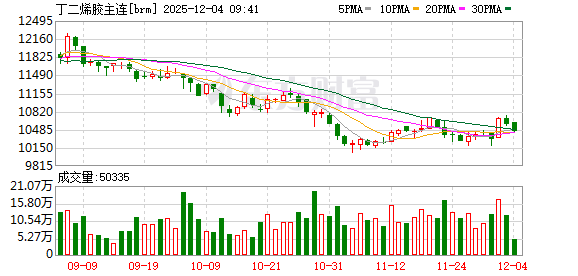
Core Viewpoint - The synthetic rubber futures prices have rebounded significantly after a second bottoming out, with the 2601 contract returning to the range of 10,500 to 11,000 yuan/ton. However, the market is facing multiple bearish factors, leading to a forecast of a bottoming phase for synthetic rubber futures in the near future [2][4]. Supply Side - The supply of synthetic rubber is currently ample, with the resumption of normal operations at Fushun Petrochemical and Jilin Petrochemical's first-phase facilities, alongside new installations increasing supply pressure. There is also an expectation of growth in imports, contributing to a continued supply surplus in the butadiene market [2]. - In November, the overall supply of synthetic rubber is expected to remain loose, with the capacity utilization rate for styrene-butadiene rubber in China at 68.13%, a month-on-month decrease of 3.27 percentage points but a year-on-year increase of 0.53 percentage points. Consequently, the production of styrene-butadiene rubber in November was 130,100 tons, down 5.44% month-on-month but up 8.43% year-on-year [2]. - The inventory levels are on the rise, with the total inventory of styrene-butadiene rubber in sample enterprises at 32,400 tons by the end of November, an increase of 5.05% compared to the end of October. Additionally, the inventory of synthetic rubber futures at the Shanghai Futures Exchange reached 15,400 tons, a significant increase of 79.25% from the end of October, with a monthly average inventory growth of 42.40% [2]. Demand Side - The tire industry, the largest end-user of synthetic rubber, underperformed in November due to seasonal demand decline and global trade tensions. The capacity utilization rate for domestic semi-steel radial tire manufacturers was 66%, down 3.36 percentage points month-on-month and down 13.64 percentage points year-on-year. For full-steel radial tires, the utilization rate was 62.75%, a slight increase of 0.71 percentage points month-on-month and a year-on-year increase of 2.68 percentage points [3]. - Semi-steel radial tires use approximately 35% synthetic rubber by total weight, while full-steel radial tires use only 8% to 10%, with natural rubber being the primary material (about 45% of total weight). The decline in semi-steel tire utilization indicates a decrease in synthetic rubber demand [3]. - The weakening demand for raw materials from tire manufacturers has further increased inventory pressure for synthetic rubber. The average inventory turnover days for semi-steel tire manufacturers was 45.86 days, an increase of 7.69 days year-on-year, while for full-steel tire manufacturers, it was 40.24 days, an increase of 0.69 days month-on-month. High inventory levels have led to a low purchasing willingness among tire manufacturers, who are adopting flexible production control strategies and maintaining minimal procurement levels for synthetic rubber [3]. Summary - In summary, the short-term outlook for synthetic rubber indicates ample supply and a lack of optimistic demand, with seasonal off-peak characteristics expected to persist until the end of the year. The tire industry remains in a low demand phase, and the traditional off-season for automotive consumption is limiting improvement in foreign trade orders. Given the supply-demand imbalance in the synthetic rubber market, December futures prices are expected to lack sustained upward momentum, with a market trend of oscillation and bottoming likely to prevail [4].
明年铜价或保持强势
Qi Huo Ri Bao· 2025-12-04 01:17
Group 1: Copper Supply Disruptions - Global copper supply has been disrupted in 2023 due to various factors, including Indonesia's suspension of copper concentrate exports and Freeport's production cuts, leading to a decrease in international copper concentrate supply [1] - The Kamoa copper mine in the Democratic Republic of Congo has reduced its annual output by approximately 150,000 tons due to seismic activity, exacerbating supply tightness [1] - Significant production halts occurred at Chile's El Teniente mine and Freeport's Grasberg mine, with the latter not expected to return to pre-accident production levels until 2027 [1] Group 2: Copper Processing Fees and Production Outlook - The copper concentrate treatment charge (TC) has entered negative territory and has been declining, remaining around -40 USD/ton since May, indicating potential losses for smelters when TC falls below 20 USD/ton [2] - Global copper production growth is expected to slow significantly in 2026, with a forecasted growth rate of only 0.9%, down from 3.4% in 2025, as the market shifts from surplus to shortage [2] Group 3: China's Copper Demand and Imports - Despite a significant increase in refined copper production in China, the country continues to import large quantities of refined copper, scrap copper, and copper products to meet domestic demand [3] - China's refined copper imports from January to October 2025 were 4.46 million tons, a decrease of 3.1% year-on-year, while scrap copper imports increased by 1.99% [3] - China's manufacturing sector is projected to account for 35% of global manufacturing value added by 2025, with copper consumption expected to rise, particularly in the context of increasing overseas demand [3] Group 4: Growth in Energy Storage and New Energy Sectors - The global energy storage system (ESS) market is experiencing robust growth, with a 99% year-on-year increase in battery shipments in the first ten months of 2025 [4] - China's domestic demand for ESS is strong, with exports growing over 140%, positioning the country as a key driver of global ESS market growth [4] - The renewable energy sector, including solar and wind power, is expected to see significant growth, further driving copper demand [4] Group 5: Domestic Market Dynamics - Despite a 14.7% year-on-year decline in real estate investment in China, investments in power generation and grid projects have increased, helping to maintain demand for copper [5] - The production of new energy vehicles in China surged by 28.1% in the first ten months of 2025, indicating strong growth in sectors that consume copper [5] - Overall, global copper production is projected to decline slightly in 2025, with limited growth expected in the following year due to various supply constraints [5] Group 6: Future Supply Gaps and Price Expectations - Countries are preparing to restrict scrap copper exports, which may further tighten domestic copper supply in China [6] - The global copper market is expected to face a supply gap of 150,000 tons in 2026, with UBS projecting a supply shortfall of 230,000 tons in 2025 and 407,000 tons in 2026, indicating a worsening supply-demand imbalance [6] - As a result of these factors, copper prices are anticipated to remain strong in 2026 [6]
华南地区玻璃产业调研:物流优化与资源整合是关键
Qi Huo Ri Bao· 2025-12-04 01:00
Group 1: Industry Overview - The glass industry is currently in a phase of capacity clearance and supply-demand mismatch, with a focus on understanding the capacity structure, product iteration trends, and market competition logic in the South China region [1] - The photovoltaic glass market is experiencing weak overall expectations, with the core logic of industry growth shifting from "anti-involution" to capacity clearance, leading to discussions on response strategies within the industry [2] - The existing capacity is primarily composed of emerging capacities, with a focus on eliminating poorly managed enterprises, while actual production capacity can reach 110% to 120% of designed capacity [2] Group 2: Product Characteristics and Supply Chain - The main product thickness is 2.0mm, with a high processing conversion rate of 90% and a processing qualification rate exceeding 99%, utilizing a B2B model for distribution [3] - The company has stable raw material supply, with quartz sand sourced from its own mines and soda ash procured through long-term agreements, impacting production costs [4] - Inventory management is efficient, with a normal inventory cycle of 30 to 40 days, aligning with the fast turnover characteristics of photovoltaic glass [5] Group 3: Market Dynamics and Competition - The core consumption market for daily-use glass is in Guangdong, with significant demand from the seasoning industry and other sectors [6] - The competition in the market is intensifying, particularly for raw soda ash, with a noticeable downward trend in synthetic soda ash costs [7] - The photovoltaic glass industry is seeing a clear direction in product iteration, with 2mm thickness accounting for 80% of the market, while the 3.2mm thickness is gradually being phased out [14] Group 4: Trade and Collaboration - The current trade model in the photovoltaic glass market is primarily point-to-point, with direct connections between glass manufacturers and component factories, leading to challenges in financing for midstream traders [15] - The cooperation ecosystem is characterized by component manufacturers holding pricing power, which affects the negotiation dynamics with glass suppliers [15] - Future industry trends indicate a focus on cost advantages and product quality, with logistics optimization and resource integration becoming critical [16]