中金点睛

Search documents
中金 | 软饮料系列报告四——椰子水新兴成长赛道
中金点睛· 2025-07-22 23:23
Core Viewpoint - The coconut water industry is experiencing rapid growth driven by increasing consumer health awareness and the popularity of coconut-flavored products, particularly in China, where the market is expected to reach $1.1 billion by 2024 with a CAGR of 60.8% over the past five years [3][13]. Industry Growth Prospects - The coconut water market in China is projected to grow significantly, with a market size of $1.1 billion by 2024, reflecting a CAGR of 60.8% from $0.1 billion in 2019 [3][13]. - Per capita consumption of coconut water in China is only 0.1 liters per person, significantly lower than in the US (1.1 liters) and Thailand (0.2 liters), indicating potential for growth [16][18]. - The supply and demand dynamics are expected to drive continued rapid growth in the coconut water industry in China [18]. Competitive Landscape - The market is characterized by a CR5 of 43.4%, with IFBH holding a leading market share of 33.9%, indicating a fragmented competitive landscape with many emerging brands [3][29]. - Coconut water brands can be categorized into four types: international brands, local brands, emerging brands, and new retail brands, with the market still evolving [29]. Key Competitive Factors - Supply chain management, brand strength, and price-to-quality ratio are identified as critical competitive factors in the coconut water industry [4][34]. - The quality of coconut water is highly dependent on the quality of raw materials, which are primarily imported, making supply chain efficiency crucial [4][35]. - Strong brand recognition is essential due to the high level of product homogeneity, with consumers relying heavily on brand trust [4][48]. Consumer Trends - There is a growing consumer preference for natural and healthy beverages, with coconut water being favored for its low sugar and calorie content, as well as its rich electrolyte profile [21][24]. - The target consumer base is expanding beyond young urban consumers and fitness enthusiasts to include middle-aged individuals and families, indicating a broader market potential [24][26]. Supply Side Developments - The market is seeing increased participation from multiple brands, with traditional and new brands entering the space, enhancing market cultivation [27]. - The supply chain is becoming more resilient through diversified sourcing strategies to mitigate risks associated with climate impacts on raw material supply [28][39]. - Innovations in processing and packaging technologies are improving product quality and efficiency, which is vital for market expansion [28][46]. Pricing and Value Proposition - The average price of coconut water has decreased significantly, with a 40% drop from 2.51 yuan per 100ml in 2018 to 1.49 yuan in 2024, making high price-to-quality brands more appealing to consumers [52][53]. - Brands are increasingly focusing on product innovation and functional benefits to enhance product value and appeal to health-conscious consumers [55][56].


中金 • 全球研究 | 日本参议院选举:执政联盟未过半,今后政策或更积极
中金点睛· 2025-07-22 23:23
点击小程序查看报告原文 参议院选举结果:执政联盟席位未能过半,自民党经历"三连败" 2025年7月20日(周日)日本举行了参议院选举。日本国会分为众议院(相当于英国下院)与参议院 (上院),虽然日本国宪法[1]规定在立法层面众议院具有比参议院更大的权力,但是在人事同意权中 众议院与参议院对等,即参议院具有对日本政府提案的经济类高级官僚人事的否决权。参议院共248个 席位,每届任期6年,每隔三年改选半数议员,不得中途解散,7月20日的参议院选举中,124个改选席 位中,自民党获得39席、公明党获得8席,自民党与公明党组成的执政联盟仅获得47席(改选之前自民 党公明党共有66席)。把本次不参与选举的另一半的席位考虑在内,参议院248个总席位中,自民党与 公明党总计122席,为2007年以来首次未能实现过半数的局面。去年10月日本的众议院选举中,自民党 与公明党也未能实现席位过半(详情参考 《日本众议院选举对资本市场的影响》 ), 目前自民党与公 明党的执政联盟在众参两院中都形成了"未能过半"的局面。 在野党方面,国民民主党在参议院的席位由9席扩大至22席,参政党的席位也由2席扩大至15席;但是最 大在野党的立宪民 ...

中金 | 公募二季报回顾:加仓成长及金融
中金点睛· 2025-07-22 23:23
点击小程序查看报告原文 公募基金仓位变动:股票仓位小幅上涨,港股加仓,A股仓位下降 2025年二季度A股市场先抑后扬,上证指数上涨3.3%,偏大盘蓝筹的沪深300上涨1.3%,成长风格分化,创业板指上涨2.3%,科创50下跌1.9%,中小市值 的中证1000和中证2000分别上涨2.1%和7.6%,中证红利基本收平。在此背景下,主动偏股型公募基金单季度收益率中位数为2.1%,收益率较上季度有所 回落。 公募基金资产规模扩张,权益资产和债券资产占比均下降。 二季度公募基金整体资产规模扩张,资产总值由上季度的33.8万亿元升至36.7万亿元。其中, 股票资产规模从上季度的6.9万亿元升至7.2万亿元,但股票占资产总值的比重较上季度下降0.9个百分点至19.6%;债券资产占比较上季度下降0.4个百分点 至57.8%;现金资产占比明显上升。 主动偏股型基金规模不变,股票仓位小幅上涨,A股仓位下降;新发基金规模上涨,存量净赎回规模走扩。 主动偏股型基金资产总值约2.6万亿元,较上 季度基本持平;股票资产规模较上季度略降至约2.3万亿元,仓位上涨0.1个百分点至87.5%;A股仓位较一季度进一步下降至70.6%,为近10 ...

中金:不一样的“股债跷跷板”
中金点睛· 2025-07-22 23:23
文/中金大类资产研究:李昭,杨晓卿 中国:不一样的股债跷跷板,不一样的资产启示 点击小程序查看报告原文 4月美国关税冲击降温之后,沪深300已从底部反弹14%,债市相对承压,"股债跷跷板"效应受到市场关注。 图表1:与过去的典型"股牛债熊跷跷板"相比,本轮"股债跷跷板"有所不同,主要为流动性驱动,更接近"股牛债平" 资料来源:Wind,中金公司研究部 我们发现本次股债跷跷板与历史上典型的股债轮动明显不同,因此市场启示相异: 资料来源:Wind,中金公司研究部 1)股票风格不一样。 典型的股强债弱跷跷板由增长预期改善驱动,周期、制造、消费等与经济增长关联紧密的股票板块领涨,大盘跑赢小盘。在7月 初"反内卷"之前,本轮股票上涨很大程度上由银行股与小微盘驱动,小盘跑赢大盘。去掉银行贡献后,股票指数涨幅有限。 资料来源:Wind,中金公司研究部 图表2:典型"股牛债熊跷跷板"行情中银行与小盘股常常跑输大盘,本轮"跷跷板"行情银行股与小盘股双双跑赢 图表3:剔除银行后,A股整体上行幅度有限 注:"全部A股"指数采用沪深北三地交易所全部上市A股标的,基于各成分股的自由流通市值进行加权计算得出;类似地,"银行"和"全部A股 ...

中金:换个视角看汇率
中金点睛· 2025-07-21 23:25
Core Viewpoint - The article discusses the evolving consensus around a weaker US dollar since April 2023, highlighting the complexities of predicting exchange rate movements due to various influencing factors, including differing views among US officials on the dollar's valuation and its implications for the economy [2][3][4]. Group 1: Exchange Rate Dynamics - The recent rebound in the US dollar index and the weakening of the euro raise questions about whether these trends are temporary or indicative of a structural reversal [2][3]. - The divergence in views among US officials, with some advocating for a weaker dollar to support manufacturing and others emphasizing the need for a strong dollar, reflects the ongoing debate about the dollar's role in the economy [3][9]. - The article suggests a shift from a neoclassical framework, which focuses on the current account as the main determinant of exchange rates, to a post-Keynesian perspective that emphasizes capital flows as the fundamental driver of currency valuation [2][10][19]. Group 2: Dollar's International Status - The dollar's status as the world's primary reserve currency has provided the US with significant advantages, including improved financing conditions and a sustained trade deficit over the past 50 years [3][23]. - Concerns about US debt sustainability and inflation have led to a consensus that the dollar's international standing is under threat, with market reactions indicating a potential decline in confidence [3][33]. - The article notes that while the dollar has weakened, the extent of this decline and its long-term implications remain uncertain, as no major events have yet tested the dollar's status in the international monetary system [32][53]. Group 3: Euro's Position - The euro has appreciated approximately 14% against the dollar since the beginning of the year, driven by market expectations and a relative improvement in the eurozone's financial accounts [4][63]. - Despite the euro's recent strength, the eurozone faces significant challenges, including high debt levels, innovation deficits, and geopolitical risks that could hinder its long-term economic prospects [4][74]. - The article emphasizes that while the euro's position may improve marginally in the short term, the underlying structural issues within the eurozone could limit its ability to capitalize on a weaker dollar [4][74].

中金:谁在主导港股行情?——港股流动性图景
中金点睛· 2025-07-20 23:21
Core Viewpoint - The Hong Kong stock market has remained active since early 2025, driven by new narratives such as DeepSeek, new consumption, and innovative pharmaceuticals, despite external challenges and a weakening domestic growth cycle. The market has experienced a structural rally characterized by high liquidity and asset scarcity [1][15]. Group 1: Market Activity and Liquidity - The average daily trading volume in the Hong Kong stock market reached 240.6 billion HKD, an increase of over 80% compared to 131.8 billion HKD in 2024, marking a historical high [1][2]. - Southbound capital has been consistently active, with an average daily inflow of 6.15 billion HKD, nearly double the 3.47 billion HKD average in 2024, totaling 787.7 billion HKD year-to-date, close to last year's total of 807.9 billion HKD [1][15]. - The IPO market has seen 51 companies listed in 2025, raising over 100 billion HKD, surpassing the total for 2024, with 10 A-share companies converting to H-shares, accounting for 70% of the fundraising [8][9]. Group 2: Structural Market Phenomena - A structurally active market has emerged, with sectors experiencing rotation despite overall macroeconomic weakness, highlighted by the performance of AI, new consumption, and innovative pharmaceuticals [4][15]. - The phenomenon of crowded trades has been observed, where favored stocks and sectors experience short-term expectations and valuation overshooting, as indicated by the analysis of trading volume and market capitalization [6][15]. - The average return on equity (ROE) for the market has stabilized after years of decline, indicating a stabilization in the credit cycle, with outperforming sectors including insurance, brokers, and new consumption [15][16]. Group 3: Future Trends and Market Dynamics - The macroeconomic backdrop of abundant liquidity and limited quality assets is expected to persist, influencing the flow of southbound capital and the number of companies listing in Hong Kong [21][32]. - The liquidity environment is anticipated to tighten in the third quarter due to various factors, including potential liquidity recovery by the Hong Kong Monetary Authority and external pressures from the U.S. dollar environment [39][40]. - The expected inflow of southbound capital for the year is projected to exceed 1 trillion HKD, although the pace may slow down in the second half of the year [40][41]. Group 4: Investment Strategy and Recommendations - The market is advised to focus on structural opportunities, with a "new dumbbell" strategy that balances stable dividend-paying stocks with growth-oriented sectors, particularly in AI applications and innovative pharmaceuticals [54][55]. - The banking sector may face short-term valuation pressures, suggesting a potential shift towards insurance stocks that still offer attractive dividend yields [54][55]. - The overall market sentiment indicates that while the index may oscillate around 24,000 points, a breakthrough will require additional catalysts, particularly in the context of fiscal policy and trade dynamics [51][53].

中金:港股通与恒指调整预览(2025-8)
中金点睛· 2025-07-20 23:21
Core Viewpoint - The article discusses the upcoming semi-annual review results of the Hang Seng Index series, which will be announced on August 22, 2025, and the potential adjustments to the index constituents that could impact significant passive fund flows [1]. Group 1: Hang Seng Index Adjustments - Potential candidates for inclusion in the Hang Seng Index include Bank of Communications, Pop Mart, Yum China, XPeng Motors, Huazhu Group, JD Logistics, and Innovent Biologics, based on market capitalization and industry representation [2]. - Historical data indicates that actual results may differ significantly from predictions based on market capitalization rankings, as non-quantitative factors may influence the final decisions [2]. Group 2: Hong Kong Stock Connect Adjustments - An estimated 19 companies are expected to be added to the Hong Kong Stock Connect, while 17 may be removed, influenced by the recent changes in the calculation method for average market capitalization [3]. - The new method for calculating average market capitalization now considers the average market value on non-suspended trading days, which may affect the eligibility of certain stocks [3]. Group 3: Inclusion and Exclusion Criteria - The criteria for inclusion in the Hong Kong Stock Connect require companies to meet specific market capitalization thresholds and other conditions, such as being listed for at least six months and having a market cap above HKD 5 billion [4]. - Companies that do not meet the criteria, such as those with market caps below HKD 4 billion or those that are suspended, may be excluded from the Stock Connect [4]. Group 4: Timeline and Market Impact - The official results of the index adjustments will be announced on August 22, 2025, and will take effect on September 8, 2025, with subsequent adjustments to the investable universe for the Shanghai and Shenzhen Stock Exchanges [5]. - Following the announcement, there may be significant trading volume spikes as active funds may engage in arbitrage, while passive funds will likely adjust their holdings to minimize tracking errors [5]. Group 5: ETF Fund Sizes - The article provides data on the sizes of ETFs tracking the Hang Seng Index, Hang Seng China Enterprises Index, and Hang Seng Tech Index, with total assets of approximately USD 30.353 billion, USD 6.629 billion, and USD 26.119 billion respectively [6].

中金:A股资金面的五大变化和市场含义
中金点睛· 2025-07-20 23:21
Core Viewpoint - The A-share market is experiencing significant changes in its funding landscape, which are crucial for understanding market dynamics and future prospects [2][66]. Group 1: Changes in Funding Landscape - Change 1: The restructuring of the monetary order is leading to a shift in asset allocation, with Chinese assets benefiting relatively [5][11]. - Change 2: The proportion of individual investors in the A-share market has increased, indicating a shift in investor structure [23][24]. - Change 3: The growth in household savings, combined with an "asset shortage," is enhancing the relative attractiveness of the stock market [32][33]. Group 2: Market Dynamics and Investor Behavior - Change 4: The improvement in the funding structure and profitability effects is leading to a positive feedback loop in the market [51][56]. - Change 5: Many institutional investors have low positions in A-shares, which may present potential bullish opportunities [6][59]. Group 3: Market Valuation and Attractiveness - The current valuation of A-shares, in terms of equity risk premium and dividend yield, remains attractive compared to historical levels [37][40]. - The total market capitalization of A-shares relative to money supply and household savings is still at historically low levels, suggesting room for growth [44][45]. Group 4: Future Market Outlook - The mid-term market performance will be determined by fundamentals, but the influence of funding flows should not be underestimated, especially in the context of the current favorable funding changes [66]. - If the market continues to attract incremental capital, it may lead to an increase in risk appetite, benefiting various sectors, particularly those with high growth potential [67].

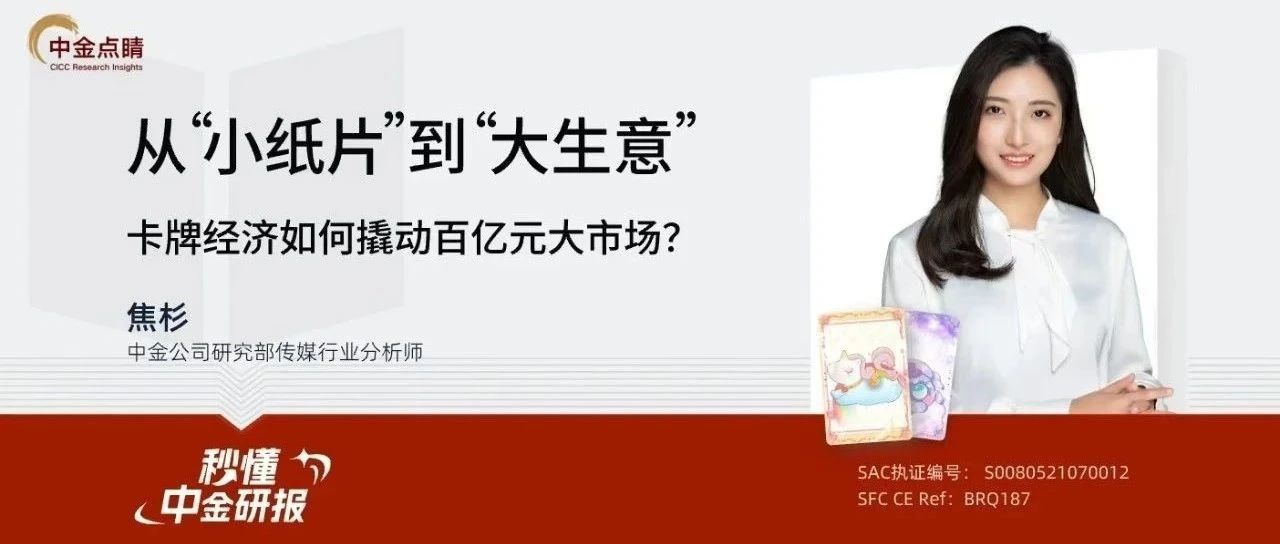
中金《秒懂研报》 | 从“小纸片”到“大生意”:卡牌经济如何撬动百亿元大市场?
中金点睛· 2025-07-19 13:14
Group 1 - The rise of card games has transformed them into trendy consumer products, merging elements of collection, social interaction, investment, and competition, thus creating a new category in consumer goods [1][2] - The card industry has seen rapid growth in China, with the collectible card market projected to reach 26.3 billion yuan by 2024, reflecting a compound annual growth rate of 56.6% from 2019 to 2024 [4][5] - Despite the rapid market growth, per capita spending on cards in China is only 15.7% of that in Japan and 29.2% of that in the United States, indicating significant room for growth [5][6] Group 2 - The consumer base for card games is driven by emotional connections to specific IPs, seeking emotional relief and low-barrier social interactions, leading to a lightweight consumption model [8][10] - Card games create diverse consumption scenarios through various gameplay styles, with competitive play providing intellectual satisfaction and collectible aspects appealing to aesthetic desires [10] - The integration of popular IPs significantly boosts consumer engagement, with 71.3% of consumers purchasing products due to beloved IP elements, demonstrating the effectiveness of content-driven marketing [10][15] Group 3 - The card industry is characterized by a collaborative supply chain involving IP owners, design and production entities, and sales channels, which enhances efficiency and reduces risks [11][13] - Recent trends show vertical integration within the card industry, with companies managing the entire supply chain from IP licensing to production and sales, optimizing profitability [13][15] - Approximately 70% of leading domestic IPs have ventured into card games, with a significant portion of sales coming from local IPs, indicating a strong market presence and potential for further growth [15][17]
中金研究 | 本周精选:宏观、策略、消费
中金点睛· 2025-07-18 14:18
Group 1: Strategy - The capital market's focus on "anti-involution" is increasing, with new policies expected to gradually emerge, particularly in emerging sectors like photovoltaic components, new energy vehicles, energy storage systems, and e-commerce platforms [3] - The policy aims to promote capacity clearance and suppress disorderly competition, with a long-term focus on technological service upgrades and industry structure optimization [3] - Industries previously facing supply-demand imbalances and low-price competition are expected to solidify their profit bottom lines, leading to a more optimized competitive landscape for high-quality development [3] Group 2: Consumption - New consumption growth is sustainable, driven primarily by demand-side factors; companies must build long-term growth capabilities to achieve sustained success [9] - Companies can enhance sustainable growth through innovation, optimizing channels, expanding product categories, promoting mid-to-high-end offerings, and accelerating global expansion [10] Group 3: Macroeconomy - The U.S. Congress is advancing legislation related to cryptocurrencies, with a focus on promoting stablecoins and prohibiting central bank digital currencies (CBDCs) [13] - The motivations for supporting stablecoins include encouraging innovation, increasing demand for U.S. Treasury bonds, and restoring the dominance of the U.S. dollar [13] - The macroeconomic implications of "anti-involution" include addressing excessive competition and resource misallocation, with a focus on promoting reasonable price recovery and sustainable innovation [16]