SAIC MOTOR(600104)

Search documents
国联民生证券:L3级自动驾驶商业化加速 行业有望开启发展新阶段
Zhi Tong Cai Jing· 2025-12-17 06:24
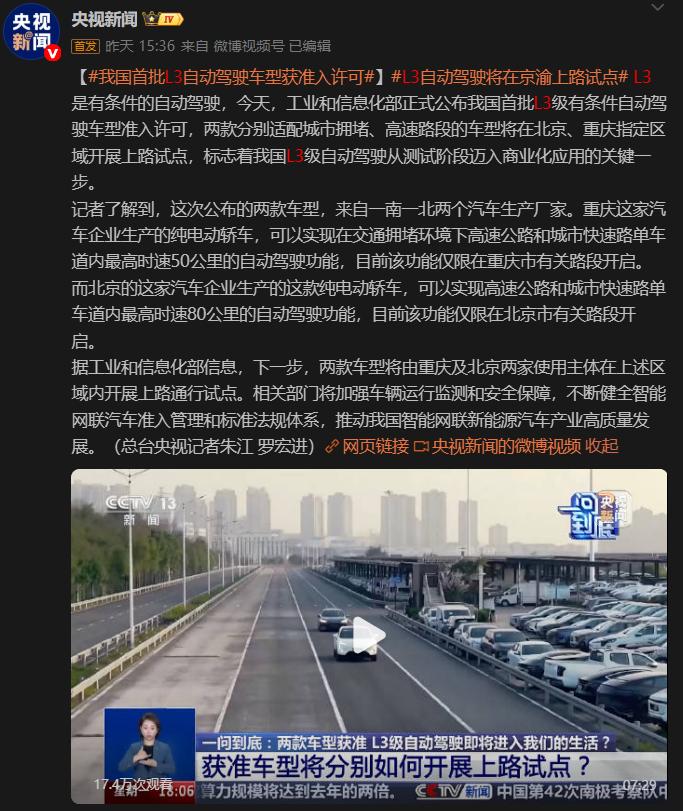
Group 1 - The Ministry of Industry and Information Technology officially announced the first batch of L3 conditional autonomous driving vehicle permits in China, marking a significant step towards the commercialization of L3 autonomous driving [1] - Two models, one from Changan Automobile and another from BAIC BluePark, have received conditional approval for L3 autonomous driving capabilities, with specific operational areas designated in Chongqing and Beijing [1] - The Changan SC7000AAARBEV can operate in congested traffic at speeds up to 50 km/h, while the Arcfox BJ7001A61NBEV can operate at speeds up to 80 km/h on designated highways [1] Group 2 - Multiple domestic automakers, including Changan, BYD, GAC, Dongfeng, SAIC, Geely, Xpeng, and Li Auto, have made substantial progress in the L3 autonomous driving sector, with several models receiving road testing permits [2] - Huawei's QianKun Intelligent Driving ADS L3 solution is undergoing internal testing across multiple cities and models, while GAC's A800 has obtained a license for L3 testing at speeds of up to 120 km/h in Guangzhou [2] - The PhiGo Max, developed by 4D Mapping and its subsidiary, is set for mass production in 2026, targeting the high-end L3 intelligent driving market [2]





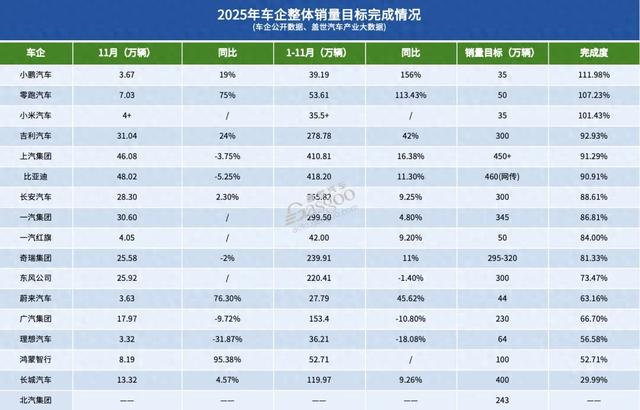
16家车企仅四成有望达成全年销量目标,新能源汽车与出口成关键因素
Xin Lang Cai Jing· 2025-12-17 03:49
Core Viewpoint - As the end of the year approaches, major automotive companies are reporting their sales for November, allowing for predictions on whether they will meet their sales targets for 2025. The total sales targets set by these companies exceed the overall market forecast, indicating that some may not achieve their goals due to intensified competition and fluctuating pricing dynamics [1][3]. Group 1: Sales Performance of Key Companies - Three companies, Leap Motor, Xiaomi Auto, and Xpeng Motors, have already met their 2025 sales targets ahead of schedule, showcasing strong performance in a competitive market [3][4]. - Leap Motor achieved a cumulative sales volume of 536,000 units from January to November, exceeding its target by 7.23% [4]. - Xiaomi Auto delivered over 355,000 units in the same period, surpassing its target of 350,000 units, despite facing production and delivery challenges [5]. - Xpeng Motors reported cumulative deliveries of 392,000 units, achieving a year-on-year growth rate of 156% and exceeding its target of 350,000 units [5][6]. Group 2: Overall Market Trends - The overall automotive market is experiencing pressure on traditional fuel vehicle sales, while the growth of new energy vehicles continues to outpace the market, driving structural transformation in the industry [3][6]. - Major companies like BYD, SAIC, Geely, Changan, and FAW have completion rates above 80%, indicating a relatively stable performance [7][10]. - However, companies with higher sales targets face significant challenges in the final month, needing to sell tens of thousands of vehicles to meet their goals [8][12]. Group 3: Challenges Faced by Other Companies - Companies such as NIO, Great Wall Motors, and Dongfeng have completion rates below 70%, making it unlikely for them to meet their annual targets [14][17]. - NIO, for instance, has a target of 440,000 units but has only delivered about 280,000 units, requiring a significant increase in December sales [14]. - The challenges faced by these companies include overly ambitious targets, lack of competitive new products, and insufficient progress in their new energy segments [14][17]. Group 4: Factors Contributing to Success - Successful companies share common traits, including realistic target setting, clear growth engines, and robust systemic capabilities that enhance their resilience during the year-end push [13][17]. - For example, Geely's Galaxy series has significantly contributed to its sales, while BYD benefits from a comprehensive product matrix supported by its entire supply chain [11][13].




L3商用加速落地,有望推动智能底盘批量应用 | 投研报告
Zhong Guo Neng Yuan Wang· 2025-12-17 02:04
Core Viewpoint - The recent approval of L3-level conditional autonomous driving vehicles by the Ministry of Industry and Information Technology (MIIT) marks a significant step towards the commercialization of advanced autonomous driving technology in China [2][5]. Group 1: L3 Autonomous Driving Approval - Changan Automobile and BAIC BluePark Magna Automotive have submitted applications for L3-level conditional autonomous driving vehicles, which have been approved by MIIT in the 401st batch of announcements [2][3]. - L3 autonomous driving allows for conditional self-driving within a limited operational range, differing fundamentally from L2 assistance systems [2][3]. Group 2: Impact on Intelligent Chassis - The approved vehicles include Changan's Deep Blue product and BAIC's Arcfox Alpha S (L3 version), which features a high-performance redundant sensor system with 34 sensors, including three LiDARs [3][4]. - The commercialization of L3 is expected to accelerate the application of intelligent chassis technologies, such as active suspension, electronic brake-by-wire (EMB), and steer-by-wire (SBW) systems [3][4]. Group 3: Investment Strategy - The approval of L3 vehicles provides policy support for the popularization of high-level autonomous driving, benefiting companies actively engaged in this sector [5]. - Key investment areas include vehicle application, where leading companies are establishing advantages in training data and smart driving ecosystems, and the intelligent chassis sector, which is expected to see rapid mass application by 2026 [5].





真·自动驾驶要来了,但它可能没你想的那么好
3 6 Ke· 2025-12-17 01:23
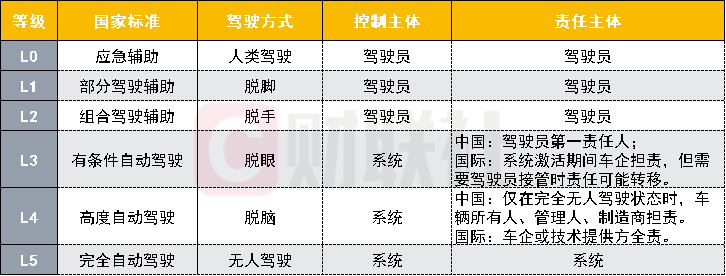
Core Viewpoint - The approval of two new vehicles for L3 conditional autonomous driving marks a significant milestone in the domestic market, transitioning from testing to mass production capabilities, which is expected to invigorate the entire autonomous driving industry [1][12]. Group 1: Industry Impact - The recent news has led to a surge in stock prices for companies related to autonomous driving, indicating a strong market reaction and excitement within the industry [3]. - The approval signifies a shift in focus for car manufacturers from merely developing driver assistance systems to fully embracing autonomous driving technologies [3][12]. - The Ministry of Industry and Information Technology (MIIT) is now the approving authority, which indicates a more formalized regulatory framework for L3 vehicles compared to previous local government approvals [9][12]. Group 2: Technical Specifications - L3 autonomous driving allows vehicles to operate independently under certain conditions, relieving drivers of the need to control the vehicle, and placing liability on the manufacturers in case of accidents [7][12]. - The two approved vehicles are the Changan Deep Blue SL03 and the Arcfox Alpha S6, utilizing advanced technologies from Horizon Robotics and Huawei, respectively [13]. - The operational parameters for these vehicles are still limited, with the SL03 restricted to a maximum speed of 50 km/h on specific roads, and the Alpha S6 allowed up to 80 km/h but also limited to a single lane without overtaking [19][21]. Group 3: Future Outlook - The national standards for L3 autonomous driving are expected to be released for public consultation early next year, which may lead to a rapid increase in the number of L3 vehicles available in the market [15]. - There is an anticipation that 2024 could be a significant year for the mass production of L3 vehicles, as more manufacturers are likely to enter the market [15]. - Despite the advancements, the experience of L3 driving may still be conservative compared to current L2 systems, focusing on safety over efficiency, which may affect consumer adoption [17][21].

L3级自动驾驶车型获附条件准入许可 商业化落地迎来关键节点
Xin Hua She· 2025-12-16 13:41
Core Insights - The Ministry of Industry and Information Technology has officially announced the first batch of L3 conditional autonomous driving vehicle permits in China, marking a significant step from testing to commercial application for L3 autonomous driving [2] Group 1: Vehicle Details - Two models have been approved: a Changan brand electric sedan and a Jihe brand electric sedan, both capable of autonomous driving in congested traffic and on highways, but limited to specific routes in Beijing and Chongqing [3] Group 2: Technology Differentiation - The core difference between L2 assisted driving and L3 conditional autonomous driving lies in the role and responsibility division between the system and the driver, with L3 offering a leap from "assisted driving" to "system-led" experience [4] Group 3: Safety and Regulation - China emphasizes safety as a prerequisite for innovative applications, establishing a systematic approach that covers key technology research, testing evaluation, policy regulations, and scenario validation [5] - The Ministry of Industry and Information Technology plans to collaborate with relevant departments and local authorities to enhance vehicle operation monitoring and safety assurance, continuously improving the management and regulatory framework for intelligent connected vehicles [6]
9.32亿主力资金净流入,网约车概念涨0.89%
Zheng Quan Shi Bao Wang· 2025-12-16 09:53
Group 1 - The ride-hailing concept sector increased by 0.89%, ranking second among concept sectors, with 16 stocks rising, including Baic Blue Valley and Jinjiang Online hitting the daily limit [1] - Notable gainers in the sector included Tongda Electric, Xiongdi Technology, and Dazhong Transportation, which rose by 7.01%, 7.00%, and 4.61% respectively [1] - The biggest decliners were Longzhou Co., Yinhui Technology, and Tianmai Technology, which fell by 9.97%, 4.06%, and 3.56% respectively [1] Group 2 - The ride-hailing sector saw a net inflow of 932 million yuan from main funds, with 13 stocks receiving net inflows, and 6 stocks exceeding 50 million yuan in net inflow [2] - Baic Blue Valley led the net inflow with 725 million yuan, followed by Jinjiang Online, Changan Automobile, and SAIC Motor with net inflows of 176 million yuan, 109 million yuan, and 96.88 million yuan respectively [2] - In terms of net inflow ratio, Jinjiang Online, Baic Blue Valley, and Tongda Electric had the highest ratios at 49.32%, 24.55%, and 13.68% respectively [2]

研报掘金丨爱建证券:首予上汽集团“买入”评级,经营表现有望逐步回升
Ge Long Hui· 2025-12-16 06:19
Core Viewpoint - The report from Aijian Securities highlights SAIC Motor Corporation's comprehensive automotive industry chain and diverse brand matrix, indicating a positive outlook for the company's operational performance due to restructuring and strategic partnerships [1] Group 1: Company Overview - SAIC Motor has a complete automotive industry chain, including passenger vehicles (Roewe, Feifan, Zhiji, etc.), SAIC Volkswagen, SAIC General Motors, SAIC Wuling, and Maxus [1] - The company is restructuring its passenger vehicle segment by integrating the Roewe and Feifan brands to enhance operational efficiency and resource synergy [1] Group 2: Strategic Initiatives - SAIC is collaborating closely with Huawei to launch a new brand "Shangjie," targeting the mainstream smart electric vehicle market priced between 150,000 to 200,000 yuan, leveraging consumer electronics experience to improve product quality and user experience [1] - The company is accelerating the industrialization of cutting-edge technologies such as solid-state batteries [1] Group 3: Market Performance - The expected outcomes of the company's reforms are anticipated to gradually manifest, with operational performance likely to improve over time [1] - Core models of the self-owned brands, such as Shangjie and Zhiji, have seen rapid monthly sales growth, stabilizing above 10,000 units [1] - Sales growth for joint venture brands SAIC Volkswagen and SAIC General Motors has returned to positive year-on-year growth [1] - Export and overseas base sales continue to show stable positive growth [1] Group 4: Valuation and Investment Recommendation - The company's valuation is below the average of comparable companies, and considering its proactive push towards electric and intelligent transformation along with strengthened external collaborations, it is given a "Buy" rating for the first coverage [1]
16只L3自动驾驶产业链概念股曝光
2 1 Shi Ji Jing Ji Bao Dao· 2025-12-16 05:45
Core Insights - The news highlights a significant breakthrough in the commercialization of L3-level autonomous driving in China, with the Ministry of Industry and Information Technology officially granting the first conditional licenses for L3 autonomous vehicles [1][3]. Group 1: Market Activity - Several companies in the autonomous driving sector saw their stock prices surge, with Hanxin Technology reaching a 30% limit up, and other companies like Wanjie Technology and Zhejiang Shibao also hitting their daily limits [1]. - The market enthusiasm is driven by the recent regulatory approval for L3-level autonomous vehicles, indicating a shift from testing to commercial application [1]. Group 2: Regulatory Developments - The Ministry of Industry and Information Technology has approved two models for L3-level autonomous driving, which will operate in designated areas of Beijing and Chongqing, marking a critical step towards commercial deployment [1][3]. - The L3-level autonomous driving classification allows vehicles to take over driving tasks under specific conditions, although drivers must remain alert and ready to take control [1][2]. Group 3: Industry Competition - Major automotive companies are competing to establish timelines for mass production of L3 vehicles, with many setting 2025-2026 as a crucial period for development [3][4]. - Companies like GAC Group and Huawei are actively testing their L3 technologies in major cities, preparing for commercial launch [4]. Group 4: Policy and Infrastructure - The recent policy changes have facilitated the expansion of testing areas for autonomous vehicles, with cities like Shanghai and Beijing designating extensive road networks for trials [3]. - The ethical guidelines released by the Ministry of Science and Technology further clarify responsibility in case of accidents, which is essential for the industry's growth [3]. Group 5: Investment Opportunities - The news lists several companies involved in the autonomous driving sector, providing insights into their market capitalization and stock performance, indicating potential investment opportunities [6].
A股,大跌!
中国基金报· 2025-12-16 05:33
Market Overview - The A-share market experienced a collective decline on December 16, with the Shanghai Composite Index falling to 3820.85 points, down 1.22%, the Shenzhen Component Index down 1.88%, and the ChiNext Index down 2.35% [2][3] - The total trading volume in the Shanghai and Shenzhen markets was 1.12 trillion yuan, a decrease of 606 billion yuan compared to the previous trading day [4] Sector Performance - The smart driving sector saw significant gains, with multiple stocks in the automotive sector rising sharply. Notable stocks included Wanji Technology, which recorded a 20% increase, and several others achieving the daily limit of 10% [15][16] - Consumer sectors, including restaurant tourism and commercial retail, continued to rise, with several stocks hitting the daily limit. For instance, Yonghui Supermarket and Baida Group both recorded a 10% increase [9][10] - Conversely, the large technology sector experienced a downturn, while precious metals, communication equipment, and chemical sectors led the declines [4][5] Notable Stocks - In the smart driving sector, several companies such as North Car Blue Valley and Changan Automobile saw increases of over 5% [18][19] - The hospitality sector also showed strength, with Junting Hotel rising nearly 7% and other hotel stocks following suit [11][12] Regulatory News - On December 15, the Ministry of Industry and Information Technology announced the approval of the first batch of L3-level autonomous driving vehicles for trial operations in designated areas of Beijing and Chongqing [20]



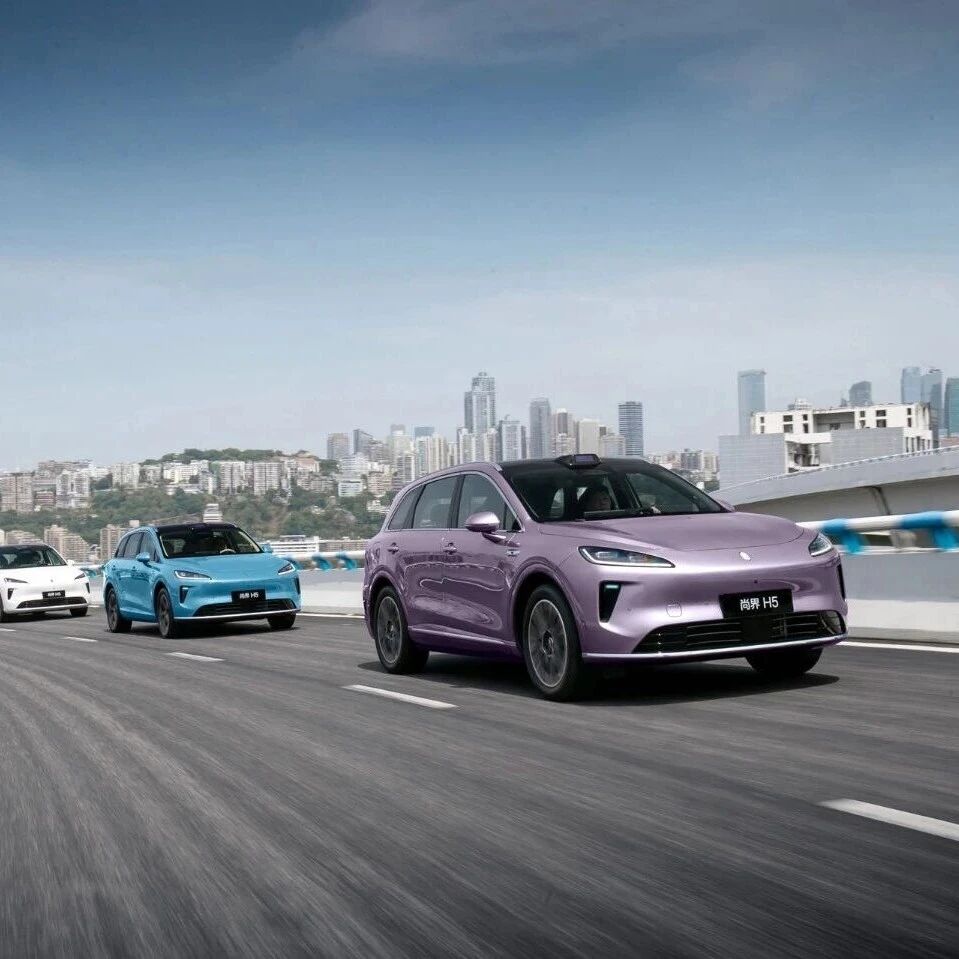
鸿蒙智行最美轿跑,华为把“最锋利”的一刀交给尚界
华尔街见闻· 2025-12-16 04:49
Core Viewpoint - The article discusses how the automotive industry, particularly the collaboration between SAIC Motor and Huawei, is poised to disrupt the market with the launch of the new brand "Shangjie" and its first model, the Shangjie H5, which has achieved significant early success in a challenging environment [2][4][10]. Group 1: Market Context and Competitive Landscape - In a competitive environment where new technologies are quickly replicated, some companies manage to enter the market effectively, exemplified by Pinduoduo in e-commerce [2]. - The automotive industry is currently dominated by the themes of new energy and new forces, with SAIC Motor preparing to make a significant impact through its partnership with Huawei [2][4]. Group 2: Product Launch and Initial Success - The Shangjie H5 has achieved a remarkable delivery volume of 20,000 units, making it the fastest new brand to surpass 10,000 units after its launch [2][4]. - The success of the Shangjie H5 is notable given the declining demand in the fourth quarter and the overall reduction in industry expectations [4][7]. Group 3: Strategic Collaboration and Resource Utilization - The partnership between SAIC and Huawei is crucial for the success of the Shangjie brand, leveraging Huawei's technology and SAIC's manufacturing capabilities [10][28]. - SAIC has invested nearly 30 billion yuan to upgrade its manufacturing facilities to ensure quality and efficiency in production [12][35]. Group 4: Consumer Insights and Market Demand - The Shangjie H5 has demonstrated a strong market response, particularly in the 150,000 to 200,000 yuan price range, challenging previous assumptions about consumer price sensitivity [11][12]. - The vehicle addresses consumer demands for safety and advanced technology, indicating a shift in market expectations [12][11]. Group 5: Future Product Development and Market Strategy - The next model from Shangjie is expected to be a high-end coupe, targeting the younger consumer demographic and aiming to redefine the market for sporty vehicles [19][21]. - The strategic focus on aesthetics and performance is intended to position Shangjie as a strong competitor in the high-end segment, potentially rivaling established European brands [21][24].