HAIER SMART HOME(600690)

Search documents
海尔智家:拟最高回购100万股D股并注销减少注册资本
Xin Lang Cai Jing· 2026-01-20 09:16
海尔智家公告称,根据2024年年度股东大会授权,拟推出D股股份回购计划,拟回购资金总额最高不超 3000万欧元(不含相关费用),最大数量不超100万股,约占公司D股股本的0.369%、总股本的 0.011%。回购的D股将被注销以减少注册资本。本次回购将于2026年1月21日或前后开始,持续至2026 年7月20日,可根据情况停止、暂停或恢复。 ...

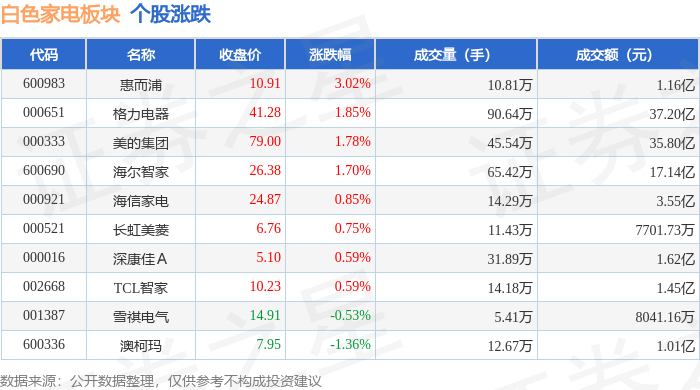
白色家电板块1月20日涨1.72%,惠而浦领涨,主力资金净流入8.44亿元
Zheng Xing Xing Ye Ri Bao· 2026-01-20 08:51
Core Viewpoint - The white goods sector experienced a rise of 1.72% on January 20, led by Whirlpool, while the overall market indices showed slight declines [1]. Group 1: Market Performance - The Shanghai Composite Index closed at 4113.65, down 0.01% [1]. - The Shenzhen Component Index closed at 14155.63, down 0.97% [1]. - The white goods sector saw a net inflow of 844 million yuan from main funds, while retail investors experienced a net outflow of 378 million yuan [1]. Group 2: Individual Stock Performance - Whirlpool (600983) closed at 10.91 yuan, up 3.02%, with a trading volume of 108,100 hands and a transaction value of 116 million yuan [1]. - Gree Electric (000651) closed at 41.28 yuan, up 1.85%, with a trading volume of 906,400 hands and a transaction value of 3.72 billion yuan [1]. - Midea Group (000333) closed at 79.00 yuan, up 1.78%, with a trading volume of 455,400 hands and a transaction value of 3.58 billion yuan [1]. - Haier Smart Home (600690) closed at 26.38 yuan, up 1.70%, with a trading volume of 654,200 hands and a transaction value of 1.71 billion yuan [1]. - Hisense Home Appliances (000921) closed at 24.87 yuan, up 0.85%, with a trading volume of 142,900 hands and a transaction value of 355 million yuan [1]. Group 3: Fund Flow Analysis - Gree Electric saw a main fund net inflow of 4.26 billion yuan, while retail investors had a net outflow of 2.02 billion yuan [2]. - Midea Group had a main fund net inflow of 4.05 billion yuan, with retail investors experiencing a net outflow of 793.78 million yuan [2]. - Haier Smart Home recorded a main fund net inflow of 1.16 billion yuan, while retail investors had a net outflow of 1.58 billion yuan [2]. - Hisense Home Appliances faced a net outflow of 441.9 million yuan from main funds, but retail investors had a net inflow of 258.89 million yuan [2].





国补高基数下12月社零同增0.9%
HTSC· 2026-01-20 02:02
Investment Rating - The report maintains a "Buy" rating for the consumer discretionary sector, highlighting structural investment opportunities [5][10]. Core Insights - The report indicates that in December, the total retail sales of consumer goods increased by 0.9% year-on-year to 4.5 trillion yuan, with a month-on-month decline of 0.4 percentage points, primarily due to high base effects from durable goods like automobiles and home appliances [7][9]. - The report emphasizes the importance of the new round of trade-in policies for 2026, which focus on core home appliance categories and expand into new categories like smart glasses and products for the elderly, supporting demand in these segments [7]. - The report suggests that consumer sentiment remains strong, particularly in sectors like emotional consumption, technology consumption, and undervalued high-dividend stocks, recommending a focus on domestic brands and global brand expansion [10]. Summary by Sections Retail Sales Performance - In December, retail sales of food and beverages grew by 2.2% and 0.7% respectively, with urban and rural retail sales increasing by 0.7% and 1.7% year-on-year [8]. - Online retail sales of physical goods in December increased by 0.8% year-on-year, with a total annual growth of 5.2%, accounting for 26.1% of total retail sales [8]. Consumer Categories - The report notes a structural differentiation in consumer categories, with home appliances, building materials, and furniture experiencing declines of 18.7%, 11.8%, and 2.2% respectively due to high base effects and trade-in policy impacts [9]. - Conversely, communication equipment saw a significant increase of 20.9% year-on-year, while emotional and self-care products like sports and entertainment goods and cosmetics grew by 9.0% and 8.8% respectively [9]. Investment Recommendations - The report identifies four main investment themes: 1. Rise of domestic brands and global brand expansion, recommending companies like Pop Mart, Shangmei, and Anta Sports [10]. 2. Technology consumption empowered by AI, recommending companies like Midea Group and Haier Smart Home [10]. 3. Emotional consumption, recommending companies like Gu Ming and Yum China [10]. 4. Undervalued high-dividend blue-chip leaders, recommending companies like Li Ning and Shenzhou International [10]. Company-Specific Insights - For Smoore International (6969 HK), the report forecasts a revenue of 10.21 billion yuan for Q1-3 2025, with a year-on-year growth of 21.8%, and maintains a "Buy" rating with a target price of 27.00 HKD [48]. - For Juzhibio (2367 HK), the report highlights the approval of a new collagen product, projecting significant sales potential and maintaining a "Buy" rating with a target price of 85.00 HKD [49]. - For Pop Mart (9992 HK), the report notes a revenue increase of 245-250% in Q3 2025, driven by strong performance in both domestic and international markets, maintaining a "Buy" rating with an updated target price of 410 HKD [51].


家电行业周报(26年第3周):12月家电内外销景气持续承压,美国家电需求回归稳健增长
Guoxin Securities· 2026-01-20 00:45
Investment Rating - The report maintains an "Outperform the Market" rating for the home appliance industry [5][6][12]. Core Views - The home appliance sector is expected to recover in 2026, driven by the continuation of national subsidies and stabilization of exports, suggesting a positive outlook for leading white goods companies [1][12][18]. - December retail performance for home appliances showed signs of bottoming out, with significant declines in major appliances but a relatively stable performance in small appliances [1][19]. - The report highlights the resilience of leading companies in the home appliance sector, with a focus on white goods, which are expected to maintain steady growth despite high base effects [12][13]. Summary by Sections 1. Key Recommendations - Recommended companies include Midea Group, Haier Smart Home, TCL Smart Home, Gree Electric Appliances, and Hisense Home Appliances for white goods; Hisense Visual for black goods; and Roborock, Bear Electric, and Ecovacs for small appliances [4][12][13]. 2. December Retail Performance - In December, the retail sales of major appliances saw declines exceeding 20%, while small appliances showed slightly better demand, with air fryers experiencing growth [1][19]. - The offline sales channels for major appliances faced declines of over 40%, while kitchen small appliances remained relatively stable [1][19]. 3. Export Performance - In December, China's home appliance exports decreased by 8.1% year-on-year, with air conditioners facing a significant decline of 20.7% [2][37]. - Other categories like refrigerators and washing machines showed modest growth, indicating a mixed performance across different product lines [2][37]. 4. U.S. Market Insights - U.S. retail sales for home appliances showed a slight increase of 0.8% in November, indicating a gradual return to stable growth despite challenges such as tariffs and inflation [3][43]. - The inventory levels in U.S. appliance stores are returning to normal, suggesting improved market conditions [3][43]. 5. Company Earnings Forecasts - The report provides earnings forecasts for key companies, indicating expected EPS growth for Midea Group, Gree Electric Appliances, and Haier Smart Home, among others, with all rated as "Outperform the Market" [5][76].


完成超10亿元B轮融资 海尔新能源冲击IPO!海尔系欲拓A股版图
Bei Jing Shang Bao· 2026-01-19 14:10
Group 1 - Haier New Energy has completed over 1 billion yuan in Series B financing, with participation from multiple financial and industrial investors, and has initiated IPO guidance [1][4] - The company focuses on "green energy + energy storage + smart energy controllers," providing integrated services for photovoltaic and energy storage systems [3][4] - Haier Group's capital expansion includes 8 listed platforms across A and H shares, with a market value of approximately 328.95 billion yuan as of January 19 [5][6] Group 2 - The trend of household appliance giants entering the new energy sector is becoming prominent, with competitors like Midea, TCL, and Skyworth also making significant investments in photovoltaic and energy storage [8][9] - The shift towards new energy is driven by the need for household energy management solutions, transforming homes from mere energy consumers to "prosumers" [10][11] - Appliance companies have advantages in customer acquisition and service capabilities, making them well-positioned in the new energy market compared to traditional energy firms [11]
家电行业周报(26年第3周):12月家电内外销景气持续承压,美国家电需求回归稳健增长-20260119
Guoxin Securities· 2026-01-19 09:50
Investment Rating - The report maintains an "Outperform the Market" rating for the home appliance industry [5][6][12] Core Insights - The home appliance sector is expected to recover in 2026, driven by the continuation of national subsidies and improvements in export performance. It is recommended to actively invest in leading white goods companies [1][12][18] - December retail performance for home appliances showed signs of bottoming out, with major appliances experiencing a decline of over 20% in domestic retail sales, while small appliances showed slightly better demand [1][19] - The report highlights that the U.S. home appliance retail sales saw a slight increase in November, indicating a gradual return to stable growth despite challenges such as tariffs and inflation [3][12] Summary by Sections 1. Core Recommendations - Key recommendations include investing in leading companies in the white goods sector such as Midea Group, Haier Smart Home, TCL Smart Home, Gree Electric, and Hisense Home Appliances. For small appliances, Stone Technology and Bear Electric are recommended [4][12][13] 2. Research Tracking and Investment Thoughts - December retail performance for home appliances continued to face pressure due to high base effects, with significant declines in major appliances. However, small appliances showed relative stability, particularly in air fryers [1][19] - December exports of home appliances decreased by 8.1% year-on-year, with air conditioners facing the most significant pressure, while refrigerators and washing machines showed modest growth [2][37] - U.S. home appliance retail sales increased by 0.8% year-on-year in November, with inventory levels returning to normal [3][12] 3. Key Data Tracking - The home appliance sector achieved a relative return of +0.23% this week compared to the broader market [49] - Raw material prices for copper and aluminum decreased by 0.5% and 0.7% respectively, while cold-rolled steel prices also saw a decline [51] - Shipping indices for routes to the U.S. West Coast, East Coast, and Europe showed slight increases, indicating a stabilization in shipping costs [64] 4. Company Announcements and Industry Dynamics - Notable company announcements include Midea Group's ongoing efforts in overseas markets and Gree Electric's dividend distribution plans [71][72] - The report discusses the structural adjustments in the air conditioning export market and the anticipated trends for 2026, highlighting the challenges and opportunities in the global supply chain [74]

白色家电板块1月19日涨0.55%,雪祺电气领涨,主力资金净流入3.07亿元
Zheng Xing Xing Ye Ri Bao· 2026-01-19 08:52
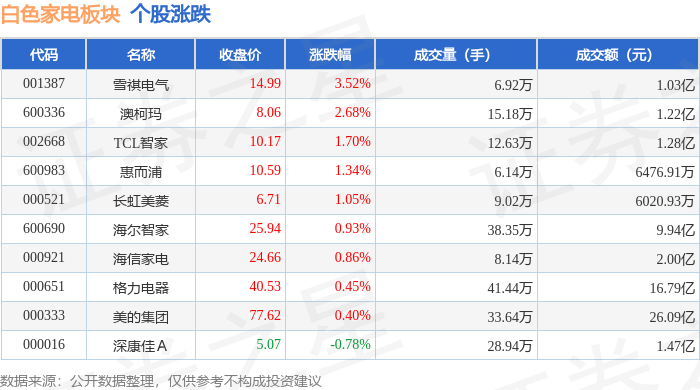
Core Viewpoint - The white goods sector experienced a slight increase of 0.55% on January 19, with Xueqi Electric leading the gains, while the Shanghai Composite Index rose by 0.29% and the Shenzhen Component Index by 0.09% [1] Group 1: Market Performance - The closing price of Xueqi Electric was 14.99, reflecting a rise of 3.52% with a trading volume of 69,200 shares and a transaction value of 103 million yuan [1] - Aokema closed at 8.06, up by 2.68%, with a trading volume of 151,800 shares [1] - TCL Smart Home's closing price was 10.17, increasing by 1.70% with a trading volume of 126,300 shares [1] - Whirlpool closed at 10.59, up by 1.34%, with a transaction value of approximately 64.76 million yuan [1] - Haier Smart Home's closing price was 25.94, reflecting a 0.93% increase with a trading volume of 383,500 shares [1] - Gree Electric's closing price was 40.53, up by 0.45%, with a transaction value of approximately 1.68 billion yuan [1] - Midea Group closed at 77.62, increasing by 0.40%, with a transaction value of approximately 2.61 billion yuan [1] Group 2: Fund Flow Analysis - The white goods sector saw a net inflow of 307 million yuan from institutional investors, while retail investors contributed a net inflow of 211 million yuan [1] - The net outflow from speculative funds was 518 million yuan [1] - Midea Group had a net inflow of 149 million yuan from institutional investors, while it experienced a net outflow of 372 million yuan from speculative funds [2] - Gree Electric saw a net inflow of 121 million yuan from institutional investors, with a net outflow of 117 million yuan from speculative funds [2] - Haier Smart Home had a net inflow of approximately 67.83 million yuan from institutional investors, while it faced a net outflow of 16.48 million yuan from speculative funds [2]


Leader召开三筒洗衣机用户共创分享会
Zhong Guo Jin Rong Xin Xi Wang· 2026-01-19 06:52
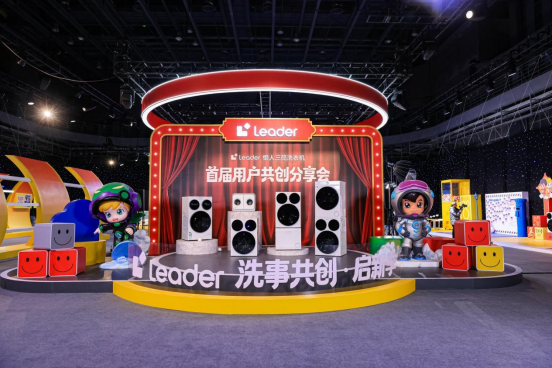
Core Insights - The event "Washing Co-Creation: New Season" hosted by Leader showcased user stories on integrating daily life expectations into product innovation and design, particularly focusing on the new three-tub washing machine [1][3] Group 1: User Engagement and Product Development - The initiative began with in-depth visits to user homes, revealing a common demand for convenience in laundry solutions, leading to the design of the three-tub washing machine [5][6] - User feedback was actively solicited, resulting in over 12,000 suggestions that informed product iterations, including features like "wash-dry integration" and space-saving installations [6] - The three-tub washing machine achieved a total sales volume of 300,000 units by 2025, reflecting its acceptance and popularity among consumers [6] Group 2: User-Centric Innovation - The event highlighted personal stories from users, illustrating how the three-tub washing machine has become an integral part of their daily lives, enhancing convenience and promoting good habits among family members [7][8] - The shared experiences emphasized the machine's versatility, such as separate washing for pet items, showcasing the technology's role in simplifying household tasks [7] - The co-creation model demonstrated that true innovation stems from deep insights into user lifestyles and continuous listening to their needs, reinforcing the relationship between the company and its customers [9]
海尔智家董事长李华刚:2025年海尔沙特销售收入同比增长39%,增速远超行业平均水平
Xin Lang Cai Jing· 2026-01-19 03:47
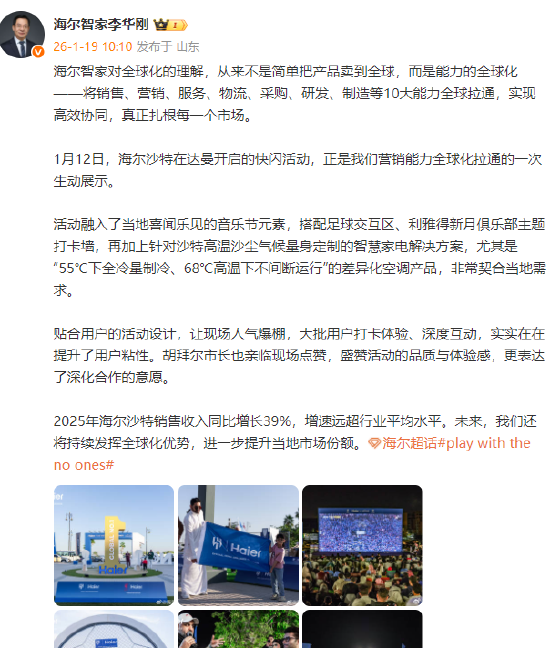
1月19日消息,海尔智家董事长兼总裁李华刚发微博表示,2025年海尔沙特销售收入同比增长39%,增 速远超行业平均水平。未来,我们还将持续发挥全球化优势,进一步提升当地市场份额。 以下为微博原文: 海尔智家对全球化的理解,从来不是简单把产品卖到全球,而是能力的全球化——将销售、营销、服 务、物流、采购、研发、制造等10大能力全球拉通,实现高效协同,真正扎根每一个市场。 1月12日,海尔沙特在达曼开启的快闪活动,正是我们营销能力全球化拉通的一次生动展示。 活动融入了当地喜闻乐见的音乐节元素,搭配足球交互区、利雅得新月俱乐部主题打卡墙,再加上针对 沙特高温沙尘气候量身定制的智慧家电解决方案,尤其是"55℃下全冷量制冷、68℃高温下不间断运 行"的差异化空调产品,非常契合当地需求。 贴合用户的活动设计,让现场人气爆棚,大批用户打卡体验、深度互动,实实在在提升了用户粘性。胡 拜尔市长也亲临现场点赞,盛赞活动的品质与体验感,更表达了深化合作的意愿。 2025年海尔沙特销售收入同比增长39%,增速远超行业平均水平。未来,我们还将持续发挥全球化优 势,进一步提升当地市场份额。 责任编辑:李思阳 1月19日消息,海尔智家董事 ...
海尔沙特举办主题快闪活动
Jin Tou Wang· 2026-01-19 03:09
Core Insights - Haier Saudi Arabia launched a five-day themed pop-up event in Dammam, integrating football elements to create an immersive interactive experience while showcasing a full range of high-end products including air conditioners, televisions, refrigerators, and washing machines [1][3] Group 1: Event and Local Engagement - The event received high praise from Mayor Hussein of Al Khobar, who commended Haier's commitment to enriching local life with high-quality home appliances and expressed a desire for deeper collaboration [3] - The interactive design of the event included a football-themed interaction area and a photo wall featuring Al Hilal Football Club, enhancing user engagement and brand affinity through cultural integration [3] Group 2: Product Innovation and Market Adaptation - Haier's UVC variable frequency air conditioner emerged as a star product, effectively addressing the challenges of extreme heat and dust in Saudi Arabia, capable of maintaining stable cooling efficiency even at outdoor temperatures of 55°C and above [5] - The product lineup also included a washing machine designed for traditional attire, a high-refresh-rate television with Dolby Vision, and a large-capacity refrigerator with advanced preservation and sterilization features, catering to diverse high-end home needs [5] Group 3: Market Performance and Future Strategy - Haier Saudi Arabia is projected to achieve a 39% year-on-year increase in sales revenue by 2025, significantly outpacing the industry average [7] - The Dammam pop-up event exemplifies Haier's global strategy of localized marketing, which will be replicated in countries such as Thailand, Japan, Kazakhstan, Egypt, Germany, and France to enhance user experience and solidify its leading position in the global market [7]