
Guotai Haitong Securities(601211)

Search documents
国泰海通:维持钢铁供给端收缩的预期 行业基本面有望逐步修复
智通财经网· 2025-11-24 03:16
Group 1 - The core viewpoint of the report is that the steel industry is rated as "overweight," with expectations for long-term development driven by increased industry concentration and high-quality growth. Companies with product structure and cost advantages are expected to benefit significantly [1] - The apparent demand for steel from the five major steel mills increased by 3.90% week-on-week to 8.94 million tons, while year-on-year demand decreased by 2.01%. The production of steel was 8.5 million tons, a decrease of 16,000 tons week-on-week, and total inventory fell by 440,000 tons to 14.33 million tons [1] - In October, crude steel production was 71.8 million tons, down 12.10% year-on-year, and pig iron production was 65.55 million tons, down 7.9% year-on-year. Cumulative steel exports reached 97.74 million tons, an increase of 6.6% year-on-year [1] Group 2 - The average gross profit for rebar was 61 yuan per ton, down 20 yuan per ton from the previous week, while hot-rolled coil had an average gross profit of -65 yuan per ton, down 48 yuan per ton [2] - The profitability rate of 247 surveyed steel companies was 37.66%, a decrease of 1.30 percentage points from the previous week, indicating an expansion of losses among steel companies due to reduced demand [2] - The new construction in the real estate sector has decreased by over 70% from its peak, significantly reducing the impact on total domestic steel demand. However, demand from infrastructure and manufacturing sectors has remained stable [3] Group 3 - The steel demand is expected to stabilize gradually, while supply is anticipated to continue contracting. Over 60% of surveyed steel companies reported losses, indicating a market clearing process is beginning [3] - The recently released "Steel Industry Stabilization and Growth Work Plan (2025-2026)" emphasizes the continuation of production reduction policies to support advanced enterprises and phase out inefficient capacities, promoting dynamic balance between supply and demand [3]

君实生物、国泰海通等新设健康并购股权投资基金
Zheng Quan Shi Bao Wang· 2025-11-24 02:15
Core Viewpoint - The establishment of the Anhui Gaotou Guotai Haitong Health M&A Equity Investment Fund Partnership (Limited Partnership) with a capital contribution of 500 million yuan indicates a strategic move towards private equity investment in the health sector [1] Group 1 - The newly formed fund will engage in activities such as private equity investment, investment management, and asset management [1] - The fund is co-funded by Junshi Biosciences and Guotai Haitong's wholly-owned subsidiary, Guotai Junan Innovation Investment Co., Ltd. [1]


国泰海通:AI点亮灯塔工厂 引领智能制造新范式
智通财经网· 2025-11-24 02:12
Core Insights - The report from Guotai Junan highlights the evolution of lighthouse factories as key carriers of new productive forces and new industrialization, driven by AI and the "14th Five-Year Plan" [1][2] - The integration of AI into manufacturing is seen as a top-level driver for the development of lighthouse factories, with a focus on digital transformation through industrial software and automation vendors [1] Group 1: Lighthouse Factory Evolution - Lighthouse factories have transitioned from being technology models to global smart manufacturing hubs, representing the highest level of intelligent manufacturing [1] - These factories leverage new technologies such as IoT, AI, cloud computing, and robotics to achieve comprehensive automation, precision, and sustainability in production processes [1] - The assessment focus of lighthouse factories has evolved from single-point applications of Industry 4.0 to a comprehensive operational upgrade that includes sustainability, supply chain resilience, talent systems, and customer orientation [1] Group 2: Policy and AI Driving Growth - The Chinese government has integrated digitalization, networking, intelligence, and greening into the main line of manufacturing development, viewing smart and lighthouse factories as crucial for new productive forces and advanced manufacturing clusters [2] - Local governments are providing financial subsidies, pilot demonstrations, and industrial funds to cultivate smart and lighthouse factories, creating a complete policy chain from diagnosis to demonstration [2] - The industry layout of lighthouse factories in China is extending into high-tech fields, with core operational indicators significantly surpassing the global average [2] Group 3: Domestic Industrial Software and Hardware Vendors - Domestic companies are focusing on industrial software, automation control, industrial internet, and AI models to provide comprehensive capabilities for lighthouse factories, from "factory operating systems" to scenario-based solutions [3]
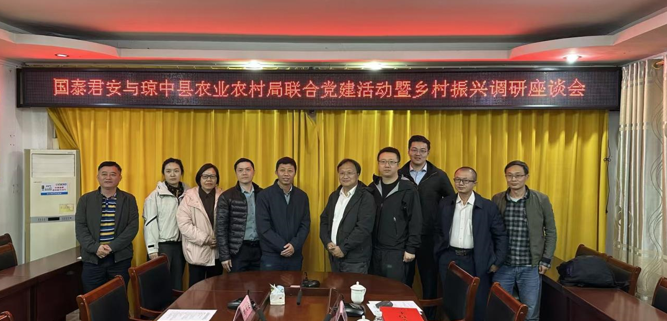
国泰君安期货赴海南省琼中县开展党建活动暨乡村振兴调研座谈会
Qi Huo Ri Bao Wang· 2025-11-24 01:43
Core Viewpoint - The event aims to promote agricultural development in Qiongzhong County through the integration of party building and business collaboration, enhancing the application of the "insurance + futures" financial service model in local practices [1][2]. Group 1: Event Overview - The event was organized by Guotai Junan Futures, Guotai Junan Risk Management Co., and the Agricultural and Rural Affairs Bureau of Qiongzhong Li and Miao Autonomous County, with strong support from the Shanghai Futures Exchange [1]. - The meeting included discussions on the current state of agricultural development in Qiongzhong County and emphasized the core role of party leadership in rural revitalization [2]. Group 2: Company Initiatives - Guotai Junan Futures has been committed to the "financial patriotism" philosophy, focusing on providing professional risk management and price hedging services to support the agricultural industry [2]. - Since 2017, Guotai Junan Futures has collaborated with China People's Property Insurance Co., Ltd. to implement the "insurance + futures" project in Qiongzhong County, with a cumulative coverage of 26,500 tons of natural rubber [2]. - The project for this year was successfully launched in September, covering 3,000 tons of natural rubber for a three-month period, reinforcing the effectiveness of financial tools in supporting local industries [2]. Group 3: Future Plans - The event represents an important step for Guotai Junan Futures in implementing the national rural revitalization strategy and deepening the integration of party building with business [2]. - The company plans to continue strengthening collaboration with local governments and agricultural operators, optimizing service mechanisms to inject robust financial momentum and professional support into rural revitalization in Qiongzhong County [2].

国泰海通:市场风险已大幅释放 坚决看好中国市场前景
智通财经网· 2025-11-23 23:05
Core Viewpoint - The report from Guotai Junan emphasizes a positive outlook for the Chinese market despite recent volatility, suggesting that the market is entering a favorable phase for investment as it approaches a critical window of policy and liquidity support from December to February [1][2]. Market Analysis - The Chinese stock market has experienced significant declines, with the ChiNext index down 12%, the STAR 50 index nearly 20%, and the Hang Seng Tech index down 22%, indicating that the market has already released much of its risk [1]. - The report highlights that the current pessimism among investors is driven by year-end profit protection, reduced positions, and external factors such as the cooling of Fed rate cut expectations and increased volatility in U.S. markets [1][2]. Investment Strategy - Guotai Junan recommends increasing exposure to the Chinese market, particularly in technology, financial services, and consumer sectors, as the market is expected to stabilize and embark on a rally [1][3]. - Specific sectors to focus on include: - **Technology**: Growth in AI applications and infrastructure, with recommendations for internet, media, computing, and manufacturing sectors [3]. - **Financial Services**: Anticipated reforms in the capital market and early bank dividends, with a focus on brokerage and insurance stocks [3]. - **Consumer Goods**: Opportunities in low-priced, low-inventory consumer stocks, particularly in food, beverages, and tourism sectors, as macroeconomic risks decrease [3]. Future Outlook - The Chinese capital market is positioned for significant growth, with expectations of double-digit profit growth in non-financial sectors by 2026, driven by improved cash flows and reduced debt [2]. - The report suggests that the historical "guaranteed return" mindset is shifting, leading to increased asset management demand and a potential influx of new capital into the market [2].
国泰君安期货·能源化工天然橡胶周度报告-20251123
Guo Tai Jun An Qi Huo· 2025-11-23 13:44
1. Report Industry Investment Rating No relevant information provided. 2. Core View of the Report - The natural rubber market is expected to trade in a narrow range in the short term. The domestic production areas are gradually entering the production - reduction and suspension season, and rainfall in southern Thailand and Vietnam continues to cause disruptions. The upstream raw material prices are likely to rise and difficult to fall, and the cost side still has strong support. However, the arrival of overseas shipments shows a seasonal increase trend, and the inventory accumulation of natural rubber remains unchanged, suppressing spot prices. There are still differences between bulls and bears in the market, and there is a lack of positive drivers [106][107]. 3. Summary by Relevant Catalogs 3.1 Industry News - In October 2025, China's rubber tire outer - tube production was 97.951 million pieces, a year - on - year decrease of 2.5%. From January to October, the production increased by 1% year - on - year to 996.421 million pieces. China's rubber tire exports from January to October reached 8.03 million tons, a year - on - year increase of 3.8%, and the export value was 140.2 billion yuan, a year - on - year increase of 2.8% [5]. - The Ghana Rubber Processors Association (RUPAG) supports the government's decision to restrict raw rubber exports in the "Revitalization Industry Plan" of the 2026 budget statement. The association plans to increase the country's dry rubber production from the current 100,000 tons to 250,000 tons by 2035 [6]. - The Malaysian government aims to increase natural rubber production to at least 400,000 tons of cup lump rubber and 20,000 tons of latex, which is expected to save 4 billion ringgit by reducing import dependence [7]. 3.2 Market Trends - This week, the domestic natural rubber market rose, while the overseas market was divided. SGX TSR20 slightly declined, and JPX RSS3 rose. On November 21, 2025, the closing price of RU2601.SHF was 15,240 yuan/ton, a week - on - week increase of 0.16%; the closing price of NR2601.SHF was 12,285 yuan/ton, a week - on - week increase of 0.16%; the closing price of Singapore TSR20:2601 was 170.90 cents/kg, a week - on - week decrease of 0.35%; the closing price of Tokyo RSS3:2601 was 333.30 yen/kg, a week - on - week increase of 2.62% [10][12]. 3.3 Price Spreads - **Base and Monthly Spreads**: The spread between whole - milk rubber and RU01 was - 390 yuan/ton on November 21, 2025, a week - on - week increase of 16.13% and a year - on - year increase of 52.44%. The 01 - 05 monthly spread was - 80 yuan/ton, a week - on - week increase of 5.88% and a year - on - year increase of 68.00% [17]. - **Other Spreads**: RU - NR and RU - BR spreads increased, while RU - JPX RSS3 and NR - SGX TSR20 spreads decreased. In the non - standard base spread, the import rubber market had trader rotations. At the beginning of the week, the monthly spread of imported mixed rubber was close to par, and holders were active in selling, but the buying sentiment was weak. At the end of the week, arbitrageurs added long positions, and factories replenished stocks cautiously. The spread between whole - milk rubber and Thai - mixed rubber and the spread between 3L rubber and Thai - mixed rubber widened [22][25]. - **Substitute Price**: The price of butadiene rubber increased slightly due to good buying at the raw material end and the postponement of the restart of some Korean cracking units. However, due to sufficient supply and good production profits, downstream resistance to price increases is rising, and intermediate trading has weakened significantly [35]. 3.4 Capital Flows - The virtual - to - physical ratio of RU increased, and the settled funds decreased. The virtual - to - physical ratio of NR decreased, and the settled funds also decreased. On November 21, 2025, the virtual - to - physical ratio of RU was 46.62, a week - on - week increase of 162.67% and a year - on - year increase of 51.19%; the virtual - to - physical ratio of NR was 19.75, a week - on - week decrease of 7.98% and a year - on - year increase of 63.92%. The settled funds of RU were 5.075 billion yuan, a week - on - week decrease of 4.29% and a year - on - year decrease of 32.27%; the settled funds of NR were 2.212 billion yuan, a week - on - week decrease of 9.19% and a year - on - year increase of 7.23% [38][40]. 3.5 Fundamental Data 3.5.1 Supply - **Weather**: In Thailand, the southern region has entered the rainy season with a rapid increase in rainfall, while the rainfall in the northeast is seasonally decreasing. In China, the rainy season in Hainan is about to end, and Yunnan is at the end of the rainy season [43][45]. - **Raw Material Prices**: Weather factors have accelerated the end of the tapping season in Yunnan, and overseas raw material prices are high, providing strong support for rubber prices. On November 21, 2025, the cup - lump price in Thailand's Songkhla Province was 52.95 baht/kg, and the latex price was 57 baht/kg [47][48]. - **Raw Material Spreads**: The spread between latex and cup - lump in Thailand decreased. The spread between the price of latex for concentrated latex production and that for whole - milk rubber production in Hainan decreased, while the spread in Yunnan increased [51]. - **Upstream Processing Profits**: As raw material prices rise, processing profits generally decline. On November 21, 2025, the theoretical production profit of Thai standard rubber was - 741 yuan/ton, a week - on - week increase of 6.32% and a year - on - year decrease of 36950.00% [54][56]. - **Delivery Profits**: The delivery profits in Hainan and Yunnan continued to recover. On November 21, 2025, the delivery profit of dry rubber (SCRWF) in Hainan was - 2420 yuan/ton, a week - on - week increase of 2.18% and a year - on - year decrease of 369.49%; the delivery profit in Yunnan was - 400 yuan/ton, a week - on - week increase of 11.89% and a year - on - year decrease of 5100.00% [59][64]. - **Exports**: In September 2025, Thailand's natural rubber exports increased slightly year - on - year and month - on - month. The exports of standard rubber decreased significantly year - on - year, while the exports of smoked sheets increased significantly year - on - year and month - on - month. In October 2025, Indonesia's natural rubber exports decreased significantly year - on - year and month - on - month, mainly due to a sharp decrease in standard rubber exports, while the exports of mixed rubber continued to increase month - on - month. In September 2025, Vietnam's natural rubber exports decreased year - on - year and month - on - month, and the exports to China decreased seasonally. In October 2025, Cote d'Ivoire's natural rubber exports decreased month - on - month, but the exports to China continued to increase year - on - year and month - on - month [65][71][75][79]. - **Imports**: In October 2025, China's natural rubber imports (including mixed and composite rubber) were 5.108 million tons, a month - on - month decrease of 14.27% and a year - on - year decrease of 0.89%. The imports of Thai standard rubber continued to decline year - on - year and month - on - month, while the imports of Indonesian standard rubber and mixed rubber were at a high level year - on - year, and the imports of Cote d'Ivoire standard rubber increased significantly year - on - year and month - on - month [82]. 3.5.2 Demand - **Tire Capacity Utilization and Inventory**: This week, the capacity utilization rate of tire sample enterprises decreased. Some full - steel and semi - steel tire sample enterprises had maintenance during the period, dragging down the overall capacity utilization rate. The main reasons for maintenance were insufficient orders, slow shipments, and equipment transformation in some sample enterprises. Both full - steel and semi - steel tires continued to accumulate inventory this week. On November 21, 2025, the capacity utilization rate of full - steel tires was 62.04%, a week - on - week decrease of 3.50%; the capacity utilization rate of semi - steel tires was 69.36%, a week - on - week decrease of 4.97%. The inventory days of full - steel tires were 40.24 days, a week - on - week increase of 1.74%; the inventory days of semi - steel tires were 45.86 days, a week - on - week increase of 1.10% [87]. - **Tire Exports and Heavy - Truck Sales**: In October 2025, the exports of semi - steel tires continued to decline significantly month - on - month, while the exports of full - steel tires decreased slightly month - on - month. The sales of heavy - trucks and passenger cars increased month - on - month in October, but the growth rate decreased slightly [88]. - **Road Transport Turnover**: In October 2025, the freight turnover of road transport decreased month - on - month, while the passenger turnover improved month - on - month [92]. 3.5.3 Inventory - **Spot Inventory**: China's natural rubber inventory slightly increased this period, with the dark - colored rubber inventory continuing to increase and the light - colored rubber inventory basically remaining stable, and the inventory reduction slowed down. The sample tire enterprises had a small amount of replenishment of dark - colored rubber, but the overall volume was limited, and the outbound volume in Qingdao decreased by 17%. On November 14, 2025, the social inventory of natural rubber in China was 1.0619 million tons, a week - on - week increase of 0.52%; the social inventory of dark - colored rubber was 669,800 tons, a week - on - week increase of 0.83%; the social inventory of light - colored rubber was 392,100 tons, a week - on - week decrease of 0.01% [98][101]. - **Futures Inventory**: On November 21, 2025, the futures inventory of natural rubber at the Shanghai Futures Exchange was 39,600 tons, a week - on - week decrease of 63.49% and a year - on - year decrease of 56.00%; the spot - and - futures inventory was 78,700 tons, a week - on - week decrease of 50.25% and a year - on - year decrease of 29.61%. The futures inventory of 20 -号 rubber at the Shanghai International Energy Exchange was 50,200 tons, a week - on - week increase of 1.01% and a year - on - year decrease of 28.76%; the spot - and - futures inventory was 53,800 tons, a week - on - week increase of 0.56% and a year - on - year decrease of 29.18% [103].
煤焦周度观点-20251123
Guo Tai Jun An Qi Huo· 2025-11-23 11:25
1. Report Industry Investment Rating - Not provided in the content 2. Core Viewpoints of the Report - The supply - demand and macro factors lead to the downward revision of coal - coke valuation. Domestic coal production has a slight month - on - month increase but may be affected by safety inspections, and Mongolian coal supply remains high. Downstream coking coal replenishment is limited due to bearish sentiment, and steel mills' production is unstable. Recently, the macro risk appetite at home and abroad has significantly declined, and the valuation of risk assets has dropped. The notice on the signing of long - term coal contracts in 2026 strengthens the market's expectation of coal supply recovery, and without significant positive drivers in demand and the macro - level, coal - coke valuation continues to fall [3] 3. Summary According to Relevant Catalogs Coal - Coke Weekly Viewpoint - **Supply**: Domestic coal production has a slight month - on - month increase, but some areas may have temporary shutdowns due to safety inspections. Mongolian coal supply remains high, especially the significant year - on - year increase in the number of trucks passing through the Ganqimaodu Port recently [3] - **Demand**: Affected by bearish sentiment, downstream coking coal replenishment is limited, but steel mills' production is unstable, and hot metal production remains high [3] - **Macro**: Recently, the macro risk appetite at home and abroad has significantly declined, the valuation of risk assets related to technology and other themes has dropped significantly, and the domestic valuation has also been significantly revised down [3] - **Viewpoint Summary**: The notice on the signing of long - term coal contracts in 2026 strengthens the market's expectation of coal supply recovery, and without significant positive drivers in demand and the macro - level, coal - coke valuation continues to fall [3] Coal - Coke Fundamental Data Changes - **Coal**: FW raw coal is 851.45 (-2.36), FW clean coal is 433.84 (-1.82), hot metal production is 236.28 (-0.6), MS total inventory is - 10.1 (mine raw coal - 0.1, mine clean coal + 20.9, independent coking - 30.8, steel mill coking + 6.9, port - 7.0, FW port + 12.7), and the profit of commercial coal is 587 (-6). The Mongolian 5 Tangshan warehouse receipt is 1223 [5] - **Coke**: The daily average of independent coking plants is 62.67 (-0.33), the daily average of steel mill coking plants is 46.22 (+0.05), hot metal production is 236.28 (-0.6), MS total inventory is + 1.3 (independent coking - 5.8, steel mill - 0.1, port + 7.1), and the average profit of coking enterprises is 19 (+53). The Rizhao quasi - first - grade coke warehouse receipt is 1621 [5] 01 Coking Coal Fundamental Data - **Supply - Weekly**: It shows the production data of raw coal, clean coal, and the production of 523 sample mines, as well as the production data of coking coal in different years [9][11][13] - **Supply - Monthly**: It shows the monthly production data of coking bituminous coal and coking clean coal from 2019 to 2025 [15] - **Supply - Mongolian Coal Customs Clearance**: It shows the customs clearance volume of Mongolian coal at the Ganqimaodu, Mandula, and Ceke ports and the total customs clearance volume of the three ports from 2021 to 2025 [17][20][21][23] - **Inventory - Pithead**: This week, the raw coal inventory of sample mines increased by 13.62 tons week - on - week to 155.81 tons, and the clean coal inventory increased by 10.41 tons week - on - week to 97.99 tons [28] - **Inventory - Port**: This week, the coking coal port inventory is 291.5 tons, a week - on - week decrease of 7 tons [30] - **Inventory - Coking Plant**: It shows the inventory and available days of coking coal in independent coking plants, including the overall situation and the situation in different regions and different production capacities [33][35][37] - **Inventory - Steel Mill**: It shows the inventory and available days of coking coal in 247 steel enterprises and steel mill coking plants, including the overall situation and the situation in different regions [39] 02 Coke Fundamental Data - **Supply - Capacity Utilization - Coking Plant**: It shows the capacity utilization rate of independent coking plants, including the overall situation, the situation of plants with different production capacities, and the situation in different regions [42] - **Supply - Capacity Utilization - Steel Mill**: It shows the capacity utilization rate of 247 steel enterprises from 2019 to 2025 [44] - **Supply - Output - Coking Plant**: It shows the daily output of coke in independent coking plants, including the overall situation and the situation in different years [46] - **Supply - Output - Steel Mill**: It shows the daily output of coke in 247 steel enterprises from 2019 to 2025 [48] - **Inventory - Coking Plant**: It shows the inventory of coke in independent coking plants, including the overall situation and the situation in different years [50] - **Inventory - Steel Mill**: It shows the inventory and average available days of coke in steel mill coking plants, including the overall situation and the situation in different years and different regions [51][53][54] - **Inventory - Full - Sample Summary**: It shows the total coke inventory from 2019 to 2025 [56] - **Demand - Pig Iron**: It shows the daily output of hot metal in 247 steel enterprises from 2019 to 2025 and the supply - demand difference of coke [58][59] - **Profit**: It shows the profit of coke, including the profit of the main - contract on the coke futures and the average profit per ton of independent coking enterprises [62][63] 03 Coal - Coke Spot and Futures Prices - **Coking Coal Futures**: It shows the futures prices, trading volumes, and open interests of coking coal 2601 and coking coal 2605 from November 14 to November 21, 2025 [67] - **Coke Futures**: It shows the futures prices, trading volumes, and open interests of coke 2601 and coke 2605 from November 14 to November 21, 2025 [69] - **Coal - Coke Month - Spread**: It shows the month - spreads of coking coal and coke from August 7 to November 7, 2025 [72] - **Coal - Coke Spot**: It shows the spot prices of different types of coking coal and coke [75] - **Coal - Coke Basis**: The basis fluctuates within a narrow range, and the futures prices have been relatively firm recently, so the basis has not broken through the previous high [77]
非银金融行业周报:汇金系下券商整合开启,保险资管公司24年股票配置规模同比增40%-20251123
Shenwan Hongyuan Securities· 2025-11-23 08:13
Investment Rating - The report maintains a positive outlook on the non-bank financial industry, indicating an "Overweight" rating for the sector [4]. Core Insights - The integration of brokerages under the Huijin system has commenced, with China International Capital Corporation (CICC) planning to merge with Dongxing Securities and Xinda Securities, potentially enhancing CICC's market position and asset base significantly [4]. - The insurance asset management sector has seen a year-on-year increase of 36% in stock allocation, with total managed funds reaching CNY 33.3 trillion, reflecting a robust growth trajectory [4]. - The report highlights three investment themes for brokerages: benefiting from improved competitive dynamics, focusing on firms with strong earnings elasticity, and targeting companies with strong international business capabilities [4]. Summary by Sections Market Review - The Shanghai Composite Index closed at 4,453.61, down 3.77% for the week, while the non-bank index fell 4.44% [7]. - The brokerage sector index decreased by 4.89%, underperforming the broader market [7]. Non-Bank Industry Data - As of the end of 2024, the total assets managed by 34 insurance asset management companies increased by 10.6% year-on-year to CNY 33.3 trillion, with a notable rise in stock allocations [4]. - The average daily trading volume in the stock market for November 2025 was CNY 19,739.55 billion, reflecting a slight decrease from the previous month [20]. Key Announcements - CICC is undergoing a significant asset restructuring, which is expected to enhance its competitive position in the market [34]. - The China Banking and Insurance Regulatory Commission has announced the inclusion of electronic savings bonds in personal pension products, effective June 2026, which may influence investment strategies in the insurance sector [21].



国泰海通:预计2026年狭义财政赤字率仍需突破4%,新增地方专项债或在4.6万亿左右
Sou Hu Cai Jing· 2025-11-23 06:25
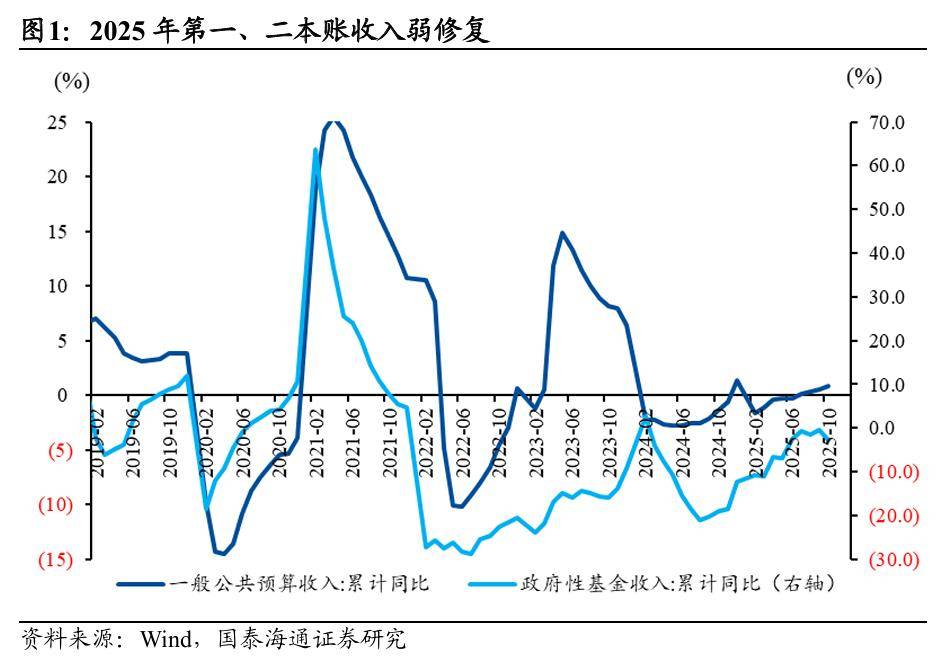
Core Viewpoint - The fiscal policy for 2026 will focus on promoting stable growth, improving people's livelihoods, and managing risks under the "15th Five-Year Plan," with a projected narrow fiscal deficit rate exceeding 4% and new local special bonds around 4.6 trillion yuan [1][5][43]. Group 1: Fiscal Policy Characteristics - The core feature of China's fiscal policy in 2025 is a shift towards a "people-oriented" expenditure structure, which is reflected in the resilience of consumption and the decline in infrastructure investment since July [1][5]. - On the revenue side, there is a weak recovery in the two accounts, with tight constraints still present. The income from individual income tax and securities transactions has improved, while land transfer income has seen a narrowing decline [5][11]. - On the expenditure side, there is a moderate expansion in total fiscal spending, with a structural shift towards social welfare. The central government's financial support is increasing, but the alignment of financial resources and responsibilities still needs optimization [1][11][15]. Group 2: Key Tasks for 2026 - The fiscal policy for 2026 will focus on three key tasks: promoting the synergy between social welfare and consumption incentives, addressing the slowdown in external demand, and resolving funding constraints for infrastructure investment [1][21][22]. - Policies such as trade-in programs and childbirth subsidies are expected to continue and be enhanced, with a focus on service consumption, projecting a retail sales growth rate of around 4.5% [2][25]. Group 3: Infrastructure Investment and Debt Management - For infrastructure investment and debt management, it is essential to clarify the scale and path of debt management funding, with an estimated need for around 3 trillion yuan in special bonds for debt management and clearing overdue accounts in 2026 [3][29]. - The pressure of interest payments after debt replacement is expected to be manageable due to a low-interest environment, which will help offset the visible interest payment pressure [3][37]. - The growth rate of infrastructure investment is projected to be around 3.5% in 2026, influenced by the constraints of debt management and the pursuit of effective investment [3][41]. Group 4: Fiscal Data Projections for 2026 - The growth rate of broad fiscal spending is expected to be around 4.6%, with a narrow fiscal deficit rate still needing to exceed 4%, and new local special bonds projected at approximately 4.6 trillion yuan [5][43][49]. - The general public budget revenue growth rate is estimated at about 1%, while government fund revenue is expected to decline by around 5% [43][46].
国泰海通:增量资金流入+优质资产汇聚 调整后港股牛市仍有望延续
Zhi Tong Cai Jing· 2025-11-23 02:30
Core Viewpoint - The Hong Kong stock market has entered a correction phase since October, primarily due to previous significant gains, tightening dollar liquidity, and a decline in expectations for Federal Reserve rate cuts. However, the ongoing AI wave and the influx of incremental capital suggest that the bull market in Hong Kong stocks is likely to continue [1][2][13]. Market Adjustment - Since the beginning of the year, the Hong Kong stock market has performed well, with the Hang Seng Index and Hang Seng Tech reaching new highs in early October. However, by mid-October, the market began to adjust, with the Hang Seng Index experiencing a maximum decline of 5.1% and Hang Seng Tech a maximum decline of 8.1% [2]. - The Hang Seng Index and Hang Seng Tech recorded maximum gains of 47% and 61% respectively this year before entering the current adjustment phase [2]. Factors Influencing the Market - The tightening of dollar liquidity and the decline in expectations for Federal Reserve rate cuts have pressured the Hong Kong stock market. The U.S. government shutdown led to a temporary halt in government spending, causing dollar liquidity to tighten [3]. - Despite the end of the government shutdown, economic data remains unclear, leading to cautious Federal Reserve rate cut decisions. The market's expectation for a 25 basis point cut in December has dropped to 40% [3]. - The significant prior gains in the Hong Kong stock market, coupled with rising concerns over AI bubbles, have created selling pressure. The Hang Seng Tech Index has seen a maximum increase of 61% this year, while the Hang Seng Biotech Index has increased by 130% [3][8]. Historical Context of Market Corrections - In bull markets, adjustments are common, categorized into small corrections (average maximum decline of about 7%) and large corrections (average maximum decline of about 17%). Small corrections typically occur due to short-term market sentiment disturbances, while large corrections are often linked to liquidity tightening or external shocks [7][8]. - Historical data shows that small corrections in the Hang Seng Index average a maximum decline of 6.5% and last about 12 trading days, while large corrections average a maximum decline of 17% and last about 53 trading days [7][8]. Future Outlook - The tightening dollar liquidity is viewed as a short-term disturbance, and the AI wave is expected to continue. The release of previously accumulated liquidity following the end of the U.S. government shutdown may support the Hong Kong stock market [13]. - Incremental capital inflows and the gathering of quality assets suggest that the bull market in Hong Kong stocks may continue. The unique characteristics of Hong Kong assets, particularly in the context of the ongoing transformation in the domestic economy, enhance their attractiveness [13][14]. - Southbound capital is expected to continue flowing into the Hong Kong market, with over 1.3 trillion yuan already invested this year. This trend is likely to be supported by institutional investors, further propelling the market upward [14].
