
GWMOTOR(601633)

Search documents
汽车股普遍下挫 小鹏汽车-W大跌超9% 1月车企销量分化特征明显
Zhi Tong Cai Jing· 2026-02-02 02:01
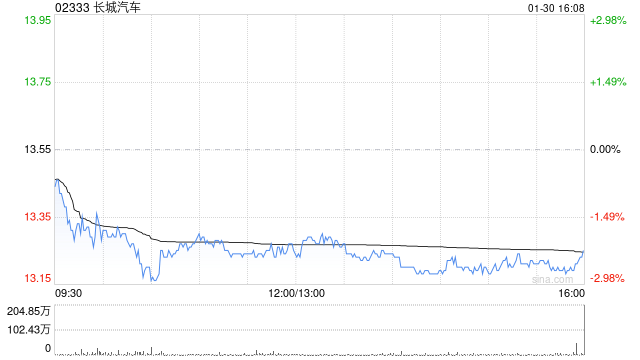
乘联分会方面分析称,2026年春节时间较晚,1月为春节前最后一个完整销售月,工作日数量多于去年 同期,随着首购需求随返乡潮开始释放,全月市场预计可实现同比微增。目前,国家报废补贴已经落 实,但购置税补贴退坡产生了一定的透支效应,各省份以旧换新补贴仍在逐步落实中,导致消费者观望 情绪较为浓重,终端市场仍存不确定性。 汽车股普遍下挫,截至发稿,小鹏汽车-W(09868)跌9.14%,报65.1港元;长城汽车(601633)(02333)跌 3.47%,报12.79港元;理想汽车-W(02015)跌3.26%,报63.8港元;赛力斯(601127)(09927)逆势涨 1.2%,报96.95港元。 消息面上,2月1日,多家车企公布了2026年1月份的销量情况,绝大多数实现销量同比增长,不过分化 特征明显。小鹏汽车1月交付新车20011辆,同比下降34.07%,环比下降46.65%;理想汽车1月交付新车 27668辆,同比增长7.55%,环比下降37.47%;蔚来方面,其1月交付量为2.72万辆,同比增长96.1%;赛 力斯1月汽车销量合计4.59万辆,同比增长104.85%。 ...



【公告精选】赛力斯1月汽车销量同比增长104.85%
Xin Lang Cai Jing· 2026-02-02 01:39
Hot Topics - Jia Mei Packaging's stock trading suspension review has concluded, and the stock will resume trading tomorrow [1] - Fenglong Co., Ltd.'s stock trading suspension review has concluded, and the stock will resume trading tomorrow [2] - Hongbaoli does not produce epoxy propylene products, and its subsidiary's related project has entered the preliminary preparation stage for trial production [2] - Hunan Gold's future market price for gold products has uncertainty regarding whether it can continue to rise or maintain high levels [2] - Tongding Interconnection's current operating conditions are normal, with no significant changes in the internal and external operating environment [3] - Tiandi Online's recent operating conditions and internal and external operating environment show no significant changes [4] - Dayue City reports no significant changes in its recent operating conditions and internal and external environment [5] - Huangtai Liquor Industry is not involved in hot concept matters, and its current operating conditions are normal [6] Performance - Leshan Electric Power reported a net profit of 23.4023 million yuan for 2025, an increase of 3.68% year-on-year [7] - Great Wall Motors sold 90,300 vehicles in January, a year-on-year increase of 11.59% [8] - Seres sold 45,900 vehicles in January, a year-on-year increase of 104.85% [9] - GAC Group sold 116,600 vehicles in January, a year-on-year increase of 18.47% [10] - BAIC Blue Valley's subsidiary sold 8,073 vehicles in January, a year-on-year increase of 11.83% [11] Shareholding Changes - Chipone Technology's shareholders plan to reduce their holdings by no more than 1.95% of the company's shares [30] Share Buybacks - Chuzhou Dongfeng's controlling shareholder proposed to repurchase shares worth 50 million to 100 million yuan [31] - GoerTek has increased the total amount for share repurchase from no less than 500 million yuan (inclusive) and no more than 1 billion yuan (inclusive) to no less than 1 billion yuan (inclusive) and no more than 1.5 billion yuan (inclusive) [31] Contract Awards - Jerry Holdings' wholly-owned subsidiary signed a sales contract for gas turbine generator sets worth approximately 1.265 billion yuan with a U.S. client [32] - Fulongma is expected to win four sanitation service projects in January, with a total first-year service fee of 83.5364 million yuan [34] Equity Changes - Yanzhou Coal Mining is transferring 100% equity of Xintai Coal [33] Mergers and Acquisitions - BGI Genomics plans to acquire 100% equity of Sanjian Qifa and 100% equity of BGI Xufeng to integrate two cutting-edge technology platforms in spatial omics and nanopore sequencing [34] Refinancing - Sanjia Technology (rights protection) plans to issue shares to its controlling shareholder to raise no more than 300 million yuan for working capital and repaying bank loans [35] Other - Fushikong's actual controller, chairman, and general manager Chen Yongliang has been placed under detention [36] - China Mobile's VAT tax category adjustment will change the applicable VAT rate from 6% to 9% [37] - China Telecom's VAT tax category adjustment will impact the company's revenue and profits [38] - China Unicom's VAT tax category adjustment will change the applicable VAT rate from 6% to 9% [39] - Nanwang Energy's price policy adjustment for pumped storage and new energy storage will increase uncertainty in revenue and profits from pumped storage power stations [39] - Wanbangde has completed the enrollment of 100 subjects for the clinical trials of Shishan Jianjia controlled-release tablets phases II and III [39] - Penghui Energy has submitted an application for issuing H-shares and listing on the Hong Kong Stock Exchange [40] - Haichuang Pharmaceutical has passed the GMP compliance inspection for drugs [41]


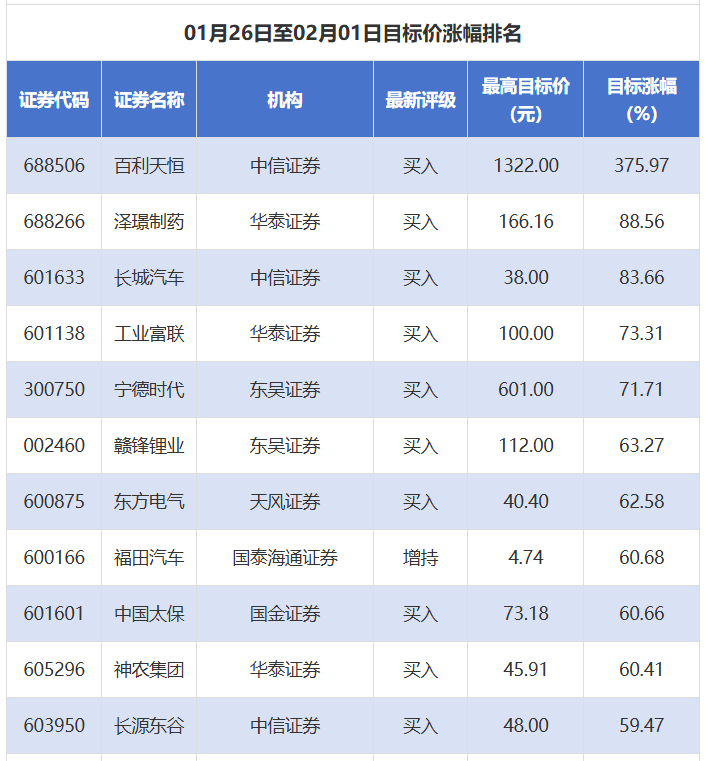
百利天恒目标价涨幅近376% 金辰股份评级被调低丨券商评级观察
2 1 Shi Ji Jing Ji Bao Dao· 2026-02-02 01:31
Core Viewpoint - The report highlights significant target price increases for several listed companies from January 26 to February 1, with notable mentions including Baili Tianheng, Zexing Pharmaceutical, and Great Wall Motors, indicating strong bullish sentiment in the market for these stocks [1][2]. Target Price Increases - Baili Tianheng (688506) has a target price increase of 375.97%, with a highest target price set at 1322.00 yuan [2]. - Zexing Pharmaceutical (688266) shows a target price increase of 88.56%, with a highest target price of 166.16 yuan [2]. - Great Wall Motors (601633) has a target price increase of 83.66%, with a highest target price of 38.00 yuan [2]. - Other companies with notable target price increases include Industrial Fulian (601138) at 73.31% and CATL (300750) at 71.71% [2][3]. Broker Recommendations - A total of 265 listed companies received broker recommendations during the period, with Qingdao Bank receiving the highest number of recommendations at 8 [3][4]. - Other companies with multiple recommendations include Xian Dao Intelligent and Wancheng Group, each receiving 5 recommendations [3][4]. Rating Adjustments - Eight companies had their ratings upgraded, including Shanghai Jahwa (600315) from "Hold" to "Buy" and ZTE Corporation (000063) from "Cautious Buy" to "Buy" [5][6]. - Two companies had their ratings downgraded, including Jincheng Shares (603396) from "Buy" to "Hold" and Huasheng Group (603018) from "Buy" to "Hold" [6]. First-Time Coverage - During the same period, 75 instances of first-time coverage were reported, with notable ratings including Shaanxi Tourism (603402) receiving a "Outperform Industry" rating and Bichu Electronics (688188) receiving a "Buy" rating [7].





长城汽车1月汽车销量约9.03万台 同比增长11.59%
Xin Lang Cai Jing· 2026-02-02 00:48
此外,1月海外销售40,278台。1月新能源车销售18,029台。 热点栏目 自选股 数据中心 行情中心 资金流向 模拟交易 客户端 责任编辑:卢昱君 责任编辑:卢昱君 长城汽车(02333)发布公告,于2026年1月,汽车销量约9.03万台,同比增长11.59%;汽车产量约9.01 万台,同比增长9.17%。 热点栏目 自选股 数据中心 行情中心 资金流向 模拟交易 客户端 此外,1月海外销售40,278台。1月新能源车销售18,029台。 长城汽车(02333)发布公告,于2026年1月,汽车销量约9.03万台,同比增长11.59%;汽车产量约9.01 万台,同比增长9.17%。 ...
月之暗面公开喊话求助百度,百度悄然优化“Kimi官网”检索结果;何小鹏回应IRON人形机器人首秀行走摔倒;王石发文疑辟谣失联传闻丨邦早报
创业邦· 2026-02-02 00:40
Group 1: Automotive Industry Performance - Xiaomi's automotive deliveries exceeded 39,000 units in January 2026 [2] - Li Auto delivered 27,668 vehicles in January 2026 [2] - Leap Motor achieved total deliveries of 32,059 units in January, a year-on-year increase of 27% [2] - AITO (问界) delivered 40,016 vehicles in January, marking an 83% year-on-year growth [2] - Lantu delivered 10,515 vehicles in January, up 31% year-on-year [2] - GAC Toyota's sales reached 63,648 units in January [2] - GAC Trumpchi's terminal sales were 26,937 units in January, a slight increase of 2.06% [2] - Great Wall Motors reported total sales of 90,312 units in January, a year-on-year increase of 11.59% [2] - Extreme Stone (极石) delivered 1,028 vehicles in January, nearly doubling year-on-year [2] Group 2: Company Developments and Innovations - Xiaomi denied reports of discussions with Ford to establish a joint venture for electric vehicles in the U.S. [7] - Xiaomi's founder Lei Jun announced that the development of the new generation Xiaomi SU7 has been completed, with production set to begin soon [7] - The AI robot YuTree G1 successfully walked 13,000 steps in extreme cold conditions of -47.4°C, marking a global first [7] - NIO launched a limited-time financial purchase plan with a low interest rate of 0.49% for vehicle purchases [9] - ByteDance's Hongguo short drama app surpassed 100 million daily active users within three years of its launch [9] - Tencent's AI assistant Yuanbao officially launched its public beta, exploring the AI social networking space [9] - Beijing Economic Development Zone issued the first national virtual idol identity certification [9] - Toyota recalled over 161,000 Tundra vehicles in the U.S. due to rearview camera issues [9] Group 3: Financing and Market Trends - Zhongke Qingneng completed nearly 500 million yuan in PreA++ financing, led by Dinghui Baifu [11] - Xuqing Intelligent secured seed round financing in the millions, focusing on technology development [11] - The global semiconductor industry saw a significant increase in exports from South Korea, reaching $20.5 billion in January, a year-on-year increase of over 102% [13]



汽车早报|多家车企公布1月销量 宝马大中华区换帅
Xin Lang Cai Jing· 2026-02-02 00:40
Group 1: Automotive Industry Overview - In January 2026, the Vehicle Inventory Alert Index for Chinese automotive dealers was reported at 59.4%, a year-on-year decrease of 2.9 percentage points and a month-on-month increase of 1.7 percentage points, indicating inventory levels above the threshold [1] - Various automotive companies reported their January delivery and sales figures, showcasing a mixed performance across the industry [2][3][4][5][6][7][8][9][10][11][12][13][14][15][16][17][18][19] Group 2: Company-Specific Performance - Xiaomi delivered over 39,000 vehicles in January 2026 [2] - Hongmeng Zhixing reported a total delivery of 57,915 vehicles in January, marking a year-on-year increase of 65.6% [3] - Aion (昊铂埃安) achieved sales of 23,591 vehicles in January, reflecting a growth of 63.9% [16] - NIO delivered 27,182 vehicles in January, up 96.1% year-on-year [7] - Li Auto reported deliveries of 27,668 vehicles in January [8] - Leap Motor achieved total deliveries of 32,059 vehicles, a year-on-year increase of 27% [9] - BYD's January sales of new energy vehicles were 210,051, a decline of 30.11% year-on-year [6] - Great Wall Motors sold 90,312 vehicles in January, an increase of 11.59% [11] - GAC Group reported sales of 116,622 vehicles in January, up 18.47% year-on-year [13] - Geely's total sales for January were 270,200 units, showing a growth of approximately 1% [13] - Chery's total sales across five brands in January decreased by 10.7% year-on-year [13] - SAIC-GM delivered approximately 51,005 vehicles in January, with a year-on-year increase of 8.2% [15] - A total of 40,016 vehicles were delivered by AITO in January, representing an 83% increase year-on-year [4] - Seres reported sales of 43,034 new energy vehicles in January, a significant increase of 140.33% [5] - GAC Trumpchi's terminal sales reached 26,937 vehicles in January, up 2.06% [14] - BAIC Blue Valley's subsidiary reported sales of 8,073 vehicles, an increase of 11.83% [19] Group 3: Leadership Changes - BMW Group announced that Christian Ach will succeed Sean Green as the President and CEO of BMW Group Greater China, effective April 1 [20]




整车主线周报:本周商用载货车表现较好,长城发布业绩预告
Soochow Securities· 2026-02-02 00:25
证券研究报告 证券分析师 :黄细里 执业证书编号:S0600520010001 联系邮箱:huangxl@dwzq.com.cn 2026年2月1日 请务必阅读正文之后的免责声明部分 板块最新观点 整车主线周报: 本周商用载货车表现较好,长城发布业绩预告 2 ( ◼ 乘用车观点更新:短期来看,行业补贴政策已落地,看好观望需求转化下26Q1乘用车景气度复苏,坚定看好乘 用车板块。全年维度来看:国内选抗波动+出口选确定性。国内关注高端电动化赛道中对政策扰动不敏感的个股 江淮汽车,以及高端化有望放量的吉利汽车/长城汽车/北汽蓝谷/赛力斯/理想等;出口主线优先配置海外体系 成熟、执行能力已验证的头部车企,优选比亚迪/长城汽车/奇瑞汽车,以及零跑/小鹏/上汽集团/长安汽车等。 ◼ 重卡观点更新:回顾2025:2025年,25年全年批发114.4万,同比+26.8%,内销79.9万,同比+32.8%,出 口34.1万,同比+17.2%,全年内销及出口超市场年初预期。25年初国四及以下营运重卡保有量69万辆,估算 25年底淘汰至45-50万辆,25年全年淘汰21万辆,25年全年内销政策拉动+自然需求回升共振。展望2026: ...
新华财经早报:2月2日
Zhong Guo Jin Rong Xin Xi Wang· 2026-02-02 00:21
Group 1: Spring Festival Travel and Tax Policies - The 2026 Spring Festival travel season will begin on February 2 and end on March 13, lasting 40 days, with an expected cross-regional population flow of 9.5 billion people, setting a historical record [1][8] - The State Taxation Administration has announced a new export tax rebate management method to make the export tax rebate application process more convenient and efficient [1][8] - The personal tax threshold for value-added tax has been raised to 1,000 yuan, with specific conditions outlined for certain transactions that will not apply to this threshold [1][8] Group 2: Shipbuilding Industry Performance - In 2025, China's shipbuilding industry maintained its global leadership for 16 consecutive years, with a completed shipbuilding volume of 53.69 million deadweight tons, a year-on-year increase of 11.4%, accounting for 56.1% of the world total [9] - The new orders received amounted to 107.82 million deadweight tons, representing 69.0% of the global total, while the hand-held order volume reached 274.42 million deadweight tons, a year-on-year increase of 31.5%, accounting for 66.8% of the world total [9] Group 3: Telecommunications and Film Industry Updates - China Mobile, China Unicom, and China Telecom announced adjustments to the applicable scope of value-added tax for telecommunications services, with the tax rate changing from 6% to 9% starting January 1, 2026 [9][11] - As of February 1, 2026, the annual box office has exceeded 2 billion yuan, with several domestic films scheduled for release during the Spring Festival [9]




长城汽车股份有限公司2026年1月产销快报
Xin Lang Cai Jing· 2026-02-01 19:22
证券代码:601633 证券简称:长城汽车 公告编号:2026-012 转债代码:113049 转债简称:长汽转债 长城汽车股份有限公司2026年1月产销快报 本公司董事会及全体董事保证本公告内容不存在任何虚假记载、误导性陈述或者重大遗漏,并对其内容 的真实性、准确性和完整性承担法律责任。 本公告乃由长城汽车股份有限公司(「本公司」)自愿刊发。 1月海外销售40,278台。 1月新能源车销售18,029台。 务请注意,上述产销量数字未经审核,亦未经本公司审计师确认,或会予以调整并有待最终确认。本公 司刊发财务业绩后,股东及潜在投资者务必详阅。 特此公告。 长城汽车股份有限公司董事会 2026年2月1日 本公司董事会谨此宣布,本公司于2026年1月产销量详细如下(单位:台): ■ ...
长城汽车(601633):2025年销量创新高,渠道搭建影响盈利潜力释放
Ping An Securities· 2026-02-01 11:12
Investment Rating - The investment rating for the company is "Recommended" [1] Core Views - The company achieved a record high sales volume in 2025, with a total of 1.324 million units sold, representing a year-on-year growth of 7.3%. The sales of new energy vehicles reached 404,000 units, up 25.4% year-on-year, while overseas sales hit 506,000 units, growing by 11.7% [7] - The establishment of direct sales channels has led to increased expenses, impacting the company's profit potential. Sales expenses for the first three quarters of 2025 reached 7.95 billion yuan, a year-on-year increase of 55.5% [7] - The company has launched the "Guiyuan" platform, which supports multiple powertrain types and is expected to drive a new product cycle with over 50 global models planned [7] Financial Summary - In 2025, the company reported operating revenue of 222.79 billion yuan, a year-on-year increase of 10.2%, and a net profit attributable to shareholders of 9.91 billion yuan, down 21.9% year-on-year. The fourth quarter saw revenue of 69.21 billion yuan, with a year-on-year growth of 15.5% [4][6] - The company's net profit forecast for 2026 and 2027 has been adjusted to 13.3 billion yuan and 16.5 billion yuan, respectively, due to the impact of direct sales channel construction [8] - Key financial metrics include a projected gross margin of 19.5% for 2025 and a net profit margin of 4.4% [6][8]