
WLY(000858)

Search documents
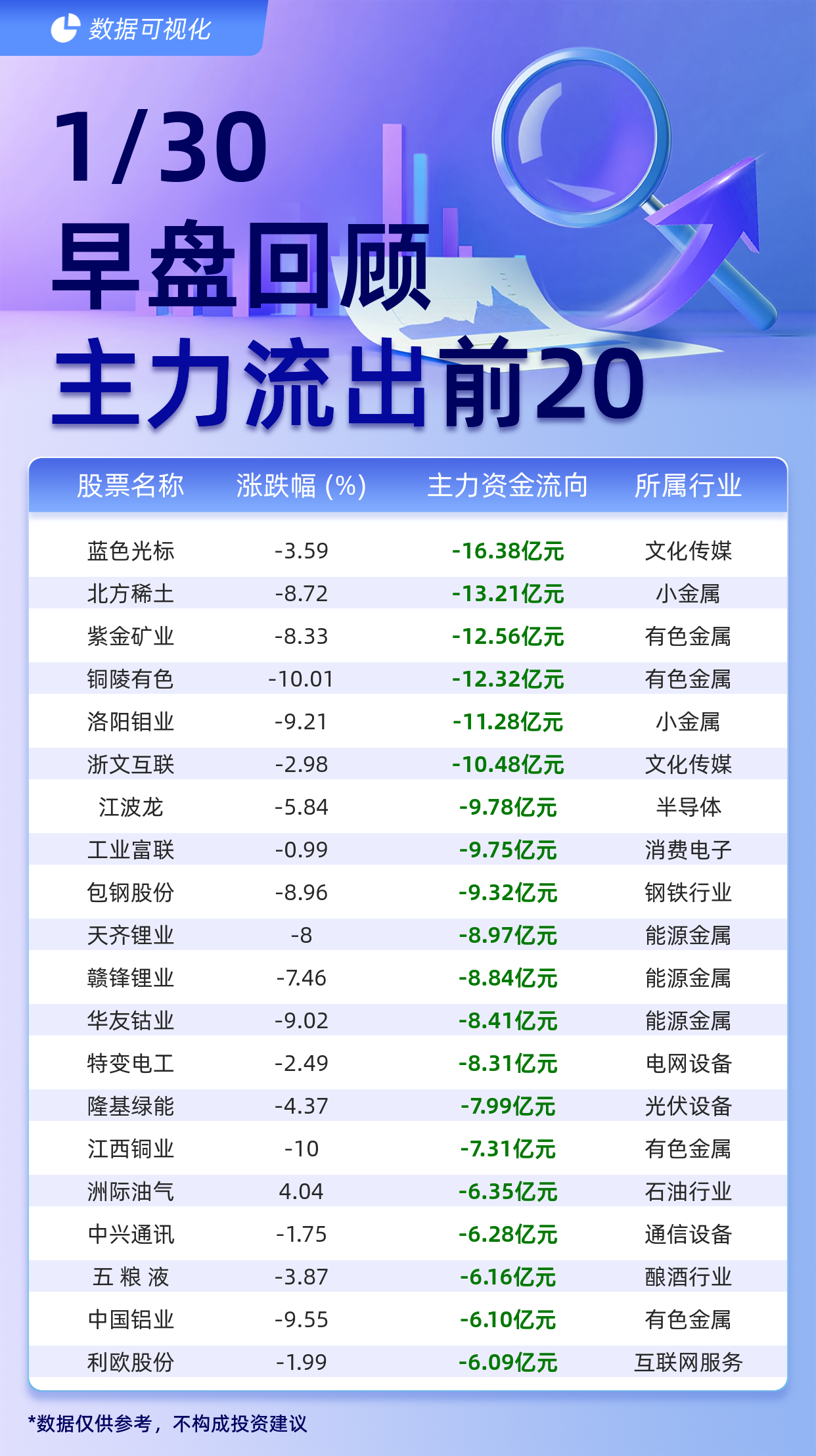
主力个股资金流出前20:蓝色光标流出16.38亿元、北方稀土流出13.21亿元




Jin Rong Jie· 2026-01-30 04:02
Core Viewpoint - The data indicates significant outflows of main funds from various stocks, with notable declines in share prices across multiple sectors, particularly in the rare metals and non-ferrous metals industries [1][2][3] Group 1: Stock Performance and Fund Outflows - BlueFocus Media experienced a fund outflow of 1.638 billion yuan, with a share price decline of 3.59% [2] - Northern Rare Earth saw a fund outflow of 1.321 billion yuan, with a share price drop of 8.72% [2] - Zijin Mining reported a fund outflow of 1.256 billion yuan, with a decrease in share price of 8.33% [2] - Tongling Nonferrous Metals had a fund outflow of 1.232 billion yuan, with a share price decline of 10.01% [2] - Luoyang Molybdenum experienced a fund outflow of 1.128 billion yuan, with a share price drop of 9.21% [2] Group 2: Sector Analysis - The rare metals sector, represented by Northern Rare Earth and Luoyang Molybdenum, is facing significant fund outflows and price declines [2][3] - The non-ferrous metals sector, including companies like Zijin Mining and Tongling Nonferrous Metals, is also experiencing substantial outflows, indicating potential challenges in this industry [2][3] - The energy metals sector, represented by Tianqi Lithium and Ganfeng Lithium, shows notable fund outflows, with share price declines of 8% and 7.46% respectively [2][3]

当前时点如何看酒类投资
2026-01-30 03:11
Summary of Key Points from Conference Call Records Industry Overview: Baijiu (Chinese Liquor) - **Strong Sales Performance**: Moutai's sales velocity is robust, with prices recovering to over 1,600 RMB, exceeding market expectations. From January 1 to January 9, over 400,000 transactions occurred, with an average daily supply exceeding 50 tons, indicating strong market demand [1][2]. - **Market Bottom Indicators**: The baijiu industry is showing signs of bottoming out, with the 1,499 RMB Moutai indicating clear volume and price bottom characteristics. Historical data suggests that Moutai and Wuliangye's volume increases signal industry recovery [1][6]. - **Investment Recommendation**: Guizhou Moutai is the preferred investment target, historically outperforming in price, stock performance, and earnings when the industry enters a recovery phase. Revenue growth rates exceeded 20% in 2016 and over 50% in 2017 [1][7]. - **Valuation of Other Baijiu Companies**: Leading baijiu companies like Wuliangye, Luzhou Laojiao, Fenjiu, and Gujing Gongjiu are currently undervalued, with valuations around 15 times earnings or lower. These companies also have high dividend yields, making them attractive for investment [1][10]. Yellow Wine Sector - **Market Expansion**: The yellow wine sector is expanding through price increases, new product launches, and innovative marketing strategies. Leading companies like Kuaijishan are performing well, and Guolongshan is actively pursuing high-end, youth-oriented, and national strategies [1][12]. Beer Industry Insights - **Resilience in Sales**: The beer industry is showing resilience with positive sales growth, particularly as the restaurant sector recovers, which is expected to positively impact beer consumption. Yanjing Beer has high expectations for operational improvement, with significant profit contributions from its health product line [1][4][14]. - **Investment Opportunities**: Yanjing Beer is recommended due to its improving operational metrics and expansion into health products, with projected profit growth. Qingdao Beer and China Resources Beer are also noteworthy, with attractive dividend yields and low valuations [1][15]. Cost Factors - **Cost Management**: The cost of aluminum cans is under control, and there are signs of improvement in malt costs. The overall impact on ton costs is minimal, suggesting a focus on revenue recovery and price increases is essential [1][16]. Conclusion - **Overall Market Sentiment**: The baijiu industry is at a critical juncture, with Moutai leading the recovery. Other sectors like yellow wine and beer are also showing potential for growth, driven by strategic initiatives and market recovery trends. Investors are encouraged to consider both Moutai and other leading brands for their strong fundamentals and growth prospects [1][9][10].





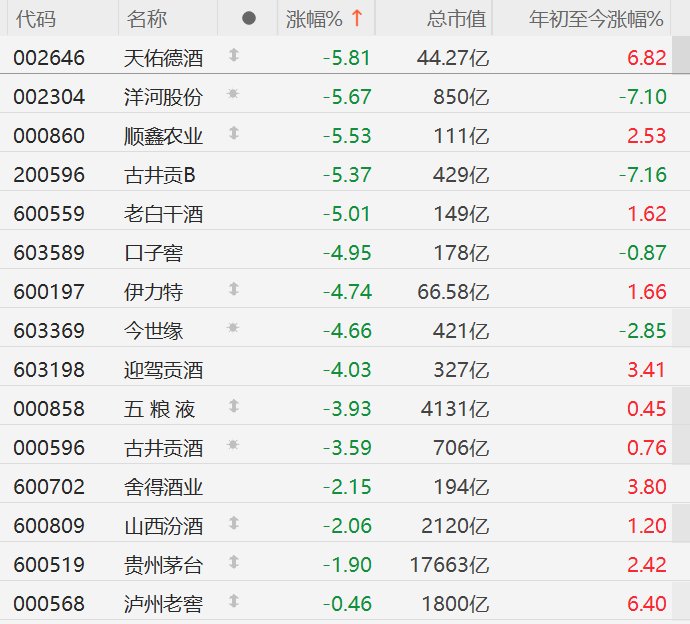
A股白酒股普跌,迎驾贡酒跌超4%,五粮液、古井贡酒跌超3%
Ge Long Hui A P P· 2026-01-30 02:55
Core Viewpoint - The liquor stocks experienced a significant decline, with major brands such as Tianyoude, Yanghe, and Shunxin all dropping over 5% in value, indicating a bearish trend in the sector [1]. Group 1: Stock Performance - Tianyoude Liquor saw a decrease of 5.81%, with a total market capitalization of 4.427 billion [2] - Yanghe shares fell by 5.67%, bringing its market value to 85 billion, with a year-to-date decline of 7.10% [2] - Shunxin Agriculture dropped by 5.53%, with a market cap of 11.1 billion and a year-to-date increase of 2.53% [2] - Other notable declines include Kuaizijiao (-4.95%, 17.8 billion), Yilite (-4.74%, 6.658 billion), and Jianshiyuan (-4.66%, 42.1 billion) [2] - Major brands like Wuliangye and Guizhou Moutai also experienced declines of 3.93% and 1.90%, respectively, with market caps of 413.1 billion and 1.7663 trillion [2]





筹码再优化,大众品阶段性优于白酒
CAITONG SECURITIES· 2026-01-30 02:30
Group 1: Market Overview - As of 4Q2025, the food and beverage sector's heavy stockholding ratio is 6%, a decrease of 0.3 percentage points (pct) from the previous quarter[9] - The food and beverage sector ranks 7th among all industries in terms of heavy stockholding ratio, falling one position[9] - The total net asset size of the sample funds is approximately 3.98 trillion yuan, with food and beverage holdings valued at 240 billion yuan[9] Group 2: Fund Allocation Changes - Both active and passive funds reduced their allocations to the food and beverage sector, with active equity funds decreasing by 0.2 pct to 3.9% and passive index funds decreasing by 0.6 pct to 8.4%[15] - The allocation to the liquor sector decreased by 0.4 pct to 5.1%, while the allocation to consumer goods increased by 0.1 pct to 0.9%[19] Group 3: Stock Performance - Among the top 20 heavy stockholdings, only Kweichow Moutai remains in the food and beverage sector, with its holding ratio decreasing by 0.08 pct to 2.97%[23] - The leading liquor brands, including Kweichow Moutai, Shanxi Fenjiu, Wuliangye, and Luzhou Laojiao, saw their holding ratios decline, while stocks in the consumer goods sector, such as Yurun Agriculture and Ximai Foods, experienced significant increases in holdings[27] Group 4: Investment Recommendations - The report suggests focusing on the restaurant supply chain and snack sectors, particularly during the Spring Festival period, which is expected to support industry improvement[29] - Key stocks to watch include those in the restaurant chain (e.g., Anjijia Foods, Angel Yeast) and snack sector (e.g., Wancheng Group, Wei Long) due to their potential for growth[29] Group 5: Risks - Risks include slower-than-expected recovery in consumer spending, increased competition in the food and beverage industry, and potential food safety issues that could impact company operations and brand reputation[30]

白酒行业更新报告:白酒筑底,政策、批价双重催化
GUOTAI HAITONG SECURITIES· 2026-01-30 02:01
Investment Rating - The report assigns an "Accumulate" rating for the liquor industry [4]. Core Insights - The liquor industry has entered a deep adjustment period, but recent positive changes in the real estate and domestic demand sectors, along with the market-oriented transformation of Moutai, are stimulating incremental demand and driving up prices, leading to a valuation recovery [2]. - The report recommends stocks with price elasticity such as Guizhou Moutai, Wuliangye, and Luzhou Laojiao, as well as those expected to clear inventory like Yingjia Gongjiu, Gujing Gongjiu, Shanxi Fenjiu, Jianshiyuan, Zhenjiu Lidu, Shede Jiuye, and Jinhui Jiu [4]. Summary by Sections Market Environment - The real estate sector is showing signs of recovery, and policies are becoming more favorable. The liquor industry is a typical cyclical sector, with market pricing influenced by both internal demand and real estate conditions. The government has prioritized boosting domestic demand as a key task for the 14th Five-Year Plan, with plans to develop a strategy for expanding domestic demand from 2026 to 2030 [4]. - The real estate market is gradually bottoming out after years of adjustment, with recent government actions aimed at stabilizing market expectations and improving conditions [4]. Moutai's Market Transformation - Moutai's market-oriented reform has sparked incremental demand, with significant attention on liquor sales during the Spring Festival. Moutai has introduced various products on its iMoutai platform, leading to a surge in online purchases and stable price performance [4]. - As of January 29, Moutai's price has increased by over 1,600 RMB, with transaction prices exceeding 1,700 RMB, indicating successful price-volume strategies [4]. Industry Outlook - The liquor industry is believed to be at the bottom of its cycle, with liquidity improvements and expectations likely to catalyze stock prices. The report anticipates that if prices stabilize, the pressure on stock prices will lessen, and further positive signals from policies could enhance stock performance [4]. - The report includes earnings forecasts for key liquor companies, indicating a compound annual growth rate (CAGR) of 5% for Moutai from 2024 to 2026, with a price-to-earnings (PE) ratio projected to decrease from 21 to 19 [5].


酒价内参1月30日价格发布 青花郎环比下跌7元/瓶
Xin Lang Cai Jing· 2026-01-30 01:34
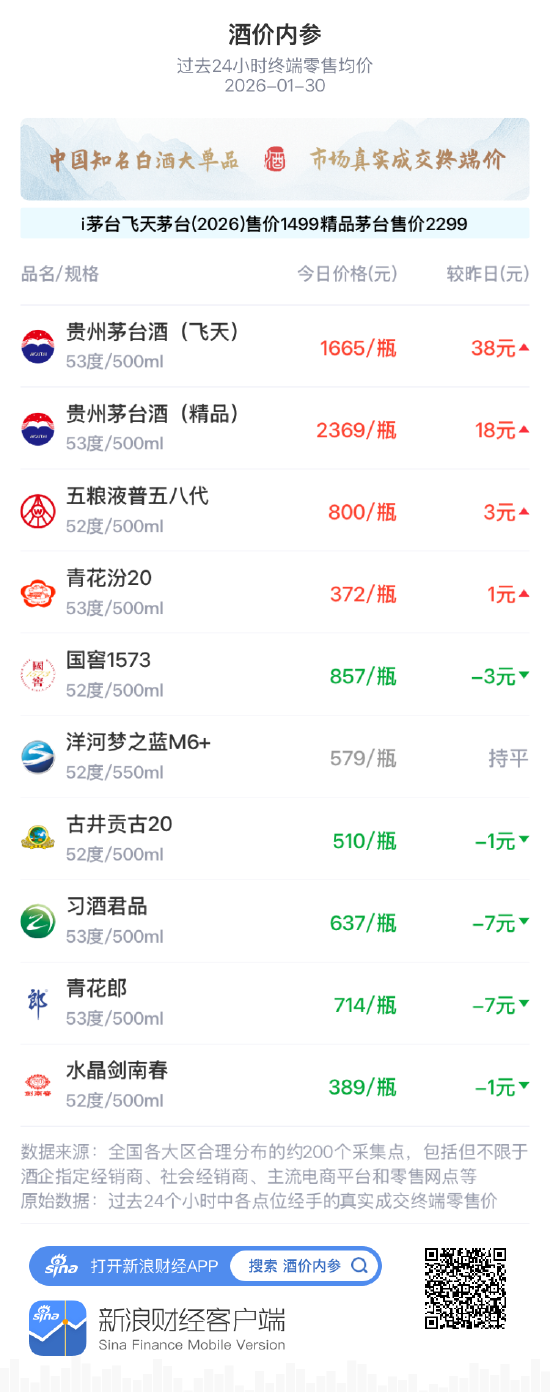
Core Viewpoint - The Chinese liquor market is experiencing a structural price differentiation, with the average retail price of the top ten liquor products showing a slight increase, driven by strong demand for premium products like Moutai [1][3]. Price Trends - The total retail price for a package of the top ten liquor products is 8,892 yuan, an increase of 41 yuan from the previous day, marking a new high in the last five days [1][4]. - Among the top ten products, four saw price increases, five decreased, and one remained stable, indicating a clear divergence in market performance [1][4]. - Moutai products are leading the price increases, with the price of Moutai flying liquor rising by 38 yuan per bottle and premium Moutai by 18 yuan per bottle, supported by pre-festival demand [1][4][6]. Individual Product Performance - The price changes for specific products include: - Moutai flying liquor: 1,665 yuan, up 38 yuan [6] - Premium Moutai: 2,369 yuan, up 18 yuan [6] - Wuliangye: 800 yuan, up 3 yuan [6] - Qinghua Fen 20: 372 yuan, up 1 yuan [6] - Xijiu Junpin: 637 yuan, down 7 yuan [7] - Qinghua Lang: 714 yuan, down 7 yuan [7] - Gujing Gonggu 20: 510 yuan, down 1 yuan [7] - Shuijing Jian Nan Chun: 389 yuan, down 1 yuan [7] - Yanghe Dream Blue M6+: 579 yuan, unchanged [7]. Stock Market Reaction - The A-share market saw a significant rise in liquor stocks, with Moutai shares increasing by 8.61% to 1,437.72 yuan per share, reaching a peak of 1,445 yuan during trading, marking the largest single-day increase in nearly a year [3][8]. - The total market capitalization of Moutai reached 1.8 trillion yuan, with a trading volume exceeding 26.3 billion yuan on that day [3][8]. Data Collection Methodology - The "Liquor Price Reference" collects data from approximately 200 sampling points across various regions, including designated distributors, social distributors, e-commerce platforms, and retail outlets, aiming to provide objective and traceable market price data [3][8].

酒价内参1月30日价格发布 五粮液普五八代小幅上涨3元/瓶
Xin Lang Cai Jing· 2026-01-30 01:34
Core Viewpoint - The Chinese liquor market is experiencing a structural price differentiation, with the average retail price of the top ten liquor products showing a recent increase, driven primarily by the recovery of high-end products like Moutai [1][4]. Price Trends - The total price for a package of the top ten liquor products is 8,892 yuan, an increase of 41 yuan from the previous day, marking a new high in the last five days [1][4]. - Among the top ten products, four saw price increases, five decreased, and one remained stable, indicating a mixed market response [1][4]. - Moutai products are leading the price increases, with Feitian Moutai rising by 38 yuan per bottle and premium Moutai by 18 yuan per bottle, supported by demand for high-end banquets and gifts [1][4][6]. Individual Product Performance - The following products experienced price changes: - Feitian Moutai: 1,665 yuan/bottle, up 38 yuan - Premium Moutai: 2,369 yuan/bottle, up 18 yuan - Wuliangye: 800 yuan/bottle, up 3 yuan - Qinghua Fen 20: 372 yuan/bottle, up 1 yuan - Guojiao 1573: 857 yuan/bottle, down 3 yuan - Xijiu Junpin: 637 yuan/bottle, down 7 yuan - Qinghua Lang: 714 yuan/bottle, down 7 yuan - Ancient Well Tribute: 510 yuan/bottle, down 1 yuan - Crystal Jian Nan Chun: 389 yuan/bottle, down 1 yuan - Yanghe Dream Blue M6+: 579 yuan/bottle, unchanged [2][6][7]. Stock Market Reaction - The A-share market saw a significant rise in liquor stocks, with Moutai shares increasing by 8.61% to 1,437.72 yuan per share, reaching a peak of 1,445 yuan during trading, marking the largest single-day increase in nearly a year [3][8]. - The total market capitalization of Moutai reached 1.8 trillion yuan, with a trading volume exceeding 26.3 billion yuan on that day [3][8]. Data Collection Methodology - The "Liquor Price Reference" collects data from approximately 200 sampling points across various regions, including designated distributors, social distributors, e-commerce platforms, and retail outlets, aiming to provide objective and traceable market price data [3][8]. - The pricing data is weighted based on actual transaction volumes to reflect the true retail prices of Moutai products [3][8]. Regulatory Response - The iMoutai platform has responded to the sale of "purchase外挂" software, which disrupts market order and poses risks to consumers, emphasizing its commitment to maintaining a fair market environment [9][10].
食品饮料ETF天弘(159736)18只成分股涨停!国务院办公厅印发《加快培育服务消费新增长点工作方案》
Mei Ri Jing Ji Xin Wen· 2026-01-30 01:29
Group 1 - The core viewpoint of the articles highlights the strong performance of the food and beverage sector, particularly driven by the recent policy initiatives and market dynamics [1][2] - The Tianhong Food and Beverage ETF (159736) saw a significant increase of 5.58% in its index, with a trading volume of 73.1867 million yuan, indicating robust investor interest [1] - Major stocks within the ETF, including Wuliangye, Luzhou Laojiao, and Shanxi Fenjiu, reached their daily limit, while Kweichow Moutai, Shunxin Agriculture, and Huanleji rose over 8% [1] Group 2 - The State Council's recent policy aims to accelerate the cultivation of new growth points in service consumption, which is expected to inject strong policy expectations into the food and beverage sector [2] - Industry leaders are showing positive signals, with the price of Feitian Moutai significantly rising in a single day, boosting overall confidence in the sector [2] - Current valuations in the food and beverage sector are at relatively low historical levels, providing a notable margin of safety, as highlighted by industry analysts [2]
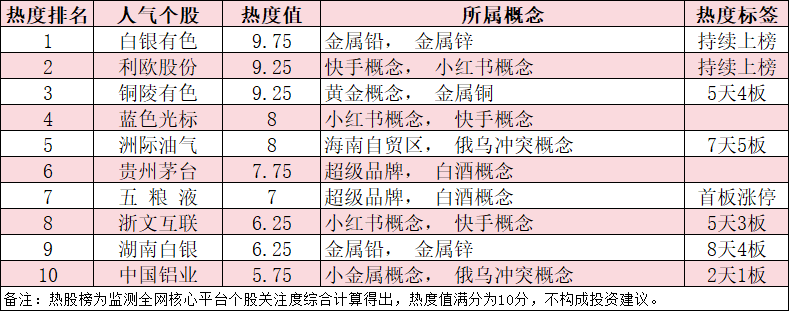
今日十大热股:白银有色连续霸榜热股第一,白酒板块久违大涨贵州茅台、五粮液上榜
Jin Rong Jie· 2026-01-30 01:20
Core Insights - The A-share market showed significant divergence on January 29, with the Shanghai Composite Index slightly up by 0.16% to 4157.98 points, while the ChiNext Index fell by 0.57% and the STAR Market dropped by 3.03% [1] - The total trading volume in the Shanghai and Shenzhen markets reached 3.23 trillion yuan, an increase of approximately 264.6 billion yuan compared to the previous day, indicating a weak market sentiment with more stocks declining than rising [1] Hot Stocks Overview - The top ten popular stocks included Baiyin Nonferrous Metals, Liou Co., Tongling Nonferrous Metals, BlueFocus Communication Group, Intercontinental Oil & Gas, Kweichow Moutai, Wuliangye Yibin, Zhejiang Wenhu Interconnect, Hunan Baiyin, and China Aluminum [2] - Baiyin Nonferrous Metals ranked first with a heat value of 9.75, driven by external factors such as rising international gold and silver prices and internal strategic developments in gold business [2][3] - Liou Co. saw a heat value of 9.25, benefiting from its dual business focus on "smart pumps and systems" and "digital marketing," aligning with market trends [2][3] - Tongling Nonferrous Metals also had a heat value of 9.25, reflecting macroeconomic trends and improvements in the company's fundamentals [2][3] Sector Analysis - BlueFocus Communication Group's performance was boosted by the high demand in the AI marketing sector, with the company actively engaging in AI transformation [3] - Intercontinental Oil & Gas benefited from geopolitical tensions driving oil price expectations higher, along with favorable domestic policies and successful overseas project developments [4] - Kweichow Moutai's rise was attributed to positive changes in its fundamentals and market capital flow, with the price of its flagship product stabilizing above 1600 yuan [4] - Wuliangye Yibin's surge was linked to strong demand during the Spring Festival and significant purchases by well-known investors [4] - Zhejiang Wenhu Interconnect, Hunan Baiyin, and China Aluminum experienced increased market attention due to various factors including technological breakthroughs and policy-driven changes [4]


1月30日每日研选丨白酒“回马枪”,是反弹还是反转?
Shang Hai Zheng Quan Bao· 2026-01-29 23:53
Core Viewpoint - The recent surge in the liquor sector, particularly on January 29, indicates a potential turning point for the industry, driven by multiple factors including short-term market signals, low valuations, and macroeconomic easing expectations [1][2]. Group 1: Market Performance - On January 29, the liquor sector saw a significant rally, with the Shenwan liquor index rising over 5%, reflecting strong performance from multiple stocks [1]. - The high-end liquor prices have established a "price bottom," with Moutai's bottle price stabilizing around 1560 yuan and Wuliangye's price also showing stability [1]. Group 2: Valuation and Dividend Appeal - The liquor sector's valuation is at a historical low of 4.1%, suggesting a high safety margin and potential for rebound [2]. - The sector's dividend yield is approximately 3.64%, with Wuliangye leading at over 5%, making it attractive for risk-averse investors [2]. Group 3: Macroeconomic Factors - Expectations of macroeconomic easing, particularly regarding potential quantitative easing (QE) by the Federal Reserve, could open up monetary policy space in China, potentially driving consumption upgrades and benefiting the liquor sector [2]. Group 4: Future Outlook - The liquor industry may be on the verge of recovery after a deep adjustment, with expectations of improved sales and financial performance in the latter half of 2026 [2]. - High-end liquor companies like Moutai and Wuliangye are actively reforming marketing strategies and expanding consumer bases, positioning themselves for future growth [2]. Group 5: Investment Opportunities - Investors are advised to focus on high-end liquor leaders with strong brand certainty, such as Moutai and Wuliangye, as well as regional companies likely to benefit from local consumption trends [3]. - Monitoring post-Spring Festival inventory reduction and price stability will be crucial for assessing the industry's bottoming out [3].