BYD(002594)

Search documents
Sora宣布关停;泡泡玛特去年营收首破300亿元丨Going Global
创业邦· 2026-03-29 11:15
Core Insights - The article highlights significant developments in the global expansion of Chinese companies, focusing on partnerships, market entries, and strategic initiatives aimed at enhancing international competitiveness. Group 1: Major Events - DHL and SHEIN signed a "GoGreen Plus" agreement to use sustainable aviation fuel in international express air transport, aiming to reduce carbon emissions in cross-border e-commerce logistics [5][6] - AliExpress and Austrian Post signed a Memorandum of Understanding (MOU) to enhance local fulfillment services in Central and Eastern Europe, focusing on local warehousing and logistics solutions [8][10] - Pinduoduo announced the launch of its "New Pinduoduo" strategy, aiming to invest 100 billion yuan over three years to build a self-operated brand model targeting global markets [12][13] - BYD officially entered the Canadian market, planning to open 20 stores within a year, benefiting from a recent trade agreement that significantly reduced tariffs on Chinese electric vehicles [15][16] - Pony.ai is set to launch Europe’s first commercial Robotaxi service in Zagreb, Croatia, in collaboration with Verne and Uber, marking a significant step towards commercializing autonomous driving [17][18] Group 2: Company Performance - Pop Mart reported a revenue of 37.12 billion yuan for 2025, a year-on-year increase of 184.7%, with a net profit of 13.01 billion yuan, reflecting a growth of 293.3% [20][21] - Geely officially launched its operations in Spain, planning to introduce at least nine models over the next three years, focusing on electric and hybrid vehicles [24][25][26] Group 3: Notable Developments in the Tech Sector - Elon Musk previously invited Mark Zuckerberg to consider bidding for OpenAI's intellectual property, indicating ongoing strategic maneuvers in the tech industry [28][29] - OpenAI announced the shutdown of its Sora video generation service due to high operational costs, as part of a strategy to streamline its product offerings ahead of a potential IPO [30][33]






比亚迪(002594):/比亚迪股份(1211.HK)2025年年报业绩点评:2025业绩披露,全球化加速推进
EBSCN· 2026-03-29 11:09
Investment Rating - The report maintains a "Buy" rating for both A-shares and H-shares of BYD, with current prices at 105.30 CNY and 106.50 HKD respectively [5]. Core Insights - In 2025, BYD's total revenue increased by 3.5% year-on-year to 804 billion CNY, while net profit attributable to shareholders decreased by 19.0% to 32.6 billion CNY [1]. - The company achieved a total sales volume of 4.6 million new energy passenger vehicles in 2025, a year-on-year increase of 7.7%, with pure electric vehicle sales rising by 27.9% to 2.26 million units [2]. - BYD's export sales surged by 150.7% year-on-year to 1.046 million units, with significant growth in Latin America and Europe [3]. Summary by Sections Financial Performance - In Q4 2025, BYD's revenue was 237.7 billion CNY, down 13.5% year-on-year but up 21.9% quarter-on-quarter. Net profit for the same quarter was 9.3 billion CNY, a decrease of 38.2% year-on-year [1]. - The company's revenue for 2026E is projected to reach 911.8 billion CNY, with a net profit of 37.7 billion CNY, reflecting a growth rate of 15.6% [4]. Product and Technology Development - BYD launched its second-generation blade battery and fast-charging technology in March 2026, addressing key industry challenges such as slow charging and low-temperature charging [2]. - The company is enhancing its multi-brand strategy, with significant sales growth in its high-end brands, which saw a combined increase of 109% in 2025 [2]. Market Expansion - BYD's overseas sales are expected to become a core growth driver, benefiting from a diversified product matrix that includes both pure electric and plug-in hybrid models [3]. - The company is advancing its global localization strategy, with production capabilities being established in countries like Brazil and Hungary [3].
汽车与零部件行业周报:新能源车海外订单大涨,GEV涨价,关注出海整车及燃机链汽零
Orient Securities· 2026-03-29 10:24
Investment Rating - The industry investment rating is Neutral (maintained) [5] Core Insights - The report highlights a significant increase in overseas orders for new energy vehicles (NEVs) from domestic manufacturers, driven by geopolitical tensions and rising oil prices, which are expected to enhance the global energy security strategy and accelerate the transition to NEVs [8][9] - There is a notable performance divergence among automotive companies for 2025, with some firms experiencing slower profit growth due to intensified competition and pressure on downstream sales, while others, like Geely and Sanhua Intelligent Control, are projected to achieve strong revenue and profit growth [10][11] - The price increase of gas turbines by industry leader GEV, attributed to rising demand, indicates a strong growth outlook for the gas power generation sector, suggesting that domestic companies in this chain may expand their market share internationally [11] Summary by Sections Investment Recommendations and Targets - Strong alpha automotive and parts companies are expected to withstand industry risks and achieve revenue and profit growth. Key sectors to watch include data center liquid cooling, gas power generation, and advanced driving technology [3][11] - Recommended automotive stocks include BYD, Geely, SAIC Motor, and Jianghuai Automobile. For gas power generation, focus on Yinlun, Weichai Power, and for liquid cooling, consider InvoTech and Top Group [12] Market Trends - The report notes a significant increase in NEV sales in Australia and other Southeast Asian markets, with a reported 30% increase in foot traffic at dealerships [8][9] - The anticipated rise in oil prices due to geopolitical conflicts is expected to further drive the adoption of NEVs globally, enhancing the market penetration of domestic brands [9] Performance Outlook - Geely is projected to achieve a 25% year-on-year revenue growth for 2025, with a 36% increase in net profit after adjustments. Sanhua Intelligent Control is also expected to see an 11% revenue growth and a 31% increase in net profit [10][11]



收藏!ESIE 2026储能展参会+观展指南发布(含详细日程)
中关村储能产业技术联盟· 2026-03-29 09:55
Core Viewpoint - The 14th Energy Storage International Conference and Expo (ESIE 2026) will take place from March 31 to April 3, 2026, at the Beijing Capital International Exhibition Center, showcasing over 800 exhibitors and attracting more than 200,000 attendees from various sectors including government, research institutions, and energy operators [7][19]. Event Overview - The event will feature a large exhibition area of over 160,000 square meters, gathering the entire energy storage industry chain [7]. - The conference will include various forums and discussions on topics such as energy transition, innovative storage technologies, and market trends [19][23]. Key Sessions and Activities - The opening ceremony will be held on March 31, featuring speeches from leaders of key energy organizations and presentations on energy transition pathways and challenges in solid-state battery research [23][24]. - A series of forums will cover topics like new energy storage technologies, market mechanisms, and the application of energy storage in zero-carbon parks [19][37]. Transportation and Venue Information - The venue is accessible via multiple transportation options, including the Beijing Subway Line 15 and various bus routes from both Beijing Capital International Airport and Daxing International Airport [14][15]. - Detailed transportation guides are provided for attendees traveling from major train stations and airports [15][16]. Networking and Collaboration Opportunities - The conference will host international business matchmaking sessions, allowing participants to explore collaboration opportunities in the energy storage sector [22][28]. - Special sessions will focus on the latest developments in energy storage technologies and their applications in different markets [26][40].



新能源车海外订单大涨,GEV涨价,关注出海整车及燃机链汽零
Orient Securities· 2026-03-29 09:10
Investment Rating - The industry investment rating is Neutral (maintained) [5] Core Insights - The overseas orders for new energy vehicles have significantly increased, driven by the geopolitical situation, providing strong momentum for domestic brands to accelerate their international expansion [8][9] - There is a notable divergence in the performance of automotive companies for 2025, with some companies showing strong growth in profitability while others face challenges due to increased competition and pressure on sales [10] - The price increase by industry leader GEV indicates a strong demand for gas power generation, suggesting continued interest in the gas power generation chain [11] Summary by Sections Investment Recommendations and Targets - Strong alpha automotive and parts companies are expected to withstand industry risks and achieve revenue and profit growth. Key sectors to watch include data center liquid cooling, gas power generation, and advanced driving technology [3][11] - Recommended automotive stocks include BYD, Geely, SAIC Motor, JAC Motors, and Seres; gas generator stocks include Yinlun, Weichai Power; liquid cooling stocks include InvoTech, Yinlun, Top Group, Feilong, and Chuanhuan Technology; robotics stocks include Xinquan, Top Group, Yinlun, Daimai, Sanhua Intelligent Control, and others; autonomous driving stocks include Jingwei Hirain, Bertel, and Desay SV [12]
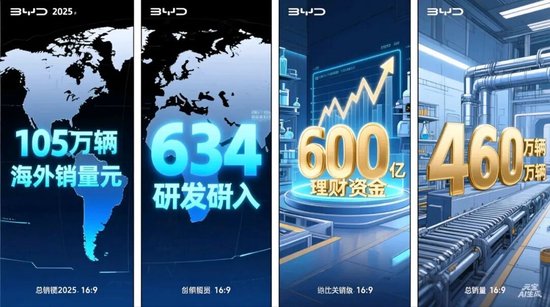
比亚迪2025年成绩单:营收首破8000亿,净利润却下滑19%,600亿理财背后有何深意?
Xin Lang Cai Jing· 2026-03-29 06:16
Core Insights - BYD's revenue for 2025 exceeded 800 billion yuan for the first time, reaching 803.96 billion yuan, a year-on-year increase of 3.46%, while net profit decreased by 18.97% to 32.62 billion yuan, indicating a clear trend of "increased revenue but decreased profit" [2][15] - The company plans to use up to 60 billion yuan of idle funds for entrusted wealth management, an amount close to its net profit for the past two years, raising questions about its financial strategy [2][15] Performance Overview - Revenue growth rate of 3.46% in 2025 is the lowest in six years, compared to 29.02% in 2024 and 22.59% during the pandemic in 2020 [3][16] - Net profit has declined for three consecutive quarters, with a 38.2% drop in Q4, falling below market expectations, marking a return to "increased revenue but decreased profit" since 2021 [3][16] - Operating cash flow decreased by 55.69% to 59.136 billion yuan, down from 133.454 billion yuan in 2024 [3][16] Business Breakdown - Automotive business revenue increased by 5.06% to approximately 648.646 billion yuan, now accounting for 80.68% of total revenue, but the gross margin fell by 1.82 percentage points to 20.49% [4][17] - Mobile phone components and assembly revenue decreased by 2.74% to approximately 155.237 billion yuan, now making up 19.31% of total revenue [4][17] - Domestic revenue (including Hong Kong, Macau, and Taiwan) fell by 11.17% to 493.223 billion yuan, while overseas revenue grew by 40.05% to 310.741 billion yuan [4][17] Sales Performance - Global sales reached a record high of 4.6024 million units, a year-on-year increase of 7.73%, placing BYD among the top five global automotive groups and maintaining its position as the world's leading electric vehicle seller [5][18] - Sales of pure electric vehicles reached 2.2567 million units, a 27.86% increase, surpassing Tesla's 1.636 million units [6][18] - Overseas sales exceeded 1 million units, growing by 145%, with operations in 119 countries and regions [6][18] R&D Investment - R&D expenditure reached approximately 63.4 billion yuan, a 17% increase, accounting for about 7.9% of revenue, nearly double the net profit for the year [7][19] - Significant technological advancements include the second-generation blade battery and fast-charging technology, achieving a record charging speed [7][19] Wealth Management Strategy - Cash reserves reached a historical high of 167.8 billion yuan by the end of 2025 [8][20] - The decision to invest up to 60 billion yuan in wealth management has sparked market discussions, marking a shift from a growth-oriented to a mature company model [8][20] Industry Context - The competitive landscape in the electric vehicle industry is intensifying, with ongoing price wars compressing profit margins [9][21] - Changes in policy, such as the reduction of the new energy vehicle purchase tax starting January 1, 2026, will test the market competitiveness of automotive companies [9][21] Future Outlook - BYD is accelerating its global expansion, with new factories and increased production capacity [10][22] - The high-end strategy is showing results, with significant sales growth in premium brands [10][22] - The integration of artificial intelligence in smart driving and connected vehicles is becoming a key focus for future development [10][22]
宁德时代/亿纬再扩产;鹏辉百亿电池项目将试产;国轩落子南京;瑞浦首次盈利;欣旺达落子北京;奇瑞安徽项目启动;比亚迪电摩锂电池上市
起点锂电· 2026-03-29 05:52
Group 1 - The second "Starting Point Lithium Battery Cylindrical Cell Technology Forum" and the release of the "Top 20 Cylindrical Battery Rankings" will take place on April 10, 2026, in Shenzhen [3] - The event will focus on advancements in all-tab technology and leadership in the large cylindrical battery market [3] - Key sponsors and speakers include major companies such as Dofluor, Tianneng, and Penghui Energy [3] Group 2 - BYD has launched a new lithium iron phosphate battery series specifically for electric motorcycles, named "Riding Fortress," with a range of 150 kilometers and a cycle life exceeding 3000 times [5] - CATL's subsidiary has begun construction on a second-phase project in Chengdu, expected to generate an annual output value of approximately 5 billion yuan upon completion [6] - CATL has signed a strategic cooperation agreement with Sanming Transportation Group to promote 100% electrification of public transport [7] Group 3 - EVE Energy plans to invest approximately 6 billion yuan in a 60GWh energy storage battery project in Huizhou [8] - Penghui Energy's 36GWh energy storage battery project in Quzhou is set to begin trial production in June [9] - Guoxuan High-tech has established a new battery technology company in Nanjing with a registered capital of 50 million yuan [10] Group 4 - Ruipu Lanjun reported a revenue of 24.334 billion yuan for 2025, a year-on-year increase of 36.7%, with a net profit of 681 million yuan [11] - Xinwanda has established a new company in Beijing with a registered capital of 300 million yuan, focusing on battery manufacturing and sales [12] - Zhongchuang Innovation has begun mass production of aviation-grade batteries at its Chengdu factory [13] Group 5 - Chery's new energy battery project in Suzhou has commenced foundation construction, with an investment of approximately 4 billion yuan [14] - A new lithium hexafluorophosphate project with a total investment of 13.6 billion yuan has started construction in Hubei [16][17] - A 6,000-ton silicon-carbon anode material project has been approved in Zhejiang, with a total investment of 1.3 billion yuan [18] Group 6 - Samsung SDI has signed a procurement agreement worth approximately 7.3 billion yuan for lithium iron phosphate materials to expand its energy storage system business in North America [26][27] - Hengtong Co. plans to build a high-end copper-aluminum composite foil project with an expected annual production capacity of 45 million square meters [28] - Yifei Laser has opened a new company in South Korea, enhancing its position in the global new energy battery supply chain [30] Group 7 - BYD reported a revenue of approximately 803.964 billion yuan for 2025, with a net profit of about 32.619 billion yuan [39] - Xiaomi's new SU7 model has exceeded market expectations with over 30,000 orders within three days of launch [41] - Leap Motor has established a thermal control company in Zhejiang, focusing on manufacturing automotive components [44]





年度榜单丨全球户用储能系统出货量TOP20发布
起点锂电· 2026-03-29 05:52
Core Insights - The article highlights the significant growth in the global residential energy storage market, projecting a shipment scale of 40 GWh in 2025, representing a year-on-year increase of 43.88% [1][2] - The market is driven by emerging applications such as virtual power plants and integrated solar-storage solutions, particularly in mature markets like Europe, North America, and Australia, as well as in emerging markets facing high electricity prices and unstable grid conditions [1][2] Market Growth and Projections - The global residential energy storage market is expected to reach 180 GWh by 2030, with a cumulative growth of 3.75 times over five years and a compound annual growth rate (CAGR) of 35% [2] - In 2025, the European market is anticipated to recover as inventory depletion is completed, with demand gradually increasing, particularly in Western Europe led by Germany, France, and Italy, while Eastern Europe is also seeing demand growth due to high electricity prices and unstable supply [4][5] Competitive Landscape - The top 20 companies in the global residential energy storage market are dominated by Chinese manufacturers, who hold 18 out of 20 positions, leveraging cost and technology advantages to penetrate overseas markets [5][11] - The market share of the top five companies (CR5) is 45.9%, while the top ten (CR10) accounts for over 71.8%, indicating a growing concentration of market power among leading firms [5][11] Key Players - The leading companies in the residential energy storage market include Tesla, Huawei, BYD, LG, and Sungrow, with Tesla maintaining a dominant position in North America and expanding into Europe and Australia [10][11] - The second tier of companies focuses on regional strengths and niche markets, with firms like Midea Energy and Goodwe making significant inroads in specific areas such as Australia and Europe [12]



比亚迪电子2025年收入达1794.77亿元,新能源汽车业务保持高速增长
Ju Chao Zi Xun· 2026-03-29 03:43
Group 1: Financial Performance - The company reported a revenue of 179.477 billion RMB for the year ending December 31, 2025, representing a year-on-year increase of 1.22% [3] - Gross profit was 10.756 billion RMB, a decrease of 12.56% compared to the previous year [3] - Net profit attributable to the parent company was 3.515 billion RMB, down 17.61% year-on-year, with earnings per share at 1.56 RMB [3] Group 2: Business Segments - The new energy vehicle segment generated approximately 27.027 billion RMB in revenue, a year-on-year growth of 27.69%, accounting for 15.06% of the total revenue [1] - The AI computing infrastructure segment achieved revenue of about 943 million RMB, reflecting a year-on-year increase of 31.7% [2] - The smart terminal business saw overall revenue of 151.507 billion RMB, with component revenue at approximately 29.331 billion RMB and assembly revenue at about 122.176 billion RMB [4] Group 3: Research and Development - The company invested approximately 4.465 billion RMB in research and development, representing 2.49% of total revenue for the year [4] - The total number of patents applied for reached 12,010, with 8,279 patents granted, indicating a significant increase in patents related to AI computing infrastructure [4] Group 4: Cash Flow and Financial Health - The net cash inflow from operating activities was approximately 1.877 billion RMB, a significant improvement from 671 million RMB in the previous year [4] - Interest-bearing bank and other borrowings were about 7.184 billion RMB, a decrease of 33.5% compared to the previous year [4] - The debt ratio improved from 18.01% to -13.53%, indicating a strong net cash position for the company [4] Group 5: Future Outlook - The company plans to continue focusing on core technology research and development, enhancing high-end manufacturing innovation capabilities [5] - The new energy vehicle business is expected to maintain rapid growth, while emerging sectors like AI computing infrastructure and AI robotics are anticipated to accelerate [5] - The company aims to capitalize on the strategic opportunities presented by the acceleration of smart technology in the automotive industry [5]

营收8040亿元,研发投入超600亿元,比亚迪2025年财报折射车企生存新逻辑
Hua Xia Shi Bao· 2026-03-29 01:52
Core Insights - BYD's 2025 annual report shows robust growth with total revenue of 804 billion yuan and a net profit of 32.6 billion yuan, alongside significant contributions to domestic taxes and R&D investments [2][3] - The company achieved a sales volume of over 4.6 million vehicles, with international sales reaching 1.05 million units, marking a significant milestone in its globalization and premiumization strategy [2][4] Financial Performance - BYD's revenue of 804 billion yuan and net profit of 32.6 billion yuan reflect a solid financial foundation, with domestic tax contributions amounting to 53.3 billion yuan, which is notably higher than net profit [3] - The company holds a cash reserve of 167.8 billion yuan, providing a strong financial buffer for future R&D and market expansion [3] R&D Investment - R&D investment reached 63.4 billion yuan, a 17% increase year-on-year, surpassing net profit and bringing total R&D spending to over 240 billion yuan [3][6] - The R&D investment as a percentage of revenue stands at 7.89%, higher than the industry average of 6.8%, indicating a strong commitment to innovation [6] Sales and Market Expansion - BYD's total vehicle sales reached 4.6 million units, placing it among the top five global automotive groups, reinforcing its competitive edge in the electric vehicle market [3][7] - International sales grew by 145% year-on-year, with operations now covering 119 countries and regions, highlighting the company's successful global expansion [4][7] Industry Context - The Chinese automotive industry is experiencing a "volume increase, profit weakness" trend, with overall revenue growth of 7.1% and a slight profit increase of 0.6%, indicating significant competitive pressures [6][8] - The global electric vehicle market saw cumulative sales surpassing 20.53 million units, with Chinese brands, including BYD, capturing a substantial market share [7] Strategic Focus - BYD is focusing on high-quality development amidst increasing competition, with internationalization and premiumization identified as key growth drivers [4][5] - The company’s strategy includes leveraging its full supply chain capabilities in battery and hybrid systems to maintain profitability and competitive advantage [8]