
XPENG(XPEV)

Search documents
当AI走出屏幕,小鹏亮出物理AI这张牌
Tai Mei Ti A P P· 2025-11-10 11:14
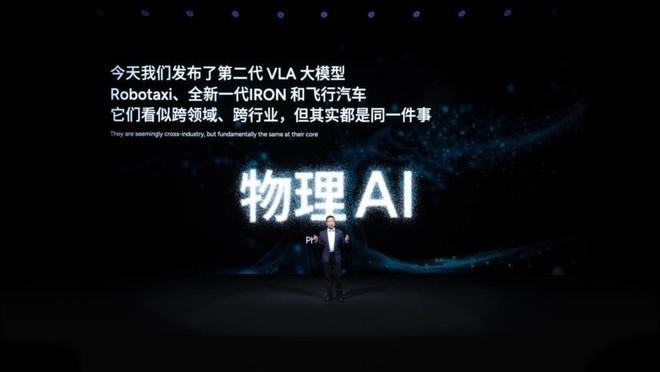
Core Insights - The article emphasizes the shift of AI from the virtual world to the physical world, marking the emergence of "Physical AI" as the next competitive frontier in technology [3][4][5] - Companies are adopting different strategies to capture the opportunities presented by Physical AI, with some opting for vertical integration while others focus on ecosystem empowerment [5][6][7] Group 1: Trends in AI Development - The consensus in the tech industry is that Physical AI is the next battleground, with leaders like Huang Renxun and Alibaba's CEO highlighting its significance [4][5] - Companies like Tesla and XPeng are pursuing vertical integration, creating a closed-loop system that encompasses chip design, sensors, software, and vehicle manufacturing [5][6] - Other players, such as NVIDIA and Huawei, are acting as ecosystem enablers, focusing on providing the necessary computational power and infrastructure for Physical AI [5][6] Group 2: XPeng's Strategy - XPeng aims to become a "Physical AI world explorer" by integrating multiple transportation scenarios, facing challenges in chip development, algorithm innovation, and commercialization [9][18] - The core of XPeng's technology is the second-generation VLA model, which allows for direct action based on visual signals, enhancing response speed and reducing information loss [9][10] - XPeng has invested heavily in computational power, achieving 2250 TOPS on its self-developed "Turing" AI chip, significantly surpassing industry standards [10][11] Group 3: Product Development and Market Positioning - XPeng plans to launch its Robotaxi in 2026, designed specifically for autonomous driving, which will reduce costs and improve reliability by not relying on expensive lidar and high-definition maps [11][15] - The company is also developing humanoid robots and flying cars, with the "Land Carrier" already receiving 7,000 orders, indicating a move towards scalable commercial applications [13][15] - These products are interconnected, forming a "capability ladder" that enhances XPeng's Physical AI capabilities through real-world applications [15][16] Group 4: Data Acquisition and Ecosystem Challenges - The success of Physical AI hinges on acquiring high-quality data, with XPeng emphasizing the importance of capturing valuable "long-tail and anomaly data" for model training [19][21] - The complexity of the physical world necessitates collaboration across the industry, leading to a paradox where companies must balance openness with maintaining core competencies [21][22] - XPeng's strategy involves a combination of core self-research and open collaboration, ensuring that it retains control over critical technologies while fostering partnerships [22][23]


前瞻全球产业早报:马斯克计划建造特斯拉超大型AI芯片工厂
Qian Zhan Wang· 2025-11-10 10:48
Trade and Economic Data - ASEAN has become China's largest trading partner in the first ten months of the year, with a total trade value of 6.18 trillion yuan, an increase of 9.1%, accounting for 16.6% of China's total foreign trade [2] - The EU is the second-largest trading partner, with a trade value of 4.88 trillion yuan, growing by 4.9%, representing 13.1% of total foreign trade [2] - The US ranks third, with a trade value of 3.38 trillion yuan, a decrease of 15.9%, making up 9% of total foreign trade [2] - China's total imports and exports with Belt and Road countries reached 19.28 trillion yuan, an increase of 5.9% [2] Digital Economy and Technology - Beijing's digital economy increased by 9% in the first three quarters, with core digital economy industries growing by 10.7% [3] - The city has released implementation opinions to build a data factor comprehensive experimental zone, focusing on market-oriented data allocation reform [3] - The State Council has issued opinions to promote the integration of new-generation information technologies, including big data and IoT, in medical applications [4] Robotics and AI Developments - Predictions indicate that there may be ten times the number of robots compared to humans working in the future, with a global robot count potentially exceeding 70 billion [5] - Tesla's full self-driving software is expected to receive full approval in China by early 2026 [5] - Ant Group has upgraded its organizational structure, establishing a health business group to accelerate its healthcare strategy [5] - Lens Technology is set to supply key components for Xiaopeng Robotics, although mass production plans are not yet finalized [6] AI and Chip Technology - Google is set to launch its most powerful AI chip, Ironwood, in the coming weeks [7] - Tesla is considering building a large AI chip factory and may collaborate with Intel for chip production [7] - Tesla's humanoid robots are expected to have a production cost of under $20,000 each [8] Funding and Investments - Thunderbird Innovation has completed a Series C financing round, led by CITIC Jinshi, to accelerate AI+AR glasses development [13] - Simple AI, a new player in the embodied AI robotics sector, has raised a total of 200 million yuan in seed funding within three months [13] - Companies like Zhongwei New Materials are pursuing dual listings in Hong Kong and A-shares [14]




【美股盘前】三大期指齐涨,明星科技股、中概股普涨;美国会参议院就结束政府“停摆”达成一致;全球首个美国以外城市级Robotaxi纯无人运营牌照花落文远知...
Mei Ri Jing Ji Xin Wen· 2025-11-10 10:21
Group 1 - Major stock index futures are up, with Dow futures rising by 0.44%, S&P 500 futures increasing by 1.00%, and Nasdaq futures gaining 1.56% [1] - Prominent tech stocks are experiencing pre-market gains, with Nvidia and AMD up over 3%, Oracle and TSMC rising more than 2.5%, and Intel increasing nearly 2% [1] - Notable Chinese concept stocks are also up in pre-market trading, with Xpeng Motors rising over 5.5%, Li Auto and NIO increasing nearly 2%, and NetEase and Pinduoduo gaining over 1.5% and 1.3% respectively [1] Group 2 - WeRide has received the first city-level Robotaxi operating license outside the U.S., allowing for fully autonomous operations in Abu Dhabi, marking a significant milestone in the Middle East [1] - Pfizer has successfully acquired Metsera for $10 billion, a biotech company developing a monthly-administered weight loss drug, positioning itself competitively against Novo Nordisk and Eli Lilly's weekly-administered products [1][2] - Rumble is set to acquire German AI company Northern Data, which will expand Rumble's cloud business and accelerate its international growth strategy [2] - Robinhood plans to launch a new fund allowing retail investors to invest in private AI companies, managed by its subsidiary Robinhood Ventures, focusing on a concentrated portfolio of top private firms [2] - UBS strategists predict the S&P 500 index will reach 7500 points by 2026, representing an 11% increase, driven by approximately 14% earnings growth, with nearly half coming from tech companies [2]


对话何小鹏:在物理AI时代,数据是新的石油
雷峰网· 2025-11-10 10:05
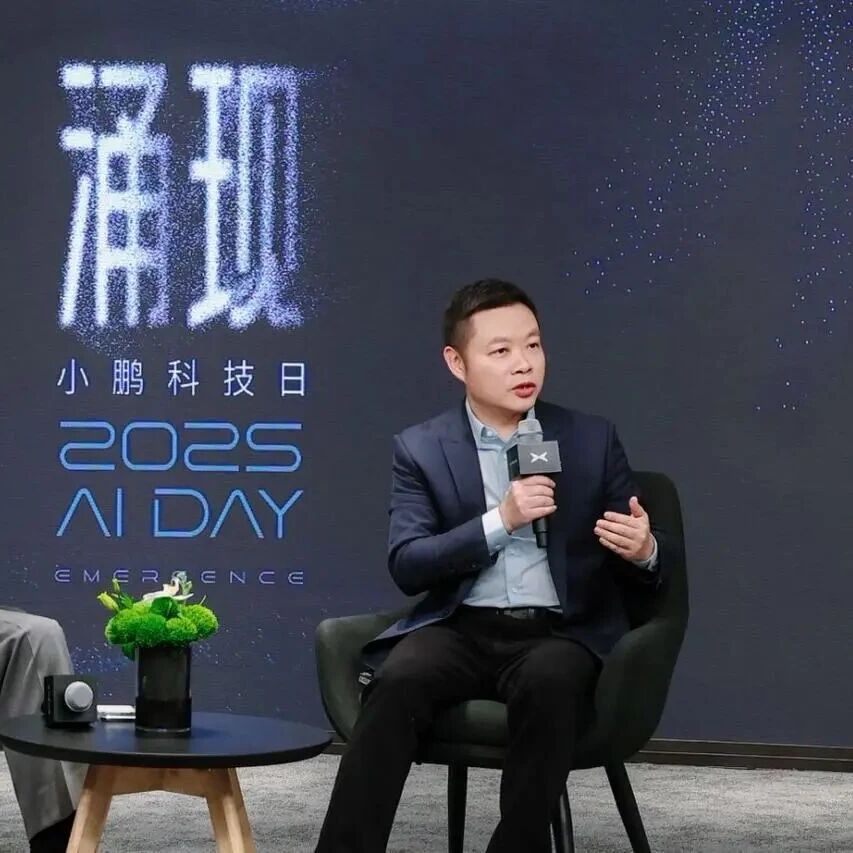
Core Viewpoint - Xiaopeng Motors is evolving into an AI-centric company, focusing on four key areas: smart cars, robots, Robotaxi, and flying cars, with intelligent driving as the core of its business strategy [3][4]. Group 1: Business Focus and Strategy - Xiaopeng Motors has shifted its positioning to become a "global embodied intelligence enterprise," moving beyond being just a Chinese car manufacturer [8]. - The company aims to leverage its hardware capabilities across various sectors, including robots and flying cars, to create a data-driven ecosystem that enhances its software and hardware synergy [5][6]. - The introduction of Robotaxi services is based on a vision of future transportation that combines shared and private mobility [5][7]. Group 2: Technological Advancements - The second-generation VLA (Visual Language Model) represents a significant breakthrough in physical AI, enabling machines to understand and interact with the physical world more effectively [4][5]. - Xiaopeng's second-generation VLA has eliminated the reliance on high-precision maps, allowing for direct support of pre-production solutions, which helps in cost management [6][7]. - The company is committed to open-sourcing some of its core technologies, with Volkswagen being the first commercial partner to utilize the second-generation VLA [8]. Group 3: Market Potential and Competition - The global market for robots is projected to be $20 trillion, significantly larger than the $10 trillion automotive market, indicating a strong growth potential for Xiaopeng's robotics initiatives [15][16]. - Xiaopeng's valuation is currently lower than Tesla's, but the company is focused on technology and product development to enhance its market position [12][13]. - The company is actively pursuing international market opportunities, with plans for half of its products to be sold outside China within the next decade [27]. Group 4: Operational Insights - Xiaopeng's Robotaxi strategy is designed to ensure profitability by utilizing pre-manufactured vehicles and sharing development costs, which provides a competitive edge in the market [17]. - The company is exploring various operational partnerships, such as with Gaode, to enhance its Robotaxi service offerings [11]. - The production capacity at the Austrian factory is expected to scale from a few thousand units this year to tens of thousands next year, indicating a commitment to local production and operational capabilities [29].
中国汽车市场一周行业信息快报——2025年11月第2期
Zhong Guo Zhi Liang Xin Wen Wang· 2025-11-10 09:48
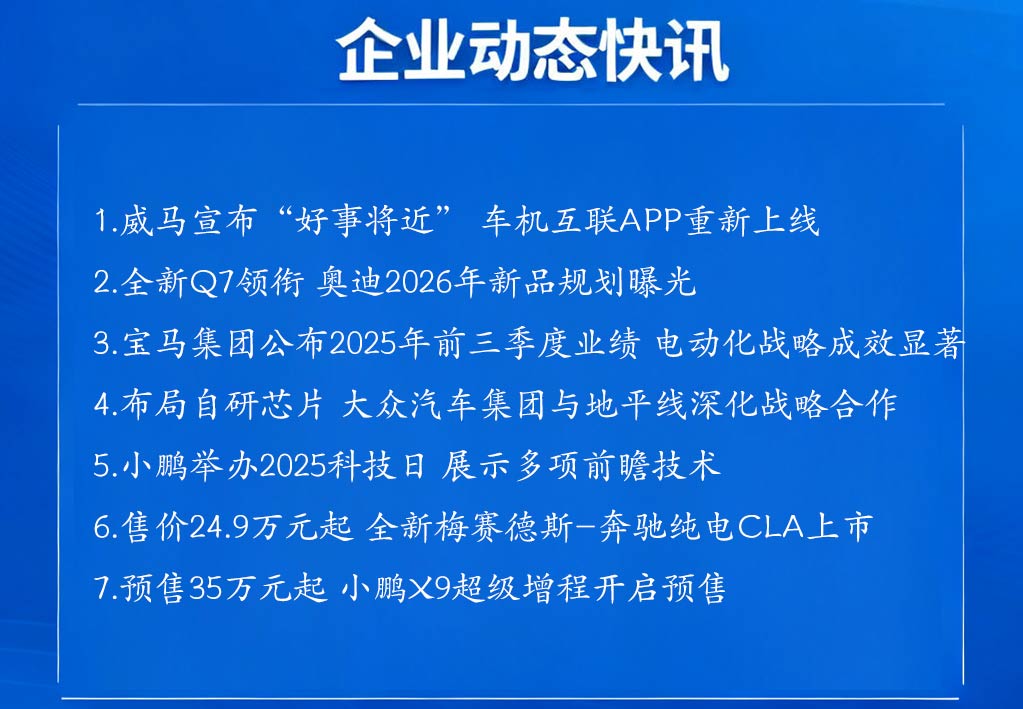
Group 1 - WM Motor announced the relaunch of its "Xiao Wei Suixing" app, which is a dedicated smart application for car owners, now available on both iOS and Android platforms [5] - The app has restored its main functionalities and currently supports models such as WM EX5 and WM EX6, with plans for further model adaptations [5] Group 2 - Audi revealed its product plan for 2026, introducing three significant new models: the next-generation Audi Q7, the Audi Q9, and a new entry-level electric vehicle [6] - The new Q7 will feature comprehensive upgrades in design and technology, including advanced driving assistance systems and improved fuel efficiency [6] - The Q9 will be Audi's first full-size SUV, offering internal combustion engine options and potentially plug-in hybrid variants [6] Group 3 - BMW Group reported a revenue of €32.314 billion for Q3 2025, with automotive segment revenue at €28.510 billion, reflecting a year-on-year growth of 2.4% [6] - Global sales for BMW Group in Q3 reached 588,300 units, marking an 8.8% increase year-on-year, with total sales for the first three quarters at 1,795,894 units, also up by 2.4% [7] - Electric vehicle sales in Q3 totaled 151,282 units, a year-on-year increase of 8.0%, while pure electric vehicle sales slightly declined by 0.6% [6][7] Group 4 - Volkswagen Group deepened its strategic partnership with Horizon Robotics to develop system-level computing solutions in China, aimed at enhancing advanced driver assistance and autonomous driving systems [8][10] - This collaboration will leverage Volkswagen's global engineering experience and Horizon's local production capabilities to create a new generation of smart connected vehicles [10] Group 5 - XPeng Motors held its seventh Technology Day, showcasing four significant applications under the theme "Emergence" and announcing a major upgrade in the company's positioning [12] - The second-generation VLA model eliminates the traditional "language translation" step, enabling direct generation of action commands from visual signals [12] - XPeng plans to launch three Robotaxi models in 2026, equipped with advanced AI capabilities and high computing power [12] Group 6 - The all-new Mercedes-Benz electric CLA was officially launched with a price range of ¥249,000 to ¥299,900, featuring a closed grille design and advanced interior technology [13][15] - The vehicle is equipped with an 89 kWh battery, achieving a maximum CLTC range of 866 km and an energy conversion rate of up to 93% [15] Group 7 - XPeng X9 Super Range has opened for pre-sale, with a price range of ¥350,000 to ¥370,000, designed as a 7-seat large MPV with advanced range capabilities [17] - The vehicle features a combination of a 1.5T range extender and an electric motor, achieving long-range and low travel costs [17]
增程的“抽屉”,何小鹏真拉开了
Xin Lang Cai Jing· 2025-11-10 09:48
Core Viewpoint - Xiaopeng Motors is transitioning from being solely an electric vehicle manufacturer to incorporating range-extended technology, starting with the launch of the Xiaopeng X9, which marks a significant shift in its product strategy [1][2]. Group 1: Entry into Range-Extended Vehicles - Xiaopeng X9 features enhancements in design, length, and interior compared to its pure electric version, with pre-sale prices starting at 350,000 yuan for the Max version, which is nearly 10,000 yuan lower than the pure electric model [2]. - The decision to enter the range-extended vehicle market was reached after five internal discussions, with the fifth attempt being successful, highlighting the challenges faced in the decision-making process [2][3]. - Industry insiders suggest that the initial reluctance to pursue range-extended technology stemmed from concerns about its maturity and the potential loss of advantages for traditional automakers [2][3]. Group 2: Technical Features and Innovations - The Xiaopeng X9 is equipped with a fast-charging lithium iron phosphate battery that meets new national standards, featuring a 24-hour fire and explosion prevention capability and a design life of 2000 cycles [4][5]. - The vehicle boasts a CLTC pure electric range of 452 kilometers and a comprehensive range of 1602 kilometers, with a rapid charging capability that allows for 70% charge in just 12 minutes [5]. - Xiaopeng's new 800V mixed silicon carbide drive system achieves a comprehensive efficiency of 93.5%, with a peak torque of 465 N·m and peak power of 210 kW, ensuring performance even at low battery levels [5]. Group 3: Market Position and Future Outlook - The introduction of range-extended models increases Xiaopeng's demand for batteries, necessitating strong supply chain management, especially with anticipated market shortages in 2025 [6]. - Xiaopeng is positioning itself as a "embodied intelligence company," moving beyond just electric vehicles to include robotics and AI technologies, with significant investments in these areas [7][8]. - The company aims to integrate hardware and software in its new generation of humanoid robots, with plans for mass production of flying cars and Robotaxis, indicating a diversified growth strategy [9][10].
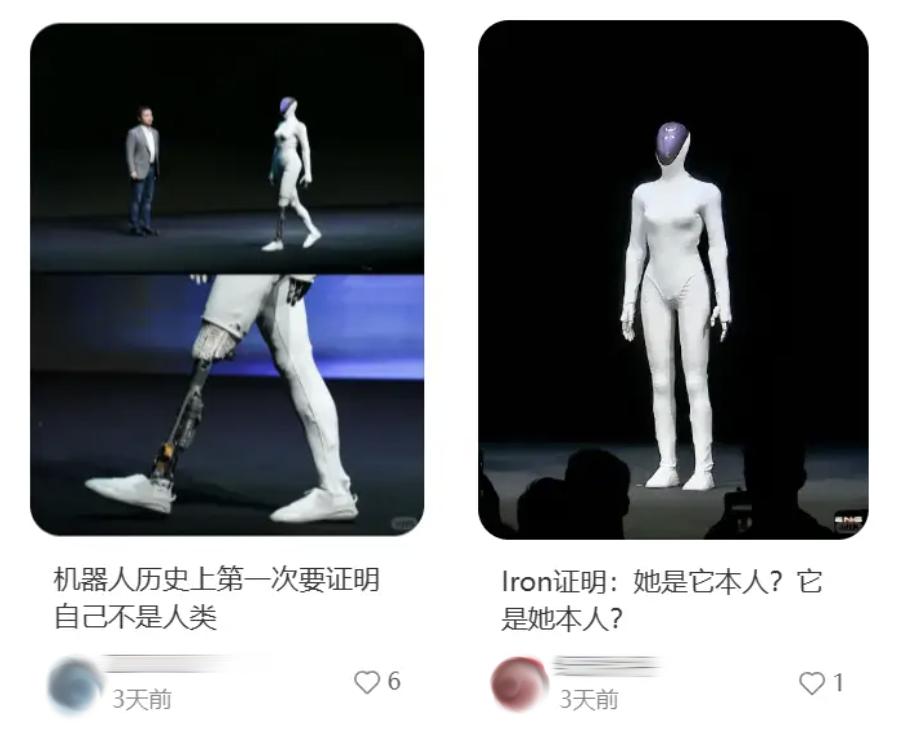
小鹏当场剪开皮肤证明里面没藏真人,但机器人长出胸部后到底能替打工人做点啥?
3 6 Ke· 2025-11-10 09:38
Core Viewpoint - The rapid development of humanoid robots, exemplified by Xiaopeng's IRON, raises questions about their capabilities and societal implications, particularly regarding their human-like appearance and functionality [1][3][20]. Group 1: Product Features and Development - Xiaopeng's humanoid robot IRON features a height of 178 cm and a weight of 70 kg, designed with a flexible fiber covering and a structure mimicking human anatomy [3][5]. - The robot's walking ability, which resembles a human's "catwalk," is a significant advancement, although the underlying technology is not considered groundbreaking within the industry [5][7]. - IRON's design includes movable joints in the shoulders and waist, enhancing its human-like movement, which is a departure from traditional robots that lack such features [7][20]. Group 2: Market Position and Applications - The initial application for IRON is as a sales assistant in car dealerships, highlighting its role in marketing rather than performing complex tasks [9][20]. - The rental market for humanoid robots has seen a drastic price drop, indicating a potential oversupply and raising questions about their practical applications beyond entertainment [10][12]. - Current uses for humanoid robots include performing at events and serving as customer service representatives, but their functionality in household tasks remains limited [12][13]. Group 3: Industry Challenges and Future Prospects - The humanoid robot industry faces challenges in achieving practical applications, with many robots still seen as novelty items rather than functional tools [10][18]. - The development of humanoid robots is driven by the need for market differentiation and the potential for high-value applications, despite current limitations in their capabilities [20][30]. - The expectation is that humanoid robots could eventually perform 40%-50% of tasks currently done by humans, but significant technological advancements are still required [30][31].

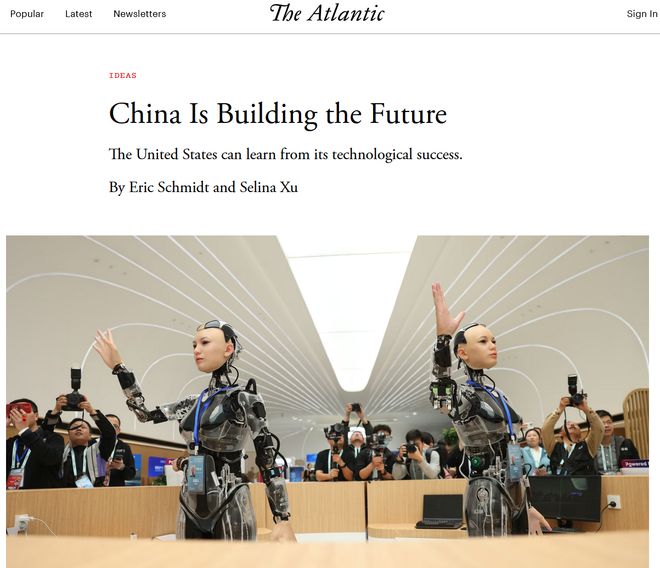
谷歌前CEO:中国正在塑造未来
Guan Cha Zhe Wang· 2025-11-10 09:33
Core Viewpoint - The article emphasizes China's remarkable resilience and innovation in technology and manufacturing, showcasing its position as a global leader despite economic slowdowns [1][4][6]. Group 1: China's Technological and Manufacturing Dominance - China is the world's largest manufacturer and exporter, producing over two-thirds of global electric vehicles, four-fifths of photovoltaic components and battery cells, and approximately 60% of wind turbines [1][4]. - The country processes the majority of the world's rare earth materials, essential for various technologies from chips to military aircraft [1]. - China's industrial robot installations account for about half of the global total, with high-speed rail mileage and 5G base stations also representing over 70% and 50% of the global totals, respectively [4]. Group 2: Success Stories of Chinese Companies - Xiaomi, once seen as an imitator of Apple, has become one of China's most valuable companies with a market capitalization of approximately $150 billion and is set to launch its first electric vehicle in 2024 [4]. - Huawei has expanded from telecommunications equipment to producing automotive components, while Alibaba is developing AI inference chips for its AI models [5]. - The article highlights the importance of China's existing supply chain, infrastructure, and skilled workforce in supporting the rapid development of these companies [4][5]. Group 3: Open Source AI and Global Influence - The open-source movement in China's AI sector is flourishing, with major companies like Alibaba, ByteDance, and Baidu releasing open-source AI models, which could enhance China's technological competitiveness and attract more developers [5][6]. - China holds 70% of global AI patent authorizations and leads in clean energy technology patent applications, indicating its growing influence in these fields [6]. Group 4: Implications for the U.S. and Global Dynamics - The article suggests that if the U.S. aims for re-industrialization, it must focus on supporting research, attracting talent, and removing regulatory barriers, while acknowledging its shortcomings in hardware and AI diversity [6][7]. - A warning is issued that if the U.S. continues to adopt a hostile stance towards China, it risks becoming more closed off and protectionist, potentially losing its status as a leading global power [7].


美股异动丨小鹏汽车盘前涨超5% 美银上调其2025至2027年的销量及收入预测
Ge Long Hui· 2025-11-10 09:17
Core Viewpoint - Xpeng Motors (XPEV.US) shares rose 5.58% to $23.67 in pre-market trading following the announcement of significant advancements in physical AI and new product launches during the 2025 Xpeng Technology Day [1] Group 1: Product Developments - Xpeng unveiled four key applications of physical AI, including the second-generation VLA large model, Xpeng Robotaxi, a new generation of IRON humanoid robots, and the Huotian flying car [1] - The company aims to be a pioneer in the physical AI world, with all new product developments based on physical AI technology [1] Group 2: Financial Forecasts - Bank of America raised its sales forecasts for Xpeng Motors for 2025 to 2027 by 0.2%, 0.2%, and 0.3% respectively, and revenue forecasts by the same percentages [1] - The target price for Xpeng Motors' U.S. stock was increased from $26 to $27, maintaining a "buy" rating due to anticipated strong model launches in the second half of 2025 and into 2026 [1]
关注人形机器人、工程机械及流程工业
Xinda Securities· 2025-11-10 09:13
Investment Rating - The investment rating for the machinery equipment industry is "Positive" [2] Core Views - The report highlights a significant growth in the sales of excavators and loaders, with excavator sales reaching 18,096 units in October, a year-on-year increase of 7.8%, and loader sales increasing by 27.7% [12][58] - The humanoid robot sector is experiencing rapid advancements, with companies like Xiaopeng and ZhiYuan launching new models aimed for mass production by 2026 [12][55] - The report emphasizes the resilience of companies like Rihuan Technology and Kangst, which have shown strong revenue growth despite external pressures [3][4][14] Summary by Sections 1. Company Highlights - Rihuan Technology, a leading supplier of industrial X-ray intelligent detection equipment, saw a nearly 100% increase in new orders year-on-year and a 44.01% revenue growth in the first three quarters [3] - Kangst, involved in digital detection instruments, reported a 22.24% increase in revenue and a 30.66% increase in net profit in Q3, demonstrating strong operational resilience [4][14] - Newrui Co., which produces hard alloys and tools, experienced a significant profit increase of 75.40% in Q3, driven by effective cost management amid rising raw material prices [5][15] 2. Industry Trends - The machinery sector is witnessing a broad recovery, with excavator and loader sales showing strong growth, indicating a positive trend in construction and infrastructure investment [12][58] - The humanoid robot market is set for significant growth, with advancements in technology and increasing investments from major companies [12][55] 3. Market Performance - The machinery index saw a slight decline of 0.25% last week, while other major indices like the Shanghai Composite Index increased by 1.08% [16] - The report notes that the machinery industry is experiencing varied performance across sub-sectors, with some segments like power distribution equipment showing strong gains [22] 4. Policy Support - Recent government policies are aimed at enhancing the industrial machinery sector, including support for high-end machine tools and automation technologies [28][35]


