海底捞

Search documents
马年将至消费板块修复在即,摩根大通研报:中国消费股已具备足够吸引力
Zhi Tong Cai Jing· 2026-01-20 14:28
Core Insights - The Chinese consumer sector is showing signs of recovery in early 2026 after a five-year underperformance period from 2021 to 2025, driven by a combination of policy support and structural differentiation in demand [1] - The report highlights that the risk-reward ratio for Chinese consumer stocks is now attractive due to valuation advantages and profit resilience, with a focus on sector differentiation and company-specific opportunities [1] Industry Fundamentals: Mild Recovery Under Pressure - The current landscape of the Chinese consumer industry is characterized by "weak demand recovery and profit repair," with retail sales growth slowing to 1.3% year-on-year in November 2025 [2] - Forecasts suggest retail sales growth will remain at 2.6% and 2.5% for 2026 and 2027, respectively, amid a GDP growth slowdown to 4.5% and 4.1% [2] - Profit expectations for 2025 have been downgraded, with projected sales and net profit growth of only 3.7% and 8.8%, respectively, indicating potential further downward revisions if no additional stimulus is implemented [2] Core Trends Iteration: Restructuring Competitive Landscape - Price deflation has become a significant characteristic of the industry, with notable declines in key products, such as the price of Feitian Moutai dropping over 60% from its peak [3] - The trend of industry consolidation is accelerating, with leading companies leveraging cost control and digital technologies to capture market share from smaller brands [3] Changes in Consumer Behavior: Affordable Self-Indulgence and Experience-Driven Consumption - In the context of consumption downgrade, "affordable self-indulgence" has emerged as a core logic for younger consumers, who are price-sensitive yet willing to pay for emotional value and experiences [4] - Successful strategies in this segment involve differentiation, as seen with companies like Pop Mart, which utilizes a multi-IP matrix to mitigate risks associated with single IP lifecycle [4] Overseas Expansion and Demographic Restructuring Growth Logic - To counter domestic growth challenges, leading companies in sectors like home appliances and sportswear are accelerating their overseas expansion, benefiting from stronger demand and more rational competition [6] - The ongoing demographic shift, including a declining birth rate and an aging population, presents both challenges and opportunities for various sectors, driving demand growth in areas like personal care and elder services [6] Global Perspective: Valuation Advantages of Chinese Consumer Stocks - After five years of adjustment, the valuation bubble in the Chinese consumer sector has significantly compressed, with a projected P/E ratio of 17 times for 2026, lower than several other markets [7] - Notable performers since early 2026 include brands like Gu Ming and Li Ning, reflecting market recognition of quality leading companies [7] Transition from High Growth to Steady Defensive Full-Spectrum Layout - The Chinese consumer industry is transitioning from a "same rise and fall" cycle to an era where "structure is king," supported by policy measures and evolving consumption trends [8] Recommended Investment Targets - JPMorgan highlights six key investment targets across different sectors, including Laopu Gold, Luckin Coffee, and Pop Mart, focusing on companies that benefit from policy support and have strong competitive advantages [9] - Investment strategies should concentrate on sectors benefiting from policy stimulus, affordable self-indulgence trends, and those with overseas expansion capabilities to navigate domestic growth challenges [9]

爆款续命后,金星啤酒火速IPO:家族套现超3亿,欠缴员工公积金
Feng Huang Wang Cai Jing· 2026-01-20 12:49
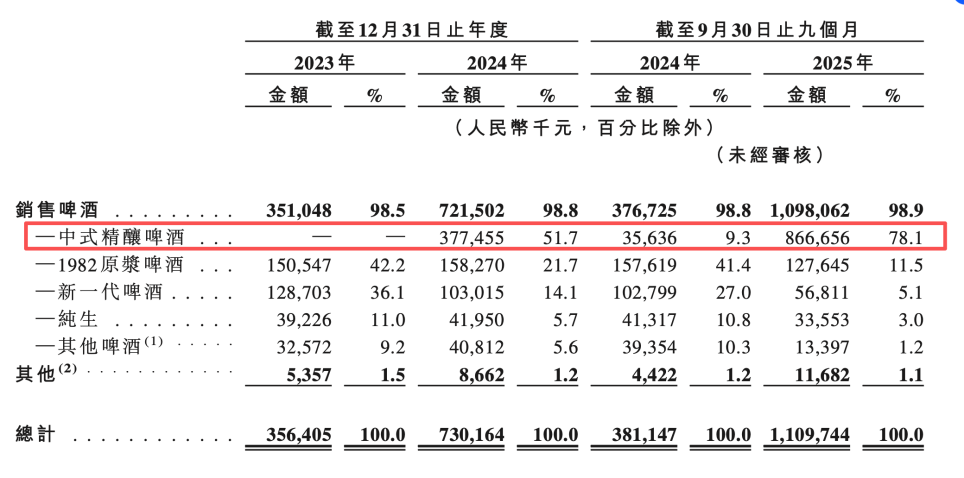
Core Viewpoint - Jinxing Beer has submitted its prospectus to the Hong Kong Stock Exchange, experiencing a significant turnaround driven by its popular product "Maojian Tea Beer," which has led to rapid revenue growth and a strong push for an IPO [1][2]. Financial Performance - Revenue for Jinxing Beer in 2023, 2024, and the first nine months of 2025 was 356 million, 730 million, and 1.1 billion RMB respectively, with net profits soaring from 12.2 million to 305 million RMB, marking a 924% increase in 2024 [1][3]. - Gross margins improved significantly, with figures of 27.3%, 37.8%, and 47% for the respective years, while net margins rose from 3.4% to 27.5% [1][6]. - Operating cash flow transitioned from a negative 60 million RMB in 2023 to a positive 360 million RMB in 2024 [1]. Product Dependency - The "Maojian Tea Beer" product line has become a major revenue contributor, accounting for 51.7% of total revenue in its launch year and increasing to 78.1% by the first nine months of 2025 [2][3]. - This heavy reliance on a single product raises concerns about revenue volatility in the face of market competition and changing consumer preferences [2]. Market Competition - The success of Jinxing Beer in the craft beer segment has attracted major competitors, including traditional beer giants and cross-industry players, leading to an increasingly competitive market landscape [2]. Corporate Governance - Jinxing Beer is a family-controlled business, with the Zhang family holding approximately 99.99% of the shares, indicating a high concentration of control [3]. - The company has faced scrutiny over its governance practices, including significant cash dividends distributed to major shareholders, raising concerns about the protection of minority shareholders' interests [4]. Financial Management Issues - The company has reported overdue social insurance and housing fund payments totaling 21.9 million RMB from 2023 to the first three quarters of 2025, although it claims to have rectified the social insurance issues [5]. - There have been irregularities in financial controls, such as allowing distributors to make payments through third-party accounts, which constituted a significant portion of cash receipts in previous years [5]. Debt Levels - Jinxing Beer had an extremely high debt-to-asset ratio of 2250% in 2023, which improved to 98.7% in 2024 and further decreased to 11.1% by the first nine months of 2025, indicating a significant reduction in financial leverage [5][6].
海底捞的腰,被“穷鬼年轻人”压弯了
3 6 Ke· 2026-01-20 11:42
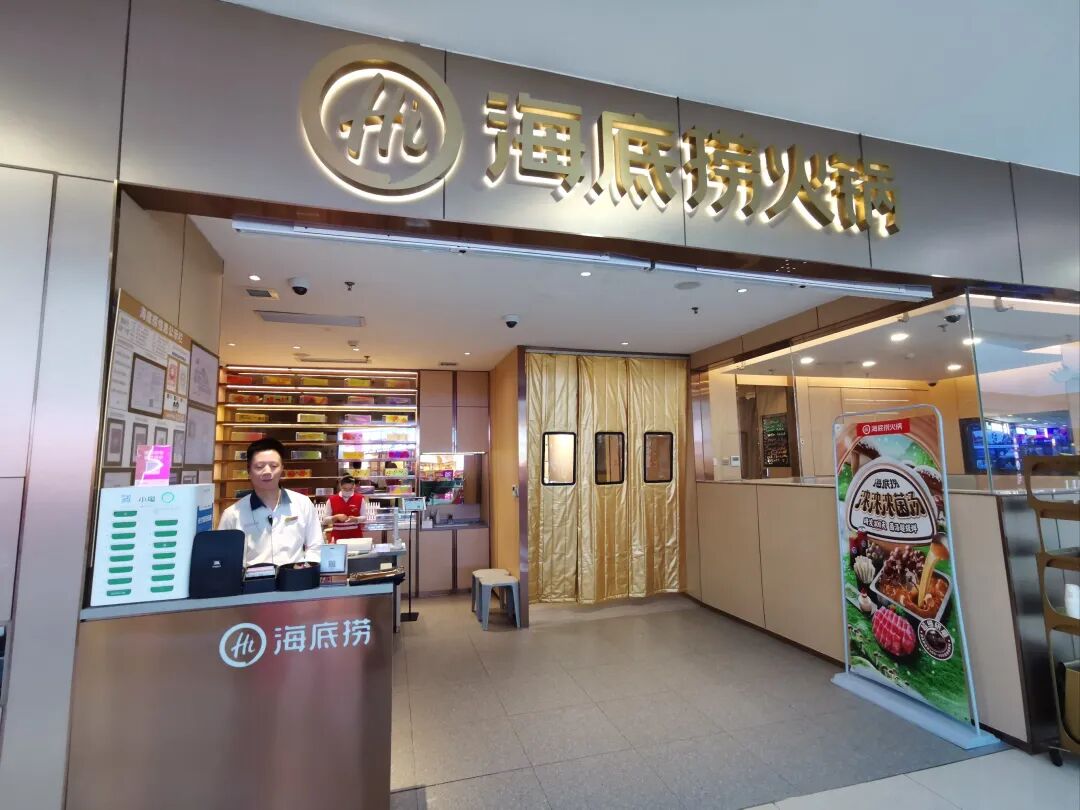
Core Insights - The return of Zhang Yong as CEO of Haidilao is driven by disappointing financial results, with a 3.7% year-on-year decline in revenue and a 13.7% drop in net profit for the first half of 2025 [1] - Key metrics such as customer traffic and table turnover rates have also declined, with a loss of 10 million customers and a turnover rate of 3.8 times per day, below the target of 4 times [1] Group 1 - The average spending per customer has decreased from 110 yuan in 2020 to below 100 yuan, indicating a shift in consumer behavior towards more cost-effective dining options [3] - Haidilao has attempted various innovations, including transforming some locations into "nightclubs" and launching "male aesthetics marketing" to attract customers [3][8] - The company has also ventured into the children's meal market, capitalizing on the crisis faced by competitors like Xibei [6] Group 2 - Haidilao's market value has plummeted from over 430 billion HKD at its peak to around 70 billion HKD, reflecting a significant loss of over 80% [11] - The company's aggressive expansion strategy has backfired, leading to a decline in table turnover rates and increased costs, prompting the closure of 300 stores as part of the "Woodpecker Plan" [15] - Despite attempts to restart some locations, the net number of stores decreased in the first half of 2025, highlighting the challenges of expansion [17] Group 3 - The "Red Pomegranate Plan" was initiated to foster internal innovation, resulting in the incubation of 14 brands and the opening of 126 stores by mid-2025 [17] - However, many of these new brands have struggled, with over half of the 26 brands launched by Haidilao either closed or failing to survive beyond a year [21] - The company is also exploring new dining concepts, such as high-end seafood hotpot and themed restaurants, but these efforts have yet to yield significant results [23][25] Group 4 - Consumer preferences have shifted towards value for money, with price being the primary consideration for dining choices, as highlighted by various market research reports [29] - Haidilao's high labor costs, which account for about 30% of expenses, are significantly higher than many competitors, impacting profitability [31] - The company is attempting to enhance its product offerings while maintaining affordability, focusing on fresh ingredients and operational efficiency [34][36] Group 5 - The return of Zhang Yong is seen as a critical move to address the company's challenges and improve operational efficiency [38] - The key to recovery lies in aligning with the cost-conscious mindset of consumers, which is essential for revitalizing the brand [39]

张勇回归,少帅上位:海底捞的“第二曲线”能否真的跑通?
虎嗅APP· 2026-01-20 10:17
Core Viewpoint - The recent leadership changes at Haidilao, including the return of founder Zhang Yong as CEO and the appointment of four experienced female executives to the board, signify a strategic pivot aimed at stabilizing the core hotpot business while accelerating the growth of the newly formed "Pomegranate Plan" [2][4][10]. Group 1: Leadership Changes - Zhang Yong's return as both Chairman and CEO is interpreted as a move to enhance decision-making efficiency and is seen as a strategic restructuring rather than a mere reaction to past challenges [6][10]. - The appointment of four internal executives, aged 35-44, to the board reflects a shift towards empowering younger leaders with operational backgrounds, transforming the board into a training ground for future leaders [10][11]. Group 2: Strategic Initiatives - The "Pomegranate Plan," launched in August 2024, aims to transition Haidilao from a single-brand operation to a multi-brand ecosystem, with a focus on diversifying its restaurant offerings [9][10]. - Since the initiation of the "Pomegranate Plan," Haidilao has successfully incubated 14 new restaurant brands, contributing significantly to revenue growth, with other restaurant income reaching 597 million yuan, a 227% year-on-year increase [13]. Group 3: Market Response and Future Outlook - Market reactions to the governance changes have been mixed, with Goldman Sachs maintaining a neutral rating while other firms like Citigroup have raised target prices, indicating confidence in the multi-brand strategy [14]. - The long-term challenge for Haidilao lies in nurturing these new brands to become substantial growth drivers while maintaining the core hotpot business, reflecting the broader challenges faced by leading companies in the restaurant industry during periods of transformation [14].
张勇又回来了
36氪· 2026-01-20 09:46
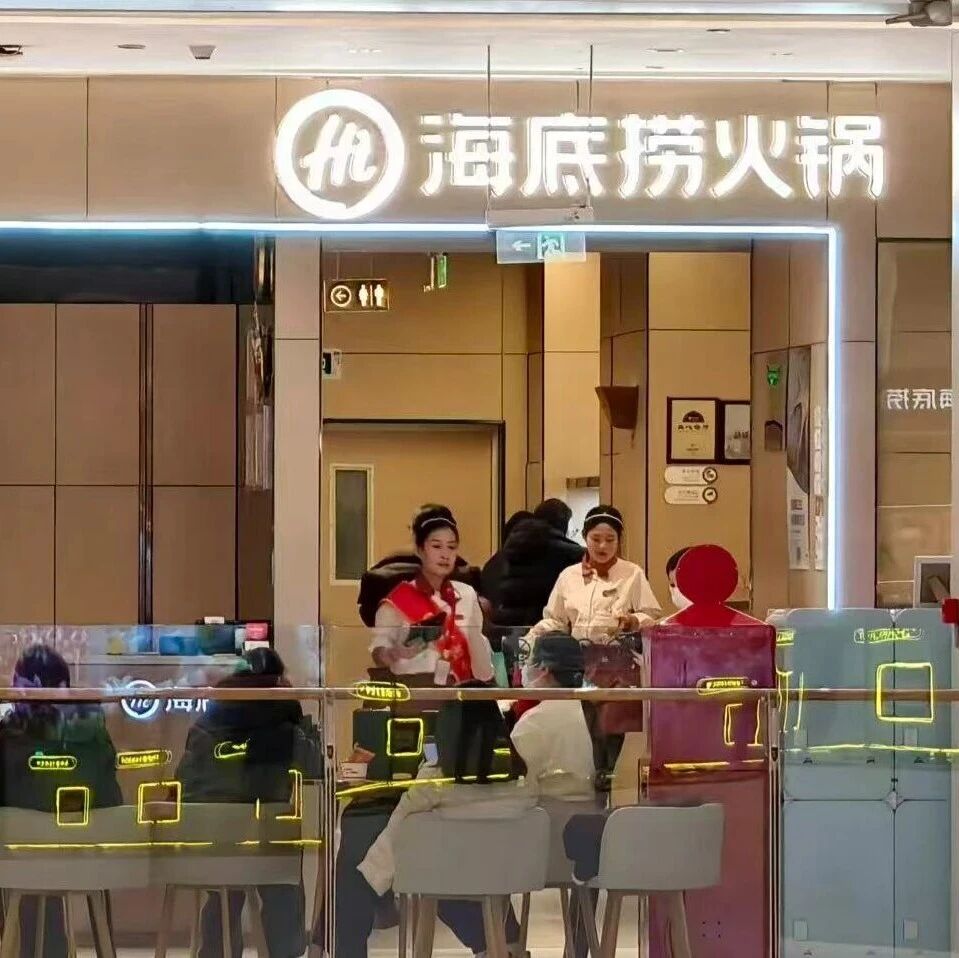
Core Viewpoint - The return of Zhang Yong, the founder and chairman of Haidilao, to the CEO position after nearly four years is a significant move that reflects the company's adaptability and the importance of leadership during challenging times [5][6][20]. Leadership Changes - Haidilao has experienced multiple CEO transitions, with Yang Lijuan taking over in March 2022 during a critical period, leading to significant restructuring and recovery from a historical loss of 4.16 billion yuan [6][14]. - The management styles of the three CEOs—Zhang Yong, Yang Lijuan, and Gou Yiqun—differ significantly, with Yang being decisive and action-oriented, while Gou focuses on logical processes and management [8][14]. - Zhang Yong's leadership is characterized by a strategic vision, while Yang Lijuan is known for her execution and reform capabilities [8][12]. Financial Performance - Following the announcement of Zhang Yong's return, Haidilao's stock price increased by 7.6%, indicating positive market sentiment [8]. - In the first half of 2025, Haidilao reported a revenue of 20.7 billion yuan, a year-on-year decline of 3.7%, and a core operating profit of 2.4 billion yuan, down 14.0% [18]. Future Challenges and Strategies - Haidilao aims to establish a smart operational platform covering various aspects of its business, including customer service and employee management, to enhance efficiency and decision-making [17]. - The company is facing challenges related to its expansion strategy, including how to manage a diverse brand portfolio and ensure effective resource allocation [20]. - The traditional approach of leveraging experienced leaders for new initiatives is emphasized, as Zhang Yong's involvement suggests a need for strong leadership to navigate upcoming challenges [20].

叮咚买菜开到盐城,“小城消费”有多大想象力?
3 6 Ke· 2026-01-20 09:35
Core Insights - The future of instant retail in China is expected to rely heavily on consumption from lower-tier cities, with the market projected to exceed 1 trillion yuan by 2026 [1] - The growth rate of users and transaction volume in lower-tier cities has already surpassed that of higher-tier cities, making these markets crucial for achieving performance growth in the instant retail sector [1][5] Group 1: Market Potential - The retail sales in county and rural areas accounted for 38.7% of the total social retail sales in the first 11 months of 2025, indicating a robust growth in small-town consumption [4] - Major brands in hospitality and retail are accelerating their entry into county markets to capture this emerging consumer base [4] - The demand for high-quality products in lower-tier cities is significant, driven by young people returning from larger cities [7] Group 2: Company Strategies - Dingdong Maicai has opened a new warehouse in Yancheng, Jiangsu, as part of its strategy to deepen its presence in the Jiangsu market, following its entry into Taizhou [1][8] - The company has established over 130 new warehouses in small cities over the past two years, leveraging its extensive supply chain network developed in the Jiangsu region [8][10] - Dingdong Maicai's operational efficiency is highlighted by a stock turnover period of 2.1 days and a product loss rate of 1.5%, significantly better than the industry average [15] Group 3: Competitive Landscape - The instant retail sector is becoming a battleground for major internet companies, with a shift in consumer behavior and spending patterns in lower-tier cities [5][12] - Dingdong Maicai's strategy focuses on cautious expansion and product differentiation, aiming to maintain a competitive edge amid price wars among larger players [12][13] - The company's "4G strategy" emphasizes quality products, which has led to a 37.2% increase in SKUs meeting quality standards, contributing to 44.7% of overall GMV [12][13]

颐海国际(01579):首次覆盖报告:股息托底,全球扩张
Western Securities· 2026-01-20 08:39
Investment Rating - The report assigns a "Buy" rating to the company, Yihai International (1579.HK) [4][15] Core Insights - Yihai International has transitioned from a high-growth valuation to a low-valuation, high-dividend company, with a focus on cash dividends and a stable return [22][24] - The compound seasoning industry in China is expected to continue growing, with a market size of approximately 126.5 billion yuan, indicating potential for further penetration and expansion [22][30] - The company is poised for growth through its B-end and overseas markets, with significant improvements expected in its affiliate income as it stabilizes alongside Haidilao [2][15] Summary by Sections Company Overview - Since its listing in 2016, Yihai International has experienced a cycle of expansion, valuation bubble, adjustment, and stabilization [22] - The company has shifted its market perception from a high-growth entity to one focused on dividends, with a high payout ratio of 89.97% in 2023 and 95.06% in 2024 [24] Industry Space - The compound seasoning market is entering a phase of steady growth after rapid expansion, with a compound annual growth rate (CAGR) of 6.1% expected from 2020 to 2024 [30] - The market for compound seasonings is driven by trends such as increased restaurant chain rates and urbanization, which support the growth of this segment [30] Growth Outlook - The company anticipates revenue growth from 6.57 billion yuan in 2025 to 7.38 billion yuan in 2027, with corresponding net profits expected to rise from 800 million yuan to 980 million yuan during the same period [15][8] - The B-end market is a key growth area, with the company planning to establish a small B team to enhance its product offerings and directly engage with restaurant clients [2][66] - Overseas markets are also expected to grow rapidly, with projected revenue of 270 million yuan in 2025, reflecting a year-on-year increase of 34.4% [70] Financial Projections - Revenue and profit forecasts for 2025-2027 indicate modest growth, with revenues expected to increase by 0.5%, 5.9%, and 6.0% respectively, while net profits are projected to grow by 8.8%, 10.3%, and 10.2% [15][8]
《上海证券报》聚焦武汉:一锅火辣撬动情绪经济
Shang Hai Zheng Quan Bao· 2026-01-20 07:52
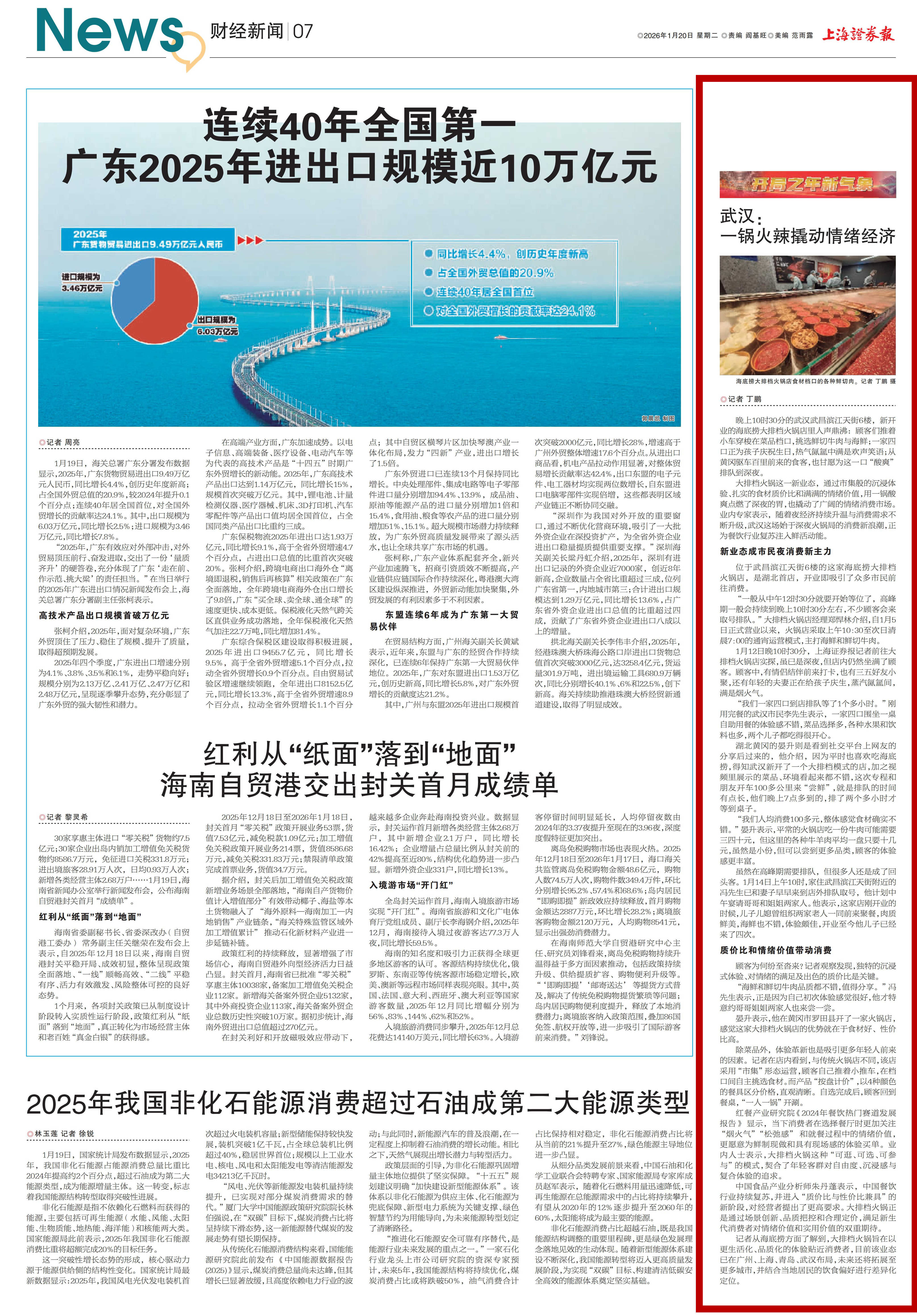
Group 1: Guangdong Trade Performance - In 2025, Guangdong's goods trade import and export reached 9.49 trillion RMB, a year-on-year increase of 4.4%, marking a historical annual high [4] - Exports amounted to 6.03 trillion RMB, up 2.5% year-on-year, while imports were 3.46 trillion RMB, increasing by 7.8% [4] - Guangdong accounted for 20.9% of the national foreign trade total, contributing 24.1% to the national foreign trade growth [4] Group 2: Quarterly Trade Growth - Guangdong's import and export growth rates for the four quarters of 2025 were 4.1%, 3.8%, 3.5%, and 6.1%, showing a steady upward trend [5] - The quarterly trade volumes were 2.13 trillion, 2.41 trillion, 2.47 trillion, and 2.48 trillion RMB, indicating a gradual increase [5] Group 3: High-tech Product Exports - High-tech product exports from Guangdong exceeded 1 trillion RMB for the first time, with a year-on-year growth of 9.5% [6] - The growth in high-tech exports reflects Guangdong's resilience and potential in the face of complex external environments [5][6] Group 4: Night Economy and New Consumption Trends - The newly opened Haidilao Dapaidang hotpot restaurant in Wuhan has attracted significant consumer interest, indicating a revival in the dining industry [12] - The restaurant operates from 10:30 AM to 7:00 AM, focusing on seafood and fresh-cut beef, and has seen long queues since its opening [13] - The unique immersive experience and high quality-to-price ratio are key factors driving consumer traffic to the new dining format [15][18]
创始人重新出任CEO 海底捞能否突破增长瓶颈?
Zhong Guo Jing Ying Bao· 2026-01-20 07:33
Core Viewpoint - Haidilao International Holding Ltd. is facing challenges with declining revenue, profit, and table turnover rates, prompting the return of founder Zhang Yong as CEO to strengthen confidence and unify strategic decision-making [1][3][5] Performance Decline - The company announced that from January 13, 2026, Zhang Yong will resume the role of CEO, following the resignation of Guo Yiqun [2] - In 2024, Haidilao achieved revenue of 42.755 billion yuan, a year-on-year increase of 3.1%, while profit rose by 4.6% to 4.7 billion yuan [3] - In the first half of 2025, revenue fell by 3.7% to 20.703 billion yuan, and profit decreased by 13.7% to 1.755 billion yuan, attributed to a decline in table turnover rates and initial adjustments in product and service innovation [3] Management Changes - The change in CEO is linked to unsatisfactory performance metrics in 2025, including revenue, net profit, and table turnover rates, alongside management issues highlighted by public controversies [3][5] - Zhang Yong's return aims to address these challenges and enhance management efficiency by promoting frontline managers to decision-making roles [3][5] Market Environment - The overall restaurant market is undergoing transformation, with intensified competition in the hot pot sector, leading to operational challenges for large-format restaurants like Haidilao [4][5] - The company has initiated a franchise model to tap into demand in lower-tier cities, with over 70% of franchise applications coming from third-tier cities and below [6] Growth Strategies - Haidilao is implementing the "Red Pomegranate Plan" to encourage the incubation of new restaurant brands, having launched 11 new brands with a total of 74 outlets by the end of 2024 [5] - The company is also focusing on diversifying consumer scenarios, with nearly 30 night snack-themed stores and over 50 standard version theme stores operational by mid-2025 [5] - In the first half of 2025, the takeaway business saw a revenue increase of nearly 60%, indicating a shift towards enhancing service delivery channels [5]
2026烤肉品类发展报告
Sou Hu Cai Jing· 2026-01-20 05:10
Core Insights - The Chinese barbecue market is undergoing significant transformation, with a projected increase in the number of barbecue outlets to 205,000 by the end of 2025, representing a year-on-year growth of 34.4% and a stable market size of approximately 106 billion yuan [1][21][18] - Consumer preferences are shifting towards fresh ingredients and diverse menu options, with emotional value and cost-effectiveness becoming key factors for brands to differentiate themselves in a competitive landscape [1][3][5] Market Overview - As of December 2025, the total number of barbecue outlets in China is expected to reach 205,000, with a market size of around 106 billion yuan, reflecting a 1.6% year-on-year growth from 105 billion yuan in 2024 [5][21][18] - The barbecue sector is characterized by a strong emphasis on high cost-performance self-service models and the rising popularity of "beautiful meals" that focus on aesthetic presentation and immersive dining experiences [5][3] Consumer Trends - The report highlights a shift in consumer behavior from merely seeking flavor to prioritizing overall emotional value in dining experiences, particularly among younger consumers [3][20] - Brands are increasingly adopting innovative strategies, such as themed store designs and interactive performances, to create memorable experiences and emotional connections with customers [3][5] Competitive Landscape - The barbecue market is becoming increasingly competitive, with the number of related enterprises growing from 86,000 in 2020 to 112,000 by the end of 2025, marking a 30.2% increase [20][21] - Notable brands are emerging in niche segments, such as regional specialties and international flavors, which are gaining traction on social media platforms [2][5] Regional Insights - The East China region has the highest concentration of barbecue outlets, accounting for 27.5% of the total, followed by Northeast and North China regions [22][24] - Major cities like Beijing, Chengdu, and Shenyang are leading in barbecue outlet numbers, reflecting strong local dining cultures [25][24]