宏观经济展望

Search documents
2026年高盛宏观经济展望:增长、就业与物价
Sou Hu Cai Jing· 2026-01-26 01:31
Core Insights - The global economy is entering a "virtuous but complex" new phase, characterized by robust growth but significant structural differentiation among major economies [1][2][3] Economic Growth - Global real GDP growth is projected to reach 2.8% in 2026, slightly above the market consensus of 2.5% [1][6] - The U.S. economy is expected to accelerate from a growth rate of 2.1% in 2025 to 2.6% in 2026, driven by reduced tariff drag, fiscal stimulus from new tax legislation, and easing financial conditions due to anticipated Fed rate cuts and AI investment [1][10] - China's economy is forecasted to grow by 4.8%, supported by a strong manufacturing and export sector, particularly in critical resources like rare earths, which offsets domestic demand pressures [1][14] Employment Trends - Despite economic growth, job market expansion is slowing, with rising unemployment rates in major developed economies, particularly in the U.S. [2][5] - The disconnect between growth and employment is partly attributed to productivity gains, especially from AI, which have not yet significantly impacted job creation [2][11] Price Stability - Core inflation in developed economies is expected to gradually decline to near the 2% policy target by 2026, aided by a slowdown in housing inflation and wage growth [2][5] - The easing of inflationary pressures creates conditions for a shift in monetary policy among major central banks [2][3] Policy Outlook - A "converging decline" in global monetary policy is anticipated, with the Fed likely to cut rates by 50 basis points in 2026, while the Bank of England may also follow suit [3][5] - Emerging market central banks will exhibit varied policies, with some regions expected to pursue further monetary easing [3] Market Implications - The macroeconomic backdrop is seen as favorable for risk assets like stocks, although tensions between growth and valuation concerns may intensify [5]



股指期货震荡整理,黄金、白银、锡期货再创上市以来新高白银、锡、燃料油、碳酸锂期货将震荡偏强
Guo Tai Jun An Qi Huo· 2026-01-14 09:42
Report Industry Investment Rating No relevant content provided. Core Viewpoints of the Report - Through macro - fundamental and technical analysis, the report predicts the trend, resistance levels, and support levels of various futures contracts on January 14, 2026, and the trend of the main (continuous) contracts in January 2026 [2][3]. Summary by Relevant Catalogs 1. Futures Market Overview - On January 13, 2026, the domestic commodity futures market showed a mixed trend. Precious metals led the gains with Shanghai silver up 5.9%, while shipping futures led the losses with the container shipping index (European line) down 5.45%. New energy materials also had a mixed performance, with polycrystalline silicon down 4.45% and lithium carbonate up 7.44% [9]. 2. Macro - economic Information - The World Bank raised its global economic growth forecast for 2026 to 2.6%, 0.2 percentage points higher than the previous forecast. It is expected that the US GDP growth rate will reach 2.2% in 2026, the Eurozone's economic growth rate will slow to 0.9%, and Japan's economic growth rate will slow to 0.8% [7]. - The US 2025 December budget deficit was $145 billion, a record high for the month. The US 2026 fiscal year - to - date deficit was $602 billion, compared with $711 billion in the same period of the 2025 fiscal year [8]. - The US CPI in December 2025 increased by 2.7% year - on - year, and the core CPI increased by 2.6%, both remaining flat compared with the previous value. The market expects the Fed to keep interest rates unchanged in January 2026, with a probability as high as 95% [8]. 3. Stock Index Futures - On January 13, 2026, the main stock index futures contracts such as IF2603, IH2603, IC2603, and IM2603 all showed a trend of rising and then falling. The short - term upward momentum weakened, and the downward pressure increased to some extent [12][13][14]. - It is expected that in January 2026, the main continuous contracts of stock index futures (IF, IH, IC, IM) will probably fluctuate strongly. On January 14, 2026, the stock index futures will fluctuate and consolidate [16][17]. 4. Precious Metal Futures - **Gold Futures**: On January 13, 2026, the main gold futures contract AU2602 rose slightly. It is expected that in January 2026, the main continuous contract will probably fluctuate strongly and will hit a record high. On January 14, 2026, the main contract AU2602 will probably fluctuate strongly and may hit a record high again [36][37]. - **Silver Futures**: On January 13, 2026, the main silver futures contract AG2604 rose slightly. It is expected that in January 2026, the main continuous contract will probably fluctuate strongly and will hit a record high. On January 14, 2026, the main contract AG2604 will probably fluctuate strongly and may hit a record high again [39][40]. - **Platinum Futures**: On January 13, 2026, the main platinum futures contract PT2606 fell. It is expected that in January 2026, the main continuous contract will probably fluctuate strongly. On January 14, 2026, the main contract PT2606 will probably fluctuate strongly [46][47]. - **Palladium Futures**: On January 13, 2026, the main palladium futures contract PD2606 fell. It is expected that in January 2026, the main continuous contract will probably fluctuate strongly. On January 14, 2026, the main contract PD2606 will probably fluctuate strongly [51]. 5. Base Metal Futures - **Copper Futures**: On January 13, 2026, the main copper futures contract CU2603 fell. It is expected that in January 2026, the main continuous contract will probably fluctuate strongly and will hit a record high. On January 14, 2026, the main contract CU2603 will probably fluctuate strongly [56]. - **Aluminum Futures**: On January 13, 2026, the main aluminum futures contract AL2603 fell. It is expected that in January 2026, the main continuous contract will probably fluctuate strongly and will hit a record high. On January 14, 2026, the main contract AL2603 will probably fluctuate strongly and may hit a record high again [59][60]. - **Nickel Futures**: On January 13, 2026, the main nickel futures contract NI2602 fell. It is expected that in January 2026, the main continuous contract will probably have a wide - range strong fluctuation. On January 14, 2026, the main contract NI2602 will probably fluctuate strongly [66]. - **Tin Futures**: On January 13, 2026, the main tin futures contract SN2602 rose. It is expected that in January 2026, the main continuous contract will probably fluctuate strongly and will hit a record high. On January 14, 2026, the main contract SN2602 will probably fluctuate strongly and may hit a record high again [69]. 6. Other Futures - **Lithium Carbonate Futures**: On January 13, 2026, the main lithium carbonate futures contract LC2605 rose sharply. It is expected that in January 2026, the main continuous contract will probably fluctuate strongly. On January 14, 2026, the main contract LC2605 will probably fluctuate strongly [75][76]. - **Rebar Futures**: On January 13, 2026, the main rebar futures contract RB2605 showed a slight decline. It is expected that in January 2026, the main contract RB2605 will probably fluctuate strongly. On January 14, 2026, the main contract RB2605 will probably fluctuate strongly [79]. - **Fuel Oil Futures**: On January 13, 2026, the main fuel oil futures contract FU2603 showed a slight increase. It is expected that on January 14, 2026, the main contract FU2603 will probably fluctuate strongly and will attack the resistance level and the daily limit [84].
中信证券2026年投资展望:推荐商品>股票>债券,人民币或进入温和升值周期
Ge Long Hui· 2026-01-07 02:01
Core Viewpoint - CITIC Securities forecasts a moderate recovery of China's macro economy in 2026, with an expected GDP growth rate of 4.9%, characterized by structural differentiation [1] Economic Outlook - The report anticipates resilient exports and a gradual recovery in investments, while consumer goods consumption may face short-term pressure [1] - The macroeconomic environment in 2026 is expected to feature marginal liquidity easing alongside moderate economic recovery [1] Asset Class Recommendations - Recommended asset classes in order of preference: commodities > stocks > bonds [1] Equity Market Projections - The report predicts a 5%-10% increase in the annual performance of the Wind All A-share index in 2026 [1] - Hong Kong stocks are expected to experience a performance rebound and a second round of valuation recovery, termed a "Davis Double" [1] - US stocks are likely to maintain growth momentum under a backdrop of fiscal and monetary easing during the midterm election year [1] Bond Market Expectations - The 10-year Chinese government bond yield is projected to fluctuate between 1.5% and 1.8%, with a pattern of decline followed by an increase [1] - The 10-year US Treasury yield is expected to remain within a range of 3.9% to 4.3% [1] Commodity Market Insights - The oil supply-demand balance is shifting from surplus to equilibrium, with Brent crude oil projected to oscillate between $58 and $70 per barrel [1] - Gold is expected to remain strong due to liquidity easing and geopolitical risks, with potential to reach $5,000 per ounce, although the growth rate may slow [1] - Copper is anticipated to have strong support driven by supply constraints and electricity demand, with an average price forecasted to rise to $12,000 per ton [1] Currency Outlook - The Chinese yuan is expected to enter a period of mild appreciation, with the USD/CNY exchange rate gradually approaching 6.8 [1]

2026年宏观经济展望:着力扩大内需,宏观政策延续稳增长取向
Dong Fang Jin Cheng· 2025-12-29 23:30
Economic Outlook - The actual GDP growth rate for China in 2026 is projected to be around 4.8%, maintaining a medium-high growth level[2] - Global GDP growth is expected to slow to 3.1% in 2026, down from 3.2% in 2025[4] - China's fixed asset investment growth is forecasted to turn positive at 2.5% in 2026, recovering from a negative growth of -3.0% in 2025[4] Trade and Export Impact - China's export growth is anticipated to decline significantly from approximately 5.0% in 2025 to around 1.0% in 2026 due to increased U.S. tariffs[15] - The average U.S. import tariff rate is projected to rise to 19.5% in 2026, impacting global trade dynamics[8] Policy Measures - The target fiscal deficit rate for 2026 is set to remain at 4.0%, with an increase in new special bond issuance expected to reach 5.0 trillion yuan[41] - A reduction in interest rates by 0.3 percentage points is anticipated in 2026, with a focus on maintaining liquidity in the market[52] Consumer and Investment Trends - Consumer retail sales growth is expected to accelerate to 5.0%-6.0% in 2026, up from 3.9% in 2025, driven by enhanced consumption policies[65] - Infrastructure investment growth is projected to increase to 5.0% in 2026, significantly higher than the previous year's performance[71] Inflation and Price Levels - The Consumer Price Index (CPI) is expected to rise to 0.4% in 2026, indicating a slight improvement in the low inflation environment[76] - The Producer Price Index (PPI) is forecasted to decline by -1.8% in 2026, reflecting ongoing price pressures in the economy[76]
国海证券首席经济学家夏磊:2026年“十五五”开局 中国经济在变局中突围
Mei Ri Jing Ji Xin Wen· 2025-12-25 22:50
External Environment - The uncertainty of U.S. policies significantly impacts the global economic order, with frequent changes in tariff policies since the Trump administration took office in early 2025 [2] - The core goal of China's economic development during the "14th Five-Year Plan" period is to lay the foundation for achieving a per capita GDP of $23,000 by 2035, which is necessary to be classified as a moderately developed economy [2][3] Economic Growth Drivers - Despite a complex external environment, China's economic foundation is solid, with a focus on promoting consumption, stabilizing investment, and strengthening exports to stimulate internal growth [4] - In the first three quarters of 2025, final consumption expenditure contributed 53.5% to economic growth, indicating its critical role as the main engine of growth [4] - Investment in high-tech industries is expected to become a significant growth driver, with a focus on key areas such as integrated circuits and advanced materials [5] - The export market is diversifying, with significant growth in exports to ASEAN, Africa, and Latin America, while the structure of export products is shifting towards high-value-added items [6] Policy Outlook - Macroeconomic policies in 2026 will continue to support stable economic operation, with ample room for both fiscal and monetary policies [7] - The government debt ratio is at a manageable level of 68.7%, allowing for sustainable fiscal policies that focus on technology innovation and basic livelihood support [7] - Monetary policy adjustments are facilitated by the U.S. Federal Reserve's interest rate cuts, providing a favorable environment for domestic economic stability [8] Asset Allocation - The A-share market is expected to maintain a slow bull trend, supported by government emphasis on capital market stability and a solid liquidity foundation [9] - The technology sector is identified as a core investment focus during the "14th Five-Year Plan," with significant advancements in AI and a complete industrial system [10] - Demand for gold as a safe-haven asset is expected to remain strong due to increasing global economic uncertainties and geopolitical conflicts, with central banks continuing to accumulate gold [11]

存款”落谁家,春水向“中游”——2026年宏观与资配展望
2025-12-08 15:36
Summary of Key Points from Conference Call Industry and Company Overview - The conference call discusses the macroeconomic outlook for China in 2026, focusing on various sectors including the midstream manufacturing industry, real estate, and the overall stock and bond markets. Core Insights and Arguments Economic Growth Projections - The actual GDP growth rate for 2026 is expected to be around 4.8%-4.9%, with nominal GDP growth at approximately 4.5% [5][6][12] - Retail sales growth could reach 4%-4.5% under certain subsidy assumptions, while export growth is projected to maintain resilience at about 5% [5][7] - Fixed asset investment is anticipated to rise from -3.1% this year to a range of 0%-1%, with manufacturing expected to grow by 2% and real estate continuing to decline by -10% to -13% [5][7] Fiscal Policy and Price Trends - Fiscal policy is expected to remain expansionary in 2026, with budget expenditure growth around 5% and new government debt between 1 trillion to 1.5 trillion [6][8] - CPI is projected to gradually rise and turn positive, while PPI trends are uncertain, with potential for stabilization in midstream PPI in the first half of 2026 [6][9][10] Midstream Manufacturing Industry - The midstream manufacturing sector is highlighted as the most promising area, benefiting from a recovery with overseas gross margins surpassing domestic margins for the first time, reaching 25%-30% [13][16] - Demand growth in this sector has outpaced supply growth for over a year, indicating a recovery in return on equity (ROE) [13][16] Stock Market Outlook - A strategic bullish outlook for the stock market in 2026 is maintained, although the pace of valuation increases and the outperformance of the ChiNext index may weaken [21][23] - The focus will shift towards sectors with low valuation percentiles and high dividend yields, such as insurance and home appliances [23][24] Bond Market Perspective - A cautious view on the bond market is expressed, with expectations of rising yields, particularly for ten-year government bonds, which are projected to exceed 2% [26] - The bond market is considered relatively expensive compared to equities, and adjustments are anticipated [26] Additional Important Insights Uncertainties in Policy Implementation - Several uncertainties regarding policy implementation are identified, including the use of special bonds and the structure of long-term special government bonds [8] - The impact of service consumption subsidies on the service sector and overall economic performance remains to be seen [8] Key Timeframes for Investors - Two critical timeframes in 2026 are highlighted: January for CPI expectations and around May for PPI consensus, which are significant for macroeconomic assessments [12] Investment Focus Areas - Investors are advised to focus on sectors with high capacity utilization and low capital expenditure, such as synthetic fibers, black metals, oil and gas, and general equipment [25] - The midstream manufacturing sector is emphasized as the most reliable investment direction due to its current performance and growth potential [20] Future of Real Estate Market - The real estate market's future remains uncertain, with a need for policy support to stabilize prices, especially given the current oversupply situation [11] This summary encapsulates the key points discussed in the conference call, providing insights into the economic outlook, sector performance, and investment strategies for 2026.
利率债2026年投资策略—步步为营(PPT)(1)
2025-12-04 04:47
Summary of Key Points from the Conference Call Industry Overview - **Industry**: Fixed Income and Macroeconomic Analysis - **Company**: CITIC Securities Research Department Core Insights Macroeconomic Outlook - **GDP Growth**: Expected to achieve around 4.9% for the year, with nominal GDP growth anticipated to rise, marking the first time since 2022 that nominal GDP growth outpaces real GDP growth [4][39] - **Economic Growth Pattern**: Projected to exhibit a "front low, back high" pattern in 2026 due to base effects and policy timing [4][39] - **Price Improvement**: Price factors are expected to improve, contributing to the rise in nominal GDP [4][39] Policy Combination - **Fiscal Policy**: Anticipated moderate expansion with a deficit rate maintained at 4%. New special bond issuance expected to increase to around 5 trillion [4][44] - **Monetary Policy**: Expected to remain moderately accommodative, with liquidity conditions remaining ample and stable funding rates [4][39][48] Interest Rates - **Interest Rate Trend**: Expected to decline initially before rising, with the 10-year government bond yield projected to fluctuate between 1.6% and 1.9% [4][71] - **Market Dynamics**: The macro policy's moderate expansion and rising nominal GDP are expected to ease the asset supply and demand dynamics [4][71] Risk Factors - **Economic Recovery Risks**: Domestic economic recovery may exceed expectations, alongside potential financial regulatory changes and credit risk exposures [4][74] - **Geopolitical Risks**: Increased risks from US-China trade tensions and global geopolitical instability [4][74] Additional Important Insights Investment Strategy - **Investment Approach**: A step-by-step strategy is recommended, focusing on capturing opportunities in the bond market as conditions evolve [4][68] Credit and Social Financing - **Credit Growth**: Anticipated stabilization in credit and social financing growth, with a gradual increase expected in 2026 [4][47] - **Government Debt Supply**: Expected slight growth in government debt supply compared to 2025, supporting social financing [4][47] Inflation Outlook - **Inflation Trends**: PPI is expected to show a steady upward trend, while CPI is projected to be positive for most months in 2026 [4][35][33] Export Dynamics - **Export Resilience**: China's exports are expected to show resilience due to diversified trade partnerships and demand from emerging markets [4][20] Consumer Spending - **Consumer Recovery**: Consumer spending is expected to continue its weak recovery, supported by policy measures [4][23] Infrastructure Investment - **Infrastructure Growth**: Infrastructure investment is projected to recover marginally in 2026, supported by fiscal policy and special bond issuance [4][26] Real Estate Market - **Real Estate Trends**: The real estate market is expected to continue its weak performance, with inventory levels remaining high [4][32] This summary encapsulates the key points discussed in the conference call, providing a comprehensive overview of the macroeconomic outlook, policy strategies, and potential risks facing the industry.
2026年宏观经济展望—G2格局再平衡(PPT)
2025-12-04 04:47
Summary of Key Points from the Conference Call Industry or Company Involved - The conference call primarily discusses the macroeconomic outlook for China and the G2 economic landscape, focusing on GDP growth, manufacturing, and trade dynamics. Core Insights and Arguments 1. **China's GDP Growth Forecast**: The GDP growth rate for China is projected to be around 4.9% in 2026, with a moderate expansion in fiscal spending and improved local government finances expected to support this growth [6][9][18]. 2. **Economic Growth Drivers**: The current macroeconomic environment shows that production is outpacing demand, with external demand (exports) remaining stronger than internal demand [11][18]. 3. **Consumer Spending Trends**: Consumer spending is expected to contribute significantly to GDP, with a projected contribution of 53.5% from final consumption expenditure, 17.5% from capital formation, and 29% from net exports in the first three quarters of the year [18]. 4. **Manufacturing Sector Dynamics**: China's manufacturing sector, which accounts for 26% of GDP, is transitioning towards high-end, intelligent, and green production. Technological innovations are anticipated to enhance total factor productivity [23][25]. 5. **Investment Trends in Manufacturing**: Manufacturing investment growth is expected to be around 4% in 2025 and 3% in 2026, driven by policies supporting high-tech manufacturing and capacity utilization [29]. 6. **Real Estate Market**: The real estate inventory remains high, but various supportive policies are expected to accelerate the inventory reduction process. As of September 2025, the unsold housing inventory is projected to decrease to 760 million square meters [30][33]. 7. **Infrastructure Investment**: Infrastructure investment is projected to grow by 3.7% in 2025 and slightly improve to 4.0% in 2026, with new policy financial tools expected to provide some support [39]. 8. **Export Performance**: Exports are expected to maintain resilience, with a year-on-year growth of 6.1% in the first three quarters of the year, supported by diversification of trade partners and strong performance in certain product categories [40][44]. 9. **Inflation Outlook**: The inflation rate for 2026 is forecasted to be around 0.5%, with core CPI showing signs of upward pressure due to various economic factors [50][73]. Other Important but Possibly Overlooked Content 1. **Global Trade Environment**: The global trade environment remains uncertain, with the WTO predicting a mere 0.5% growth in global trade volume for 2026, which could impact China's export performance [47]. 2. **U.S. Economic Conditions**: The U.S. economy is facing challenges, including rising government leverage and a tightening interest rate environment, which may affect its recovery trajectory [67][83]. 3. **Technological Advancements**: The focus on technological innovation in manufacturing is crucial for sustaining long-term economic growth, with significant investments in AI, big data, and other advanced technologies [23][64]. This summary encapsulates the key points discussed in the conference call, providing insights into the economic outlook for China and the broader G2 economic dynamics.
华创证券张瑜:2026年宏观展望报告,“存款”落谁家,春水向“中游”
Xin Lang Cai Jing· 2025-12-02 13:19
来源:一瑜中的 报告目录 | 一、看短期:中游景气度或更胜一筹 | | --- | | (一)关注中游:已出现若干"新"变化 . | | (二)思考中游:宏观景气度或更胜一筹 . | | 1、景气观察 1: 静态看,潜力与表现均更优 …………………………………………………………………… 16 | | 2、景气观察 2:动态看,机电出口或高增长 | | (三)分析中游:微观 ROE 或继续回升 . | | 1、思考框架:ROE 的核心在哪? | | 2、思考焦点:供需两侧的预测!……………………………………………………………………………………………………………………………………………………… 19 | | 二、看中期: 聚焦存款分布与物价走势 . | | (一)聚焦存款:花落谁家?谈三部门存款交互框架 | | 1、2025 存款在哪?重视两个交互 . | | 2、2026 存款去哪?提示三个变化 . | | (二)聚焦物价:何时转正?谈三物价趋势判断框架 | | 1、CPI:趋势确定,时点已至 | | 2、PPI:趋势确定,时点难定 | | 3、房价:或低位震荡,仍待加力 | | 三、看长期:转型之路的合理"靠 ...
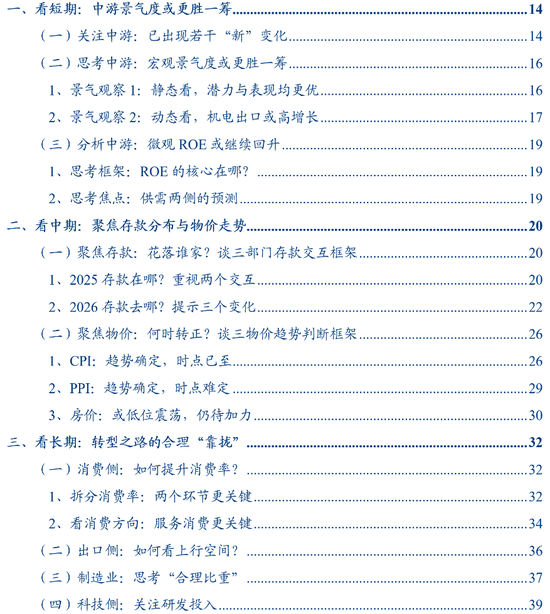
张瑜:“存款”落谁家,春水向“中游”——2026年宏观展望报告
一瑜中的· 2025-12-02 12:45
Group 1 - The article emphasizes the importance of the midstream sector, highlighting four positive changes: recovery in profitability (ROE), focus on reducing supply through "anti-involution," increased overseas revenue and profit share, and benefits from the ongoing technological revolution [29][30][33][37] - The recovery of ROE in midstream manufacturing is noted, with a significant increase observed from Q1 to Q3 of 2025, indicating improved corporate profitability [29][30] - The midstream sector's investment growth is lagging behind demand growth, suggesting a potential balance in supply and demand dynamics [30][38] Group 2 - The article discusses the macroeconomic outlook, predicting a nominal GDP growth rate of 4.8-5.0% for 2026, with retail sales growth around 4.0% and exports maintaining a growth rate of approximately 5% [7][8] - The Consumer Price Index (CPI) is expected to turn positive, with a projected annual growth rate of about 0.7% for 2026, while the Producer Price Index (PPI) is anticipated to remain negative but show signs of recovery [8][9] - The article highlights the importance of monitoring the distribution of deposits among different sectors, as it significantly influences future economic trends [64] Group 3 - The article identifies the midstream sector as having superior demand and potential compared to upstream and downstream sectors, with a demand growth rate of 9.6% and potential growth rate of 9% as of October [38][42] - The article predicts strong growth in China's electromechanical exports, driven by global monetary policy easing and increased demand for technology products [42][44][46] - The midstream sector's profitability is expected to continue improving, supported by favorable macroeconomic conditions and increased investment in technology [55][59] Group 4 - The article discusses the structural changes in M2 and its impact on the stock market, indicating that M2 growth may slow down in 2026, which could affect stock valuations [10][11] - The relationship between corporate and household deposits is analyzed, suggesting that a recovery in corporate deposits could positively influence stock market performance [12][13] - The article emphasizes the need for investors to focus on sectors with low valuations and high dividend yields, particularly in the midstream sector, where ROE improvement is anticipated [25][26]