
降准

Search documents
2026年度展望:货币政策:在“利率比价”中寻锚
Soochow Securities· 2025-11-19 11:32
Monetary Policy Outlook - The monetary policy in 2026 is expected to maintain a supportive stance, with potential for 1-2 rate cuts corresponding to a 10-20bps reduction[1] - The 10-year government bond yield is projected to fluctuate within the range of 1.70%-2.0%, while the 30-year yield may range from 1.90%-2.30%[1] - The central bank may implement 1 trillion yuan in net purchases of government bonds, equating to a 50bps reduction in reserve requirement ratio (RRR) in terms of liquidity supply[2] Interest Rate Corridor Adjustment - The interest rate corridor is expected to narrow, with DR001 becoming the benchmark rate, guiding fluctuations around the 7-day reverse repurchase rate[2] - The new interest rate corridor may see adjustments, with a target range of 70bps for the upper and lower limits based on temporary reverse repo rates[2] Interest Rate Pricing and Spread Management - The focus will shift towards managing the interest rate spread while maintaining a reasonable interest rate relationship, particularly between loans and government bonds[3] - The average weighted interest rate for loans was 3.24% as of Q3 2025, with the after-tax yield on loans at 1.787%, closely matching the 10-year government bond yield of 1.76%[3] Risks and Challenges - Potential risks include unexpected inflation due to "anti-involution" policies and the possibility of monetary policy easing if economic performance falls short of expectations[3] - The banking sector may face challenges with asset duration mismatches and unstable deposit scales, necessitating timely adjustments in monetary policy to enhance liquidity supply[3]
流动性周报:如何理解社会融资条件相对宽松?-20251117
China Post Securities· 2025-11-17 10:28
1. Report Industry Investment Rating No relevant content provided. 2. Core Viewpoints of the Report - In the fourth quarter, the bond market may move in a volatile manner. The short - end has high allocation and trading value, and the inter - bank certificate of deposit rate is in a high - allocation - value range with the possibility of an unexpected decline at the end of the year. The long - end has some room for repair due to the previous expansion of the term spread. With the increasing expectation of easing, a more optimistic view on the subsequent bond market can be taken [2][9]. - To maintain relatively loose social financing conditions, it is necessary to maintain the growth rates of social financing and money supply, and pay attention to the red - line level around 8%. If the growth rates fall below this level, it may trigger monetary easing [2][4][10]. - The current interest - rate comparison relationships concerned by the central bank are relatively reasonable, which is a prerequisite for further reducing policy rates. After the large - scale repurchase in November, the necessity for the central bank to increase bond purchases and cut the reserve requirement ratio is low. The conditions for another reduction of policy rates are mature. For the bond market, the yield may maintain a narrow - range oscillation. A reduction in policy rates will bring an opportunity for the yield curve to shift downward, but the short - end has a more solid foundation for decline, while the long - end still faces strong cashing - out pressure [3][4][15]. 3. Summary According to the Directory 3.1 How to Understand the Relatively Loose Social Financing Conditions? - **Bond Market Outlook**: In the fourth quarter, the bond market may move in a volatile way. The short - end has high value, and the long - end has repair space. With the increasing easing expectation, the subsequent bond market can be viewed more optimistically [2][9]. - **Social Financing and Money Growth Rates**: Credit growth decline is not a major concern, but a further decline in social financing and money growth rates needs attention. The 8% growth - rate range reflects economic growth and price - expectation targets, and a fall below it may trigger monetary easing. The social financing growth is affected by the government bond issuance rhythm, and non - bank deposits maintain high volatility [10]. - **Interest - Rate Relationships and Policy Implications**: The current interest - rate comparison relationships are relatively reasonable. To maintain relatively loose social financing conditions, policy rates and related interest - rate levels can be further reduced to hedge economic pressure from a "cross - cycle" perspective [12]. - **Central Bank Operations**: After the large - scale repurchase in November (the combined scale of 3 - month and 6 - month repurchases reached 500 billion, and the stock scale rose to a new high of 6.3 trillion), the necessity for the central bank to increase bond purchases and cut the reserve requirement ratio is low [14].
债市日报:11月14日
Xin Hua Cai Jing· 2025-11-14 08:46
Core Viewpoint - The bond market is experiencing a period of consolidation with limited fluctuations in both futures and cash bonds, as market participants remain cautious following recent significant news and events [1] Market Performance - The closing prices for government bond futures showed minimal changes, with the 30-year main contract up by 0.03% to 116.16, while the 10-year and 5-year contracts remained flat at 108.415 and 105.875 respectively [2] - The interbank bond market displayed slight differentiation, with the yield on the 10-year government bond "25附息国债16" rising by 0.25 basis points to 1.805%, while the yield on the 10-year policy bank bond "25国开15" fell by 0.15 basis points to 1.8745% [2] International Bond Market - In North America, U.S. Treasury yields increased across the board, with the 10-year yield rising by 5.18 basis points to 4.121% [3] - Japanese government bond yields also rose, with the 10-year yield up by 0.4 basis points to 1.699% [4] - In the Eurozone, yields on 10-year bonds increased, with French bonds rising by 3.9 basis points to 3.415% and German bonds up by 4.4 basis points to 2.686% [4] Primary Market - The Ministry of Finance reported weighted average yields for 10-year and 30-year government bonds at 1.78% and 1.81% respectively, with a bid-to-cover ratio of 3.67 for both [5] - The China Export-Import Bank's 3-year floating rate bond had a winning rate of 1.6579% with a bid-to-cover ratio of 7.72 [6] Liquidity Conditions - The central bank conducted a 7-day reverse repo operation totaling 212.8 billion yuan at an interest rate of 1.40%, resulting in a net injection of 71.1 billion yuan for the day [7] - The Shibor rates showed mixed movements, with the overnight rate rising by 4.8 basis points to 1.363% [7] Institutional Perspectives - Institutions suggest that the likelihood of a comprehensive rate cut is low, with the central bank favoring a mix of liquidity management tools rather than standalone rate cuts [9] - The anticipated window for interest rate cuts is expected to open between Q4 of this year and Q1 of next year, with the bond market likely to price in expectations of monetary easing in advance [9]
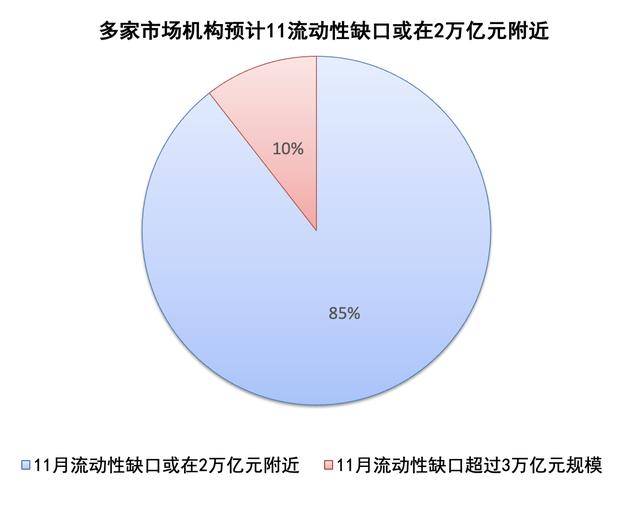
财联社C50风向指数调查:年末资金大概率延续平稳宽松,本轮国债买卖重启后四季度降准概率降低
Sou Hu Cai Jing· 2025-11-07 07:15
Core Viewpoint - The latest C50 Wind Index indicates that liquidity pressure in November is expected to increase compared to October, with a liquidity gap around 2 trillion yuan, as many market institutions anticipate seasonal pressures due to the maturity of financial instruments [1][2][3]. Liquidity Conditions - In October, the central bank maintained a relatively proactive liquidity injection strategy, with a net injection of 4,000 billion yuan, the largest monthly value since March 2025 [2]. - The central bank's operations included a 1.1 trillion yuan front-loaded reverse repo to ease the liquidity pressure at the beginning of the month [2]. - The liquidity gap for November is projected to be around 2 trillion yuan, with some institutions suggesting it could exceed 3 trillion yuan [3]. Monetary Policy Outlook - The central bank has restarted open market operations for government bonds, which many institutions believe could replace the need for a reserve requirement ratio (RRR) cut [1][7]. - The necessity for an RRR cut in the fourth quarter is perceived to be lower, with 17 out of 20 institutions indicating a reduced likelihood of such a move [7][8]. - Analysts suggest that the resumption of government bond trading may serve as a substitute for RRR cuts, allowing for continued liquidity support without aggressive monetary easing [8][9]. Market Reactions - The bond market is expected to experience renewed downward trends, with the 10-year government bond yield potentially approaching the low of 1.7% seen in August [9]. - The overall sentiment in the market indicates that while the central bank's easing measures may be less aggressive, the need for monetary policy support remains due to ongoing economic challenges [9].

货币政策体系及其对国债利率的启示
Qi Huo Ri Bao Wang· 2025-11-07 01:17
Core Viewpoint - The 20th Central Committee's Fourth Plenary Session approved the "Suggestions on Formulating the 15th Five-Year Plan for National Economic and Social Development," emphasizing a stable and continuous monetary policy framework that will guide financial market operations during the 15th Five-Year Plan period [1] Monetary Policy Framework - The "scientific and stable" monetary policy aims to balance short-term and long-term goals, economic growth and risk prevention, as well as internal and external factors [1] - The central bank's liquidity toolbox is well-stocked, with a reasonable distribution of terms, allowing for both short-term and long-term liquidity adjustments [2] Liquidity Tools and Mechanisms - The central bank has shifted its focus from quantity targets to interest rate levels, indicating a reduced emphasis on the monetary supply's direct control [2] - Different liquidity tools serve distinct purposes, with reserve requirement ratio (RRR) adjustments being used more cautiously compared to other tools [3] Interest Rate Mechanism - The central bank will adjust the timing of MLF operations to follow LPR announcements, reinforcing the significance of the 7-day reverse repurchase rate as a policy interest rate [3] - The transmission mechanism of monetary policy is structured as "economic growth - policy interest rate - market interest rate," with the 7-day reverse repurchase rate becoming a key determinant for 10-year government bond yields [5] Economic Indicators and Policy Signals - Historical data shows that each round of RRR cuts corresponds with a decline in government bond yields, indicating that RRR adjustments signal policy easing [4] - The frequency of interest rate cuts is lower than that of RRR cuts, suggesting a more cautious approach by the central bank regarding interest rate adjustments [6]
央行开展7000亿买断式逆回购操作
Sou Hu Cai Jing· 2025-11-05 18:56
Core Points - The People's Bank of China (PBOC) conducted a 700 billion yuan reverse repurchase operation with a term of 3 months, indicating a strategy to maintain market liquidity and support government bond issuance [1] - The operation is a continuation of the 700 billion yuan 3-month reverse repos maturing in November, with an expectation of a second operation later in the month due to an additional 300 billion yuan of 6-month reverse repos maturing [1] - The PBOC has resumed open market operations for government bonds, injecting liquidity into the market, which is seen as a dual signal for stabilizing growth and expectations [1] Industry Insights - The recent slowdown in credit issuance has led to a relatively ample liquidity situation in the banking system, reducing the need for increased liquidity injections [1] - There is a possibility of a reserve requirement ratio (RRR) cut by the PBOC before the end of the year to further lower bank funding costs and stabilize the interest margin while reducing overall financing costs in the economy [2]
7000亿元逆回购托底流动性,降准要来了?
3 6 Ke· 2025-11-05 08:58
Group 1 - The People's Bank of China (PBOC) injected 700 billion yuan of liquidity through a reverse repurchase operation to maintain ample liquidity in the banking system [1] - The operation is a continuation of the 700 billion yuan reverse repurchase that will mature on November 7, indicating a stable liquidity environment [1] - Analysts expect the PBOC to conduct another 6-month reverse repurchase operation this month, with a possibility of increasing the amount [1] Group 2 - In October, the PBOC net injected 20 billion yuan of liquidity through open market operations, reflecting a cautious approach to managing market liquidity [2] - The PBOC's resumption of government bond trading is aimed at stabilizing market expectations without causing a rapid decline in interest rates [2] - Future expectations include potential increases in the scale of net bond purchases to counteract the pressure from maturing monetary tools [2]
11月4日央行公告开展7000亿买断式逆回购及10月恢复国债买卖解读
Dong Fang Jin Cheng· 2025-11-05 00:21
Report Summary Core View - The central bank will use repurchase agreements and MLF to inject medium - term liquidity into the market, and the scale of medium - term liquidity increase may decline due to the expected RRR cut in the fourth quarter. The resumption of treasury bond trading in October releases a signal of stabilizing growth and does not affect the RRR cut expectation [3][4] Key Points 1. Open Market Operations - On November 5, 2025, the central bank will conduct 700 billion yuan of 3 - month (91 - day) outright repurchase operations, equivalent to a 300 - billion - yuan roll - over of 3 - month outright repurchase in November. It is expected to conduct a 6 - month outright repurchase operation with a likely increase in volume, resulting in a continuous 6 - month injection of medium - term liquidity [1] - There will be 900 billion yuan of MLF maturing in November, and the central bank may conduct an equivalent or slightly increased roll - over [3] 2. Reasons for Liquidity Injection - The issuance of 500 billion yuan of local government bonds by the end of the year, the growth of supporting loans after the 500 - billion - yuan policy - based financial instruments are put into use, and the increase in the maturity volume of inter - bank certificates of deposit in November will lead to a tightening of the capital market. The central bank injects medium - term liquidity to maintain a stable and abundant capital supply [2] 3. Treasury Bond Trading - In October, the central bank resumed treasury bond trading, injecting 20 billion yuan of long - term liquidity into the banking system. The resumption is due to the rise of the 10 - year treasury bond yield to around 1.8% and the widening of the term spread, and it also helps to stabilize the macro - economy [4] 4. Policy Outlook - A new round of growth - stabilizing policies may be introduced in the fourth quarter, with fiscal stimulus, monetary easing, and efforts to stabilize the real estate market. The central bank will use various price - based and quantity - based policy tools to boost growth, and there is ample room for monetary policy due to low inflation [3][4]
7000亿元!央行今日开展操作
Hua Xia Shi Bao· 2025-11-05 00:10
Group 1 - The People's Bank of China (PBOC) will conduct a 700 billion yuan reverse repo operation on November 5, maintaining market liquidity [2] - The operation is a continuation of a previous 700 billion yuan reverse repo maturing this month, aimed at keeping liquidity ample in the banking system [2] - In addition to the reverse repo, there are 300 billion yuan of 6-month reverse repos and 900 billion yuan of Medium-term Lending Facility (MLF) maturing this month, indicating further liquidity support is expected [2] Group 2 - Analysts suggest that the lack of an increase in the reverse repo operation is due to relatively ample liquidity in the banking system and a slowdown in credit growth [2] - The resumption of government bond trading in October, with a net injection of 20 billion yuan, is seen as a measure to support long-term liquidity in the banking system [3] - The current low inflation levels provide the PBOC with sufficient room to maneuver its monetary policy, with expectations of potential reserve requirement ratio (RRR) cuts before year-end [3][4]

数量型政策工具持续加力 10月恢复国债买卖或不影响四季度降准预期
Xin Hua Cai Jing· 2025-11-04 11:52
Core Viewpoint - The People's Bank of China (PBOC) is set to conduct a 700 billion yuan reverse repurchase operation on November 5, aimed at maintaining ample liquidity in the banking system, with a focus on medium-term liquidity support [1][2]. Group 1: Reverse Repo Operations - On November 5, the PBOC will conduct a 700 billion yuan buyout reverse repo operation with a term of 3 months (91 days) [1]. - In November, there will be 700 billion yuan of 3-month reverse repos maturing, indicating a continuation of the same amount of operations [1]. - An additional 300 billion yuan of 6-month reverse repos is expected to mature in November, with a high likelihood of another 6-month reverse repo operation being conducted [1][2]. Group 2: Liquidity Management - The PBOC's actions are in response to potential liquidity tightening due to various factors, including the issuance of 500 billion yuan in local government bonds and the expiration of 500 billion yuan in new policy financial instruments [2]. - The central bank aims to stabilize the funding environment and support government bond issuance while encouraging financial institutions to increase credit supply [2][3]. - The PBOC may also consider rolling over or slightly increasing the 900 billion yuan Medium-term Lending Facility (MLF) due in November [2]. Group 3: Bond Market and Economic Stability - The PBOC resumed net purchases of government bonds in October, indicating improved conditions in the bond market, with the 10-year government bond yield around 1.8% [3]. - The resumption of government bond trading is expected to enhance long-term liquidity support for the banking system and signal a commitment to stabilizing economic growth [3]. - The central bank has sufficient operational space to implement various monetary policy tools to support economic stability in the upcoming quarters [3].