反内卷

Search documents
证券市场周刊-第1期2026
2026-01-08 02:07
Summary of Key Points from the Conference Call Industry Overview - The focus is on the Chinese stock market and its potential for a "comprehensive bull market" in 2026, driven by multiple favorable factors including policy benefits, a moderately loose liquidity environment, and continuous improvement in the fundamentals of listed companies [3][15][66]. Core Investment Themes 1. **AI Computing and Applications**: - AI computing is expected to be a core investment theme, with significant growth anticipated in the AI server market, projected to reach $158.7 billion by 2025, with a compound annual growth rate (CAGR) of 17.3% [78]. - Companies like Haiguang Information are leading in AI computing, with their DCU deep computing chips receiving bulk orders from major internet firms [79]. 2. **Traditional Cyclical Industry Recovery**: - The recovery of traditional cyclical industries is highlighted as a key investment area, with expectations for improved profitability in sectors such as steel, cement, and chemicals due to policy support and market demand [69][70]. 3. **High Dividend Yield Assets**: - High dividend yield assets, particularly in banking, insurance, and coal sectors, are expected to attract long-term investors, providing a stable income during the anticipated bull market [14][15][66]. Market Dynamics - The Shanghai Composite Index has shown strong performance, breaking the 4000-point mark, indicating a return of profitable investment opportunities [12]. - The market is expected to experience a "spring rally," with strong performance anticipated in sectors like non-ferrous metals and technology [17]. Policy Environment - The Central Economic Work Conference emphasized the need for a more proactive fiscal policy and a moderately loose monetary policy to support economic growth and stabilize prices [68][70]. - Key tasks for 2026 include building a strong domestic market and enhancing support for technological innovation and industrial upgrades [69][70]. Economic Indicators - The manufacturing Purchasing Managers' Index (PMI) rose to 50.1 in December 2025, indicating expansion, driven by policy support and improved external demand [49]. - Industrial profits for large-scale enterprises showed a slight increase, with total profits reaching 66,268.6 billion yuan, a year-on-year growth of 0.1% [50]. Investment Recommendations - Investors are advised to focus on three main sectors for 2026: 1. **Technology Growth Stocks**: Emphasizing AI and semiconductor industries. 2. **Core Blue-Chip Stocks**: Including traditional consumer sectors like liquor and real estate. 3. **High Dividend Stocks**: Expanding beyond banks to include insurance and coal sectors [12][14][15]. Conclusion - The combination of favorable policies, improved company fundamentals, and a supportive liquidity environment is expected to create a robust foundation for a comprehensive bull market in 2026, with significant opportunities in AI, traditional industries, and high dividend yield assets [3][15][66].
电石-氯碱行业交流
2026-01-08 02:07
Summary of Industry Conference Call on Calcium Carbide and Chlor-alkali Industry Industry Overview - The conference discussed the calcium carbide, chlor-alkali, and PVC industries, focusing on recent policy changes and market dynamics in China, particularly in Shaanxi and Inner Mongolia regions [1][3][4]. Key Points and Arguments Policy Changes - Shaanxi Province has introduced a differentiated electricity pricing policy targeting "restricted" and "eliminated" enterprises, aiming to drive industrial restructuring and technological upgrades. The impact on the national market is expected to be limited due to the low capacity share (approximately 10%) and low operating rates [1][4]. - The policy classifies "restricted" enterprises as those with outdated technology or non-compliance with safety and environmental standards, while "eliminated" enterprises are those hindering carbon neutrality goals [5][6]. - Inner Mongolia has implemented a policy to phase out calcium carbide furnaces below 30,000 kVA, with existing furnaces being medium to large-sized, thus having a lower impact on energy consumption and pollution [7]. Industry Performance - The calcium carbide industry has a total capacity of 40.58 million tons in 2025, with an operating rate of 72%-73%. New capacity additions are limited, reducing the likelihood of supply tightness [3][9]. - The PVC industry has a total capacity of 29.93 million tons, with an operating load rate of nearly 78%. Although 1.1 million tons of capacity is expected to exit, new capacity additions are anticipated to exceed this figure [2][9]. - The chlor-alkali industry has a total capacity of 49.88 million tons, with an operating rate of about 88%. Significant new capacity is expected in 2026, estimated at around 4.2 million tons [10]. Market Dynamics - PVC exports are benefiting from domestic oversupply, increased international demand, and supportive policies such as the Belt and Road Initiative. The suspension of India's anti-dumping policies also supports exports [13]. - The relationship between PVC and real estate remains strong, with emerging applications having limited impact on overall demand [13]. - The chlor-alkali sector is performing well, with minimal impact from market exits due to its overall profitability [8]. Technological Developments - The development of mercury-free PVC production methods is ongoing, with costs increasing by approximately 150 RMB compared to traditional methods. The future of this technology depends on its economic feasibility and international agreements [14]. Additional Important Insights - The differentiated pricing policy is not a new requirement but an adjustment based on local conditions, with limited external impact due to the small share of total capacity [4]. - The long-term impact of the policy on market sentiment may be significant, but the actual fundamental effects are expected to be limited [4]. - The industry is more reliant on market-driven mechanisms for optimization rather than forced government interventions, allowing for a natural process of elimination and upgrade [8].
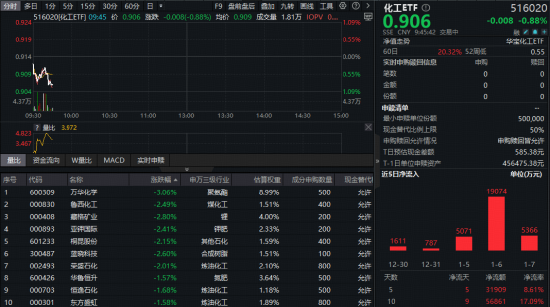
化工板块低位震荡,化工ETF(516020)跌近1%!资金持续加码,机构看好盈利估值双升
Xin Lang Cai Jing· 2026-01-08 02:04
化工板块今日(1月8日)继续回调,反映化工板块整体走势的化工ETF(516020)开盘后持续低位震 荡,截至发稿,场内价格跌0.88%。 成份股方面,聚氨酯、煤化工、锂等板块部分个股跌幅居前。截至发稿,万华化学跌超3%,鲁西化 工、藏格矿业、亚钾国际等多股跌超2%,拖累板块走势。 | | | 分时 各日 1分 5分 15分 30分 60分 日 * | | | | | | | | > | CTETE O | | | | 516020 | | | | | | | | | F9 受航盘后 盘加 九井 图达 工具 @ 0 | | --- | --- | --- | --- | --- | --- | --- | --- | --- | --- | --- | --- | --- | --- | --- | --- | --- | --- | --- | --- | --- | --- | --- | --- | --- | | 0.92 | | | | | 516020(化工ETF) 09:45 价 0.906 强跌 -0.008(-0.88%) 均价 0.909 成交量 1.81万 IOPV 0. | | | | ...

中国银河证券:风光储反内卷与科技共振 供需改善周期拐点将至
Zhi Tong Cai Jing· 2026-01-08 01:39
Group 1 - The core viewpoint of China Galaxy Securities highlights the acceleration of new technologies in photovoltaic BC, perovskite, and copper paste, leading to industrialization and global opportunities, with an expected turning point in supply-demand improvement cycle [1] - In 2025, the oversupply situation in wind and solar energy will persist, but profit recovery driven by anti-involution and overseas expansion is anticipated, with the Shanghai Composite Index up by 17.66% and the ChiNext Index up by 49.57% as of December 31, 2025 [1] - The 136th document accelerates the comprehensive entry of new energy into the market, with 2026 marking the beginning of a new cycle for new energy during the 14th Five-Year Plan, highlighting AIDC storage, offshore wind, and solar storage as key areas of demand [1] Group 2 - The energy storage market is driven by domestic and international policies, with significant growth in demand for large-scale storage, particularly in North America, where demand is projected to increase from 8.9 GWh in 2025 to 190 GW by 2030, representing a CAGR of approximately 84% [2] - In Europe, a concentrated implementation period is expected in the next 3-5 years, with strong demand for industrial and commercial storage, leading to a surge in orders for Chinese companies expanding overseas [2] - Domestic independent storage has attractive internal rate of return (IRR), with a projected CAGR of about 37% from 2025 to 2027 [2] Group 3 - The wind power sector is expected to see simultaneous growth in volume and profit, with domestic installations of onshore and offshore wind projected at 110-120 GW and 12-16 GW respectively by 2026, and global offshore wind CAGR expected to reach 27% over the next 25-30 years [3] - The reduction of internal competition and increased quality awareness are stabilizing prices for onshore wind turbines, while offshore wind prices are expected to remain limited in decline [3] - The acceleration of overseas orders and the recovery of profitability for main engine manufacturers are anticipated, with increased benefits from the utilization of capacity and overseas expansion in components [3] Group 4 - The photovoltaic sector is leading in growth, with installations expected to reach 230-250 GW in 2026, driven by recovery in Europe and strong demand in the US and India, as well as emerging markets [4] - The anti-involution trend is driving profit recovery across the entire industry chain, with expectations for component prices to stabilize as early as spring [4] - Technological advancements such as the expansion of BC battery capacity, mass production of perovskite, and breakthroughs in silver reduction technology are expected to lower costs and enhance profitability [4]

中泰期货晨会纪要-20260108
Zhong Tai Qi Huo· 2026-01-08 01:21
1. Report's Industry Investment Rating No relevant content provided. 2. Core Views of the Report - A - share market shows an upward - trending shock, and the stock index futures can consider following the trend. The government bond futures maintain the strategy of flattening the yield curve. [10][11] - The steel market is expected to rebound in the short - term and fluctuate in the medium - term, while iron ore suggests holding short positions at high levels. The double - coking price may fluctuate and rise in the short - term, and the ferroalloy market is short - term recommended to wait and see. For soda ash, wait and see and try short positions at high levels after the positive feedback subsides; for glass, buy at low levels with caution in chasing high prices. [14][16][17] - For non - ferrous metals, zinc suggests waiting and seeing, and aggressive investors can short at high levels; lead also recommends waiting and seeing; lithium carbonate will fluctuate strongly in the short - term; industrial silicon can focus on selling out - of - the - money call options at high levels, and be cautious in holding positions in polysilicon. [20][22][23] - In the agricultural products market, cotton can reduce long - positions and wait and see; sugar can conduct short - term trading in the low - value range; eggs' short - term contracts have limited upside space, and the far - month contracts have strong support below. The apple market may run strongly; corn will fluctuate strongly in the short - term; jujubes will run in a shock; and live pigs' futures should be short - biased at high levels. [28][30][31] - In the energy and chemical market, crude oil will fluctuate without new event fermentation; fuel oil will follow the oil price; plastics should be treated with a shock mindset; rubber will run in a shock; synthetic rubber suggests waiting and seeing; methanol can consider long - biased allocation in the far - month contracts; caustic soda futures should follow the trend; asphalt's price fluctuation may increase; the polyester industry chain can consider PX and PTA 5 - 9 inter - month positive spreads; LPG has limited support space; pulp and logs suggest waiting and seeing, and urea will run in a shock. [38][39][43] 3. Summary by Relevant Catalogs 3.1 Macro Information - China's foreign exchange reserves reach a ten - year high, and gold reserves increase for 14 consecutive months. As of the end of December 2025, foreign exchange reserves are 3.3579 trillion US dollars, and gold reserves are 74.15 million ounces. [5] - Market regulatory authorities jointly issue regulations to address problems in live - streaming e - commerce and online trading platforms. [5] - Eight departments including the Ministry of Industry and Information Technology issue an implementation opinion on "AI + Manufacturing" aiming to lead the world in AI by 2027. [5] - The central bank conducts a 1.1 - trillion - yuan 3 - month repurchase operation to offset the maturity amount. [5] - Multiple departments hold a battery industry symposium focusing on anti - involution measures. [6] - xAI completes a 20 - billion - dollar E - round financing, with a valuation of 230 billion US dollars. [6] - Ukraine hopes to end the conflict with Russia in the first half of 2026. [6] - The US "small non - farm" shows a mild recovery in December 2025, and the ISM service PMI rises to the highest level since October 2024. [6][7] - The eurozone's CPI in December 2025 slows down to 2%, and the market expects the European Central Bank to remain inactive. [7] - The Shanghai Futures Exchange adjusts trading rules for silver and tin futures. [7] - Key coking enterprises plan to limit production and stabilize prices. [8] 3.2 Macro Finance 3.2.1 Stock Index Futures - A - shares rise in a shock, with the Shanghai Composite Index achieving 14 consecutive positive days. The strategy is to consider following the trend. [10] 3.2.2 Government Bond Futures - The capital market tightens, and the bond market weakens. The strategy is to maintain a flattening yield curve strategy. [11] 3.3 Black Metals 3.3.1 Steel and Iron Ore - Policy interference in the steel industry is low. The demand for building materials is weak, while the demand for coils is good. Supply is stable, and inventory is relatively high. Steel is expected to rebound in the short - term and fluctuate in the medium - term, and iron ore suggests holding short positions at high levels. [13][14] 3.3.2 Coking Coal and Coke - The double - coking price may fluctuate and rise in the short - term, affected by policies and winter storage expectations, but the upside space is limited due to the pressure on the steel industry chain. [16] 3.3.3 Ferroalloys - The market is influenced by news disturbances. In the short - term, it is recommended to wait and see, and investors with small positions can expand the position - adding range. In the long - term, the trend is bearish. [17] 3.3.4 Soda Ash and Glass - Soda ash: Wait and see, and try short positions at high levels after the positive feedback subsides. Glass: Buy at low levels with caution in chasing high prices. [18][19] 3.4 Non - ferrous Metals and New Materials 3.4.1 Zinc - Domestic zinc inventories increase. It is recommended to wait and see, and aggressive investors can short at high levels. The supply support weakens, and the demand is expected to weaken. [20][21] 3.4.2 Lead - Lead inventories are expected to rise. It is recommended to wait and see. In the short - term, lead prices may rise due to raw material shortages, but downstream demand may affect the price. [22] 3.4.3 Lithium Carbonate - The short - term price will fluctuate strongly, affected by mine disturbances and long - term demand, and attention should be paid to inventory changes. [23] 3.4.4 Industrial Silicon and Polysilicon - Industrial silicon: Consider selling out - of - the - money call options at high levels. Polysilicon: Be cautious in holding positions due to policy changes. [24] 3.5 Agricultural Products 3.5.1 Cotton - The short - term supply is loose, and the long - term supply is expected to shrink. Cotton prices may fall in the short - term, and it is recommended to reduce long - positions and wait and see. [28][29] 3.5.2 Sugar - The global sugar supply is in surplus, and domestic sugar is in a season of high supply and demand. It is recommended to conduct short - term trading in the low - value range. [30][31] 3.5.3 Eggs - The short - term contracts are driven by the spot market but have limited upside space. The far - month contracts have strong support below. [31][32] 3.5.4 Apples - The market may run strongly. The sales area has a certain digestion pressure, and attention should be paid to price changes in the sales area. [33] 3.5.5 Corn - The short - term price will fluctuate strongly. Attention should be paid to the grain - selling sentiment and policy - related grain auctions after the New Year. [33][34] 3.5.6 Jujubes - The market will run in a shock, and attention should be paid to the sales area's sales rhythm and purchasing mentality. [34] 3.5.7 Live Pigs - The spot price may fall in the middle of January, and the futures should be short - biased at high levels. [34][35] 3.6 Energy and Chemicals 3.6.1 Crude Oil - Geopolitical trading ends, and the supply is in surplus. The oil price will fluctuate without new events. [38] 3.6.2 Fuel Oil - The price will follow the oil price, affected by geopolitical and macro factors, and the supply is loose. [39] 3.6.3 Plastics - The supply pressure is high, and the price may have a small - scale rebound but no strong upward drive. It should be treated with a shock mindset. [39][40] 3.6.4 Rubber - The price will run in a shock, with cost support. Attention should be paid to international situations and downstream procurement. [40] 3.6.5 Synthetic Rubber - Short - term sentiment fluctuates significantly, and it is recommended to wait and see. [41][42] 3.6.6 Methanol - The fundamentals are improving in the long - term. The far - month contracts can consider long - biased allocation, but attention should be paid to inventory changes and price corrections. [43] 3.6.7 Caustic Soda - The futures should follow the trend and maintain a short - term long - biased mindset, while the spot market is not optimistic. [44] 3.6.8 Asphalt - The price fluctuation may increase, and attention should be paid to the price bottom after the winter storage game. [44][45] 3.6.9 Polyester Industry Chain - The short - term price will follow the cost. Consider PX and PTA 5 - 9 inter - month positive spreads. Each product has different supply - demand and cost situations. [46][47] 3.6.10 Liquefied Petroleum Gas (LPG) - There is support but limited space, affected by supply and demand factors. [48] 3.6.11 Pulp - The spot market trading weakens, and the futures face hedging pressure. It is recommended to wait and see due to the multi - empty game. [49] 3.6.12 Logs - The fundamentals are weak, and the price will run in a shock. The spot market is relatively stable. [50] 3.6.13 Urea - The spot and futures markets will run in a shock, with the spot market trading weakening and the futures being slightly strong. [51]
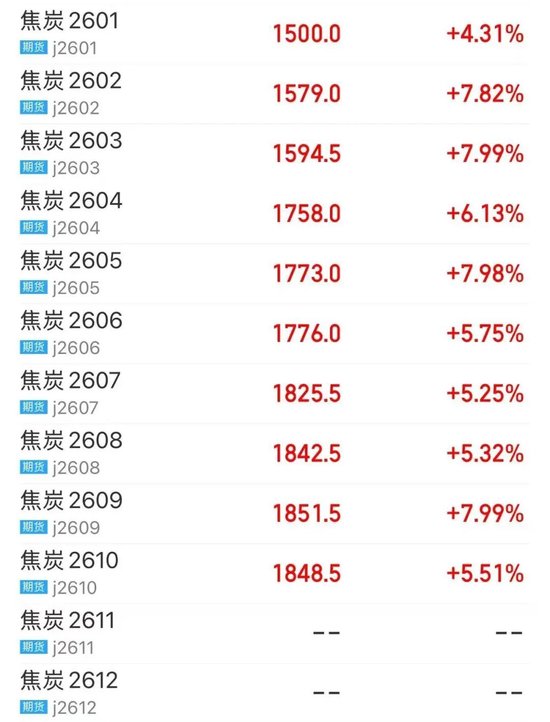
焦煤、焦炭期价双双涨停!一则消息引爆?
Qi Huo Ri Bao· 2026-01-08 01:01
Core Viewpoint - The coal market, particularly coking coal and coke futures, has experienced significant price increases, driven by market sentiment and supply concerns related to production capacity adjustments in Shanxi province [1][4][5]. Group 1: Market Performance - Multiple coking coal and coke futures contracts hit the daily limit up, with notable increases in A-share coal sector stocks, including major players like Daya Energy and Shanxi Coking Coal [1]. - Coking coal futures saw a rise of up to 8%, reaching the highest level since November of the previous year, while coke futures increased by over 5% [3]. Group 2: Supply and Production Insights - A report indicated that 26 out of 52 coal mines in Yulin, Shaanxi province, were removed from the supply guarantee list, resulting in a reduction of 19 million tons in production capacity, which is relatively small compared to the overall production [4]. - Yulin's projected coal output for 2024 is 624 million tons, with a slight increase to 640 million tons expected in 2025, indicating that the capacity reduction will have a limited impact on overall supply [4]. Group 3: Market Sentiment and Future Outlook - Analysts noted that the market is currently sensitive to positive news, which has overshadowed negative fundamental factors, leading to a bullish sentiment in the coal market [4][5]. - The expectation of improved macroeconomic conditions and potential policy support in January has contributed to a favorable outlook for black commodities, including coking coal [5]. - Despite the current bullish trend, there are indications that the sustainability of this price increase may be limited, with potential for price fluctuations in the short term [8].
【光大研究每日速递】20260108
光大证券研究· 2026-01-07 23:04
Macro - The bond market has partially digested three major concerns, with actual impacts being lower than market expectations. However, upward policy impulses and a positive start for the economy and stock market may continue to pressure bond market sentiment. Favorable factors include the lack of strong explanatory power of government bond supply on interest rate trends and the central bank's willingness and ability to maintain liquidity. The overall outlook for the bond market is not pessimistic, and current strategies should focus on allocation while patiently waiting for trading opportunities [5]. Non-ferrous Metals - As of January 5, 2026, domestic electrolytic aluminum prices reached 23,300 yuan/ton, the highest since March 2022. The copper-aluminum price ratio peaked at 4.5, the highest since 2003, indicating potential acceleration in aluminum replacing copper in certain sectors. Disruptions in overseas electrolytic aluminum supply and limited short-term expansion of new capacity are noted. The aluminum consumption in 2026 is expected to remain resilient due to the transformation of old and new driving forces and the rise of emerging fields. Policy expectations in both domestic and international markets are gradually solidifying the bottom for alumina prices [5]. Petrochemical - Future policies will focus on "anti-involution" and the elimination of outdated production capacity. The profitability of high-energy-consuming industries like calcium carbide and chlor-alkali is at a low point, and intensified competition on the cost side is expected to accelerate the exit of outdated facilities. This will help reduce industry supply and increase concentration, while also promoting the modernization and large-scale development of facilities, thereby enhancing the overall competitiveness of the calcium carbide and chlor-alkali industries [5]. Overseas TMT - Minimax, a leading general multimodal large model platform, has entered a phase of scaled commercialization as of 2025. The company's business model centers on self-developed general large models, achieving commercialization through API calls, model customization, solution output, and proprietary AI applications. The company is increasing R&D investment to enhance model training, inference efficiency, and multimodal capabilities, establishing technical and data barriers. Additionally, the open platform model lowers the entry threshold for downstream customers, increasing model usage and ecosystem stickiness [7]. - The company, Zhiyuan Huazhang, is a provider of general multimodal large models and AI native applications, focusing on commercializing model capabilities. Its commercialization path centers on model API calls, while also offering model customization, project solutions, and AI native application services. Revenue recognition is primarily linked to model usage volume, service fulfillment progress, and specific delivery situations. The prospectus indicates that the company is still in the commercialization development stage, with continuous growth in model usage expected as downstream application scenarios expand [7]. Internet Media - The film market is anticipated to transition from "single film support" to "multiple strong resonance" and structural repair. Although Q1 2026 faces high base pressure from the 2025 release of "Nezha 2," the overall market is expected to return to normalization and show moderate growth throughout the year, driven by the diversification of leading domestic films and the recovery of imported film supply [8]. Infrastructure - Hongrun Construction, a leading enterprise with technical experience and project management capabilities, has accumulated over 300 kilometers of shield tunneling in more than 20 cities, including Shanghai, Hangzhou, and Ningbo. The company is deeply integrated with core urban agglomerations under the "Yangtze River Delta Integration" strategy, with stable business in rail transit, municipal, and underground space. In recent years, the company has been advancing a strategy of "construction + new energy + technology," expanding from traditional infrastructure to areas such as photovoltaic energy storage, distributed energy, and intelligent construction, resulting in a more balanced growth structure [8].
【石油化工】电石、氯碱工业:“反内卷”加速供给侧出清,龙头竞争力有望提升——反内卷稳增长系列十二(赵乃迪/周家诺/蔡嘉豪/王礼沫)
光大证券研究· 2026-01-07 23:04
Core Viewpoint - The recent "anti-involution" policies and the Ministry of Industry and Information Technology's (MIIT) initiatives are expected to accelerate the elimination of outdated capacities in high-energy-consuming industries, promoting healthier development in the chemical sector [4]. Group 1: Policy Impact - The MIIT announced a new round of stability growth plans for ten key industries, including steel, non-ferrous metals, petrochemicals, and building materials, aimed at structural adjustments and the elimination of outdated capacities [4]. - The "anti-involution" policies emphasize the need for orderly market competition and the governance of chaotic corporate behaviors, which will further drive capacity management in key industries [4]. - The petrochemical industry is projected to achieve an average annual growth of over 5% in value-added from 2025 to 2026, with significant improvements in economic efficiency and technological innovation capabilities [4]. Group 2: Industry Analysis - Calcium Carbide - By 2025, China's total calcium carbide production capacity is expected to be 41.66 million tons, a decrease of 7.1% from the peak of 44.83 million tons in 2022 [5]. - The top six companies in the calcium carbide industry have a combined capacity of 9.8 million tons, resulting in a CR6 concentration of only 23.5%, indicating a fragmented capacity structure [5]. - The apparent consumption of calcium carbide is projected to be 24.90 million tons in 2025, reflecting a year-on-year decline of 6.45% due to weak downstream PVC demand [5][6]. Group 3: Industry Analysis - Liquid Alkali - The single-ton gross profit for liquid alkali is expected to be 744 yuan by the end of 2025, marking a low point since 2021 [7]. - The total production capacity for caustic soda is projected to reach 51.66 million tons in 2025, a year-on-year increase of 2.46%, with a CR6 concentration of only 12.9% [7]. - The current low industry profitability and intensified competition are anticipated to lead to the accelerated elimination of outdated capacities, improving supply-side conditions [7]. Group 4: Industry Analysis - PVC - The construction and real estate sectors remain the primary application areas for PVC, accounting for 41% of the total consumption in 2025, indicating a close relationship between PVC demand and these industries [8]. - The apparent consumption of PVC is expected to be approximately 18.66 million tons in 2025, a decline of 7.1% compared to 2020, with recovery in demand still awaited [8]. - The total PVC production capacity is projected to be 30.38 million tons in 2025, with the top six companies holding a combined capacity of 7.89 million tons, resulting in a CR6 concentration of 26% [8].
资产配置日报:涨势不改-20260107
HUAXI Securities· 2026-01-07 15:21
Market Performance - On January 7, the stock market showed strong resilience, with the Shanghai Composite Index closing up, marking a record of fourteen consecutive gains[1] - The total trading volume of the A-share market reached 2.88 trillion yuan, an increase of 493 billion yuan compared to January 6[1] - The Hang Seng Index fell by 1.02%, while the Hang Seng Tech Index dropped by 1.56%[1] Capital Flow - Net inflow of southbound funds amounted to 9.178 billion HKD, with Tencent and Xiaomi seeing net inflows of 1.955 billion HKD and 1.633 billion HKD respectively[1] - Conversely, China Mobile and SMIC experienced net outflows of 1.126 billion HKD and 1.070 billion HKD respectively[1] Debt Market - Long-term interest rates showed a "V-shaped" reversal, with 10-year and 30-year government bond yields rising to 1.90% and 2.34% respectively, up by 1.6bp and 2.5bp[5] - The 10-year government bond yield is facing a critical level at 1.90%, while some 30-year bonds have exceeded 2.40%[5] Commodity Market - The commodity market saw a net inflow of nearly 12 billion yuan, with the black series (steel and coal) receiving over 4.5 billion yuan in capital[9] - Precious metals faced selling pressure, with silver down 2.07% and gold slightly down 0.17%[9] Sector Performance - Semiconductor materials and equipment led the gains, with significant increases in prices for DDR5 and NAND Flash, up 573% and 63% year-on-year respectively[3] - The rare earth index rose by 4.23%, driven by the upward trend in industrial non-ferrous metals[3]
李迅雷专栏 | 大国博弈,科技领航——2026年中国经济展望
中泰证券资管· 2026-01-07 12:15
Core Viewpoint - The GDP growth target for 2026 is expected to remain around 5%, with macro policies aimed at promoting consumption and expanding investment to ensure a good start for the "14th Five-Year Plan" [1][6] Export Performance - China's exports are expected to maintain resilience, with a projected nominal growth of 3.4% year-on-year in 2026, supported by factors such as strong external demand and stable Sino-US tariffs [8][12][32] - In 2025, China's export performance exceeded expectations, with nominal year-on-year growth rates of 5.4% in USD and 6.2% in RMB for the first 11 months [9] - The contribution of net exports to GDP growth in the first three quarters of 2025 was 1.5 percentage points, accounting for 29% of the total GDP growth [9] Manufacturing Investment - Manufacturing investment is expected to recover slightly from 1% in 2025 to around 2% in 2026, supported by resilient exports and policy support for advanced manufacturing [2][62] - The decline in manufacturing investment observed since Q3 2025 is attributed to factors such as "strong supply, weak demand" and trade uncertainties [41][47] - The government is likely to continue supporting advanced manufacturing through fiscal, credit, and industrial policies, emphasizing the importance of technological independence [40][52] Real Estate Sector - The direct drag of the real estate sector on the economy is expected to weaken, with a projected year-on-year decline of 5% in housing sales area for 2026 [63][64] - Real estate investment is anticipated to decline by approximately 11% year-on-year in 2026, an improvement from a 16% decline in 2025 [63][66] - Policies aimed at stabilizing the real estate market are being strengthened to prevent negative spillovers to other sectors [66][68] Consumption and Investment - Expanding domestic demand is crucial for achieving the 5% GDP growth target in 2026, with a focus on promoting consumption and investment [70][75] - The government is expected to maintain support for consumption through long-term special bonds, with a focus on enhancing consumer sentiment and addressing high baseline effects from previous consumption incentives [4][73] - Infrastructure investment is projected to rebound to around 8% year-on-year in 2026, supported by previously announced policies [4][70]