市场情绪

Search documents
牛顿是怎么破产的?
雪球· 2026-01-14 13:01
Core Viewpoint - The article discusses the importance of caution in a bullish market, using the historical example of Sir Isaac Newton's financial losses during the South Sea Bubble to illustrate the risks of emotional trading and market speculation [3][4][18]. Group 1: Historical Context - In 1720, the South Sea Company received a charter from the British government to trade with South America, leading to widespread speculation and a dramatic increase in stock prices from £128 to over £1000 within six months, an increase of nearly 8 times [8][10]. - Newton initially profited by investing £7000 and selling at a 100% return, but later succumbed to the fear of missing out and reinvested £20,000, which was equivalent to ten years of his salary [10][11]. Group 2: Market Behavior and Human Emotion - The article highlights that even a genius like Newton could not predict market behavior, emphasizing that the underlying emotions of greed and fear have remained constant throughout history [13][15]. - The fear of missing out can lead investors to make irrational decisions, as seen in Newton's case when he re-entered the market at its peak, resulting in significant losses when the bubble burst [11][18]. Group 3: Investment Strategy - The article advises investors to control their risk by managing their positions and avoiding going "all in" during market euphoria, suggesting that maintaining some cash reserves is crucial for stability and future opportunities [19]. - It emphasizes the importance of taking profits and reassessing one's portfolio during high market sentiment, rather than being swept up in the excitement [19].


沪指冲高回落!帮主郑重:AI疯狂背后的市场“人格分裂”
Sou Hu Cai Jing· 2026-01-14 09:46
Core Viewpoint - The market is experiencing a significant divergence, characterized by a strong performance in AI-related stocks while traditional sectors like banking and insurance are declining, indicating a shift in capital flow and investment focus [3][4]. Group 1: Market Dynamics - The market exhibited a "沪弱深强" (weak Shanghai, strong Shenzhen) pattern, highlighting a split in performance between indices, with the Shanghai Composite Index closing down 0.31% while the Shenzhen Component and ChiNext indices rose [1]. - AI application stocks have seen a dramatic surge, with over twenty stocks hitting the daily limit up, driven by a strong profit-making effect and a significant influx of capital into AI-related applications [3]. Group 2: Investment Strategies - For investors already holding AI-related positions, it is advisable to take partial profits on stocks that have seen substantial short-term gains and have deviated from their fundamentals, as market sentiment can shift rapidly [4]. - For those looking to enter the market, chasing hot stocks may not be cost-effective; instead, it is recommended to wait for a potential pullback to identify better opportunities in the AI supply chain or other quality growth sectors that have recently been undervalued [4]. - Investors holding positions in declining sectors should reassess their investment logic; if the fundamentals remain strong despite market pressures, the downturn may present a mid-to-long-term buying opportunity, rather than simply buying the dip due to price declines [4].

三和管桩:股价波动受多种复杂因素共同影响
Zheng Quan Ri Bao Wang· 2026-01-14 09:44
Group 1 - The core viewpoint of the article emphasizes that the stock price fluctuations of Sanhe Pile (003037) are influenced by various complex factors, including macroeconomic conditions, industry policies, and market sentiment [1] - The company states that its primary task as a listed entity is to focus on operational management, strengthen its main business, and enhance core competitiveness [1] - The company is committed to delivering stable performance and long-term sustainable development to provide returns to investors, while continuously paying attention to the growth of its intrinsic value [1]

黑色建材日报 2026-01-14-20260114
Wu Kuang Qi Huo· 2026-01-14 01:47
Report Industry Investment Rating No relevant content provided. Core Viewpoints - The black series is still in a bottom - range oscillation pattern, sensitive to news changes. The actual terminal demand for steel is weak, and the short - term macro level is in a policy vacuum period. Attention should be paid to the de - stocking of hot - rolled coils, the "dual - carbon" policy, and its impact on the supply - demand pattern of the steel industry [2]. - For iron ore, the supply is expected to enter the off - season, and after the resumption of iron - making, the supply - demand margin is expected to improve. The price is expected to oscillate at a relatively high level in the short term, and attention should be paid to the rhythm of steel mill restocking and iron - making production [5]. - For manganese silicon and ferrosilicon, the future market is mainly affected by the overall market sentiment and the cost - push problem of manganese ore for manganese silicon and the supply - contraction issue for ferrosilicon [9][10]. - For coking coal and coke, the commodity bullish sentiment may continue, but there is a risk of short - term high volatility. The supply - demand structure is relatively balanced, and the price is expected to oscillate in the current range in the short term [16]. - For industrial silicon, it is expected to face inventory accumulation pressure, and the price is expected to be under pressure. Attention should be paid to new supply disturbances in the northwest [19]. - For polysilicon, the price is expected to be weak in the short term. Attention should be paid to actual spot transactions and official policies [22]. - For glass, the price is boosted by production line cold - repair and fuel - cost increase, but the high inventory restricts the upward space. It is recommended to wait and see [24]. - For soda ash, the supply pressure persists, the demand is weak, and the overall pattern remains weak [26]. Summary by Related Catalogs Steel Market Quotes - The closing price of the rebar main contract was 3158 yuan/ton, down 7 yuan/ton (- 0.22%) from the previous trading day. The registered warehouse receipts were 55933 tons, a net increase of 1512 tons. The main contract positions were 1.6879 million lots, a net decrease of 38760 lots. The Tianjin aggregated price of rebar was 3210 yuan/ton, up 10 yuan/ton, and the Shanghai aggregated price was 3300 yuan/ton, down 10 yuan/ton [1]. - The closing price of the hot - rolled coil main contract was 3303 yuan/ton, down 8 yuan/ton (- 0.24%) from the previous trading day. The registered warehouse receipts were 173103 tons, a net increase of 60866 tons. The main contract positions were 1.4403 million lots, a net increase of 12752 lots. The Lecong aggregated price of hot - rolled coils was 3280 yuan/ton, down 10 yuan/ton, and the Shanghai aggregated price was 3280 yuan/ton, unchanged [1]. Strategy Views - The output of hot - rolled coils increased slightly, demand continued to weaken, and inventory continued to decline slightly. The output of rebar increased against the season, demand declined, and inventory increased slightly. The black series is in a bottom - range oscillation pattern, and attention should be paid to market rumors and information screening [2]. Iron Ore Market Quotes - The main contract of iron ore (I2605) closed at 819.50 yuan/ton, with a change of - 0.36% (- 3.00), and the positions changed by - 1527 lots to 653300 lots. The weighted positions were 989800 lots. The spot price of PB fines at Qingdao Port was 826 yuan/wet ton, with a basis of 58.83 yuan/ton and a basis ratio of 6.70% [4]. Strategy Views - Supply: The overseas iron - ore shipment volume continued to decline. The shipment from Brazil decreased significantly, and the shipments of Rio Tinto and BHP decreased. The shipment from non - mainstream countries increased, and the near - end arrival volume continued to increase [5]. - Demand: The daily average pig - iron output was 229.5 tons, continuing to rise. The blast - furnace utilization rate in some areas recovered, and the steel - mill profitability decreased slightly [5]. - Inventory: Port inventory continued to accumulate, and steel - mill imported - ore inventory increased but remained at a low level [5]. - Outlook: The supply - demand margin is expected to improve. The price is expected to oscillate at a relatively high level in the short term, and attention should be paid to steel - mill restocking and iron - making production [5]. Manganese Silicon and Ferrosilicon Market Quotes - On January 13, the main contract of manganese silicon (SM603) closed down 0.24% at 5916 yuan/ton. The spot price of 6517 manganese silicon in Tianjin was 5750 yuan/ton, with a basis of 24 yuan/ton [8]. - The main contract of ferrosilicon (SF603) closed down 0.28% at 5682 yuan/ton. The spot price of 72 ferrosilicon in Tianjin was 5850 yuan/ton, with a basis of 168 yuan/ton [8]. Strategy Views - Market sentiment: The bullish sentiment in the commodity market may continue, but there is a risk of short - term high volatility. The ferrosilicon showed relative strength due to rumors but then gave up the gains [9]. - Fundamental analysis: The supply - demand structure of manganese silicon is loose, with high inventory and weak downstream demand, but these factors are mostly priced in. The supply - demand structure of ferrosilicon is basically balanced, with marginal improvement [10]. - Future drivers: The market direction of the black sector and the overall market sentiment, as well as the cost - push problem of manganese ore for manganese silicon and the supply - contraction issue for ferrosilicon [10]. Coking Coal and Coke Market Quotes - On January 13, the main contract of coking coal (JM2605) closed down 3.80% at 1191.0 yuan/ton. The spot price of low - sulfur main - coking coal in Shanxi was 1525.3 yuan/ton, with a basis of 143 yuan/ton [12]. - The main contract of coke (J2605) closed down 1.41% at 1745.0 yuan/ton. The spot price of quasi - first - grade wet - quenched coke at Rizhao Port was 1490 yuan/ton, with a basis of 108 yuan/ton [12]. Strategy Views - Previous drivers: The bullish commodity - market atmosphere and the news of coking - coal production - capacity reduction [15]. - Outlook: The commodity bullish sentiment may continue, but there is a risk of short - term high volatility. The supply - demand structure is relatively balanced, and the price is expected to oscillate in the current range in the short term [16]. Industrial Silicon Market Quotes - The main contract of industrial silicon (SI2605) closed at 8635 yuan/ton, with a change of - 1.37% (- 120). The weighted positions changed by + 3755 lots to 378736 lots. The spot price of 553 in East China was 9200 yuan/ton, with a basis of 565 yuan/ton [18]. Strategy Views - Supply: The production in December was stable, the furnace - opening number in the southwest decreased to a low level, and the supply improvement was limited [19]. - Demand: The polysilicon production in January continued to decline, and the demand for industrial silicon was weak. The demand from the organic - silicon industry was relatively stable [19]. - Outlook: It is expected to face inventory accumulation pressure, and the price is expected to be under pressure. Attention should be paid to new supply disturbances in the northwest [19]. Polysilicon Market Quotes - The main contract of polysilicon (PS2605) closed at 49005 yuan/ton, with a change of - 1.98% (- 990). The weighted positions changed by - 2302 lots to 88766 lots. The average spot price of N - type granular silicon was 54.25 yuan/kg, and the basis was 5745 yuan/ton [20]. Strategy Views - Market sentiment: The anti - monopoly meeting minutes and market adjustment led to price weakness [21]. - Fundamental analysis: The spot price increased, but downstream hesitation persisted. The supply pressure may ease if the production - cut plan of a leading enterprise is implemented [22]. - Outlook: The price is expected to be weak in the short term. Attention should be paid to actual spot transactions and official policies [22]. Glass and Soda Ash Glass - Market Quotes: The main contract of glass closed at 1096 yuan/ton, down 4.11% (- 47). The inventory of float - glass sample enterprises decreased by 134.80 million cases (- 2.37%) [24]. - Strategy Views: The glass daily melting volume decreased, and the fuel - cost increase boosted the price. However, the terminal demand was weak, and the high inventory restricted the upward space. It is recommended to wait and see [24]. Soda Ash - Market Quotes: The main contract of soda ash closed at 1212 yuan/ton, down 2.18% (- 27). The inventory of sample enterprises increased by 16.44 million tons [25]. - Strategy Views: The supply was stable, the demand was weak, and the inventory continued to accumulate. The overall pattern remained weak [26].
市场情绪降温,震荡运?为主
Zhong Xin Qi Huo· 2026-01-14 01:19
Report Industry Investment Rating - The mid - term outlook for the black building materials industry is "Oscillation" [5] Core Viewpoints - The market sentiment has cooled down, and the industry is mainly in an oscillatory operation. The downstream procurement enthusiasm for coking coal and coke has increased, and the spot price of coke has started to rise. However, in January, coal mines resumed production, and Mongolian coal imports rebounded to a high level, so the high - supply pressure still exists, and the futures prices have corrected from high levels. The resumption of hot metal production and pre - holiday restocking expectations support the iron ore price, but high inventory restricts the upward space. In the off - season, demand has seasonally weakened. With the gradual resumption of production by steel mills, the inventory accumulation pressure on the steel end has become more obvious, and fundamental contradictions have begun to gradually accumulate, suppressing the valuation of the steel futures market. The oversupply of glass and soda ash continues to suppress the futures prices [1]. Summary by Directory 1. Iron Element - **Iron Ore**: The port inventory continues to accumulate, and there are expected disturbances on the supply side. The resumption of hot metal production and pre - holiday restocking on the demand side support the ore price. In reality, both the supply and demand sides need to be verified, and it is expected to oscillate in the short term. The spot price has weakened, but the futures market still shows resilience. Overseas mine shipments have decreased month - on - month, and arrivals are expected to remain at a high level. The demand side has a mixed situation of blast furnace maintenance and resumption, and the inventory pressure is still accumulating [1][7]. - **Scrap Steel**: The supply and demand of scrap steel are both weak. Steel mills' inventories are relatively high, and restocking has slowed down. However, the profit of electric furnaces is acceptable, and the daily consumption is at a high level, supporting the demand. The overall fundamental contradictions are not prominent. Recently, leading steel enterprises in East China announced a price increase of 50 yuan/ton, and it is expected that the spot price will follow the increase [1][8]. 2. Carbon Element - **Coke**: The cost side of coke has shown signs of stabilization, and the expectation of steel mill复产 still exists. As the mid - and downstream winter restocking gradually begins, and the sharp rise in the futures market may drive the entry of spot - futures and speculative demand for procurement, the supply - demand structure of coke may gradually tighten, and the spot price increase is expected to be implemented. The futures price is expected to follow the coking coal [2]. - **Coking Coal**: As the New Year approaches, the winter restocking intensity gradually increases, and the impulse behavior of Mongolian coal imports has improved. The overall supply pressure will be alleviated, the fundamentals of coking coal will continue to improve marginally, and the futures and spot prices still have upward momentum [2]. 3. Alloys - **Manganese Silicon**: The pattern of loose supply and demand of manganese silicon continues, the upstream has great pressure to destock, and it is difficult to transmit costs downward. When the futures price rises to a high level, it will face selling pressure from hedging. In the medium term, the futures price is still expected to gradually fall back to the cost valuation [2]. - **Silicon Iron**: Currently, the supply and demand of the silicon iron market are both weak, and the fundamental contradictions are relatively limited. In the short term, it is expected that the futures price will follow the sector [2]. 4. Glass and Soda Ash - **Glass**: There are still expected disturbances in the supply, but the mid - and downstream inventories are moderately high. Fundamentally, the current supply and demand are still in oversupply. If there is no more cold repair before the end of the year, the high inventory will always suppress the price, and it is expected to oscillate weakly; otherwise, the price will rise [2][14]. - **Soda Ash**: The overall supply and demand of soda ash are still in oversupply. It is expected to oscillate in the short term. In the long run, the oversupply pattern will further intensify, and the price center will still decline, promoting capacity reduction [2][14]. 5. Steel - The cost provides support, but the inventory suppresses. The futures market oscillates. The spot market trading is weak, and the demand has seasonally weakened. The overall steel inventory has stopped falling and rebounded, and fundamental contradictions have begun to gradually accumulate [7]. 6. Indexes - **Comprehensive Index**: On January 13, 2026, the comprehensive index was 2425.27, down 0.30%; the commodity 20 index was 2779.12, down 0.28%; the industrial product index was 2348.14, down 0.52% [106]. - **Steel Industry Chain Index**: On January 13, 2026, the steel industry chain index was 2024.77, with a daily decline of 0.75%, a decline of 0.72% in the past 5 days, an increase of 6.09% in the past month, and an increase of 2.47% since the beginning of the year [108].
A股成交再创新高!市场风格转向
Wind万得· 2026-01-13 08:12
Core Viewpoint - The A-share market experienced a decline on January 13, ending a continuous upward trend, but the trading volume reached a new historical high, indicating concentrated trading structures and potential sector rotation [2][11]. Market Performance - The Shanghai Composite Index fell by 0.64%, while the ChiNext Index dropped by 1.96%. Notably, commercial aerospace stocks faced significant declines, and the computing hardware industry chain, including servers and CPOs, led the downturn. In contrast, sectors such as AI applications, innovative pharmaceuticals, medical services, and ultra-high voltage concepts showed strength [7][10]. Trading Volume Insights - The A-share market's trading volume approached 3.7 trillion yuan, setting a new record. Analysts attribute this surge to several factors, including positive policy expectations, strong liquidity support from long-term funds, and heightened market sentiment [12][13][14]. Policy Expectations - As the first year of the "14th Five-Year Plan," market participants have a more proactive outlook on policy direction. Analysts expect the central economic work conference to focus on expanding domestic demand and stabilizing consumption, with a continuation of "loose fiscal + loose monetary" policies into 2026, providing strong confidence support for the market [12]. Liquidity Factors - The record trading volume is supported by significant inflows of new capital. Long-term funds, including public funds and newly issued ETFs, have contributed to market liquidity. The margin trading balance has increased to over 2.6 trillion yuan, reflecting a robust bullish sentiment among investors [13]. Market Sentiment - The previous widespread increase in individual stocks has led to positive feedback among investors, attracting more capital into the market. Analysts suggest that advanced manufacturing and technological self-reliance are becoming new growth engines, indicating further upward potential for the Chinese stock market [15].

20260113申万期货有色金属基差日报-20260113
Shen Yin Wan Guo Qi Huo· 2026-01-13 02:28
Report Industry Investment Rating - Not provided Core Viewpoints - The copper price closed 0.46% lower overnight. The concentrate supply remains tight, and smelting profits are on the verge of profit and loss. Although the smelting output has declined month - on - month, it generally continues to grow at a high rate. The copper supply - demand expectation has turned to a deficit due to mine supply disruptions, and the short - term copper price is more affected by market sentiment [2]. - The zinc price closed 0.66% higher overnight. The zinc concentrate processing fee has declined, the concentrate supply is temporarily tight, and the smelting output continues to grow. The overall inventory of galvanized sheets is at a high level. The overall difference in zinc supply and demand is not obvious, but the overall market sentiment of non - ferrous metals needs to be concerned [2]. Summary by Related Catalogs Copper - Price change: The copper price closed 0.46% lower overnight [2]. - Supply: The concentrate supply is tight, the smelting profit is at the break - even point, and the smelting output has declined month - on - month but still shows high growth. The mine supply disruption leads to an expected supply - demand deficit [2]. - Demand: Power investment is stable, automobile production and sales are growing positively, home appliance production is in negative growth, and the real estate market is continuously weak [2]. - Market data: The previous domestic futures closing price was 103,430 yuan/ton, the domestic basis was 35 yuan/ton, the previous LME 3 - month closing price was 13,172 dollars/ton, the LME spot premium was 64.31 dollars/ton, the LME inventory was 138,975 tons, and the daily change was - 2,100 tons [2]. Zinc - Price change: The zinc price closed 0.66% higher overnight [2]. - Supply: The zinc concentrate processing fee has declined, the concentrate supply is temporarily tight, and the smelting output continues to grow [2]. - Demand: The cumulative growth rate of infrastructure investment has slowed down, automobile production and sales are growing positively, home appliance production is in negative growth, and the real estate market is continuously weak. The overall inventory of galvanized sheets is at a high level [2]. - Market data: The previous domestic futures closing price was 24,315 yuan/ton, the domestic basis was 45 yuan/ton, the previous LME 3 - month closing price was 3,214 dollars/ton, the LME spot discount was - 40.90 dollars/ton, the LME inventory was 107,450 tons, and the daily change was - 550 tons [2]. Other Metals - Aluminum: The previous domestic futures closing price was 24,350 yuan/ton, the domestic basis was - 120 yuan/ton, the previous LME 3 - month closing price was 3,185 dollars/ton, the LME spot premium was 10.40 dollars/ton, the LME inventory was 497,825 tons, and the daily change was - 1,925 tons [2]. - Nickel: The previous domestic futures closing price was 147,400 yuan/ton, the domestic basis was - 5,940 yuan/ton, the previous LME 3 - month closing price was 18,075 dollars/ton, the LME spot discount was - 200.47 dollars/ton, the LME inventory was 284,790 tons, and the daily change was 8,490 tons [2]. - Lead: The previous domestic futures closing price was 17,755 yuan/ton, the domestic basis was - 130 yuan/ton, the previous LME 3 - month closing price was 2,053 dollars/ton, the LME spot discount was - 43.63 dollars/ton, the LME inventory was 222,725 tons, and the daily change was - 3,725 tons [2]. - Tin: The previous domestic futures closing price was 357,800 yuan/ton, the domestic basis was 2,290 yuan/ton, the previous LME 3 - month closing price was 48,200 dollars/ton, the LME spot discount was - 87.01 dollars/ton, the LME inventory was 5,415 tons, and the daily change was 10 tons [2].
IC平台:英镑对美元汇率继续上涨,但后续动力有限
Sou Hu Cai Jing· 2026-01-13 02:04
Core Viewpoint - The GBP/USD exchange rate has shown a recovery trend after hitting a three-week low, with current trading around 1.3475, reflecting a short-term rebound despite multiple constraints on further upward movement [1]. Group 1: USD Factors - Concerns regarding the independence of the Federal Reserve's policies have increased, impacting the attractiveness of the USD and contributing to the rise of GBP/USD [3]. - Recent mixed economic data from the U.S. has heightened market uncertainty regarding the Fed's policy direction, with non-farm payroll data falling short of expectations while the unemployment rate has decreased, leading to a cautious outlook on the USD [3]. - The market is focused on upcoming U.S. consumer inflation data, which will provide critical guidance for future USD movements and Fed policy expectations [3]. Group 2: GBP Factors - Market expectations regarding the Bank of England's policies are a significant constraint on the strength of the GBP, with predictions of two potential rate cuts by 2026 putting pressure on the currency [3]. - The upcoming release of the monthly GDP report for the UK is anticipated to provide clearer direction for GBP movements and currency pair volatility [4]. - Key economic data releases this week, including U.S. consumer inflation and producer price index, are expected to influence GBP/USD dynamics, with a likely range-bound trading pattern in the short term [4].

宏观金融类:文字早评2026/01/13星期二-20260113
Wu Kuang Qi Huo· 2026-01-13 00:53
1. Report Industry Investment Rating No relevant content provided. 2. Core Viewpoints of the Report - For stocks, with the entry of incremental funds at the beginning of the year, the financing scale has increased significantly, and the market trading volume has rapidly expanded. In the long - term, the policy support for the capital market remains unchanged. Strategically, the idea of buying on dips is recommended [4]. - For bonds, the improvement of economic expectations may put pressure on the bond market, but the sustainability of economic recovery momentum needs to be observed. The central bank's attitude of caring for funds remains, and the bond market is expected to be volatile and weak [8]. - For precious metals, if the silver price stabilizes, it will continue a new upward trend, and the driving force for the gold price remains strong. It is recommended to pay attention to the support of gold and silver prices around the BCOM and tariff adjustment nodes and buy on dips after short - term negative factors end [10]. - For non - ferrous metals, most metal prices are expected to be volatile. For example, copper prices are expected to fluctuate and consolidate in the short term; aluminum prices are expected to remain high; zinc and lead prices are expected to fluctuate widely following the sentiment of the non - ferrous sector [13][15][18]. - For black building materials, steel prices are expected to continue to fluctuate at the bottom; iron ore prices are expected to fluctuate at a relatively high level; glass and soda ash markets are generally weak; coking coal and coke prices are expected to fluctuate in a range [32][34][37]. - For energy and chemicals, different products have different trends. For example, rubber is recommended to be treated neutrally; the valuation of heavy - quality oil products is raised; methanol has the feasibility of buying on dips; urea is recommended to take profits on rallies [55][57][59]. - For agricultural products, the short - term trend of hog prices is expected to be stable or slightly rising, and different trading strategies are recommended for different contract periods; egg prices are expected to be stable or rising, and different strategies are also recommended for different contract periods [79][80][81]. 3. Summary by Relevant Catalogs 3.1 Macro - financial 3.1.1 Stock Index - **Market Information**: China Chamber of Commerce for Import and Export of Machinery and Electronic Products promoted a "soft landing" of the EU's anti - subsidy case on electric vehicles; Lihong No.1 completed its first sub - orbital flight test; Brain - Machine Haihe Laboratory completed the first "space brain - machine interface experiment"; prices of multiple non - ferrous and precious metal futures reached new highs [2]. - **Basis Ratio of Stock Index Futures**: Different ratios are provided for IF, IC, IM, and IH contracts in different periods [3]. - **Strategy Viewpoint**: With incremental funds entering at the beginning of the year, the financing scale has increased significantly, and the market trading volume has rapidly expanded. In the long - term, the policy support for the capital market remains unchanged. Strategically, the idea of buying on dips is recommended [4]. 3.1.2 Treasury Bonds - **Market Information**: On Monday, the closing prices of TL, T, TF, and TS main contracts changed by 0.30%, 0.07%, 0.05%, and 0.00% respectively. The Canadian Prime Minister will visit China, and the National Development and Reform Commission and other departments issued relevant policies on government investment funds [5]. - **Liquidity**: The central bank conducted 861 billion yuan of 7 - day reverse repurchase operations on Monday, with a net investment of 361 billion yuan [6][7]. - **Strategy Viewpoint**: The improvement of economic expectations may put pressure on the bond market, but the sustainability of economic recovery momentum needs to be observed. The central bank's attitude of caring for funds remains, and the bond market is expected to be volatile and weak [8]. 3.1.3 Precious Metals - **Market Information**: Shanghai gold rose 1.31%, and Shanghai silver rose 7.23%. The US federal prosecutor launched a criminal investigation into Fed Chairman Powell, which impacted the Fed's independence [9]. - **Strategy Viewpoint**: If the silver price stabilizes, it will continue a new upward trend, and the driving force for the gold price remains strong. It is recommended to pay attention to the support of gold and silver prices around the BCOM and tariff adjustment nodes and buy on dips after short - term negative factors end [10]. 3.2 Non - ferrous Metals 3.2.1 Copper - **Market Information**: Silver prices were strong, and the domestic equity market strengthened, driving copper prices to rise. LME copper inventory decreased, and domestic electrolytic copper social inventory increased [12]. - **Strategy Viewpoint**: The Fed's interest - rate cut expectation has weakened, and short - term sentiment may cool down. The copper mine supply is in a tight pattern, and copper prices are expected to fluctuate and consolidate in the short term [13]. 3.2.2 Aluminum - **Market Information**: The general atmosphere of bulk commodities was strong, and aluminum prices fluctuated and rose. LME aluminum inventory decreased, and domestic aluminum ingot and aluminum rod social inventories increased [14]. - **Strategy Viewpoint**: The high - level fluctuations of precious metals and non - ferrous metals have increased, and short - term sentiment may cool down. Aluminum prices are expected to remain high [15]. 3.2.3 Zinc - **Market Information**: The Shanghai zinc index rose, and LME zinc also increased. Zinc ingot social inventory decreased slightly [16][17]. - **Strategy Viewpoint**: The zinc price has a large room for catch - up compared with copper and aluminum. It is expected to fluctuate widely following the sentiment of the non - ferrous sector [18]. 3.2.4 Lead - **Market Information**: The Shanghai lead index rose, and LME lead also increased. Lead ingot social inventory increased [19]. - **Strategy Viewpoint**: The lead price is approaching the upper edge of the long - term oscillation range, and it is expected to fluctuate widely following the sentiment of the non - ferrous sector [19]. 3.2.5 Nickel - **Market Information**: Nickel prices rebounded, and the prices of nickel ore and nickel iron also changed accordingly [20]. - **Strategy Viewpoint**: The oversupply pressure of nickel is still large, and it is expected to fluctuate widely in the short term. It is recommended to wait and see in the short term [20][21]. 3.2.6 Tin - **Market Information**: Tin prices rose significantly. The supply in Myanmar is gradually recovering, and the demand is mainly for rigid needs [22]. - **Strategy Viewpoint**: The tin market demand is weak, and the supply is expected to improve. It is recommended to wait and see. The price is expected to fluctuate following the market risk preference [22]. 3.2.7 Carbonate Lithium - **Market Information**: The spot index of carbonate lithium rose, and the futures price also increased [23]. - **Strategy Viewpoint**: The "rush to export" effect has increased the demand expectation, but the rapid rise may increase the callback risk. It is recommended to wait and see or try with a light position [23]. 3.2.8 Alumina - **Market Information**: The alumina index rose, and the inventory continued to accumulate [24]. - **Strategy Viewpoint**: The mine price is expected to decline, and the alumina market continues to face over - capacity. It is recommended to wait and see and consider shorting on rallies [25]. 3.2.9 Stainless Steel - **Market Information**: The stainless steel main contract price was stable, and the social inventory decreased [26]. - **Strategy Viewpoint**: The optimistic expectation of Indonesia's RKAB supports the price. The price is expected to remain high and volatile in the short term [27]. 3.2.10 Casting Aluminum Alloy - **Market Information**: The price of casting aluminum alloy rose, and the inventory increased slightly [28]. - **Strategy Viewpoint**: The cost is strong, and the supply is disturbed. The price is expected to remain high in the short term [29]. 3.3 Black Building Materials 3.3.1 Steel - **Market Information**: The prices of rebar and hot - rolled coil increased, and the inventory of rebar increased slightly while that of hot - rolled coil decreased slightly [31]. - **Strategy Viewpoint**: The steel price is expected to continue to fluctuate at the bottom. It is necessary to pay attention to the de - stocking of hot - rolled coil and relevant policies [32]. 3.3.2 Iron Ore - **Market Information**: The iron ore main contract price rose, and the port inventory continued to accumulate [33]. - **Strategy Viewpoint**: The overseas iron ore shipment is in the off - season, and the iron ore price is expected to fluctuate at a relatively high level. It is necessary to pay attention to the steel mill's replenishment and iron - making rhythm [34]. 3.3.3 Glass and Soda Ash - **Market Information**: The glass main contract price decreased slightly, and the inventory decreased. The soda ash main contract price increased, and the inventory increased [35][37]. - **Strategy Viewpoint**: The glass price is expected to fluctuate, and it is recommended to wait and see. The soda ash market is generally weak [36][37]. 3.3.4 Coking Coal and Coke - **Market Information**: The prices of coking coal and coke rose. The spot prices of coking coal and coke also changed [38]. - **Strategy Viewpoint**: The commodity market sentiment is positive, but the fundamental support for the price is limited. The price is expected to fluctuate in a range [40][41]. 3.3.5 Manganese Silicon and Ferrosilicon - **Market Information**: The prices of manganese silicon and ferrosilicon rose. The spot prices also changed [42]. - **Strategy Viewpoint**: The future market trend is mainly affected by the overall market sentiment and cost factors. It is recommended to pay attention to manganese ore and "dual - carbon" policies [45]. 3.3.6 Industrial Silicon and Polysilicon - **Market Information**: The price of industrial silicon rose slightly, and the price of polysilicon decreased. The inventory of industrial silicon may increase, and the supply of polysilicon may be adjusted [46][48]. - **Strategy Viewpoint**: Industrial silicon is expected to face inventory pressure, and polysilicon is expected to be weak and volatile. It is necessary to pay attention to relevant policies and production plans [47][49]. 3.4 Energy and Chemicals 3.4.1 Rubber - **Market Information**: The rubber price fluctuated and rebounded. The tire start - up rate had marginal fluctuations, and the inventory increased [51][53]. - **Strategy Viewpoint**: The overall commodity atmosphere is positive, but the rubber seasonality is weak. A neutral strategy is recommended, and short - selling can be considered if the price falls below a certain level [55]. 3.4.2 Crude Oil - **Market Information**: The main contract price of INE crude oil rose, and the inventories of refined oil products changed [56]. - **Strategy Viewpoint**: The Latin American geopolitical situation does not have enough positive impact on the overall oil price, but the valuation of heavy - quality oil products is raised [57]. 3.4.3 Methanol - **Market Information**: The regional spot prices of methanol changed, and the main contract price decreased [58]. - **Strategy Viewpoint**: The current valuation of methanol is low, and it has the feasibility of buying on dips [59]. 3.4.4 Urea - **Market Information**: The regional spot prices of urea changed slightly, and the main contract price increased [60]. - **Strategy Viewpoint**: The import window has opened, and it is recommended to take profits on rallies [62]. 3.4.5 Pure Benzene and Styrene - **Market Information**: The prices of pure benzene and styrene rose. The inventory of pure benzene increased, and the inventory of styrene decreased [63]. - **Strategy Viewpoint**: The non - integrated profit of styrene can be long - bought before the first quarter [64]. 3.4.6 PVC - **Market Information**: The PVC main contract price rose, and the inventory increased [65]. - **Strategy Viewpoint**: The domestic PVC market has a pattern of strong supply and weak demand. It is recommended to short on rallies [66]. 3.4.7 Ethylene Glycol - **Market Information**: The ethylene glycol main contract price rose, and the inventory increased [67]. - **Strategy Viewpoint**: The ethylene glycol market needs to increase production cuts to improve the supply - demand pattern. It is necessary to beware of rebound risks [68]. 3.4.8 PTA - **Market Information**: The PTA main contract price rose, and the inventory decreased [69]. - **Strategy Viewpoint**: The PTA is expected to enter the Spring Festival inventory - accumulation stage. It is recommended to pay attention to long - buying opportunities on dips [70]. 3.4.9 p - Xylene - **Market Information**: The p - xylene main contract price rose, and the inventory decreased [71][72]. - **Strategy Viewpoint**: The p - xylene load is high, and it is recommended to pay attention to long - buying opportunities following the crude oil price [73]. 3.4.10 Polyethylene (PE) - **Market Information**: The PE main contract price rose, and the inventory increased [74]. - **Strategy Viewpoint**: The PE price may be supported, and it is recommended to long - buy the LL5 - 9 spread on dips [75]. 3.4.11 Polypropylene (PP) - **Market Information**: The PP main contract price rose, and the inventory situation was complex [76]. - **Strategy Viewpoint**: The PP price may bottom out in the first quarter of next year [77]. 3.5 Agricultural Products 3.5.1 Hogs - **Market Information**: The domestic hog price was mixed, and the price may stabilize or rise slightly [79]. - **Strategy Viewpoint**: The short - term hog price may support the futures price, but in the medium - term, supply pressure exists. Different trading strategies are recommended for different contract periods [80]. 3.5.2 Eggs - **Market Information**: The national egg price mostly rose, and the price is expected to be stable or rise [81]. - **Strategy Viewpoint**: The short - term egg price may support the futures price, but in the medium - term, supply pressure exists. Different trading strategies are recommended for different contract periods [82]. 3.5.3 Soybean and Rapeseed Meal - **Market Information**: The protein meal futures price fluctuated. The import cost of soybeans may have a bottom, but the fundamental situation is weak [83][84]. - **Strategy Viewpoint**: It is recommended to wait and see in the short term due to the combination of long - and short - term factors [84]. 3.5.4 Oils and Fats - **Market Information**: The oil futures price fluctuated. The palm oil inventory in Malaysia increased, and the domestic three - major oil inventories were at a relatively high level [85][86]. - **Strategy Viewpoint**: The current fundamental situation is weak, but the long - term expectation is optimistic. The oil price may be close to the bottom [86]. 3.5.5 Sugar - **Market Information**: The Zhengzhou sugar futures price fluctuated. The spot price of sugar decreased slightly [87]. - **Strategy Viewpoint**: The international sugar price may rebound after February, and it is recommended to wait and see in the short term [89]. 3.5.6 Cotton - **Market Information**: The Zhengzhou cotton futures price decreased. The cotton supply and demand situation changed [90]. - **Strategy Viewpoint**: The cotton price may fluctuate after rising. It is recommended to wait for a callback to buy [91].
八大指标看当前市场情绪到什么位置了?
Ge Long Hui A P P· 2026-01-13 00:06
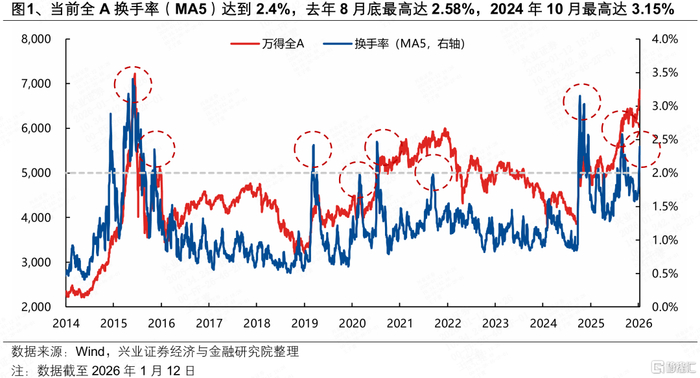
Market Turnover - The current turnover rate of the entire A-share market (MA5) is 2.4%, with a peak of 2.58% at the end of August last year and a maximum of 3.15% in October 2024 [1] Financing Sentiment - The current financing sentiment indicator, measured by the ratio of the recent 20-day financing buy amount to the recent 60-day financing buy amount, stands at 36%, with historically overheated levels above 40% [3] Financing Buy Proportion - The current proportion of financing buy is 11.26%, with a peak of 12.09% in October last year and a historical maximum of 18% in 2015 [4] A-Shares Above 30-Day Average - The current proportion of A-shares above the 30-day average is 66.8%, with historically overheated levels around 80% [7] Retail Investor Net Inflow - The current net inflow of retail investors, measured by small orders, has a 20-day moving average of 27.5 billion yuan, with peaks close to 40 billion yuan in February and September last year [8] New Highs in A-Shares - The current proportion of A-shares reaching new highs over the last 60 days is 11.27%, with historically overheated levels around 20% [9] Relative Strength Index (RSI) - The current RSI for the entire A-share market (14-day) is 80.4, with a peak of 82.3 at the end of July last year and a maximum of 91.3 in October 2024 [10] Stock-Bond Risk Premium - The current stock-bond risk premium for the entire A-share market is near -0.5 standard deviations from the rolling five-year average [16]