
通缩

Search documents
老美终于结束关门,但根却早已腐败?
大胡子说房· 2025-11-11 10:19
Core Viewpoint - The article discusses the transition from traditional content sharing to video and live streaming formats, reflecting broader economic transformations and challenges faced by individuals and businesses in adapting to new realities [1]. Group 1: Economic Transformation - The economy is at a critical juncture of transitioning from old to new growth drivers, moving away from being solely a manufacturing powerhouse to focusing on high-tech advancements [1]. - There is a significant push to expand domestic demand, highlighted by the record 9-day Spring Festival holiday aimed at increasing consumer spending [1]. - The shift from a period of high growth and inflation to one of deflation and slower GDP growth has left many feeling uncertain and unprepared [1]. Group 2: Content Sharing Evolution - The author has transitioned from behind-the-scenes content creation to a more public-facing role, creating a personal video account to share insights on macroeconomic policies [1]. - The challenges of adapting to video content include overcoming stage fright and adjusting to the differences between video scripts and written articles [1]. - The author emphasizes the importance of maintaining written content alongside video formats, as written communication can sometimes convey information more quickly [1]. Group 3: Engagement and Interaction - The author encourages audience engagement through weekly live streams, providing a platform for direct interaction and clarification of economic topics [2]. - The recent U.S. government shutdown is highlighted as a significant event, with implications for global assets and economic understanding [2].


要不了多久,中国值钱的不是房子车子,而是这四样!
Sou Hu Cai Jing· 2025-11-10 08:43
Core Viewpoint - The perception of valuable assets is shifting from real estate and automobiles to health, skills, cash flow, and financial knowledge due to recent economic changes in China [1][3][5][12]. Group 1: Real Estate and Automobiles - Historically, real estate and automobiles were seen as the most valuable assets, with national average housing prices increasing from 2000 RMB per square meter in 1998 to a peak of 11,000 RMB per square meter in 2021, a rise of 5.5 times [1]. - In major cities like Shanghai and Shenzhen, average housing prices surged from 3,000 RMB per square meter to 60,000-70,000 RMB per square meter [1]. - Recently, from 2022 to now, average housing prices across the country have dropped by 30%, with significant adjustments even in core areas of first-tier cities [3]. Group 2: Health - The importance of health is increasingly recognized, with individuals prioritizing their well-being over work, leading to a rise in gym memberships and regular health check-ups [5][7]. Group 3: Skills - Possessing strong skills is crucial in the current job market, as it reduces the likelihood of being laid off and facilitates quicker re-employment if job loss occurs [7][8]. Group 4: Cash Flow - Stable cash flow is essential during economic downturns, allowing individuals to manage expenses and navigate unemployment without immediate financial stress [9][11]. Group 5: Financial Knowledge - Mastery of financial knowledge and investment skills is becoming increasingly valuable, as it helps individuals avoid losses and seize investment opportunities, especially as the economy recovers from deflation [12][14].

不是通胀要来了,真实体感还在变差!
Sou Hu Cai Jing· 2025-11-09 08:58
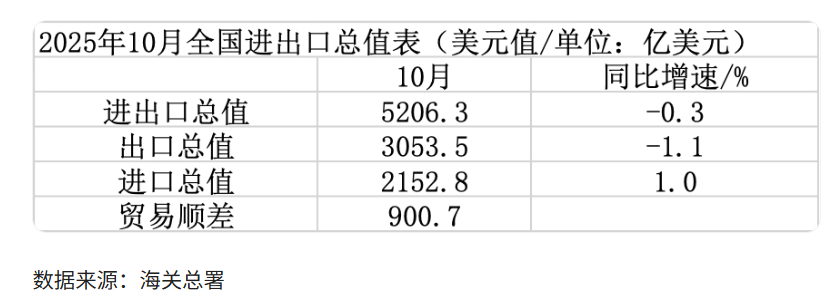
Core Viewpoint - The recent increase in the Consumer Price Index (CPI) and the narrowing decline in the Producer Price Index (PPI) suggest potential inflation, driven by rising global commodity prices and the effects of loose monetary and fiscal policies [1][2]. Economic Indicators - October CPI rose by 0.2% year-on-year, while core CPI, excluding food and energy, increased by 1.2% [1]. - The total import and export value in October was $520.63 billion, with exports at $305.35 billion (down 1.1% year-on-year) and imports at $215.28 billion (up 1.0% year-on-year) [6]. Investment Trends - National fixed asset investment decreased by 0.5% in the first three quarters, with private investment down by 3.1% [4]. - Investment in high-tech sectors has seen significant growth, exceeding 20%, while traditional sectors like real estate are struggling [6][7]. Consumer Behavior - Despite loose monetary policies, consumer borrowing is declining as individuals focus on deleveraging, impacting consumption [4]. - The introduction of new tax policies for e-commerce is expected to reduce disposable income for many, further constraining consumer spending [11][14]. Employment and Production - The potential for inflation may not translate into increased demand, as companies may reduce production in response to rising costs, leading to layoffs and decreased consumer spending [9][10]. - The shift towards high-tech investments may not provide immediate employment solutions for the broader workforce, which still relies heavily on traditional industries [7]. Trade Dynamics - The tightening of tax regulations is anticipated to negatively impact export activities, with businesses facing increased tax burdens and reduced profit margins [11][13][14]. - The overall trade environment is showing signs of contraction, with exports beginning to decline significantly from October onwards [5][13].
2025通缩信号显现?手里有现金的人有4大优势,早已悄悄占了先机
Sou Hu Cai Jing· 2025-11-06 07:32
Core Viewpoint - The current economic environment in China is experiencing deflation, contrary to predictions of inflation due to excessive money supply, with the CPI showing a year-on-year decrease of 0.3% in September [1][3]. Group 1: Economic Conditions - The broad money supply (M2) reached 335.38 trillion yuan by the end of September 2025, which is double the GDP, indicating severe monetary overexpansion [1]. - The lack of money circulation in the economy is a primary reason for deflation, as excess money is not reaching the goods market but remains stagnant in the financial system [3]. - Consumer caution due to unstable incomes has led to reduced spending, resulting in significant inventory buildup and price reductions across various sectors [3]. Group 2: Advantages of Holding Cash - Individuals holding cash are experiencing increased purchasing power, with prices for essential goods like pork dropping from 25 yuan to 17-18 yuan per kilogram [7]. - Cash holders can effectively mitigate investment risks, as stock market volatility has led to significant losses for retail investors, with many public funds reporting losses of 20-30% last year [9]. - Cash provides a safety net for unexpected events such as job loss or medical emergencies, allowing individuals to manage expenses without immediate financial stress [11]. Group 3: Investment Opportunities - In a deflationary environment, asset bubbles in the stock and real estate markets are expected to burst, presenting buying opportunities for those with cash [14]. - Cash holders can strategically position themselves for the upcoming economic growth cycle by making investments at lower prices during the deflation period [14].

一张图戳穿G20格局:中国“通缩”躺赢,欧美工业为啥集体“发烧”?
Sou Hu Cai Jing· 2025-11-05 08:51
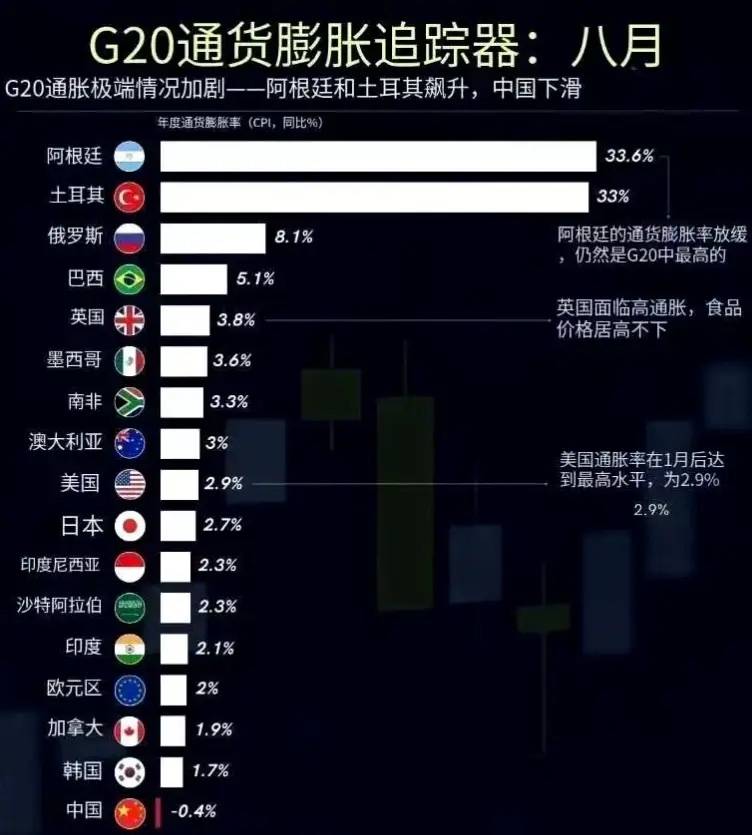
Group 1 - The G20 inflation data reveals a stark contrast between countries, with China experiencing a -0.4% CPI year-on-year, while Argentina and Turkey face inflation rates of 33.6% and 33.0% respectively, highlighting China's unique position in the global economy [1][3][4] - China's manufacturing sector accounts for 30% of global manufacturing output, surpassing the combined output of the US, Germany, and Japan, indicating its dominant role in the global supply chain [4][6] - The trade surplus with the US reached over $800 billion in the first eight months of 2025, showcasing China's strong export capabilities despite trade restrictions imposed by the US [4][6] Group 2 - The inflation crisis in the US and Europe is attributed to a lack of manufacturing strength, with the US manufacturing sector contributing only 11% to GDP, while service industries dominate [5][6] - The energy crisis in Germany has led to a significant increase in manufacturing costs, with electricity prices tripling since 2019, forcing many factories to reduce production or relocate [5][6] - China's ability to maintain low inflation is a result of its robust manufacturing capabilities and a large domestic market, which can absorb excess production, contrasting with the industrial challenges faced by Western economies [6][7]
通缩记忆牵制加息步伐 日本央行内部分歧白热化
智通财经网· 2025-11-05 04:07
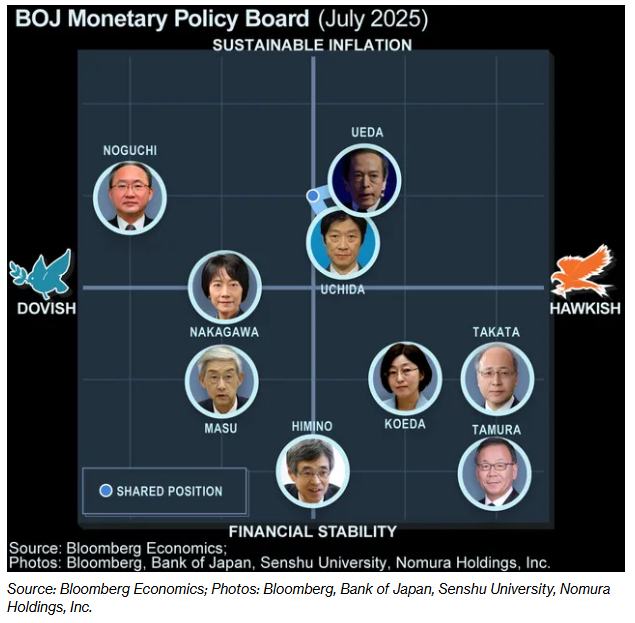
Core Points - The Bank of Japan's September meeting minutes reveal a cautious stance among some board members regarding the timing of interest rate hikes, emphasizing the need to consider Japan's prolonged experience with deflation [1][3] - The minutes indicate a heated discussion during the September policy meeting, with the governor facing opposition for the first time during his tenure, suggesting a potential interest rate increase in the near future [3][4] - The upcoming labor negotiations are expected to push for wage increases exceeding 5%, which may influence the Bank of Japan's decision on interest rates [4] Summary by Sections Interest Rate Policy - Some board members advocate for a careful approach to interest rate hikes due to Japan's long-standing deflationary context, contrasting with two members who support an increase [1] - The minutes highlight that while conditions for a rate hike are gradually being met, immediate action is deemed risky as it could disrupt financial markets [3] Economic Indicators - The next policy decision is scheduled for December 19, with observers closely monitoring the Bank's communication regarding the possibility of rate hikes [3] - A recent survey indicates that nearly all economists expect the Bank of Japan to raise the benchmark interest rate before January, with half predicting this could happen in December [4] Labor Market Dynamics - The largest labor union in Japan is set to negotiate for over 5% wage increases for the third consecutive year, which may provide initial signals for the Bank of Japan regarding wage adjustments [4]
存款搬家停下来了!这是什么信号?
大胡子说房· 2025-11-04 11:21
Group 1 - The core viewpoint of the article emphasizes the current economic situation, particularly focusing on CPI and PPI data, indicating a lack of inflation and a need for continued monetary and fiscal policy support [5][6][10] - In September, the CPI decreased by 0.3% year-on-year and increased by 0.1% month-on-month, while the PPI fell by 2.3% year-on-year, suggesting weak consumer demand and manufacturing prices [1][3] - The article highlights the importance of M1 and M2 monetary supply data, with M2 growing by 8.4% year-on-year and M1 by 7.2%, indicating a narrowing gap between the two, which reflects a shift in liquidity dynamics [6][8][9] Group 2 - The increase in M1 is attributed to a decline in government bond prices, leading individuals to withdraw funds from fixed-term investments and place them into demand deposits [9][10] - In September, household deposits rose by 2.96 trillion yuan, while non-bank financial institution deposits fell by 1.06 trillion yuan, indicating a trend of funds returning to banks rather than remaining in investment accounts [10][11] - The article suggests that the current market volatility and lack of clear upward trends in the stock market have led to a decrease in the "money-moving" phenomenon, with investors opting to keep funds in banks [12][13] Group 3 - The article anticipates that as the stock market stabilizes and begins to rise, there will be a renewed influx of deposits into the market, driven by improved investor sentiment [14][15] - It discusses the government's intention to stimulate the capital market to help escape the current economic stagnation and achieve asset price recovery [16][18] - The upcoming key events, including trade negotiations and monetary policy decisions, are expected to influence market movements, necessitating strategic asset allocation in anticipation of these developments [20][21]

“高市早苗经济学”面临哪些挑战?
Di Yi Cai Jing· 2025-11-03 08:20
Economic Challenges - The Japanese economy is facing significant constraints due to demographic issues, with a focus on the long-term impact of population decline and aging [1][5] - The government has initiated the "Japan Growth Strategy Council" to implement active fiscal policies aimed at increasing income, improving consumer confidence, and enhancing tax revenue [1] - Despite achieving a 5.4% wage increase agreement in 2025, real wage income is still declining due to rising prices, indicating a need for wages to grow at least 3% to meet sustainable inflation targets [3][5] Inflation Impact - The core consumer price index in Tokyo rose by 2.8% year-on-year as of October 31, surpassing previous expectations, with nationwide price increases remaining above the Bank of Japan's 2% target for three and a half years [3] - The rising cost of living, particularly for essential goods, is significantly impacting low-income groups, leading to increased financial strain on the population [3][4] Corporate and Labor Market Dynamics - The number of bankrupt companies in Japan with debts exceeding 10 million yen reached 4,990 in the first half of 2025, marking a 1% increase from the previous year, highlighting the financial strain on small and medium-sized enterprises [4] - Large corporations are raising wages, but the cost is often passed onto suppliers, which poses challenges for small businesses that employ 70% of the workforce [3][4] Demographic Trends - Japan's total population is projected to be slightly above 124.33 million in 2024, reflecting a decrease of approximately 554,500 from 2023, continuing a 16-year trend of population decline [5] - The aging population is leading to increased social security expenditures, which accounted for 33.1% of the total fiscal budget in the 2025 initial budget proposal [5] Workforce Investment - Addressing labor shortages is seen as a structural issue, with calls for reforms in human resource systems to attract talent through flexible work arrangements and salary structures [6] - There is an emphasis on increasing investments in human capital, particularly focusing on women's potential and enhancing productivity in small and medium enterprises [6]

全球央行周“下半场”来袭:英国央行恐按兵不动,持续一年的季度性降息节奏或迎转折点
智通财经网· 2025-11-03 03:47
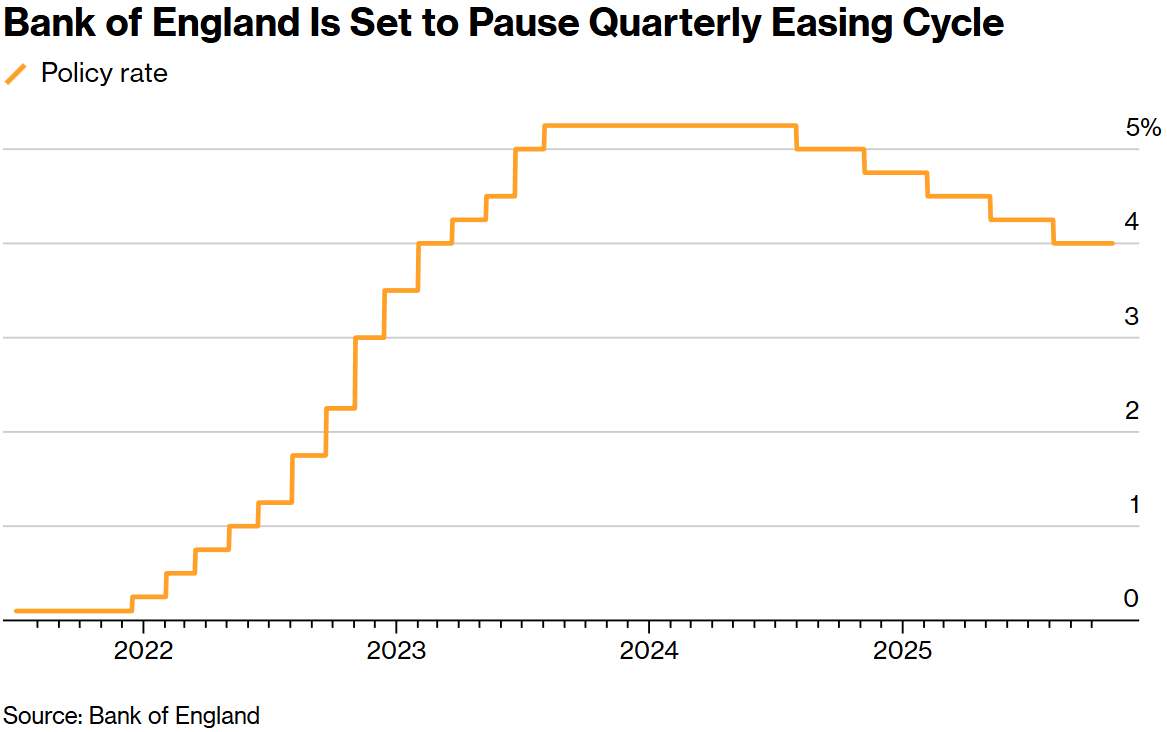
Group 1 - The Bank of England is expected to maintain interest rates at 4% during the upcoming meeting on November 7, breaking a pattern of rate cuts that has persisted since August 2024 [1][5] - The decision comes amid inflation rates nearly double the 2% target and in anticipation of the autumn budget announcement on November 26 [1][5] - If the Bank of England holds rates steady, it will contrast sharply with the Federal Reserve's recent policy easing [1][5] Group 2 - Despite the pause in rate cuts, there is speculation that this may be temporary, with traders increasing bets on a potential rate cut in December, with probabilities nearing 60% [5] - Bank of England Governor Andrew Bailey has indicated uncertainty regarding the timing of future rate cuts, especially with the upcoming budget announcement [5] - Economists suggest that the Bank of England is unlikely to cut rates again until there is a clear downward trend in inflation data, potentially not until April next year [5]
每日机构分析:10月31日
Xin Hua Cai Jing· 2025-10-31 14:26
Group 1: Central Bank Policies - Barclays suggests that traders are underestimating the likelihood of an unexpected interest rate cut by the Bank of England next week, predicting a 25 basis point cut to 3.75% [1] - According to Capital Economics, Eurozone inflation is expected to decline further in the coming months, potentially leading to another rate cut by the European Central Bank [2] - DBS Bank analysts indicate that the Bank of Japan may raise its policy rate by 25 basis points in December, depending on wage negotiations and the Federal Reserve's actions [3] - UOB economists believe that the Bank of Thailand may need to cut rates more than expected to combat deflation risks, with predictions of 25 basis point cuts in December and Q1 of next year [5] Group 2: Inflation and Economic Growth - Eurozone inflation decreased from 2.2% in September to 2.1% in October, attributed to falling energy and food prices, while core inflation remained at 2.4% [2] - The European Central Bank's survey indicates that inflation is expected to stabilize around the 2% target in the coming years, with economic growth projected to gradually recover [2] - Thailand's consumer prices have fallen for six consecutive months, raising concerns about deflation driven by weak bank credit and high private sector leverage [5] Group 3: Market Trends and Investment Sentiment - Hedge funds are betting that the Japanese yen will fall to 160 against the US dollar by year-end, driven by the divergence in monetary policy between the Fed and the Bank of Japan [4] - A report from Bank of America highlights a record outflow of $7.5 billion from gold funds in a single week, following a previous week of significant inflows [6]