
供需平衡

Search documents
食品饮料行业周报:茅台市场化探索,看好大众品出行需求-20260103
国泰海通· 2026-01-03 08:19
Investment Rating - The industry investment rating is "Overweight" [16] Core Insights - The report highlights that the consumer sector is expected to rebound as domestic demand is elevated to a strategic position. The liquor sector is accelerating its bottoming process towards supply-demand balance. The demand for soft drinks, snacks, dining, and dairy products is anticipated to improve due to travel and gift box-related consumption [3][4] Summary by Sections Investment Recommendations - The investment strategy focuses on growth as the main line, emphasizing opportunities at supply-demand clearing points. Key recommendations include: 1. Preferred stocks with price elasticity: Kweichow Moutai, Wuliangye, Luzhou Laojiao, and those expected to clear inventory: Yingjia Gongjiu, Gujing Gongjiu, Shanxi Fenjiu, Jianshiyuan, Zhenjiu Lidu, Shede Liquor, and Jinhui Liquor [8] 2. Beverage stocks benefiting from travel demand: Dongpeng Beverage, Nongfu Spring (Hong Kong), and low valuation high dividend stocks: China Foods (Hong Kong), Master Kong Holdings (Hong Kong), and Uni-President China (Hong Kong) [8] 3. Growth stocks in snacks and food raw materials: Recommended stocks include Bailong Chuangyuan, Yanjinpuzi, Weilong Delicious (Hong Kong), Three Squirrels, and Ximai Foods [8] 4. Beer recommendations: Yanjing Beer, Tsingtao Brewery, Zhujiang Beer, and Bai Run Co., Huaren Beer (Hong Kong) [8] 5. Stable condiments and livestock production capacity reduction: Recommended stocks include Qianhe Flavor Industry, Baoli Foods, Ximai Foods, Babi Foods, Anji Foods, Haitian Flavor Industry, Angel Yeast, Yili Co., New Dairy, Youran Livestock (Hong Kong), and Modern Animal Husbandry (Hong Kong) [8] Liquor Sector - The liquor sector is in a process of bottoming out, with the industry accelerating its bottoming since Q3 2025. The report suggests that the clearing of financial statements will help reduce channel inventory pressure. Looking ahead to 2026, the price movements of leading brands like Moutai and Wuliangye are expected to stimulate sales, achieving a balance between volume and price. The macroeconomic and policy environment is anticipated to catalyze positive expectations for the consumer sector, with liquor being a cyclical asset that has entered an accelerated adjustment phase [11][12] Consumer Goods - The report notes that good traffic flow during the New Year period will benefit food and beverage demand related to travel. From December 31, 2025, to January 2, 2026, the nationwide cross-regional personnel flow is expected to grow by 25.4%, 20.3%, and 13.4% year-on-year, respectively. This positive flow is likely to enhance demand for soft drinks, snacks, and dining. Additionally, the relatively late timing of the 2026 Spring Festival is expected to favor the release of gift-related demand for snacks, soft drinks, and dairy products in Q1 2026 [13][14] Profit Forecast and Valuation - The report includes a profit forecast and valuation table for key stocks as of January 2, 2026, indicating expected earnings per share (EPS) growth and price-to-earnings (PE) ratios for various companies, with Kweichow Moutai having a market cap of 172.46 billion and an EPS forecast of 75.57 yuan for 2026, reflecting a 5% CAGR [15]

长江有色:31日锡价上涨 假期临至轻仓观望看向节后交易
Xin Lang Cai Jing· 2025-12-31 08:34
Core Viewpoint - The tin market is experiencing volatility with prices showing a "roller coaster" trend due to weak seasonal demand, high inventory pressure, and year-end risk aversion among investors [1][2]. Group 1: Market Performance - The Shanghai tin contract 2602 opened at 327,910 CNY/ton, peaked at 331,950 CNY/ton, and closed at 322,920 CNY/ton, down 1,460 CNY, a decrease of 0.45% [1]. - The trading volume for the main contract was 297,836 lots, with open interest at 37,828 lots, a decrease of 5,841 lots from the previous day [1]. - The spot tin price in the Yangtze River market reported an average of 325,900 CNY/ton, an increase of 4,300 CNY from the previous day [1]. Group 2: Supply and Demand Dynamics - The supply side is characterized by a structural balance, with Myanmar's resumption of production and Indonesia's export recovery providing marginal increases, while domestic smelting is constrained by raw material shortages and low processing fees [2]. - Demand is weak in traditional sectors like consumer electronics, while emerging sectors such as new energy vehicles and AI servers show resilience, although high prices are suppressing purchasing willingness [2]. - The divergence between spot prices rising slightly due to some merchants replenishing stock and significant declines in futures prices indicates a deep market struggle between short-term weaknesses and long-term expectations [2]. Group 3: Price Outlook - Short-term, tin prices are expected to continue a volatile adjustment trend, primarily pressured by inventory accumulation and year-end capital withdrawal, but cost and long-term logic will limit downside potential [3]. - In the medium to long term, after the seasonal downturn ends and inventory shows a clear reduction, the focus will shift back to supply constraints and growth in emerging demand, potentially leading to a stronger price trend driven by fundamentals [3]. - Investors are advised to remain cautious, maintaining light positions and observing the speed of inventory reduction and recovery of downstream orders post-holiday [3].


《黑色》日报-20251231
Guang Fa Qi Huo· 2025-12-31 01:26
1. Report Industry Investment Ratings - No industry investment ratings are mentioned in the reports [1][3][6][7][8] 2. Core Views of the Reports Steel Industry - Yesterday's steel prices remained stable. Steel production continued to decrease and inventories declined. There was a large supply - demand gap for rebar, with good inventory reduction, while hot - rolled coil inventory reduction was still slow. Seasonal decline in apparent demand led to weak demand. Although production cuts and strong raw materials supported steel prices to repair upwards from low levels, the weak demand limited the upward drive. Rebar price fluctuations were expected to be in the 3000 - 3200 range, and hot - rolled coil in the 3150 - 3350 range. It was recommended to wait and see for unilateral operations [1] Iron Ore Industry - Yesterday, the 09 iron ore contract fluctuated. In terms of fundamentals, the supply side was in the shipping peak season, with some mines ramping up production at the end of the year. Although the arrival volume decreased slightly, it was still at a high level in the same period of history. Based on shipping calculations, the arrival volume would remain high in the next two weeks, but it would enter the off - season in the first quarter of next year, and the impact of weather on supply needed attention. On the demand side, the molten iron output remained flat week - on - week, at a historically low level. Some steel mills resumed production, while others were under maintenance. The profitability of steel mills improved, but due to the off - season and many overhauls, the subsequent resumption of production was expected to be limited. In terms of inventory, iron ore inventory was at a high level in the same period, and it would continue to accumulate due to high future arrival volumes and low off - port volume in the off - season. Although the short - term resumption of molten iron production was limited, winter storage and pre - festival restocking might support the ore price. In the future, iron ore would transition from a supply - demand surplus to a supply - demand weakness. The price was capped by high inventory, and the demand could not absorb the supply increase when priced above $110 in the off - season. There was support from the restocking expectation of steel mills with low inventory. In the short term, the focus was on the molten iron trend and the restocking rhythm of steel mills, and in the long term, on the negotiation situation. It was expected that the iron ore price would fluctuate strongly. Short - term operations were recommended, with the reference range of 770 - 840 [3] Coke Industry - Yesterday, the coke futures rebounded in a fluctuating manner. On the spot side, the third round of price cuts for coke was implemented on December 22, and the fourth round was launched on the 29th. The port price fell in advance and was currently stable with a weak trend. On the supply side, the coking coal prices in the Shanxi market showed mixed trends, and the auction prices of various coal types showed signs of bottom - rebounding. Coke price adjustment lagged behind coking coal, squeezing the coking profit and reducing the start - up rate. On the demand side, steel mills increased maintenance due to losses, molten iron output declined, and steel prices fluctuated at a low level, with the intention to suppress coke prices. In terms of inventory, ports, steel mills, and coking plants all increased their inventories, and the overall inventory increased slightly. Coke supply - demand weakened. The coke futures fell in advance, and the spot price decline referred to the coking coal decline space. For strategies, after three rounds of spot price cuts, the basis weakened, and the expected - driven rebound was difficult to sustain. It was recommended to short the coke 2605 contract on rallies, and pay attention to the strategy of going long on coking coal and short on coke for arbitrage [6] Coking Coal Industry - Yesterday, the coking coal futures rebounded in a fluctuating manner. On the spot side, the auction prices of Shanxi coking coal turned to a mixed trend, Mongolian coal quotes fluctuated with futures, the auction failure rate rebounded again recently, and traders were cautious about restocking. The thermal coal market continued to decline. On the supply side, near the end of the year, coking coal production might continue to decline; for imported coal, the port inventory was at a high level at the end of the year, and mines carried out shipping volume ramping up. On the demand side, steel mill losses and maintenance decreased, and molten iron output remained stable, but the coking profit declined, the daily output of coking plants decreased slightly, and the market's restocking demand weakened. In terms of inventory, coal washing plants, coke enterprises, mines, ports, steel mills, and ports all increased their inventories, and the overall inventory increased slightly. The policy focused on ensuring the long - term coal supply for power plants. For strategies, the rebound expectation was over - priced in advance. Unilateral operations were recommended to short on rallies, and pay attention to the strategy of going long on coking coal and short on coke for arbitrage [7] Ferrosilicon and Ferromanganese Industry - Ferrosilicon: Yesterday, the ferrosilicon price continued to be strong, breaking through the previous pressure level, and the spot market was also strong, with discussions about capacity elimination in Shaanxi. On the supply side, this week's ferrosilicon production continued to decline, but the decline narrowed compared with the previous period. The production cuts were mainly concentrated in Shaanxi and Gansu, while production in Inner Mongolia and Qinghai increased slightly. In terms of steel - making demand, the molten iron output was basically flat week - on - week, with some steel mills under maintenance and some resuming production. With more large - scale overhauls and weak demand, the molten iron output was expected to remain stable in the short term, and the steel - making demand would be stable. In terms of non - steel demand, downstream restocking increased near the end of the month, but the downstream acceptance of high prices was poor. In terms of exports, overseas inquiries and transactions were okay near Christmas, but the acceptance of high prices was insufficient, and there were still impacts from the re - export trade of Russia and North Korea. On the cost side, the semi - coke price decreased slightly, and low - cost power regions had an advantage. Looking forward, the supply - demand contradiction of ferrosilicon still needed to be alleviated, but the production cut expectation was priced in. The improvement expectation of the demand side was insufficient, and the price lacked upward momentum. Attention should be paid to the expectation change and the semi - coke price. In the short term, the price was expected to fluctuate within the range of 5650 - 5900 [8] - Ferromanganese: Recently, ferromanganese was strongly running, and the spot market was stable. On the supply side, the production increased slightly, and the supply remained at a normal level in the same period of history. Recently, new capacities in Inner Mongolia were released, and the short - term production still had room for growth. There were rumors of production cuts in Guangxi and Guizhou, but they were not implemented. In terms of steel - making demand, the molten iron output was basically flat week - on - week, with some steel mills under maintenance and some resuming production. With more large - scale overhauls and weak demand, the molten iron output was expected to remain stable in the short term, and the steel - making demand would be stable. The price - pressing sentiment of steel mills in the copper - aluminum industry was strong. In terms of inventory, the factory inventory remained at a high level, and the inflection point had not appeared, and the supply - demand contradiction still existed. On the cost side, the manganese ore price was stable, and some overseas mines raised their January quotes. The low - inventory situation supported the ore price. Overall, ferromanganese was in a state of self - supply surplus but relatively balanced in the whole market. The manganese ore supported the ferromanganese price, and the key was the production cut amplitude and the end - year winter storage restocking expectation of steel mills. The short - term supply - demand contradiction was priced in, and there was no clear trend - reversal signal. It was expected that the price would fluctuate downward. The strategy was mainly range - trading, with the reference range of 5700 - 6000 [8] 3. Summary by Relevant Catalogs Steel Industry Steel Prices and Spreads - Rebar spot prices in East China, North China, and South China remained unchanged at 3300 yuan/ton, 3170 yuan/ton, and 3260 yuan/ton respectively. Rebar futures contracts 05, 10, and 01 increased by 4 yuan/ton, 1 yuan/ton, and 7 yuan/ton respectively. Hot - rolled coil spot prices in East China and South China remained unchanged, while the North China price increased by 10 yuan/ton. Hot - rolled coil futures contracts 05, 10, and 01 decreased by 5 yuan/ton, 5 yuan/ton, and 3 yuan/ton respectively [1] Cost and Profit - The billet price remained unchanged at 2940 yuan/ton, and the slab price remained at 3730 yuan/ton. The cost of Jiangsu electric - furnace rebar decreased by 1 yuan/ton to 3209 yuan/ton, and the profit of East China hot - rolled coil increased by 10 yuan/ton to - 12 yuan/ton [1] Production - The daily average molten iron output decreased slightly by 0.1 to 226.5 tons, with no significant change. The output of five major steel products decreased by 1.1 tons to 796.8 tons. Rebar production increased by 2.7 tons to 184.4 tons, and hot - rolled coil production increased by 1.6 tons to 293.5 tons [1] Inventory - The inventory of five major steel products decreased by 36.8 tons to 1258.0 tons, rebar inventory decreased by 18.3 tons to 434.3 tons, and hot - rolled coil inventory decreased by 13.5 tons to 377.2 tons [1] Transaction and Demand - The building materials trading volume decreased by 2.5 to 11.3, a decrease of 20.8%. The apparent demand of five major steel products decreased by 1.7 to 833.6 tons, rebar apparent demand decreased by 6.0 to 202.7 tons, and hot - rolled coil apparent demand increased by 8.8 to 307.0 tons [1] Iron Ore Industry Iron Ore - Related Prices and Spreads - The warehouse - receipt costs of different iron ore powders showed different trends. The 05 - contract basis of some iron ore powders increased, and the 5 - 9 spread decreased by 1.0 to 22.0, while the 1 - 5 spread increased by 0.5 to 20.0 [3] Spot Prices and Price Indexes - The spot prices of some iron ore powders at Rizhao Port decreased, and the Singapore Exchange 62% Fe swaps remained unchanged, while the Platts 62% Fe increased by 1.0 to 107.9 [3] Supply - The 45 - port arrival volume decreased by 76.7 tons to 2646.7 tons, the global shipping volume decreased by 128.0 tons to 3464.5 tons, and the national monthly import volume decreased by 74.7 tons to 11054.0 tons [3] Demand - The 247 - steel - mill daily average molten iron output remained unchanged at 226.6 tons, the 45 - port daily average off - port volume increased by 1.6 to 315.1 tons, the national monthly pig iron output decreased by 320.6 tons to 6234.3 tons, and the national monthly crude steel output decreased by 212.6 tons to 6987.1 tons [3] Inventory Changes - The 45 - port inventory increased by 176.2 tons to 15858.66 tons, the 247 - steel - mill imported ore inventory increased by 136.2 tons to 8860.2 tons, and the inventory available days of 64 steel mills decreased by 2.0 to 19.0 [3] Coke Industry Coke - Related Prices and Spreads - The prices of Shanxi and Rizhao Port quasi - first - grade wet - quenched coke remained unchanged. The coke 01 contract decreased by 6, and the 05 contract increased by 35. The coking profit decreased by 11 [6] Upstream Coking Coal Prices and Spreads - The coking coal (Shanxi warehouse - receipt) price remained unchanged at 1230 yuan/ton, and the coking coal (Mongolian coal warehouse - receipt) price increased by 5 to 1159 yuan/ton [6] Supply - The daily average output of all - sample coking plants decreased by 0.3 to 62.7 tons, and the 247 - steel - mill daily average output increased by 0.3 to 46.8 tons [6] Demand - The 247 - steel - mill molten iron output remained unchanged at 226.6 tons [6] Inventory Changes - The total coke inventory increased by 12.2 tons to 912.6 tons, the all - sample coking plant coke inventory increased by 1.1 tons to 92.2 tons, the 247 - steel - mill coke inventory increased by 8.5 tons to 642.2 tons, and the port inventory increased by 2.5 tons to 178.2 tons [6] Supply - Demand Gap Changes - The coke supply - demand gap remained at - 0.2 tons [6] Coking Coal Industry Coking Coal - Related Prices and Spreads - The price of Shanxi medium - sulfur main - coking coal (warehouse - receipt) remained unchanged at 1230 yuan/ton, and the Mongolian 5 raw coal (warehouse - receipt) price increased by 5 to 1159 yuan/ton. The coking coal 01 contract increased by 35, and the 05 contract increased by 32. The sample coal mine profit decreased by 1 [7] Overseas Coal Prices - The Australian Peak Downs coking coal arrival price remained unchanged at 230 US dollars/ton, the Jingtang Port Australian main - coking coal ex - warehouse price increased by 20 to 1560 yuan/ton, and the Guangzhou Port Australian thermal coal ex - warehouse price decreased by 1.9 to 698 yuan/ton [7] Supply - The raw coal output decreased by 2.7 tons to 853.4 tons, and the clean coal output decreased by 0.6 tons to 438.2 tons [7] Demand - The all - sample coking plant daily average output decreased by 0.3 to 62.7 tons, and the 247 - steel - mill daily average output increased by 0.3 to 46.8 tons [7] Inventory Changes - The Fenwei coal mine clean coal inventory increased by 1.7 tons to 134.9 tons, the all - sample coking plant coking coal inventory increased by 3.4 tons to 1039.7 tons, the 247 - steel - mill coking coal inventory increased by 1.7 tons to 806.7 tons, and the port inventory increased by 13.3 tons to 299.5 tons [7] Ferrosilicon and Ferromanganese Industry Spot Prices and Spreads - Ferrosilicon: The spot prices in different regions increased to varying degrees, and the main - contract closing price increased by 74 to 5676 yuan/ton. Ferromanganese: The spot prices in different regions also increased, and the main - contract closing price increased by 80 to 5862 yuan/ton [8] Cost and Profit - Ferrosilicon: The production cost in Inner Mongolia increased slightly, and the production profit increased. Ferromanganese: The manganese ore prices in Tianjin Port remained stable, and the production costs in different regions remained unchanged [8] Manganese Ore Supply - The manganese ore shipping volume increased by 15 to 85.2 tons, the arrival volume increased by 2.5 to 40.8 tons, and the off - port volume decreased by 3.5 to 55.7 tons [8] Supply - Ferrosilicon: The production decreased slightly, and the production enterprise start - up rate decreased. Ferromanganese: The start - up rate increased, and the production increased [8] Demand - The 247 - steel - mill daily average molten iron output remained unchanged at 226.6 tons, the five - major - steel - product output decreased by 1.1 tons to 796.8 tons, the ferrosilicon demand remained unchanged at 1.8 tons, and the ferromanganese demand increased by 0.0 to 11.3 tons [8] Inventory Changes - Ferrosilicon: The inventory of 60 sample enterprises decreased by 0.2 tons to 6.4 tons, and the average available days decreased by 0.4 to 15.4 days. Ferromanganese: The inventory of 63 sample enterprises increased by 0.1 tons to 38.6 tons, and the average available days increased by 0.1 to 16 days [8]
招商期货-期货研究报告:商品期货早班车-20251231
Zhao Shang Qi Huo· 2025-12-31 01:12
Report Industry Investment Rating There is no information regarding the industry investment rating in the provided content. Core Viewpoints The report presents market analyses and trading strategies for various commodity futures, including basic metals, black industries, agricultural products, and energy chemicals. It assesses the supply and demand, market performance, and price trends of each commodity, and provides corresponding trading suggestions based on these factors. Summary by Categories Basic Metals - **Copper**: Market rebounded sharply; influenced by silver's decline and Fed's rate - cut decision; supply remains tight. Suggest waiting for volatility to decline [2]. - **Aluminum**: Price closed slightly lower; supply increased, demand decreased. Expected to oscillate in the short - term [2]. - **Alumina**: Price unchanged; supply decreased due to environmental control, demand remained high. Price to stay weak [2]. - **Industrial Silicon**: Price rose; supply increased, demand from some industries decreased. Expected to oscillate between 8400 - 9200 [2]. - **Lithium Carbonate**: Price dropped; supply increased, demand from some sectors decreased, inventory decreased in December. Expected to oscillate at a high level [2][3]. - **Polycrystalline Silicon**: Price rose; supply stable, demand from downstream sectors decreased. Suggest waiting for price to decline to enter the market [3]. - **Tin**: Price rebounded; supply tight, influenced by silver and Fed's decision. Suggest waiting for buying opportunities [3]. Black Industry - **Rebar**: Price dropped; inventory decreased, demand weak, supply decreased. Suggest waiting and trying to short the 2605 contract [4]. - **Iron Ore**: Price dropped; supply increased, demand may decrease. Suggest waiting, reference range 765 - 795 [4][5]. - **Coking Coal**: Price rose; supply and demand weak, futures overvalued. Suggest waiting and trying to short the 09 contract [5]. Agricultural Products - **Soybean Meal**: US soybeans oscillate weakly; domestic market is near - strong and far - weak. Core depends on South American output [5]. - **Corn**: Price oscillated; supply - demand contradiction is small. Futures price expected to oscillate [5]. - **Edible Oils**: Market is in oscillation and differentiation. Pay attention to production and bio - diesel policies [5]. - **Cotton**: Suggest buying at low prices, reference range 14300 - 14800 yuan/ton [5]. - **Eggs**: Price oscillated weakly; supply - demand contradiction is small. Futures price expected to oscillate [6]. - **Pigs**: Price rebounded; supply - demand pressure eased. Futures price expected to oscillate strongly [6]. Energy Chemicals - **LLDPE**: Price oscillated; supply pressure increased but slowed, demand decreased. Suggest buying far - month contracts at low prices in the long - term [7]. - **PVC**: Price dropped; supply - demand is weak, macro situation improved. Suggest reverse arbitrage [7]. - **PTA**: PX supply is balanced and loose, PTA supply is balanced and tight. Suggest mid - term long - position for PX and focus on 05 contract for PTA [7][8]. - **Glass**: Price rose; supply - demand expected to improve, undervalued. Suggest waiting [8]. - **PP**: Price oscillated; supply increased, demand decreased. Suggest buying far - month contracts at low prices in the long - term [8]. - **MEG**: Price situation; supply is high, inventory increased. Suggest short - position at high prices [8]. - **Crude Oil**: Price oscillated; supply pressure is large, demand is in the off - season. Suggest short - position at high prices [8]. - **Styrene**: Price oscillated; supply - demand is weak in the short - term. Suggest long - position for styrene or reverse arbitrage for pure benzene in the second quarter [9]. - **Soda Ash**: Price rose; supply is large, demand is weak. Suggest short - position [9].
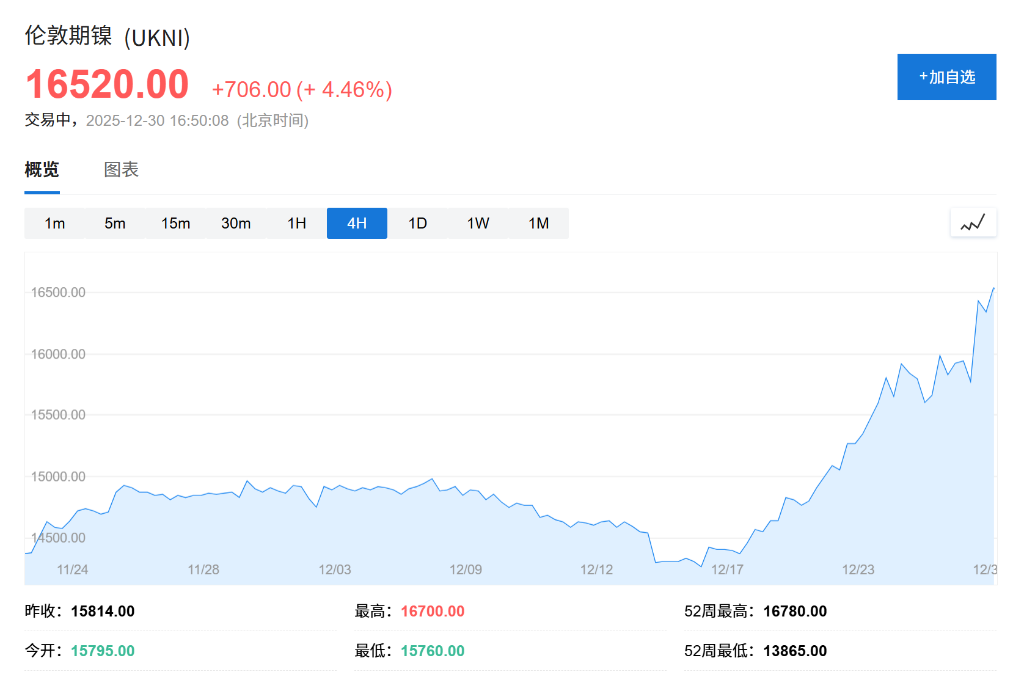
印尼拟于2026年减产,推动镍价升至九个月新高
Hua Er Jie Jian Wen· 2025-12-30 10:20
Core Viewpoint - The Indonesian government signals a supply cut to boost nickel prices, pushing prices to their highest level since March this year [1] Group 1: Supply and Demand Dynamics - Indonesia plans to reduce nickel production by 2026 to better match market demand, controlling nearly 70% of global nickel output [1][5] - The supply cut is a direct response to the current supply-demand imbalance, as Indonesia has significantly expanded its production capacity over the past decade [5] - The government has the ability to control supply through tightening mining quota issuance, indicating both willingness and capability to intervene in the market [5][6] Group 2: Market Conditions - Despite recent price rebounds, nickel remains one of the weaker performers on the London Metal Exchange this year due to ongoing weak demand from the battery industry [4][5] - The rise of alternative battery chemistries, such as lithium iron phosphate, has led to disappointing demand for nickel, which is used in both stainless steel and electric vehicle batteries [4][5] - High inventory levels have been a major obstacle to nickel price recovery, exacerbated by continuous increases in Indonesian production despite low prices [5] Group 3: Future Outlook - Indonesia's production policy is now a key variable determining nickel price trends for the coming year, with any changes having systemic impacts on the global supply chain [6] - Market participants are closely monitoring the Indonesian government's announcements regarding mining quota details to assess the execution and scale of the production cut plan [6]
大越期货沪铜早报-20251230
Da Yue Qi Huo· 2025-12-30 01:32
交易咨询业务资格:证监许可【2012】1091号 沪铜早报- 大越期货投资咨询部 : 祝森林 从业资格证号:F3023048 投资咨询证号: Z0013626 联系方式:0575-85226759 重要提示:本报告非期货交易咨询业务项下服务,其中的观点和信息仅作参考之用,不构成对任何人的投资建议。 我司不会因为关注、收到或阅读本报告内容而视相关人员为客户;市场有风险,投资需谨慎。 每日观点 铜: 1、基本面:供应端有所扰动,冶炼企业有减产动作,废铜政策有所放开,11月中国制造业采购经理指 数(PMI)为49.2%,较上月回升0.2个百分点,仍处于收缩区间但显现边际改善;中性。 2、基差:现货101110,基差2250,升水期货; 偏多。 3、库存:12月29日铜库存减2450至154575吨,上期所铜库存较上周增15898吨至111703吨;中性。 4、盘面:收盘价收于20均线上,20均线向上运行;偏多。 5、主力持仓:主力净持仓空,空减;偏空。 6、预期:地缘扰动仍存印尼的Grasberg Block Cave矿事件发酵,铜价再次创出历史新高,高位大幅 波动,注意仓位控制 近期利多利空分析 利多: 利空: ...
PTA、MEG早报-20251230
Da Yue Qi Huo· 2025-12-30 01:25
1. Report Industry Investment Rating - Not provided in the content 2. Core Views of the Report - For PTA, the market situation is neutral. Recently, there have been many changes in PTA devices, but the downstream polyester load has also decreased. The supply - demand pattern of PTA itself has not changed much. The futures price has rapidly declined following the cost side. It is expected that in the short term, the spot price of PTA will fluctuate following the cost side, and the spot basis will fluctuate within a range. Attention should be paid to macro - sentiment and the changes in upstream and downstream devices [5]. - For MEG, the market situation is also neutral in the short - term. From January to February, MEG shows obvious seasonal inventory accumulation. The visible inventory is continuously piling up. In the long - term, starting from March, the supply - demand structure will improve with the implementation of the spring maintenance of coal - chemical plants and the maintenance of Gulei Petrochemical. The overseas supply of MEG will be further reduced and will gradually be reflected in the import volume starting from February. However, the transmission in the polyester industry chain is not smooth, and the terminal demand is weak, and the production cuts of polyester plants will be gradually implemented. It is expected that the price center of MEG will be range - bound in the near future, with certain buying support at low levels [7]. 3. Summary According to the Directory 3.1前日回顾 (Previous Day's Review) - Not provided in the content 3.2每日提示 (Daily Tips) - Not provided in the content 3.3今日关注 (Today's Focus) - Not provided in the content 3.4基本面数据 (Fundamental Data) 3.4.1 PTA - **Price**: The spot price was 5070 yuan/ton, and the basis of the 05 contract was - 52 yuan/ton, with the futures price higher than the spot price. The trading range of the spot price was 5020 - 5105 yuan/ton, and the current mainstream spot basis was 05 - 63 [5][6]. - **Inventory**: The inventory of PTA factories was 3.61 days, a decrease of 0.15 days compared to the previous period [6]. - **Supply - Demand Balance**: The PTA supply - demand balance table from 2024 to 2025 shows the changes in PTA production capacity, load, output, import, total supply, polyester production, consumption, and inventory. For example, in December 2025, the PTA production capacity was 9472, the load was 85.00%, the output was 684, and the total demand was 666 [11]. 3.4.2 MEG - **Price**: On Monday, the price center of ethylene glycol (MEG) was narrowly sorted, and the market negotiation was average. The spot price was 3683 yuan/ton, and the basis of the 05 contract was - 134 yuan/ton, with the futures price higher than the spot price. The overseas price of MEG was stable, with the negotiation price of recent arrival shipments at 442 - 445 US dollars/ton and that of shipments from late January to early February at 444 - 448 US dollars/ton [7]. - **Inventory**: The total inventory in East China was 65.78 tons, a decrease of 11.22 tons compared to the previous period [7]. - **Supply - Demand Balance**: The MEG supply - demand balance table from 2024 to 2025 shows the changes in MEG output, import, total supply, polyester production, consumption, and port inventory. For example, in December 2025, the total supply of MEG was 252, and the total consumption was 247 [12]. 3.4.3 Other Data - **Price Changes**: The price data table shows the price changes of various products such as naphtha, p - xylene (PX), PTA, MEG, and polyester products from December 26 to December 29, 2025. For example, the spot price of naphtha (CFR Japan) increased from 575.500 to 584.500 US dollars/ton, and the price of CCFEI price index: PTA (domestic) decreased from 5160 to 5060 yuan/ton [13]. - **Profit**: The profit data table shows the profit changes of products such as PTA processing, MEG production from different raw materials (naphtha, ethylene, methanol, coal), and polyester products. For example, the PTA processing fee increased from 439.48 to 525.55 yuan/ton [13].
光大期货:12月29日能源化工日报
Xin Lang Cai Jing· 2025-12-29 01:25
热点栏目 自选股 数据中心 行情中心 资金流向 模拟交易 客户端 原油:供应过剩担忧下,油价震荡偏弱运行 周度油价先涨后跌,其中WTI 2月合约收盘下跌1.61美元至56.74美元/桶,跌幅2.76。布伦特2月合约收 盘下跌1.60美元至60.64美元/桶,跌幅2.57%。SC2602周五夜盘以432.6元/桶收盘。外盘因圣诞节休市, 随后周五大幅收跌,基本回吐油价周内涨幅。 市场关注俄乌谈判进展,俄方将要求对美乌拟定的这份和平方案作出关键性修改,其中包括对乌克兰军 方施加更多限制条款。该人士表示,俄方将这份二十点和平方案视作后续谈判的起点,但同时认为,这 份方案未能回应俄方提出的诸多核心问题。当前来看,俄乌和平仍需要较长时间来达成,地缘带来的扰 动仍会持续。 国内原油产量方面,2025年我国海洋石油产量约6800万吨,同比增长约250万吨,约占全国石油增产量 的八成。2025年我国持续加大海洋勘探力度,海上油气增储上产资源基础不断夯实。截至今年三季度 末,中国海域获5个新发现,成功评价22个含油气构造,11个新项目投产。在北部湾盆地潜山领域实现 重大突破,成功发现我国海上首个深层—超深层碎屑岩亿吨级油田惠州 ...

国泰海通|食饮:白酒探底,乳制品国产替代有望加速
国泰海通证券研究· 2025-12-28 14:49
Investment Recommendations - Focus on growth as the main line, emphasizing turning point opportunities under supply and demand clearing [1] - Prioritize targets with price elasticity and those expected to clear inventory [1] - Structural high growth in beverages, with attention to undervalued high dividend stocks [1] - Growth targets in snacks and food raw materials [1] - Beer sector outlook [1] - Stable performance in condiments, with livestock capacity reduction and recovery in food service expected [1] Baijiu Industry - The baijiu industry has accelerated its bottoming process since Q3 2025, with financial statement clearing helping to reduce channel inventory pressure [1] - By 2026, leading brands like Moutai and Wuliangye are expected to see price declines that could stimulate sales, achieving volume and price balance [1] - Recent macroeconomic and policy developments are positively catalyzing consumer sector expectations, with baijiu being a pro-cyclical asset [1] - The sector's valuation is relatively low, and the dividend yield is attractive, suggesting that stock prices may bottom out ahead of fundamentals under policy guidance [1] Dairy Industry - The recent temporary anti-subsidy measures on EU dairy products by the Ministry of Commerce are expected to accelerate domestic substitution in dairy products, particularly cheese and cream [1] - This policy is likely to increase milk consumption and accelerate the industry cycle reversal [1]

长河冰渐开,静流深未改
Dong Zheng Qi Huo· 2025-12-26 08:12
Report Industry Investment Rating - The PVC industry is rated as "Oscillating" [5] Core Viewpoints - In 2026, PVC may continue to face inventory accumulation, but the magnitude will narrow, and the toughest period for the industry may have passed [3][71] - The cost side will provide a relatively solid bottom - support for PVC, but the overall oversupply situation remains, restricting the upward elasticity and space of PVC prices. The main operating range of the PVC main contract in 2026 is expected to be between 4,400 yuan/ton and 5,400 yuan/ton [3][71] - In the short term, the supply - demand contradiction before the Spring Festival is difficult to ease, and the post - festival spring centralized maintenance may be a key catalyst for the phased market [3][71] Summary by Directory 1. 2025 PVC Market Review - In 2025, the domestic PVC market was dominated by the core contradiction of increasing supply pressure and weakening demand, with the price center moving down again and hitting a record low in Q4. The main contract price ranged from 4,220 yuan/ton to 5,373 yuan/ton [12] - The market trend in 2025 can be divided into three stages: marginal improvement in H1 with price pressure from new capacity expectations; a strong rebound around July driven by policy expectations and coal price increases; and a return to fundamental pricing in Aug - Dec with increased supply and pessimistic export expectations [12][13] 2. Supply: PVC Industry Supply May Grow at a Low Pace in 2026 - **2.1 New Capacity Investment Pressure Will Significantly Ease in 2026** - In 2025, there was a small peak of new capacity investment, with a net increase of 220 tons/year and a capacity growth rate of about 7.4%. From January to November 2025, the total PVC output was 2,223.1 tons, a year - on - year increase of 3.6% [21] - In 2026, only Zhejiang Jiahua's 30 tons/year new device is planned to be put into production, with a capacity growth rate of only 1.0% without considering the elimination of backward capacity. There will be a structural vacuum period of new capacity investment from 2026 - 2027 [24] - **2.2 The Market Still Needs to Digest the Output Climbing Pressure of Previous New Capacities in H1** - New devices in 2025 were mostly put into production in Q3 and Q4, and their output contribution will be released in 2026. The market, especially in H1 2026, still needs to digest the real - world supply pressure [26] - **2.3 Low Profits Will Limit the Upward Elasticity of PVC Supply** - Under the long - term low - profit pattern, the number of eliminated and long - stopped PVC devices continues to increase. Since 2023, nearly 200 tons/year of capacity has been long - stopped or eliminated [29] - Currently, both single - product and chlor - alkali comprehensive profits of PVC are under pressure, but the industry maintains a high operating rate due to winter conditions. If profits do not improve, enterprises may increase maintenance in spring 2026, alleviating supply pressure [31][32] - Overall, in 2026, the PVC industry will shift to a new stage of optimizing and digesting existing capacity. With low profits, increased maintenance may offset the output climbing pressure in H1, and the output is expected to grow by about 2.5% year - on - year [36] 3. Domestic Demand: The Downturn in Real Estate Continues to Drag Down PVC Demand Recovery - In 2025, the real estate market was in structural adjustment pain. From January to November, the cumulative year - on - year decline in commercial housing sales area was 7.8%, new construction area was 20.5%, and completion area was 18.0%. The real estate industry will focus on high - quality development, and its recovery may take time, suppressing PVC demand elasticity, but the drag may ease [37] - In 2025, PVC downstream demand showed significant structural differentiation. Products highly related to construction, such as pipes and profiles, had low operating rates, while film products in consumer goods and other fields showed strong demand resilience [42] - In 2025, from January to November, the export volume of Chinese PVC floor coverings decreased by 10.9% year - on - year, affected by trade protectionism and the downturn in the developed countries' real estate cycle. In 2026, with the expected interest rate cuts in the US and Europe, PVC floor covering exports may improve marginally [46] - In 2025, from January to November, the apparent demand growth rate of PVC was - 1.8%, and the real demand growth rate was about - 1.2%. In 2026, PVC demand may end negative growth and be roughly the same as in 2025 [50] 4. Exports Will Be the Core Variable Affecting the PVC Supply - Demand Pattern in 2026 - In the context of weak demand, exports became an important way to digest domestic surplus PVC capacity. From January to November 2025, the cumulative PVC exports were 3.509 million tons, a year - on - year increase of 47.2%, and the export share increased from 11% to 16% [54] - **4.1 Removal of Trade Barriers in India** - India is still the largest single export market for Chinese PVC. From January to November 2025, the export volume to India was 1.421 million tons, a year - on - year increase of 14.2%. India's PVC demand has great growth potential, but domestic capacity expansion is restricted by raw material supply and power resources [56][57] - In November 2025, India removed the BIS certification and anti - dumping measures for PVC. Despite possible over - drawn short - term demand, exports to India are still expected to grow at a high rate [57] - **4.2 Comprehensive Growth in Non - Indian Exports** - While exports to India increased by 14.2%, its proportion in total exports decreased from 50.9% in 2024 to 40.5%. Exports to Southeast Asia, Central Asia, the Middle East, and Africa also increased significantly [63] - Overseas supply is constrained by slow short - term capacity release and the clearance of high - cost capacity. The current export growth is partly due to the "source substitution" effect of the low domestic price [63][64] - In 2026, exports will be a key variable for balancing the PVC supply - demand pattern. Although there are uncertainties in trade policies, exports still have room for growth, with an expected annual export growth rate of 20%. However, the "price - for - volume" model is fragile, and exports are more likely to play a "bottom - supporting" role [69][70] 5. Investment Recommendations - Based on supply - demand estimates, PVC may continue to face inventory accumulation in 2026, but the magnitude will narrow. The cost side will provide bottom - support, but the oversupply situation restricts price increases. The main operating range of the PVC main contract in 2026 is expected to be between 4,400 yuan/ton and 5,400 yuan/ton. Before the Spring Festival, the supply - demand contradiction is difficult to ease, and post - festival spring centralized maintenance may be a key market catalyst [71]