
关税政策

Search documents
美国大豆玉米出口与价格“双杀”,农业会否左右明年中期选举?
2 1 Shi Ji Jing Ji Bao Dao· 2025-09-29 11:51
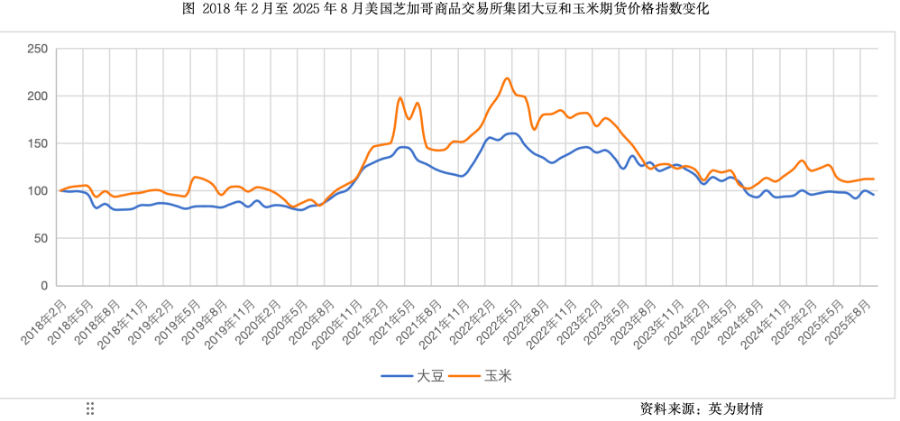
Group 1: Commodity Price Trends - As of September 26, 2023, the December soybean futures price closed at 1013.75 cents per bushel, reflecting a slight increase of 0.32% this year, but a significant decline of 28.63% over the past three years. The December corn futures price was 422 cents per bushel, down 7.96% year-to-date and 36.97% over three years [1] - Since reaching historical highs in 2022, the price index for CME soybean and corn futures has shown a slow downward trend, returning to levels seen several years ago [1] Group 2: Agricultural Economic Challenges - U.S. farmers are heavily reliant on weather conditions for their harvests, and agricultural yields directly impact their income. Rising production costs due to prolonged inflation have reached historical highs, while soybean and corn prices have remained low for several years, causing significant financial strain on farmers [4] - A survey conducted among 1,034 corn farmers revealed that nearly half (46%) believe the U.S. is on the brink of a farm crisis, with 80% expressing concerns about the economic viability of their farms [4][5] Group 3: Political Implications of Agriculture - The agricultural sector's performance is closely tied to U.S. political dynamics, particularly in key soybean and corn-producing states that predominantly lean Republican. The economic conditions of farmers can influence election outcomes, especially in swing states [6][7] - The Trump administration's proposed "One Big Beautiful Bill Act" aims to allocate approximately $66 billion to the agricultural sector, but the majority of this funding is directed towards production safety networks, leaving farmers with minimal relief amid rising costs [8] Group 4: Tariff Impact on Agriculture - High tariffs have been identified as a significant factor contributing to the challenges faced by U.S. agriculture, with the OECD predicting a decline in economic growth rates due to these policies. The actual tax rate is expected to rise to its highest level since 1933, further straining the agricultural sector [9] - The agricultural workforce, which numbers around 3.4 million, may see a decline in recent years, reflecting the broader economic pressures affecting this critical industry [9] Group 5: Market vs. Government Intervention - The debate continues over whether to rely on market mechanisms or government intervention to address agricultural challenges. Market principles suggest reducing trade barriers, while government intervention typically involves subsidies. However, the effectiveness of subsidies is limited given the federal government's high debt levels [10]

老美经济开始衰退!基辛格曾发出预警:若美国倒下,谁也别想好过
Sou Hu Cai Jing· 2025-09-29 11:24
Economic Overview - The U.S. economy appears strong on the surface, but underlying issues are significant, with real GDP growth projected to be only 1.5% for the year, down from 2.5% last year [2] - The unemployment rate is expected to rise to 4.5%, indicating potential job losses and reduced consumer spending [2] Inflation and Consumer Confidence - Core inflation remains high at around 3.5%, far from the Federal Reserve's target of 2%, with tariffs contributing to increased import prices [4] - Consumer confidence has plummeted, with the Michigan University index hitting a low not seen since the end of 2023 [4] Industrial Production and Economic Predictions - Industrial production fell by 0.4% month-over-month in July, with manufacturing PMI barely above the threshold, and order volumes declining sharply [4] - Predictions for GDP growth in Q4 are as low as 1.2%, indicating a potential economic slowdown [6] Emerging Markets Impact - Emerging markets are facing challenges as U.S. economic issues ripple globally, with trade growth in these markets dropping to just 1.7% [8] - Countries like Vietnam, Brazil, and Mexico are experiencing reduced orders and production cuts due to their reliance on U.S. imports [8] Geopolitical Risks - Geopolitical tensions are rising, particularly between the U.S. and China, with potential for increased conflict as the U.S. seeks to regain its global leadership [15] - Historical patterns suggest that economic crises often lead to heightened international tensions and conflicts [12] China's Economic Strategy - China is preparing for potential economic downturns, focusing on domestic demand and infrastructure investment to bolster its economy [18] - The Chinese government is emphasizing stability and cooperation in international relations, aiming to avoid isolation [19]

避险情绪增加,节前管控风险
Ning Zheng Qi Huo· 2025-09-29 09:03
Report Industry Investment Rating - The strategy recommendation is "oscillating with a bullish bias" [5] Core View of the Report - International risk aversion has increased, with geopolitical factors and tariff disruptions leading to a rise in market risk aversion. The Fed's independence and internal disagreements have added more uncertainties, increasing the risk aversion factors and making precious metals oscillate with a bullish bias. However, due to the large increase in precious metals prices in the previous period, there is a need to be vigilant about external market fluctuations during the National Day holiday [2][31] Summary by Relevant Catalogs Chapter 1: Market Review - After the implementation of US tariffs and the Fed's interest rate cut, the US dollar index rose significantly, and precious metals corrected to some extent. The market is currently pricing in two more interest rate cuts by the Fed this year, totaling 50 basis points. Subsequently, gold and silver may rise simultaneously driven by the expectation of consecutive Fed interest rate cuts. The upward trend of silver also needs to pay attention to the short - term fluctuations of gold [10] Chapter 2: Overview of Important News - Trump announced new high - tariff policies on multiple imported products starting from October 1, but will adhere to the 15% tariff ceiling for trade partners with existing agreements. The Trump administration is considering a $550 billion investment fund for infrastructure construction, with priority in semiconductor and key mineral fields [14] - In August, the US core PCE price index met expectations, and real consumer spending exceeded expectations. The Fed cut interest rates by 25 basis points, and the market expects a high probability of another cut in October. The US PPI inflation unexpectedly declined in August, providing support for the Fed's potential interest rate cut [16][17] - The number of initial jobless claims in the US last week decreased, but the number of continued claims remained above 1.9 million, indicating pressure in the labor market [16] Chapter 3: Analysis of Important Influencing Factors 3.1 US Economy and Policy - The preliminary value of the University of Michigan Consumer Confidence Index in September was at a low since May, and the 5 - year inflation expectation rebounded. The ISM manufacturing index in August was below expectations, and the output index fell into the contraction range. The second - quarter GDP and core PCE price index were revised, showing that the US economic downward pressure is increasing [18] 3.2 International Economy and Geopolitics - China and the US will hold talks in Spain. Trump mentioned sanctions on Russia, asked Europe to put economic pressure on China, and announced tariffs on semiconductor companies. After China's military parade, the geopolitical situation has become tense again [22] 3.3 Other Financial Markets - US non - farm payrolls in August were far lower than expected, and the unemployment rate reached a new high since 2021. The US economic downward pressure has increased, indicating the need for interest rate cuts. The US stock market, copper, and crude oil may strengthen, but the upward momentum of crude oil is limited [24] 3.4 RMB Exchange Rate - The RMB exchange rate tracks the US dollar index. With the increasing expectation of Fed interest rate cuts, the US dollar index is expected to decline, and the RMB has a certain appreciation expectation. The impact of the RMB exchange rate on gold is limited [28] Chapter 4: Market Outlook and Investment Strategy - International risk aversion has increased, and precious metals are expected to oscillate with a bullish bias. However, due to the large previous increase in precious metals prices, attention should be paid to external market fluctuations during the National Day holiday [31]
美国最新关税政策引业界不满 “关税墙”阻碍美企发展
Zhong Guo Xin Wen Wang· 2025-09-29 06:39
Core Points - The recent U.S. tariff policy has sparked dissatisfaction among various industries, with many companies expressing concerns over increased costs and competitiveness [1][2] - President Trump announced significant tariffs on pharmaceuticals and heavy trucks, which are expected to disrupt supply chains and raise consumer prices [1][2] Group 1: Tariff Details - Starting October 1, the U.S. will impose a 100% tariff on all imported brand-name or patented drugs, a 50% tariff on kitchen cabinets and bathroom vanities, a 30% tariff on soft furniture, and a 25% tariff on heavy trucks produced outside the U.S. [1] - The tariffs are seen as a move to protect U.S. industries from foreign competition and to encourage domestic production [2] Group 2: Industry Reactions - Companies like Naturepedic are reconsidering product launches due to the new tariffs, highlighting the dilemma of absorbing costs versus passing them on to consumers [1] - The National Retail Federation has indicated that the increased costs will make home ownership more expensive, complicating planning for retailers [1] Group 3: Economic Implications - Analysts warn that the tariffs could lead to higher drug prices, particularly affecting Americans without comprehensive health insurance [2] - The current administration's approach is viewed as a departure from decades of U.S. trade policy aimed at reducing trade barriers globally [1]
美国关税大棒挥向家具!但中国“家具王国”早已弃美转身
Jin Tou Wang· 2025-09-29 04:20
Core Viewpoint - The recent announcement by the U.S. government to impose significant tariffs on kitchen cabinets, bathroom sinks, and related materials, as well as upholstered furniture, is expected to impact China's home building materials industry, particularly in furniture production and exports [1][2]. Group 1: Impact on Chinese Furniture Industry - The U.S. will impose a 50% tariff on kitchen cabinets and related materials, and a 30% tariff on upholstered furniture starting October 1 [1]. - China is the world's largest furniture producer, accounting for over 25% of global output and is also the leading exporter of furniture [1]. - In Guangdong's Lecong Town, known as the "furniture capital," local manufacturers have already shifted focus away from the U.S. market due to previous tariff announcements [1]. Group 2: Shift in Export Strategies - Many exporters are redirecting their products to domestic markets and exploring opportunities in India, Southeast Asia, and Africa [2]. - In Zhejiang's Anji region, which is a major office chair production base, the share of exports to the U.S. has decreased from over 60% to 30% due to tariff pressures [2]. - Local manufacturers have implemented smart reforms that reduced production costs by 18%, partially offsetting the impact of tariffs [2]. Group 3: U.S. Market Dynamics - The tariffs are part of a broader strategy to revitalize the furniture industry in North Carolina, South Carolina, and Michigan [2]. - The U.S. furniture and wood products manufacturing jobs have halved, with only about 340,000 jobs remaining [2]. - Despite the tariffs, a California furniture buyer noted that Chinese suppliers' design optimization keeps overall procurement costs stable, indicating that Chinese products remain irreplaceable in the U.S. market [2].
宏观周报(9月第4周):利润改善持续性需进一步观察-20250929
Century Securities· 2025-09-29 02:42
Group 1: Economic Indicators - August industrial enterprise profits showed a cumulative year-on-year increase of 0.9%, compared to a previous decline of 1.7%[4] - Monthly profits turned from a decrease of 1.5% to a growth of 20.4%, primarily driven by price and profit margin contributions[4] - The Producer Price Index (PPI) for the month increased by 0.7 percentage points to -2.9% compared to the previous month[4] Group 2: Market Trends - The market experienced a volume-decreasing rise last week, with an average transaction amount of 23,132 billion yuan, down by 2,047 billion yuan[4] - Small-cap indices saw a significant decline, with the small-cap index down by 1.50%[4] - The overall bond market yield rose, with the 10-year government bond yield increasing by 0.3 basis points[4] Group 3: Monetary Policy and Global Factors - The expectation of a domestic interest rate cut in October is increasing due to ongoing weak economic data[4] - The Federal Reserve's interest rate cut expectations have fluctuated, influenced by Powell's statements and better-than-expected economic data[4] - The U.S. announced new high tariffs on various imported products starting October 1, raising trade uncertainty[4] Group 4: Risks and Considerations - The sustainability of profit improvements requires further observation due to low base effects and short-term adjustments in some industries[4] - Risks include potential weakening of the economic fundamentals, escalation of trade frictions, and rapid contraction of Fed rate cut expectations[4]
海外宏观周报:美国政府关门风险上升-20250929
Ping An Securities· 2025-09-29 02:36
Group 1: U.S. Economic Policy - The risk of a U.S. government shutdown is increasing, with Trump canceling a meeting with Democratic leaders and the House planning to reconvene only on October 1[1] - The U.S. has confirmed a 15% tariff on EU cars and parts starting August 1, and new tariffs on various imports, including 50% on kitchen cabinets and 100% on patented drugs, effective October 1[1] - The U.S. second-quarter GDP growth was revised up to an annualized rate of 3.8%, significantly higher than the previous estimate of 3.3%[1] - Initial jobless claims fell by 14,000 to 218,000, the lowest level since mid-July, and well below the market expectation of 235,000[1] Group 2: Global Economic Indicators - Eurozone's September manufacturing PMI fell to 49.5, below the neutral mark, while services PMI rose to 51.4, exceeding expectations[1] - Japan's Tokyo core CPI rose by 2.5% year-on-year in September, indicating stable inflation pressure[5] - The CME FedWatch data shows an 87.7% probability of a 25 basis point rate cut in October, with an average expected policy rate of 3.59% by the end of 2025[1] Group 3: Market Reactions - Global stock market optimism has decreased, with precious metal prices rising due to the increased risk of a U.S. government shutdown[10] - The S&P 500 index fell by 0.3%, while the Dow Jones and Nasdaq dropped by 0.1% and 0.7%, respectively[12] - The dollar index rose by 0.55%, closing at 98.19, while major non-U.S. currencies declined against the dollar[19]
国新国证期货早报-20250929
Guo Xin Guo Zheng Qi Huo· 2025-09-29 01:47
Variety Views Stock Index Futures - On September 26, the three major A-share indices all pulled back. The Shanghai Composite Index fell 0.65%, the Shenzhen Component Index dropped 1.76%, and the ChiNext Index declined 2.60%. The trading volume of the two markets exceeded 2.1 trillion yuan, a decrease of over 200 billion yuan from the previous day [1] - The CSI 300 Index encountered resistance and fluctuated on September 26, closing at 4550.05, down 43.44 from the previous day [2] Coke and Coking Coal - On September 26, the weighted index of coke was weak, closing at 1710.3, down 48.5 from the previous day [3] - The weighted index of coking coal trended weakly on September 26, closing at 1207.0 yuan, down 32.4 from the previous day [4] - For coke, port spot prices rose, with the price at Rizhao Port up 10 yuan/ton. Supply - rising coking coal prices increased costs for coke enterprises, squeezing profit margins, but production enthusiasm remained. Demand - steel mills' overall operation remained high, and rigid demand for coke increased as holidays approached, but terminal consumption was average with steel inventory accumulation, so overall restocking was expected to be limited [5] - For coking coal, prices in some regions changed. Supply - most mines in production areas operated normally, traders were actively buying, demand was good, and coal mine shipments were smooth, with online auctions generally showing an upward trend [5] Zhengzhou Sugar - Last Friday, ICE raw sugar futures fluctuated slightly and closed slightly higher. Due to the approaching long holiday, both long and short positions reduced to avoid risks, and the Zhengzhou Sugar 2601 contract fluctuated and closed slightly lower in the night session on September 26. As of the week ending September 23, speculators increased their net short positions in ICE raw sugar futures and options by 22,260 contracts to 168,357 contracts [5] Rubber - Due to market concerns about the impact of tariffs on the European auto industry and the holiday effect, long - position liquidation pressured Shanghai rubber futures to fall on September 26. As of September 26, Shanghai Futures Exchange's natural rubber inventory decreased by 8852 tons to 187,972 tons, and futures warehouse receipts decreased by 5500 tons to 149,420 tons. The inventory of 20 - grade rubber decreased by 1713 tons to 47,982 tons, and futures warehouse receipts decreased by 1611 tons to 42,942 tons [6] Palm Oil - On the night of September 26, palm oil futures continued to trade in a narrow range, with prices rebounding slightly from the daytime close but still within the daytime price range. The main contract P2601 closed with a small positive K - line, at 9278, up 0.45% from the daytime close. From September 1 - 25, 2025, Malaysia's palm oil yield per unit area decreased by 3.19% month - on - month, the oil extraction rate decreased by 0.18% month - on - month, and production decreased by 4.14% month - on - month [6][7] Soybean Meal - Internationally, on September 26, CBOT soybean futures fluctuated. Argentina resumed the export tax on grains and by - products after a two - day suspension. Brazil's ANEC lowered the estimated soybean exports for September from 7.53 million tons to 7.15 million tons. Domestically, on September 26, the main soybean meal M2601 contract closed at 2937 yuan/ton, down 1.01%. Chinese buyers actively ordered Argentine soybeans, improving the long - term supply situation. Currently, the arrival of imported soybeans in China is still high, and the soybean crushing volume of major oil mills has remained above 2.3 million tons for four consecutive weeks, resulting in a large output of soybean meal. In the short term, soybean meal supply is abundant [7] Live Hogs - On September 26, live hog futures trended weakly. The main LH2511 contract closed at 12,575 yuan/ton, down 0.87%. Currently, production capacity is being released intensively, with group farms accelerating the slaughter of standard hogs and individual pig farmers more willing to sell. Traditional demand is approaching the peak season, and pre - holiday stocking enthusiasm has increased, but market consumption has not met expectations and is not enough to strongly support prices [8] Shanghai Copper - The expectation of the Fed's interest rate cut has been strengthening, and the US dollar index has declined. China will implement more active consumption - expansion policies, and with the arrival of the traditional consumption peak season, the outlook for the copper industry has improved, with downstream copper product production expected to pick up significantly, and refined copper demand may increase significantly. In terms of inventory, with positive consumption expectations and the development of power and new energy industries, the previously accumulated social inventory may gradually decrease, and copper prices are expected to rise [8] Iron Ore - On September 26, the main iron ore 2601 contract fell 1.74% to close at 790 yuan. Iron ore shipments decreased while arrivals increased, and pig iron production remained high. As pre - holiday restocking nears the end, steel mills' purchasing pace has slowed down, and the upward space for iron ore may be limited. In the short term, iron ore prices will fluctuate [8] Asphalt - On September 26, the main asphalt 2511 contract rose 0.7% to close at 3450 yuan. Asphalt production capacity utilization increased month - on - month, social inventory continued to decline, while refinery inventory pressure increased, and shipments continued to rise. In the north, pre - holiday construction rush still supports demand to some extent, but in the south, heavy rainfall has weakened demand. In the short term, asphalt prices will fluctuate [9] Logs - On September 26, the 2511 log contract opened at 806, with a low of 805, a high of 810, and closed at 808.5, with a reduction of 668 lots. The futures price rebounded above the 10 - day moving average of 805. Pay attention to the support at the 800 mark and the resistance at 815 - 820. Spot prices in Shandong and Jiangsu remained unchanged. There is no major contradiction in the supply - demand relationship, with a game between strong expectations and weak reality, and spot trading is weak. Pay attention to spot prices during the peak season, import data, inventory changes, and market sentiment [9] Cotton - On the night of September 26, the main Zhengzhou cotton contract closed at 13,400 yuan/ton. Cotton inventory decreased by 186 lots from the previous day. The price of machine - picked cotton is between 6.15 - 6.5 yuan per kilogram [10] Steel - Recently, typhoons in South China and the upcoming double - holiday have affected construction site demand. However, as the weather cools down, steel demand may recover after the holiday. Since mid - September, there have been many market rumors, causing the futures price to rise rapidly, but now there is a lack of further upward momentum. Recently, rebar production has resumed, so there is still pressure on steel prices. If downstream demand recovers more than expected in October, steel prices may rise further. The "15th Five - Year Plan" content will also affect the futures price. Pay attention to peak - season demand, coal mine safety inspections, overseas tariffs, and domestic macro and industrial policies [10] Alumina - Due to the rainy season in Guinea, bauxite shipments remain low, which is reflected in the domestic arrival data. Northern Chinese bauxite mines have not resumed production, and only some compliant capacities are expected to resume by the end of the year due to environmental protection policies. Although bauxite inventory has decreased slightly, the absolute inventory is still high, and bauxite supply is still abundant. Meanwhile, the weakening alumina price has increased the price - cutting intention of alumina plants. In the short term, bauxite prices may remain weakly volatile. The core factor leading the alumina price is still oversupply. Currently, domestic operating capacity remains high, and recently imported alumina from overseas has arrived in large quantities, increasing inventory and causing prices to fall both at home and abroad. In the short term, the price may trend weakly [11] Shanghai Aluminum - Fundamentally, the supply of alumina, the raw material, is still excessive, and the spot price is close to the cost line and at a low level. Electrolytic aluminum plants have good profit margins and are enthusiastic about production. On the supply side, previously replaced capacity projects have gradually been completed and put into operation, and with the release of new capacity, the operating capacity of electrolytic aluminum has increased slightly again, and high - level operation may lead to a slight increase in domestic electrolytic aluminum supply. On the demand side, positive consumption - expansion policies have improved the outlook for aluminum product consumption, and the improvement of downstream production will boost aluminum demand. Overall, the fundamentals of Shanghai aluminum may be in a stage of slightly increasing supply and rising demand [11]
美国50%关税生效!大批订单连夜被撤印度钻石130万工人何去何从?
Sou Hu Cai Jing· 2025-09-28 16:02
Core Viewpoint - The increase of tariffs on Indian diamond imports to 50% by the U.S. has severely impacted India's diamond industry, leading to significant job losses and a decline in exports [2][3]. Group 1: Impact on the Diamond Industry - The U.S. is India's largest buyer of diamonds, accounting for one-third of India's jewelry export revenue, approximately $9 billion annually [2]. - The tariff increase from 25% to 50% has drastically reduced the competitiveness of Indian diamonds in the U.S. market, resulting in order cancellations and factory shutdowns [2][3]. - The Indian diamond export is projected to decline by 17-20% in the fiscal year 2025-2026, potentially dropping to $11 billion [2]. Group 2: Employment Consequences - The diamond industry in Surat employs over 800,000 workers, many of whom are skilled artisans [3]. - The implementation of tariffs has led to layoffs, with estimates of unemployment reaching between 100,000 to 200,000 workers [3]. - Many affected workers are struggling to find alternative employment due to their specialized skills, leading to increased social instability in the region [3]. Group 3: Market Diversification Challenges - Efforts to shift exports to other markets, such as China, face challenges due to competitive pricing from local synthetic diamond producers [5]. - The Middle East and Europe present some potential, but Indian exporters need to adjust their marketing strategies to penetrate these markets effectively [5]. - The overall outlook for the diamond industry remains bleak, with significant inventory buildup and reduced demand from U.S. buyers [5]. Group 4: Future Strategies and Adaptations - The industry is encouraged to diversify and reduce reliance on a single market, with suggestions for government support in simplifying export regulations [7]. - There is a push for skill training programs to help workers transition to new roles within the jewelry sector or synthetic diamond processing [7]. - The rise of the Chinese diamond industry, with significant growth in local brands and sales, poses a competitive threat to Indian exports [7].

海外经济跟踪周报20250928:降息预期回落,关税升级-20250928
Tianfeng Securities· 2025-09-28 14:43
固定收益 | 固定收益点评 降息预期回落,关税升级 证券研究报告 海外经济跟踪周报 20250928 海外市场复盘(9.22-9.26) 海外权益,本周美股呈"N"型走势,全周收跌。本周一,英伟达和 OpenAI 宣布达成合作,在大型科技股的带动下,美股三大指数集体上涨。本周二 至周四,美股连跌三天。鲍威尔表示美股估值相当高,特朗普宣布征收新 的行业关税,以及周中多位美联储官员表态偏鹰,均打击美股。周五核心 PCE 通胀符合预期,美股反弹。 本周美元上涨。一方面,多名美联储官员放鹰,例如,博斯蒂克表示预期 今年只降息一次;穆萨莱姆表示进一步降息的空间有限;古尔斯比表示下 次会议不愿支持降息。另一方面,本周经济数据偏强,美国二季度 GDP 大 幅上修,耐用品订单增速大超预期,支撑美元。 美债收益率上行。本周,博斯蒂克、穆萨莱姆、古尔斯比、哈玛克等多名 美联储官员放鹰,给市场降息预期泼冷水。美国耐用品订单、二手房销售、 二季度 GDP 终值均高于预期,初请失业金人数低于预期,经济数据支撑美 债收益率上行。另外,美国联邦政府"关门"的风险升温,给长端利率带 来额外的上行压力。 商品方面,黄金、原油、铜均收涨。本周, ...
