
预防式降息

Search documents
五矿期货早报有色金属-20250915
Wu Kuang Qi Huo· 2025-09-15 02:57
Group 1: Report Overview - The report is the Non - ferrous Metals Daily Report on September 15, 2025, from Wukuang Futures [1] Group 2: Copper - Last week, the copper price strengthened. LME copper rose 2.02% to $10,064/ton, and SHFE copper closed at 80,810 yuan/ton. The total inventory of the three major exchanges increased by 12,000 tons, with SHFE inventory up 12,000 to 94,000 tons, LME inventory down 4,000 to 154,000 tons, and COMEX inventory up 5,000 to 282,000 tons. Shanghai bonded area inventory decreased by 4,000 tons. The copper price is expected to fluctuate strongly. The reference range for SHFE copper is 79,000 - 82,500 yuan/ton, and for LME copper 3M is $9,800 - $10,300/ton [2] Group 3: Aluminum - The domestic aluminum ingot inventory decreased, and the aluminum price continued to be strong. LME aluminum rose 0.82% to $2,701/ton, and SHFE aluminum closed at 21,075 yuan/ton. The inventory of domestic three - place aluminum ingots decreased by 5,500 tons to 462,000 tons. The aluminum price is expected to continue to run strongly. The reference range for SHFE aluminum is 20,900 - 21,250 yuan/ton, and for LME aluminum 3M is $2,660 - $2,730/ton [4] Group 4: Lead - Last Friday, SHFE lead index rose 0.85% to 17,043 yuan/ton, and LME lead 3S rose to $2,000.5/ton. The lead concentrate TC declined again, the raw materials were in short supply. The production of primary and secondary lead increased year - on - year. The lead price is expected to run strongly in the short term [5] Group 5: Zinc - Last Friday, SHFE zinc index rose 0.29% to 22,318 yuan/ton, and LME zinc 3S rose to $2,913/ton. The zinc concentrate TC showed differentiation. The domestic zinc ingot social inventory increased, and the overseas LME zinc ingot inventory decreased. The zinc price is expected to run strongly in the short term [6][7] Group 6: Tin - Last week, the tin price rebounded. The supply decreased significantly due to slow复产 in Myanmar and raw material shortages in domestic smelters. The demand improved marginally with the arrival of the traditional peak season. The tin price is expected to oscillate strongly [8] Group 7: Nickel - The nickel ore price was stable. The nickel iron price was strong. The refined nickel price oscillated, with the inventory increasing. In the short term, the nickel price may decline, but in the long term, it has support. The reference range for SHFE nickel is 115,000 - 128,000 yuan/ton, and for LME nickel 3M is $14,500 - $16,500/ton [9][12] Group 8: Lithium Carbonate - The spot index of lithium carbonate decreased by 3.29% last week. The lithium price was suppressed by pessimistic sentiment and loose expectations. The domestic lithium carbonate is expected to continue destocking, which may support the bottom price. The reference range for the main contract of Guangzhou Futures Exchange is 69,900 - 73,300 yuan/ton [14] Group 9: Alumina - On September 12, 2025, the alumina index fell 1.05% to 2,915 yuan/ton. The import window opened. The short - term strategy is to wait and see. The reference range for the main contract AO2601 is 2,800 - 3,100 yuan/ton [16] Group 10: Stainless Steel - On Friday, the stainless - steel main contract closed at 12,950 yuan/ton. The social inventory decreased. The raw material cost increased, and the price is expected to oscillate strongly [19] Group 11: Cast Aluminum Alloy - As of Friday, the AD2511 contract rose 0.83% to 20,645 yuan/ton. The downstream is transitioning from the off - season to the peak season. The cost is strongly supported, and the price is expected to remain high in the short term [21]
美联储议息会议在即,港股科技30ETF(513160)盘中涨近1%,近10日持续获资金净流入
2 1 Shi Ji Jing Ji Bao Dao· 2025-09-15 02:15
Group 1 - The Hong Kong stock market opened lower but rebounded, with active performance in sectors such as electrical equipment, semiconductors, and pharmaceuticals [1] - The Hong Kong Technology 30 ETF (513160) showed a strong increase of 0.83%, with a premium/discount rate of 0.23%, and active trading volume [1] - The ETF has seen a net inflow of nearly 130 million yuan over the last five trading days, totaling over 540 million yuan in net inflows over the past ten trading days [1] Group 2 - Analysts from Guotai Junan Securities believe that the upcoming interest rate cut by the Federal Reserve will benefit Hong Kong assets, particularly in the context of the A/H market rotation and easing internet competition [2] - Huatai Securities noted that despite the Hang Seng Index rising 30% this year, Hong Kong stocks still offer value for overseas investors, benefiting from global liquidity and foreign capital inflows [2] - The anticipated global financial conditions remain loose, driven by the Fed's potential rate cut and coordinated fiscal and monetary policies worldwide, which could enhance the performance of Hong Kong stocks as offshore RMB assets [2]
螺纹钢、热轧卷板周度报告-20250914
Guo Tai Jun An Qi Huo· 2025-09-14 07:11
螺纹钢&热轧卷板周度报告 黑色高级分析师:李亚飞 投资咨询号:Z0021184 日期:2025年09月14日 Guotai Junan Futures all rights reserved, please do not reprint 螺纹&热卷观点:需求有待验证,钢价低位震荡 ◼ 逻辑:需求有待验证,钢价低位震荡; | 2025/9/12 | | 供应 | | (万吨) | | | | 需求 | | (万吨) | | | | | 库存 | | | | 现货 | 主力 | 10-01 | 现货 | 盘面 | | --- | --- | --- | --- | --- | --- | --- | --- | --- | --- | --- | --- | --- | --- | --- | --- | --- | --- | --- | --- | --- | --- | --- | --- | | | 当周值 | | | 环差 | | 同差 | | 当周值 | | 环差 | | 同差 | | 当周值 | | 环差 | | 同差 | 价格 | 基差 | 价差 | 利润 | 利润 | | 铁水 | 240 6 ...
国泰海通海外策略:美联储降息,资产价格如何演绎?
Zhi Tong Cai Jing· 2025-09-10 22:57
Core Viewpoint - The Federal Reserve's interest rate cuts significantly impact the performance of equity, debt, and currency assets, while the relationship with commodity prices is less clear [1][2] Equity Market - Equity assets have a higher success rate during preemptive rate cuts, while they are likely to decline during crisis-driven cuts [1][2] - The success rate of equities improves one month after a preemptive rate cut, and the performance during crisis-driven cuts is closely related to the recovery of fundamentals [2] Debt Market - U.S. Treasury yields are more likely to decline during crisis-driven rate cuts, while the trend during preemptive cuts is uncertain [1][2] - After rate cuts, U.S. Treasury yields typically decrease, while the trend for Chinese bonds is generally downward, with no clear pattern for German and Japanese bonds [2] Currency Market - The strength of the U.S. dollar is inconsistent in the early stages of rate cuts, but after 2-3 months, the dollar tends to depreciate under recessionary cuts and appreciate under preemptive cuts, with the Chinese yuan showing relative independence [1][2] - The average appreciation of the euro and yen is noted during these periods [2] Commodity Market - The relationship between commodity prices and interest rate cuts is weak, with gold showing a higher average increase during crisis-driven cuts and greater elasticity in price increases [1][2] - Oil prices are less correlated with rate cuts and are more influenced by supply and demand dynamics [1]

国泰海通|海外策略:美联储降息,资产价格如何演绎
国泰海通证券研究· 2025-09-10 14:41
Core Insights - The article discusses the impact of Federal Reserve interest rate cuts on various asset classes, highlighting the differences between "relief" and "preventive" rate cuts [1][2] Group 1: Stock Market - Equity assets tend to perform better during preventive rate cuts, while they are likely to decline during relief rate cuts [1][2] - The winning rate of equities increases one month after preventive rate cuts, with performance during relief cuts being closely tied to fundamental recovery [2] Group 2: Bond Market - U.S. Treasury yields are more likely to decline during relief rate cuts, while their behavior during preventive cuts is uncertain [1][2] - After rate cuts, U.S. Treasury yields typically decrease, and domestic bond yields also tend to drop in the short term, with no clear pattern observed in German or Japanese bonds [2] Group 3: Currency Market - The dollar's performance is mixed in the early stages of rate cuts, but tends to depreciate two to three months after relief cuts, while it may appreciate during preventive cuts [1][2] - The Chinese yuan shows relative independence in its movements compared to the dollar, while the euro and yen generally appreciate [2] Group 4: Commodity Market - Gold tends to have a higher average increase during preventive rate cuts, and its price elasticity is greater during relief rate cuts [1][2] - The relationship between oil prices and interest rate cuts is weak, as oil prices are more influenced by supply and demand dynamics [1][2]


8月非农数据点评:就业骤冷,降息已成定局
Guoxin Securities· 2025-09-10 14:10
Employment Data Overview - In August, the U.S. added only 22,000 non-farm jobs, significantly below the expected 75,000 and down from 79,000 in July, marking a 10-month low[2][4] - The unemployment rate rose slightly to 4.3%, aligning with expectations and above the one-year average of 4.1%[2][17] - Year-on-year wage growth for August was recorded at 3.7%[2][22] Sector Performance - The education and healthcare sector added 46,000 jobs, but this was a decrease of 31,000 from the previous month, indicating a cooling trend[7] - The leisure and hospitality sector contributed 28,000 jobs, while professional and business services saw a decline of 17,000 jobs[7] - Manufacturing jobs decreased by 12,000, and the financial sector lost 3,000 jobs, reflecting broader economic pressures[7] Economic Implications - The weak employment data raises concerns about a potential economic recession, with labor market dynamics showing signs of structural issues[4][33] - The Federal Reserve is expected to lower interest rates in September, with an 85.8% probability of a 25 basis point cut, driven by the deteriorating job market[29][30] - The market's reaction includes a potential recovery in stock valuations, particularly in small-cap and interest-sensitive sectors[30][33] Structural Unemployment Trends - The average duration of unemployment increased to 24.5 weeks, indicating a rise in long-term unemployment[20] - The unemployment rate for Black or African American individuals reached 7.5%, the highest this year, while the Hispanic unemployment rate rose to 5.3%[18][20] - Structural mismatches in the labor market are exacerbated by immigration policies, leading to increased hiring costs and reduced recruitment willingness[18][20]
美联储或9月降息,全球大类资产迎流动性红利?
Sou Hu Cai Jing· 2025-09-10 08:39
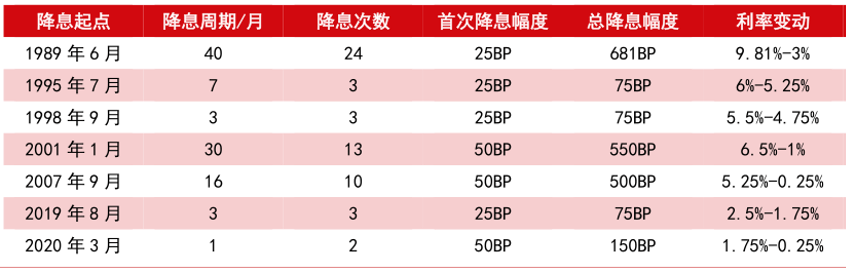
Core Viewpoint - The article discusses the potential for a shift in global asset classes due to the Federal Reserve's dovish stance and rising expectations for a rate cut in September, following a significant decline in U.S. employment data [1][5]. Historical Review: Federal Reserve Rate Cut Cycles - The article categorizes past Federal Reserve rate cut cycles into three scenarios: 1. **Preventive Rate Cuts** (1995-1996, 2019): Small and gradual cuts aimed at softening potential economic slowdowns [2]. 2. **Recessionary Rate Cuts** (2001-2004, 2007-2008): Large and rapid cuts in response to economic recessions or financial crises [3]. 3. **Crisis Response Rate Cuts** (1987, 1998): Quick measures taken to stabilize market sentiment during specific risk events [4]. Asset Performance During Rate Cut Cycles - **Equities**: Rate cuts typically boost risk appetite, leading to stock market gains. For instance, after the 2019 rate cut, the S&P 500 index rose nearly 10% over the following year [5][6]. - **Bonds**: The bond market often reacts first to rate cuts, with U.S. Treasury yields generally declining. Historically, 10-year Treasury yields have dropped by an average of 80-100 basis points during rate cut cycles [7]. - **Gold**: Gold tends to perform well during rate cut cycles due to lower holding costs and increased demand for safe-haven assets. Since 1990, gold has shown an 83% success rate in the 10 trading days following rate cuts [8][9]. Market Outlook and Strategy - The article suggests that if the Federal Reserve cuts rates, it may lead to a narrowing of the China-U.S. interest rate differential, potentially easing depreciation pressure on the RMB and allowing for more accommodative domestic monetary policy [7]. - It emphasizes the importance of maintaining diversified and flexible asset allocations to navigate market uncertainties, regardless of the rate cut outcome [10][11].
渤海证券研究所晨会纪要(2025.09.08)-20250908
BOHAI SECURITIES· 2025-09-08 03:02
Macro and Strategy Research - The U.S. economy is experiencing a shift in the balance of risks between inflation and employment, with a potential monetary policy shift expected in September. The focus is on August's non-farm payroll and inflation data, as well as adjustments to the annual non-farm benchmark [2] - In Europe, economic expectations are improving, and stable inflation allows the European Central Bank (ECB) to maintain current policy rates. ECB President Lagarde indicated that trade negotiations are not posing significant threats to monetary policy [2] Domestic Economy - Domestic economic growth slowed in July due to extreme weather and policy expectations, characterized by strong external demand and weak internal demand. Future external demand growth is expected to be supported by a weakening U.S. demand and a reshaped long-term trade landscape [3] - The domestic policy environment emphasizes stabilizing market expectations and strengthening the domestic circulation, with structural monetary policies focusing on inclusive finance and technological innovation [3][4] Fixed Income Research - In August, the central bank injected a net liquidity of 386.5 billion yuan, maintaining low funding prices. The issuance of interest rate bonds decreased to 3 trillion yuan, with net financing increasing to 1.7 trillion yuan [6][7] - The bond market is expected to face pressure from external demand uncertainties and "anti-involution" measures, with a focus on the stability of the funding environment in September [8] Industry Research - The medical insurance payment management method was introduced in August, and the 11th batch of centralized procurement is progressing. The medical care CPI in July was 100.5, with a year-on-year increase of 0.5% [9][10] - The pharmaceutical manufacturing industry reported a cumulative revenue of 1,401.07 billion yuan from January to July, a year-on-year decrease of 1.7%, while cumulative profits fell by 2.6% [10] - The upcoming World Lung Cancer Conference (WCLC) is expected to provide opportunities for innovation in the pharmaceutical and medical device sectors, with a focus on companies benefiting from optimized procurement rules and the recovery of domestic demand [10]
美联储降息之箭已在弦,全球钱往哪里跑?
Soochow Securities· 2025-09-05 10:32
Group 1 - Developed markets are expected to outperform emerging markets following a dovish signal from the Federal Reserve, with historical data indicating greater upward elasticity in developed markets during the first 1-3 months after such signals [2][3][4] - The S&P 500 has historically shown an average increase of 1.3% in the month following dovish meetings, with a larger average increase of 5.5% over three months [2][5] - Large-cap stocks are generally favored over small-cap stocks in the aftermath of preventive rate cuts, although small-cap stocks may show significant improvement if economic indicators point to recovery [3][4] Group 2 - Growth sectors such as information technology and healthcare, along with cyclical sectors like financials, are expected to perform better due to their sensitivity to interest rate changes [3][4] - The U.S. dollar may not necessarily decline following rate cuts, as historical trends show a slight average increase in the dollar one month and three months after dovish meetings [3][4][5] - Short-term U.S. Treasury yields are expected to decline more significantly than long-term yields, which may be constrained by factors such as fiscal deficits and credit conditions [4][5] Group 3 - In the Chinese market, the impact of rate cuts is seen as a supplementary factor, with the primary influence being the economic fundamentals [4][5] - A-shares are anticipated to favor growth sectors over value sectors, particularly in interest-sensitive industries like pharmaceuticals and electronics, which tend to perform better in the six months following rate cuts [6][7] - Hong Kong stocks, particularly in the information technology sector, are expected to show superior performance both in the short and long term following rate cuts [6][7]
鲍威尔转鸽,9月或开启降息
Haitong Securities International· 2025-09-01 14:05
Group 1: U.S. Economic Indicators - U.S. manufacturing PMI rose from 49.8 to 53.3, exceeding market expectations of 49.7[8] - New home starts increased by 10.6 percentage points to 12.9%, the highest since December 2023[10] - Existing home sales annualized at 4.01 million units, above the expected 3.92 million[10] Group 2: Market Reactions - U.S. stock indices showed mixed performance, with the S&P 500 up 0.3% and the Nikkei 225 down 1.7%[3] - The 10-year U.S. Treasury yield fell by 7 basis points to 4.26%[3] - The U.S. dollar index decreased by 0.12% to 97.72[3] Group 3: Federal Reserve Policy Outlook - Powell signaled a dovish shift at the Jackson Hole meeting, indicating potential rate cuts in September[1] - The Fed may implement a maximum of two rate cuts within the year due to inflation concerns[1] - The ECB is expected to remain on hold in September, as inflation is no longer a primary focus[1]