反内卷

Search documents
供需格局改善 包装纸龙头议价能力显著增强
Zheng Quan Ri Bao· 2025-12-03 16:13
Core Viewpoint - The packaging paper industry is experiencing a price increase for products such as corrugated paper and boxboard, driven by multiple factors including rising raw material costs, industry self-regulation, and improved demand dynamics. The competitive landscape is shifting from price competition to value collaboration, enhancing the market power of leading companies [1][2][3]. Group 1: Price Increases - Major companies like Nine Dragons Paper and Shanying International have issued price increase notices, raising prices by 50 to 80 yuan per ton for key products [1]. - The average price of waste yellow board paper has risen to approximately 1800 yuan per ton by the end of October 2025, reflecting a year-on-year increase of 2.92% [1]. Group 2: Supply and Demand Dynamics - The supply-demand balance has improved significantly since 2025, with leading companies voluntarily reducing production to stabilize prices [2][3]. - Factors such as increased consumption of waste yellow board paper and a decrease in finished paper inventory have contributed to a stable demand environment [3]. Group 3: Industry Strategy Shift - Leading companies are shifting their strategies from "market share acquisition" to "profit preservation," utilizing tactics like production halts and price increases to manage supply and demand effectively [3]. - The industry is moving towards a new phase characterized by "collaborative price maintenance" and "capacity exchange," driven by the dominance of leading firms [3].

科技成长有望成2026年可转债市场布局主线
Zheng Quan Ri Bao· 2025-12-03 16:07
Core Viewpoint - The convertible bond market has seen active trading in 2023, with a total transaction volume of 15.89 trillion yuan, reflecting a year-on-year increase of 22.33%. The overall market trend is positive, with the China Convertible Bond Index rising by 15.44% year-to-date [1]. Group 1: Market Overview - The convertible bond market is expected to maintain a tight supply-demand balance, with continued strong demand driven by the positive equity market and the rise of "fixed income+" funds [1][2]. - As of December 3, the average price of convertible bonds in the market is 142.77 yuan, with an average conversion premium rate of 41.32%. There are 37 convertible bonds with a conversion premium rate exceeding 100% [1]. Group 2: Investment Outlook - Analysts predict that the valuation of the convertible bond market will remain high in 2026, supported by optimistic expectations for the equity market and potential policy benefits [2]. - Key investment opportunities are identified in sectors such as hard technology, new consumption, and "anti-involution" themes, with a focus on industries likely to experience significant performance turning points [2].
LyondellBasell Industries (NYSE:LYB) 2025 Conference Transcript
2025-12-03 15:22
Summary of LyondellBasell Industries Conference Call Company Overview - **Company**: LyondellBasell Industries (NYSE:LYB) - **Date of Conference**: December 03, 2025 - **Speaker**: Agustin Izquierdo, CFO Key Highlights Financial Performance - **Q3 Performance**: Reported a strong recovery in the olefins and polymers segment, particularly in the Americas, with a positive impact from the absence of the Channelview turnaround, which had a $200 million impact on earnings [2][3] - **Cash Generation**: Historically strong cash conversion with a long-term average of 80%. Achieved 90% over the last 12 months and 135% in Q3 alone [3] - **Cash Improvement Plan**: Aiming for at least $1.1 billion in cash improvements over 2025 and 2026, with $600 million targeted for 2025 [4] Operational Strategies - **Cost Management**: Focus on working capital release of at least $200 million, aggressive fixed cost reductions targeting $200 million, and CapEx reductions from an initial target of $2.2 billion down to $1.7 billion [4][5] - **CapEx Plans**: Maintenance CapEx projected at $1.2 billion for the next year, with a focus on essential projects and operational improvements [7][8] Market Outlook - **North America**: Inventory days on hand have decreased from 45 to 40 days, indicating improved discipline in the industry. Operating rates have dropped to around 83% from mid-90s [9][10] - **Europe**: Facing challenges with price compression in polyethylene (PE) and polypropylene (PP), with prices dropping by $70 per ton for PE and $40 per ton for PP [10] - **Asia**: Continues to experience pressure from new capacity additions, with uncertain future impacts from anti-evolution policies [10] End Markets - **Packaging**: Remains resilient, while the building and construction sector is depressed due to stagnant existing home sales [11] - **Automotive**: No significant deterioration noted, with share gains in the APS business [11] - **Oxyfuels**: Improved performance in Q3 after a challenging summer season, with expectations for normal seasonality in Q4 [11] Future Projections - **2025 vs. 2026**: Anticipated improvement of $400 million to $450 million from 2025 to 2026, driven by the absence of major turnarounds and a normal oxyfuels season [15][16] - **Demand Growth**: Expected to continue at 3% annually, with potential boosts from housing and automotive sectors [16] Industry Dynamics - **Supply and Demand**: Projected supply increase of 9% and demand growth of 6% over the next couple of years, with a focus on rationalization in Europe and Asia [20] - **Polyethylene Capacity**: New capacities in the U.S. Gulf Coast expected to run at full rates, while Chinese capacities may operate at 65%-70% [22] Strategic Initiatives - **Portfolio Optimization**: Actions taken to improve profitability, including the sale of non-core assets and a focus on high-return projects [25][26] - **European Asset Sale**: Expected to close in the first half of 2026, with minimal EBITDA impact from the divested assets [28][29] Environmental Initiatives - **MoReTec Technology**: On track for a 2027 start, with strong demand for chemically recycled plastics, particularly in Europe [42][43] Financial Health and Dividends - **Cash Position**: Started the year with $3.4 billion in cash, with ongoing efforts to maintain investment-grade status while managing dividends [34][35] - **Debt Management**: Targeting a net debt to EBITDA ratio of 2.5 times, with a focus on maintaining liquidity and operational flexibility [36][37] Additional Insights - **Polypropylene Market**: Currently facing challenges with zero margins, dependent on the recovery of durable goods [45] - **Acetic Acid Business**: Positioned well with ongoing investments and a stable EBITDA contribution [46] This summary encapsulates the key points discussed during the conference call, highlighting LyondellBasell's financial performance, operational strategies, market outlook, and future projections.

2026年信用债年度投资策略:因势配置,控险取息
Huachuang Securities· 2025-12-03 14:45
Group 1 - The report highlights that the bond market in 2025 was characterized by a low interest rate environment, leading to limited trading space and strong credit bond allocation sentiment among institutions, with notable differentiation in performance across various bond types [3][4][12] - It is projected that in 2026, the fundamental and monetary conditions may not support a significant shift in the bond market, with credit risks primarily focusing on individual sentiment, and bond yields expected to maintain low volatility [3][4][12] - The report emphasizes the importance of identifying high coupon opportunities in a fluctuating market, while also monitoring seasonal, rotational, and redemption-related fluctuations for potential allocation windows [3][4][12] Group 2 - The credit bond market is expected to see a structural shift in demand, with a tendency towards shorter-duration bonds, while the stability of liabilities may weaken marginally [3][4][12] - The supply of credit bonds is anticipated to remain stable, with net financing in 2026 projected to be similar to that of 2025, and a continued focus on industrial bonds as the main supply source [3][4][12] - The report identifies specific sectors such as local government financing vehicles, real estate, steel, and coal as areas of concern regarding credit risk, highlighting the need for careful monitoring of individual issuers' fundamentals [3][4][12] Group 3 - The investment strategy for 2026 suggests focusing on high coupon asset allocation, particularly in a challenging trading environment, with a preference for weaker quality local government bonds and other high-yielding assets [3][4][12] - The report outlines the significance of seasonal characteristics and redemption impacts on credit bond performance, indicating that the first quarter may present favorable allocation opportunities [3][4][12] - Structural opportunities are noted in the development of credit bond ETFs, which are expected to attract long-term capital inflows and present arbitrage opportunities [3][4][12]
走出低通胀(四):供给侧改革为什么能够成功?
China Securities· 2025-12-03 13:45
Group 1: Supply-Side Reform Background - The supply-side reform aims to address excessive capacity in the midstream and upstream sectors after a decade of expansion in export manufacturing and significant infrastructure investment[1] - In 2015, the capacity utilization rate of industrial enterprises in China fell to 74%, below the international standard of 75% for severe overcapacity[8] - By 2015, 13 out of 14 major industrial sectors were experiencing severe overcapacity, particularly in heavy industries like steel and coal[9] Group 2: Causes of Overcapacity - Overcapacity was primarily driven by excessive external and internal demand expansion, leading to abnormal capacity growth[2] - Local governments, incentivized by GDP growth targets, contributed to overcapacity by supporting state-owned enterprises in upstream investments[2] - The overcapacity issue was exacerbated by repeated construction of heavy industrial projects, driven by local government interests in boosting GDP and tax revenues[10] Group 3: Economic Impact - From 2012 to 2015, domestic industrial prices plummeted, with the Producer Price Index (PPI) recording negative values for three consecutive years[10] - By 2015, the total debt in six overcapacity industries reached 10 trillion yuan, with 8.7 trillion yuan classified as debt[15] - The banking sector faced rising non-performing loan rates, with the total non-performing loan balance reaching 1.2744 trillion yuan by the end of 2015, a 51.2% increase from the previous year[65] Group 4: Capacity Reduction Strategies - The reform included three main strategies: administrative capacity reduction, industry self-discipline with staggered production, and market-driven natural clearance[17][18][79] - Administrative measures focused on controlling new capacity, eliminating outdated capacity, and encouraging enterprise restructuring, particularly in state-dominated sectors like steel and coal[17] - The steel industry saw a reduction of 120 million tons of crude steel capacity from 2016 to 2017, achieving 80% of its capacity reduction target[28] Group 5: Outcomes of Supply-Side Reform - The steel industry's capacity utilization improved significantly, with the industry concentration rising to 60% by 2020[29] - The coal industry eliminated 810 million tons of capacity between 2016 and 2018, exceeding the targets set for the 13th Five-Year Plan[30] - The cement industry's profits increased from 33 billion yuan in 2015 to 154.6 billion yuan in 2018, reflecting improved pricing and profitability[33]
2026年资本市场年度策略展望:全球格局重构与“十五五”战略新机遇
ZHONGTAI SECURITIES· 2025-12-03 13:24
Group 1 - The core driver of the current A-share market is the systematic increase in risk appetite, stemming from a profound "reconstruction" of the global landscape [6][29][37] - The ongoing geopolitical competition and the shift in national power dynamics have elevated the strategic position of capital markets, reflecting long-term expectations of national strength and institutional stability rather than short-term profit fluctuations [7][41][43] Group 2 - The report identifies two key time points in 2026 regarding the Federal Reserve and US-China relations, which will significantly influence market dynamics [8][10][62] - The potential change in the Federal Reserve's leadership could lead to a more dovish monetary policy, impacting global liquidity and risk appetite in emerging markets, including A-shares [10][60][61] Group 3 - The capital market is expected to play a crucial role in "debt management" and "expectation management," with a focus on stabilizing local government debt risks through asset securitization [12][46] - The market is anticipated to exhibit a "slow bull" characteristic, with accelerated rotation and the importance of retail investor sentiment as a contrarian indicator [12][46] Group 4 - The report emphasizes the significance of the AI industry, particularly in storage chips and humanoid robots, as key areas for investment due to their strategic importance in the AI era [20][22] - The focus on "反内卷" (anti-involution) will benefit upstream resources critical to national competitiveness, such as lithium and graphite materials, which are expected to see increased demand [22][23] Group 5 - The new consumption trends among younger generations are highlighted as structural opportunities, with sectors like gaming and pet products poised for growth [23] - The report suggests that safety asset allocations, such as high-dividend stocks and gold, will become increasingly attractive amid ongoing geopolitical tensions [24][25]
行业景气观察:11月制造业PMI环比上行,化工品价格多数上涨
CMS· 2025-12-03 13:05
Core Insights - The manufacturing PMI for November increased to 49.2%, up by 0.2 percentage points, remaining below the threshold for eight consecutive months, while the non-manufacturing PMI decreased to 49.5%, marking the first contraction since 2024 [12][14][21] - The report highlights improvements in the resource, consumer services, and information technology sectors, with notable price increases in industrial and precious metals, as well as in the new energy supply chain [1][21] - Recommendations are made for sectors with high or improving sentiment, including non-ferrous metals, steel, chemicals, batteries, traditional Chinese medicine, film, and semiconductors [1][21] Industry Overview Manufacturing Sector - The manufacturing sector shows a slight recovery with a production index at 50.0%, and new orders index at 49.2%, indicating a marginal improvement in demand despite remaining in contraction territory [14][15] - The purchasing price index rose to 53.6%, driven by increases in coal, metals, and new energy materials, reflecting a rebound in prices due to supportive policies and improved supply [14][15][21] Information Technology - The Philadelphia Semiconductor Index and Taiwan Semiconductor Industry Index both increased, with the Philadelphia index rising by 6.48% to 7149.47 points [24] - Prices for DDR4 and DDR5 DRAM memory increased, with 8GB DDR4 prices rising by 13.66% to $16.51 and 16GB DDR5 prices up by 3.95% to $27.20 [27][28] Consumer Services - The film industry saw a significant increase in box office revenue, with a ten-day average up by 250.53%, while ticket prices decreased slightly [19][21] - The price index for traditional Chinese medicine increased, indicating a positive trend in this sector [19][21] Resource Sector - Industrial metal prices generally increased, with copper, zinc, and nickel prices rising, while coal prices showed mixed trends with some declines in specific regions [23] - The national cement price index decreased, while glass prices increased, reflecting varied trends across different materials [23] Financial and Real Estate Sector - The real estate market showed signs of improvement with an increase in land transaction premium rates and total area sold, despite a decline in the number of second-hand homes listed for sale [23] - The monetary market experienced a net withdrawal, with a decrease in A-share turnover rates and daily transaction volumes [23] Public Utilities - Natural gas prices in China decreased, while electricity generation from key power plants showed a widening year-on-year decline [23]
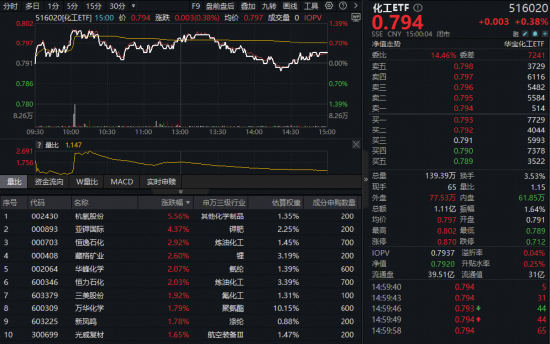
化工股逆市崛起!化工ETF(516020)盘中上探1.39%!板块近5日吸金189亿元,机构高呼行业景气或边际回暖
Xin Lang Ji Jin· 2025-12-03 12:01
Group 1 - The chemical sector experienced a counter-market rise on December 3, with the chemical ETF (516020) showing a maximum intraday increase of 1.39% and closing up 0.38% [1] - Key stocks in the sector included Hangyang Co., which surged by 5.56%, and Yara International, which rose by 4.37%, along with several others gaining over 2% [1] - The basic chemical sector attracted significant capital inflow, with a net inflow of 1.877 billion yuan on the day, ranking third among 30 major industries [3] Group 2 - The chemical ETF (516020) has shown a year-to-date increase of 28.13%, outperforming major indices such as the Shanghai Composite Index (15.7%) and the CSI 300 Index (15.15%) [4] - The basic chemical sector has seen a cumulative net inflow of 18.977 billion yuan over the past five days, ranking second among the 30 major industries [3][5] Group 3 - The chemical industry is expected to benefit from ongoing "anti-involution" policies, which may strengthen supply-side constraints and gradually reverse the overcapacity situation [6] - The overall profitability of the chemical sector is anticipated to recover from its bottom due to a slowdown in fixed asset investment and demand recovery [6] - The current price-to-book ratio of the chemical ETF (516020) is 2.33, indicating a relatively low valuation compared to the past decade, suggesting good long-term investment potential [6] Group 4 - Looking ahead, the chemical industry is projected to experience a cyclical upturn starting in 2026, driven by a combination of supply-side contraction and increased demand [7] - The demand recovery in downstream sectors such as automotive, home appliances, and textiles is expected to continue, supported by macroeconomic improvements and consumption stimulus policies [7] - The chemical ETF (516020) provides a diversified investment opportunity across various sub-sectors, with nearly 50% of its holdings in large-cap leading stocks [7]




李迅雷专栏 | 对当前经济热点的一点思考
中泰证券资管· 2025-12-03 11:35
Real Estate Cycle - The long-term upward phase of the real estate market from 2000 to 2020 led many to believe that housing prices would not decline, despite early warnings from analysts like Professor Zhu Ning [4] - Current average rental yield in core cities of China is estimated at around 2%, indicating a price-to-earnings ratio of 50 times, while Shanghai's rental yield is even lower, suggesting a need for adjustment to around 3% [5][6] - Real estate development investment in China has decreased by 14.7% year-on-year in the first ten months of the year, indicating a potential acceleration in the downward trend [5][6] Export Performance - China's export growth has exceeded expectations this year, with a 5.3% increase in the first ten months, despite concerns about negative growth earlier in the year [10] - The export price index has declined by 18% since 2023, indicating challenges in maintaining export value [10][13] - Future export growth is expected to slow down due to the diminishing "import grabbing" effect from the U.S. and high base effects from previous years [13] Consumer Contribution to GDP - Consumer spending is projected to contribute more than half of GDP growth this year, as capital formation's contribution declines [15] - The consumption growth has shown a pattern of being high in the first half of the year and lower in the second half, influenced by previous stimulus measures [17] - Long-term consumption growth will depend on rising household incomes and improved social security systems [19] Inflation and Price Recovery Challenges - The relationship between supply and demand, particularly in manufacturing investment, is crucial for price recovery, but manufacturing investment growth has significantly slowed [21] - The current economic environment presents challenges for inflation recovery, as high unemployment rates correlate with low inflation [25] - Effective measures to boost consumer demand are necessary for price recovery, including expanding social security and employment opportunities [25] GDP Growth Targets - The GDP growth target for 2026 is estimated to remain around 5%, with various uncertainties affecting this goal, including population changes and exchange rate fluctuations [26] - A more aggressive fiscal policy is anticipated to support this growth target, with an expected increase in the fiscal deficit [30] - The need for fiscal and monetary policy coordination is emphasized to address local government debt and stimulate economic growth [40] Stock Market Dynamics - The stock market has faced resistance around the 4000-point mark, with recent gains driven more by valuation increases than profit growth [41] - For a sustained bull market, corporate profits must grow faster than GDP, which has not been the case recently [41][44] - Structural bull markets are anticipated, particularly in the context of the AI revolution, but require supportive policies for corporate growth [46]

金属行业12月投资策略展望:降息预期再升温,金属价格受提振
BOHAI SECURITIES· 2025-12-03 09:30
Industry Overview - The report highlights a warming expectation for interest rate cuts, which is expected to boost metal prices, particularly in the context of the Federal Reserve's potential policy changes [1][3]. Steel Industry - In December, demand for steel may continue to weaken due to weather factors, leading to a reduction in steel production and a fluctuating price trend [3][19]. - The steel industry is expected to benefit from growth policies, with demand in shipbuilding and construction likely to increase, alongside trends in equipment upgrades and low-carbon transitions [5][19]. - The average daily transaction volume of construction steel in October 2025 was 101,300 tons, down 1.13% month-on-month and 13.06% year-on-year [20][19]. Copper Industry - The copper supply remains tight, with expectations of continued high price fluctuations supported by low domestic inventory levels and the Fed's interest rate cut expectations [3][36]. - In October, domestic refined copper production was 1,204,000 tons, a year-on-year increase of 7.89% [37][36]. - The report suggests a positive outlook for the copper industry, driven by demand from power grids, electric vehicles, and AI servers [5][36]. Aluminum Industry - The aluminum sector is experiencing a stable profit level for electrolytic aluminum plants due to low alumina prices, although downstream demand is expected to weaken in December [3][41]. - Domestic electrolytic aluminum production in October was 3,798,000 tons, a year-on-year increase of 2.23% [42][41]. - The report anticipates that the aluminum price will continue to fluctuate in the short term, supported by the Fed's interest rate cut expectations [5][41]. Precious Metals - Gold prices are expected to fluctuate at high levels in the short term, influenced by the Fed's interest rate policies and geopolitical tensions, particularly regarding the Russia-Ukraine situation [3][47]. - From October 31 to November 28, 2025, COMEX gold prices increased by 6.05% to $4,256.40 per ounce [47][47]. New Energy Metals - Lithium prices are expected to remain high due to strong demand in the energy storage sector, despite a slight decline in demand from the electric vehicle sector [3][52]. - Domestic battery-grade lithium carbonate prices increased by 17.50% to 94,000 yuan per ton from October 31 to November 28, 2025 [53][52]. - The report indicates a trend towards regulatory strengthening in the lithium supply side, which may optimize the future supply structure and support lithium prices [5][52]. Cobalt Industry - The cobalt market is expected to face pressure on prices due to a potential decline in demand from the power battery market, while the consumer electronics sector remains robust [4][62]. - In October, domestic cobalt sulfate production was 12,500 tons, a year-on-year decrease of 32.72% [66][62].