
反内卷

Search documents
2025年1-10月工业企业效益数据点评:工企利润短期波动,后续关注政策部署
BOHAI SECURITIES· 2025-11-27 12:01
Group 1: Industrial Profit Trends - From January to October 2025, the profit growth rate of industrial enterprises decreased to 1.3%, down from 1.9% in the previous month[1] - In October 2025, the profit of industrial enterprises fell by 5.5%, a decline of 27.1 percentage points compared to September[1] - The cumulative profit growth rate varied by enterprise type, with state-owned enterprises showing improvement while private and foreign-invested enterprises experienced a decline, though still maintaining positive growth[1] Group 2: Economic Indicators and Future Outlook - The industrial added value growth rate for October was 4.9%, a decrease of 1.6 percentage points from September[1] - The operating revenue growth rate for industrial enterprises fell by 0.6 percentage points to 1.8% in the same period[1] - The profit margin for January to October was 5.25%, down 0.8 percentage points year-on-year, indicating a widening decline compared to the first nine months[1] Group 3: Sector Performance and Investment Opportunities - Among 41 industrial sectors, 17 sectors achieved positive profit growth from January to October, a reduction of 4 sectors compared to the previous month[1] - High-tech manufacturing, particularly in computer and communication equipment, showed accelerated profit growth, driven by ongoing capital investment and domestic substitution trends[1] - Future investment opportunities are anticipated in sectors like TMT and robotics, driven by AI capital expansion and domestic demand stimulation[4]
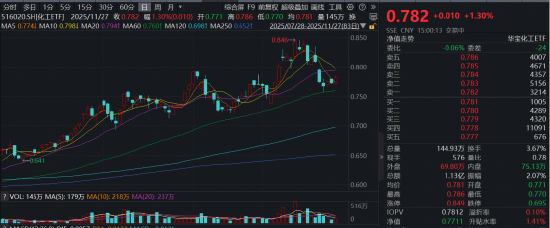
头部电解液企业订单火爆,化工ETF(516020)收涨1.3%,机构:2026年化工行业或迎周期拐点向上
Xin Lang Ji Jin· 2025-11-27 11:53
Core Viewpoint - The chemical sector has shown significant strength in the market, outperforming major indices like the Shanghai Composite and CSI 300, driven by a "de-involution" trend and favorable supply-demand dynamics [1][2][7]. Group 1: Market Performance - The Shanghai Composite Index weakened towards the end of the trading day, while the ChiNext Index turned negative, with the chemical sector leading the gains [1]. - The Chemical ETF (516020) experienced a daily increase of 1.30%, with a trading volume of 1.13 billion yuan [1]. - The cumulative increase of the Chemical ETF's underlying index reached 26.07% year-to-date, significantly outperforming the Shanghai Composite Index (15.62%) and the CSI 300 Index (14.75%) [2][3]. Group 2: Stock Performance - Notable stocks in the chemical sector included Xin Fengming, which rose by 5.75%, and several others like Lu Xi Chemical and Wan Hua Chemical, which saw increases of over 3% [2][4]. - The trading volume and transaction amounts for leading stocks indicate strong investor interest, with Wan Hua Chemical achieving a transaction amount of 2.464 billion yuan [2]. Group 3: Industry Trends - The solid-state battery concept remains active, with a significant increase in lithium battery material demand, as evidenced by the rise in electrolyte prices from approximately 19,400 yuan/ton at the beginning of the year to 54,250 yuan/ton recently [5]. - The current price-to-book ratio of the chemical sector stands at 2.27, indicating a relatively low valuation compared to historical levels, suggesting potential for long-term investment [5]. Group 4: Future Outlook - The chemical industry is expected to experience a dual uplift in performance and valuation due to the "de-involution" trend, with leading companies likely to gain market share through improved management and energy efficiency [7]. - Analysts predict that the chemical sector may see a cyclical upturn starting in 2026, driven by supply-side reforms and increased demand, particularly as the U.S. enters a rate-cutting cycle [7]. Group 5: Investment Strategy - Investors are encouraged to consider the Chemical ETF (516020) for efficient exposure to the sector, as it tracks the CSI Sub-Industry Chemical Index and includes a diversified portfolio of leading stocks [8].





宏观点评报告:剔除基数,利润仍弱-20251127
CAITONG SECURITIES· 2025-11-27 11:47
Profit Trends - In October, the profit of industrial enterprises decreased by 5.5% year-on-year, a significant drop from the previous value of 21.6%[6] - The decline in profit growth is attributed to a combination of falling production volumes and rising prices, alongside a decrease in profit margins[7] - The profit margin for industrial enterprises in October was approximately 5.1%, down 0.3 percentage points from September, deviating from the typical seasonal increase observed in previous years[12] Sector Analysis - The mining sector experienced a revenue decline, with coal mining and non-metallic mineral extraction showing monthly revenue growth rates of -13.9% and -23.9%, respectively[20] - The beverage and alcohol manufacturing sector saw a profit growth rate of 3.0%, up 27.8 percentage points from the previous value, but the profit margin fell to 13.5%, down 4.8 percentage points[20] - Equipment manufacturing continues to lead in revenue growth and maintains a relatively high profit margin, benefiting from overseas expansion and supply chain restructuring[20] Economic Indicators - The Producer Price Index (PPI) in October showed a year-on-year decline of 2.1%, a slight improvement from September's decline of 2.3%[8] - Seasonal factors related to winter heating demand contributed to price increases in coal mining and processing, with prices rising by 1.6% and 0.8% respectively in October[20] - The overall industrial profit total for October was 577.1 billion yuan, marking a 103.1 billion yuan decrease from September, the lowest level for the same period since 2020[12] Future Outlook - Excluding base effects, there may be a marginal recovery in industrial enterprise profits in November and December, although the base effect could continue to exert downward pressure[21] - Factors such as prolonged holidays and trade tensions have impacted October's industrial profits, but these disturbances are expected to dissipate[21] Risk Factors - Potential risks include the possibility that domestic policy measures may not achieve the desired effects, and unexpected changes in international geopolitical situations could arise[25]
商贸零售行业快评报告:增强消费品供需适配性方案出台,多领域有望迎来扩容
Wanlian Securities· 2025-11-27 11:12
Investment Rating - The industry investment rating is "Outperform the Market," indicating an expected relative increase of over 10% in the industry index compared to the broader market within the next six months [3][10]. Core Insights - The report highlights the implementation of a plan by six government departments aimed at enhancing the adaptability of consumer goods supply and demand, with a goal to optimize the supply structure by 2027, creating three trillion-level consumption sectors and ten hundred-billion-level consumption hotspots [1][2]. - The plan focuses on addressing the issue of "involution" in the consumer sector, which is characterized by homogeneous competition and price wars, by promoting high-quality supply to meet consumer demand for premium products [1][2]. Summary by Sections Investment Highlights - The plan includes 19 key tasks to expand domestic demand and deepen supply-side structural reforms, aiming for a healthier and more sustainable balance between supply and demand [1]. - The report emphasizes the need for high-quality supply to meet the growing demand for premium consumer products, particularly in the context of evolving consumer preferences towards personalized and diverse offerings [2]. Focus Areas for Quality Supply - Development of new consumption types focusing on green, digital, and intelligent sectors to stimulate consumption potential [2]. - Expansion of unique product offerings in areas such as green products, rural consumption, and leisure sports to enhance market attractiveness [2]. - Implementation of targeted supply strategies for distinct consumer groups, including children, students, fashion enthusiasts, and the elderly [2]. - Promotion of new business models such as platform consumption and shared consumption to better align supply and demand [2]. Investment Recommendations - The report suggests focusing on sectors such as sports goods, trendy toys, cosmetics, gold and jewelry, and health products, which are expected to benefit from rising consumer awareness and market trends [8]. - Specific recommendations include investing in companies with strong product development capabilities, effective channel strategies, and robust marketing in these sectors [8].
2025年1-10月工业企业盈利数据的背后:工业利润渐进修复,新质生产力表现积极
ZHESHANG SECURITIES· 2025-11-27 10:53
Group 1: Industrial Profit Trends - In the period from January to October 2025, the profit growth of industrial enterprises was 1.9%, down from 3.2% previously, indicating a gradual recovery trend[1] - In October 2025, profits of industrial enterprises decreased by 5.5% year-on-year, influenced by a high base from the previous year and rising financial costs[1] - The average two-year profit growth rate for October was -1.2%, showing a further slowdown compared to previous months[1] Group 2: Price and Demand Dynamics - The Producer Price Index (PPI) in October recorded a year-on-year decline of 2.1%, slightly improved from -2.3% in the previous month, reflecting marginal optimization in market competition[2] - The operating profit margin for industrial enterprises was 5.25% from January to October, a slight increase of 0.01 percentage points year-on-year, but decreased to 5.16% in October compared to 5.42% in September[2] Group 3: New Productive Forces - High-tech manufacturing profits grew by 8.0% year-on-year, outperforming the overall industrial average by 6.1 percentage points[3] - Equipment manufacturing profits increased by 7.8%, contributing 2.8 percentage points to the overall profit growth of industrial enterprises, with a total profit share of 38.5%[3] Group 4: Traditional Industries Performance - In traditional industries, new productive forces showed positive results, with profits in specific sectors like graphite and carbon products increasing by 77.7% and biochemical pesticides by 73.4%, both significantly above their respective industry averages[4] Group 5: Future Outlook - Industrial profits are expected to gradually recover, with a projected annual growth rate of 3.6% for 2026, supported by steady demand and reduced pressure on industrial growth[7] - The inventory of industrial enterprises increased by 3.7% year-on-year by the end of October 2025, indicating that destocking is not yet complete and further demand strength is needed[8] Group 6: Risk Factors - Insufficient economic recovery momentum could lead to weak industrial demand and pressure on prices, adversely affecting profit recovery[9] - Delays in the implementation of demand-side policies may hinder the expected recovery in industrial profits, particularly if internal growth drivers remain weak[9]
1-10月工企利润数据点评:原材料价格仍是当前工业企业盈利能力的主要拖累
Bank of China Securities· 2025-11-27 07:58
Profit and Revenue Performance - From January to October, industrial enterprises achieved a total profit of CNY 59,502.9 billion, a year-on-year increase of 1.9%, with growth slowing by 1.3 percentage points compared to the previous three quarters[1] - In October alone, profits fell by 5.5% year-on-year, marking a significant decline of 27.1 percentage points from September[1] - Revenue for the same period grew by 1.8% year-on-year, with the revenue-to-asset ratio at CNY 74.5 per CNY 100 of assets, slightly down by CNY 0.2 from the previous quarter[1] Cost and Profitability Analysis - Industrial enterprises' operating costs increased by 2.0% year-on-year, with the growth rate narrowing by 0.6 percentage points compared to the previous three quarters[1] - The operating profit margin for industrial enterprises remained stable at 5.3% from January to October[1] - The Producer Price Index (PPI) and the PPI for production materials both showed negative growth, declining by 2.7% and 3.2% respectively, indicating continued pressure on profitability[2] Sector Contributions and Challenges - The mining sector's profit contribution to industrial enterprises was negative, with a year-on-year profit decline of 27.8%, impacting overall profit growth by 4.7 percentage points[10] - Real estate investment decreased by 14.7% year-on-year, further dragging down fixed asset investment growth by 3.0 percentage points, highlighting a significant demand shortfall[3] - The coal mining and washing industry had an import price index of 73.7 in October, indicating ongoing negative growth and contributing negatively to overall profit growth by 4.2 percentage points[24]
摩根大通展望2026年中国股票:聚焦“反内卷”政策执行、AI基础设施变现等四大主题
Zheng Quan Shi Bao Wang· 2025-11-27 07:52
Core Viewpoint - Morgan Stanley's China equity strategy team maintains a constructive outlook on the CSI 300 index, projecting a target level of 5200 points by the end of 2026 [1] Investment Themes - The four major investment themes for 2026 include the implementation of "anti-involution" policies, growth in domestic and international AI infrastructure/monetization, favorable macroeconomic conditions in developed markets benefiting overseas sales, and a K-shaped consumption recovery, along with potential new real estate policies [1] Stock Selection - The team has identified IT and healthcare A-shares that can capitalize on China's innovation opportunities, using metrics such as market capitalization, average daily trading volume, and overseas revenue [1] - A shift from value stocks to growth stocks is expected by early 2026 [1] Sector Focus - The team has selected leading A-share companies in sectors such as automotive, battery materials, lithium, photovoltaics, cement, chemicals, coal, steel, dairy, hog farming, liquor, and logistics, which are likely to benefit from the "anti-involution" trend [1] - The transition from price/scale competition to quality competition is seen as a long-term adjustment over a decade [1]

ETF日报 | “反内卷”行情又来了!传统能源板块布局有何选择?
Sou Hu Cai Jing· 2025-11-27 07:36
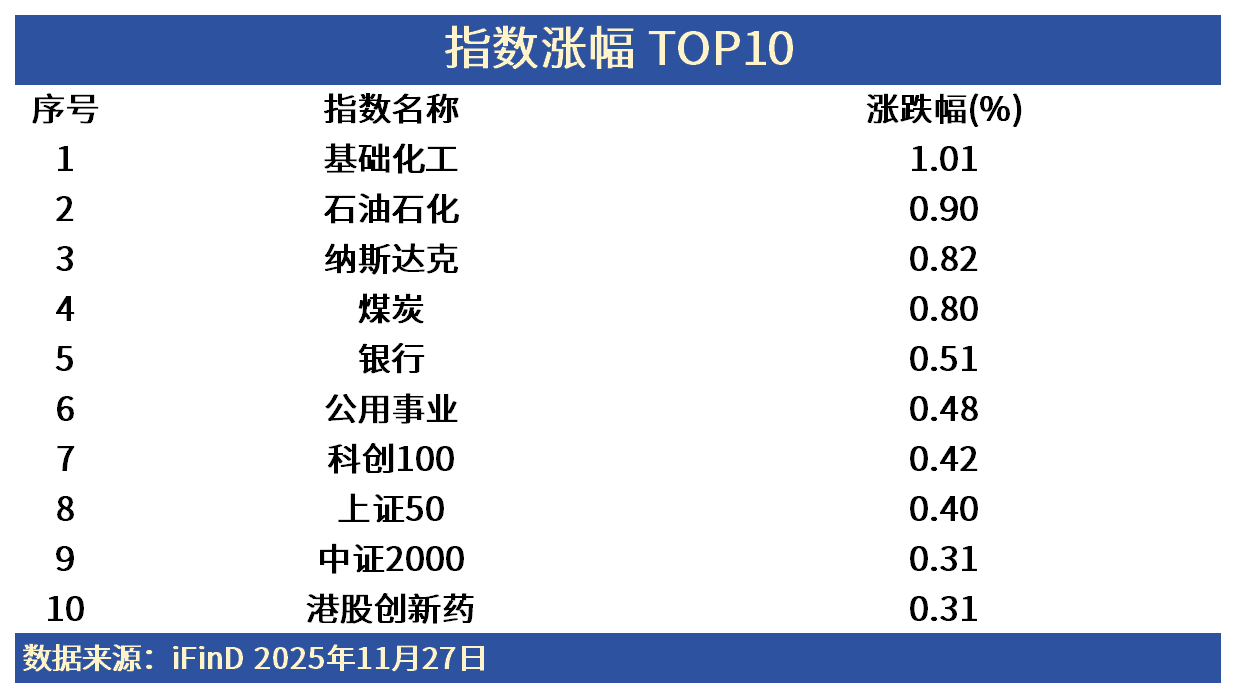
Group 1: Market Performance - As of November 27, 2025, the A-share market saw significant gains in the basic chemical, petroleum and petrochemical, and coal sectors, with increases of 1.01%, 0.90%, and 0.80% respectively [1][4] - The overall market performance indicates a recovery trend, particularly in cyclical industries such as non-ferrous metals, steel, coal, and petrochemicals, driven by improved supply-demand dynamics [3] Group 2: Policy and Industry Developments - The China Nonferrous Metals Industry Association has expressed opposition to the zero or negative processing fees in the copper smelting industry, calling for global action to address this unsustainable structural contradiction [2] - Recent government initiatives include a joint issuance of a growth support plan for the petrochemical industry, which emphasizes the renovation of old facilities and the development of coal-to-oil and gas projects [2] - The National Energy Administration has released guidelines to promote the integration of coal and new energy, encouraging innovation in carbon-based fuels and biodegradable materials [2] Group 3: Investment Opportunities - The "anti-involution" measures in the chemical industry are expected to provide a reference for other sub-industries, potentially leading to a new round of supply-side reforms and optimization of the supply-demand structure [3] - Leading companies in the chemical sector are anticipated to gain market share due to improved management practices and energy consumption control [3] - ETFs tracking energy and materials indices are gaining attention, indicating a growing interest in these sectors among investors [3]
洪灝:中国股市30年大周期走出巨浪结构,牛市第5浪最值得期待,将涨到你不信
对冲研投· 2025-11-27 06:46
Core Viewpoint - The Chinese market is experiencing a bull market supported by strong fundamentals, particularly in manufacturing, despite concerns about the real estate sector and consumer spending [3][4][29]. Group 1: Market Performance - The Chinese market is the best-performing market globally this year, with expectations of profit-taking as the year ends [6][74]. - The stock market has diverged from real estate prices and ten-year government bond yields since January, indicating a shift in market dynamics [5][31]. - The bull market is characterized by a significant wave structure over the past 30 years, with the fifth wave expected to be the most promising [6][70][73]. Group 2: Economic Fundamentals - Industrial profits are expected to recover, which will positively influence the Shanghai Composite Index [7][58]. - The manufacturing sector remains robust, with the contribution of real estate to GDP declining from over 30% to around 10% [32][34]. - The new five-year plan emphasizes economic construction, a strong industrial system, and revitalizing consumption, with little focus on real estate [49][54]. Group 3: Inflation and Deflation - The long-term deflationary pressures in upstream industries are affecting downstream consumption, necessitating policy measures to alleviate these issues [8][14]. - The implementation of the Yarlung Tsangpo River project is seen as a significant step towards addressing overcapacity and price competition [12][16]. - There is an expectation that upstream price and consumption sentiment will begin to recover in the next 3 to 6 months [10][23]. Group 4: Commodity Trends - Gold has experienced a significant price increase, indicating potential historical changes in the market, with expectations for industrial metals to follow suit [35][47]. - The U.S. is projected to issue approximately $2.1 trillion to $2.2 trillion in debt by 2026, raising concerns about the sustainability of U.S. debt levels [39][48]. - The current pricing of industrial metals reflects a pessimistic outlook similar to the 2008 financial crisis, suggesting a potential for recovery [43][46].

小摩:预期2026年底沪深300指数目标5200点,列出中资股首选股名单
Ge Long Hui· 2025-11-27 06:24
Core Viewpoint - Morgan Stanley expresses optimism for the Chinese capital market in 2026, expecting continued growth in the MSCI China Index and the CSI 300 Index, with target levels set at 100 points and 5200 points respectively by the end of 2026, indicating potential increases of 19% and 17% from November 24 [1] Group 1: Investment Themes - The acceleration of "anti-involution" policies is expected to structurally enhance profit margins and return on equity (ROE) for the MSCI China Index and CSI 300 Index, with current market estimates for net profit margins and ROE being relatively low [1] - Strong growth in global artificial intelligence infrastructure capital expenditure is anticipated to boost China's local AI ecosystem and related domestic industries, with emerging "world dynamic models" increasing demand for computing power [1] - The fiscal and monetary easing environment in developed markets is likely to stabilize China's export sales [1] - Consumption is showing a K-shaped recovery, with significant growth in high-end food and beverage and luxury goods sales, while mid-tier consumption recovery remains relatively weak [1] Group 2: Preferred Stocks - Morgan Stanley lists its preferred Chinese stocks for the first quarter of next year, including Baidu, NetEase, Midea Group, Mixue Group, Pinduoduo, Pop Mart, Trip.com, Master Kong, Futu Holdings, Sinopharm, CATL, and China Overseas Development [1] - Additionally, the bank identifies preferred stocks benefiting from the AI supercycle, including cloud service providers (CSP) like Alibaba and Tencent, AI data center companies (AIDC) such as Zhongji Xuchuang, Huqin Technology, and Northern Huachuang, as well as electrification and battery material firms like CATL, Yiwei Lithium Energy, and Ganfeng Lithium [2]
