
供应压力

Search documents
沙特下调12?OSP报价,聚酯需求延续良好态势
Zhong Xin Qi Huo· 2025-11-07 04:01
1. Report Industry Investment Rating The report does not explicitly mention the industry investment rating. 2. Core Viewpoints of the Report - The energy and chemical industry is expected to continue its oscillatory consolidation. Crude oil should be treated with an oscillatory mindset. PX is in a strong position, and the short - term price is expected to be oscillatory and slightly bullish. PTA's supply - demand pattern shows an improvement expectation, and the price is expected to be supported [3][14]. - Most products in the energy and chemical sector are expected to oscillate, with some showing a slightly bullish or bearish tendency in the short - term, depending on factors such as supply - demand relationships, cost changes, and market sentiment [3]. 3. Summary According to Relevant Catalogs 3.1 Market Overview - On November 6, 2025, the Chinese A - share market rose, and the commodity market sentiment generally improved. PX and PTA in the energy and chemical sector performed well, with PX rising more than PTA, and TA's processing fee per ton dropping to 120 yuan/ton. The rise of aromatics is related to the high cracking spread of global gasoline, and there has been arbitrage from Asian blending products to the Americas recently. The downstream demand for polyester remains healthy, and the loom operating rate has increased week - on - week [2]. 3.2 Product - by - Product Analysis 3.2.1 Crude Oil - **Viewpoint**: Supply pressure persists, geopolitical risks remain, and the price is expected to oscillate. - **Main Logic**: Saudi Arabia has lowered the official selling price for Asia, corresponding to the downward shift of the Middle - East oil premium center in the past month. Russian refineries have been attacked, and the US refined oil inventory has decreased smoothly since October. The overseas gasoline and diesel markets remain strong, and the reduction of refined oil inventory pressure and the strong cracking spread support the crude oil demand. However, the continuous inventory build - up in reality is difficult to change, so the price oscillates [9]. 3.2.2 Asphalt - **Viewpoint**: The asphalt futures price may test the 3200 yuan/ton resistance level again. - **Main Logic**: OPEC+ is expected to continue increasing production in December, the Israel - Palestine conflict has ended, and the situation between the US and Venezuela is under control. The asphalt futures price has fallen below the important support level of 3200 yuan/ton, which may turn into a resistance level. The asphalt - fuel oil spread has fallen below 400 yuan/ton, the production schedule in November has decreased significantly, but the demand has entered the off - season. The supply shortage problem has been resolved, and the driving force for the high premium of asphalt has weakened. The pricing weight of asphalt futures has returned to Shandong, and the inventory build - up pressure is still large [11]. 3.2.3 High - Sulfur Fuel Oil - **Viewpoint**: The fuel oil is expected to oscillate weakly. - **Main Logic**: OPEC+ is expected to continue increasing production in December, the Israel - Palestine conflict has ended, but the premium on Russian products in Europe and the US still exists. The fuel oil supply in the Asia - Pacific region in November is expected to decrease due to the decline in Russian exports. However, the refinery processing demand is weak, and the fuel oil demand is still weak as it has entered the off - season [11]. 3.2.4 Low - Sulfur Fuel Oil - **Viewpoint**: The refined oil market is strong, and low - sulfur fuel oil may run strongly. - **Main Logic**: Low - sulfur fuel oil follows the weak oscillation of crude oil, and the 3500 yuan/ton resistance level is effective in the short - term. The main product attribute of low - sulfur fuel oil is strong, and the decline in Russian refined oil exports has driven the rebound of the gasoline and diesel cracking spread, supporting low - sulfur fuel oil. However, it faces negative factors such as the decline in shipping demand, green energy substitution, and high - sulfur substitution. The valuation of low - sulfur fuel oil is low, and it is expected to follow the movement of crude oil [13]. 3.2.5 Methanol - **Viewpoint**: The 2100 yuan/ton integer level provides some support, and methanol is expected to oscillate. - **Main Logic**: The methanol futures price oscillated on November 6. The domestic methanol factory operating rate remains high, resulting in sufficient supply. The port inventory is relatively high, which still suppresses the price in the short - term. However, considering the possible disturbances in Iran in winter, methanol still has long - buying value and should be treated with an oscillatory view in the short - term [28]. 3.2.6 Urea - **Viewpoint**: The export information has been confirmed, and urea is expected to oscillate strongly in the short - term. - **Main Logic**: On November 6, the supply - demand pattern of urea remained loose. Although the supply has returned to a high level after the end of plant maintenance, the demand is weak due to the end of winter wheat sowing. The high inventory pressure still exists, but the coal cost provides strong support. Combined with the speculation about export information in the market, urea is expected to oscillate strongly [28]. 3.2.7 Ethylene Glycol (EG) - **Viewpoint**: Supply and demand are under pressure, and the rebound height is limited under the fermentation of market sentiment. - **Main Logic**: The polyester chain products have strengthened, but EG's own supply - demand is weak, and the port inventory has continued to increase this week. The overall price elasticity of EG will be significantly suppressed in the medium - term. Although the factory operating rate of EG has decreased this week, providing some support to the price, the long - term inventory build - up pressure is large, and the rebound height is limited [20][21]. 3.2.8 PX - **Viewpoint**: PX is leading the polyester chain strongly, and the short - term market sentiment is enthusiastic. - **Main Logic**: The cost change is limited. There are rumors of production cuts and PX factory maintenance in the market, driving PX and PTA prices up. PX has been in a strong position in 2025, with continuous inventory reduction and tight spot liquidity. The supply of PX is expected to be tight in the first half of next year, and the positive growth of downstream demand supports PX demand to some extent [14]. 3.2.9 PTA - **Viewpoint**: After the meeting, PTA plants have stopped production in batches, and the market sentiment continues to ferment. - **Main Logic**: Affected by market news, the PTA futures price has strengthened significantly. Although it is difficult for enterprises to reach a coordinated production - cut agreement, there are many planned plant disturbances in November. The supply - demand pattern of PTA is expected to improve, and the downward compression space of the PTA processing spread is limited, but the upward space depends on whether there is more than expected production cut [14]. 3.2.10 Short - Fiber - **Viewpoint**: Caught between rising costs and falling demand expectations, the processing fee is passively compressed. - **Main Logic**: The price of upstream raw materials has risen due to capital speculation, and short - fiber has followed the cost increase but with a smaller increase, resulting in a passive compression of the processing fee. Although the downstream procurement has increased in the afternoon under the influence of market sentiment, the overall sales this week have been weak, and short - fiber has continued to accumulate inventory [22][23]. 3.2.11 Bottle - Chip - **Viewpoint**: It follows the rise of raw materials passively. - **Main Logic**: The upstream raw material futures have risen, driving some polyester bottle - chip factories to raise their prices. The market trading atmosphere is okay, and the processing fee is within a stable range [24][25]. 3.2.12 Polypropylene (PP) - **Viewpoint**: As the price drops, the trading volume increases, and PP is expected to oscillate. - **Main Logic**: The downstream trading volume has increased as the price drops. The price of crude oil oscillates, and OPEC+ has shown a cautious attitude towards increasing production. PP's own fundamental support is limited. As the peak season fades, the upstream and mid - stream still have the intention to reduce inventory at high prices, and the production pressure is large due to the decrease in maintenance and the increase in production capacity [31][32]. 3.2.13 Linear Low - Density Polyethylene (LLDPE) - **Viewpoint**: The downstream trading volume has increased, and LLDPE is expected to oscillate. - **Main Logic**: The LLDPE futures price oscillates. The price of crude oil oscillates, and OPEC+ has shown a cautious attitude towards increasing production. LLDPE's own fundamental support is limited. As the peak season fades, the upstream and mid - stream still have the intention to reduce inventory at high prices, and the production pressure is large due to the decrease in maintenance and the increase in production capacity [30]. 3.2.14 PVC - **Viewpoint**: The market sentiment has cooled down, and PVC is expected to oscillate weakly. - **Main Logic**: At the macro - level, the macro - disturbances in November have subsided. At the micro - level, the PVC fundamentals are under pressure, with stable costs. The upstream maintenance has ended in early November, and PVC production will increase. The downstream operating rate has recovered, but only the low - price procurement volume has increased. The PVC export order signing has weakened this week, and the anti - dumping measure suppresses the export expectation [34]. 3.2.15 Caustic Soda - **Viewpoint**: With low valuation and weak expectations, caustic soda is expected to oscillate. - **Main Logic**: At the macro - level, the macro - disturbances in November have subsided. At the micro - level, the fundamentals of caustic soda have improved this week, but the driving force for continuous improvement is limited. The alumina production capacity has decreased, the demand for caustic soda from Weiqiao is still high, the new alumina project in Guangxi in the first quarter of 2026 will boost the demand for caustic soda, the non - aluminum operating rate is stable, and the replenishment intention is not high. The maintenance of caustic soda plants will end in early November, and the production will increase month - on - month [35]. 3.3 Data Monitoring - **Inter - period Spreads**: The inter - period spreads of various products such as Brent, Dubai, PX, PTA, etc. have changed to different extents. For example, the 1 - 5 month spread of PX has increased by 22 yuan/ton [37]. - **Basis and Warehouse Receipts**: The basis and warehouse receipts of different products also show different changes. For example, the basis of asphalt has increased by 17 yuan/ton, and the warehouse receipt is 7690 [38]. - **Inter - product Spreads**: The spreads between different products, such as 1 - month PP - 3MA, 1 - month TA - EG, etc., have also changed. For example, the 1 - month TA - EG spread has increased by 78 yuan/ton [40].
中印均可能继续购买俄罗斯原油,地缘对原油的?撑有减弱迹象
Zhong Xin Qi Huo· 2025-10-29 02:34
1. Report Industry Investment Rating - Most of the varieties in the energy and chemical industry are rated as "oscillating", including PX, PTA, short - fiber, methanol, urea, LLDPE, PP, PL, PVC, and caustic soda. Some are rated as "oscillating weakly", such as crude oil, pure benzene, and styrene. Others are rated as "oscillating downward", like asphalt, high - sulfur fuel oil, and low - sulfur fuel oil [9][17][18] 2. Core Viewpoints of the Report - The geopolitical support for crude oil shows signs of weakening. If there is no further reduction in supply, oil prices will return to a weak supply - demand situation. The chemical sector is waiting for more guidance. The bullish power of styrene is gradually brewing, but it still faces pressure from high inventory and new installations. The strong pattern of PTA may change after the meeting of the Price Department of the Ministry of Industry and Information Technology. Overall, the energy and chemical industry is expected to oscillate and consolidate in the short term, waiting for the geopolitical situation to calm down [1][2][3] 3. Summary by Variety Crude Oil - **Viewpoint**: Supply pressure continues, and geopolitical risks still exist. - **Main Logic**: Concerns about Russian oil supply have eased, and the spot market for Middle Eastern crude oil has weakened. The marginal geopolitical risk has decreased. The API data shows a decline in US crude oil inventories last week, but the overseas supply pressure still persists. If geopolitical concerns continue to ease, oil prices will return to a weak state [9] Asphalt - **Viewpoint**: As crude oil prices fall, asphalt may be pressured to decline. - **Main Logic**: OPEC+ will continue to increase production in November, Saudi Arabia has lowered the export premium to Asia, and the Israel - Palestine conflict has ended. After the sharp rise in oil prices, the market is evaluating the situation, and oil prices have fallen, which may put pressure on asphalt futures prices. The asphalt - fuel oil spread is expected to continue to decline, and the over - valuation premium of asphalt is starting to fall [9][10] High - Sulfur Fuel Oil - **Viewpoint**: As crude oil prices fall, fuel oil may be pressured to decline. - **Main Logic**: After the rise in oil prices, the market is evaluating the situation, and oil prices have fallen, driving fuel oil prices down. Although the Israel - Palestine conflict has ended, the Russia - Ukraine conflict continues to escalate, and the demand for fuel oil is still weak [10] Low - Sulfur Fuel Oil - **Viewpoint**: Low - sulfur fuel oil fluctuates and rises following crude oil. - **Main Logic**: Low - sulfur fuel oil follows the oscillation of crude oil. It is affected by factors such as sanctions on Russia, and its fundamentals face challenges such as a decline in shipping demand and substitution by green energy [12] Methanol - **Viewpoint**: Overseas disturbances will increase after November, and methanol is viewed with oscillation. - **Main Logic**: On October 28, the methanol futures price oscillated and declined. The high port inventory still has a suppressing effect in the short term, but considering the high probability of Iranian disturbances approaching winter, methanol still has value for low - buying [29] Urea - **Viewpoint**: The market sentiment has ebbed, and it is viewed with continuous pressure. - **Main Logic**: On October 28, the market sentiment weakened, and the spot downstream transactions were cautious. Urea returned to the fundamental situation and is expected to oscillate and consolidate [30] Ethylene Glycol (MEG) - **Viewpoint**: Driven by the sentiment of related varieties, but the fundamentals are under pressure and the elasticity is limited. - **Main Logic**: The cost side oscillates without a clear direction. The supply of coal - based MEG is high, and the supply pressure in November is still large, leading to a significant inventory build - up from November to December [20] PX - **Viewpoint**: The market sentiment fermentation and cost game, pay attention to the conference resolution. - **Main Logic**: The concern about Russian oil supply has eased, and the medium - and long - term oil prices still face surplus pressure, causing the cost support to be insufficient in the short term. The PX supply - demand pattern has slightly improved, and the bottom support of PXN has increased. The price is expected to be sorted out within the range in the short term [13][14] PTA - **Viewpoint**: The cost has fallen and failed to resonate with the sentiment. Pay attention to the subsequent situation of the conference. - **Main Logic**: The cost support is insufficient in the short term due to the easing of concerns about Russian oil supply. The downstream production and sales have turned cold. The PTA price is expected to oscillate under the game between cost and the fermentation of the conference news [14][16] Short - Fiber - **Viewpoint**: Pay attention to the upstream sentiment fermentation, and there is no pressure on its own inventory. - **Main Logic**: After the slowdown in price increase, the production and sales of polyester short - fiber have become dull. The downstream demand is weak, and the cost support is disturbed. The price is expected to be sorted out within the range in the short term [24][25] Bottle - Chip - **Viewpoint**: The cost support has weakened, pay attention to the conference results. - **Main Logic**: The market is digesting the impact of anti - involution on upstream polyester raw materials. The oil price has turned down again, and the polyester bottle - chip price is expected to oscillate following the cost in the short term [26] Propylene and PP - **Viewpoint**: The spread between propylene and PP continues to fluctuate in the range of 500 - 550, and PL oscillates. PP is viewed within a range. - **Main Logic**: The oil price oscillates, and the supply - side situation of Russian oil is difficult to verify. The fundamentals of PP support are limited, and the inventory is at a high level. The PL price oscillates, and the spread between PP and PL fluctuates around 500 [33][34] Plastic (LLDPE) - **Viewpoint**: The cost - side support confronts the supply - demand pressure, and plastic is viewed within a range. - **Main Logic**: The oil price rebounds, and the supply - side situation of Russian oil is difficult to verify. The plastic's own fundamentals support is limited, and the profit support is also limited. The price is expected to oscillate in the short term [32] Styrene - **Viewpoint**: There is a lack of positive driving factors, and styrene oscillates weakly. - **Main Logic**: Styrene has followed the decline in oil prices and then rebounded, but the rebound is weak. It is affected by factors such as new installations and weak downstream follow - up [18][19] PVC - **Viewpoint**: It has low valuation and weak expectations, and PVC oscillates. - **Main Logic**: The macro - level sentiment has improved, but the PVC fundamentals are under pressure. The production will increase, the downstream demand is only released at low prices, and the export is affected by anti - dumping [36] Caustic Soda - **Viewpoint**: The spot price stabilizes, and the futures price oscillates. - **Main Logic**: The macro - level sentiment has improved, but the upstream production is high. The demand elasticity of caustic soda is limited, and the price is expected to oscillate widely [37] 4. Summary of Index Data - **Comprehensive Index**: The commodity index was 2242.59, down 0.90%; the commodity 20 index was 2532.38, down 1.19%; the industrial products index was 2238.86, down 0.64% [285] - **Energy Index**: On October 28, 2025, the energy index was 1168.84, with a daily decline of 0.85%, a 5 - day increase of 3.52%, a 1 - month decline of 2.56%, and a year - to - date decline of 4.81% [287]
天然橡胶产业周报:触底后与板块共振反弹,后期关注供应压力-20251027
Nan Hua Qi Huo· 2025-10-27 11:11
1. Report Industry Investment Rating No relevant content provided. 2. Core Viewpoints of the Report - Short - term, rubber shows a strong performance, but the further driving force is limited. It should focus on macro - sentiment changes. In the medium - to - long - term, it is regarded as neutral to weak due to supply pressure and demand uncertainties [1]. - The future trend of rubber prices is expected to be volatile, with weak fundamental drivers. Attention should be paid to macro - sentiment changes [15]. 3. Summary According to Relevant Catalogs 3.1 Core Contradictions and Strategy Recommendations 3.1.1 Core Contradictions - Short - term: Rubber rebounded in resonance with the crude oil and chemical sectors. The low valuation of RU, tight spot liquidity of dark - colored rubber, and certain digestion of fundamental negative factors led to the rebound. However, rubber's rebound may suppress procurement demand [1]. - Medium - to - long - term: The global total production capacity cycle has not fully peaked, and supply pressure will increase. Stable demand expectations require continuous macro - positive factors, and export growth faces risks [1]. 3.1.2 Trading - Type Strategy Recommendations - **Price Range and Trend Judgement**: The reference oscillation range for RU2601 in the next week is 14,900 - 15,500; for NR2511, it is 12,100 - 12,600. It is expected to maintain oscillation in the future, with weak fundamental drivers [15]. - **Strategy Recommendations**: Adopt a wait - and - see approach for single - side trading. Consider shorting at high prices for far - month contracts with protective option strategies. For basis trading, consider reverse cash - and - carry at high prices. For now, wait and see for spread arbitrage and consider widening the spread at low prices for variety arbitrage [16]. 3.1.3 Industrial Customer Operation Recommendations - **Price Range Forecast**: The price range for rubber RU in the next two weeks is 14,800 - 15,500; for 20 - grade rubber NR, it is 12,100 - 12,600 [20]. - **Risk Management Strategies**: For inventory management, short rubber futures and use options to lock in profits and reduce risks. For procurement management, buy far - month rubber futures and use options to lock in costs and reduce risks [20][22]. 3.2 Important Information and Concerns 3.2.1 Last Week's Important Information - **Positive Information**: Tensions between the US and Russia, a significant drop in EIA inventory, and other factors drove up the prices of crude oil and the chemical sector. There was an acceleration in dry - rubber de - stocking, positive macro - economic data, and growth in global light - vehicle sales [23]. - **Negative Information**: Macroeconomic data such as LPR remaining unchanged, a decline in fixed - asset investment, and an increase in rubber imports put downward pressure on rubber prices [25]. 3.2.2 This Week's Focus - Monitor rainfall in rubber - producing areas, Fed FOMC interest - rate decisions, Chinese official PMI data, EIA inventory reports, and new foreign - trade policies [27]. 3.3 Disk Interpretation 3.3.1 Price, Volume, and Capital Analysis - **Domestic Market**: Rubber prices rebounded last week. RU's position increased, while NR's decreased. Short - position profits for RU and NR decreased, and net positions rebounded. Spot prices generally rebounded, and the basis and term structure of RU and NR changed [28][29][32]. - **Foreign Market**: The foreign - market trend was similar to that of the domestic market, with less volatility in Japanese rubber and stronger performance in Singapore's 20 - grade rubber. The term structure of Japanese and Singaporean rubber also changed [53][55]. 3.3.2 Other Analyses - **Virtual - to - Physical Ratio and Sentiment Index**: Rubber sentiment fluctuated greatly last week, with a bullish sentiment. RU's virtual - to - physical ratio increased, while NR's decreased [57]. - **Domestic - Foreign Spread Tracking**: The spread between RU and Japanese rubber futures decreased significantly, while the spread between NR and Singaporean rubber was similar to the previous period [59]. - **Variety Spread Analysis**: The spread between light and dark rubber rebounded. The spread between natural and synthetic rubber slightly adjusted [62][71]. 3.4 Valuation and Profit Analysis 3.4.1 Industry Chain Profit Tracking - **Raw Material Costs**: Domestic raw - material prices rebounded. In Thailand, water and cup - rubber prices remained stable, and the spread between them slightly narrowed [77]. - **Processing Profits**: The delivery profit of whole - latex remained low, and the profit of TSR9710 decreased. The processing and import profits of imported rubber showed different trends [85][86][89]. 3.5 Supply - Demand and Inventory Deduction 3.5.1 Supply Side - **Production in Major Producing Countries**: Thailand's production is expected to increase smoothly, Indonesia's production may slightly decrease, and Malaysia's production may be affected by weather and low rubber prices. Vietnam's production and exports are affected by weather and tariffs [90]. - **Import Situation**: In September, China's imports of natural and synthetic rubber increased both month - on - month and year - on - year. The import of Thai standard rubber decreased, while that of Thai mixed rubber increased [94][95]. 3.5.2 Demand Side - **Total Demand in Major Producing Countries**: In August, China's actual consumption of natural rubber was stable year - on - year, while the demand in other major producing countries decreased [104]. - **Tire Production and Sales**: After the holiday, tire - enterprise capacity utilization increased. Tire exports showed strong resilience but decreased month - on - month [107]. - **Replacement Demand**: The domestic logistics industry is stable, but fixed - asset investment may suppress replacement demand in the long run [112]. - **Supporting Demand**: Domestic automobile sales were good, and tire supporting demand was stable. However, long - term tire supporting demand from trucks may be limited [115]. - **Overseas Tire Production and Demand**: Japanese tire production was stable, and Thai tire shipments increased. US tire imports increased, and European passenger - car production and sales were stable [126][129]. 3.5.3 Inventory Side - **Futures Inventory**: RU warehouse receipts continued to decline, while NR warehouse receipts increased [133]. - **Social Inventory**: As of October 26, 2025, Qingdao's natural - rubber inventory decreased, with changes in inbound and outbound rates [136].
宝城期货铁矿石早报-20251015
Bao Cheng Qi Huo· 2025-10-15 01:41
Report Summary 1. Report Industry Investment Rating No industry investment rating is provided in the report. 2. Core Viewpoints - The iron ore price is expected to continue its high - level oscillation before steel mills cut production, and the performance of key steel products should be closely monitored [2]. 3. Summary by Relevant Contents 3.1 Variety Viewpoint Reference - For the iron ore 2601 contract, the short - term and medium - term trends are expected to be oscillatory, while the intraday trend is expected to be oscillatory and slightly stronger. Attention should be paid to the support level at the MA60 line. The core logic is that the supply - demand pattern is weakly stable, and the iron ore price has fallen from its high level [1]. 3.2 Market Driving Logic - Market sentiment is weak, causing the over - valued iron ore price to fall under pressure. The supply - demand pattern of iron ore is weakly stable. The rigid demand for ore is relatively good, providing support for the price. However, the contradictions in the steel market are continuously accumulating, and the positive effects are weakening. - The arrival of ore at domestic ports has reached a new high, and the shipments from miners remain at a high level. Overseas ore suppliers are actively supplying under high prices, and domestic ore supply has also recovered, increasing the supply pressure. - In summary, the supply pressure of ore persists, and combined with the weakening market sentiment, the over - valued iron ore price has fallen under pressure. But the high - level rigid demand for ore continues to support the price, creating resistance to the downward movement [2].
能源化工日报-20251013
Wu Kuang Qi Huo· 2025-10-13 01:33
Report Summary 1. Investment Rating The research report does not mention the industry investment rating. 2. Core Views - For crude oil, although the geopolitical premium has disappeared and OPEC's production increase is minimal with supply not yet surging, short - term oil prices are not easy to be overly bearish. A range - trading strategy of buying low and selling high is maintained, but it is recommended to wait and see for now, waiting for a decline in OPEC exports when oil prices fall for verification [3]. - For methanol, with the return of concentrated domestic installations, high production profits, and increased imports, supply pressure is high. Demand is weak, and inventory pressure is large. However, short - selling is not cost - effective, and it is recommended to wait and see [4]. - For urea, after the holiday, the futures price dropped significantly, and the spot price dropped less. Supply pressure increased, demand was weak, and inventory rose. It is recommended to wait and see or look for long - position opportunities when there are clear positive signals [6]. - For rubber, affected by the macro - environment, the rubber price broke down in the short term. It is recommended to wait and see or operate short - term, and partially re - establish a hedging position of buying RU2601 and selling RU2511 [13]. - For PVC, the enterprise's comprehensive profit has declined to a low level, supply is strong, demand is weak, and export expectations are poor. It is recommended to consider short - selling opportunities in the medium term [16]. - For pure benzene and styrene, although the spot and futures prices are falling, the BZN spread has room for upward repair. With the approaching of the seasonal peak season, the port inventory may decline, and the price may stop falling [19]. - For polyethylene, cost support exists, and the downward space of PE valuation is limited. With the approaching of the seasonal peak season, the price may fluctuate upward [22]. - For polypropylene, supply pressure remains, demand is seasonally rebounding from a low level, and inventory pressure is high. There is no prominent short - term contradiction [25]. - For PX, the load remains high, downstream PTA has many unexpected short - term overhauls, and the expected PX inventory accumulation cycle will continue. It is recommended to wait and see [28]. - For PTA, the supply - side overhaul volume is high, the de - stocking pattern continues, but the processing fee space is limited. It is recommended to wait and see [29]. - For ethylene glycol, the supply is high, imports are increasing, and the port is starting to accumulate inventory. It is recommended to short - sell on rallies [31]. 3. Summary by Commodity Crude Oil - **Market Information**: The main INE crude oil futures fell 6.80 yuan/barrel, or 1.45%, to 461.90 yuan/barrel. European ARA weekly data showed that gasoline inventory decreased by 0.27 million barrels, diesel inventory increased by 0.31 million barrels, fuel oil inventory decreased by 0.12 million barrels, naphtha inventory increased by 0.78 million barrels, and aviation kerosene inventory decreased by 0.39 million barrels. The total refined oil inventory increased by 0.32 million barrels [2]. - **Strategy**: Wait and see, and verify OPEC's export - price - support intention when oil prices fall [3]. Methanol - **Market Information**: The price in Taicang fell 3 yuan, in Inner Mongolia fell 5 yuan, and remained stable in southern Shandong. The 01 - contract on the futures market rose 17 yuan to 2307 yuan/ton, and the basis was - 97. The 1 - 5 spread increased by 12 to - 44 [3]. - **Strategy**: Wait and see as the current short - selling cost - effectiveness is low [4]. Urea - **Market Information**: The spot price in Shandong fell 20 yuan, and in Henan fell 30 yuan. The 01 - contract on the futures market fell 12 yuan to 1597 yuan, and the basis was - 57. The 1 - 5 spread decreased by 1 to - 69 [6]. - **Strategy**: Wait and see or look for long - position opportunities when there are clear positive signals [6]. Rubber - **Market Information**: Affected by the US tariff statement, global risk asset prices dropped. Forecasted rainfall in Thailand and other places will increase in the next 7 - 14 days. Tire开工率 decreased during the National Day holiday. As of October 9, 2025, the all - steel tire开工率 in Shandong was 46.38%, and the semi - steel tire开工率 was 50.87%. The export of semi - steel tires slowed down. As of September 21, 2025, China's natural rubber social inventory was 111.2 million tons, a decrease of 0.1 million tons [11]. - **Strategy**: Wait and see or operate short - term, and partially re - establish a hedging position of buying RU2601 and selling RU2511 [13]. PVC - **Market Information**: The PVC01 contract fell 34 yuan to 4735 yuan. The spot price of Changzhou SG - 5 was 4640 yuan/ton, and the basis was - 95. The 1 - 5 spread was - 318. The cost side remained stable, the overall开工率 was 82.6%, and the downstream开工率 was 47.8%. Factory inventory was 38.4 million tons, and social inventory was 103.6 million tons [13]. - **Strategy**: Consider short - selling opportunities in the medium term due to strong supply, weak demand, and poor export expectations [16]. Pure Benzene and Styrene - **Market Information**: The cost of East China pure benzene remained unchanged at 5770 yuan/ton. The styrene spot price fell 50 yuan/ton to 6750 yuan/ton, and the active - contract closing price fell 75 yuan/ton to 6743 yuan/ton. The basis was 7 yuan/ton, and the BZN spread was 125.75 yuan/ton. The upstream开工率 was 73.61%, and the Jiangsu port inventory increased by 0.44 million tons to 20.19 million tons. The demand - side three - S weighted开工率 was 38.54% [18]. - **Strategy**: The styrene price may stop falling as the BZN spread has room for upward repair and the seasonal peak season is approaching [19]. Polyethylene - **Market Information**: The main - contract closing price fell 40 yuan/ton to 7037 yuan/ton, and the spot price fell 15 yuan/ton to 7100 yuan/ton. The basis was 63 yuan/ton. The upstream开工率 was 83.6%. The production enterprise inventory decreased by 7.56 million tons to 38.27 million tons, and the trader inventory decreased by 0.43 million tons to 4.67 million tons. The downstream average开工率 was 45% [21]. - **Strategy**: The price may fluctuate upward as cost support exists and the seasonal peak season is approaching [22]. Polypropylene - **Market Information**: The main - contract closing price fell 23 yuan/ton to 6722 yuan/ton, and the spot price remained unchanged at 6780 yuan/ton. The basis was 58 yuan/ton. The upstream开工率 was 77.29%. The production enterprise inventory decreased by 3.03 million tons to 52.03 million tons, the trader inventory decreased by 0.11 million tons to 18.72 million tons, and the port inventory increased by 0.47 million tons to 6.65 million tons. The downstream average开工率 was 52% [24]. - **Strategy**: There is no prominent short - term contradiction due to high supply pressure, seasonal demand rebound, and high inventory pressure [25]. PX, PTA, and Ethylene Glycol - **PX** - **Market Information**: The PX11 contract fell 82 yuan to 6504 yuan. The PX CFR fell 11 dollars to 798 dollars. The PX load in China was 87.4%, and in Asia was 79.9%. Some domestic and overseas installations restarted, and one Japanese installation was under maintenance. The PTA load was 74.4%. In September, South Korea's PX exports to China were 37.9 million tons [27]. - **Strategy**: The PX inventory accumulation cycle may continue, and it is recommended to wait and see [28]. - **PTA** - **Market Information**: The PTA01 contract fell 50 yuan to 4534 yuan, and the East China spot price fell 10 yuan to 4490 yuan. The PTA load was 74.4%. The downstream load was 91.5%. The social inventory (excluding credit warrants) on September 26 was 210.7 million tons [28]. - **Strategy**: Wait and see as the supply - side overhaul volume is high and the processing fee space is limited [29]. - **Ethylene Glycol** - **Market Information**: The EG01 contract fell 58 yuan to 4100 yuan, and the East China spot price fell 18 yuan to 4206 yuan. The supply - side load was 75.1%. The downstream load was 91.5%. The port inventory increased by 9.8 million tons to 50.7 million tons [30]. - **Strategy**: Short - sell on rallies due to high supply, increasing imports, and expected inventory accumulation [31].
供应高位库存承压,关注需求情况
Dong Zheng Qi Huo· 2025-09-30 03:12
1. Report Industry Investment Rating - Manganese silicon/silicon iron: Volatile [1] 2. Core Viewpoints of the Report - In the fourth quarter, the ferroalloy market will face a game between fundamentals and macro - factors. The cost center will move up due to the rebound of coking coal prices, while the supply pressure remains with the continuous release of new manganese silicon production capacity and high - level silicon iron supply. With lackluster demand, the prices of ferrous commodities may be more affected by the macro - environment and policy expectations, deviating from fundamentals. It is expected that ferroalloy prices will seek a balance between weak fundamentals and macro - sentiment, showing a range - bound trend with limited upside and downside space [4] 3. Summary by Relevant Catalogs 3.1 Third - Quarter Review of the Manganese Silicon and Silicon Iron Markets - In the first quarter, manganese ore prices rose steadily due to factors such as decreasing port inventories and reduced Gabonese shipments, driving up manganese silicon prices. Then, as the cost - driving force weakened, manganese silicon prices declined until a rebound in the third quarter. Silicon iron prices were under pressure in the first half of the year due to weak demand. Although it followed the upward trend of manganese silicon passively, it continued to decline. In the third quarter, both manganese silicon and silicon iron prices rebounded with the recovery of coking coal prices [11] 3.2 Manganese Silicon: Rising Costs and High - Level Supply 3.2.1 Cost Increase - Manganese ore prices reached a high in the first quarter, driven by factors like slow overseas shipments, low port inventories, and concentrated ownership of oxidized ore. After that, prices declined as supply increased. In the third quarter, the price increase was limited. In the fourth quarter, port inventories are expected to be replenished, but the decline in prices may be limited. Chemical coke prices fell in the first half of the year and rebounded in the third quarter. In the fourth quarter, they are expected to fluctuate within a range, providing some support to alloy prices [22][40] 3.2.2 High - Level Supply - Manganese silicon manufacturers' operating rates declined this year due to shrinking profits, but increased slightly in the second quarter as costs eased. In the third quarter, the operating rate remained high. In the fourth quarter, new production capacity is expected to be put into operation, maintaining high - level supply [42] 3.3 Silicon Iron: Rising Operating Rates and Increasing Inventories 3.3.1 Supply Release Driven by Rising Futures Profits - Silicon iron production was high from January to April. In the second quarter, production decreased due to losses. In the third quarter, with the recovery of prices and profits, supply increased. In different regions, Inner Mongolia had a high and rising operating rate, Ningxia was stable, and Shaanxi had a relatively low operating rate. In the fourth quarter, the over - capacity situation remains, and the operating rate will be profit - driven, with high supply elasticity [50][51] 3.3.2 Pressured Steel Demand at Home and Abroad - In the fourth quarter, steel demand is expected to weaken due to seasonal factors and weak real - estate investment. Silicon iron exports have been under pressure this year and are expected to remain weak in the fourth quarter. The demand from the magnesium market has limited impact on silicon iron. The balance of the silicon iron market in the fourth quarter will depend on supply - side adjustments [68] 3.4 Summary of Manganese Silicon and Silicon Iron in the Second Half of the Year - In the fourth quarter, the ferroalloy market will face a game between fundamentals and macro - factors. Cost centers will move up, while supply pressure remains. With lackluster demand, prices are expected to be range - bound, and the market's volatility will depend on the game between cost support, supply pressure, and macro - factors [70][71]
化?终端需求增减不?,俄罗斯?海港?重启油价震荡
Zhong Xin Qi Huo· 2025-09-26 01:27
1. Report Industry Investment Rating - The report does not explicitly provide an overall industry investment rating. However, it offers individual outlooks for various energy and chemical products, including "oscillating weakly", "oscillating", and "oscillating strongly" [277]. 2. Core Viewpoints of the Report - The energy and chemical market is influenced by multiple factors, including geopolitical tensions, supply - demand dynamics, and cost factors. Geopolitical concerns, such as the situation in Ukraine and the potential for increased sanctions on Russia, are major drivers of price volatility. Supply - demand imbalances vary by product, with some facing oversupply issues while others have improving demand [2][3][8]. - The prices of most energy and chemical products are expected to oscillate in the short - term, with some products having a weakening or strengthening bias. The market is also affected by seasonal factors, such as pre - holiday stocking and autumn maintenance [3][4]. 3. Summary by Related Catalogs 3.1 Market News and Main Logic - **Crude Oil**: Geopolitical concerns have resurfaced, and supply pressure persists. Despite the expected resumption of Iraqi oil exports, the potential for increased restrictions on Russian oil by the US and the uncertainty of sanctions policies are driving price volatility. OPEC+ is accelerating production, and refinery operations are expected to decline, putting downward pressure on prices. The outlook is for weak oscillation, with attention on short - term geopolitical disturbances [2][8]. - **Asphalt**: It follows the upward trend of crude oil. However, its absolute price is overestimated, and the monthly spread is expected to decline as warehouse receipts increase. The profit margin is compressed, and the supply situation has improved significantly, with the October production plan increasing by 19% year - on - year [9]. - **High - Sulfur Fuel Oil**: Geopolitical disturbances have driven up prices. Although Russian fuel oil exports reached a high in September, geopolitical factors may cause a significant decline in export expectations. Demand is expected to improve, but the impact of geopolitical events on prices is likely to be short - lived [10]. - **Low - Sulfur Fuel Oil**: It oscillates upward following crude oil. It faces challenges such as a decline in shipping demand, green energy substitution, and high - sulfur substitution. However, its current low valuation means it will likely follow crude oil price movements [13]. - **Methanol**: Inland olefin procurement continues, and the price oscillates. There is a contradiction between near - term and far - term inventory pressures, and there may be opportunities for long - positions in September - October [26]. - **Urea**: The supply - demand situation remains loose, and prices are under long - term pressure along the cost line. Although there are some positive expectations, the market is cautious, and prices are expected to oscillate narrowly [27]. - **Ethylene Glycol (MEG)**: The expectation of inventory accumulation suppresses upward price elasticity, and inventory has increased slightly. The price is expected to have limited rebound in the short - term [20][22]. - **PX**: Cost provides support, but the supply - demand outlook is weakening, and processing fees are under pressure. Supply remains high, and the potential for PTA factory production cuts may further affect demand [14][15]. - **PTA**: There are rumors of major PTA manufacturers cutting production to support prices, and processing fees have improved significantly. The market is expected to oscillate in the short - term, with attention on the TA01 - 05 reverse spread [15][16]. - **Short - Fiber**: Downstream markets are replenishing stocks before the holiday, and inventory has decreased slightly. The price is expected to oscillate at the bottom in the short - term, following raw material prices [22][23]. - **Bottle Chip**: Typhoons have caused short - term plant shutdowns, and supply - demand drivers are limited. The price is expected to oscillate, following raw material prices [23][24]. - **PP**: Before the holiday, both long and short positions are cautious. The price is expected to oscillate, with attention on the support level of previous lows. Supply is increasing more than demand, and inventory pressure remains [31]. - **Propylene**: It follows the fluctuations of PP and oscillates in the short - term [32]. - **Plastic**: Before the holiday, both long and short positions are cautious. The price is expected to oscillate, with short - term support from factors such as reduced inventory pressure in the US and pre - holiday replenishment demand [30]. - **Pure Benzene**: The rebound is limited, and the price oscillates. There is difficulty in reducing inventory before the end of the year, especially in October when import pressure is high [17][19]. - **Styrene**: The rebound is limited, and the price oscillates. High inventory levels in the upstream and downstream are difficult to reduce, and the cost of pure benzene may drag down prices [19][20]. - **PVC**: Market sentiment has improved, and the price oscillates. Although the fundamentals are under pressure, factors such as production cuts in September and increased downstream procurement at low prices are providing some support [33]. - **Caustic Soda**: There are strong expectations but weak reality, and the price oscillates. The demand outlook is positive, but there are still short - term supply pressures [34]. 3.2 Variety Data Monitoring - **Inter - Period Spreads**: The inter - period spreads of various products show different trends, with some narrowing and others widening. For example, the 1 - 5 month spread of PX has decreased by 20, while the 5 - 9 month spread of PP has increased by 17 [35]. - **Basis and Warehouse Receipts**: The basis and warehouse receipt data of different products also vary. For instance, the basis of asphalt is 60 with a change of - 48, and the number of warehouse receipts is 55980 [36]. - **Inter - Variety Spreads**: The inter - variety spreads, such as the spread between PP and methanol, and PTA and PX, show different degrees of change, reflecting the relative price relationships between different products [37].
对二甲苯:短期有反弹,中期仍偏弱,PTA:短期有反弹,中期仍偏弱;MEG:1-5 月差反套
Guo Tai Jun An Qi Huo· 2025-09-24 06:30
Report Summary 1) Report Industry Investment Rating No specific industry investment rating is provided in the report. 2) Core Views of the Report - PX: Short - term rebound due to oil price support, but mid - term trend remains weak. Hold short positions and maintain reverse calendar spreads [6]. - PTA: Short - term cost support is strong, but mid - term unilateral trend is weak. Implement 1 - 5 reverse calendar spreads [7]. - MEG: Unilateral trend is bearish due to large supply pressure. Short on rallies and hold reverse calendar spreads [7][8]. 3) Summary by Related Catalogs Market Dynamics - **Crude Oil**: Due to the instability of the Russia - Ukraine situation and potential escalation of US sanctions on some oil - producing countries, international oil prices rose. NYMEX crude futures contract 11 rose $1.13/barrel (+1.81% month - on - month), and ICE Brent crude futures contract 11 rose $1.06/barrel (+1.59% month - on - month) [3]. - **PX**: On September 23, PX price declined. The Asian PX price dropped month - on - month as market sentiment and buying interest weakened. The 10 - month MOPJ was estimated at $586/ton CFR. The PX valuation on September 23 was $803/ton, a $5 decrease from September 22 [3][4]. - **PTA**: The spot price dropped to 4470 yuan/ton, with a mainstream basis of 01 - 79 [5]. - **MEG**: The spot price this week and next week was around 4325 yuan/ton (high) and 4270 yuan/ton (low), with a daily average of 4297 yuan/ton. The planned arrival at major ports from September 22 - 28 was about 7.3 tons [5]. - **Polyester**: On September 23, the sales of polyester yarn in Jiangsu and Zhejiang were generally weak, with an average sales rate of just over 30% by 3:30 pm. The sales of direct - spun polyester staple fibers were average, with an average sales rate of 44% by 3:00 pm [6]. Trend Intensity - The trend intensity of PX, PTA, and MEG is 0, indicating a neutral trend [6]. Fundamental Data | Futures | Yesterday's Closing Price | Change | Change Rate | Month Spread | Yesterday's Closing Price | Previous Day's Closing Price | Change | | --- | --- | --- | --- | --- | --- | --- | --- | | PX Main | 6530 | - 6592 | - 0.94% | PX11 - 1 | 4 | 18 | - 14 | | PTA Main | 4556 | - 30 | - 0.65% | PTA11 - 1 | - 22 | - 20 | - 2 | | MEG Main | 4212 | - 28 | - 0.66% | MEG1 - 5 | - 67 | - 54 | - 13 | | PF Main | 6250 | - 24 | - 0.38% | PF11 - 12 | 40 | 34 | 6 | | SC Main | 473.1 | - 9.9 | - 2.05% | SC11 - 12 | - 0.5 | - 0.2 | - 0.3 | | Spot | Yesterday's Price | Previous Day's Price | Change | | --- | --- | --- | --- | | PX CFR China ($/ton) | 803.33 | 808.33 | - 5 | | PTA East China (yuan/ton) | 4468 | 4515 | - 47 | | MEG Spot | 4292 | 4342 | - 50 | | Naphtha MOPJ | 597.5 | 595.62 | 1.88 | | Dated Brent ($/barrel) | 68.41 | 66.75 | 1.66 | | Spot Processing Fee | Yesterday's Price | Previous Day's Price | Change | | --- | --- | --- | --- | | PX - Naphtha Spread | 218.92 | 227.29 | - 8.38 | | PTA Processing Fee | 174.72 | 189.33 | - 14.61 | | Short - Fiber Processing Fee | 237.89 | 220.08 | 17.81 | | Bottle - Chip Processing Fee | 67.94 | 40.17 | 27.78 | | MOPJ Naphtha - Dubai Crude Spread | - 6.01 | - 6.01 | 0 | [2]
薛鹤翔:政策预期仍在,警惕供应压力-工业硅期货
Sou Hu Cai Jing· 2025-09-20 02:50
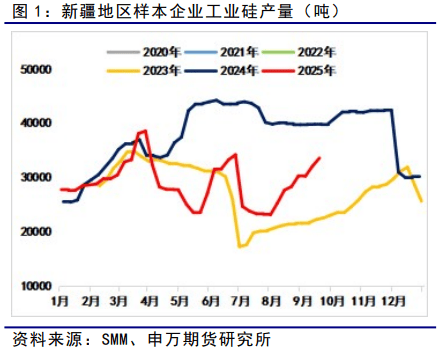
Core Viewpoint - The industrial silicon market is experiencing a short-term high-level fluctuation due to increased production in Xinjiang and strong coal prices providing cost support, despite overall inventory levels being high [3]. Supply - In Xinjiang, the weekly industrial silicon production increased by 0.15 million tons to 33.6 thousand tons, with the operating rate rising by 3.1% to 69.36% [2]. - In Yunnan, production slightly increased by 50 tons to 7,565 tons, while Sichuan's production remained stable at 2,135 tons [2]. Demand - The operating rates for recycled and primary aluminum alloys remained stable week-on-week, with a slight decrease in aluminum alloy spot prices [2]. - The weekly production of organic silicon DMC saw a minor increase, while spot prices remained stable; however, the production of polysilicon decreased by 200 tons to 31,000 tons, still at a high level [2]. Inventory - Social inventory of industrial silicon increased by 0.4 million tons to 543 thousand tons, remaining at a high level compared to the same period last year [2]. - Downstream industrial silicon inventory was stable at 221.5 thousand tons, and registered warehouse receipts totaled 49,874 hands, also stable week-on-week [2]. Price and Profit - As of September 19, the price in East China was 9,600 yuan/ton, up 100 yuan/ton week-on-week, with a basis of -1,705 yuan/ton, down 460 yuan/ton [2]. - The price of silicon coal in Xinjiang increased by 200 yuan/ton to 1,500 yuan/ton, leading to a decrease in industrial silicon production profits week-on-week [2].

PP:后期低位追空需谨慎,中期或是震荡市
Guo Tai Jun An Qi Huo· 2025-09-15 05:29
1. Report Industry Investment Rating - No information provided on the industry investment rating 2. Core View of the Report - Later, be cautious about short - selling at low levels for PP, and it may be a volatile market in the medium - term [1] - Short - term demand improves month - on - month, but the cost side remains weak. Supply pressure will increase in the future, but there are also positive factors such as holiday effects, potential Fed rate cuts, and uncertainties in the Middle East [2] 3. Summary by Relevant Catalogs 3.1 Fundamental Tracking - **Futures Data**: The closing price of PP2601 yesterday was 6913, with a daily decline of 0.43%. The trading volume was 255,093, and the open interest increased by 19,156. The 01 - contract basis was - 193, and the 01 - 05 contract spread was - 23 [1] - **Spot Price**: The spot price of PP in North China was 6700 - 6860 yuan/ton, in East China was 6720 - 6920 yuan/ton, and in South China was 6690 - 6900 yuan/ton yesterday [1] 3.2 Spot News - The domestic PP market declined slightly by 10 - 30 yuan/ton. Futures fluctuated at a low level, weakening cost support. Traders actively sold goods, and downstream demand was weak [2] 3.3 Market Condition Analysis - Short - term demand improves, but the cost side is weak. Supply pressure will increase due to the resumption of maintenance devices and new capacity expansion. However, there are positive factors such as holiday effects, potential Fed rate cuts, and uncertainties in the Middle East [2] 3.4 Trend Intensity - The trend intensity of PP is 0, indicating a neutral trend [3]