
供应收缩预期

Search documents
有色板块影响,镍不锈钢冲高回落
Hua Tai Qi Huo· 2026-01-27 05:13
Report Summary 1. Report Industry Investment Rating - Not provided in the content 2. Report's Core View - For the nickel market, the market divergence lies in the game between "supply contraction expectation" and "weak demand reality", with short - term prices being easily affected by policy news and capital sentiment, showing a wide - range oscillation pattern. For the stainless - steel market, the core contradiction is the balance between cost and demand. If the supply contraction in Indonesia materializes and the ferronickel price continues to rise, the cost support will strengthen, and the price is expected to maintain a high - level oscillation. If demand remains weak and inventories are high, the price may face downward pressure [2][3][6]. 3. Summary by Related Catalogs Nickel Variety - **Market Analysis** - **Futures**: On January 26, 2026, the Shanghai nickel main contract 2602 opened at 149,880 yuan/ton and closed at 145,380 yuan/ton, with a 0.25% change from the previous trading day's close. The trading volume was 730,480 (-22,360) lots, and the open interest was 59,283 (-9,313) lots. It showed a pattern of "rising and then falling, wide - range oscillation", rising due to the expected supply contraction in Indonesia and the linkage with LME nickel, but then falling under short - selling pressure [1][2]. - **Nickel Ore**: The nickel ore market remained stable overall. After continuous price increases in previous days, it entered a high - level consolidation stage, with a calmer trading atmosphere and increased wait - and - see sentiment. The mine end maintained firm quotes. In Indonesia, the market price remained stable, and there was an expectation that the February domestic trade benchmark price (HPM) might be further raised due to the rising nickel price [2]. - **Spot**: Jinchuan Group's Shanghai market sales price was 157,300 yuan/ton, up 4,600 yuan/ton from the previous day. Spot trading was average, and the spot premiums of refined nickel brands were stable with a slight decline. The previous trading day's Shanghai nickel warehouse receipts were 42,517 (450) tons, and LME nickel inventories were 285,552 (1,824) tons [3]. - **Strategy** - Market divergence is concentrated in the game between "supply contraction expectation" and "weak demand reality". Short - term prices are volatile. The strategy is mainly range - bound operation for the single - side, and no operations are recommended for cross - period, cross - variety, spot - futures, and options [3]. Stainless - Steel Variety - **Market Analysis** - **Futures**: On January 26, 2026, the stainless - steel main contract 2603 opened at 12,720 yuan/ton and closed at 14,645 yuan/ton. The trading volume was 365,984 (+18,855) lots, and the open interest was 155,289 (-4,171) lots. It showed a pattern of "rising and then falling, narrow - range decline", rising at the opening due to the cost - side nickel price but lacking upward momentum due to weak downstream demand and light spot trading [3][4]. - **Spot**: Recently, stainless - steel prices have risen, leading to increased downstream price - aversion sentiment. Actual trading was poor. The stainless - steel price in Wuxi market was 14,550 (+100) yuan/ton, and in Foshan market was 14,450 (+100) yuan/ton. The 304/2B premium was - 140 to - 40 yuan/ton. The ex - factory tax - included average price of high - nickel pig iron changed by 7.50 yuan/nickel point to 1,050.0 yuan/nickel point [5]. - **Strategy** - The core contradiction is the balance between cost and demand. Short - term strategy is range - bound operation, high - selling and low - buying with strict stop - loss. Medium - term, pay attention to policy and demand changes and wait for a clear trend before deploying single - side positions. The single - side view is neutral, and no operations are recommended for cross - period, cross - variety, spot - futures, and options [6].
“强现实”+“强预期” 碳酸锂期价创阶段新高!市场分歧加大
Qi Huo Ri Bao· 2026-01-24 23:56
Core Viewpoint - The recent surge in lithium carbonate futures prices, surpassing 180,000 yuan/ton, is driven by expectations of domestic supply contraction and improving demand dynamics [2][4]. Supply Dynamics - Concerns over supply contraction are heightened due to stricter regulations in the Jiangxi production area, with reports suggesting potential mine shutdowns [4]. - The current weekly production of lithium carbonate is approximately 22,200 tons, a decrease of 388 tons from the previous week, while weekly inventory has also declined by 783 tons to about 108,900 tons [6]. Demand Factors - The continuation of subsidies for new energy vehicles has positively influenced market expectations, with the National Development and Reform Commission and the Ministry of Finance announcing policies to extend subsidies for heavy trucks and buses [5]. - Despite a marginal reduction in subsidy strength, the timing of the policy has improved expectations for demand in the first quarter of 2026 [5]. Market Sentiment - There is a growing divergence in market sentiment, with downstream companies showing limited acceptance of high prices and reduced purchasing enthusiasm [7]. - The current high prices are seen as a potential trigger for previously shut-down production capacities to re-enter the market [7]. Inventory and Pricing Trends - The current inventory structure indicates low levels in the lithium salt plants and downstream sectors, while traders hold higher inventories [6]. - The static inventory days for downstream usage have decreased to 7-8 days, compared to the normal level of around 14 days in 2025, indicating strong demand [6]. Future Outlook - Analysts suggest that the market is entering a phase of "weak expectations" versus "strong expectations," with the current price levels stimulating supply increases [9]. - The impact of rising lithium carbonate prices on energy storage costs is significant, potentially affecting the profitability of storage projects [8]. - The market is advised to monitor actual demand developments closely, as the current price surge may not be sustainable without continued strong demand [9].

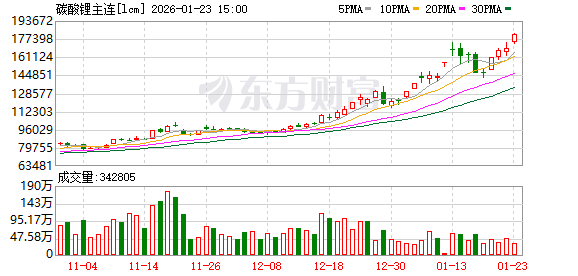
“强现实”+“强预期”,碳酸锂期价创阶段新高!市场分歧加大
Qi Huo Ri Bao· 2026-01-24 23:56
Core Viewpoint - The recent surge in lithium carbonate futures prices is attributed to a combination of domestic supply contraction expectations and positive demand trends [2][3]. Group 1: Supply Dynamics - Concerns over supply contraction are heightened due to stricter regulations and potential production halts in the Jiangxi region, which is a key lithium production area [2]. - Current lithium carbonate weekly production is approximately 22,200 tons, a decrease of 388 tons from the previous week, indicating a tightening supply situation [4]. - The inventory of lithium carbonate has been decreasing, with a weekly inventory of about 108,900 tons, down 783 tons from the previous week, suggesting strong demand despite the supply constraints [4]. Group 2: Demand Factors - The continuation of subsidies for new energy vehicles has improved market expectations, with the National Development and Reform Commission and the Ministry of Finance announcing policies that maintain previous subsidy levels for heavy trucks and buses [3]. - Strong orders in the energy storage sector, combined with adjustments to export tax rebates for battery products, are expected to support the lithium carbonate market in the early months of the year [3]. - Downstream demand remains robust, with no significant signs of weakness during the traditional "off-season," as indicated by the current low inventory levels [4]. Group 3: Market Sentiment and Price Trends - There is a growing divergence in market sentiment, with downstream companies showing limited acceptance of high prices and a cautious approach to purchasing [5]. - The current high prices are seen as a double-edged sword, potentially stimulating the re-entry of previously halted production capacities into the market [5]. - The rising prices of lithium carbonate are expected to impact demand, particularly in the energy storage sector, where costs are more sensitive to price changes [6]. Group 4: Future Outlook - The market is entering a phase of "weak expectations" versus "strong expectations," with the current price levels stimulating supply increases while demand needs to be closely monitored [7]. - Analysts suggest that while short-term demand may support prices, the sustainability of this demand and the potential for price stabilization remain uncertain [7]. - The focus will be on the actual realization of demand and the potential for systemic price corrections as the market adjusts to high price levels [7].
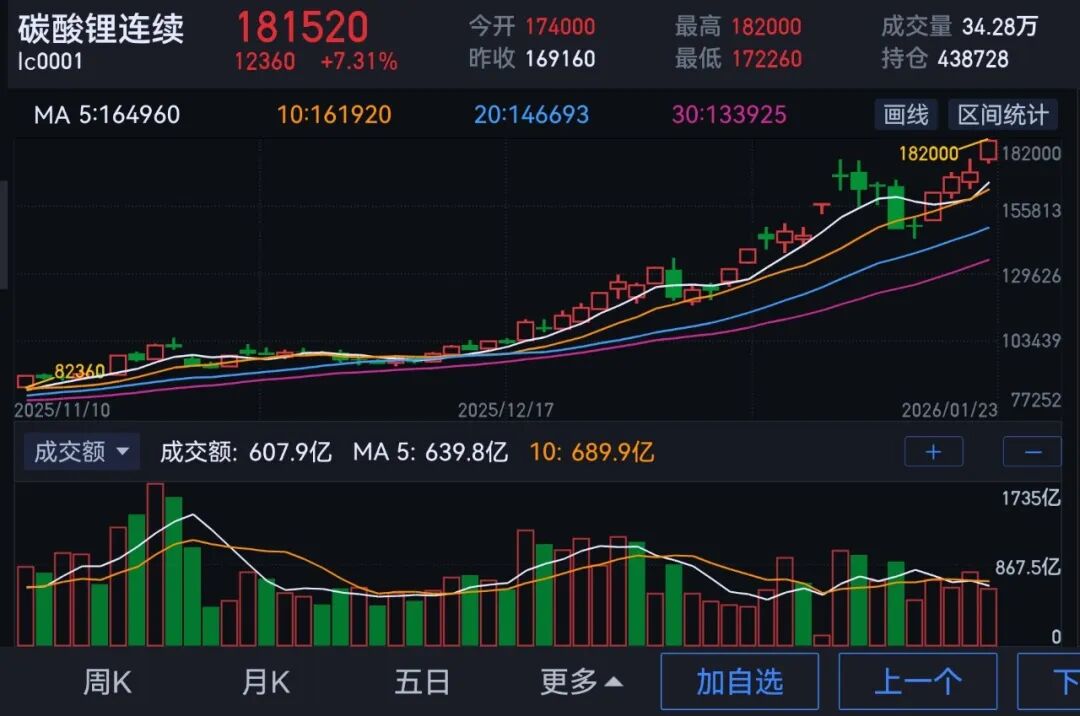
有色板块整体走高,镍不锈钢跟随上涨
Hua Tai Qi Huo· 2026-01-13 05:15
Report Summary 1. Report Industry Investment Rating No investment rating information is provided in the report. 2. Report's Core View - The nickel and stainless - steel sectors in the non - ferrous metals industry are affected by multiple factors, with prices showing different trends. The nickel price is expected to oscillate sharply between 135,000 - 150,000 yuan/ton, and the stainless - steel price is expected to fluctuate in the range of 13,400 - 14,500 yuan/ton [1][3][4]. 3. Summary by Related Catalogs Nickel Variety - **Market Analysis** - **Futures**: On January 12, 2026, the main contract of Shanghai nickel opened at 140,000 yuan/ton and closed at 144,200 yuan/ton, up 5.65% from the previous trading day. The trading volume was 1,083,202 (-38,224) lots, and the open interest was 124,148 (+3,553) lots. The price increase was driven by supply contraction expectations, macro - easing, and geopolitical risk premiums, along with the overall rise of non - ferrous and precious metals sectors [1]. - **Nickel Ore**: The nickel ore market was calm with limited resources. Affected by macro factors, the price was strong. Philippine mines were eager to sell at higher prices. In Indonesia, the February 2026 domestic trade base price was expected to rise by 2.8 - 4.9 dollars/wet ton, and the current mainstream premium was +25, with a range of +25 - 26. Factories might push down the premium due to cost pressure [1]. - **Spot**: Jinchuan Group's Shanghai market sales price was 150,600 yuan/ton, up 5,300 yuan/ton from the previous day. Spot trading was average, with strong reluctance to sell low - priced resources. The spot premiums of refined nickel were stable or rising. The previous trading day's Shanghai nickel warehouse receipts were 39,670 (+814) tons, and LME nickel inventory was 284,562 (-228) tons [2]. - **Strategy** - Due to the game between supply contraction expectations and the reality of the off - peak demand season, combined with short - term disturbances from macro sentiment and capital behavior, the price is expected to oscillate sharply between 135,000 - 150,000 yuan/ton. It is recommended to focus on range operations and be cautious when chasing high prices. The strategy for single - side trading is range - based, while there are no strategies for inter - period, inter - variety, spot - futures, or options trading [3]. Stainless - steel Variety - **Market Analysis** - **Futures**: On January 12, 2026, the main contract of stainless steel opened at 13,870 yuan/ton and closed at 13,855 yuan/ton. The trading volume was 256,679 (-44,151) lots, and the open interest was 128,736 (-4,171) lots. Affected by the rise of LME nickel, the night trading session opened high and moved high, and the daily trading session was suppressed by weak demand, with the price gradually falling and oscillating between 13,800 - 13,880 yuan/ton in the afternoon [3]. - **Spot**: The futures price increase drove the spot price up, but downstream buyers were reluctant to buy at high prices, resulting in poor inquiry and trading. The stainless - steel price in Wuxi market was 13,900 (+100) yuan/ton, and in Foshan market was 13,775 (+50) yuan/ton. The 304/2B premium was 115 - 315 yuan/ton. The ex - factory tax - included average price of high - nickel pig iron increased by 10.00 yuan/nickel point to 972.0 yuan/nickel point [3][4]. - **Strategy** - The uncertainty of Indonesian policies has a significant impact on the cost of stainless steel, which will be the main short - term price trend logic. The price is expected to fluctuate in the range of 13,400 - 14,500 yuan/ton. However, the dismal spot trading may suppress price rebounds. The single - side trading strategy is neutral, and there are no strategies for inter - period, inter - variety, spot - futures, or options trading [4].
报价试探性上涨,需求响应冷淡!供应收缩与高库存博弈下僵持格局!焦炭有五轮降价预期
Xin Lang Cai Jing· 2026-01-06 13:41
Market Overview - The thermal coal market is characterized by a stalemate between supply-side price support and weak demand response, with supply gradually recovering and port inventories decreasing, but actual transactions remain light due to high inventory levels at power plants and weak procurement from non-electric sectors [1][2][4] Supply Side - Main production areas are gradually resuming operations, with prices showing differentiation; some high-quality coal mines have raised prices by 5-10 yuan/ton due to slight demand recovery, while overall market activity remains low [2] - Port inventories have decreased to 28.37 million tons, down 120,000 tons day-on-day, with trade merchants reluctant to sell at low prices due to ongoing cost disadvantages, particularly for low-sulfur coal types [3] Demand Side - Daily coal consumption at power plants has slightly increased to 4.515 million tons, up 159,000 tons, but total inventory remains high at 110 million tons, limiting the need for large-scale procurement [4] - Non-electric sector demand is weak, with limited increases in coal usage from industries like cement and chemicals, leading to a cautious procurement stance [4] - Weather conditions are expected to bring some marginal increases in consumption, but overall temperatures are close to seasonal averages, limiting significant spikes in coal usage [4] Import Coal - Indonesian coal prices have risen to FOB $49-50 per ton due to export restrictions, while Australian coal prices are at FOB $77-78 per ton, with high shipping costs narrowing the price gap with domestic coal [5][6] - The terminal's acceptance of high-priced imported coal is low, with procurement focused on future contracts [7] Market Dynamics and Outlook - The current core contradiction in the market is between expectations of supply contraction and the reality of high inventories, with structural shortages in low-sulfur coal types but difficulties in trading ordinary coal types [8] - The market is in a phase of "weak reality and strong expectations," with no strong drivers to break the current balance; short-term coal prices are expected to remain volatile with limited upward movement until inventories decrease significantly [9]
供应收缩预期再度升温,多晶硅领涨新能源金属
Zhong Xin Qi Huo· 2025-11-27 01:42
Report Industry Investment Rating No relevant content provided. Core Viewpoints of the Report - Supply contraction expectations have intensified again, with polysilicon leading the rise in new energy metals. In the short - to - medium term, lithium carbonate has stopped falling due to tight supply - demand, and polysilicon prices may rise due to supply contraction expectations. In the long term, silicon supply contraction is expected, and the supply - demand surplus of lithium carbonate is narrowing [3]. - For industrial silicon, there is a situation of weak supply and demand during the dry season, and the price will fluctuate. For polysilicon, policy expectations have risen again, and the price will fluctuate and rebound. For lithium carbonate, demand expectations have boosted the price, which will oscillate at a high level [4]. Summary by Related Catalogs 1. Market Views Industrial Silicon - **Viewpoint**: During the dry season, supply and demand are both weak, and the silicon price will oscillate [8]. - **Information Analysis**: As of November 26, 2025, the spot price of industrial silicon is stable. The domestic inventory is 448,200 tons, a month - on - month decrease of 0.8%. In October, the domestic monthly output was 452,000 tons, a month - on - month increase of 7.5% and a year - on - year decrease of 3.8%. The export volume in October was 45,073 tons, a month - on - month decrease of 35.8% and a year - on - year decrease of 30.8%. The new photovoltaic installed capacity in October was 12.6GW, a month - on - month increase of 30.43% and a year - on - year decrease of 38.3%. The organic silicon industry may enter a production - cut and price - support stage [8]. - **Main Logic**: On the supply side, the number of open furnaces in the southwest has decreased rapidly, and the supply in the northwest fluctuates slightly. On the demand side, the demand from polysilicon and organic silicon industries may decline, and the demand from the aluminum alloy industry has limited growth. The social inventory is still at a high level, and attention should be paid to the progress of new warehouse receipts registration [8]. - **Outlook**: If the organic silicon industry cuts production, the demand for industrial silicon will weaken further, but the short - term market sentiment is volatile, so the price will oscillate [8]. Polysilicon - **Viewpoint**: Policy expectations have risen again, and the polysilicon price will fluctuate and rebound [8]. - **Information Analysis**: As of November 26, 2025, the average transaction price of N - type re -投料 is 53,200 yuan/ton, unchanged from the previous week. The number of warehouse receipts on the Guangzhou Futures Exchange is 7,270 lots. In October, the export volume decreased by 58% year - on - year, and the import volume decreased by 39.1% year - on - year. From January to October, the domestic new photovoltaic installed capacity increased by 39.5% year - on - year. The China Photovoltaic Industry Association will promote industry self - discipline and "anti - involution" work [9]. - **Main Logic**: Macroscopically, policy expectations have risen. In terms of supply, production in the southwest will decrease during the dry season, and long - term attention should be paid to the impact of anti - involution policies. In terms of demand, the demand has weakened since November. Overall, the demand has declined marginally, but the supply is also shrinking, and the anti - involution policy is expected to strengthen, so the price will maintain a wide - range oscillation [10][11]. - **Outlook**: The anti - involution policy can boost the price, but the demand is weakening, so the price will show a wide - range oscillation [11]. Lithium Carbonate - **Viewpoint**: Demand expectations have boosted the price, which will oscillate at a high level [8]. - **Information Analysis**: On November 26, 2025, the closing price of the lithium carbonate main contract increased by 0.99% to 96,340 yuan/ton, and the total position increased by 22,323 lots to 1,055,957 lots. The spot price of battery - grade lithium carbonate increased by 750 yuan/ton to 92,800 yuan/ton [11][12]. - **Main Logic**: Currently, supply and demand are both strong, and de - stocking is expected to continue from November to December. The supply is growing strongly but is restricted by ore shortages. The demand is good, and speculative demand may emerge. The social inventory is de - stocking, and attention should be paid to the resumption of production at Jiuxiaowo. In the long term, a bullish view is recommended [13]. - **Outlook**: In the short term, supply and demand are in a tight balance, and the price will oscillate at a high level [13]. 2. Market Monitoring No specific content provided for analysis. 3. Commodity Index - On November 26, 2025, the comprehensive index of CITIC Futures commodities showed that the commodity index was 2,241.06, up 0.12%; the commodity 20 index was 2,543.53, up 0.04%; the industrial products index was 2,200.67, up 0.03%; the PPI commodity index was 1,336.40, down 0.13% [54]. - The new energy commodity index on November 26, 2025, was 451.43, with a daily increase of 0.35%, a decrease of 0.33% in the past 5 days, an increase of 6.41% in the past month, and an increase of 9.47% since the beginning of the year [55].
宝城期货动力煤早报(2025年11月13日)-20251113
Bao Cheng Qi Huo· 2025-11-13 01:43
Group 1: Report Industry Investment Rating - No information provided Group 2: Core View of the Report - The reference view for power coal is to oscillate. The supply contraction expectation and downstream replenishment expectation support the coal price to run strongly. Attention should be paid to the strength of the peak season for thermal coal from this winter to next spring [5] Group 3: Summary by Related Catalog Price and Market Conditions - As of November 6, the quotation of 5500K at Qinhuangdao Port was 799 yuan/ton, with a week-on-week increase of 31 yuan [5] Supply Side - In the first week of November, the production of main - producing area coal mines was generally stable, and the supply was still lower than the same period last year. After the safety production inspection team entered in November, there was still some pressure on the recovery of power coal supply. In October, China imported 4173.7 million tons of coal and lignite, a decrease of 426.6 million tons from the previous month [5] Demand Side - As of the period of October 30, the daily coal consumption of power plants in 8 coastal provinces was 1.806 million tons, basically flat week - on - week; the daily coal consumption of power plants in 17 inland provinces was 3.335 million tons, a week - on - week decrease of 192,000 tons/day. The peak season for thermal coal demand has not started [5]
宝城期货贵金属有色早报-20251110
Bao Cheng Qi Huo· 2025-11-10 02:11
Report Summary 1. Report Industry Investment Rating - No industry investment rating is provided in the report. 2. Report's Core View - For gold, the short - term view is to maintain a wait - and - see attitude due to the Fed's hawkish stance and a relatively strong US dollar index. For copper, the long - term outlook is positive, supported by macro - economic easing and expected supply contractions [1]. 3. Summary by Variety Gold (AU) - **Price Performance**: Gold prices are in a high - level consolidation phase, with New York gold mainly fluctuating around the $4,000 key psychological level [3]. - **Core Logic**: The Fed's policy divergence dominates market sentiment, with some officials advocating a restrictive policy to control inflation and others open to rate cuts. The US government shutdown risk provides some safe - haven support for gold, while the strengthening US dollar suppresses gold prices. The short - term pullback of the US dollar index around 100 corresponds to a rebound in gold prices. Attention should be paid to the long - short battle at the $4,000 level of New York gold [3]. - **Viewpoint**: In the short - term (within a week), the view is "swing"; in the medium - term (two weeks to one month), it is "swing"; the intraday view is "swing - bullish", and the reference view is "wait - and - see" [1][3]. Copper (CU) - **Price Performance**: Last week, Shanghai copper showed a trend of reducing positions and falling, and the main contract price stabilized around 85,000 yuan, with a slowdown in the decline of open interest [4]. - **Core Logic**: The Fed's hawkish stance has cooled the market sentiment, and LME copper is at a five - year high, causing short - term long - position closure. However, in the long - run, macro - economic easing and supply contractions are expected to support copper prices. Attention should be paid to the technical support at the 85,000 yuan level [4]. - **Viewpoint**: In the short - term, the view is "bullish"; in the medium - term, it is "strong"; the intraday view is "swing - bullish", and the reference view is "long - term bullish" [1][4].
午后铜价增仓上行
Bao Cheng Qi Huo· 2025-10-29 09:58
Report Summary 1. Investment Rating No investment rating for the industry is provided in the report. 2. Core Views - **沪铜**: In the afternoon of the day, the macro - atmosphere warmed up, and the copper price increased with rising positions. The main contract price broke through the high on Monday and approached the 89,000 mark. LME copper also broke through the high in May 2024 during the session. The warming of both domestic and foreign macro - environments, combined with the expected supply contraction, led to the continuous increase in copper price with rising positions [4]. - **沪铝**: In the afternoon, the macro - atmosphere warmed up, and the aluminum price increased with rising positions. As the macro - environment improved and the copper price rose strongly, the aluminum price followed. At the industrial level, the inventory of downstream aluminum rods decreased, while the inventory reduction of intermediate electrolytic aluminum slowed down due to the high aluminum price. Technically, attention should be paid to the pressure at the previous high [5]. - **沪镍**: In the afternoon, the position of Shanghai nickel decreased while the price rebounded, especially at the end of the session. Previously, when the macro - environment improved and non - ferrous metals prices rose, nickel rebounded with a decreasing position but lacked strength. With the improvement of the macro - environment today, the nickel price rebounded again with a decreasing position. Technically, attention should be paid to the pressure at the high on Monday [6]. 3. Summary by Directory 3.1 Industry Dynamics - **Copper**: The Trump administration in the United States on Friday overturned an air - pollution regulation of the previous administration, which imposed stricter restrictions on the emissions of copper smelters. The copper rule finalized in May 2024 required smelters to control pollutants such as lead, arsenic, mercury, benzene, and dioxins according to the latest US federal air standards. The US announcement provided a two - year exemption for affected fixed sources, aiming to promote US mineral security by reducing the regulatory burden on domestic copper producers [8]. - **Nickel**: On October 29, the price of SMM1 electrolytic nickel was 120,400 - 123,400 yuan/ton, with an average price of 121,900 yuan/ton, a decrease of 250 yuan/ton compared to the previous trading day. The mainstream spot premium quotation range of Jinchuan 1 electrolytic nickel was 2,300 - 2,500 yuan/ton, with an average premium of 2,400 yuan/ton, an increase of 100 yuan/ton compared to the previous trading day. The spot premium and discount quotation range of domestic mainstream brand electrowinning nickel was - 300 - 100 yuan/ton [9]. 3.2 Relevant Charts - **Copper**: The report presents multiple charts related to copper, including domestic visible inventory (social inventory + bonded area inventory), LME copper cancelled warrant ratio, overseas copper exchange inventory, SHFE warrant inventory, copper monthly spread, etc. These charts show the inventory and price spread trends of copper from different aspects [10][11][12]. - **Aluminum**: The charts for aluminum include the aluminum basis, electrolytic aluminum domestic social inventory, alumina inventory, aluminum monthly spread, electrolytic aluminum overseas exchange inventory (LME + COMEX), and aluminum rod inventory, which reflect the market situation of aluminum [20][22][24]. - **Nickel**: The nickel - related charts cover the nickel basis, LME inventory, LME nickel price trend, SHFE inventory, nickel ore port inventory, and nickel monthly spread, providing information on the nickel market [32][34][36].
南华期货玻璃纯碱产业周报:供应政策预期,盘面反复-20250928
Nan Hua Qi Huo· 2025-09-28 12:49
Report Industry Investment Rating No relevant content provided. Core Viewpoints of the Report - The core contradictions affecting the trends of glass and soda ash include supply contraction expectations and the current weak balance state of glass and high - production and high - inventory situation of soda ash. The trading logic lies in expectations that are difficult to be falsified in the short term [1]. - In the short term, glass is prone to rise and difficult to fall, and soda ash follows. The情绪 for glass has not fully released [6]. - The demand for glass is currently weak with high inventories in the upper and middle reaches, and the demand for soda ash remains stable [54][66]. Summary by Relevant Catalogs Chapter 1: Core Contradictions and Strategy Recommendations 1.1 Core Contradictions - Supply contraction expectations: There may be industrial policies. For glass, there are disturbances such as coal - to - gas conversion in Shahe, and there is an expectation of petroleum coke - to - gas conversion next year, which implies cost increase. Soda ash has no clear indication and its price fluctuates with glass or market sentiment [1]. - In reality, glass is in a weak balance with high middle - stream inventories, and without real production cuts, the upward price elasticity is limited. Soda ash has high production and high inventories, with strong upward pressure, but the price is supported by expectations [1]. - Near - term trading logic: Glass has general real - world demand but some speculative demand, and the middle - stream still has "water - storage capacity". Soda ash follows coal prices and glass, but is suppressed by high near - term inventories and production, while upstream soda ash plants currently have limited pressure due to downstream replenishment at low prices [2]. - Long - term trading expectations: There are expectations of cost increase, mainly from coal prices, and whether the supply contraction expectations will be fulfilled, mainly related to industrial policies. When the expectations cannot be falsified, the futures market may be prone to rise and difficult to fall [3]. 1.2 Trading - Type Strategy Recommendations - Trend judgment: In the short term, glass is prone to rise and difficult to fall, and soda ash follows [6]. - Month - spread strategy: Without substantial cold - repair or production cuts in glass, continue to focus on the 1 - 5 reverse spread [6]. - Hedging arbitrage strategy: Consider going long on glass and short on soda ash [6]. 1.3 Industry Customer Operation Recommendations - Price range prediction: The price range of glass is predicted to be 1000 - 1400, and that of soda ash is 1100 - 1500 [6]. - Hedging strategies: Different hedging strategies are recommended for glass and soda ash in terms of inventory management and procurement management, including futures trading and option trading [6]. 1.4 Basic Data Overview - Glass spot prices: The average price of glass in Shahe decreased slightly, and prices in different regions showed different trends [8]. - Glass futures prices and month - spreads: The prices of glass futures contracts decreased, and the month - spreads changed [9]. - Soda ash spot prices: The prices of soda ash in different regions remained stable [11]. - Soda ash futures prices and month - spreads: The prices of soda ash futures contracts decreased, and the month - spreads changed [12]. Chapter 2: This Week's Important Information and Next Week's Attention Events 2.1 This Week's Important Information - Bullish information: There were rumors of a glass industry symposium, and relevant departments issued a work plan for the building materials industry. The upstream inventories of glass and soda ash decreased, with glass inventory (factory warehouse) down 2.55% week - on - week and 18.56% year - on - year, and soda ash factory inventory down 10.41 tons week - on - week [13]. - Bearish information: The inventory of Shahe's spot - futures reached a new high this year, and the soda ash delivery warehouse inventory increased, with the total inventory of factory and delivery warehouses at an absolute high [14]. 2.2 Next Week's Important Events to Follow - Whether there are further clear instructions on industrial policies [16]. - The downstream transmission situation after the spot price increase [16]. - Track daily production and sales [16]. Chapter 3: Futures Market Interpretation - Unilateral trends and capital movements: The main contracts of glass and soda ash maintained a position of over one million hands, in line with the seasonality. The price difference between the two narrowed, and neither showed a good trend. Glass once rose due to supply contraction expectations and spot price increases, but then declined as the sentiment subsided [16]. - Basis and month - spread structure: Glass generally maintains a C - structure, and the 1 - 5 reverse spread idea is maintained in logic. Soda ash also maintains a C - structure, with limited short - term month - spread opportunities [31][33]. Chapter 4: Valuation and Profit Analysis 4.1 Upstream and Downstream Profit Tracking in the Industrial Chain - Glass: The theoretical cost changes little. Natural gas production lines are in loss, while petroleum coke and coal - gas production lines still have profits. Glass factories have limited willingness to cold - repair at current prices [38]. - Soda ash: The cash - flow cost of the ammonia - soda process in Shandong is around 1170 yuan/ton, and the full cost is 1300 - 1320 yuan/ton. The full cost of the combined - soda process (mainly in Central China) is 1200 yuan/ton. There are still profits in the soda ash industrial chain at current prices [38]. 4.2 Import and Export Analysis - Glass: The monthly average net export of float glass is 5 - 7 tons, accounting for 1.2% - 1.3% of the apparent demand, with limited impact [45]. - Soda ash: The monthly average net export of soda ash is 16 tons, accounting for 5.6% of the apparent demand, and the export in August was slightly higher than expected, maintaining high expectations [45]. Chapter 5: Supply, Demand, and Inventory 5.1 Supply - Side and Projections - Glass supply: The daily melting of glass has slightly increased, and there may be ignition plans for some production lines in the fourth quarter. Attention should be paid to the impact of coal - to - gas conversion in Shahe and industrial policies on glass production capacity [49]. - Soda ash supply: The production of soda ash fluctuates slightly with planned maintenance, and high supply is maintained [52]. 5.2 Demand - Side and Projections - Glass demand: This week, the spot price increase improved the shipment, but the overall demand is weak with high inventories in the upper and middle reaches [54]. - Soda ash demand: The daily melting of float and photovoltaic glass is stable, and the rigid demand for soda ash remains stable. The fundamentals of photovoltaic glass have improved significantly [66]. 5.3 Inventory Analysis - Glass: The factory inventory of glass decreased, but the middle - stream inventories in Shahe and Hubei are at a high level [75]. - Soda ash: The factory inventory of soda ash decreased, and the inventory in the delivery warehouse increased. The total inventory decreased, and the pressure on soda ash plants continued to ease [76].