
牛市

Search documents
策略周报:衡以待:行情下半场的配置思路-20260131
Guoxin Securities· 2026-01-31 12:52
Core Conclusions - The A-share market typically exhibits balanced performance during spring rallies, with both growth and value sectors showing gains. In the latter half of bull markets, sector differentiation tends to converge, leading to a more uniform upward trend [1][2] - Recently, previously lagging sectors such as liquor and real estate have performed well, indicating a structural convergence in the market as it enters the latter half of the bull market and spring rally [1][3] - The equity market is expected to remain stable with potential for further upward movement. A balanced allocation strategy is recommended, with a focus on technology represented by AI applications, as well as traditional assets like liquor and real estate, and upstream cyclical sectors [1][3] Historical Context - Historically, during spring rallies since 2005, both growth and value styles have performed similarly, with average maximum gains of 24.0% for growth and 23.5% for value [2][14] - The current market is still within a bull market atmosphere that began in September 2024, with significant structural differentiation observed. The latter half of bull markets typically sees a more balanced performance across sectors [2][18] Market Dynamics - The recent A-share market has shown notable sector rotation, with the performance gap between styles narrowing. Since December 17, 2025, the spring rally has gradually unfolded, supported by broad-based ETFs, flexible foreign capital, and leveraged funds [1][11] - As of January 23, 2026, the industry rotation strength in the A-share market was at a historical low of 18% over the past five years, but there has been a recent uptick, suggesting that structural rotation may be beginning [12][14] Future Outlook - The current spring rally is expected to continue, with historical comparisons indicating a potential index increase of around 20%. The maximum increase of the Shanghai Composite Index since December 17, 2025, has only been 9.8%, indicating room for growth [3][30] - Continued macroeconomic policy support is anticipated to provide a fundamental basis for market growth, with a focus on stabilizing the real estate market as indicated by recent government statements [30][31] Sector Allocation - The technology sector, particularly driven by the AI wave, remains a key focus, with expectations for the rally to expand from hardware to application sectors. Recent developments in AI applications have been notable, suggesting a shift towards practical implementations [31][32] - In addition to technology, traditional value sectors such as undervalued liquor and real estate assets are also recommended for consideration in the current market environment [31][32]
按这种节奏,这轮牛市又将走成一地鸡毛
Sou Hu Cai Jing· 2026-01-29 10:13
Group 1 - The A-share market has experienced a historical 17 consecutive days of gains in the Shanghai Composite Index from December 22 to January 12, indicating a strong bullish trend [2] - Despite efforts from the "national team" to suppress the market, the trend of speculative stocks continues to rise, while quality stocks are facing declines, which contradicts value investing principles [2] - The current market situation reflects a scenario where poor-performing stocks are thriving at the expense of quality stocks, leading to concerns about the effectiveness of the national team's market control measures [2] Group 2 - There is a suggestion for the national authorities to implement measures sooner to prevent market instability, as current regulatory responses may be too late to address the ongoing speculative activities [3]


A股三次大牛市:启动、上涨与终结
泽平宏观· 2026-01-28 16:05
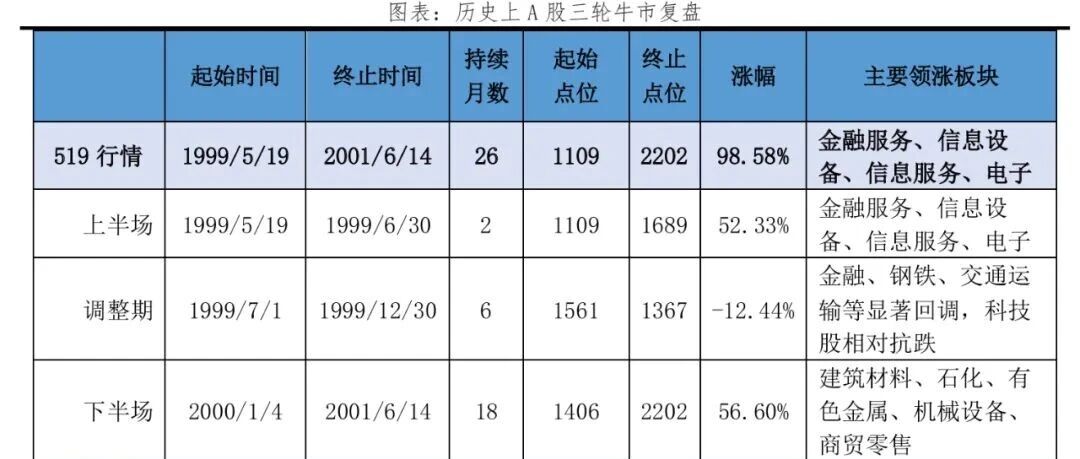
Core Viewpoint - The article analyzes the historical patterns of major bull markets in A-shares, focusing on the recent "confidence bull" market ignited by unprecedented macroeconomic easing policies and the AI technology wave since late September 2024 [2][11]. Group 1: Historical Bull Markets - The three major bull markets in A-shares are identified: the 1999-2001 "519 market," the 2005-2007 cyclical bull market, and the 2014-2015 reform bull and water bull [3][11]. - The "519 market" began during economic downturns with policy stimuli, leading to a 98.6% increase in the Shanghai Composite Index over 26 months, but ended due to valuation bubbles and profit failures [4][17][23]. - The 2005-2007 cyclical bull market was driven by fundamental improvements and lasted 28 months, with a 513.6% increase, ending due to the 2008 financial crisis and tightening policies [5][25][38]. - The 2014-2015 bull market was characterized by policy-driven growth and a lack of fundamental support, resulting in a 148.96% increase over 11 months, concluding with regulatory tightening and profit realizations [6][49][53]. Group 2: Key Discoveries from Bull Markets - Seven key findings from the analysis of past bull markets include the necessity of policy shifts, capital inflows, and low valuations for market initiation, as well as the typical three phases of policy-driven, capital-driven, and fundamental-driven growth [7][55]. - A-shares exhibit characteristics of short bull markets and long bear markets, with an average bull market duration of 17.35 months compared to 27.12 months for bear markets [8][55]. - The first half of bull markets is primarily driven by policy and sentiment, averaging 6.3 months with a 59.41% increase, while the second half relies on fundamental and profit growth, averaging 12.5 months with a 130.25% increase [8][56]. Group 3: Current "Confidence Bull" Market - The current "confidence bull" market shares similarities with previous bull markets, starting from economic downturns and low valuations, driven by macroeconomic easing and a new wave of technological advancements [9][63]. - The bull market is characterized by three strong drivers: continuous policy easing, a new technological revolution, and abundant liquidity, indicating a combination of policy, technology, and liquidity-driven growth [59][61]. - The article emphasizes the importance of maintaining supportive macroeconomic policies, promoting technological innovation, and ensuring the stability of the real estate market to sustain the current bull market [9][63].
现在已经牛市后期了吗?
集思录· 2026-01-28 13:53
今天出差,发现座位左边在看股票,右边也在看股票,到了目的地,发现在项目的人个个都在看股票,最后一个从来不聊股票的群,今天 都在聊什么有色行情,AI行情,这让我感到恐惧,集友们有什么观察吗,分享一下。 小白律师 现在是中场休息时间。 即使是中国式疯牛,也不是一百连阳没有回调的。 07年的6月,15年的1月都出现过长达一个月的中等幅度回调。 这之后才会进入后半场。 牛市来之不易,且行且珍惜。 陪伴成长 我再等等,等到有人教我炒股的时候。。。 CarryCai 早着呢,现在还有人亏损,有人卖飞,有人才新进坑。。。还需要等这批人赚到甜头,逐渐都梭哈,他们都坚定持有了,才算牛市后期。 林之夕 在我赚钱之前都不相信牛市结束。 指标狂人 身边好几个亲戚朋友都进场了,刚进场赚了几百块得瑟得很,哈哈!看看什么时候收割! 来自地球1984 牛二阶段,自己的接连卖飞 周围人偷偷炒股。 lw0w 看图说话 | 23:50 | | | 司花顺 App | | ·II 6 O | | | --- | --- | --- | --- | --- | --- | --- | | | | | A股平均股价 | | | | | | | | 83 ...

不对劲了!系好安全带,周三,A股走势分析
Sou Hu Cai Jing· 2026-01-27 14:08
Group 1 - The market is currently experiencing a complex situation, with small-cap stocks undergoing corrections while large-cap indices remain stable, indicating no immediate risk in major indices like the Shanghai 50 and CSI 300 [1] - There has been a significant reduction in holdings by large investors, including substantial sell-offs of broad-based ETFs, leading to a volatile market environment where small-cap stocks fluctuate frequently [3] - The current market sentiment suggests that investors should avoid impulsive trading and instead wait patiently for a market turnaround, as many are likely to face emotional challenges during this period [3] Group 2 - The A-share market is expected to continue a trend of upward fluctuations, with potential for a rebound in Hong Kong stocks followed by a catch-up in A-shares, particularly in sectors like real estate and finance [5] - The market is characterized as one of the most unpredictable in history, with a focus on undervalued blue-chip stocks rather than speculative small-cap stocks, which have historically led to losses for retail investors [5] - There is a likelihood of new highs being reached in the market, contingent on the behavior of large investors, with sectors such as banking, securities, insurance, and liquor poised for potential rebounds [7]

普徕仕:维持股票资产正面看法 增加对美国小型股配置
Zhi Tong Cai Jing· 2026-01-27 08:23
不过,历史经验显示,牛市并不会单纯因时间流逝而结束。即使目前估值偏高,但仍未达到以往周期的 极端水平。看好一方亦指出,多项支持因素仍然存在,包括企业盈利预期依然稳健、人工智能(AI)受惠 范围持续扩大、财政政策支持、资本开支增加、监管环境趋于宽松、并购活动回升,以及贸易紧张局势 逐步降温。 普徕仕(T.Rowe Price)表示,美国股市的牛市周期现已踏入第四年,过去三年均录得双位数升幅,令市 场开始再度关注升势能否延续。诚然,股市连续多年上升并不罕见,但连续四年录得双位数回报的情况 却相当少见。在宏观环境有利及基本面稳健的支持下,普徕仕对股票资产维持正面看法。鉴于估值仍属 合理,加上盈利前景向好、利率回落,以及监管松绑与并购活动、首次公开招股(IPO)等利好因素,该 行增加了对美国小型股的配置。 看淡一方指出,多项不确定因素正逐步浮现,包括估值水平偏高、市场升势集中于少数股份、美联储在 领导层变动下的政策方向仍存变数、劳动市场出现降温迹象,以及美国中期选举带来的政治风险。 ...
贺博生:黄金强势上涨空单 原油今日行情最新操作建议
Xin Lang Cai Jing· 2026-01-26 10:52
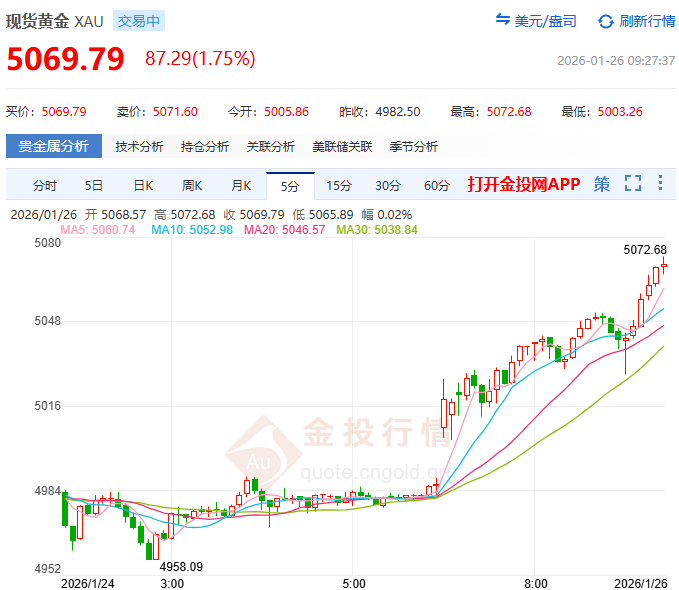
黄金最新行情趋势分析: 1月26日,黄金消息面解析:金价周一(1月26日)突破每盎司5000美元关口,并继续冲高,接08:55, 现货黄金一度创下历史新高至5051.94美元/盎司,涨幅约1.32%。市场在地缘政治不确定性加剧背景下 持续寻求避险资产。美国银行最近发布的报告引发广泛关注,该机构将短期黄金价格目标上调至每盎司 6000美元,这不仅是主要金融机构中最激进的预测,也预示着黄金市场可能迎来新一轮强劲牛市。这一 预测基于历史牛市经验、市场供需动态以及宏观经济因素的综合分析,预计黄金价格将在2026年春季实 现这一里程碑式跃升,较当前历史高点上涨近10%。 黄金技术面分析:黄金上周五日间如期冲高至4966一线,再度刷新历史纪录,随后欧盘展开技术性回调 至4900附近。此走势完全符合创新高后的常规市场行为——多头部分获利了结引发回踩,但整体结构仍 稳固运行于大趋势多头格局之中。技术层面传递出清晰信号:1小时布林带收口,显示短期动能进入整 理;4小时级别趋势完好,但急需一次健康的回调来修复超买指标并巩固升势基础。不用看都是多头走 势,全部都是大阳线起飞,底部呈现圆弧底的形态,k线始终站稳均线,始终踩着均线上行 ...
金荣中国:黄金突破5000美元继续上看
Sou Hu Cai Jing· 2026-01-26 07:10
周线级别,金价上周强势拉升,冲出布林带上轨之外,本周也继续运行在其之外,有调整走低的风险预 期,但布林上轨则转为支撑,如回撤触及,则也是入场看涨机会。 展望本周周一(1月26日):国际黄金高开至5005.58美元/盎司后继续走强,如期验证去年就说道的2026年 金价将最少触及5000美元的观点。其美元指数低开走弱,IMF表示美元全球外汇储备占比跌破60%,暗 示美元吸引力下降,以及周末地缘局势和不确定性再度升级,继续助力金价。 日内可留意美国11月耐用品订单月率及美国1月达拉斯联储商业活动指数等数据,市场预期偏向利空金 价,但预计压力有限,受周末局势风险推动,包括特朗普称美国将取得格陵兰岛美军基地所在区域"主 权"、美航母打击群已抵达印度洋;伊朗官员称伊武装力量已进入全面戒备状态、美参议院民主党誓言 阻挠国土安全部拨款,政府停摆风险再起等等,将会在短期内持续对金价产生利好,故此,周内金价将 继续保持看涨上行,下方将关注布林带上轨支撑和5日均线支撑位再度的入场点。 日图,金价目前自突破上升趋势通胀阻力之后,连续反弹走强,多头动力加强,暗示阻力有效突破,行 情已经稳健迈向新的牛市空间,之前的上升趋势阻力则转为支撑 ...

史诗级牛市!黄金突破5000美元大关 白银迈入“三位数”时代
Jin Tou Wang· 2026-01-26 03:13
周一(1月26日)亚市早盘,贵金属市场迎来历史性时刻,现货黄金历史首次突破5000美元/盎司整数大 关,距离其首次突破4000美元关口(2025年10月8日)仅过去100余日,本月累涨730美元。现货白银同 步刷新纪录,银价首次突破107美元/盎司关口,日内涨幅扩大至3.6%,本月累涨超35美元。 现货铂金上涨逾3%,首次站上2800美元/盎司,今年首月累涨约37%,或755美元,将历史新高刷新至 2862美元/盎司附近。 沪银主力合约日内暴涨14.00%,现报27639.00元/千克。纽约期银日内暴涨6.00%,现报107.43美元/盎 司。铂主力合约日内涨幅扩大至12.00%,现报760.85元/克。钯主力合约日内涨幅达8.00%,现报539.00 元/克。 投资者在地缘政治紧张局势加剧之际,纷纷寻求避险资产。美国与北约盟友就格陵兰岛问题不断升级的 摩擦,进一步推高了今年以来的金价,原因是市场预期未来金融和地缘政治的不确定性将进一步加剧。 受美国宽松货币政策、各国央行需求以及ETF资金流入创纪录等因素支撑,黄金价格在2025年上涨逾 64%。 目前COMEX金银比价已下行至48,为近50年的低位。当前地缘 ...
廖市无双-如何应对当下指数分化格局
2026-01-26 02:49
Summary of Conference Call Records Industry Overview - The current market is experiencing a bull market that has lasted for 24 months, entering its mid-to-late stage, benefiting from a downturn in the real estate and trust industries, leading to capital inflow into the securities market. The outlook for the next decade remains positive, but the spring offensive in 2026 should be viewed as a mid-game break [1][4]. Market Performance - The Shanghai Composite Index has shown slight upward movement, while the Shanghai 50 and CSI 300 have entered a correction phase, indicating a consolidation of heavyweight indices. Conversely, small and mid-cap growth stocks have performed strongly, with the CSI 500, CSI 1000, and National CSI 2000 reaching new highs since September 2024 [1][5][6]. - In the recent week, 17 out of 24 sectors in the Shenwan primary industry index saw gains, with small and mid-cap sectors showing significant excess returns [7]. Sector Analysis - Underperforming sectors include construction materials, oil and petrochemicals, steel, real estate, environmental protection, and textiles, while sectors such as non-ferrous metals, defense, and basic chemicals have shown strong performance [8]. - The recent rebound in underperforming sectors is attributed to the market entering a mid-to-late stage, with a rotation and broad-based rally emerging. Stocks that had been stagnant are beginning to rise, particularly in construction materials and oil and petrochemicals [9]. Investment Strategy - A dual strategy is recommended: 1. Invest in indices like CSI 500, CSI 1000, and National CSI 2000 for relative returns. 2. Focus on sectors with high growth potential and reasonable valuations, such as electronics, semiconductor storage, and renewable energy [3][14]. - Investors are advised to avoid panic selling due to corrections in heavyweight indices, as adjustments are not expected to be severe. Short-term strategies should avoid blind chasing of high prices [12][13]. Future Market Outlook - The heavyweight indices may continue to adjust, while growth indices like CSI 500 and CSI 1000 are expected to maintain upward momentum. The Shanghai Composite Index is currently above the 20-day moving average, indicating potential for upward movement, but caution is advised as the slope has flattened [11]. Regulatory Impact - New regulations set to take effect on March 1 will require disclosure of deviations and gradually increase external monitoring, leading to a decrease in investment freedom. Prior to this, optimizing portfolios for maximum returns is essential, while post-regulation, a focus on balanced allocation will be necessary [22][25]. Key Focus Areas - Attention should be given to the banking and non-banking financial sectors, which have seen significant declines. The telecommunications sector also requires close monitoring due to signs of weakness in leading stocks [10]. Conclusion - The market is characterized by structural differentiation, with small-cap stocks showing superior performance. Investors should remain vigilant and adjust strategies according to market conditions, particularly during the spring rally period [21][23].