
地缘政治

Search documents
美媒:访问委内瑞拉前夕,美国能源部长仍辩称“特朗普政府并没看中该国石油财富”
Huan Qiu Wang· 2026-02-09 12:29
1月3日,美军对委内瑞拉发动大规模军事打击,强行控制委总统马杜罗及其妻子并将他们带到美国。特朗普称,美国将"管理"委内瑞拉直至实施"安全"过 渡,美大型石油企业将进入委内瑞拉投资。 事件发生后,特朗普屡次在公开场合谈及委内瑞拉的石油开采问题。特朗普1月9日在白宫与美国大型石油企业高管举行会议,他向高管们施压,要求他们迅 速推动在委内瑞拉的石油开采投资。 尽管美国石油巨头大多对进入委内瑞拉石油市场持观望态度,但部分跨国贸易集团已率先开始了对委库存石油的销售。特朗普1月21日在瑞士达沃斯举办的 世界经济论坛年会上发表演讲时说,"上周我们从委内瑞拉获取了5000万桶原油。" 据报道,赖特主张,特朗普政府的对委行动"并非是为了获得更多石油供应",该国的原油储量从来都不是"决策过程中的重要因素"。"这是一个地缘政治问 题,委内瑞拉对所有邻国、对整个西半球都构成威胁。委内瑞拉的主要产品和巨大资源储量正好是石油,这或许只是一个巧合。"赖特辩称。 赖特补充说,他此次访问委内瑞拉的首要任务是"与委内瑞拉人进行面对面的直接交流",包括委政府官员和石油天然气行业的领导层。他还表示,他计划与 委内瑞拉官员就委内瑞拉国家石油公司的未来 ...


中俄混合双打!稀土断供能源告急,日本制造业陷入窒息,这一仗该怎么打的?
Sou Hu Cai Jing· 2026-02-09 10:45
Group 1 - The atmosphere in Japan's precision manufacturing sector is increasingly tense, as companies reflect on the implications of slowing production due to critical resource shortages, particularly from China and Russia [1][3] - Japan's reliance on rare earth elements, such as dysprosium and terbium, is highlighted, with recent changes in import approval processes causing significant delays for Japanese companies, impacting their production lines [3][5] - The long-standing support of a cost-effective Chinese supply chain is now under threat, leading to rising production costs and extended delivery timelines for Japanese manufacturers [5][7] Group 2 - Japan faces dual pressures from resource limitations and geopolitical tensions, particularly with Russia's military activities affecting fishing and energy transport routes [5][7] - The nationalization of the Sakhalin-2 project by Russia has eliminated Japan's investments in the project, severely impacting its natural gas supply and increasing energy costs, which undermines the potential for manufacturing to return to Japan [8][10] - Japan is experiencing comprehensive constraints on resources, technology, and energy, signaling a decline in its industrial power and emphasizing the interconnectedness of global supply chains and geopolitical realities [10]

懒人财知道:2月9日复盘总结 氧化铝小作文诱导多空双杀 生猪怕还要新低
Xin Lang Cai Jing· 2026-02-09 08:55
Core Viewpoint - The global commodity market is experiencing increased volatility and overall weakness, influenced by geopolitical tensions, a stronger dollar, and diverging global economic growth expectations [3][15]. Group 1: Market Overview - The energy sector is expected to face downward pressure on oil prices due to anticipated supply being relatively loose [15]. - Precious metals are showing a "short-term pullback, long-term bullish" trend, with gold prices supported by global uncertainties and ongoing central bank purchases [15]. - Industrial metals are experiencing significant differentiation, with demand for metals related to new energy, AI, and power transition remaining resilient [15]. - The competition for strategic resources like rare earths is intensifying, with supply chain security becoming a key focus for various countries [15]. Group 2: Commodity Trends - The overall trend in commodities is characterized as oscillating, with strong bullish sectors including non-ferrous metals, precious metals, and energy chemicals, while agricultural products are underperforming [16]. - Notable bullish commodities include tin, gold, lithium carbonate, and alumina, while bearish markets include rebar, iron ore, hot-rolled steel, and live pigs [16]. - The global financial market is maintaining a mixed oscillating pattern, with stable macro sentiment and no extreme risks or strong stimulus policies impacting commodity pricing [16]. Group 3: Trading Strategies and Performance - The company executed a bearish strategy on caustic soda, achieving a maximum profit of 25% before exiting the position [17]. - A bearish strategy was also implemented for live pigs, with entry points set between 11,500-11,600, stop-loss at 11,700-11,800, and take-profit at 11,400-11,300, based on supply and inventory fundamentals [17]. - Alumina is being closely monitored due to its significant price increase, indicating a strong bullish trend [18]. Group 4: Reflections and Future Strategies - The effectiveness of trend trading is highlighted, with caustic soda continuing its downward trend and alumina experiencing rapid upward movement [21]. - The market is showing extreme differentiation, necessitating a focus on strong trend commodities while avoiding weak and volatile trades [21]. - Strict risk management practices are in place, including position limits and defined stop-loss and take-profit levels, with ongoing monitoring of alumina's bullish trend and live pigs' bearish trend [21].

金荣中国:金价早盘高开大涨反弹,关注预期承压回落走低
Sou Hu Cai Jing· 2026-02-09 08:46
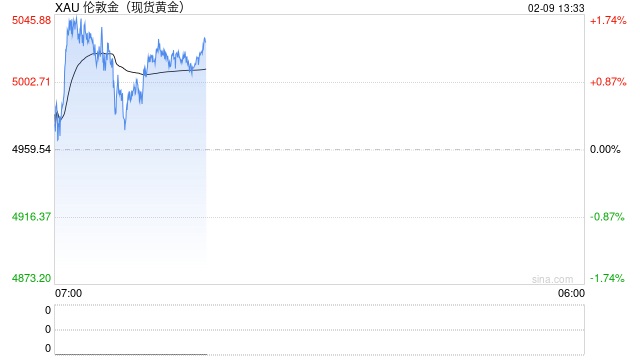
基本面: 周一(2月9日)黄金价格早盘高开大涨,随后大跌,市场短线追空或者等地回落支撑位多单布局,金价早盘上演绝地反击,单日狂飙近4%,现货价格一度 逼近每盎司4955美元,周线顽强收涨。现货黄金延续涨势,一度上涨1.7%至5046.15美元/盎司。与此同时,白银的波动更为剧烈,上周五盘中暴跌后10%后 大幅反弹,收盘上涨逾9%,收报77.50美元/盎司,波动幅度令人咋舌,周一续涨3%至79.90美元/盎司。这绝非简单的技术性反弹,其背后是美元指数的微妙 转向、中东地缘政治"火药桶"引信的忽明忽暗、以及全球央行政策路径的混沌交织。 本次金价暴力拉升,最直接的催化剂来自于外汇市场与地缘政治两个层面的"共振"。美元的"短暂喘息":美元指数在上周五下跌0.2%,结束了连续多日的强 势。尽管整周仍录得上涨,但此时的回落,对于以美元计价的黄金而言,如同卸下了一副沉重的枷锁,使其对持有欧元、日元等其他货币的投资者而言变 得"更便宜",从而刺激了实物买盘和投资需求。这种"跷跷板"效应在情绪敏感时期总是被放大。中东迷雾中的"避险脉冲":伊朗方面关于在阿曼与美国举行 的核谈判取得"良好开端"并将持续推进的表态,本意是缓和局势, ...
全球ETF月流入超80亿美元 黄金看向5100阻力
Jin Tou Wang· 2026-02-09 06:06
摘要今日周一(2月9日)亚盘时段,国际黄金最新报价为1120.17元/克,较前一交易日上涨14.52元,涨幅 1.31%,日内呈现震荡上涨走势。当日开盘价报1110.53元/克,盘中最高触及1124.59元/克,最低下探至 1106.41元/克。 今日周一(2月9日)亚盘时段,国际黄金最新报价为1120.17元/克,较前一交易日上涨14.52元,涨幅 1.31%,日内呈现震荡上涨走势。当日开盘价报1110.53元/克,盘中最高触及1124.59元/克,最低下探至 1106.41元/克。 【最新国际黄金行情解析】 黄金市场在上周五展现出稳健的修复态势。价格自4655一线稳步起涨,摆脱了此前抛物线式的狂飙模 式,转而通过"慢阳上行"的健康方式,收复了前一交易日近半数的跌幅,并以阳线稳固了周线收盘。本 周一开盘,多头动能得以延续,金价成功突破并站稳5000这一重要的整数心理关口,标志着阶段性反弹 进入新阶段。 【要闻速递】 当前,金价面临的首要技术阻力位于5100附近,次要阻力则在5150一线。这两个位置因前期套牢盘及短 线获利了结压力,预计将产生较为明显的压制作用。小时线上今天开盘先跌后涨,4965是阳线起涨点, ...
甲醇周报:基本面驱动有限,后续仍关注宏观-20260209
Hua Long Qi Huo· 2026-02-09 05:52
Group 1: Report Industry Investment Rating - Not provided Group 2: Core Viewpoints of the Report - Last week, methanol futures declined and adjusted due to weak fundamentals. The methanol weighted price closed at 2,248 yuan/ton on Friday afternoon, a 3.19% drop from the previous week. The methanol supply was sufficient while the demand was insufficient, and the fundamentals remained weak. The support mainly came from the macro - face and geopolitical tensions. Future methanol trends need to closely follow the guidance of the macro - face, geopolitics, and crude oil [4][6][7] - In the future, methanol may fluctuate strongly. It is advisable to consider selling put options or using a bull spread strategy [8] Group 3: Summary by Relevant Catalogs 1. Methanol Trend Review - Last week, affected by weak fundamentals, methanol futures declined. Spot prices in ports were weak, and inland prices continued to fall. The price range of Ordos North Line in the main production area was 1,785 - 1,798 yuan/ton, and the price range of Dongying in the downstream was 2,145 - 2,160 yuan/ton [10] 2. Methanol Fundamental Analysis - **Production**: Last week, China's methanol production increased to 2,061,085 tons, with a capacity utilization rate of 92.26%, a 1.15% increase from the previous week [11] - **Downstream Demand**: As of February 5, the olefin开工率 increased, the dimethyl ether capacity utilization rate remained flat, the acetic acid capacity utilization rate decreased, the chloride capacity utilization rate increased, and the formaldehyde capacity utilization rate decreased [15][17] - **Inventory**: As of February 4, the inventory of Chinese methanol sample production enterprises decreased by 55,800 tons to 368,300 tons, a 13.16% decrease. The order backlog increased by 21,400 tons to 287,100 tons, an 8.05% increase. The port sample inventory decreased by 61,100 tons to 1.411 million tons, a 4.15% decrease [20][22] - **Profit**: Last week, the raw material side was stable and slightly stronger, and methanol prices fluctuated. The theoretical profits of different process routes for methanol production showed different trends [26] 3. Methanol Trend Outlook - **Supply**: This week, more methanol plants are expected to resume production than to undergo maintenance. The estimated methanol production is about 2.073 million tons, with a capacity utilization rate of about 92.79%, an increase from last week [27] - **Downstream Demand**: The olefin开工率 is expected to continue to rise; the dimethyl ether capacity utilization rate may decline; the acetic acid capacity utilization rate is expected to increase slightly; the formaldehyde capacity utilization rate may decline; the chloride capacity utilization rate may increase slightly [30][31] - **Inventory**: The inventory of Chinese methanol sample production enterprises is expected to slightly decrease to 365,500 tons. The port methanol inventory is expected to accumulate, and the accumulation range depends on the unloading speed of foreign vessels and the change in提货量 [31]
中辉有色观点-20260209
Zhong Hui Qi Huo· 2026-02-09 05:50
1. Report Industry Investment Ratings - Gold: Bullish, suggesting stable and multi - allocation [1] - Silver: Bearish, not recommended for participation [1] - Copper: Bullish in the long - term, suggesting long - term holding and short - term profit - taking [1][7] - Zinc: Neutral in the short - term, suggesting waiting for more macro guidance; bullish in the long - term, suggesting buying on dips [1][11] - Lead: Bearish, price under pressure [1] - Tin: Bearish, price rebound under pressure [1] - Aluminum: Bearish, price rebound under pressure [1] - Nickel: Bearish, price rebound under pressure [1] - Industrial Silicon: Neutral, wide - range oscillation [1] - Polysilicon: Bearish, price under pressure [1] - Lithium Carbonate: Neutral, waiting for stabilization [1] 2. Core Views of the Report - **Gold**: With the decline of US inflation expectations, the market sentiment has recovered after adjustment. In the long - term, due to the reshaping of the geopolitical order and central banks' continuous gold purchases, the long - term strategic allocation value remains unchanged [1][3] - **Silver**: Although there are long - term supply - demand gaps and favorable factors from global fiscal policies, short - term market adjustments continue, and the risk - return ratio is not suitable for short - term participation [1] - **Copper**: In the short - term, approaching the Spring Festival, market risk - aversion sentiment rises, demand is weak in the traditional off - season, and high global copper inventories suppress the upside space. In the long - term, it is still optimistic due to copper's strategic position and green demand [1][6][7] - **Zinc**: In the short - term, speculation enthusiasm cools down, demand is weak approaching the Spring Festival, and inventories are accumulating. In the long - term, it is advisable to buy on dips due to potential supply challenges [1][10][11] - **Aluminum**: Overseas bauxite prices are under pressure, alumina costs are low, domestic inventories are accumulating, and downstream开工 rates are declining, so the price rebound is under pressure in the short - term [1][12][14] - **Nickel**: The expectation of supply contraction in Indonesia has been digested, domestic high inventories and weak consumption continue, and stainless steel inventories have rebounded slightly, so the price rebound is under pressure in the short - term [1][16][18] - **Lithium Carbonate**: Total inventories have been decreasing for 4 consecutive weeks, production has declined. Market sentiment has been affected, and it is recommended to wait for stabilization before layout [1][20][21] 3. Summaries by Related Catalogs Gold and Silver - **Market Performance**: After a significant adjustment, the prices of gold and silver rebounded on Friday, but market confidence has not been fully restored. Positions and narratives are in an unstable state [2] - **Influencing Factors**: US inflation expectations have declined, and the Chinese central bank has been continuously buying gold. The three pillars supporting the gold price (central bank purchases, de - dollarization, and global policy uncertainty) remain stable, but the market needs time to digest volatility [3] - **Strategy**: Domestic gold should be observed around 1060, and silver around 19000. Gold VIX and silver VIX are still at relatively high levels, and attention should be paid to volatility reduction [4] Copper - **Market Performance**: Shanghai copper stopped falling and rebounded. Global copper inventories are at a high level, and downstream demand is weak approaching the Spring Festival [5][6] - **Influencing Factors**: Global copper mines are in short supply, and the growth of copper smelting capacity has been curbed. The output in January increased slightly year - on - year, and is expected to decline slightly in February [6] - **Strategy**: In the short - term, it is recommended that long - position holders take profits on rallies and hold cash and be empty during the holiday. In the long - term, copper is still optimistic. Short - term Shanghai copper should focus on the range of 99500 - 104000 yuan/ton, and LME copper on 12500 - 13200 US dollars/ton [7] Zinc - **Market Performance**: Shanghai zinc is in a range - bound consolidation [9][10] - **Influencing Factors**: Global zinc mine supply may shrink in 2026. Domestic zinc ingot output increased in January, and inventories are accumulating approaching the Spring Festival. Traditional demand is weak, but emerging demand may make up for part of the gap [10] - **Strategy**: In the short - term, it is recommended to reduce positions and control risks, waiting for more macro guidance. In the long - term, it is advisable to buy on dips. Shanghai zinc should focus on the range of 24000 - 25000 yuan/ton, and LME zinc on 3250 - 3300 US dollars/ton [11] Aluminum - **Market Performance**: Aluminum prices rebounded under pressure, and alumina prices declined [12][13] - **Influencing Factors**: The Fed's interest - rate cut expectation continues in 2026. The electrolytic aluminum industry is profitable, but inventories are increasing, and downstream demand is weak. Overseas bauxite prices are under pressure, and alumina inventories are still under pressure [14][15] - **Strategy**: It is recommended to take profits and wait and see in the short - term, paying attention to the accumulation of aluminum ingot inventories. The main operating range is 22000 - 24500 yuan/ton [14] Nickel - **Market Performance**: Nickel prices are under pressure, and stainless steel prices rebounded under pressure [16][17] - **Influencing Factors**: Indonesia may reduce nickel ore production quotas in 2026. Domestic pure nickel inventories are accumulating, and downstream stainless steel inventories have rebounded slightly. The downstream is in a seasonal off - season [18] - **Strategy**: It is recommended to take profits and wait and see, paying attention to Indonesian policies and downstream stainless steel inventory changes. The main operating range of nickel is 120000 - 140000 yuan/ton [19] Lithium Carbonate - **Market Performance**: The main contract LC2605 opened low and went low, and recovered the 130,000 - yuan mark at the end of the session [20] - **Influencing Factors**: The external atmosphere of precious metals and non - ferrous metals is weak, and the market liquidity is insufficient. The fundamentals have no obvious negative factors, and the inventory is decreasing in the off - season. The market is worried about inventory accumulation in the peak season in March [21] - **Strategy**: It is recommended to be empty - position mainly, with the range of 130000 - 145000 yuan/ton [22]
光大期货:地缘局势反复,节前黄金交易需谨慎
Jin Rong Jie· 2026-02-09 05:50
2月9日,早盘伦敦现货 黄金再次站上5000美元/盎司。本周内盘为春节长假前最后一周,海外地缘局势 不确定性较高,资金或有退潮迹象,黄金交易需谨慎。地缘政治方面,海湾局势继续紧张,美伊阿曼谈 判并未达成有效共识,未来两国发生冲突的可能性仍然存在。目前,市场寄希望于地缘政治,但地缘政 治的反复性可能会增加对行情预判的难度。近期贵金属走势来看,波动率难以下降,但趋势仍然不明 了,建议节前谨慎操作,轻仓过节。 ...
光大期货0209黄金点评:地缘局势反复,节前黄金交易需谨慎
Xin Lang Cai Jing· 2026-02-09 05:35
Core Viewpoint - London spot gold has risen above $5000 per ounce, reflecting high uncertainty in overseas geopolitical situations, suggesting a cautious approach to gold trading [6][1]. Macroeconomic Data - The U.S. is set to release CPI and non-farm employment data this week, which may cause fluctuations in gold and other precious metals [6][1]. - The ISM services PMI for January is reported at 53.8, unchanged from December and at the highest level since October 2024, exceeding market expectations, although the new orders index has shown signs of slowing [6][1]. - In January, the ADP reported an addition of 22,000 jobs, significantly below the market expectation of 45,000, indicating a weakening labor market [6][1]. - The JOLTS job openings for December stood at 6.542 million, the lowest since September 2020, falling short of the expected 7.25 million and the previous value of 6.928 million [6][1]. - Federal Reserve Governor Milan, known for his dovish stance, indicated a need for interest rate cuts exceeding 100 basis points this year, expressing anticipation for upcoming comments from Walsh [6][1]. - The U.S. House of Representatives has passed a funding agreement negotiated between President Trump and Senate Democrats, potentially ending parts of the government shutdown [6][1]. Geopolitical Situation - Tensions in the Gulf region remain high, with no effective consensus reached in U.S.-Iran-Oman negotiations, indicating a continued possibility of conflict between the two nations [6][1]. Market Sentiment - The market is currently hopeful regarding geopolitical developments, but the volatility in precious metals remains high, making trend predictions challenging; a cautious trading approach is advised ahead of the holiday [7][2].
原油周报:地缘局势扑朔迷离,国际油价宽幅波动-20260209
Guo Mao Qi Huo· 2026-02-09 05:15
Report Industry Investment Rating - The investment view on crude oil is "oscillation" [3] Core View of the Report - Geopolitical situations are complex and uncertain, leading to wide - range fluctuations in international oil prices. The short - term market is mainly driven by the Middle East geopolitical situation, while the long - term supply - demand of crude oil remains in a relatively loose pattern. It is expected that oil prices will fluctuate widely [3] Summary According to the Directory 1. Main Views and Strategy Overview - **Supply (medium - long term)**: EIA slightly raises the forecast for global crude oil and related liquid production in 2026 to 10,765 million barrels per day, up 139 million barrels per day from 2025. OPEC and IEA provide different data on OPEC and Non - OPEC DoC countries' production in December 2025 [3] - **Demand (medium - long term)**: EIA lowers the forecast for the growth rate of global crude oil and related liquid demand in 2026 and first announces the forecast for 2027. OPEC keeps the forecast for 2026 and first announces the forecast for 2027. IEA slightly raises the forecast for 2025 and 2026 [3] - **Inventory (short term)**: As of the week ending January 30, US commercial crude oil inventory (excluding strategic reserves) decreased by 3.455 million barrels to 420 million barrels, a decrease of 0.82%. There were also changes in Cushing crude oil inventory, refined oil inventory, and gasoline inventory [3] - **Oil - producing country policies (medium - long term)**: OPEC's oil production decreased last month due to the obstruction of Venezuela's oil exports and the implementation of a three - month freeze on production increase by other member states. Saudi Arabia lowered the price of its main crude oil grade sold to Asian buyers [3] - **Geopolitics (short term)**: The US President Trump takes diplomacy as the "primary option" in handling international affairs, and the next round of Ukraine - US - Russia tripartite talks is planned to be held soon [3] - **Macro - finance (short term)**: As of the week ending January 24, 2026, the number of initial jobless claims in the US was 209,000. The probability of the Fed cutting interest rates by 25 basis points in March is 24.7% [3] - **Investment view**: OPEC+ continues to suspend production increase in the first quarter. The long - term supply - demand of crude oil remains relatively loose, but the complex Middle East geopolitical situation is the main short - term driver. It is expected that oil prices will fluctuate widely [3] - **Trading strategy**: Both unilateral and arbitrage trading are advised to wait and see [3] 2. Futures Market Data - **Market review**: This week, oil prices fluctuated sharply due to the game between the "emotional switch" of the US - Iran geopolitical situation and the reality of oversupply. As of February 6, WTI crude oil futures closed at $63.50 per barrel, down $2.24 per barrel (-3.41%); Brent crude oil futures closed at $68.10 per barrel, down $1.73 per barrel (-2.48%); SC crude oil futures closed at 465.4 yuan per barrel, down 5.4 yuan per barrel (-1.15%) [7] - **Month - spread and internal - external spread**: The near - month spread weakened slightly, and the internal - external spread declined slightly [10] - **Forward curve**: It shows a Back structure in the near - term and a Contango structure in the long - term [22] - **Cracking spread**: The cracking spreads of gasoline, diesel, and jet fuel all declined [25][36] 3. Crude Oil Supply - Demand Fundamental Data - **Production**: In December 2025, global crude oil production decreased slightly. Non - OPEC countries' production increased. US weekly crude oil production was 13.215 million barrels per day, with a slight decrease. The number of active drilling rigs in the US increased [46][58][70] - **Inventory**: US commercial crude oil inventory decreased by 3.455 million barrels, and Cushing inventory decreased by 743,000 barrels. Northwest European crude oil inventory increased, while Singapore fuel oil inventory decreased [81][90] - **Demand**: In the US, the implied demand for gasoline and diesel rebounded, and the refinery operating rate declined. In China, the refinery capacity utilization rate decreased, and the main refinery's gross profit decreased [108][118] - **Macro - finance**: US Treasury bond yields and the US dollar index rebounded [139] - **CFTC positions**: The speculative net long positions of WTI crude oil increased [150]