
财政政策

Search documents
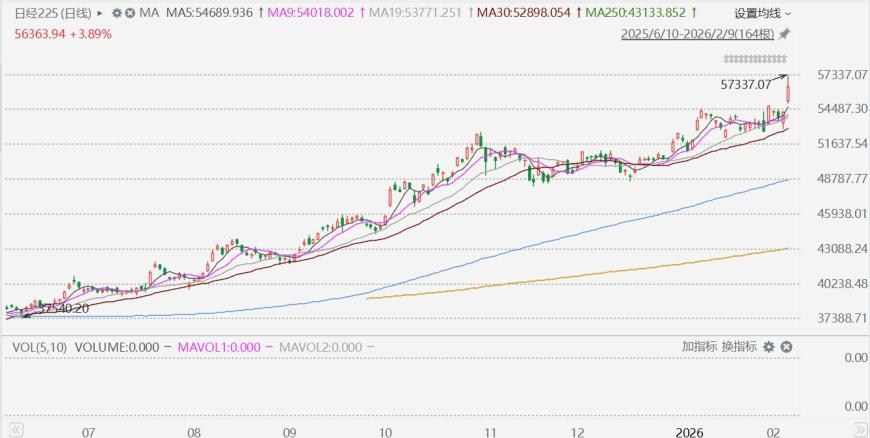
高市“碾压式”大胜!日股收涨近4%,再创历史新高,年内累涨11.97%
Ge Long Hui· 2026-02-09 06:55
责任编辑:山上 股票频道更多独家策划、专家专栏,免费查阅>> 2月9日,日经225指数盘中一度大涨超5%至57337.07点,再创历史新高;最终收涨3.89%,报56363.94点,创下收盘历史新 高。日经225指数年内累涨11.97%。 消息面上,日本国会众议院举行提前改选投票,执政的自民党以压倒性得票胜出,在众议院总席次465席中取得316席。摩 根士丹利表示,选举结果或利好日经指数,短期内大型股、高流动性、高贝塔系数股票及国防相关类股有望跑赢大市。大 摩表示,如果预算审议期间维持扩张性财政政策倾向,且日美强调国防战略协调,高市贸易策略的有效性可望暂时延续。 市场应审视日本版政府效率部的实际成效,而现阶段将消费税减税辩论视为内需相关类股的利好因素仍为时过早。 ...

早盘直击|今日行情关注
申万宏源证券上海北京西路营业部· 2026-02-09 02:10
风险提示 :国际地缘、贸易冲突超出预期;全球金融市场风险暴露;国内上市公司业绩增速回落超预期;全球经济衰退超预期。 首先,上周市场围绕着美元的流动性预期而展开。 北京时间1月30日,特朗普宣布提名凯文•沃什(KevinWarsh)接任美联储主席。沃什强调央行的 独立性,其核心理念是将货币政策与财政政策分开,并明确支持美联储未来推进大幅缩表。其偏鹰派的标签使得市场担心流动性出现紧缩,随之而来的是 贵金属市场出现了较大波动,美股科技股上周震荡幅度同样较大。A股受到国际市场的影响,上周也同步出现了调整,投资者情绪开始转向谨慎,市场成 交大幅萎缩。 上周市场震荡调整,日均量能大幅下降。 沪指上周震荡调整,周一跌破30天均线后,围绕5天均线反复争夺。深圳成指表现弱于沪市,周中的反弹基 本被5天均线所压制。量能方面,上周两市日均量能不到24000亿元,较前周大幅回落。上周市场热点主要集中在消费品和新能源行业。中证2000与沪深 300的比值(归一化处理后)为1.47,较前周小幅反弹。上周大盘蓝筹股相对抗跌,中小盘和科技股领跌。 从运行节奏看,沪指连续反弹后,进入横盘震荡阶段。 沪指于12月中下旬启动上行趋势,1月中旬创出 ...

2026年2月9日申万期货品种策略日报-黄金白银-20260209
Shen Yin Wan Guo Qi Huo· 2026-02-09 01:53
Report Industry Investment Rating No information provided Core View - Precious metals rebounded after a significant shock, mainly influenced by the nomination of the Fed chair and fund stampede. The nomination of Kevin Warsh, a traditional hawk, cooled the expectation of interest rate cuts and led to a rebound in the US dollar index. A large number of funds took profits. In the long run, the supporting factors for the upward movement of gold have not reversed. After the market is fully adjusted and new positive factors accumulate, gold is expected to return to a steady upward channel. Due to the higher volatility of silver and the relatively low gold - silver ratio, investors are advised to wait and see [3] Summary by Related Catalogs Futures Market - **Prices and Changes**: The closing prices of Shanghai Gold 2606 and 2604 decreased by 1.48% and 1.41% respectively, and those of Shanghai Silver 2606 and 2604 decreased by 7.93% and 7.19% respectively compared with the previous day [2] - **Positions and Volumes**: The positions of Shanghai Gold 2606 and 2604 are 84,618 and 163,840 respectively, and the trading volumes are 126,031 and 494,742 respectively. The positions of Shanghai Silver 2606 and 2604 are 128,060 and 227,163 respectively, and the trading volumes are 597,736 and 1,291,544 respectively [2] - **Spot Premium and Discount**: The spot premium and discount of Shanghai Gold 2606 is - 1.23, and that of Shanghai Gold 2604 is 1.37. The spot premium and discount of Shanghai Silver 2606 is 253, and that of Shanghai Silver 2604 is - 602 [2] Spot Market - **Prices and Changes**: The closing price of Shanghai Gold T + D decreased by 1.30%, and the closing price of London Gold increased by 3.98%. The closing price of Shanghai Silver T + D decreased by 8.49%, and the closing price of London Silver increased by 9.70% [2] - **Price Ratios**: The current value of Shanghai Gold 2606 - Shanghai Gold 2604 is 2.60, and the current value of Shanghai Silver 2606 - Shanghai Silver 2604 is - 855.00. The current value of the gold - silver ratio (spot) is 59.98, the ratio of Shanghai Gold to London Gold is 0.98, and the ratio of Shanghai Silver to London Silver is 1.05 [2] Inventory - **Changes**: The inventory of Shanghai Futures Exchange gold remained unchanged at 104,052 kilograms, and the inventory of silver decreased by 62,559 kilograms to 349,900 kilograms. The COMEX gold inventory decreased by 121,403 ounces to 35,370,105 ounces, and the COMEX silver inventory decreased by 3,498,075 ounces to 394,511,408 ounces [2] Related Derivatives - **Positions and Changes**: The position of SPDR Gold ETF decreased by 2 tons to 1,076 tons, and the position of SLV Silver ETF decreased by 56 tons to 16,191 tons. The net position of CFTC speculators in gold decreased by 39,792 to 165,604, and the net position in silver increased by 2,174 to 25,877 [2] Macro Information - **Political News**: The scandal of Peter Mandelson's appointment as the British Ambassador to Washington has put pressure on Prime Minister Starmer. His chief of staff Morgan McSweeney resigned, and there are speculations about Starmer's possible resignation. In the Japanese House of Representatives election, the ruling coalition of the Liberal Democratic Party and the Japan Innovation Party won a majority of seats [3] - **Market Trends**: The yen continued its recent decline in the Asian trading session on Monday. The market is concerned about the design and communication of fiscal policies. The US Treasury Secretary believes that gold is in a typical speculative selling market and does not expect the Fed to take rapid action on the balance - sheet issue [3]
高市早苗夺取众议院控制权 市场紧盯后续财政刺激规模
Sou Hu Cai Jing· 2026-02-09 00:10
周一亚洲交易时段早盘,日元延续近期跌势。瑞穗 证券驻东京首席利率与外汇策略师Shoki Omori表 示:"自民党的压倒性胜利消除了政治不确定性并加强了政策执行力,但市场的焦点已完全转向财政政 策的设计与沟通。财政扩张带来的风险在大选前已基本被市场消化。现在的关键问题是,这些风险是会 进一步强化,还是会逐渐消退。" ...
专家建议全年降息至少50个基点
21世纪经济报道· 2026-02-08 13:35
Group 1 - The conference focused on macroeconomic policy goals set by the Central Economic Work Conference, emphasizing that development is the foundation for solving all problems in China, and growth is essential for development [1] - Experts suggested that economic growth should be maintained within a reasonable range by 2026, and that there is a need to effectively balance qualitative improvements with reasonable quantitative growth [1] - The implementation of more proactive macro policies and increased counter-cyclical and cross-cyclical adjustments were recommended to fully unleash growth potential [1] Group 2 - Fiscal policy should play a larger role this year, with a deficit rate higher than or at least not lower than the previous year, and an increase in the scale of national debt issuance to expand total expenditure [2] - To stimulate investment and consumption, a significant overall interest rate cut of at least 50 basis points for the entire year is suggested, along with better utilization of reserve requirement ratio cuts [2] - Strengthening the coordination between fiscal and monetary policies is essential, with an emphasis on expanding the scale of new financial policy tools to leverage investment [2] - To stabilize investment and boost consumption, efforts to restore effective credit issuance conditions should be intensified, particularly in stabilizing the real estate market [2]

全国两会政策前瞻 这场闭门研讨会提出四方面建议
Jing Ji Guan Cha Wang· 2026-02-08 11:09
Core Viewpoint - The conference emphasized that development is the foundation for solving all problems in China, and economic growth is essential for high-quality development. It is crucial to balance qualitative improvements with reasonable quantitative growth, aiming to maintain economic growth within a reasonable range by 2026 [2]. Group 1: Economic Policy Recommendations - Experts suggested that fiscal policy should play a larger role this year, with a deficit ratio higher than or at least not lower than the previous year, increasing the scale of national debt issuance and expanding total expenditure [2]. - The current actual financing costs are still relatively high; to stimulate investment and consumption, a significant overall interest rate cut of at least 50 basis points should be implemented, along with better utilization of reserve requirement ratio (RRR) cuts [2]. - There is a need to strengthen the coordination between fiscal and monetary policies, leveraging new financial policy tools to expand their scale and achieve a leverage effect on investment [2]. - To stabilize investment and boost consumption, it is necessary to enhance efforts to stabilize the real estate market and restore effective credit supply conditions promptly [2].

宏观周报(2月2日-2月8日):假日需求稳中有升,海外制造业景气回暖-20260208
Yin He Zheng Quan· 2026-02-08 09:42
Domestic Demand - Domestic travel demand is steadily increasing, with subway passenger volume up 8.8% compared to the same period in 2024, and domestic flight numbers averaging 14,500, a 1.6% increase year-on-year[2] - Movie ticket revenue has decreased by 37.2% year-on-year, averaging 62.245 million yuan per day[2] - Passenger car sales in January were 679,000 units, down 31.7% from the previous year[2] External Demand - The Baltic Dry Index (BDI) averaged 1993.2, showing a marginal decline but significantly higher than the previous year[2] - The China Export Container Freight Index averaged 1122.2, down 4.5% week-on-week and 16.4% year-on-year[2] - Port cargo throughput reached 281.597 million tons, a 25.5% increase compared to the same period in 2024[2] Production Sector - The operating rate of blast furnaces increased by 0.53 percentage points to 79.55%[2] - The operating rate for automotive semi-steel tires decreased by 2.08 percentage points to 72.76%[2] - PTA production increased by 35,500 tons to 1.4639 million tons, with an operating rate of 76.29%[2] Price Trends - Consumer Price Index (CPI) remains low, with pork prices down 1.12% week-on-week and vegetable prices down 1.46%[3][4] - Producer Price Index (PPI) shows significant increases in coking coal and coke prices, while non-ferrous metals have adjusted downwards due to a stronger dollar and seasonal demand decline[4] Monetary Policy - The central bank's reverse repurchase operations netted 756 billion yuan this week, with SHIBOR rates showing a seasonal decline[5] - The yield curve for government bonds has flattened, with the 30-year yield at 2.2510% and the 10-year yield at 1.8102%[5] International Context - U.S. consumer confidence index rose to 57.3, with one-year inflation expectations dropping to 3.5%, the lowest in 13 months[5] - The ISM Manufacturing PMI rebounded to 52.6%, indicating a return to expansion, with new orders and production indices showing significant growth[7]
截至1月末 我国外汇储备规模为33991亿美元
Yang Shi Wang· 2026-02-07 02:25
国家外汇管理局统计数据显示,截至2026年1月末,我国外汇储备规模为33991亿美元,较2025年12月末 上升412亿美元,升幅为1.23%。 2026年1月,受主要经济体财政政策、货币政策及预期等因素影响,美元指数下跌,全球主要金融资产 价格总体上涨。汇率折算和资产价格变化等因素综合作用,当月外汇储备规模上升。我国经济运行稳中 有进,发展韧性进一步彰显,为外汇储备规模保持基本稳定提供支撑。 ...
双利差走阔:曲线陡峭化延续,定价逻辑分化
LIANCHU SECURITIES· 2026-02-06 09:08
1. Report Industry Investment Rating No information provided in the content. 2. Core Viewpoints of the Report - The current 10Y - 1Y and 30Y - 10Y spreads are continuously widening, reaching a ten - year high. The report analyzes the driving mechanisms and characteristics of these two key spreads, revealing the differences in dominant forces and structural change trends of different term spreads [1]. - In 2026, the steepening of the yield curve will continue, and the 10Y - 1Y and 30Y - 10Y spreads will generally widen marginally. The 10Y - 1Y spread will be steepened by monetary easing and may widen, while the 30Y - 10Y spread will be repaired by supply and rise in an oscillatory manner [3][4]. 3. Summary According to the Directory 3.1 10Y - 1Y Spread: Short - end Dominant, Long - end Amplifying - **Driving Factors: Policy Anchor, Growth Expectation, and Supply - demand Structure** - The 10Y - 1Y spread reflects the relative changes among short - term policy interest rates, medium - and long - term growth and inflation, and bond supply - demand structure. Short - term interest rates are more sensitive to monetary policy and the money market, while long - term interest rates reflect future growth trends, inflation expectations, and economic cycle changes. Bond supply - demand structure differences and investor behavior also affect the spread [9]. - **Pricing Logic: A Stable Negative Dynamic Equilibrium Relationship between 1Y and 10Y - 1Y** - Short - term interest rates determine the core direction of the 10Y - 1Y spread. After removing the influence of interest rate central migration, the 1 - year Treasury yield and the spread show a clear negative correlation. Long - term interest rates have a limited and unstable impact on the 10Y - 1Y spread [10][13]. - **Periodic Deviation: Structural Disturbance under Short - end Dominance** - The short - term interest rate and the 10Y - 1Y spread generally show a strong negative correlation, but there are also periodic changes in their correlation during the interest rate central switching stage. The 1 - year yield dominates the spread direction, and the negative correlation between the spread and the 1 - year yield may deviate or weaken in the short term. The correlation between the spread and the 10 - year Treasury yield is weak [17]. 3.2 30Y - 10Y Spread: The Dominance Shifting to the Ultra - long End, Spread Repricing - **Driving Factors of the 30Y - 10Y Spread: Differentiation in Supply - demand, Expectation, and Term Sensitivity** - The 30Y - 10Y spread reflects the differences in supply - demand structure, long - term expectations, and policy sensitivity between long - term and medium - long - term Treasuries. Its core drivers include supply - demand structure differences, differences in long - term economic growth and inflation expectations, and the impact of policy uncertainty and term sensitivity differences [25]. - **Core Pricing Logic: The Ultra - long End is Becoming the Dominant Force of the Spread** - The correlation between the 10 - year Treasury yield and the 30Y - 10Y spread is generally weak. The 30 - year Treasury yield has a more stable positive linkage with the spread, indicating that the ultra - long - end interest rate is playing an increasingly prominent role in driving the 30Y - 10Y spread [26][27]. - **Stage Switching: Multiple Combination Forms of Interest Rate Central Changes** - The pricing center of the 30Y - 10Y spread is gradually shifting to the ultra - long end. In different macro - economic and policy environments, the spread may show multiple combination forms, and the mid - term trend shows that the ultra - long end is gradually becoming the core anchor of spread pricing [34][43]. 3.3 Outlook: The Steepening of the Curve Continues, and the Double Spreads Widen - **10Y - 1Y Spread: Steepened by Easing, May Widen** - In the first half of 2026, the 10Y - 1Y spread may widen. The strengthening of the interest rate cut expectation will lower the short - term interest rate, and the front - loaded fiscal policy will increase the supply pressure, with the long - term pressure being higher [44][45]. - **30Y - 10Y Spread: Repaired by Supply, Rise in an Oscillatory Manner** - In 2026, the supply premium will replace the liquidity premium as the dominant factor of the 30Y - 10Y spread. In the first half of 2026, the 30Y - 10Y spread will remain high and oscillate, and the center may widen further [46].
首席点评:贵金属再度下挫
Shen Yin Wan Guo Qi Huo· 2026-02-06 05:10
1. Report Industry Investment Rating - The report provides a table indicating the investment rating possibilities for various varieties, including "cautiously bearish" and "cautiously bullish" assessments [6]. 2. Core View of the Report - The report analyzes multiple key financial and commodity markets, including precious metals, crude oil, and stock indices. It suggests that the long - term upward trend of gold remains intact despite recent volatility. The stock market is expected to continue its short - term positive trend in February, but potential risks from overseas markets during the Spring Festival need to be watched. For other markets, it provides detailed analyses of supply - demand relationships, price trends, and influencing factors [2][4][20]. 3. Summary by Relevant Catalogs 3.1 Daily Main News Focus - **International News**: The European Central Bank maintained its benchmark interest rate, pausing rate cuts for the fifth consecutive time since June last year. It did not signal the next policy direction, strengthening the market's expectation of a stable monetary policy. Officials are monitoring the impact of the euro's appreciation on export competitiveness and inflation [7]. - **Domestic News**: Eight departments jointly issued an implementation plan for the high - quality development of the traditional Chinese medicine industry, aiming to achieve certain goals by 2030, such as cultivating high - standard raw material bases and new large - scale Chinese patent medicines [8]. - **Industry News**: In January, China's logistics industry prosperity index was 51.2%, indicating an expansion of logistics business, with key sub - indices in the expansion range [9]. 3.2 Daily Earnings of Overseas Markets - The report presents the daily earnings of various overseas market indices and commodities on February 4th and 5th, including the S&P 500, European STOXX50, and others. Most showed declines, except for the US dollar index and some commodities like CBOT soybeans [10]. 3.3 Morning Comments on Major Varieties - **Financial**: - **Stock Indices**: US stock indices declined. The A - share market also fell, with the beauty and care sector leading the gain and the non - ferrous metal sector leading the loss. The stock market's positive trend since 2026 is due to multiple factors. It is expected to continue its short - term positive trend in February, but potential risks from overseas markets during the Spring Festival need attention [4][11]. - **Treasury Bonds**: Treasury bonds rose slightly, with the yield of the 10 - year Treasury bond active bond falling. The central bank's open - market operations and the expected "rate - cut and balance - sheet reduction" policy in the US, along with domestic economic data, have influenced the Treasury bond market [12]. - **Energy and Chemicals**: - **Crude Oil**: SC crude oil fell 0.73% at night. The US and Iran plan to hold nuclear - issue talks, but reaching an agreement is considered difficult. The strengthening US dollar and volatile precious metal prices have negatively affected the commodity market [3][14]. - **Methanol**: Methanol fell 1.46%. The operating rate of coal - to - olefin plants increased, as did the overall methanol plant operating rate. Coastal methanol inventories decreased slightly but were still at a relatively high level [15]. - **Natural Rubber**: Natural rubber futures declined. With domestic and some overseas production areas in different production states, and the inventory in Qingdao increasing, the price is expected to fluctuate and adjust [16]. - **Polyolefins**: Polyolefin futures mainly declined, with the market focusing on supply improvement expectations and macro - factors. The falling oil price also contributed to the cooling of the polyolefin market [17]. - **Glass and Soda Ash**: Glass and soda ash futures mainly declined. Glass production enterprise inventories increased slightly, and soda ash inventories also rose. The supply - demand situation is gradually adjusting, and the future market depends on the real - estate and photovoltaic industries [18][19]. - **Metals**: - **Precious Metals**: Precious metals fluctuated at night. Recent volatility was mainly due to the nomination of the Fed chair and capital stampede. In the long run, gold is expected to resume its upward trend, while investors are advised to wait and see for silver [2][20]. - **Copper**: Copper prices rose 0.15% at night. The concentrate supply is tight, and downstream demand is mixed. Copper prices may enter an adjustment phase [21]. - **Zinc**: Zinc prices rose 0.84% at night. The zinc concentrate processing fee decreased, and downstream demand is also mixed. Zinc prices may follow the overall trend of non - ferrous metals [22]. - **Aluminum**: Shanghai aluminum fell 0.23% at night. Short - term spot - level upward drivers are limited, but long - term factors such as low inventory and stable demand provide support [23]. - **Lithium Carbonate**: The lithium carbonate main contract touched the daily limit down and then slightly recovered. The market has high attention, and downstream buyers are cautious. Supply and demand factors are complex, and a cautious short - selling view is maintained [24][25]. - **Black Metals**: - **Coking Coal and Coke**: Coking coal and coke main contracts fluctuated at night. Steel production and demand are in a seasonal off - peak, but import disruptions and pre - holiday restocking provide support [26]. - **Steel**: Steel prices are expected to fluctuate before the Spring Festival. The macro - environment is improving, and raw - material costs provide support. The steel market is in a situation of weak supply and demand [27]. - **Iron Ore**: Iron ore prices are expected to fluctuate. Shipping volumes and port inventories have changed, and steel mills will continue to purchase on - demand [28]. - **Agricultural Products**: - **Protein Meals**: Bean and rapeseed meal prices fluctuated and rose at night. Brazilian soybean harvest is progressing, and the US - China soybean purchase plan affects the market. Domestic high inventories and sufficient supply expectations pressure prices [29]. - **Oils and Fats**: Bean and palm oils were weak, while rapeseed oil rose slightly. Malaysian palm oil exports are strong and production is falling, but market supply expectations affect prices [30][31]. - **Sugar**: Zhengzhou sugar futures fluctuated and were slightly stronger. With a seasonal supply increase and import pressure, prices are expected to remain low in the short term [32]. - **Cotton**: Zhengzhou cotton futures maintained a volatile trend. With approaching Spring Festival, the market has a certain demand support, but import factors may limit price increases [33]. - **Hogs**: The hog market continued to be weak and volatile, with regional differences. The market is in a "price - decline and reluctance - to - sell" game, and pre - holiday prices are expected to adjust [34]. - **Shipping Index**: - **Container Shipping to Europe**: The EC index rose 3.86%. Pre - holiday spot freight rates are expected to decline. The market has a large discount, and future price trends depend on factors such as the pre - April 1st export rush and shipping company price increases [35].