
贸易摩擦

Search documents
明天就要开盘,市场传来3大消息,每一个都将影响A股!
Sou Hu Cai Jing· 2025-05-05 12:55
第一:国际油价突然大跌 5月5日,国际原油期货价格突然大跌,WTI原油、布伦特原油、美原油跌幅一度扩大至5%。 消息面上,主要产油国将连续两个月超预期增产。欧佩克发表声明说,8个成员国决定自今年6月起日均 增产41.1万桶。这将是其连续第二个月以高于预期的幅度增产石油。 不过油价大跌的主要推手还是美国的经济不明朗和贸易摩擦所致,经济不好,油价打击很大。 第二:本周是美联储将公布最新利率 五一假期已经接近尾声了,估计不少朋友都在返程工作地的路上,或者已经到了。 我昨天已经在主战场了,想到未来即将开启的波澜壮阔事业,内心稍有激动。人只有为梦想而奋斗,才 活得有意义。 第三:离岸人民币继续大涨 5月2日,离岸人民币兑美元暴涨近1%。今天开盘,再度飙升。两个交易日最大涨幅接近900点。 同时,A50指数走势也相当不错,联想起周五中概的大涨,看来明天开盘,A股应该不会太弱。 第四:迎接周二开盘 北京时间周四凌晨,美联储将公布最新利率决议,市场预计其继续按兵不动。 美联储5月维持利率不变的概率为96.8%,降息25个基点的概率为3.2%。美联储到6月维持利率不变的概 率为63.3%。 近期美国经济数据还算不错,非农人口、 ...


A股策略周报:暗藏的变化
Minsheng Securities· 2025-05-05 12:23
Group 1: Asset Performance Post Tariff Implementation - Since the implementation of "reciprocal tariffs" on April 2, 2025, global risk assets have shown a "V"-shaped recovery, with U.S. and European stock markets outperforming Chinese equity assets and demand-side commodities[1] - As of May 2, 2025, U.S. stock indices (e.g., NASDAQ, S&P 500) have recovered above their April 2 closing prices, while Chinese assets (e.g., Hang Seng Index, CSI 800) and commodities like copper and oil remain below their April 2 levels[1] - The disparity in asset performance is attributed to different driving factors and recovery rhythms, with demand-related commodities reflecting weaker demand expectations[1] Group 2: U.S. Economic Outlook - Recent positive non-farm payroll data has alleviated immediate recession concerns, but potential market volatility remains due to ongoing trade negotiations and the Federal Reserve's interest rate decisions[2] - The U.S. economy's first-quarter GDP growth was reported at -0.30%, slightly below expectations, while April's ADP employment growth was only 62,000, compared to the expected 115,000[2] - Structural issues in the U.S. labor market show that manufacturing sector job growth has been negative since October 2023, indicating a shift towards service-oriented job creation[2] Group 3: Domestic Economic Adjustments - The April PMI data indicates that the impact of tariffs on China's exports is becoming evident, with new export orders declining significantly[3] - Recent trade negotiations between China and the U.S. have begun to show signs of engagement, suggesting that policy responses may become clearer as talks progress[3] - The offshore RMB appreciated significantly on May 2, 2025, indicating a positive correlation between Chinese equity assets and the currency, suggesting a potential market revaluation[3] Group 4: Investment Recommendations - Chinese assets are considered to have better value compared to other markets, with a focus on sectors benefiting from domestic demand, such as consumer goods and services[4] - The report recommends investing in resource products (copper, aluminum, gold) and capital goods (engineering machinery, steel) as global economic conditions evolve[4] - Financial sectors with low valuations (banks, insurance) are also highlighted as potential safe havens against external shocks[4]
美国糊弄人,日本拆台:对汽车征税,不可接受
Guan Cha Zhe Wang· 2025-05-03 10:47
Core Viewpoint - The trade negotiations between Japan and the United States have shown little progress, with the U.S. expressing optimism while Japan remains cautious about the outcomes of the discussions [1][2]. Group 1: Negotiation Dynamics - The U.S. Treasury Secretary and other officials described the discussions as "frank and constructive," emphasizing the importance of tariffs and economic security [1]. - Japan's representatives indicated measures to reduce trade surplus, such as reviewing non-tariff barriers on auto imports and increasing purchases of U.S. agricultural products [2]. - Japanese Prime Minister Shigeru Ishiba stated that tariffs on automobiles are "absolutely unacceptable" and emphasized that reducing the U.S. trade deficit should not come at the expense of Japanese jobs [2]. Group 2: Future Negotiation Prospects - The U.S. has taken a hard stance, refusing to discuss tariffs on automobiles, steel, and aluminum, which complicates cooperation [4]. - Japan's Economic Revitalization Minister indicated plans for another meeting in mid-May, focusing on expanding trade and reducing non-tariff barriers [4]. - Japan's Finance Minister acknowledged the need to consider its own economic security when responding to U.S. demands, particularly regarding economic ties with China [4]. Group 3: Financial Implications - Japan holds approximately $1.08 trillion in U.S. Treasury bonds, which could be used as leverage in trade negotiations, although this approach has been previously denied by Japanese officials [5]. - Analysts suggest that Japan's mention of U.S. debt as a negotiation tool marks a new phase in trade tensions, despite concerns about the potential negative impact of selling U.S. bonds [5][6]. - The strategy of using U.S. debt as a bargaining chip could position Japan favorably in negotiations without immediate action [6].
博弈视角看“关税战”:特朗普策略与各经济体不同反应 | 国际
清华金融评论· 2025-05-03 09:47
Core Viewpoint - The article analyzes the implications of Trump's tariff war on the global economy, particularly focusing on the strategies and responses of various economic entities, including China, Canada, and Mexico, as well as the broader international context [2][4]. Group 1: Trump's Psychological Bottom Line - Trump's key demands in the tariff negotiations include a 10% baseline tariff on global imports, protective tariffs on key industries like automobiles, and specific measures targeting China, Canada, and Mexico [5][6][8]. - The 10% baseline tariff is seen as a potential concession point for Trump, aimed at preventing trade loopholes and increasing fiscal revenue [6]. - Protective tariffs on industries such as steel, aluminum, and automobiles are intended to limit competition and protect American jobs, with tariffs already set at 25% for steel and aluminum [7]. Group 2: Trump's Game Strategy - The U.S. holds a strategic advantage in the tariff war due to its position as the largest global demand-side economy, allowing it to dictate terms to other economies [10]. - Trump's unpredictable behavior in tariff announcements serves to increase the decision-making costs for opponents, maintaining strategic flexibility [11]. - The U.S. is shifting from multilateral frameworks like the WTO to bilateral negotiations, using tariffs as leverage to reshape trade relationships [10]. Group 3: China's Response - China has demonstrated a strong and rapid response to U.S. tariffs, indicating both the necessity and capability to counteract U.S. measures [15][16]. - The trade conflict is characterized as a repeated prisoner's dilemma, where mutual cooperation is beneficial, but unilateral concessions would disadvantage China [15]. - China's economic resilience and strategic reforms are expected to mitigate the impacts of the tariff war, with a focus on expanding domestic demand and technological self-sufficiency [18]. Group 4: Responses from Other Economies - Canada has taken a firm stance against U.S. tariffs, leveraging its economic ties with the U.S. to push back effectively, while Mexico has shown a more passive response due to its dependency on the U.S. [22][23]. - Other economies like the EU, Japan, and India have exhibited a tendency to negotiate rather than retaliate, reflecting their reliance on the U.S. and a lack of unified response strategies [25][26]. - The EU's delayed response to U.S. tariffs highlights internal divisions and a lack of cohesive strategy compared to China's swift actions [26].

发生了什么?隔夜美股、中概集体暴涨!
Sou Hu Cai Jing· 2025-05-03 07:10
第一:隔夜美股集体大涨 美东时间周五,美股三大指数集体收涨,道指、标普录得日线九连涨,标普500指数创2004年以来最长 连涨纪录。 截止收盘,道指涨幅1.39%,纳指涨幅1.51%,标普500涨幅1.47%。 第四:时间真快 没想到刚放的五一,今天都5月3日了,时间真快。度个假,感觉真好,暂时忘记公司发展规划、暂时忘 记尘世的烦恼,好好给大脑放个假。 5月2日盘中,人民币汇率持续走强。其中,离岸人民币兑美元汇率强势反弹,盘中连续升穿7.27、 7.26、7.25、7.24、7.23五道关口。 大型科技股多数上涨,Meta涨逾4%,英特尔涨超3%,特斯拉、微软、英伟达、奈飞涨超2%,谷歌涨 超1%;苹果跌超3%,亚马逊小幅下跌。 热门中概股多数上涨,纳斯达克中国金龙指数涨3.5%,本周累涨3.14%。3大造车新势力集体上涨,阿 里涨幅超4%。按此情况,下周开盘,A股不错呀。 第二:人民币大涨700点 截至北京时间5月3日04:59,离岸人民币兑美元汇率报7.2103,较周四纽约尾盘涨686个基点。 这跟贸易摩擦近期比较温和、美元走低有关系,总算是抗住了。 第三:美国非农数据增加17.7万 最新数据显示,美国4 ...



4月全国PMI数据解读:PMI虽有回落,政策积极发力
Haitong Securities International· 2025-05-02 08:12
Group 1: Manufacturing PMI Insights - The manufacturing PMI for April 2025 is 49.0%, a decrease of 1.5 percentage points from the previous month, indicating a contraction in the sector[5] - The decline in manufacturing PMI is primarily attributed to external shocks from trade friction, although domestic demand remains relatively stable[5] - New export orders index fell to 44.7%, down 4.3 percentage points, reflecting increased pressure on export-oriented industries due to trade uncertainties[15] Group 2: Non-Manufacturing Sector Performance - The services business activity index is at 50.1%, a slight decrease of 0.2 percentage points, indicating stability in the sector[22] - The construction business activity index is 51.9%, down 1.5 percentage points, with civil engineering showing improvement at 60.9%[26] - Seasonal factors, such as the upcoming "May Day" holiday, may lead to a rebound in the travel sector's activity[22] Group 3: Policy and Economic Outlook - The central government is accelerating the implementation of existing policies to boost domestic demand in response to external uncertainties[30] - Over 160 billion yuan has been allocated for consumption incentives, with an additional 140 billion yuan planned for future investments[30] - The focus on enhancing domestic consumption and effective investment is expected to support economic recovery in the second quarter[30]
“铜博士”上演“跳水式”暴跌 投资者对经济前景愈发悲观
智通财经网· 2025-04-30 23:12
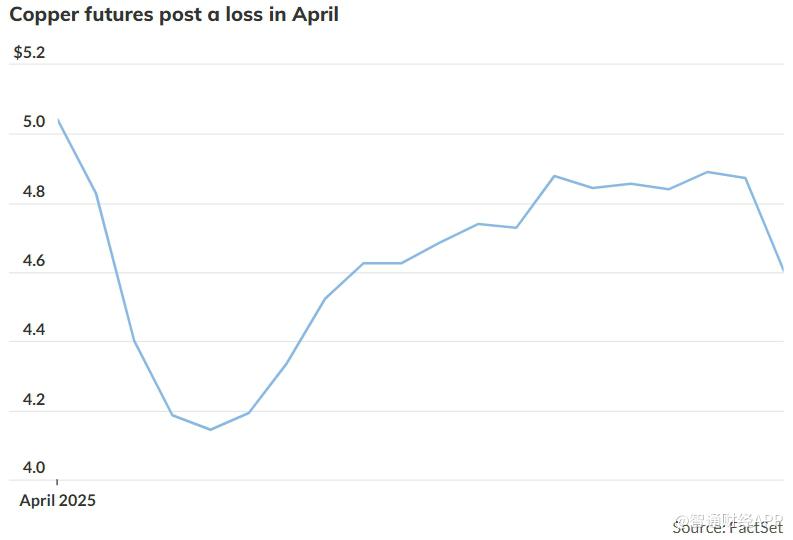
Core Viewpoint - The sharp decline in copper prices is seen as a negative indicator for global economic health, reflecting increasing investor pessimism about economic prospects [1][5]. Group 1: Market Performance - On a single trading day, copper futures for July delivery fell by 5.4%, closing at $4.61 per pound, marking the lowest closing level since April 11 and the largest single-day drop in over three weeks [1]. - In April, copper prices experienced an 8.4% cumulative decline, the largest monthly drop since June 2022, despite a year-to-date increase of 14.5% [4]. Group 2: Economic Indicators - The current market trends suggest a "W-shaped recovery," indicating a potential second downturn after an initial recovery, which poses a more complex challenge than the typical "V-shaped recovery" [4]. - The decline in copper prices is attributed to macroeconomic concerns, including falling U.S. Treasury yields and oil prices, signaling pressure on the global economy [1][5]. Group 3: Trade Relations and Market Sentiment - Market anxiety is heightened by fears of a recession and a lack of substantial progress in U.S.-China trade relations, which are seen as the primary factors suppressing copper prices [5]. - The dramatic price fluctuations are linked to previous tariff discussions initiated by the Trump administration, which initially caused a spike in copper prices [6]. Group 4: Future Outlook - Current support for copper prices is identified at $4.39 per pound, with a potential danger zone if prices fall below $4.03, indicating deeper economic issues [7]. - Optimism remains regarding upcoming trade negotiations, particularly with Japan, India, and South Korea, which could influence copper prices positively [7]. - A rebound in copper prices is contingent on several factors, including tariff relief and improved economic data from the U.S. and China, with projections suggesting a potential rise to $10,000 per metric ton by the end of 2025 [7][8].
多空交织 PVC底部震荡
Qi Huo Ri Bao· 2025-04-30 15:55
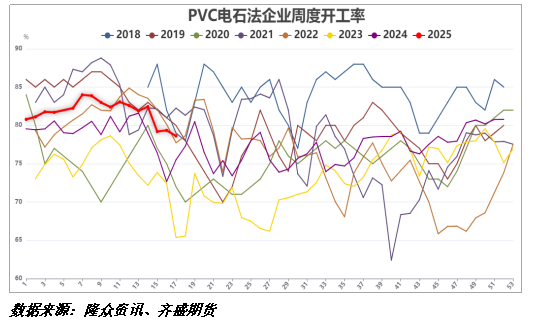
Core Viewpoint - The PVC market is experiencing significant challenges due to increased trade friction, weak demand, and a supply-demand imbalance, leading to price fluctuations and potential risks of further declines in the future [1][8]. Supply and Production - The spring maintenance has led to a noticeable increase in PVC maintenance, resulting in a significant drop in operating rates, which are now below 80%, with weekly production around 450,000 tons [4]. - The production pressure is temporarily alleviated due to ongoing maintenance plans, which are expected to keep operating rates at low levels [4]. Cost and Profitability - The PVC supply-demand imbalance is evident, with prices near a 10-year low, causing substantial profit compression for producers, leading to losses becoming the norm [5]. - The integrated chlor-alkali enterprises that produce PVC are facing losses, particularly in the external procurement of calcium carbide, which is around 600 yuan/ton [5]. - The profitability of PVC and caustic soda has recently turned negative, indicating that cost support may gradually become more apparent [5]. Demand Dynamics - Weak demand has become a norm for PVC, with 80% of its downstream demand linked to the real estate sector, which is currently in a weak cycle [6]. - Despite recent stimulus policies aimed at the real estate market, the impact on PVC demand remains limited, with new construction data still showing weakness [6]. Export Trends - In March, China exported 360,000 tons of PVC, a year-on-year increase of 11%, with cumulative exports from January to March reaching 970,000 tons, up 56% year-on-year [7]. - However, increasing trade friction and higher import/export tariffs are expected to complicate future PVC exports, potentially diminishing the positive impact of exports on domestic supply-demand balance [7].
聚焦欧美GDP和科技股财报 美股盘前三大期指下跌 超微电脑跌超15% 欧股上涨
Hua Er Jie Jian Wen· 2025-04-30 09:57
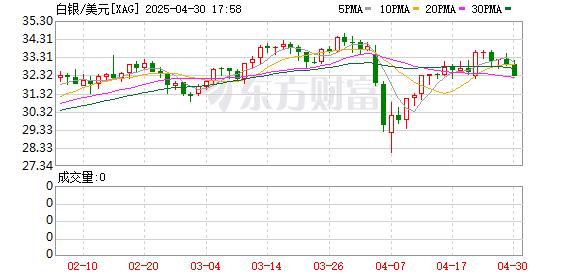
Market Overview - After six days of gains, the US stock market appears to be in a correction phase due to escalating trade tensions, weak US economic data, and a disappointing earnings forecast from Advanced Micro Devices (AMD) [1][2] - On Monday, US stock index futures fell, while European stocks opened higher, with the euro slightly rising against the dollar [1] Company Performance - Several companies, including General Motors Co. and JetBlue Airways Corp., have withdrawn their earnings guidance amid increasing trade friction, with United Parcel Service Inc. announcing a layoff of 20,000 employees this year [2] - Mercedes-Benz Group AG also retracted its earnings outlook for the year due to uncertainties related to trade barriers [2] - Advanced Micro Devices (AMD) saw its stock drop over 15% following an earnings forecast that significantly missed expectations [5][9] Commodity Prices - WTI crude oil experienced a decline of 2.0%, trading at $59.2 per barrel [4] - Spot silver fell by 2.00%, priced at $32.27 per ounce [2] - Spot gold dropped by 0.9%, briefly falling below $3,290 per ounce [7]
日度策略参考-20250430
Guo Mao Qi Huo· 2025-04-30 07:43
Report Industry Investment Rating - Not mentioned in the report. Core Viewpoints - Most commodities are expected to be in a state of oscillation in the short term, with some showing potential for decline or upside. Amid uncertainties in tariffs and changing policies, investors are advised to be cautious and adjust their strategies according to market conditions [1]. Summary by Related Catalogs Macro Finance - For stock index futures, it's recommended to hold a light position and wait for a clear market direction. Due to high overseas uncertainties during the May Day holiday and low option volatility, consider a double - buy strategy for stock index options before the holiday [1]. - The bond futures are favored by asset shortage and weak economy, but the central bank's short - term interest rate risk warning restricts the upside [1]. - Gold is in short - term oscillation adjustment, but the long - term upward logic remains unchanged [1]. Non - Ferrous Metals - Copper has decent downstream demand, but there is a risk of price correction due to trade frictions [1]. - Aluminum prices oscillate due to uncertainties in global trade frictions [1]. - Alumina's supply - demand pattern has improved, with limited downside but lack of upward momentum [1]. - Zinc has support from low near - month inventory but faces fundamental suppression, presenting short - selling opportunities [1]. - Nickel prices oscillate after bottom - up repair. Pay attention to the cost support of electrowon nickel and beware of policy changes [1]. - Stainless steel futures oscillate in the short term. It's advisable to wait and see, and the industrial side should focus on policy changes and steel mill production schedules [1]. - Tin has a risk of supply premium disappearing as the复产 expectation in Low - Bang strengthens [1]. Industrial and Energy - Related Commodities - Industrial silicon is in a state of oversupply, with demand not improving and inventory pressure not relieved [1]. - Polysilicon's抢装潮 is ending, with demand expected to decline in the second half of the year. There is a need for a rebound after a large short - term decline [1]. - Carbonate lithium has a pattern of supply exceeding demand, with downstream maintaining just - in - time purchases [1]. - Steel products such as rebar and hot - rolled coil face downward pressure on opening prices due to trade disputes [1]. - Iron ore is under short - term pressure due to tariff policies and market sentiment [1]. - Manganese silicon and silicon iron oscillate, with cost and supply - demand factors at play [1]. - Glass and soda ash face supply - demand imbalances, with prices under pressure [1]. - Coke and coking coal are in a relatively oversupplied situation, and industrial customers can seize hedging opportunities [1]. Agricultural Products - Palm oil, soybean oil, and rapeseed oil are affected by weather and market sentiment, and it's recommended to wait and see before the holiday [1]. - Cotton prices may be affected by the trend of crude oil and the substitution effect between chemical fiber and cotton [1]. - Sugar prices are affected by overseas supply shortages and domestic high inventory [1]. - Corn may have a correction risk after the hype cools down, with a long - term bullish logic [1]. - Soybean meal is expected to oscillate weakly, and M09 is recommended to be bought at low prices [1]. Forestry and Livestock - Pulp is recommended to be short - sold or hedged due to weak cost support and entering the off - season [1]. - Logs have high inventory and no short - term positive factors, expected to oscillate at a low level [1]. - Pigs have a clear downward expectation in the futures market due to increased supply and lack of downstream highlights [1]. Energy and Chemicals - Crude oil, fuel oil, and asphalt are affected by factors such as tariffs, OPEC + policies, and cost - demand relationships [1]. - Rubber products such as natural rubber and BR rubber oscillate, with weak fundamentals [1]. - PTA is bearish due to device maintenance and weak market sentiment [1]. - Ethylene glycol, styrene, urea, methanol, PE, PP, PVC, and caustic soda all have their own supply - demand and market sentiment factors affecting their price trends [1]. Others - For the container shipping European line, the peak - season contracts can be lightly tested for long positions, and attention should be paid to the 6 - 8 reverse spread [1].