反内卷

Search documents
中国12月外贸加速回暖,伊朗局势担忧加剧
Hua Tai Qi Huo· 2026-01-15 05:20
1. Report Industry Investment Rating No information provided. 2. Core Viewpoints - Inflation is a current focus. China aims to boost consumption and promote reasonable price recovery through monetary policies. The future price recovery path depends on supply - side policies. Geopolitical tensions in Iran and Venezuela may impact the global competition for minerals and energy resources. Only economic recession and interest - rate hike expectations can cool down the inflation sentiment [2]. - There is a certain differentiation in domestic and foreign economic outlooks. China's exports and new orders are positive in December, and the trade surplus is large. The country's foreign trade growth rate is expected to remain resilient. The US economy shows mixed signals with manufacturing index decline and inflation changes. Japan may dissolve the House of Representatives and hold an early election [3]. - In the commodity market, focus on high - certainty sectors such as non - ferrous metals and precious metals. There are potential opportunities for low - valued commodities to rise in price. Pay attention to the sentiment risks in the new energy sector, the Iran situation, "anti - involution" space in the chemical sector, and weather and disease factors in the agricultural product sector [4]. - The strategy is to buy stock index futures, precious metals, and non - ferrous metals on dips [5]. 3. Summary by Related Catalogs Market Analysis - Central economic work conferences in China emphasize boosting consumption and price recovery. The People's Bank of China will use various monetary policy tools. Geopolitical tensions between Iran and Venezuela are rising, and the CME will change the margin setting method for precious metal contracts [2]. Trade Situation - China's exports and imports in December exceed expectations, mainly due to the global AI investment boom and manufacturing recovery. Exports to emerging markets are strong, and trade with the US shows a mixed picture. The domestic demand recovery foundation is not solid. The trade surplus in December is 1141.4 billion US dollars, and the annual surplus exceeds 1 trillion. The US manufacturing index declines, and inflation shows different trends [3]. Commodity Market - Focus on non - ferrous metals (especially aluminum and nickel) and precious metals. There are sentiment risks in the new energy sector. The US has actions related to Venezuelan oil, and there are tensions between the US and Iran. In the chemical sector, pay attention to the "anti - involution" space of some products. In the agricultural product sector, focus on weather and disease. On January 14, some commodity futures and spot silver have significant price increases [4]. Strategy - Suggest to buy stock index futures, precious metals, and non - ferrous metals on dips [5]. Important News - The overall market shows a volatile trend with high trading volume. China's trade data in December is positive. The US core CPI growth is lower than expected. Trump has actions related to the Fed and Iran, which impact the oil market. Japan may dissolve the House of Representatives and hold an early election. Some commodity futures and spot silver have significant price changes [7].
“反内卷”与“扩内需”构成行业反转逻辑,石化ETF(159731)早盘大涨2%
Mei Ri Jing Ji Xin Wen· 2026-01-15 04:02
每日经济新闻 银河证券研报称,建议关注化工品结构性投资机会。成本端,在不发生供应大幅中断的情况下,预 计2026年Brent原油价格运行区间为60-70美元/桶,成本端有望逐步止跌企稳,行业景气修复程度预计仍 与供需情况息息相关。供给端,一方面,2024年以来化工行业资本开支迎来负增长,在建、存量产能将 逐渐消化;另一方面,国内"反内卷"浪潮汹涌,海外落后产能加速出清,供给端有望收缩。需求 端,"十五五"规划建议稿"坚持扩大内需"为未来五年定调,国内新旧动能切换将持续推进叠加美国降息 周期开启,化工品需求增长可期。银河证券认为,2026年供给侧的反抗和需求侧的新动能有望加速化工 行业周期反转。 石化ETF(159731)及其联接基金(017855/017856)紧密跟踪中证石化产业指数,从申万一级行 业分布来看,基础化工行业占比为59.23%,石油石化行业占比为32.60%,"十五五"开局之年,供给 侧"有扶有控"与"反内卷"趋势结合,同时坚持扩大内需,化工行业周期将加速反转。 截至1月15日11点05分,石化ETF(159731)早盘现涨2%。持仓股中,彤程新材、广东宏大、和邦 生物等涨幅居前,涨幅超4%。 ...
万类霜天竞自由——兴银基金2026年度权益投资策略展望
Sou Hu Cai Jing· 2026-01-15 02:53
Group 1: Macro Trends and Investment Focus - The investment team at Xingyin Fund emphasizes deep research and value discovery amidst market uncertainties, focusing on macro trends and core industries such as new energy, technology, consumption, and pharmaceuticals for 2026 [1] - The AI sector remains a key growth engine globally, driven by significant capital expenditure from overseas giants, with a focus on the application side's revenue generation to create a closed loop [3][9] - The cyclical recovery strategy combines anti-involution and capacity cycles, prioritizing sectors with natural upward trends even without specific policies [3] Group 2: Consumption and Pharmaceuticals - The central economic work conference highlights expanding domestic demand as a primary task, indicating a need for a higher-level perspective on consumption in 2026 [4] - The consumption sector has faced downward pressure but is at a reasonable valuation after years of decline, with potential for a Davis double-click if upward momentum is found [4][5] - The consumption sector is categorized into traditional, new, and overseas consumption, with traditional consumption recovery linked to supply-side changes and new consumption benefiting from evolving consumer habits [5][6] Group 3: Technology Sector Insights - The technology sector is expected to thrive in 2026, with AI leading the charge, although the overall market valuations have risen significantly, indicating potential volatility [9][10] - Capital expenditure in AI is projected to increase, with a focus on the application of AI technologies and the performance of related companies [10] - Key areas of interest include consumer electronics, AI application software, chip equipment, nuclear power, aerospace, quantum technology, and innovative medical technologies [10] Group 4: Capital Market Outlook - The capital market is anticipated to play a crucial role in China's economic development over the next five years, driven by increased competition among major economies and a shift towards financial assets [12] - The transition from real estate to stock and fund-based wealth generation is expected to enhance consumer willingness and capacity [12] - The capital market may mitigate external risks through deeper openness and allow overseas capital to benefit from China's manufacturing strength [12]


近百亿资金狂扫化工股,化工ETF(516020)盘中涨超2%!景气周期“破晓时分”已至?
Xin Lang Cai Jing· 2026-01-15 02:32
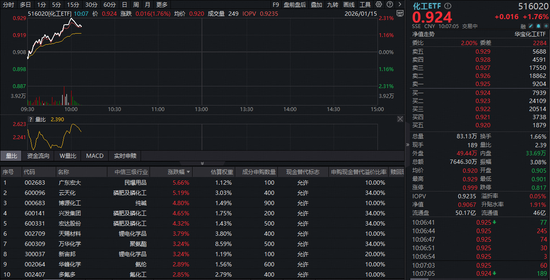
化工板块今日(1月15日)继续猛攻,反映化工板块整体走势的化工ETF(516020)开盘后震荡上行, 盘中场内价格最高涨幅达到2.31%,截至发稿,涨1.76%。 成份股方面,民爆用品、磷化工、锂电等板块部分个股涨幅居前。截至发稿,广东宏大、云天化双双大 涨超5%,博源化工、兴发集团、宏达股份涨超4%,天赐材料、万华化学涨超3%。 | 序号 | 代码 | 名称 | 主力净流入额 ▼ | | --- | --- | --- | --- | | 1 | CI005006 | 基础化工(中信) | 95.41亿 | | 2 | CI005003 | 有色金属(中信) | 84.41亿 | | 3 | CI005013 | 汽车(中信) | 20.42亿 | | 4 | CI005025 | 电子(中信) | 11.87亿 | | 5 | CI005010 | 机械(中信) | 11.50亿 | 广发证券指出,化工作为典型周期性行业,通常5年一轮周期,经历"盈利上行-产能扩张-盈利触底-产能 出清/需求预期改善"四个阶段。伴随资本开支增速转负、反内卷、海外降息、扩内需,看好十五五开局 阶段化工"破晓时分"。此外,全球 ...
中信建投期货:1月15日能化早报
Xin Lang Cai Jing· 2026-01-15 01:42
Group 1: Rubber Market - Domestic natural rubber price for full latex increased to 15,850 CNY/ton, up by 150 CNY/ton from the previous day [4] - Thai mixed rubber price reached 15,150 CNY/ton, up by 100 CNY/ton from the previous day [4] - As of January 11, 2026, China's natural rubber social inventory was 1.256 million tons, an increase of 24,000 tons, or 1.9% [4][21] - The total inventory of dark rubber in China was 835,000 tons, up by 2.5% [4][21] - The market is expected to see high volatility in RU, NR, and Sicom prices in the short term due to seasonal factors and inventory dynamics [5][22] Group 2: PX Market - PX industry load in China increased by 0.3 percentage points to 90.9%, while Asia's load also increased by 0.3 percentage points to 81.2% [6][23] - The demand for PX is expected to rise as downstream PTA facilities restart, leading to a narrowing of PX inventory accumulation in January [6][23] - Despite geopolitical tensions affecting oil prices, the polyester industry remains supported, although seasonal demand weakness is anticipated [6][23] Group 3: PTA Market - PTA industry load increased by 0.1 percentage points to 78.2%, remaining at a historically low level [7][24] - New order sentiment is weak, with a decline in operating rates in the Jiangsu and Zhejiang regions [7][24] - PTA inventory is expected to face accumulation pressure in January due to seasonal demand decline and maintenance schedules [7][24][25] Group 4: EG Market - Ethylene glycol industry load increased by 0.5 percentage points to 74.2%, with significant room for further improvement [10][27] - Despite rising shipping costs and potential import reductions, domestic supply remains ample, leading to significant supply pressure [10][27] - January is expected to see inventory accumulation, with February potentially being the peak period for inventory pressure in the first half of the year [10][27] Group 5: PF Market - The direct-spun polyester short fiber load remained stable at 99.1%, supported by low inventory levels [11][28] - Demand from downstream yarn enterprises is cautious as they prepare for the holiday season, leading to a decline in purchasing [11][28] - Short-term demand weakness is expected to continue to suppress prices, although cost support remains [11][28] Group 6: PR Market - The bottle-grade PET industry load increased by 0.8 percentage points to 74.8%, but remains at historically low levels [11][28] - Demand is limited due to the traditional off-season for beverage consumption, with limited production recovery expected in January [11][28] Group 7: Soda Ash Market - Soda ash futures saw a slight decline, with stable spot prices [12][29] - Recent production increased by 57,000 tons to 754,000 tons, leading to increased supply pressure [12][29] - Downstream demand has slightly decreased, with inventory levels showing mixed trends [12][29] Group 8: Glass Market - Glass futures experienced a slight decline, with stable spot prices [13][30] - Recent production decreased, while downstream purchasing activity has improved, leading to a reduction in inventory [13][30] - Seasonal demand weakness is anticipated, with short-term price fluctuations expected [13][30] Group 9: Caustic Soda Market - Caustic soda prices have seen slight declines, with high supply levels maintained [14][31] - Downstream demand remains weak, impacting market prices [14][31] Group 10: PVC Market - PVC futures declined by 10 CNY/ton to 4,878 CNY/ton, with ongoing supply pressure [15][32] - The supply side remains in an upward trend, while demand is expected to improve only slightly [15][32] - Short-term market dynamics are expected to remain volatile, with a focus on price fluctuations [15][32]


中金2026年展望 | 钢铁:新变革,新驱动,新均衡
中金点睛· 2026-01-14 23:52
Core Viewpoint - The steel industry is expected to remain in a trend of demand reduction and structural adjustment through 2026, with limited improvement in supply-demand dynamics and profitability. However, the structural changes brought about by anti-involution are noteworthy, focusing on two main lines: differentiated production control and the acceleration of domestic substitution in high-end steel materials, benefiting leading special steel companies [2][6]. Supply Dynamics - The steel industry is entering a new phase of "reduction and quality improvement," with increasing differentiation and structural changes. The tightening of capacity replacement policies and the promotion of green transformation are expected to drive differentiated production control, benefiting ESG-compliant companies [6][20]. - The new capacity replacement implementation measures are becoming stricter, signaling a gradual solidification of the industry's capacity ceiling. Companies unable to meet the new standards may exit the market, reshaping the competitive landscape [21][20]. Demand Dynamics - The real estate sector is experiencing a downturn, with sales and new construction areas declining significantly. The forecast for 2026 indicates a further reduction in real estate steel demand by 5.3% [23]. - Infrastructure investment is expected to see marginal improvement, with a projected 2.8% increase in steel demand for infrastructure in 2026, driven by government debt management and project funding optimization [23]. - Manufacturing demand is anticipated to grow, with a 1.7% increase in steel consumption expected in 2026, supported by high-tech manufacturing and equipment upgrades [24]. Price and Profitability Outlook - The black series prices are expected to seek a new equilibrium, with projections for rebar, hot-rolled, and cold-rolled steel prices to decline to 2960, 3050, and 3850 yuan per ton, respectively, in 2026. The gross profit margins for these products are forecasted to be 127, 66, and 346 yuan per ton, showing year-on-year increases [5][28]. - The profitability of steel companies is expected to improve moderately as raw material prices decline, with the gross profit margins projected to be below the historical median [28][29]. Investment Opportunities - The focus is on high-quality cash flow assets that are undervalued and leading in green transformation, which are likely to see a recovery in profitability and value reassessment [2][38]. - The special steel sector is poised for growth, driven by domestic substitution and the increasing demand from advanced manufacturing sectors, indicating a favorable outlook for leading special steel companies [39][41].

产销连续3年保持3000万辆以上规模 汽车产业竞争力源自硬实力
Xin Hua Wang· 2026-01-14 23:37
Core Insights - The continuous advancement of electrification technology and the rapid application of cutting-edge technologies have led to sustained growth in China's automotive production and sales, reflecting the resilience and dynamic momentum of the economy [1][7]. Group 1: Automotive Production and Sales - China's automotive production and sales have maintained a scale of over 30 million units for three consecutive years, ranking first globally for 17 years [7]. - In 2025, the production and sales of new energy vehicles (NEVs) are projected to reach 16.626 million and 16.49 million units, respectively, representing year-on-year growth of 29% and 28.2% [8]. Group 2: Technological Advancements - The average range of pure electric passenger vehicles in China is expected to approach 500 kilometers by 2025, with fast-charging technology allowing for 80% charge in 15 minutes [8]. - The integration of various technological routes, including electric, hydrogen fuel, and synthetic fuels, is advancing, with China's "super electric hybrid technology" becoming a successful example for reverse technology export to multinational automotive companies [8]. Group 3: Export Growth - In 2025, the export of NEVs is expected to reach 2.615 million units, doubling year-on-year, with passenger vehicle exports at 2.532 million units and commercial vehicle exports at 83,000 units, showing growth rates of 100% and 86.8%, respectively [9]. Group 4: Intelligent Manufacturing and Automation - BYD's factory demonstrates advanced manufacturing capabilities, achieving a vehicle production time of 51 seconds per unit, supported by nearly a thousand industrial robots and a fully automated welding rate of 100% [7]. - The market for L2-level assisted driving vehicles has surpassed 60% of new car sales, with the first L3-level conditional autonomous driving models receiving approval [10]. Group 5: Industry Transformation and Profitability - Measures to combat "involution" in the automotive industry, such as halting price wars and improving payment terms, have led to a profit growth of 4.4% in the automotive sector from January to October 2025, accelerating to 7.5% by November [11]. - High-quality supply and brand upgrades are being emphasized, with several flagship models gaining market recognition, including the Hongmeng Zhixing's Zun Jie S800 and the AITO series [11].

资产配置日报:回归理性-20260114
HUAXI Securities· 2026-01-14 15:24
证券研究报告|宏观点评报告 [Table_Date] 2026 年 01 月 14 日 [Table_Title] 资产配置日报:回归理性 [Table_Title2] [Table_Summary] 1 月 14日, 股市经历显著的"倒 V型"反转行情,继昨日的调整行情过后,今日早盘机构与主力资金追高情 绪较强,上证指数午间收盘前上涨 1.20%至 4189 点,午间监管发文调整融资保证金比例,通过限制杠杆水平抑制 股市投机,午后市场自发矫正定价,各大股指普遍迎来回落。债市则继续"佛系定价",长端品种收益率多随股 市风险摇摆窄幅震荡。 权益市场在上涨后回落。万得全 A上涨 0.31%,全天成交额 3.99 万亿元,较昨日(1 月 13 日)放量 2881 亿元。港股方面,恒生指数上涨 0.56%,恒生科技上涨 0.66%。南向资金净流入 28.65 亿港元,其中腾讯控股、 阿里健康、阿里巴巴分别净流入 20.09 亿港元、14.58 亿港元和 11.34 亿港元,中国移动则净流出 9.13亿港元。 市场情绪有望回归理性。1 月 14 日中午,沪深北交易所发布通知调整融资保证金比例,将投资者融资买入证 券时的 ...
干货满满!瑞银预测中国资本市场将再迎“丰年”,AI模型发展加速、应用场景拓宽、泡沫可控
Zhong Guo Ji Jin Bao· 2026-01-14 13:18
Group 1: Market Outlook - UBS analysts express optimism for the Chinese stock market in 2026, citing macroeconomic improvements, strong policy support, optimized market structure, and continued capital inflows as key factors [2][3] - The Chinese stock market is expected to experience a significant rebound, with a projected 10% growth in earnings per share (EPS) driven by revenue growth, share buybacks, and improved profit margins [3] - The A-share market is anticipated to see an 8% growth in earnings, with a shift in growth drivers from financial sectors to a broader range of non-financial enterprises [3][4] Group 2: Investment Opportunities - Key investment opportunities identified include artificial intelligence (especially hardware and semiconductor equipment), leading internet companies, brokerage firms, and companies with strong international capabilities [3][4] - The growth potential in cyclical sectors, such as certain metals and chemicals, is highlighted, alongside a cautious outlook for consumer sectors that may require more time to show substantial improvement [4] Group 3: IPO and M&A Trends - The IPO market in Hong Kong is expected to remain active in 2026, with over 300 companies having submitted listing applications, and a potential increase in financing scale compared to 2025 [6][7] - The M&A market is projected to continue its active trend, driven by domestic state-owned enterprise restructuring, large private equity transactions, and a resurgence in cross-border M&A activities [8] Group 4: Economic Outlook - China's GDP growth is forecasted at approximately 4.5% for 2026, with inflation expected to rise to around 0.4% and a narrowing decline in the Producer Price Index (PPI) [9] - The structural rebalancing theme is emphasized, with expectations for infrastructure investment to recover, supporting overall investment cycles [9] Group 5: AI Industry Development - The Chinese AI industry is set for significant advancements in 2026, with improvements in model capabilities and a broader range of application scenarios anticipated [10][11] - The focus on practical applications of AI, such as cloud services and advertising, is expected to drive commercialization efforts [11] - Concerns about an "AI bubble" in China are deemed low, as leading model firms rely on existing business cash flows for R&D, and there is a pragmatic approach to capital expenditures [11][12]

【转|太平洋化工&新材料-26年度策略】“反内卷”催化周期复苏,“新经济”拉动新材料成长
远峰电子· 2026-01-14 12:46
Investment Highlights - The article highlights the increasing trend of industry consolidation driven by recent mergers and acquisitions among leading companies, indicating a clear upward trajectory in industry concentration [2] - The chemical industry is expected to experience a recovery in 2026, supported by improving supply-demand dynamics, macroeconomic stability during the 14th Five-Year Plan, and the impact of new technologies such as AI and robotics on demand for new materials [39][40] 2025 Chemical Industry Review and 2026 Outlook 1.1 2025 Industry Review: Clear Differentiation - As of December 12, 2025, the basic chemical industry outperformed the market with a 32.16% increase in the CITIC Basic Chemical Index, compared to a 6.59% increase in the CITIC Oil and Petrochemical Index [3][6] 1.2 2025 Industry Review: Sub-industry Differentiation - Among 39 sub-industries, 38 saw increases, with potassium fertilizer leading at +85.87% and refining lagging at -8.99% [6] 1.3 Energy Chemical Products Review and 2026 Outlook - Oil prices have significantly decreased, with WTI and Brent averaging $65.05 and $68.36 per barrel respectively in 2025, down from $76.10 and $80.11 in 2024 [8] 1.4 Supply-Demand Dynamics Improvement: Capacity Expansion Slowing - Fixed asset investment in the chemical industry decreased by 7.9% year-on-year from January to October 2025, indicating a slowdown in capacity expansion [13] 1.5 Supply-Demand Dynamics Improvement: Demand Side Stabilization Expected - The basic chemical industry achieved revenue of 676.5 billion yuan in Q3 2025, reflecting a 5.32% year-on-year increase [18] 1.6 Supply-Demand Dynamics Improvement: Capital Expenditure and Construction Projects - Capital expenditure in the basic chemical industry fell by 1.17% year-on-year in Q3 2025, indicating a trend of reduced investment [22] 1.7 Revenue and Profit Situation: Revenue Growth of 2.87% in 2025 - The basic chemical industry saw a revenue increase of 2.87% in the first three quarters of 2025, with 14 out of 33 sub-industries reporting growth [25] 1.8 Revenue and Profit Situation: Profit Growth of 5.61% in 2025 - The industry recorded a profit increase of 5.61% in the first three quarters of 2025, with notable growth in sectors like pesticides and membrane materials [27] 1.9 Capital Expenditure and Construction Projects: Capacity Expansion Slowing - Capital expenditure in the basic chemical sector decreased by 9.07% year-on-year in the first three quarters of 2025, indicating a slowdown in capacity expansion [29] 1.10 Oil and Petrochemical Industry Revenue and Construction Projects - The oil and petrochemical industry reported a revenue of 19,037 billion yuan in Q3 2025, a decline of 4.67% year-on-year [33] 1.11 Strategic Emerging Industries Development Direction - The focus for 2026 will be on quality improvement in the chemical industry, with an emphasis on new materials and technologies [37] Chemical Cycle Products: "Anti-Internal Competition" Catalyzing Cycle Recovery 2.1 Petrochemical Refining: Oil Price Stabilization - Oil prices are expected to stabilize around $60 per barrel, benefiting refining margins and improving profitability for domestic refineries [42][45] 2.2 Pesticides: Industry Outlook Improving - The pesticide industry is expected to see gradual improvement in market conditions as raw material prices stabilize [48][50] 2.3 Potash: Resource Endowment Supporting Industry Stability - The potash industry is characterized by a concentrated global supply chain, ensuring food security [52][56] 2.4 Phosphate: Favorable for Integrated Resource Companies - The phosphate industry is expected to benefit from stable demand in agriculture and the growth of new energy sectors [59][62] 2.5 Civil Explosives: Steady Growth Supported by Demand - The civil explosives industry is projected to grow steadily due to stable demand from infrastructure projects [64][66] 2.6 Fluorochemicals: Growth Potential in High-Value Applications - The fluorochemical industry is expected to benefit from increasing demand for high-value applications in various sectors [71][74] 2.7 Soda Ash: Tight Supply-Demand Balance - The soda ash industry is expected to maintain a tight supply-demand balance, with limited new capacity expected [81][83] 2.8 Titanium Dioxide: Industry Recovery Anticipated - The titanium dioxide industry is expected to recover as supply constraints and environmental regulations drive consolidation [86][89] Chemical New Materials: "New Economy" Driving Growth 3.1 Electronic Chemicals: Accelerating Domestic Substitution - The semiconductor materials market is projected to grow, with domestic companies making strides in replacing imported products [91][93]