
反内卷政策

Search documents
月度供需宽松,猪价整体承压-20251017
Zhong Xin Qi Huo· 2025-10-17 00:35
1. Report Industry Investment Ratings - The report does not explicitly provide an overall industry investment rating. However, it gives individual ratings for different agricultural products: - **Oils and Fats**: Oscillating [5] - **Protein Meals**: Oscillating [6] - **Corn/Starch**: Oscillating [9] - **Hogs**: Oscillating Weakly [9] - **Natural Rubber**: Oscillating [10] - **Synthetic Rubber**: Oscillating [13] - **Cotton**: Oscillating Weakly [14] - **Sugar**: Oscillating Weakly [15] - **Pulp**: Oscillating Weakly [17] - **Offset Printing Paper**: Oscillating [18] - **Logs**: Oscillating Strongly [20] 2. Core Views of the Report - The agricultural market shows a complex situation with different products having their own supply - demand dynamics, influenced by factors such as macro - environment, trade relations, production, and consumption patterns. Overall, most products are expected to be in an oscillating state, with some showing a weakening or strengthening trend [5][9][14]. 3. Summary by Related Catalogs 3.1 Market Views - **Oils and Fats**: Due to factors like the US government "shutdown", trade tensions, and mixed supply - demand expectations, oils and fats are expected to continue oscillating. Brazilian soybean production is expected to increase, and the inventory situation varies among different types of oils [5]. - **Protein Meals**: US soybean exports face challenges, while Brazilian soybean planting progresses smoothly. In China, short - term supply pressure is high, and long - term supply is expected to increase. Demand for protein meals may be stable or slightly increase [6]. - **Corn/Starch**: Market sentiment has improved, with spot prices stabilizing and futures rebounding. However, new - grain supply pressure exists in the short term, and the market is expected to be short - term bearish and long - term bullish [9]. - **Hogs**: Monthly supply - demand is loose, and hog prices are under pressure. In the short and medium term, supply is abundant, while in the long term, if the "anti - involution" policy leads to capacity reduction, supply pressure may ease in the second half of 2026 [9]. - **Natural Rubber**: NR shows a relatively strong performance, while RU is affected by over - expected state reserve sales. The market is influenced by factors such as raw material prices, import volume, and demand [10]. - **Synthetic Rubber**: The price is at a low level and has rebounded from the bottom, but the fundamental pressure is large, and the market is expected to oscillate at the bottom [13]. - **Cotton**: Cotton prices have stabilized and oscillated. The expected reduction in Xinjiang cotton production and the outcome of Sino - US trade negotiations are the main influencing factors [14]. - **Sugar**: The international and domestic sugar markets are in a relatively loose supply situation. In the short term, there is some support, but in the medium - long term, prices are expected to decline [15]. - **Pulp**: The market remains weak, and pulp prices are at a low level. Although there are some short - term factors driving up futures prices, the overall fundamental situation is bearish [17]. - **Offset Printing Paper**: The market maintains a narrow - range oscillation, with supply increasing and demand remaining weak [18]. - **Logs**: The market is affected by the special port fee and weak fundamentals. Although there is a potential for short - term upward movement, the long - term outlook is still under pressure due to weak demand [20]. 3.2 Variety Data Monitoring - The report lists the data monitoring section for different varieties, but no specific data details are provided in the content for further summary. 3.3 Commodity Index - On October 16, 2025, the comprehensive index, special index, and sector index of the commodity are presented. The special index shows an increase, while the agricultural product index has a decline in different time - periods [179][181].
中煤能源20251016
2025-10-16 15:11
Summary of China Coal Energy Company Conference Call Industry Overview - **Coal Market**: In September 2025, the thermal coal market experienced fluctuations due to seasonal demand, tight supply, and macroeconomic recovery, with port prices for 5,500 kcal thermal coal rising by 10 CNY/ton to 705 CNY/ton, a year-on-year decrease of 19% [2][5] - **Coking Coal Market**: The coking coal market showed an upward trend due to increased terminal inventory and production, with Shanxi low-sulfur coking coal prices rising by 50 CNY/ton to 1,521 CNY/ton, down 11% year-on-year [2][6] - **Urea Market**: The urea market faced significant price drops due to off-season agricultural demand, with expected prices in October between 1,500-1,650 CNY/ton, a decrease of about 15% compared to last year's average [2][7] - **Polyolefins Market**: Prices for polyolefins declined due to insufficient demand and increased supply, with expectations of continued weakness in October [2][7] - **Methanol Market**: The methanol market saw price increases driven by procurement and market conditions, with forecasts for October prices between 1,800-2,000 CNY/ton [2][8] Company Performance - **Production and Sales**: In the first three quarters of 2025, China Coal Energy produced 110.2 million tons of commercial coal, a decrease of 730,000 tons year-on-year. Total sales were 190 million tons, down 15 million tons year-on-year, with self-produced coal sales increasing by 1.07 million tons [3][4] - **Urea and Methanol Production**: Urea production increased by 28,000 tons to 159.4 million tons, while methanol production rose by 20.6 million tons to 147.8 million tons [3][4] - **Equipment Output**: Equipment output value was 7.2 billion CNY, a decrease of 500 million CNY year-on-year, primarily due to the coal market's impact [3][4] Market Outlook - **Thermal Coal**: The thermal coal market is expected to continue fluctuating in October, with prices projected to range between 685-735 CNY/ton [5] - **Coking Coal**: The coking coal market is anticipated to experience a pullback after an initial rise due to increased imports and supply [6] - **Urea and Polyolefins**: Both markets are expected to remain weak in October due to seasonal factors and cautious replenishment by downstream distributors [7] - **Methanol**: The methanol market is expected to remain strong due to maintenance and increased demand from downstream ethylene facilities [8] Additional Insights - **Long-term Contracts**: The company reported significant improvement in long-term contract fulfillment rates, meeting regulatory requirements and maintaining a high level [9] - **Price Stability**: The company believes that with a price around 723 CNY, there will be no significant issues with price inversion across different regions [10] - **Coal Price Stability Factors**: Key factors supporting stable coal prices include a slight increase in domestic supply (less than 3%), a decrease in imports (about 11%), and a GDP growth rate of approximately 5.5% supporting energy demand [11][12] - **Winter Storage Plans**: Companies are planning for winter and spring coal needs, with orderly storage expected to have minimal impact on the spot market [13]

博时基金2025年第四季度投资联席会:乐观其势,力展其长,共话资本市场新机遇
Quan Jing Wang· 2025-10-16 11:53
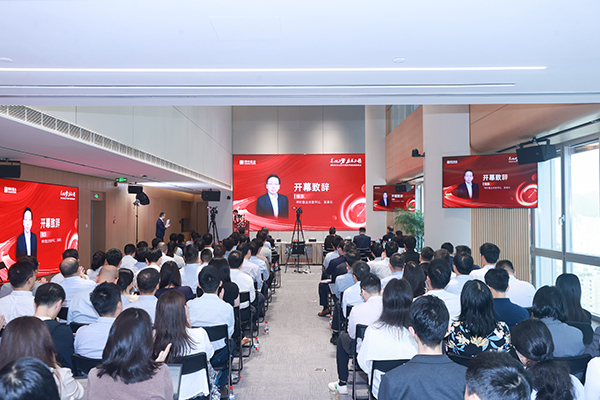
Core Insights - The conference held by Bosera Fund focused on global macro changes, the outlook for China's capital markets, and investment opportunities in various industries [2][4] - Experts from various financial institutions provided insights on the current economic landscape and future market expectations [6][8] Economic Performance - In the first three quarters of 2025, China's economy grew by 5.3%, standing out globally amid a complex macro environment and the Federal Reserve's interest rate cuts [4] - Major indices such as the CSI 300, CSI 500, and STAR Market 50 saw significant increases, indicating an active capital market [4] Market Outlook - The fourth quarter of 2025 is viewed as a critical turning point, with Bosera Fund committed to its strategic positioning as a value creator and high-quality development leader [5] - Experts predict that the A-share market will reflect expectations for 2026, with attractive valuations in Chinese manufacturing, which now accounts for 32% of global manufacturing [6][8] Investment Strategies - Bosera Fund's macro strategy report suggests a balanced asset allocation, focusing on technology, consumer sectors, and gold [8][9] - The report highlights that the domestic equity market performed well in Q3, led by sectors like telecommunications, electronics, and power equipment, while financials and real estate lagged [8] Sector Insights - The pharmaceutical sector is transitioning towards being a strategic emerging industry, opening up valuation opportunities [7] - The retail sector is expected to see profitability improvements among leading companies due to industry reforms [7] - The chemical industry is at a cyclical low but is anticipated to experience an upturn in 2026-2027 [7] Conclusion - Experts agree that the capital market is entering a historic opportunity phase amid global order restructuring and China's economic transformation [9] - Investors are encouraged to adopt a long-term perspective and actively participate in this evolving landscape [9]

Crazy Thursday
Datayes· 2025-10-16 11:39
Core Viewpoint - The article discusses the fluctuations in the A-share market, highlighting the impact of geopolitical tensions, particularly between the US and China, on market performance and investor sentiment [4][11]. Market Performance - The Shanghai Composite Index briefly fell below 3900 points but managed to recover, supported by certain stocks [2]. - As of October 16, the A-share market showed mixed results, with the Shanghai Index up by 0.1%, Shenzhen Component down by 0.25%, and the ChiNext Index up by 0.38% [11]. - The total trading volume for the day was 19,488.83 billion yuan, a decrease of 1,417.72 billion yuan from the previous day [11]. Geopolitical Influences - The article emphasizes the ongoing trade tensions between the US and China, with Trump confirming that the two countries are in a trade war [4]. - Key figures from the US government have suggested a decoupling from China if it continues to act against global cooperation [4]. Sector Insights - The coal sector experienced a rise, with expectations of tighter supply in the fourth quarter due to production halts from heavy rainfall and upcoming safety inspections [14]. - The port and shipping sector saw gains, with specific stocks like Nanjing Port performing well amid rumors of increased port fees for US vessels [12]. Investment Trends - The article notes a significant net outflow of 560.98 billion yuan from major funds, with the non-ferrous metals sector experiencing the largest outflow [26]. - The banking, coal, transportation, food and beverage, and oil and petrochemical sectors saw net inflows, indicating a shift in investor focus [26]. Regulatory Developments - The National Medical Insurance Administration announced reforms to advance the immediate settlement of medical insurance funds by the end of 2025 [21]. - The article also mentions the establishment of a multi-crystalline silicon storage platform, although rumors regarding this have been denied [22]. Company-Specific News - Nio Inc. is facing a lawsuit from Singapore's sovereign wealth fund for allegedly inflating revenue, which is not related to its recent operational performance [10]. - The article highlights significant profit increases for companies like Shijia Photon, which reported a net profit growth of 727.74% year-on-year for the first three quarters of 2025 [22].

河南资本市场月报(2025年第9期)-20251016
Zhongyuan Securities· 2025-10-16 11:35
Economic Performance and Comparison - In August 2025, major economic indicators in China showed signs of slowing down, with industrial production and investment facing pressures due to external tariff policies and internal "anti-involution" governance [11][14] - The industrial added value in Henan province grew by 8.2% year-on-year in August, outperforming the national average by 3.0 percentage points, with strong performance in upstream mining and processing industries [21][24] - Social retail sales in Henan reached 2264.55 billion yuan in August, with a year-on-year growth of 3.7%, slightly above the national average [22][24] Investment Trends - From January to August 2025, fixed asset investment in Henan increased by 4.7%, surpassing the national growth rate of 4.2%, with industrial investment showing a robust growth of 20.5% [23][28] - The real estate market in Henan continued to show weakness, with real estate development investment declining by 8.1% year-on-year [23][24] Policy Tracking - In September 2025, the financial regulatory authorities introduced a series of policies aimed at releasing consumption potential, optimizing resource allocation, and promoting digital transformation in industries [29][30] - The Henan provincial government launched several initiatives to support technological innovation and stabilize the real estate market, including a plan to enhance financial services for high-tech and green enterprises [36][38] Securities Market Performance - In September 2025, the Henan Index rose by 3.36%, outperforming both the Shanghai Composite Index and the CSI 300 Index, with a cumulative increase of 32.92% in the first nine months of the year [59][61] - The bond financing scale in Henan reached 370.72 billion yuan in September, marking an 8.18% increase from the previous month [42][47]


航空:客运量增长、票价修复,看好板块中长期景气提升
GOLDEN SUN SECURITIES· 2025-10-16 07:41
Investment Rating - The report maintains an "Overweight" rating for the transportation industry [4] Core Viewpoints - The transportation sector is expected to see a long-term improvement in demand, driven by strong travel intentions during holidays and a significant increase in passenger flow [1][2] - The recovery in air travel demand is evident, with domestic passenger volume showing resilience and international flight numbers increasing significantly [2][3] - The supply of aircraft is expected to grow at a low rate due to manufacturing constraints, which will limit capacity expansion in the aviation sector [2] - The decline in oil prices is beneficial for airline profitability, and ongoing regulatory measures against excessive competition are anticipated to support ticket price recovery [3] Summary by Sections Passenger Flow and Travel Intentions - The National Day and Mid-Autumn Festival holiday period is projected to see a record 2.432 billion people traveling, with a daily average increase of 6.2% year-on-year [1] - Civil aviation passenger volume reached 19.138 million during this period, with daily averages showing a year-on-year increase of 4.1% compared to 2024 and 26.9% compared to 2019 [1] Flight Operations and Capacity - As of October 14, 2025, the daily average of civil aviation flights is 15,539, a 3.73% increase from the same period in 2024 [2] - The average seat occupancy rates for major airlines have improved, with September 2025 showing an average of 85.7%, up 5 percentage points from 2019 [1][3] Pricing Trends - The average ticket price for domestic economy class in September 2025 was 697 RMB, a 0.6% increase year-on-year, indicating a recovery from previous declines [1] - During the holiday period, the average ticket price was 849 RMB, reflecting a slight increase compared to 2019 [1] Supply Constraints - Global aircraft deliveries are expected to remain constrained, with Boeing and Airbus projected to deliver 348 and 766 aircraft respectively in 2024, representing a year-on-year decline of 34.1% and an increase of 4.2% [2] - The introduction of the C919 domestic aircraft and the aging fleet will further limit capacity expansion in the aviation sector [2] Profitability and Policy Impact - The reduction in jet fuel costs due to falling oil prices is expected to enhance airline profitability [3] - The "anti-involution" policy in the civil aviation sector aims to stabilize ticket prices and improve overall market conditions [3]
TrendForce:政策或继续主导光伏行业价格走势 关注反内卷推进落地效果
智通财经网· 2025-10-16 06:32
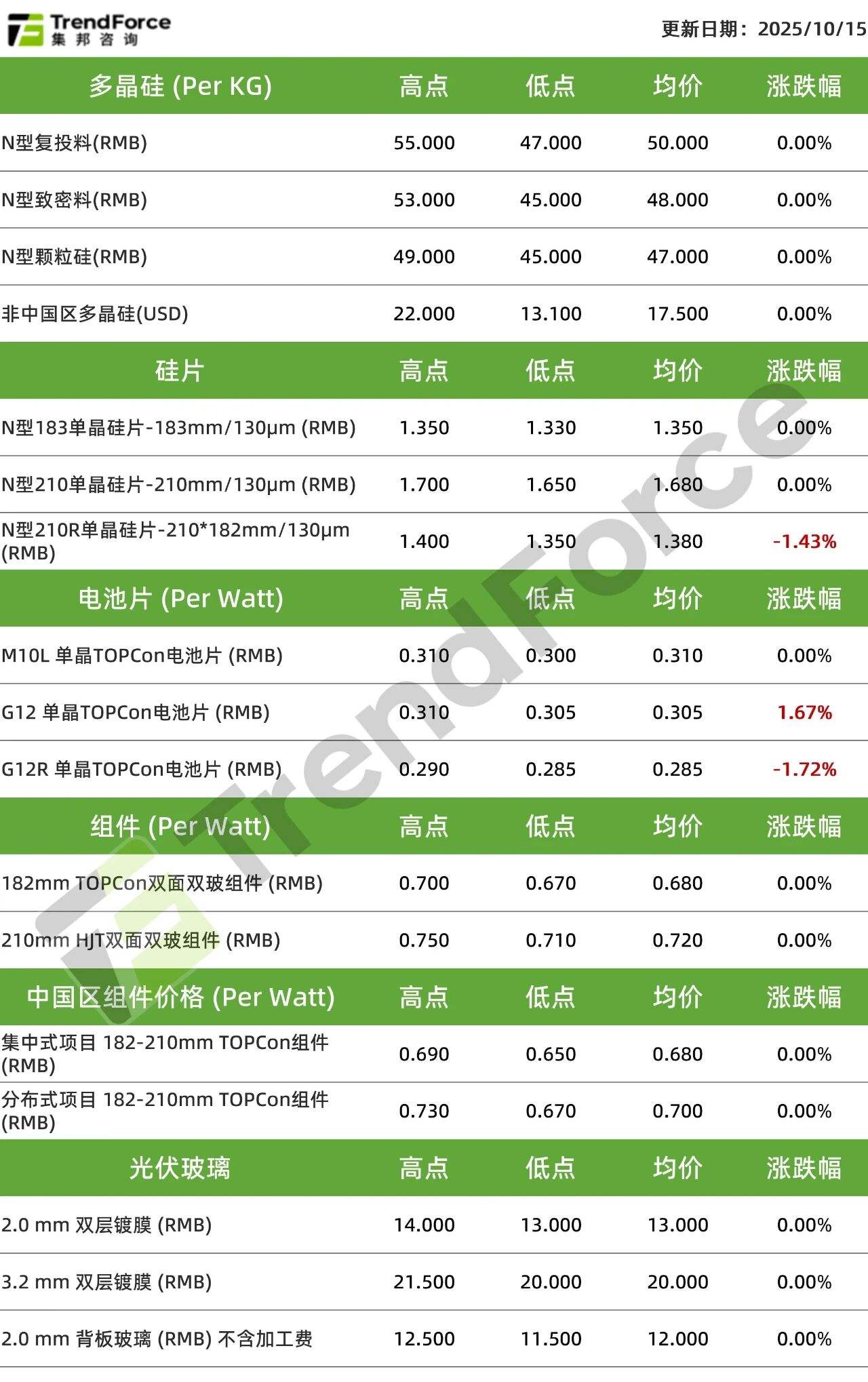
Core Viewpoint - The photovoltaic industry chain is expected to stabilize prices despite short-term supply-demand challenges, influenced by anti-involution policies [1][2] Group 1: Polysilicon Segment - The overall inventory in the industry has risen to over 410,000 tons, with a slight accumulation trend in polysilicon inventory this month [1] - The market for polysilicon is currently quiet, with a decrease in order volume month-on-month [1] - Price stability is influenced by stable operating rates of wafer companies and limited new orders due to maintenance or production cuts from some polysilicon manufacturers [1] Group 2: Wafer Segment - Current wafer inventory is around 19 GW, with little change in total volume, primarily dominated by 210RN wafers [3] - There is significant pressure on shipments, leading to a downward shift in price focus, while demand for 183N wafers has seen a temporary decline [3] - The oversupply situation in the wafer market persists, with indications of increased production this month exacerbating the oversupply trend [3] Group 3: Cell Segment - Battery inventory has risen to about 7 days, with a slight accumulation trend due to reduced shipments during holidays and weak terminal demand [5] - Demand for 183N cells has decreased, while 210RN demand remains weak; however, domestic demand for 210N cells is relatively optimistic [5] - Price pressure is evident for 210RN and 183N cells, with potential for price adjustments, while 210N maintains a relatively balanced supply-demand relationship [6] Group 4: Module Segment - Overall terminal market demand is not optimistic, with a temporary decline in overseas installation demand and mixed production plans among module manufacturers [7] - Despite rising costs from upstream suppliers, terminal demand for modules remains weak, leading to limited price increases [7] - The impact of anti-involution policies will continue to be a key factor in determining industry price trends [7] Group 5: Price Trends - Polysilicon prices are expected to remain stable at high levels this month due to policy regulation, despite pressure from downstream markets [2] - Wafer prices are under pressure with risks of decline, although recent self-discipline meetings have provided some confidence for price stabilization [4] - Battery and module prices are also facing downward pressure, but the ongoing anti-involution policies may help stabilize prices in the longer term [6][7]
化工板块遇冷,化工ETF(516020)盘中跌超1%!充电设施三年倍增计划带来新风口,布局时机或至?
Xin Lang Ji Jin· 2025-10-16 03:22
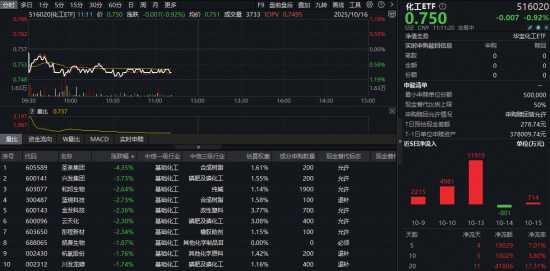
Group 1 - The chemical sector is experiencing a pullback, with the chemical ETF (516020) showing a decline of 0.92% as of the latest report, reflecting a broader downturn in the sector [1][3] - Key stocks in the sector, including Shengquan Group and Xingfa Group, have seen significant declines, with Shengquan Group dropping over 4% and several others falling more than 2% [1] - The chemical ETF's price-to-book ratio is at 2.3, indicating a relatively low valuation compared to the past decade, suggesting potential for medium to long-term investment [3] Group 2 - The National Development and Reform Commission has launched a three-year plan to double the service capacity of electric vehicle charging facilities by 2027, aiming for 28 million charging points and over 300 million kilowatts of public charging capacity [3] - The used car market in China saw a transaction volume of 1.7944 million units in September, reflecting a month-on-month increase of 5.1% and a year-on-year increase of 8.2%, with a total transaction value of 110.466 billion yuan [3] - Long-term outlook for the petrochemical industry remains positive, with expectations of recovery driven by policy adjustments and improved supply-side conditions [4] - Investment strategies suggest focusing on sectors benefiting from supply-side improvements, such as pesticides and organic silicon, as well as resource-rich sectors like potassium and phosphate fertilizers [4] - The chemical ETF (516020) tracks the CSI sub-industry index, providing exposure to major players in the chemical sector, with nearly 50% of its holdings in large-cap stocks [4]
新世纪期货交易提示-20251016
Xin Shi Ji Qi Huo· 2025-10-16 03:16
Report Industry Investment Ratings - Iron ore: Oscillation [2] - Coking coal and coke: Oscillation with a downward bias [2] - Rebar and wire rod: Oscillation with a downward bias [2] - Glass: Adjustment [2] - Soda ash: Adjustment [2] - CSI 300 Index Futures/Options: Oscillation [4] - SSE 50 Index Futures/Options: Oscillation [4] - CSI 500 Index Futures/Options: Rebound [4] - CSI 1000 Index Futures/Options: Rebound [4] - 2 - year Treasury Bonds: Oscillation [4] - 5 - year Treasury Bonds: Oscillation [4] - 10 - year Treasury Bonds: Uptrend [4] - Gold: Strong - biased oscillation [4] - Silver: Strong - biased oscillation [4] - Logs: Increased volatility [6] - Pulp: Consolidation [6] - Offset paper: Oscillation [6] - Soybean oil: Wide - range oscillation [6] - Palm oil: Wide - range oscillation [6] - Rapeseed oil: Wide - range oscillation [6] - Soybean meal: Oscillation with a downward bias [6] - Rapeseed meal: Oscillation with a downward bias [6] - Soybean No. 2: Oscillation with a downward bias [6] - Soybean No. 1: Oscillation [6] - Live pigs: Oscillation with a downward bias [7] - Rubber: Oscillation [7] - PX: Wait - and - see [7] - PTA: Oscillation [9] - MEG: Wait - and - see [9] - PR: Wait - and - see [9] - PF: Wait - and - see [9] Core Views - The black industry is affected by trade frictions, policy regulations, and supply - demand relationships. The prices of iron ore, coking coal, coke, rebar, etc. are expected to oscillate or adjust. The key lies in the demand for steel products in October and the implementation of relevant policies [2]. - The financial market is influenced by factors such as economic data, trade policies, and central bank operations. The market sentiment has improved, but it is still recommended to reduce risk appetite. The prices of stocks, bonds, and precious metals have different trends [4]. - The light industry and agricultural products markets are affected by supply - demand relationships, cost factors, and macro - environment. The prices of logs, pulp, oils, and agricultural products are expected to have different trends, and attention should be paid to factors such as supply changes and demand recovery [6][7]. - The polyester industry is affected by factors such as supply - demand relationships, cost support, and oil price trends. The prices of PX, PTA, MEG, etc. are expected to follow cost fluctuations or be in a wait - and - see state [9]. Summary by Categories Black Industry - **Iron ore**: Trade frictions and supply - side news affect market sentiment. The short - term price is expected to oscillate, and the key lies in the demand for steel products in October [2]. - **Coking coal and coke**: Tariff expectations and supply - side policies affect the market. The supply of coking coal has eased, and the demand for coke is strong. Pay attention to low - buying opportunities and policy implementation [2]. - **Rebar**: The supply pressure is relatively large, and the demand recovery in October is the key. The price needs to cooperate with rapid de - stocking to stabilize [2]. - **Glass**: The short - term supply - demand pattern has not improved significantly. The market expects policy implementation, but the new - start strength is difficult to recover quickly in the fourth quarter [2]. Financial Market - **Stock Index Futures/Options**: The market sentiment has improved, but it is still recommended to reduce risk appetite and control positions [4]. - **Treasury Bonds**: The market trend is slightly rebounding, and long - positions can be held lightly [4]. - **Precious Metals**: Gold and silver are expected to oscillate strongly, affected by factors such as central bank gold purchases, interest rate policies, and geopolitical risks [4]. Light Industry and Agricultural Products - **Logs**: The supply will increase after the holiday, and the demand is expected to gradually recover. The price is expected to have increased volatility, and the macro - impact may dominate [6]. - **Pulp**: The cost support for the pulp price is weakening, and the demand improvement needs to be verified. The price is expected to consolidate at the bottom [6]. - **Offset paper**: The supply is stable, and the demand is expected to improve. The price is expected to oscillate [6]. - **Oils**: The high inventory of palm oil and the supply increase of soybeans put pressure on the market. The price is expected to oscillate widely [6]. - **Meal Products**: The supply of soybean meal and rapeseed meal is expected to increase, and the demand is weak. The price is expected to oscillate downward [6]. - **Live Pigs**: The supply is sufficient, and the demand is weak. The price is expected to oscillate weakly in the short term [7]. - **Rubber**: The supply pressure has decreased, and the demand has increased. The price is expected to oscillate widely [7]. Polyester Industry - **PX**: The market is worried about future supply over - capacity, and the price follows oil price fluctuations [7]. - **PTA**: The cost support is weak, and the supply - demand relationship has marginally improved. The price follows cost fluctuations [9]. - **MEG**: The port inventory has increased, and the supply pressure is increasing. The price is affected by cost fluctuations [9]. - **PR and PF**: The market is waiting for new information, and the price is expected to be in a wait - and - see state or continue to be sorted weakly [9].
新能源及有色金属日报:期权到期叠加消息端扰动,多晶硅盘面大幅反弹-20251016
Hua Tai Qi Huo· 2025-10-16 03:14
1. Report Industry Investment Rating No information provided. 2. Core Viewpoints - For industrial silicon, the spot price is stable, the futures market fluctuates slightly, and there is short - term inventory accumulation. The industrial silicon market is mainly affected by overall commodity sentiment and policy news. If there are policies to promote capacity exit, the futures price may rise [1][3]. - For polysilicon, the futures market is affected by weak reality and strong policy expectations. It recently fell back due to slow progress of anti - involution policies and approaching 11 - month warrant cancellation. When the futures price is much lower than the spot price, there is buying support. If the policy progresses, polysilicon can be bought at low prices in the medium - to - long - term [5][8]. 3. Summary by Catalog Industrial Silicon Market Analysis - On October 15, 2025, the industrial silicon futures price fluctuated. The main contract 2511 opened at 8495 yuan/ton and closed at 8570 yuan/ton, a change of - 0.12% from the previous settlement price. The position of the main contract was 142,381 lots, and the warrant number was 50,357 lots, a decrease of 840 lots from the previous day [1]. - The industrial silicon spot price was stable. The price of East China oxygen - passing 553 silicon was 9300 - 9500 yuan/ton, 421 silicon was 9600 - 9800 yuan/ton, Xinjiang oxygen - passing 553 was 8700 - 9000 yuan/ton, and 99 silicon was 8700 - 9000 yuan/ton [1]. - Due to the decline in raw coal prices and reduced demand from silicon plants in the southwest during the dry season, the price of Xinjiang bonding silicon coal decreased by about 250 yuan/ton to 1300 - 1650 yuan/ton. The price of Shaanxi silicon coal also decreased slightly by about 25 yuan/ton to an average of 750 yuan/ton [1]. Consumption End - The price of organic silicon DMC was 11100 - 11500 yuan/ton. Most manufacturers had pre - orders, many were under maintenance, and some planned to enter maintenance. The market supply was reduced, and it was expected to fluctuate strongly in the short term [2]. Strategy - Short - term interval operation is recommended, and contracts during the dry season can be bought at low prices. There are no suggestions for cross - period, cross - variety, spot - futures, and options operations [3]. Polysilicon Market Analysis - On October 15, 2025, the main polysilicon futures contract 2511 fluctuated widely, opening at 49975 yuan/ton and closing at 50865 yuan/ton, a 3.37% increase from the previous trading day. The position was 80,114 lots, and the trading volume was 276,176 lots [5]. - The polysilicon spot price was stable. The price of N - type material was 50.50 - 55.00 yuan/kg, and N - type granular silicon was 50.00 - 51.00 yuan/kg. The polysilicon inventory increased by 6.19% to 240,000 tons, and the silicon wafer inventory increased by 3.39% to 16.78GW. The weekly polysilicon output was 31,000 tons, a decrease of 0.10%, and the silicon wafer output was 12.83GW, a decrease of 6.89% [5]. - The price of domestic N - type 18Xmm silicon wafers was 1.35 yuan/piece, N - type 210mm was 1.70 yuan/piece, and N - type 210R was 1.38 yuan/piece. The polysilicon price was generally stable, and the market was quiet during the National Day. The polysilicon output in October was expected to increase by 3000 - 5000 tons [7]. - The prices of various types of battery cells and components remained stable [7]. Strategy - The polysilicon futures market is affected by weak reality and strong policy expectations. It recently fell back due to slow policy progress and approaching warrant cancellation. It is expected to fluctuate between 48,000 - 54,000 yuan/ton in the short term. If the price corrects significantly, it can be bought at low prices in the medium - to - long - term. There are no suggestions for cross - period, cross - variety, spot - futures, and options operations [8].