美联储降息

Search documents
大越期货沪铜早报-20260226
Da Yue Qi Huo· 2026-02-26 01:30
交易咨询业务资格:证监许可【2012】1091号 沪铜早报- 大越期货投资咨询部 : 祝森林 从业资格证号:F3023048 投资咨询证号: Z0013626 联系方式:0575-85226759 重要提示:本报告非期货交易咨询业务项下服务,其中的观点和信息仅作参考之用,不构成对任何人的投资建议。 我司不会因为关注、收到或阅读本报告内容而视相关人员为客户;市场有风险,投资需谨慎。 每日观点 铜: 近期利多利空分析 利多: 利空: 逻辑: 风险: 全球政策宽松 和 矿端紧张 1、基本面:供应端有所扰动,冶炼企业有减产动作,废铜政策有所放开,1月份,制造业采购经理指 数(PMI)为49.3%,比上月下降0.8个百分点,制造业景气水平有所回落;偏多。 2、基差:现货102125,基差-765,贴水期货;偏空。 3、库存:2月25日铜库存增6475至249650吨,上期所铜库存较上周增23564吨至272475吨;中性。 4、盘面:收盘价收于20均线上,20均线向上运行;偏多。 5、主力持仓:主力净持仓多,多增;偏多。 6、预期:地缘扰动仍存印尼的Grasberg Block Cave矿事件发酵,铜价再次创出历史新高 ...
戴康:2026的王者?黄金新高的逻辑与展望
戴康的策略世界· 2026-01-21 14:24
Core Viewpoint - Gold has recently reached new highs, driven by its financial, hedging, and monetary attributes, with expectations for continued strength in 2026 [1]. Financial Attribute - The actual interest rate of 10-year U.S. Treasury bonds is negatively correlated with gold prices, and since the Fed's interest rate cut in September 2025, the market has been trading on expectations of continued liquidity easing [1]. - As of January 21, 2026, the market's expectation for a further 25 basis point rate cut by the Fed has diminished, indicating a potential slowdown in liquidity easing in the short term, but the long-term outlook remains in a liquidity easing channel [1]. Hedging Attribute - Recent geopolitical tensions, such as tariff disputes between the U.S. and Europe over Greenland, have heightened market risk aversion, leading to a narrative of "de-Americanization" and causing a sell-off in U.S. assets [1]. - Concerns about the U.S. economy, including weak employment and high inflation, are increasing uncertainty about short-term stagflation and long-term recession risks, thereby boosting demand for gold as a safe-haven asset [1]. Monetary Attribute - A weak dollar and the trend of de-globalization are undermining the credibility of the dollar, while global central banks continue to increase their gold reserves, with Poland recently announcing a purchase of 150 tons of gold [1]. - The high global fiscal deficit context suggests that the depreciation of currencies relative to gold is unlikely to reverse in the short term, which will support gold's relative price [1]. Long-term Outlook - The new paradigm of gold as a super-sovereign credit asset, akin to a perpetual zero-coupon bond, is expected to form the basis of long-term investment logic, especially as concerns about U.S. debt continue to erode dollar credibility [3]. - The ongoing trend of de-dollarization, combined with geopolitical risks and central bank demand for gold, is likely to support gold prices in the medium to long term [3].


全球大放水开启!2026年起全民大化债,对普通人的钱袋子有什么影响?
Sou Hu Cai Jing· 2026-01-15 16:46
Core Viewpoint - The global economic landscape is shifting, with the Federal Reserve and the Bank of Japan adopting opposing monetary policies, leading to changes in liquidity and debt management strategies across major economies [1][3][4]. Group 1: Monetary Policy Changes - The Federal Reserve is expected to lower interest rates four times from late 2025 to late 2026, making money cheaper [1]. - In contrast, the Bank of Japan has begun raising interest rates, with a current benchmark rate of 0.5%, and plans to reduce its bond purchasing by approximately 2 trillion yen monthly starting April 2026 [1][3]. - This divergence in monetary policy between the two largest economies is creating a complex global liquidity environment [3]. Group 2: Impact on Global Liquidity - The yen carry trade, where investors borrow yen at low rates to invest in higher-yielding assets, has reached a scale of over 140 trillion yen (approximately $930 billion), which is 236% of Japan's GDP [3]. - As Japanese interest rates rise and U.S. rates fall, the profitability of this carry trade is being squeezed, potentially leading to a sell-off of U.S. assets as investors return to yen [3]. Group 3: Debt Management Strategies - High debt levels are a common issue for many economies, with emerging markets and developing economies facing the highest public debt levels in over fifty years [4]. - The Eurozone's debt-to-GDP ratio reached 78.1% in July, indicating significant debt challenges [4]. - China plans to maintain an active fiscal policy with a projected fiscal deficit rate of around 4% and a slight increase in the broad fiscal deficit rate to 8.9% [4]. Group 4: Effects on Interest Rates and Inflation - Lower interest rates from central banks will likely lead to reduced loan rates, benefiting borrowers but potentially shrinking interest income for savers [5][7]. - The average mortgage rate has decreased to approximately 3.24%, which is favorable for homeowners [7]. - Global inflation is projected to decline from 4% in 2024 to 3.1% in 2026, although certain essential costs, such as services, continue to rise [7][8]. Group 5: Asset Prices and Investment Strategies - Low interest rates and increased liquidity typically drive up asset prices, with U.S. stock indices showing gains amid rate cut expectations [8]. - However, high valuations in sectors like artificial intelligence pose risks of market corrections [8]. - Governments may resort to issuing more bonds to manage debt, which could lead to lower bond prices and higher yields, impacting bond investors [8]. Group 6: Trade Policies and Economic Growth - The U.S. high tariff policies are affecting global trade, with the World Trade Organization downgrading the 2026 global goods trade growth forecast to 0.5%, significantly lower than 2.4% in 2025 [9]. - Trade difficulties may lead to increased production costs, ultimately affecting consumer prices [9]. Group 7: Recommendations for Individuals - Adjusting savings strategies is crucial in a declining interest rate environment, with a recommendation to diversify into medium- to long-term deposits [11]. - Borrowers should consider the benefits of lower interest rates on existing loans, while being cautious about increasing debt [11]. - Investment strategies should focus on diversification to mitigate risks associated with high asset valuations [11][12].
1月资产配置月度报告:跨年行情多点开花,外需韧性超预期
Sou Hu Cai Jing· 2026-01-13 02:57
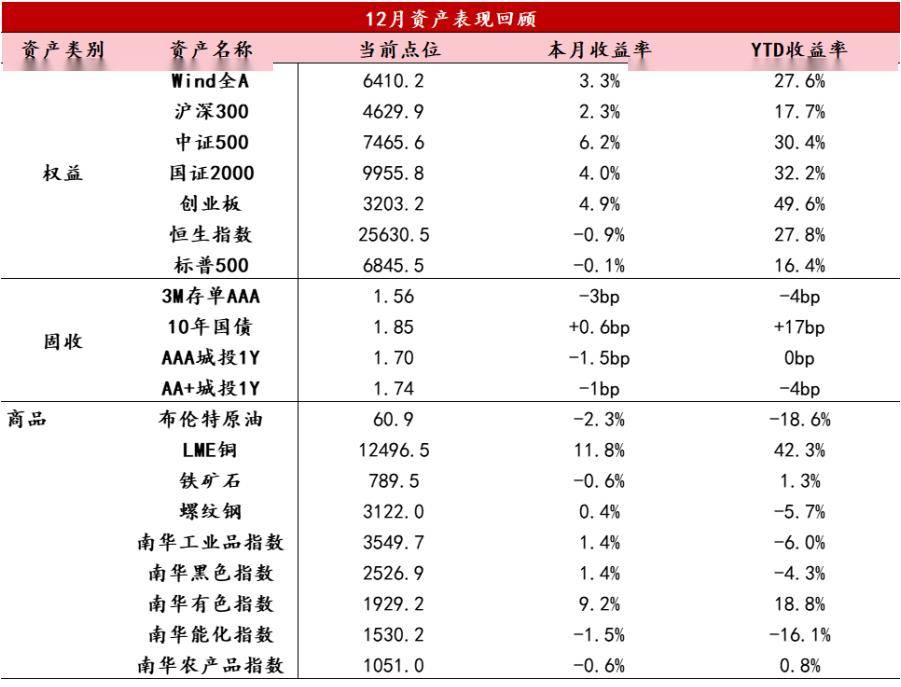
Stock Market Overview - In December, the Federal Reserve's interest rate cut was implemented as expected, leading to fluctuations in future rate cut expectations, while the Nasdaq index experienced volatility [1] - The A-share market showed overall fluctuations, with the Shanghai Composite Index achieving 11 consecutive gains by the end of the month, driven by a positive tone from the Central Economic Work Conference and a declining US dollar index [1] - The Wind All A index recorded a +3.3% increase for the month, with 60% of the Shenwan first-level industries rising, particularly strong performances in defense and military (+17.22%) and non-ferrous metals (+13.68%) [1] Bond Market Overview - The bond market continued to experience wide fluctuations in December, with increased yield volatility and a steeper curve [2] - Despite relatively ample liquidity and the central bank's resumption of bond purchases providing some support, concerns over long-term bond supply and other factors kept the market in a weak oscillation pattern [2] - The 10-year government bond yield ended the month at 1.85%, reflecting an N-shaped trend throughout December [2] Commodity Market Overview - The commodity market showed a bullish atmosphere in December, with precious metals and non-ferrous sectors being the strongest performers [3] - Gold prices fluctuated, with London gold closing at $4318.25 per ounce, up 2.36% from the previous month, while copper prices also saw significant increases [3] - The oil market experienced a downward trend, with Brent crude oil closing at $60.91 per barrel, down 2.26% for the month [3] Macroeconomic Performance - In November, China's exports demonstrated strong resilience, growing by 5.9% year-on-year, driven by a significant increase in machinery and high-tech product exports [5] - However, domestic consumption remained weak, with retail sales growth slowing to 0.3% year-on-year, indicating structural constraints on internal demand [5] - Fixed asset investment continued to decline, with real estate investment adjustments dragging down overall figures, highlighting the challenges in achieving self-sustaining growth [5] Policy Outlook - The Central Economic Work Conference set the tone for macroeconomic policy in 2026, focusing on addressing the structural imbalance of "strong supply and weak demand" [9] - The strategic shift will prioritize investment in human capital and social welfare, aiming to enhance income levels and consumer demand [9] - Fiscal policy is expected to maintain a more active stance, with a nominal deficit rate targeted around 4.0%, while monetary policy will shift focus from total volume to price stability [10][11] Asset Allocation Analysis - In December, net buying in the stock market rebounded to over 2.5 trillion yuan, with significant inflows into equity ETFs [14] - The manufacturing PMI showed a seasonal rebound, indicating improved trade conditions and proactive inventory preparations by companies [15] - Looking ahead to 2026, the market is expected to experience structural trends, with a focus on sectors that demonstrate sustainable performance and profitability [16]
2025年丁二烯市场回顾与展望:供增需缓下的行业变局
Zhong Guo Neng Yuan Wang· 2026-01-08 11:00
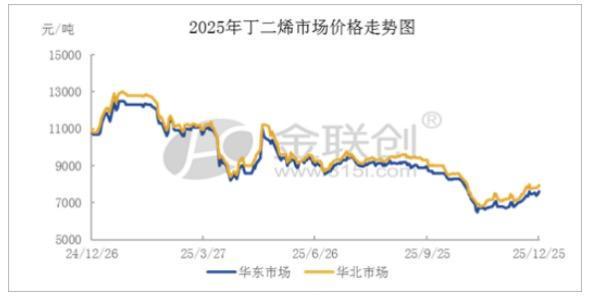
Core Viewpoint - The domestic butadiene market in 2025 experienced fluctuations with a significant price drop compared to 2024, influenced by macroeconomic disturbances, new production capacities, high import volumes, and the performance of downstream synthetic futures [2][3][4][5][6] Group 1: Price Trends - In 2025, the average price of butadiene in Shandong was 9689 yuan/ton, a year-on-year decrease of 17.74%, with a high of 13150 yuan/ton and a low of 6800 yuan/ton [2] - The first quarter saw a strong price increase followed by a decline due to geopolitical factors and increased supply from the restart of certain production facilities [2] - The second quarter experienced significant price volatility, with a sharp drop in April due to U.S. tariffs and new production capacities coming online, followed by a recovery in May after positive trade talks between China and the U.S. [3] - In the third quarter, butadiene prices fluctuated widely, with tight supply in July leading to higher prices, but a subsequent easing of supply in August and September caused prices to decline [4] - The fourth quarter saw a "V"-shaped price trend, with prices hitting a low in November before recovering in December due to external market influences and improved demand from downstream synthetic rubber [5] Group 2: Supply and Demand Dynamics - The supply side in 2026 is expected to be robust with new butadiene facilities coming online, including those from Zhongsha Gulei and Huajin Aramco, alongside continued production from facilities that started in late 2025 [6] - Demand may be affected by slowing growth in natural rubber production and ongoing global trade conflicts, which could hinder the improvement of terminal demand [6] - The potential for increased butadiene exports due to the planned exit of some overseas ethylene facilities and the possibility of domestic facilities shifting to lighter hydrocarbons should be monitored closely [6]
大涨4462点,人民币进入6字头,中国官媒12个字罕见警告
Sou Hu Cai Jing· 2026-01-01 11:41
Group 1 - The core point of the article is that the recent appreciation of the Renminbi (RMB) against the US dollar is a result of both external and internal factors, leading to a complex situation where the Chinese government has issued warnings despite the apparent benefits of currency appreciation [2][3][5][11]. - The external factor driving the RMB appreciation is the change in US monetary policy, specifically the shift from interest rate hikes to rate cuts, which weakened the US dollar and made RMB assets more attractive to international investors [5][9]. - Internally, a "settlement tide" has emerged as Chinese export companies, previously holding onto US dollars in anticipation of further depreciation, are now converting their dollars to RMB due to fears of losing value, creating a self-reinforcing cycle of appreciation [7][9]. Group 2 - The Chinese government warns that while currency appreciation may seem beneficial, it poses risks to export-oriented businesses, as a stronger RMB can make their products more expensive and less competitive internationally [11][13]. - There is concern about speculative capital entering the market, which could lead to volatility and potential financial instability, reminiscent of past economic crises in other countries [13][15]. - The government emphasizes the importance of maintaining a stable RMB exchange rate rather than focusing solely on appreciation, advocating for a dual-directional fluctuation as the norm to prevent market overheating and speculative behavior [15][16]. Group 3 - For businesses, especially exporters, it is crucial to adopt a "risk-neutral" mindset and utilize financial instruments to hedge against currency fluctuations, ensuring stable profits regardless of exchange rate movements [16][18]. - Ordinary individuals are advised not to engage in currency speculation unless there is a clear need for foreign currency, as the long-term stability of the RMB is expected, and efforts should be focused on enhancing personal capabilities and investing in domestic assets [19][21]. - The article concludes that the recent RMB appreciation is justified by underlying factors, but the government's warnings serve as a precaution against potential market excesses that could harm the real economy [21].
2025:25个关键词里的中国与世界
Di Yi Cai Jing· 2025-12-30 13:27
Group 1 - The core focus of China's economic work in 2025 is to comprehensively rectify "involution" and disorderly competition, with policies aimed at improving product quality and stabilizing market prices [2] - The reform of state-owned enterprises is nearing completion, with significant progress in strategic functions, governance, and regulatory efficiency [4] - The introduction of the Private Economy Promotion Law marks a significant legal framework for promoting fair competition and protecting the rights of private enterprises [5] Group 2 - The resolution of local government debt risks is progressing rapidly, with a plan to replace 10 trillion yuan of hidden debts, achieving over half of the target by the end of 2025 [6] - The issuance of ultra-long special government bonds reached 1.3 trillion yuan in 2025, with a focus on supporting major projects and expanding consumption [6][7] - A special action plan to boost consumption was launched, emphasizing income growth and improving consumer confidence [8] Group 3 - The A-share market saw the Shanghai Composite Index reach 4000 points for the first time in ten years, driven by a recovery in technology stocks and supportive government policies [10] - Gold prices experienced a historic surge, with spot prices rising from $2625 to a peak of $4550 per ounce, driven by macroeconomic factors and central bank purchases [11] - The introduction of the "Science and Technology Innovation Growth Layer" on the STAR Market accelerated the IPO process for unprofitable companies, marking a significant shift in capital market dynamics [12] Group 4 - The deposit interest rates in China underwent a comprehensive decline, with significant adjustments across various banks, impacting personal investment behaviors [12] - The external environment, including the U.S.-China trade tensions and geopolitical factors, influenced the Federal Reserve's monetary policy, leading to interest rate cuts [14] - The rise of DeepSeek as a key player in the AI sector reshaped global competition, emphasizing open-source strategies and high cost-performance [15] Group 5 - The external delivery market saw significant changes with the entry of new players like JD.com and the upgrade of Ele.me, leading to increased competition and consumer choice [18] - The family disputes within Wahaha highlighted the complexities of family governance in business, affecting brand perception and market dynamics [19] - The success of "Nezha 2" at the box office marked a significant milestone for Chinese animation, reflecting the industry's growth and potential for global recognition [21]

金价何以不断创新高?
Sou Hu Cai Jing· 2025-12-25 16:37
■韩昱 黄金可算是今年全球金融市场表现最亮眼的资产了。 第一,美元信用体系承压是支撑金价上行的核心逻辑。近年来,美国债务规模加速扩张,财政可持续性 备受质疑,美元信用不断经受冲击,从宏观层面为黄金的资产配置提供了机遇。作为历史悠久的避险资 产,黄金凭借其避险属性以及与其他传统资产较低的相关性,成为投资者多元化资产配置的优先选择。 第二,全球央行增持黄金,从需求端为金价走高提供坚实支撑。出于优化外汇储备结构、实现资产多元 化配置等因素考量,全球央行"囤金"动作从未停歇,近两年更加突出。世界黄金协会发布的最新数据显 示,今年10月份,全球官方黄金储备净增53吨,较9月份环比增长36%,延续了全年强劲趋势,同时创 下年初以来最大月度净购金规模。截至10月底,全球央行年内累计净购金量为254吨。 第三,美联储降息成为金价上行的关键推手。黄金作为无息资产,其投资吸引力与实际利率呈现出负相 关关系。美联储降息周期中利率的下降使得持有黄金的机会成本降低,继而增强黄金的吸引力。 此轮金价再创新高,与美联储降息密切相关。美国11月份失业率创四年来新高,反映出就业市场持续降 温,强化了市场对未来美联储降息的预期,为金价上涨提供了 ...
中美贸易降温!美联储降息,国内经济在转型,普通人抓这2条线
Sou Hu Cai Jing· 2025-12-25 16:21
Global Economic Environment - The relationship between the US and China has improved, reducing trade tensions and the risk of tariff increases, which enhances market stability for businesses [3] - The Federal Reserve has cut interest rates by 100 basis points in 2025, with expectations of further cuts in 2026, potentially lowering rates to around 3%, making borrowing cheaper and increasing liquidity in the market [3] Domestic Economic Policies - The Chinese government is focusing on consumption as the core engine for economic growth, with policies to promote trade-in programs for appliances and vehicles, encouraging consumer spending [5] - The shift in China's economic development model emphasizes consumption and technology, with increased investment in R&D and a growing competitive edge in AI applications [7] Support for Emerging Industries - The government is implementing policies to support emerging industries while addressing issues in traditional sectors, promoting initiatives like "Artificial Intelligence +" and enhancing regulations for the digital economy [9] - 2026 marks the beginning of the "14th Five-Year Plan," with significant policy support expected for cutting-edge fields such as AI, quantum information, and deep space exploration [9] Capital Market Outlook - The domestic capital market is expected to continue its recovery, supported by government policies and ample liquidity, with significant investments from central financial institutions and long-term funds [11] - Actions such as stock buybacks by state-owned enterprises and increased allocations to equities by social security and insurance funds are stabilizing market expectations [11]
美委战争一触即发,俄罗斯大批黄金运往中方,金价疯涨,美国很慌
Sou Hu Cai Jing· 2025-12-25 04:08
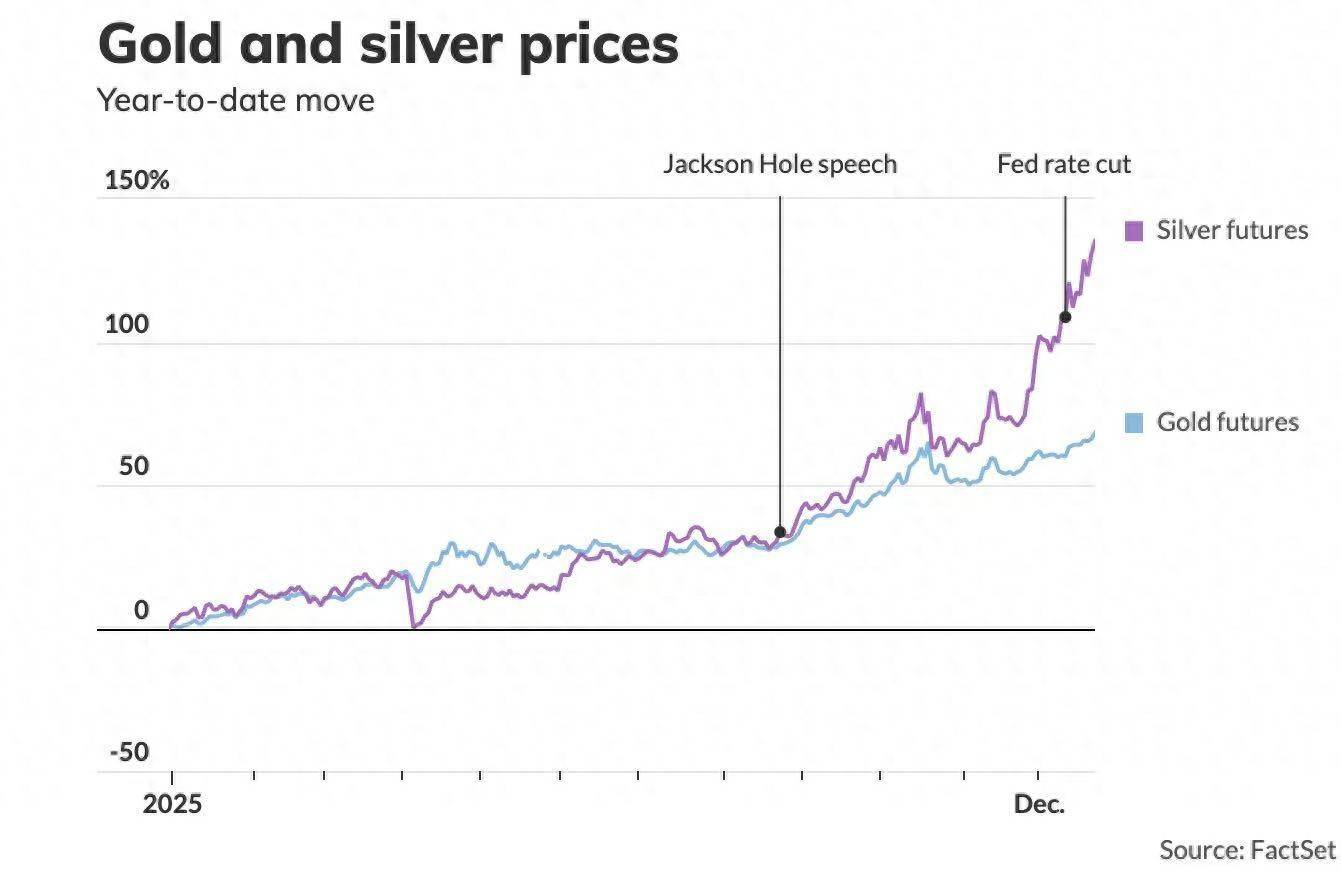
同时,乌克兰对俄罗斯港口和航运的新一轮袭击,进一步强化了黄金作为避险资产的吸引力。面对局势,中国迅速采取行动,从战略层面判断并运作。12月 20日,中国海关公布数据显示,今年前11个月,中国已从俄罗斯购买约19亿美元黄金,仅11月就采购了9.6亿美元,创下中俄黄金交易的新纪录。 欧洲刚刚加大对乌克兰的支持力度,紧接着特朗普政府就对委内瑞拉施加了极大压力,使其几乎陷入封锁状态。同时,俄罗斯也开始撤离驻委内瑞拉外交官 的家属,局势明显在升级,战争的阴影似乎一触即发。消息一出,国际黄金价格迅速飙升,突破4500美元的重要关口,今年累计涨幅已高达68%。普京也迅 速做出决定,大批俄罗斯黄金被运往中国。 有人认为,在乱世中囤积黄金是一种古老的思维方式,但实际上,黄金真正的对手是纸币。只要纸币持续超发,黄金就会不断上涨,其价值会稳步攀升。 此次黄金价格的飙升,很大程度上源于美联储近期的降息举措,以及市场对债务货币化的担忧。所谓债务货币化,是指央行通过购买政府发行的债券,即印 钞票的方式,来推动通胀,从而偿还国家债务。前高盛首席货币策略师罗宾布鲁克斯指出,美联储主席鲍威尔在8月杰克逊霍尔年会上发表的鸽派言论,以 及12月1 ...