
有色

Search documents
我国创新药IND审批正式迈入30天高效时代,该公司已布局
摩尔投研精选· 2025-09-16 10:33
Macro Strategy Highlights - The market consensus has been strong since August, with industry rotation intensity showing a seasonal decline, while September is traditionally a window for upward industry rotation intensity [1] - As the third-quarter report disclosure period approaches in late September to October, the correlation between stock prices and performance will gradually increase, marking a phase of enhanced effectiveness for cyclical investments [1] - Key areas to focus on include Hong Kong internet stocks, innovative pharmaceuticals, and new energy sectors, which are expected to benefit from interest rate cuts and industry catalysts [1][2][3] Industry Tracking - The Hong Kong internet sector is positioned to benefit from interest rate cuts and AI expansion, with platforms that have the best social scenarios and ecosystems likely to see early gains [1] - The innovative pharmaceutical sector has reached a moderate level of crowding, with sentiment sufficiently digested, and is expected to see catalysts from industry conferences in September and Q4 [1] - The new energy sector is driven by technological breakthroughs and anti-involution trends, providing a flexible new direction [2] - The new consumption sector has high odds currently, with seasonal catalysts and improved cyclical expectations enhancing success rates [3] - The cyclical sectors, particularly non-ferrous metals and chemicals, are experiencing multiple catalysts, with leading chemical companies showing a high safety margin in valuations [3]


稳住70%工业基本盘!十大行业放大招
2 1 Shi Ji Jing Ji Bao Dao· 2025-09-16 09:48
Core Viewpoint - The government is launching a new round of "stabilizing growth" policies targeting ten key industries to support economic stability and future industrial upgrades, which collectively account for 70% of the industrial economy [1][2]. Group 1: Key Industries Benefiting - The ten key industries identified include steel, non-ferrous metals, petrochemicals, chemicals, building materials, machinery, automobiles, power equipment, light industry, and electronic information manufacturing [1]. - These industries are crucial as they not only stabilize the industrial economy but also serve as a foundation for new productive forces and technological innovations [1]. Group 2: Rationale for Policy Implementation - The timing of the new policies is strategic, coinciding with the end of the "14th Five-Year Plan" and the tenth anniversary of supply-side structural reforms, amidst increasing economic pressures in the third quarter [2]. - The government aims to counter potential economic downturns while ensuring both growth and quality improvements, emphasizing a dual focus on quantity and quality for genuine growth [2]. Group 3: Policy Focus and Implementation - The policies are designed to be precise, addressing supply and demand, technology, and market needs, with a strong emphasis on innovation, quality enhancement, and the integration of artificial intelligence in traditional industries [2]. - On the demand side, the policies promote consumption, expand application scenarios, and encourage major engineering projects to stimulate investment and consumption [2]. Group 4: Market Environment and Competition - The policies signal a rejection of irrational competition, urging industries to focus on technology, brand differentiation, and quality rather than price wars [2]. - Support is provided for XR equipment, smart grids, and pilot projects for first-time equipment, creating opportunities for businesses of all sizes [2].
A股缩量却冲上3892点!AI狂欢背后,这三个信号才是慢牛关键
Sou Hu Cai Jing· 2025-09-16 08:26
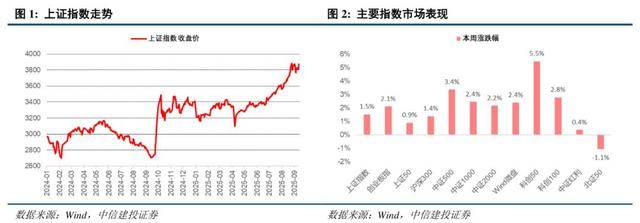
Market Overview - A-shares experienced a sudden surge, approaching 3900 points, despite a decline in trading volume from an average of nearly 3 trillion to 2.3 trillion [1] - The AI computing sector significantly boosted the Sci-Tech 50 Index, which rose by 5.5% [1] - Concerns about whether the shrinking volume indicates a trap or an opportunity are prevalent among investors [1] Fund Flows - Margin trading accounted for 11.5% of total trading volume, with a weekly net inflow of 51.8 billion, more than double the previous week [1] - Industry-themed ETFs attracted 101 billion over the past four weeks, indicating that investors are not withdrawing but rather seeking direction [1][3] Economic Indicators - August CPI fell by 0.4% year-on-year, primarily due to high base effects from last year, particularly in food prices [4] - Core CPI rose to 0.9%, indicating stable recovery in domestic demand [4] - PPI showed signs of improvement, with a month-on-month stability and a year-on-year decline of 2.9%, narrowing from -3.6% in previous months [4][6] Sector Analysis - Upstream industries such as coal, oil, steel, and non-ferrous metals showed significant PPI improvements, supported by recent anti-involution policies [6] - The recovery in upstream sectors is expected to positively impact the entire industrial chain, providing fundamental support for A-shares [6] External Environment - The U.S. is expected to lower interest rates by 25 basis points in September, with potential for two more cuts this year [8] - A weaker dollar and increased liquidity may lead to foreign capital flowing into emerging markets, including Chinese assets [8] - Sectors such as internet stocks in Hong Kong, and financial, consumer, and new energy sectors in A-shares may benefit from foreign inflows [8] Investment Strategy - The market is in a slow bull consolidation phase, with no signs of a funding collapse or disruption in high-growth sectors [9] - Focus on sectors with policy support or PPI recovery, such as pig farming, non-ferrous metals, and basic chemicals [11] - Key signals to monitor include the continued rise of core CPI and the pace of foreign capital inflows [11]
周期王者归来?又一个黄金赛道诞生
券商中国· 2025-09-16 06:03
Core Viewpoint - The traditional cyclical sectors, represented by non-ferrous metals and chemicals, have recently experienced a strong upward trend, contrasting with the technology growth style that has dominated the market [1][2]. Group 1: Market Trends - Since the low point in April, the China Securities Non-Ferrous Metals Index and the China Securities Chemical Sub-Industry Index have rebounded by 57% and 32% respectively, ranking among the top in the secondary industry indices [2]. - Significant capital has flowed out of technology-focused ETFs and into chemical and non-ferrous metal ETFs, indicating a "high cut low" trend in investment [3]. - In the past three months, chemical ETFs and non-ferrous metal ETFs have seen net inflows of 19.2 billion and 13.7 billion respectively, reflecting a shift in market expectations [3]. Group 2: Supply and Demand Dynamics - The previous peak in capital expenditure for traditional cyclical industries has passed, leading to market-driven supply-side adjustments and enhanced industry self-discipline [4]. - The demand for precious metals has been driven by a shift in the Federal Reserve's stance and a weak non-farm payroll report, leading to rising gold prices [4]. - Industrial metals like copper are in a tight supply-demand balance, while aluminum prices are supported by limited global production increases [4]. Group 3: Policy and Economic Context - The "anti-involution" policy is seen as a significant macroeconomic factor that could enhance domestic production factor prices and improve corporate balance sheets, thereby boosting consumption and reinvestment [7][9]. - The current economic context differs from previous supply-side reforms, focusing more on market-driven adjustments rather than forced elimination of excess capacity [8][9]. Group 4: Emerging Opportunities - New technologies such as AI and renewable energy are injecting unprecedented demand into traditional cyclical industries, reshaping their value chains [10]. - The demand for copper, driven by AI and renewable energy sectors, has already surpassed 20% of global copper demand and continues to grow rapidly [11]. - The development of AI is expected to revolutionize material science, potentially leading to new materials and industrial revolutions in the future [11].

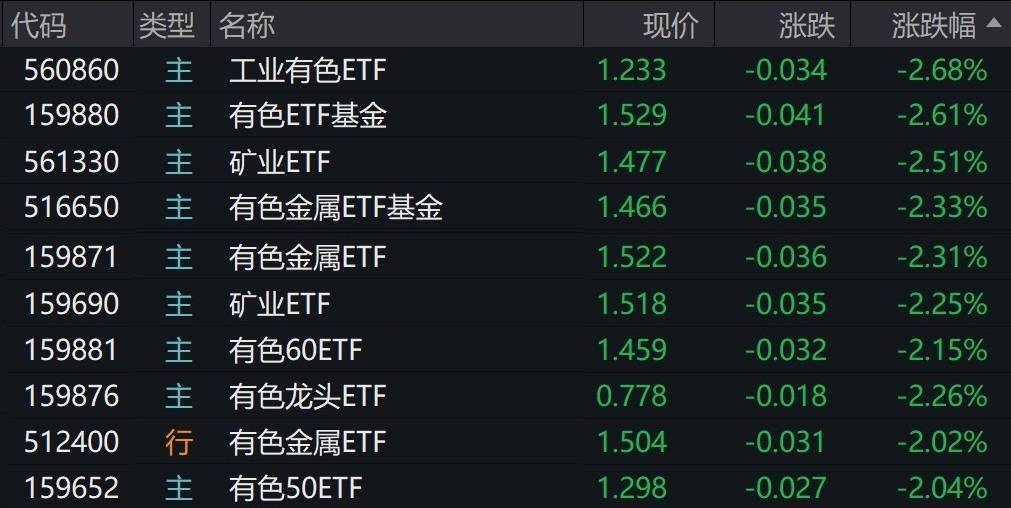
有色金属概念股早盘走低,有色、矿业相关ETF跌超2%
Sou Hu Cai Jing· 2025-09-16 03:36
Group 1 - The core viewpoint indicates that non-ferrous metal stocks are experiencing a decline, with significant drops in Chinese rare earths and other related companies [1] - The market impact shows that related ETFs in the non-ferrous and mining sectors have fallen over 2% [1] - Specific declines include over 5% drop in Chinese rare earths, and more than 4% drop in companies like Northern Rare Earth and Luoyang Molybdenum [1] Group 2 - Various non-ferrous metal ETFs have reported declines, with the Industrial Non-Ferrous ETF down 2.68% and the Non-Ferrous Metal ETF down 2.61% [2] - A broker has indicated that the non-ferrous metal sector will continue to face high market volatility risks in 2025 due to uncertainties from both demand and supply sides [2] - Emerging demand in the downstream structure of copper and aluminum is expected to support a long-term upward shift in non-ferrous metal prices [2]




研究所晨会观点精萃-20250916
Dong Hai Qi Huo· 2025-09-16 02:40
Report Industry Investment Rating No relevant content provided. Core Viewpoints of the Report - Overseas, the US plans to include more steel and aluminum derivatives in the tariff scope, increasing short - term tariff risks. The market is preparing for the Fed's rate cut this week, leading to a weaker dollar and rising global risk appetite. Domestically, China's consumption, investment, and industrial增加值 in August were lower than previous values and market expectations, with slowing domestic demand. The Ministry of Finance will advance the issuance of part of the new local government debt quota for 2026 and take multiple measures to resolve existing implicit debts. Short - term external risk uncertainty is reduced, and domestic easing expectations are enhanced, leading to an overall increase in domestic risk appetite. The recent market trading logic focuses on domestic incremental stimulus policies and easing expectations, with a strengthened short - term upward macro - drive. Attention should be paid to the progress of China - US trade negotiations and the implementation of domestic incremental policies [3]. - Different asset classes have different trends: the stock index is short - term oscillating strongly, and short - term cautious long positions are recommended; government bonds are short - term oscillating weakly, and cautious observation is advised; in the commodity sector, black metals are short - term oscillating, and short - term cautious observation is needed; non - ferrous metals are short - term oscillating strongly, and short - term cautious long positions are recommended; energy and chemicals are short - term oscillating, and cautious observation is required; precious metals are short - term oscillating strongly at high levels, and cautious long positions are recommended [3]. Summary by Directory Macro - finance - Overseas, the US tariff risk increases, the dollar weakens, and global risk appetite rises. Domestically, economic data is lower than expected, domestic demand slows, but policy expectations are positive, and domestic risk appetite also increases. The trading logic focuses on domestic policies and easing expectations, and the short - term macro - drive is upward [3]. - Asset trends: the stock index is short - term oscillating strongly, government bonds are short - term oscillating weakly, black metals are short - term oscillating, non - ferrous metals are short - term oscillating strongly, energy and chemicals are short - term oscillating, and precious metals are short - term oscillating strongly at high levels [3]. Stock Index - Affected by sectors such as small metals, precious metals, and military industry, the domestic stock market declined slightly. Domestic economic data is weak, but policy expectations are positive, and risk appetite increases. The trading logic focuses on policies and easing expectations, and short - term cautious long positions are recommended [4]. Black Metals - **Steel**: The steel spot and futures markets continued to rebound on Monday, but trading volume was low. Macroeconomic data in August was weak, increasing anti - involution expectations. Real - world demand is weak, with different trends among varieties. Supply has shown some changes, and the steel market is likely to oscillate in the short term [5]. - **Iron Ore**: The spot and futures prices of iron ore declined slightly on Monday. Iron - making water production increased, and supply is at a high level. The price is expected to oscillate in the short term [5][6]. - **Silicon Manganese/Silicon Iron**: The spot and futures prices of silicon iron and silicon manganese rebounded slightly on Monday. Supply is increasing slightly, and the market is in a state of game. The prices are expected to oscillate in the short term [6]. - **Soda Ash**: The main contract of soda ash was strong on Monday. Supply is increasing, and the pattern of over - supply remains. Demand is weak, and it should be treated with a medium - to - long - term bearish view, while being vigilant about short - term positive impacts [6]. - **Glass**: The main contract of glass was strong on Monday. Supply is stable, and demand has limited growth. It is expected to oscillate in the short term [7]. Non - ferrous Metals and New Energy - **Copper**: Macroeconomic factors lead to a weaker dollar and a rise in copper prices. However, considering the global economic slowdown and weakening domestic demand, the upward space is limited [8]. - **Aluminum**: Aluminum prices oscillated on Monday. Inventory increased unexpectedly, and the mid - term upward space is limited, with slow de - stocking expected [8]. - **Aluminum Alloy**: The supply of scrap aluminum is tight, and demand is weak. The price is expected to oscillate strongly in the short term, but the upward space is limited [9]. - **Tin**: Supply is affected by short - term factors, and demand is weak. The price is expected to oscillate in the short term, and the upward space is limited [9]. - **Lithium Carbonate**: The main contract of lithium carbonate rose on Monday. Supply and demand are both increasing, and the market is expected to oscillate and stabilize [10]. - **Industrial Silicon**: The main contract of industrial silicon rose on Monday. It is expected to oscillate strongly in the short term [10]. - **Polysilicon**: The main contract of polysilicon fell slightly on Monday. With rumors of storage and capacity reduction, the price is expected to oscillate at a high level in the short term [11]. Energy and Chemicals - **Crude Oil**: The market is weighing measures to restrict Russian oil and supply - surplus expectations. Ukraine's attacks on Russian oil facilities and the expected Fed rate cut provide short - term support for oil prices [12]. - **Asphalt**: The price of asphalt rebounded with the rise in oil prices. The upward space is limited, and attention should be paid to the follow - up with oil prices [13]. - **PX**: The price of PX rebounded slightly. It is in a tight pattern and is expected to oscillate in the short term [13]. - **PTA**: The price of PTA rebounded slightly. Downstream and terminal开工 rates have different recovery situations, and the price is expected to oscillate in the short term [13]. - **Ethylene Glycol**: The ethylene glycol sector heated up slightly, but inventory increased, and downstream demand is limited. It is expected to oscillate weakly in the short term [14]. - **Short - Fiber**: The price of short - fiber adjusted slightly. Terminal orders increased seasonally, but the upward space is limited, and it can be shorted on rallies in the medium term [14]. - **Methanol**: Supply is increasing, demand is weakening, and inventory is rising. However, there are some supporting factors, and it is expected to oscillate weakly in the short term [14]. - **PP**: Production decreased due to maintenance, and downstream demand improved, but supply is still loose. It is expected to oscillate weakly in the short term [14]. - **LLDPE**: Supply increased, and demand improved slightly. With low inventory and a weak market sentiment, it is expected to oscillate weakly in the short term [15]. - **Urea**: Supply pressure is expected to increase. Demand is weak, and the price is expected to decline in the medium - to - long - term, but short - term support may come from downstream replenishment [16][17]. Agricultural Products - **US Soybeans**: The price of US soybeans declined slightly. Export inspection data was better than expected, and Brazilian drought may support the market [18]. - **Soybean Meal/Rapeseed Meal**: The domestic short - term supply - demand situation is surplus. The supply pressure of soybean meal is large, and the price is expected to improve in late September and October. Rapeseed meal has high inventory, but there is an upward basis in the later period [19]. - **Oils and Fats**: The supply of soybean oil is sufficient, and consumption support is limited. The supply of rapeseed oil decreased. The production of palm oil in Malaysia is affected by floods, and domestic demand is weakening, with increasing inventory [20][21]. - **Corn**: The initial listing price of new - season corn is chaotic, with a slight year - on - year increase. The price is expected to be strong, and the futures price has low - valuation support [21]. - **Pigs**: The planned slaughter of large - scale pig farms increased in September, demand has no obvious increase, and the price rebound expectation is reduced. There may be pressure on the price from October to November, which may promote capacity reduction [21].
史诗级利好来袭!发令枪响,A股即将狂暴上涨!
Sou Hu Cai Jing· 2025-09-16 02:37
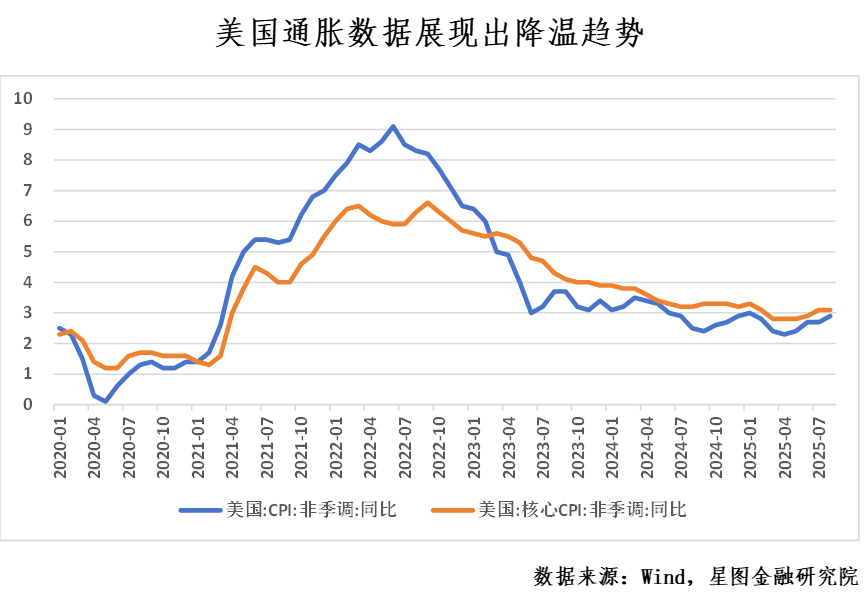
Group 1: Federal Reserve's Rate Decision - The Federal Reserve is expected to initiate a rate cut cycle, potentially lowering the policy rate by 25-50 basis points [1][8] - Current inflation levels are manageable, with August CPI at 2.9%, and are not expected to hinder the Fed's shift towards easing [2] - Rising recession risks, evidenced by a slowdown in the job market and declining consumer confidence, make preemptive rate cuts likely [5][7] Group 2: Impact on A-Share Market - The anticipated Fed rate cut is expected to significantly boost global capital markets, particularly benefiting the A-share market [9] - A potential influx of foreign capital into the A-share market is anticipated, as historical data shows net inflows during Fed rate cut cycles [9] - The Chinese central bank may gain more operational space for policy adjustments following the Fed's rate cut, potentially leading to additional stimulus measures [10] Group 3: Economic and Market Fundamentals - The Fed's rate cut is likely to enhance external demand for the Chinese economy, positively impacting exports and overall economic growth [13] - A combination of improved funding conditions, policy easing, and a recovering economic backdrop is expected to support a long-term upward trend in the A-share market [16] - Specific sectors such as metals, brokerage firms, and technology are highlighted as having high elasticity and potential for significant gains in a favorable liquidity environment [16]
大宗商品周报:流动性积极背景下商品短期或偏稳运行-20250915
Guo Tou Qi Huo· 2025-09-15 12:20
Report Investment Rating - The report does not provide an overall investment rating for the commodity industry. Core Viewpoint - In the context of positive liquidity, the commodity market may operate stably in the short term. Geopolitical disturbances persist, but the expectation of loose liquidity and peak demand season provides support [1]. Market Review Overall Market - Last week, the rise - fall ratio of the commodity market was basically flat compared to the previous week. The precious metals sector led the gain with 2.34%, followed by the non - ferrous metals with 0.35%. The energy - chemical, agricultural products, and black sectors declined by 1.26%, 0.65%, and 0.01% respectively [1][5]. - The top - gainers were gold, silver, and aluminum with increases of 2.28%, 2.27%, and 2.05% respectively. The top - losers were natural rubber, palm oil, and asphalt, dropping 3.09%, 2.41%, and 2.01% respectively [1][5]. - The decline of the 20 - day average volatility of the commodity market continued to narrow. Most sectors saw a decrease in volatility. The overall market scale increased, with most of the capital inflow coming from the precious metals sector, while the scale of the black and agricultural products sectors decreased slightly [1]. Sub - sectors - **Precious Metals**: The increase in weekly initial jobless claims and cooling inflation data led the market to fully price in three Fed rate cuts this year. However, the sector showed signs of fatigue after continuous rises. Geopolitical disturbances may amplify short - term fluctuations [2]. - **Non - ferrous Metals**: A weaker dollar and the traditional "Golden September and Silver October" consumption season provided support. Although the inventory inflection point was not clear, downstream consumption in the automotive and power industries was strong, and the sector may operate stably in the short term [2]. - **Black Metals**: The apparent demand and production of rebar continued to decline, and inventory continued to accumulate. Blast furnaces resumed production rapidly, and hot metal output increased significantly. However, low steel mill profits may limit further复产. The raw material market was volatile, and the cost increase supported the industry chain, but price contradictions intensified after the cost rebound [2]. - **Energy**: The IEA's September oil market report showed that the upward adjustment of the supply forecast was greater than that of the demand, increasing the market surplus. Geopolitical factors supported oil prices in the short term, but the mid - term surplus limited the geopolitical premium [2]. - **Chemical Industry**: For polyester, terminal weaving orders increased, and the textile and dyeing industry's operating rate rose slightly. However, high inventory and poor profits of polyester filaments led to slow load increases. The industry chain's valuation may recover relative to oil prices [3]. - **Agricultural Products**: The USDA's September supply - demand report was neutral to bearish. U.S. soybeans rebounded after a brief correction and may continue to be strong in the short term. Palm oil was supported by the mid - term seasonal production cut cycle, long - term biodiesel policies, and aging trees, providing a floor for the oil market [3]. Commodity Fund Overview - Most gold ETFs had a weekly return of around 2.3%. The total scale of gold ETFs increased by 1.36%, and the total scale of commodity ETFs increased by 1.41%. However, the trading volume of most gold ETFs decreased [35]. - The energy - chemical ETF had a return of - 0.42%, the soybean meal ETF had a return of 0.96%, the non - ferrous metal ETF had a return of 0.88%, and the silver fund had a return of 1.81% [35][36].
中信证券谈A股:淡化波动,不做扩散
Hua Er Jie Jian Wen· 2025-09-15 10:24
Core Viewpoint - The current market rally is primarily driven by companies with overseas exposure or those deeply integrated into global supply chains, necessitating a global perspective for evaluating fundamentals and liquidity [1][2][3] Group 1: Market Dynamics - The majority of the top-performing stocks since June are linked to overseas strategies, particularly in sectors like AI, innovative pharmaceuticals, and resource stocks with global pricing [2][3] - The market has shown rational behavior, with institutional funds driving the rally rather than retail investors, indicating a structural market rather than a speculative one [2][4] - The proportion of overseas revenue for A-share companies has increased from 12.6% to an estimated 19.4% by 2024, highlighting a shift towards global business perspectives [2][3] Group 2: Investment Strategy - The recommended investment focus should be on sectors with real profit generation and strong industry trends, including resources, consumer electronics, innovative pharmaceuticals, chemicals, gaming, and military industries [8][9] - The strategy emphasizes minimizing volatility and avoiding broad market exposure, instead concentrating on high-quality sectors [4][8] Group 3: Trading Activity - The average daily turnover rate for the A-share market has reached historically high levels, with a reasonable turnover rate estimated between 1.7% and 1.9% after accounting for emotional premiums [5][6] - Specific sectors such as dual innovation, electronics, non-ferrous metals, and military have seen significant increases in trading activity, indicating heightened investor interest [7][8] Group 4: Future Outlook - The future fundamentals will reflect the gradual realization of China's manufacturing competitiveness in global markets, particularly in sectors like robotics, gaming, and innovative pharmaceuticals [3][9] - Continued focus on industries with sustainable pricing power, such as rare earths and chemicals, is advised, as these sectors are expected to maintain profitability despite global economic fluctuations [9]

午评:创业板指涨超2% 半导体、汽车板块拉升 机器人概念等活跃
Zheng Quan Shi Bao Wang· 2025-09-15 04:49
Core Viewpoint - The market is experiencing a mixed performance with the Shanghai Composite Index slightly up, while the Shenzhen and ChiNext indices show stronger gains, indicating a divergence in sector performance and investor sentiment [1]. Market Performance - As of the midday close, the Shanghai Composite Index rose by 0.22% to 3879.28 points, the Shenzhen Component Index increased by 1.07%, and the ChiNext Index surged by 2.13% [1]. - The total trading volume across the Shanghai, Shenzhen, and Beijing markets reached 15,249 billion yuan [1]. Sector Analysis - Sectors such as real estate, steel, liquor, and non-ferrous metals experienced declines, while automotive, semiconductor, and agriculture sectors saw upward movement [1]. - The gaming and humanoid robot concepts were notably active in the market [1]. Investor Sentiment and Market Outlook - According to CITIC Securities, investor focus on fundamentals has diminished in recent months, but as market valuations stabilize and enter a slow bull phase, fundamental factors may regain importance [1]. - A slow bull market requires strong sectors to lead, but it is challenging to sustain without overall fundamental support, particularly needing a reversal of deflationary trends to attract foreign investment in Chinese assets [1]. - Overall, the current market sentiment and liquidity are in a high-level consolidation phase without collapse, with promising sectors continuing to catalyze market activity [1].
