
有色

Search documents
每日投行/机构观点梳理(2025-08-11)
Jin Shi Shu Ju· 2025-08-11 10:54
Group 1: Gold and Tariffs - Goldman Sachs maintains the view that the U.S. will not impose tariffs on gold, predicting London spot gold to reach $3,700 per ounce by the end of 2025 and $4,000 by mid-2026 [1] - U.S. consumers are expected to bear 67% of the tariff costs, up from 22% as of June, while businesses' share will drop to below 10% [1] Group 2: U.S. Treasury Yield Curve - Morgan Stanley suggests that if Trump successfully appoints Stephen Milan to the Federal Reserve, the U.S. Treasury yield curve may steepen, with the spread between 5-year and 30-year Treasury yields widening [2] Group 3: Currency Reactions to Tariffs - UBS reports that the Swiss franc's reaction to a 39% tariff on Swiss goods has been mild, reflecting market confidence in a potential tariff reduction agreement [2] Group 4: Central Bank Divergence - ING highlights increasing uncertainty in central bank actions, with notable disagreements among policymakers, particularly in the UK and U.S. [3] Group 5: Domestic Economic Policies - CICC emphasizes the need for stronger policies to effectively drive inflation back to historical levels, noting that PPI and CPI trends are improving but require further support [4] - CITIC Securities indicates that the recent easing of housing purchase restrictions in Beijing is a significant signal for stabilizing the real estate market [4] Group 6: Stock Market Trends - CITIC Securities states that the A-share market remains in a bull market continuation phase, with recent pullbacks presenting good investment opportunities [5] - The release of GPT-5 by OpenAI is expected to drive investment in AI computing chips and related sectors in the U.S. tech market [6] Group 7: AI Development and Market Impact - CITIC Securities notes that the launch of GPT-5 and Huawei's open-source CANN ecosystem are likely to accelerate AI application development [7] Group 8: Banking Sector Investment - Zheshang Securities reports that bank stocks are appealing to insurance capital due to their long-term stability and absolute return potential [8] Group 9: Semiconductor Tariffs - CITIC Securities believes that the impact of the 232 semiconductor tariffs on domestic companies is minimal, reinforcing the need for localized production [9] Group 10: Market Sentiment and Trends - Industrial metals are experiencing a bullish trend, supported by expectations of U.S. interest rate cuts and domestic production optimization [13]
每日市场观察-20250811
Caida Securities· 2025-08-11 05:07
Market Overview - The market experienced a slight decline on August 11, 2025, with a trading volume of 1.74 trillion RMB, down approximately 110 billion from the previous trading day[1] - The majority of industries saw gains, particularly in construction, building materials, steel, and non-ferrous metals, while sectors like computers, electronics, media, and non-bank financials faced declines[1] - The market's strength weakened, with reduced volatility compared to the previous day, and no panic sentiment was observed during the intraday decline[1] Sector Performance - Cyclical industries led the gains, although they generally had lower trading volumes[1] - The technology sector underwent a correction, which is seen as a technical adjustment after significant gains in prior days, indicating that the market's tech-driven style is not necessarily over[1] - Recent performance disclosures from leading semiconductor firms showed an increase in capacity utilization, and advancements in AI models were noted, suggesting ongoing focus on semiconductors, AI, and applications[1] Fund Flow and Trade Data - On August 8, 2025, the Shanghai Composite Index saw a net inflow of 9.658 billion RMB, while the Shenzhen Composite Index experienced a net outflow of 0.174 billion RMB[3] - The total trading volume for the day was 1.71 trillion RMB, a decrease of 115.3 billion from the previous day, with the Shanghai index down 0.12%, Shenzhen down 0.26%, and the ChiNext down 0.38%[2] Economic Indicators - In the first seven months of 2025, China's total goods trade reached 25.7 trillion RMB, reflecting a year-on-year growth of 3.5%, with exports at 15.31 trillion RMB (up 7.3%) and imports at 10.39 trillion RMB (down 1.6%) [7] - In July 2025, the total goods trade value was 3.91 trillion RMB, with exports at 2.31 trillion RMB (up 8%) and imports at 1.6 trillion RMB (up 4.8%) [7] Fund Dynamics - In the past week, 68.968 billion RMB flowed into ETFs, with the total ETF scale nearing 4.7 trillion RMB, indicating a significant interest in core asset allocation[13] - A total of 255 funds have suspended large-scale subscriptions in the past two weeks, reflecting a trend of limited purchases across various fund types, including actively managed and quantitative funds[14]
20cm速递|创业板50ETF国泰(159375)涨超1.8%,市场聚焦成长风格盈利预期改善
Mei Ri Jing Ji Xin Wen· 2025-08-11 05:03
Group 1 - The core viewpoint of the news is that the market has improved its profit expectations for growth sectors, particularly in the context of the ChiNext 50 ETF, which has seen a rise of over 1.8% [1] - Profit forecasts for various sectors including electricity and utilities, non-ferrous metals, pharmaceuticals, real estate, chemicals, coal, and light industry have been raised for 2025/2026 [1] - The pharmaceutical sector is experiencing high trading activity, ranking above the 80th percentile, with significant net purchases in pharmaceuticals, electronics, and computers [1] Group 2 - The ChiNext 50 ETF (159375) tracks the ChiNext 50 Index (399673), which includes 50 large-cap, liquid stocks from the ChiNext market, focusing on sectors like semiconductors, information technology, communications, and pharmaceuticals [1] - The index reflects the performance of innovative and high-growth companies, characterized by high R&D investment and significant strategic emerging features [1] - The communication and military sectors have seen increased allocations from actively managed equity funds, with the communication sector's financing buy-in ratio exceeding the 90th historical percentile [1]

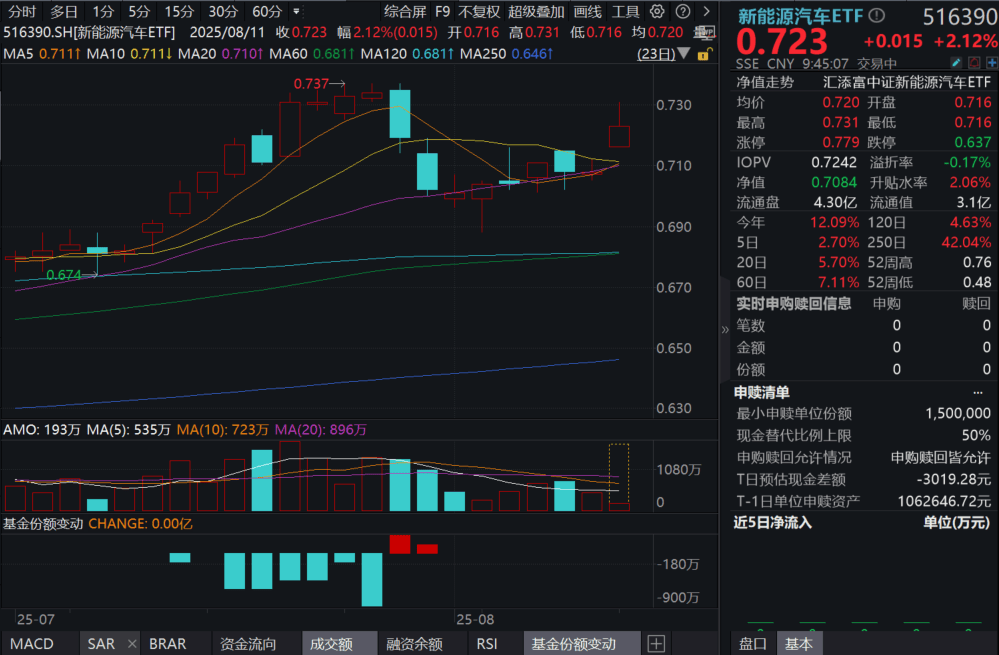
锂矿飙涨,宁德时代枧下窝锂矿停产!盛新锂能、天齐锂业涨停,新能源汽车ETF(516390)放量涨超2%!邱祖学:行业平衡偏紧,或刺激反转信号
Sou Hu Cai Jing· 2025-08-11 02:34
Group 1 - The A-share market experienced a strong upward trend on August 11, with the lithium mining sector seeing significant gains, particularly in the New Energy Vehicle ETF (516390) which rose over 2% [1][3] - Major stocks in the lithium mining sector, such as Shengxin Lithium Energy and Tianqi Lithium, hit the daily limit, while Ganfeng Lithium increased by over 7% [3][4] - The performance of the New Energy Vehicle ETF's top ten constituent stocks was generally positive, with notable increases in stocks like Ningde Times and BYD, although they experienced smaller gains compared to lithium stocks [3][4] Group 2 - Citigroup predicts that supply disruptions will drive lithium prices above 80,000 RMB per ton in the coming days, before stabilizing between 70,000 and 80,000 RMB per ton [7] - Analysts from Minsheng Securities noted that the lithium price has rebounded strongly due to supply concerns from mining rights issues in Jiangxi and Qinghai, alongside increased demand expectations [8] - National Securities highlighted that supply disruptions, including the suspension of operations at key mines, could lead to a significant increase in lithium prices, potentially surpassing previous highs [9] Group 3 - The demand for lithium is expected to remain strong, with battery production in July showing a year-on-year increase of 50%, indicating robust growth in the electric vehicle sector [10] - The supply of lithium is primarily sourced from Jiangxi and Qinghai, and any regulatory issues leading to production halts could tighten the market balance, pushing prices higher [8][9] - The overall sentiment in the lithium market is optimistic, driven by both supply constraints and strong demand from the battery manufacturing sector [9][10]





十大券商一周策略:A股仍处于牛市中继,避免参与似是而非的资金接力
Zheng Quan Shi Bao· 2025-08-10 23:59
Group 1 - The current market for small and micro-cap stocks needs to slow down, as high valuations and negative TTM profits make it difficult to justify further upward movement [2] - The five strong industry trends (non-ferrous metals, telecommunications, innovative pharmaceuticals, gaming, and military industry) have more reasonable valuations compared to the small and micro-cap stocks [2] - The main drivers of small and micro-cap stocks are liquidity and retail investor contributions, but their overall profit growth is not as strong as in 2015 [2] Group 2 - A rebound in A-shares was observed, driven by trading funds, with a focus on themes like dividends and small micro-cap stocks [3] - The two financing balance reached a nearly 10-year high, indicating that liquidity-driven market conditions may still have incremental support [3] - The PPI has shown signs of bottoming out, and the "anti-involution" policy is beginning to show effects, suggesting a stable economic outlook [3] Group 3 - July exports exceeded expectations, particularly in competitive manufacturing sectors like machinery, automobiles, and integrated circuits [4] - The PPI decline has stabilized, benefiting from price rebounds in sectors like black metals, non-ferrous metals, coal, and photovoltaics [4] - The basic economic fundamentals are showing a trend of steady improvement, with recommendations to focus on sectors with high growth or improvement in earnings [4] Group 4 - The two financing balance has risen above 2 trillion yuan, but remains at historical mid-levels compared to the peak in 2015 [5] - The market is expected to maintain a high volatility range, with a focus on sectors with strong earnings performance during the concentrated reporting period [5] - The "anti-involution" concept is anticipated to be a recurring theme in the market, alongside opportunities in growth sectors driven by AI and emerging industries [5] Group 5 - The current bull market atmosphere is not expected to dissipate easily, with potential mainline directions including domestic technological breakthroughs and competitive manufacturing sectors [6] - The market is likely to maintain its characteristics of sector rotation and high micro-level activity, with small-cap growth stocks continuing to outperform [6] - There are new opportunities for participation, particularly in event-driven individual stocks [6] Group 6 - Short-term upward movement in A-shares may face resistance, but the market remains in a bull market continuation phase [7] - The focus is on new low-level niche products in emerging sectors, with significant potential in areas like brain-computer interfaces and liquid cooling technologies [7] - The military sector is expected to have a short-term rally, with attention on new combat capabilities and military trade-related stocks [7] Group 7 - The current market rally is supported by various sources of incremental capital, with a notable increase in M1-M2 growth rates indicating enhanced liquidity [8] - The two financing balance reaching a 10-year high reflects a rising risk appetite among individual investors [8] - The focus on new technologies and growth directions, such as domestic computing power and robotics, is expected to drive future market trends [8] Group 8 - There is a divergence in judgment regarding the liquidity-driven bull market, with the potential for significant resident capital inflow into the stock market [9] - Historical patterns suggest that the initial phases of a bull market often see improvements in specific channels before broader participation [9] - The current market's rise is still modest compared to previous bull markets, indicating that concerns about a major downturn may be premature [9] Group 9 - The current market adjustment is seen as a structural shift rather than a peak in the broader cycle, with manageable index fluctuations [11] - The market is transitioning from traditional cyclical sectors to technology sectors, driven by policies similar to previous economic stimulus measures [11] - Continued focus on technology sectors, including AI and robotics, is recommended for future investment strategies [11]
A股分析师前瞻:存款搬家将如何影响权益市场?
Xuan Gu Bao· 2025-08-10 23:46
Group 1 - The focus of various brokerage strategies this week is on the impact of deposit migration on the equity market [1] - The Huaxi strategy team believes that the current upward trend in A-shares and market space should not be questioned, with margin trading balances reaching a ten-year high, indicating a recovery in individual investor risk appetite [1][2] - The Xinda strategy team highlights that the main upward wave of the bull market is coming, driven by policy and capital, with a significant amount of existing assets available for market impact [1][3] Group 2 - The Guohai strategy team estimates that by June 2025, residents will have accumulated approximately 33.57 trillion yuan in excess savings, with the financial market capable of absorbing over 1.84 trillion yuan in inflows [1][3] - The current market sentiment is reflected in the active financing transaction volume, which is an important indicator of market sentiment improvement, although it should not be the sole basis for market characterization [3] - The strategy from Zhongxin emphasizes the need to slow down in high-valuation sectors, as the market remains cautious about sectors with high earnings visibility [1][2] Group 3 - The Guangfa strategy team suggests focusing on high-odds sectors such as domestic computing power, consumer electronics, and AI, which are currently underperforming but have low downside risk and are sensitive to positive news [2][4] - The market is expected to experience fluctuations due to various factors, including policy expectations and the upcoming mid-year report disclosures [3] - The overall investment sentiment is improving, with a notable increase in the proportion of actively managed equity funds, indicating a return of active investment advantages [2][4]
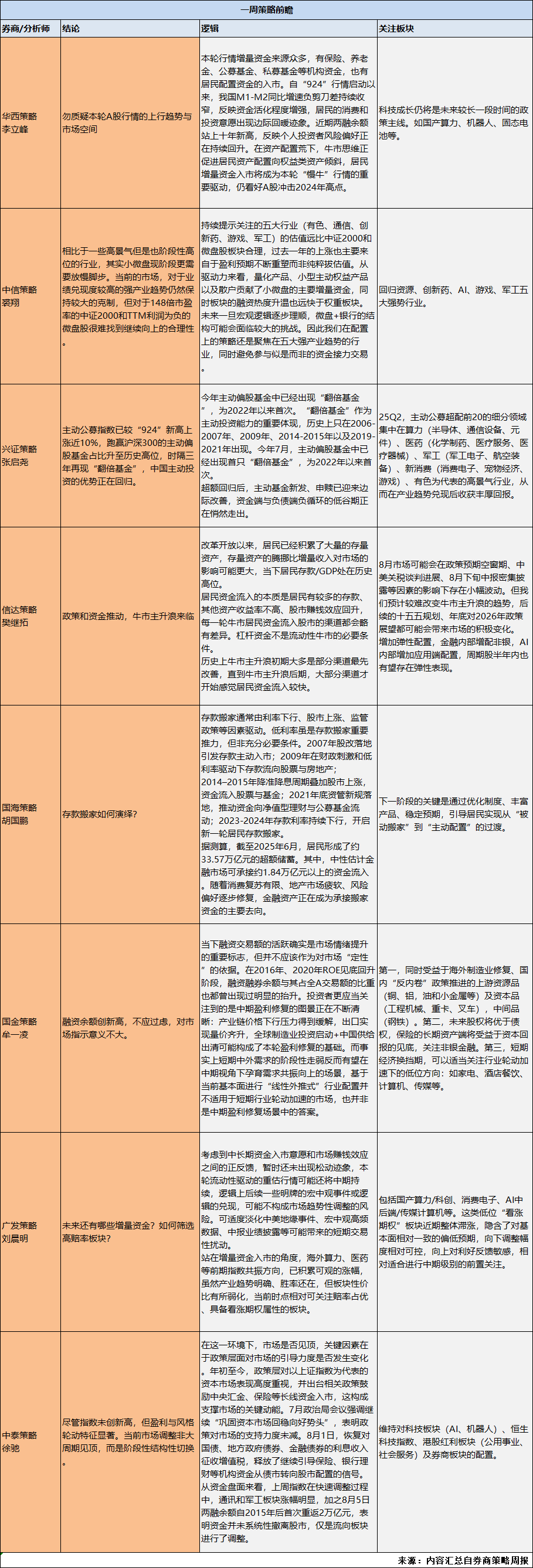
【十大券商一周策略】A股仍处于牛市中继!避免参与似是而非的资金接力
券商中国· 2025-08-10 16:05
Group 1 - The current market sentiment suggests that small and micro-cap stocks need to slow down, as their valuation and earnings growth do not justify further upward movement [2] - The five strong industries (non-ferrous metals, telecommunications, innovative pharmaceuticals, gaming, and military industry) have more reasonable valuations compared to the small and micro-cap stocks [2] - The driving force behind the small and micro-cap stocks is primarily liquidity, with significant contributions from quantitative products, small active equity products, and retail investors [2] Group 2 - Recent data indicates that A-shares experienced a rebound driven by trading funds, with a notable increase in margin trading balances reaching a near 10-year high [3][6] - The market is expected to maintain a high level of volatility, with sector rotation likely to occur as companies report their semi-annual results [3][6] - The "anti-involution" policy is showing initial effects, and the determination and difficulty of implementing such policies should not be underestimated [3] Group 3 - July exports exceeded expectations, particularly in the machinery, automotive, and integrated circuit sectors, indicating resilience in growth [5] - The Producer Price Index (PPI) has stabilized, benefiting sectors like black metals, non-ferrous metals, coal, and photovoltaic industries, which are experiencing price rebounds [5] - The overall economic fundamentals are showing a trend of stability and improvement, suggesting a focus on sectors with high growth or improvement in earnings for investment [5] Group 4 - The market is expected to remain in a high oscillation range, supported by favorable liquidity conditions, with a focus on sectors with strong earnings momentum [6][10] - The "anti-involution" concept is anticipated to be a recurring theme in market trends, with growth sectors likely to show high levels of activity [6] - The military industry is expected to remain a point of interest, particularly as the "14th Five-Year Plan" concludes and the "15th Five-Year Plan" begins to take shape [6] Group 5 - The current market adjustment is seen as a structural shift rather than a peak in the economic cycle, with limited impact on overall market sentiment [14] - The market is transitioning from traditional cyclical sectors to technology sectors, with a focus on AI and robotics as key investment areas [14] - The "anti-involution" policies are expected to lead to a structural market trend similar to previous government-led initiatives aimed at boosting demand [14]

大类资产与基金周报:权益、QDII以及商品基金均录得较大涨幅-20250810
Tai Ping Yang Zheng Quan· 2025-08-10 14:17
- The report provides an overview of the major asset markets, including equities, bonds, commodities, and foreign exchange[5][10][11][33][40] - The report highlights the performance of various indices in the A-share market, such as the Shanghai Composite Index, Shenzhen Component Index, and others, with specific percentage changes for each[10][12][13] - The report also details the performance of different sectors within the A-share market, noting significant gains in sectors like military, non-ferrous metals, and machinery, and declines in sectors like pharmaceuticals, computers, and retail[10][15] - The report includes information on the performance of the Hong Kong stock market, with specific indices and their percentage changes, as well as sector performance within the Hong Kong market[11][18][20][22] - The report covers the performance of the US stock market, including indices like the Dow Jones Industrial Average, Nasdaq, and S&P 500, along with other international indices[11][26][27] - The report provides details on the bond market, including changes in yields for various government and corporate bonds, as well as credit spreads and term spreads[28][29][30][31] - The report discusses the performance of the commodity market, listing the percentage changes for various commodities such as crude oil, gold, copper, and others[33][34][35][36][38] - The report includes information on the foreign exchange market, detailing the exchange rates of various currencies against the RMB and their percentage changes[40][42] - The report provides an overview of the fund market, including the number of newly established funds, their types, and their sizes[43][44] - The report details the overall performance of different types of funds, including equity funds, balanced funds, fixed income funds, FOFs, commodity funds, and QDII funds, with specific percentage returns for each category over different time periods[49][50][51] - The report lists the top-performing funds over the past week, month, year, and year-to-date, along with their specific returns and other details[52] - The report also lists the worst-performing funds over the same periods, with specific returns and other details[53]
蓄力新高7:牛市第二轮上涨的规律
CAITONG SECURITIES· 2025-08-10 11:10
Core Insights - The report emphasizes a potential second wave of market growth, focusing on technology and cyclical leaders as key investment opportunities [3][6][11] Liquidity and Market Conditions - The report notes a decline in U.S. non-farm employment figures, raising concerns about the U.S. economy and increasing expectations for interest rate cuts, with a 10Y/2Y U.S. Treasury yield drop of 10BP/18BP since August [4][12] - Continuous monetary easing is highlighted, with weekly reverse repos exceeding 1 trillion yuan for four consecutive weeks, and a strong inflow into the bond market expected due to anticipated tax incentives [4][12] - Market trading volume remains stable at 1.6 to 1.8 trillion yuan, with financing balances nearing 2 trillion yuan, indicating robust new inflows [4][12] Investment Themes - The report identifies three main investment themes: 1. **Leading Companies**: Focus on sectors like non-ferrous metals, military industry, and state-owned enterprise restructuring, with PPI hitting a bottom [4][12] 2. **Domestic Innovation**: Anticipation of a recovery in domestic technology and semiconductor sectors, with high utilization rates in domestic foundries and clear expansion trends [5][13] 3. **Global Expansion**: The report discusses the ongoing global expansion of new investments in cultural sectors, gaming, and innovative pharmaceuticals [5][14] Market Phases and Performance - Historical analysis indicates that each market cycle sees a flow of new capital from institutional investors to retail investors, with the current phase identified as a second wave of growth [6][14][15] - The report outlines the performance of various sectors across different market phases, noting that technology and cyclical sectors are expected to lead in the current second wave of growth [16][30] PPI Trends - The report discusses the PPI cycle, indicating that PPI has reached a bottom and is expected to recover, which aligns with the performance of cyclical sectors [32][33]
光大期货交易内参20250808
Guang Da Qi Huo· 2025-08-08 11:36
Report Summary 1. Investment Rating No investment rating for the industries is provided in the report. 2. Core Views - The stock market's recent rise is driven by long - term expectations of fiscal policy shift to consumption and inflation recovery, mid - term anti - involution policies benefiting upstream cycle sectors, and short - term capital inflows due to RMB appreciation and improved enterprise deposit - loan data. Wait for clearer policy and market trends before adjusting positions [2]. - Short - term treasury bonds are expected to be strong as the market - driving effect of anti - involution policy expectations since July is over, and the bond market is likely to have a repair market [3]. - Gold is in a window supported by both "rising interest - rate cut expectations" and "geopolitical uncertainties" and is expected to maintain a strong trend. For silver, low - buying and holding is a good strategy [4]. - Most commodities in the steel, coal, and coke sectors are expected to move in a narrow or wide - range oscillation in the short term, affected by factors such as supply - demand balance, policy expectations, and cost changes [6][7][9]. - Copper prices may be weak but the expected peak season in September will limit the decline. Nickel and stainless steel prices are affected by market sentiment and will oscillate. Aluminum - related products' prices face downward pressure due to supply increases, while industrial silicon and polysilicon have different trends and investment opportunities [14][15][19]. - Oil prices are under pressure. High and low - sulfur fuel oils are expected to oscillate weakly. Asphalt is supported by low supply and inventory but is affected by crude oil price fluctuations. Rubber is expected to oscillate widely. PX, PTA, MEG, methanol, polyolefins, PVC, urea, soda ash, and glass all have their own supply - demand characteristics and are expected to have different short - term price trends [24][25][27]. - Protein meal prices are rising, and a long - position strategy is recommended. Most oils are strong, and a long - position strategy is also suggested. Livestock and poultry products such as pigs and eggs have complex supply - demand situations and are expected to oscillate. Corn has a short - term rebound but a mid - term weakening trend [39][41][42]. - Sugar is expected to continue its weak trend. Cotton's 09 contract is expected to oscillate, and the 01 contract is expected to oscillate in the short term and strengthen in the medium - long term [46][49]. 3. Summary by Category Financials - **Stock Index**: A - share market was flat yesterday. The implementation of the parenting subsidy system is significant. The stock market's rise is driven by multiple factors. Wait for clearer trends before adjusting positions [2]. - **Treasury Bonds**: Treasury futures rose slightly. The central bank conducted reverse repurchase operations with a net withdrawal. Short - term treasury bonds are expected to be strong [3]. - **Precious Metals**: Gold and silver prices rose. Gold is supported by multiple factors, and silver can be held through low - buying [4]. Mineral, Steel, Coal, and Coke - **Rebar**: Futures prices were slightly down. Production increased, inventory rose, and demand improved slightly. Exports remained high. It is expected to move in a narrow range [6]. - **Iron Ore**: Futures prices fell. Supply decreased, demand was mixed, and inventory increased. It is expected to oscillate [7][8]. - **Coking Coal**: Futures prices rose. Supply was affected by inspections, and demand was strong. It is expected to oscillate widely [9]. - **Coke**: Futures prices rose. Supply was affected,and demand was good. It is expected to oscillate widely [10]. - **Manganese Silicon and Ferrosilicon**: Both futures prices weakened. They are affected by policies, cost, and supply - demand factors and are expected to oscillate widely [11][12]. Non - ferrous Metals - **Copper**: Prices were slightly down. Affected by macro factors, inventory changes, and weak demand, copper prices may be weak but limited by the peak - season expectation [14]. - **Nickel and Stainless Steel**: Prices fell slightly. Affected by inventory, price differentials, and supply - demand, they are expected to oscillate [15]. - **Aluminum - related Products**: Prices of alumina, electrolytic aluminum, and aluminum alloy were weak. Supply is expected to increase, and prices face downward pressure [16][18]. - **Industrial Silicon and Polysilicon**: Industrial silicon was strong, and polysilicon was weak. There are different investment opportunities [19]. - **Lithium Carbonate**: Futures prices rose. Supply is expected to increase, demand is improving, and inventory is changing. The market focuses on production uncertainties [20][22]. Energy and Chemicals - **Crude Oil**: Prices fell for six consecutive days. Affected by geopolitical events and supply - demand, oil prices are under pressure [24]. - **Fuel Oil**: Futures prices rose slightly. Supply is sufficient, demand may weaken, and it is expected to oscillate weakly [25][26]. - **Asphalt**: Futures prices rose slightly. Supply may decrease, demand is expected to improve, and it is expected to oscillate [27]. - **Rubber**: Futures prices rose. Supply is increasing, demand is stable, and it is expected to oscillate widely [28]. - **PX, PTA, MEG**: Prices of related products rose slightly. Affected by cost and demand, PTA may be under pressure, and MEG may adjust weakly [29][30]. - **Methanol**: Prices are expected to oscillate as inventory is expected to increase slightly in August with limited import and stable demand [31]. - **Polyolefins**: Supply and demand will recover in August, and the upside is limited without significant cost increases [32]. - **PVC**: Market pressure eases, inventory decreases slowly, and prices are expected to oscillate weakly [33][34]. - **Urea**: Futures prices were weak. Supply increased, demand was weak, and the Indian tender can relieve some pressure. It is expected to oscillate widely and weakly [35]. - **Soda Ash**: Futures prices oscillated widely. Supply increased, demand was weak, and it is expected to oscillate widely with a weak sentiment [36]. - **Glass**: Futures prices oscillated widely. Supply was stable, demand was weak, and inventory increased. It is expected to oscillate widely [37]. Agricultural Products - **Protein Meal**: Prices rose. U.S. soybeans had strong sales, and domestic prices were boosted by external and cost factors. A long - position strategy is recommended [39]. - **Oils**: BMD palm oil fell, while domestic oils were strong. A long - position strategy is suggested [40][41]. - **Livestock and Poultry Products**: Pig prices are expected to oscillate due to supply and policy factors. Egg prices have a complex situation with a possible seasonal rebound but a short - term bearish sentiment [42][43]. - **Corn**: Futures prices rebounded technically, but the mid - term is expected to be weak [44]. Soft Commodities - **Sugar**: Prices are expected to continue to be weak due to production increase expectations and domestic price adjustments [46]. - **Cotton**: ICE cotton fell. The 09 contract is expected to oscillate, and the 01 contract is expected to oscillate in the short term and strengthen in the long term [47][49].