玻璃

Search documents
黑色建材日报:环保检查影响供给,产区煤价稳中有涨-20250624
Hua Tai Qi Huo· 2025-06-24 03:43
Report Industry Investment Ratings - No specific industry investment ratings are provided in the content. Core Views - The glass and soda ash markets are experiencing a weak demand in the off - season, with both showing a trend of narrow - range fluctuations and a general outlook of weakening oscillations [1][2]. - The ferrosilicon and silicomanganese markets have obvious off - season characteristics, with both showing a continuous oscillating trend [3][4]. Summary by Related Catalogs Glass and Soda Ash Market Analysis - Glass: The glass futures rebounded slightly yesterday. In the spot market, the morning buying sentiment was good, but the overall purchase volume was average. Except for a price increase of a small - board safety glass brand, other brands' quotes were stable [1]. - Soda Ash: The soda ash futures oscillated downward yesterday. In the spot market, the overall downstream procurement was average, mainly for rigid - demand restocking, and the speculative sentiment was weak [1]. Supply - Demand and Logic - Glass: With some production lines in the red, the glass supply decreased month - on - month. The downstream rigid demand remained weak, and real - estate data was still at a low level. During the traditional consumption off - season, the high inventory of glass strongly suppressed prices. Attention should be paid to glass factories' cold - repair plans and profit situations [1]. - Soda Ash: As previously - overhauled alkali plants resumed production and new projects were launched, the soda ash output increased month - on - month, resulting in a relatively loose supply. The demand from the float and photovoltaic sectors weakened, and the real - estate sector continued to drag down consumption. With the expected contraction of float - glass supply in the future and the approaching of the short - term consumption off - season, the demand for heavy soda ash was expected to weaken further. In the long run, oversupply would continue to push down prices [1]. Strategy - Glass: Oscillating weakly [2]. - Soda Ash: Oscillating weakly [2]. Double Silicon (Silicomanganese and Ferrosilicon) Market Analysis - Silicomanganese: Yesterday, the main contract of silicomanganese futures fell by 6 yuan/ton to 5610 yuan/ton. In the spot market, the silicomanganese market oscillated. At the beginning of the week, the market was full of wait - and - see sentiment, and there were few spot quotes. The price of 6517 silicomanganese in the northern market was 5480 - 5530 yuan/ton, and in the southern market, it was 5500 - 5550 yuan/ton. The silicomanganese output rebounded from a low level, the molten - iron output increased slightly, and the demand for silicomanganese increased slightly. The inventories of silicomanganese manufacturers and registered warrants were at medium - to - high levels, suppressing the price of silicomanganese. The port inventory of manganese ore decreased slightly. Attention should be paid to silicomanganese inventories and manganese - ore shipments [3]. - Ferrosilicon: Yesterday, the main contract of ferrosilicon futures closed at 5316 yuan/ton, up 16 yuan/ton from the previous day. In the spot market, the ferrosilicon market rose slightly. The ex - factory price of 72 - grade ferrosilicon natural lumps in the main production areas was 5050 - 5150 yuan/ton (cash and tax included), and the price of 75 - grade ferrosilicon was 5600 - 5750 yuan/ton. Currently, the ferrosilicon output increased month - on - month, the demand increased slightly, and the factory inventory was at a high level. As the consumption off - season approached, the consumption intensity of ferrosilicon would be tested. The ferrosilicon production capacity was relatively loose, and the short - term price was dragged down by costs. However, the overall restocking of ferrosilicon was in a healthy state. Attention should be paid to the impact of electricity - price changes and industrial policies on the black - metal sector [3]. Strategy - Silicomanganese: Oscillating [4]. - Ferrosilicon: Oscillating [4].
商品期货早班车-20250624
Zhao Shang Qi Huo· 2025-06-24 03:33
1. Report Industry Investment Ratings No relevant content provided. 2. Core Views of the Report The report provides market analysis and trading strategies for various commodities including basic metals, agricultural products, and energy chemicals. It evaluates the market performance, fundamentals, and offers corresponding trading suggestions for each commodity based on supply - demand dynamics, macro - economic factors, and industry - specific events. 3. Summary by Commodity Category Basic Metals Copper - Market performance: Copper prices oscillated strongly yesterday [1]. - Fundamentals: Trump announced a cease - fire between Israel and Iran, causing a sharp drop in crude oil prices. US PMI data exceeded expectations while European PMI data was weak. The supply of copper ore remained tight, and Glencore stated that the mountain ISA smelter was difficult to continue operating. Demand showed some resilience, with premiums for flat - water copper in East and South China at 70 yuan and 20 yuan respectively, and the London structure at a 392 - dollar back [1]. - Trading strategy: Maintain the idea of buying on dips [1]. Aluminum - Market performance: The closing price of the electrolytic aluminum 2508 contract showed no significant change from the previous trading day, closing at 20,365 yuan/ton. The domestic 0 - 3 month spread was 435 yuan/ton, and the LME price was 2,559 dollars/ton [1]. - Fundamentals: On the supply side, electrolytic aluminum plants maintained high - load production, and the operating capacity increased slightly. On the demand side, the operating rate of aluminum products decreased slightly [1]. - Trading strategy: LME has forced traders holding near - month contract positions exceeding available inventory to reduce their positions to limit spot liquidity risk. Aluminum ingots have seen inventory accumulation (15,000 tons) for the first time since June. It is necessary to observe whether the inventory accumulation is continuous, and aluminum prices may come under pressure to decline. It is recommended to wait and see [1]. Alumina - Market performance: The closing price of the alumina 2509 contract showed no significant change from the previous trading day, closing at 2,906 yuan/ton. The domestic 0 - 3 month spread was 288 yuan/ton. On June 20, India had a transaction of 30,000 tons at a price of 366 dollars/ton (the previous transaction was also at 366 dollars/ton) [1]. - Fundamentals: On the supply side, new production capacity continued to be released, and the operating capacity increased. On the demand side, electrolytic aluminum plants maintained high - load production, and the operating capacity was stable [1]. - Trading strategy: The alumina futures price encountered resistance when rising. In the medium term, the pressure of production capacity release and inventory accumulation persists, and the price may continue to operate at a low level [1]. Industrial Silicon - Market performance: On Monday, the market opened low and then oscillated. The main 09 contract closed at 7,420 yuan/ton, up 30 yuan/ton from the previous trading day. The position decreased by 2,437 lots to 303,119 lots. Today, the warehouse receipt volume decreased by 439 lots to 54,184 lots [1]. - Fundamentals: Last week, spot prices stopped falling. On the supply side, there was no significant contraction, and the number of open furnaces increased by 5. Weekly inventory decreased slightly for two consecutive weeks, and after the market decline, the visible inventory of warehouse receipts turned into invisible inventory. On the demand side, the production of polysilicon in June may increase slightly compared to May, and there are plans for复产 this week. The production of organic silicon was relatively stable, and the decline in industrial chain prices widened. The downstream demand for aluminum alloys entered the off - season, and the operating rate was relatively stable [1]. - Trading strategy: If the futures price continues to rise, it may face hedging pressure, and the rebound of the market may be limited. Before there is an effective reduction in actual supply during the flood season, maintain a bearish view. It is expected that the market will oscillate at a low level. Consider shorting lightly after a rebound. Pay attention to the on - site sentiment at the Leshan industry conference [1]. Polysilicon - Market performance: On Monday, the market opened low and then oscillated. The main 08 contract closed at 30,615 yuan/ton, down 605 yuan/ton from the previous trading day. The position increased by 10,054 lots to 78,183 lots. The 11 contract closed at 30,030 yuan/ton. Today, the warehouse receipt volume remained unchanged at 2,600 lots (7,800 tons) [1]. - Fundamentals: On the supply side, the weekly production changed little, and the industry inventory decreased slightly. There are still expectations of复产 in the future, and the market is pessimistic about the joint production cuts by leading enterprises. On the demand side, the silicon wafer production schedule data has recovered, which is related to the production scheduling of some enterprises' previous orders in the third quarter due to limited quotas. The expected production schedule for the third quarter is still declining quarter - on - quarter. According to the balance sheet, inventory will start to accumulate in July [1]. - Trading strategy: The industry's复产 plan exceeded expectations. In the short term, it is recommended to go short on the 07 contract on rallies. Pay attention to the industry's production cut plan [2]. Agricultural Products Soybean Meal - Market performance: Overnight, CBOT soybeans declined, affected by favorable weather in the production area and the sharp drop in crude oil prices [2]. - Fundamentals: On the supply side, the supply from South America was abundant in the near term, and the growth of US soybeans was normal in the long term. On the demand side, South America was the main influence in the short term, US soybean exports were seasonally weak, but the US biodiesel policy was beneficial to the demand for soybean crushing [2]. - Trading strategy: In the short term, US soybeans will oscillate strongly; in China, although there will be a large arrival of soybeans later, demand will also remain high. The domestic market will follow the international cost side [2]. Corn - Market performance: The corn 2509 contract corrected, and the spot price of corn declined slightly [2]. - Fundamentals: This year, the supply - demand situation has tightened marginally, and the grain rights have shifted to channels, increasing the bargaining power of channels. The expected import volume of substitutes will decrease significantly, which is beneficial to the demand for domestic corn. The wheat support - price purchase has boosted the wheat price, which will also drive up the corn price. The spot price is expected to oscillate strongly [2]. - Trading strategy: With the reduction of remaining grain and the wheat support - price purchase, the futures price is expected to oscillate strongly [2]. Palm Oil - Market performance: Malaysian palm oil rose yesterday [2]. - Fundamentals: On the supply side, the production area is in the seasonal production - increasing period, and Malaysia's production in May increased by 5% month - on - month. On the demand side, the exports from the production area improved month - on - month. ITS showed that exports,from June 1 - 20 increased by 14% month - on - month [2]. - Trading strategy: In the short term, the volatility of palm oil will increase, affected by the large fluctuations in crude oil and other factors. The trading difficulty has increased. Pay attention to crude oil and biodiesel policies [2]. Eggs - Market performance: The egg 2508 contract performed strongly, and the spot price was stable [2]. - Fundamentals: Due to breeding losses, the culling of old hens is expected to decrease temporarily. Supply remains high, and the hot and humid weather is not conducive to egg storage, but low prices stimulate demand. With strong supply and weak demand and cost support, the futures and spot prices are expected to oscillate [2]. - Trading strategy: With sufficient supply and cost support, the futures price is expected to oscillate [2]. Pigs - Market performance: The pig 2509 contract performed strongly, and the spot price of pigs rose [2]. - Fundamentals: Large - scale farms have been continuously reducing the weight of pigs recently, and the pressure to sell at the end of the month has decreased. Small - scale farmers, on the contrary, continue to hold back pigs to gain weight. At the end of the month, the supply from the breeding side will decrease, and the entry of second - fattening will support the price. The pig price is expected to be strong in the short term. In the medium term, the supply will continue to increase, and the center of the pig price will gradually decline. Pay attention to the slaughter rhythm of enterprises and the trend of second - fattening [2]. - Trading strategy: With reduced supply at the end of the month, the futures price is expected to oscillate strongly [2]. Energy Chemicals PVC - Market performance: The V09 contract closed at 4,897, down 0.3% [3]. - Fundamentals: PVC was driven up by the rise in crude oil prices and then retreated. On the supply side, the plants of Wanhua, Bohua, etc. are gradually being put into production, and the supply growth rate is expected to reach about 5%. The upstream operating rate is 80%, and maintenance has gradually ended. Social inventory has been continuously decreasing. On June 19, the new sample of PVC social inventory was 569,300 tons, a decrease of 0.74% month - on - month and 37.97% year - on - year. India has postponed the BIS anti - dumping investigation until December, which is beneficial to exports. The carbide price is 2,400 yuan, and it is expected to decline in the future. The spot price has stopped rising, with 4,800 yuan in East China and 4,870 yuan in Inner Mongolia [4]. - Trading strategy: It is recommended to gradually close short positions and wait and see. Since there is no driving force for a rebound, consider selling call options above 4,950 [4]. PTA - Market performance: The CFR China price of PX is 899 dollars/ton, equivalent to 7,430 yuan/ton in RMB at the current exchange rate. The spot price of PTA in East China is 5,260 yuan/ton, and the spot basis is 264 yuan/ton [4]. - Fundamentals: On the cost side of PX, domestic production still has maintenance plans for plants such as Zhejiang Petrochemical and Shandong Weilian, and the load increase is limited. Overseas, a 400,000 - ton plant of South Korea's GS has restarted, a 500,000 - ton plant of Japan's Eneos has unexpectedly shut down, plants in Iran and Israel have shut down, the restart of a Saudi plant has been postponed, and Vietnam's NSRP has reduced production. It is expected that imports will remain at a low level. For PTA, Hengli Dalian and Fuhai Chuang are implementing maintenance plans, Yisheng New Materials has briefly reduced production, and Jiaxing Petrochemical's 1.5 - million - ton plant has restarted. Overall, the supply has decreased, but the medium - and long - term supply pressure remains large. The polyester load remains around 92%, the comprehensive inventory is at a medium - level in history, and the profit of polyester products has been greatly compressed. Continuously pay attention to the implementation of production cuts. The load of downstream texturing and weaving machines has decreased overall and is at a medium - level in history. After the peripheral factors drove the market last Friday, there was concentrated replenishment at the terminal; since the weekend, downstream enterprises have mainly been digesting their stocks, with only rigid demand following up. As of now, the downstream raw material inventory is mainly 10 - 15 days, with sporadic high - inventory reaching about 1 month. Overall, both PX and PTA are in a de - stocking pattern [4]. - Trading strategy: Continue to hold long positions in PX. PTA has tight short - term liquidity but large medium - and long - term surplus pressure. Maintain the view of shorting the processing margin on rallies [4]. Glass - Market performance: The FG09 contract closed at 1,007, up 0.1% [4]. - Fundamentals: The glass trading volume has been mixed, and the average price has been stable. Downstream demand is gradually improving. On the supply side, 4 production lines will resume production in July, and the supply growth rate is expected to increase by 1.2% month - on - month. The daily melting volume of glass is 156,000 tons, a decrease of 8.8% year - on - year. Inventory has unexpectedly accumulated. On June 19, the upstream inventory was 69,887,000 heavy boxes, an increase of 0.29% month - on - month and 16.82% year - on - year. The order days of downstream deep - processing enterprises are 9.8 days, the operating rate is about 48%, which is lower than in previous years. In terms of valuation, losses have increased, with a large loss of 195 yuan for the natural - gas route, a profit of about 85 yuan for the coal - gas route, and a loss of 105 yuan for the petroleum - coke route. The spot prices are 1,120 yuan in North China, 1,020 yuan in Central China, 1,230 yuan in East China, and 1,280 yuan in South China [4]. - Trading strategy: The downward trend of glass prices is hard to reverse. It is recommended to sell call options above 1,250 [4]. MEG - Market performance: The spot price of MEG in East China is 4,597 yuan/ton, and the spot basis is 78 yuan/ton [4]. - Fundamentals: Plants are restarting in a concentrated manner, increasing the supply. Pay attention to the implementation of Zhejiang Petrochemical's maintenance plan at the end of the month. Overseas, plants in Canada, Saudi Arabia, and Malaysia have restarted, increasing the import supply. The inventory at East China ports is around 620,000 tons, at a historically low level. The polyester load remains around 92%, the comprehensive inventory is at a medium - level in history, and the profit of polyester products has been greatly compressed. Continuously pay attention to the implementation of production cuts. The load of downstream texturing and weaving machines has decreased overall and is at a medium - level in history. As of now, the downstream raw material inventory is mainly 10 - 15 days, with sporadic high - inventory reaching about 1 month. Overall, the supply - demand situation of MEG has weakened [4]. - Trading strategy: With the easing of the geopolitical situation, it is recommended to take short positions [4]. Soda Ash - Market performance: The SA09 contract closed at 1,173, down 0.3% [4]. - Fundamentals: The supply - demand of soda ash is in a weak balance, and the supply is gradually recovering. On the supply side, the Lianyungang Soda plant has reached full production, and the upstream operating rate of soda ash is 86%. Summer maintenance has gradually ended, and Qinghai Fatou Soda and Xuzhou Fengcheng Soda have maintenance plans this month. Inventory has accumulated at a high level. On June 23, the upstream inventory was 1.7559 million tons, an increase of 29,200 tons from last Thursday, a rise of 1.69%. The number of days of pending orders for upstream manufacturers is 11 days. The inventory at delivery warehouses is 311,000 tons, a decrease of 20,000 tons month - on - month. On the downstream demand side, the daily melting volume of photovoltaic glass is 98,000 tons, the inventory days are 30.5 days, and the photovoltaic glass production line of China National Building Materials Yixing has blocked the kiln mouth. The soda ash price has changed little, with the delivered price around 1,250 yuan, the futures - spot quotation in Shahe at 09 contract + 20, and the factory - pickup price in Inner Mongolia at 09 contract - 160 [4][5]. - Trading strategy: The supply - demand of soda ash is weak on both sides, and it will oscillate at the bottom. Consider selling out - of - the - money call options above 1,400 for soda ash options [5].
研究所晨会观点精萃-20250624
Dong Hai Qi Huo· 2025-06-24 01:04
Group 1: Overall Market Sentiment - The geopolitical risk in the Middle East has declined, leading to an overall increase in global risk appetite. In China, economic growth is generally stable, with strong consumption growth in May but a slowdown in investment and industrial production, which also boosts domestic risk appetite [2]. Group 2: Asset Recommendations - Stock indices are expected to oscillate and rebound in the short - term, with a recommendation of cautious short - term long positions. Treasury bonds are expected to remain at a high level and oscillate, with a suggestion of cautious observation. For commodities, black metals are in short - term low - level oscillation (cautious observation), non - ferrous metals are oscillating strongly (cautious short - term long positions), energy and chemicals are experiencing increased volatility (cautious observation), and precious metals are at a high - level oscillation (cautious observation) [2]. Group 3: Stock Indices - Driven by sectors such as digital currency, energy metals, and port shipping, the domestic stock market has risen. The short - term market trading logic focuses on Middle East geopolitical risks, changes in US trade policies, and trade negotiation progress. With the decline in short - term Middle East geopolitical risks, the impact on the market has weakened. It is recommended to be cautiously long in the short - term [3]. Group 4: Precious Metals - On Monday, the precious metals market oscillated upward. Geopolitical conflicts and the Fed's hawkish stance have an impact on precious metals. The market is currently focused on the Middle East situation, and the attitude of Iran should be closely monitored [3]. Group 5: Black Metals Steel - With demand at a low level, the spot and futures prices of steel continue to oscillate. The real - world demand for steel still has resilience, but the market's outlook is pessimistic. Supply is expected to remain high in the short - term, and the market is expected to oscillate at the bottom [4][5]. Iron Ore - On Monday, the spot and futures prices of iron ore slightly declined, while the futures price rebounded. Short - term demand is okay, but the supply is expected to remain high in the second quarter. The price is expected to oscillate within a range [5]. Silicon Manganese/Silicon Iron - The spot prices of silicon manganese and silicon iron remained flat on Monday. Short - term demand is okay, but downstream procurement is weak. The market is expected to oscillate within a range, and short - term rebound opportunities can be considered if energy prices continue to strengthen [6]. Group 6: Chemicals Soda Ash - On Monday, soda ash oscillated. Supply remains abundant, demand has contracted, and inventory has increased. The price is expected to be under pressure and oscillate within a range [7]. Glass - On Monday, glass was weakly oscillating. Supply is mainly for rigid demand, and demand is weak due to the poor real - estate market. The price is expected to oscillate within a range [7]. Group 7: Non - Ferrous Metals Copper - The US Federal Reserve's June interest - rate meeting was more hawkish. The production of copper is at a high level, and demand may decline marginally. The price is expected to oscillate, and the negotiation results between the US and other countries and the US's copper tariff policy should be monitored [8]. Aluminum - Central funds of 138 billion yuan will be gradually released in the third and fourth quarters. Aluminum prices are rising, mainly driven by the external market. Downstream demand may weaken, and the inventory situation should be monitored [9]. Aluminum Alloy - It has entered the off - season for demand, but the tight supply of scrap aluminum provides some support for the price. The price is expected to oscillate strongly in the short - term, but the upside is limited [9]. Tin - The supply of tin ore is tight, and the demand is in the off - season. The price is expected to oscillate strongly in the short - term, but the upside is restricted by high tariffs,复产 expectations, and weakening demand [10]. Group 8: Energy and Chemicals Crude Oil - Iran's attack on a US airbase did not target energy infrastructure, and the probability of Iran blocking the Strait of Hormuz has decreased significantly, leading to a sharp decline in oil prices [11]. Asphalt - Asphalt prices will follow the decline in oil prices. The shipment volume has improved slightly, and the inventory is being depleted. It will continue to fluctuate at a high level following crude oil [11]. PX - The cost support for PX is strong in the short - term, but the decline in oil prices brings uncertainties. PX prices may face a callback risk and will continue to oscillate strongly following crude oil [11]. PTA - The basis of PTA remains at a high level. The upstream - downstream contradiction is significant, and the inventory is accumulating. The decline in oil prices will severely impact the futures price [12][13]. Ethylene Glycol - The probability of Iran blocking the Strait of Hormuz has decreased, and the impact on device shutdowns has weakened. The inventory depletion has slowed down, and the price may experience a larger callback following the decline in oil prices [13]. Short - Fiber - The decline in crude oil prices will drive down short - fiber prices. It will continue to oscillate strongly following the polyester sector, but the terminal orders are average [13]. Methanol - Methanol prices have squeezed downstream profits, and the price is expected to decline in the short - term due to the possible end of geopolitical conflicts [13]. PP - The production of PP is increasing, and downstream开工 has slightly declined. The price is expected to fall with the decline in oil prices [13]. LLDPE - The device production has not increased significantly, and downstream demand has not changed much. The futures price is expected to continue to weaken, with increased short - term volatility [13]. Group 9: Agricultural Products US Soybeans - Overnight, CBOT soybeans declined. Favorable weather in the US Midwest is expected to benefit crop growth [14]. Soybean and Rapeseed Meal - The inventory of soybeans and soybean meal in Chinese oil mills has increased. The supply - demand of soybean meal is gradually becoming more balanced, and the rapeseed meal market is dominated by the soybean meal market [15]. Oils and Fats - The decline in geopolitical risks in the Middle East has led to a decline in the premium of international oils and fats. The inventory of palm oil and soybean oil in China has increased [15][16]. Corn - The price of corn in the Northeast has risen, but the supply from the Northeast to North China has increased, and the price in North China has decreased. The start of wheat procurement and the possible increase in old - corn sales may lead to a high - level consolidation of corn prices [16]. Hogs - The weight - reduction efforts of pig - raising groups are limited. The spot price in the benchmark area is stable, and the futures price is expected to be repaired. The price is expected to fluctuate within a range, with possible stronger fluctuations [17].
黑色产业链日报-20250623
Dong Ya Qi Huo· 2025-06-23 11:09
1. Report Industry Investment Rating - No information about the industry investment rating is provided in the report. 2. Report's Core View - The steel market in 2025 differs significantly from 2023. Current demand support is weakening, and future demand may be over - drawn. Although short - term fundamentals have limited pressure, the upward space of the steel futures market is restricted [3]. - The iron ore market is in a state of high supply and demand, slightly weakening at the margin. Considering the approaching off - season, the current state is acceptable. Prices may fluctuate, and macro - changes need attention [23][24]. - The coking coal market has short - term upward potential in the futures market, but the spot market remains under pressure. The probability of coking plants raising prices is low [40]. - The ferroalloy market has a weak long - term trend. Although the negative factors of high inventory and high supply are weakening, cost reduction expectations and the off - season demand may lead to a weak operation [57]. - The soda ash market is in a long - term oversupply situation. Production is expected to remain high, and demand is weak. The futures price may continue to decline [69][70]. - The glass market's supply may increase, and the cumulative apparent demand has declined. The futures price has limited support and lacks obvious driving factors [98]. 3. Summary by Related Catalogs Steel - **Price Data**: On June 23, 2025, the closing prices of steel futures contracts such as rebar and hot - rolled coil showed minor fluctuations compared to June 20. The basis of rebar and hot - rolled coil decreased, and the spread between rebar and hot - rolled coil remained relatively stable [4][9]. - **Market Analysis**: The current steel market has limited short - term fundamental pressure, but the upward space of the futures market is restricted due to factors such as the approaching off - season and potential over - drawn future demand [3]. Iron Ore - **Price Data**: On June 23, 2025, the closing prices of iron ore futures contracts increased slightly compared to June 20, while the basis decreased. The prices of iron ore varieties in Rizhao also showed minor changes [25]. - **Market Analysis**: The iron ore market is in a state of high supply and demand, slightly weakening at the margin. With the approaching off - season, prices may fluctuate, and macro - changes need attention [23][24]. Coking Coal and Coke - **Price Data**: On June 23, 2025, the coking coal and coke futures prices, basis, and spreads showed different degrees of change compared to June 20. The coking profit decreased slightly [41]. - **Market Analysis**: The coking coal market has short - term upward potential in the futures market, but the spot market remains under pressure. The probability of coking plants raising prices is low [40]. Ferroalloy - **Price Data**: On June 23, 2025, the ferroalloy (silicon - iron and silicon - manganese) futures prices, basis, and spreads showed different degrees of change compared to June 20. The spot prices of silicon - iron and silicon - manganese also changed [59][60]. - **Market Analysis**: The ferroalloy market has a weak long - term trend. Although the negative factors of high inventory and high supply are weakening, cost reduction expectations and the off - season demand may lead to a weak operation [57]. Soda Ash - **Price Data**: On June 23, 2025, the soda ash futures prices and spreads showed minor changes compared to June 20. The spot prices of heavy and light soda ash in different regions also changed [71][72]. - **Market Analysis**: The soda ash market is in a long - term oversupply situation. Production is expected to remain high, and demand is weak. The futures price may continue to decline [69][70]. Glass - **Price Data**: On June 23, 2025, the glass futures prices and spreads showed different degrees of change compared to June 20. The daily sales - to - production ratios in different regions also changed [99][101]. - **Market Analysis**: The glass market's supply may increase, and the cumulative apparent demand has declined. The futures price has limited support and lacks obvious driving factors [98].
安粮期货投资早参-20250623
An Liang Qi Huo· 2025-06-23 02:26
Report Industry Investment Ratings No relevant content provided. Core Views - The stock index market is in a "weak reality and strong expectation" situation, with a "range - bound" strategy recommended, and attention should be paid to the key support levels of Shanghai Composite 50 and CSI 300 [2]. - For crude oil, high attention should be paid to the development of the Israel - Iran conflict, and the WTI main contract should focus on the pressure around $78 per barrel [3]. - Gold is in a sensitive intersection area of fundamentals and technicals, and without major geopolitical events, it is expected to be in high - level oscillations, with attention on US CPI data from July to August and the Israel - Iran conflict [4][5]. - Silver is in a correction range, with high volatility. Attention should be paid to the weekly support around $35.5 per ounce of the COMEX silver main contract [6]. - PTA may fluctuate in the short - term following the cost side [7]. - Ethylene glycol may have a range - bound operation in the short - term [8]. - PVC has a weak fundamental situation, and the risk of sentiment decline should be vigilant [10]. - PP has no improvement in fundamentals, and the risk of sentiment decline should be vigilant [12]. - Plastic has a weak fundamental situation, and the risk of sentiment decline should be vigilant [13]. - Soda ash should be treated with a bottom - oscillation mindset in the short - term [15]. - Glass can be treated with a strong - oscillation mindset in the short - term [16]. - Rubber's rebound height is limited, and attention should be paid to the downstream starting rate and the rebound height of the energy - chemical sector [17][18]. - Methanol's futures price may be in a strong - oscillation state in the short - term, and attention should be paid to the port inventory reduction rhythm and downstream demand recovery [19]. - Corn's main contract is in an upward channel and may be in a strong - oscillation state in the short - term [20]. - Peanut's main contract price is difficult to have a trending market in the short - term and should be treated as a range - bound operation [21]. - Cotton's price may be in a strong - oscillation state in the short - term, and attention should be paid to whether it can fill the previous gap [22]. - For live pigs, attention should be paid to whether the 2509 contract can break through the upper pressure level, and continuous attention should be paid to the slaughter situation [24]. - Eggs may still face pressure after a short - term rebound, and it is recommended to wait and see [25]. - Bean No. 2 may be in a strong - oscillation state in the short - term [26]. - Bean meal may be in a range - bound state in the short - term [27]. - Bean oil may be in a strong - oscillation state in the short - term [28]. - For copper, it is recommended to hold, using the lower neckline of the copper price island as the defense line [29][30]. - For aluminum, aggressive investors can hold moderately, while conservative investors should wait and see [30][31]. - Alumina's 2509 contract shows a weak adjustment trend [32]. - Cast aluminum alloy's 2511 contract may maintain a range - bound operation [33]. - For lithium carbonate, conservative investors should wait and see, while aggressive investors can operate within the range [35]. - Industrial silicon's 2509 contract is in bottom - level oscillations [36]. - Polysilicon's 2507 contract may be in a weak - oscillation state, and short - selling on rallies is advisable [37]. - Stainless steel is in a low - level wide - range oscillation, and it is recommended to wait and see [38]. - Rebar has a low overall valuation, and a light - position long - on - dips strategy is recommended in the short - term [39]. - Hot - rolled coil has a low overall valuation, and a light - position long - on - dips strategy is recommended in the short - term [41]. - Iron ore's main contract may maintain an oscillation pattern in the short - term, and attention should be paid to the port inventory reduction speed and steel mill restart rhythm [42]. - Coking coal and coke's main contracts may oscillate in the near future, and attention should be paid to steel mill inventory reduction and policy implementation [43]. Summary by Category Stock Index - Macro environment: The current situation shows a "weak reality and strong expectation" differentiation, with external disturbances suppressing market risk appetite and domestic economic data showing "weak recovery" characteristics [2]. - Market analysis: The margin trading balance - to - floating market capitalization ratio remains low, with funds flowing to small - and medium - cap stocks [2]. - Reference view: Adopt a "range - bound" strategy and pay attention to key support levels [2]. Crude Oil - Macro and geopolitics: The Israel - Iran conflict is the key factor affecting oil prices, and the price is fluctuating at a high level [3]. - Market analysis: The approaching summer peak season and declining US inventories support price increases, and the risk premium will change with the development of the conflict [3]. - Reference view: Focus on the pressure around $78 per barrel of the WTI main contract [3]. Gold - Macro and geopolitics: High - interest rate expectations suppress gold, while the Israel - Iran conflict and potential tariff increases drive up safe - haven demand [4]. - Market analysis: Gold prices have fallen under pressure this week, with the game between bulls and bears intensifying [4][5]. - Reference view: Treat it as high - level oscillations, and pay attention to US CPI data and the Israel - Iran conflict [5]. Silver - Market price: Spot silver has fallen into a correction range [6]. - Market analysis: Hawkish Fed statements and changes in geopolitical risk appetite affect silver, and industrial demand and inventory are also important factors [6]. - Reference view: Pay attention to the support level and be vigilant against price fluctuations [6]. Chemicals PTA - Spot information: The spot price in East China has increased, and the basis is positive [7]. - Market analysis: The cost side is strong, but the supply - demand contradiction is prominent, and demand is in the off - season [7]. - Reference view: Fluctuate following the cost side in the short - term [7]. Ethylene Glycol - Spot information: The spot price in East China has increased, and the basis is positive [8]. - Market analysis: The supply side shows an "internal increase and external decrease" pattern, and demand is in the off - season [8]. - Reference view: Range - bound operation in the short - term [8]. PVC - Spot information: The spot price in East China has increased, and the price difference between ethylene and electricity has decreased [10]. - Market analysis: Supply capacity utilization has decreased, demand is mainly for rigid needs, and inventory has decreased [10]. - Reference view: Weak fundamentals, be vigilant against sentiment decline [10]. PP - Spot market: Spot prices in different regions have increased [11]. - Market analysis: Supply capacity utilization has increased, demand has decreased, and inventory has increased [12]. - Reference view: No improvement in fundamentals, be vigilant against sentiment decline [12]. Plastic - Spot market: Spot prices in different regions show different trends [13]. - Market analysis: Supply capacity utilization has decreased slightly, demand has a mixed performance, and inventory has decreased [13]. - Reference view: Weak fundamentals, be vigilant against sentiment decline [13]. Soda Ash - Spot information: Spot prices in different regions are stable [14]. - Market analysis: Supply has increased, inventory has increased, and demand is average [14]. - Reference view: Bottom - level oscillations in the short - term [15]. Glass - Spot information: Spot prices in different regions are stable [16]. - Market analysis: Supply is relatively stable, inventory has increased, and demand is weak [16]. - Reference view: Strong - oscillation mindset in the short - term [16]. Rubber - Market price: Different types of rubber have different prices [17]. - Market analysis: Affected by market sentiment and fundamentals, supply is loose, and demand is affected by trade policies [17]. - Reference view: Pay attention to downstream starting rates and the rebound height of the energy - chemical sector [18]. Methanol - Spot information: Different regions have different spot prices [19]. - Market analysis: Futures prices have increased, port inventory has decreased, supply is at a high level, and demand has recovered unevenly [19]. - Reference view: Oscillate strongly in the short - term, pay attention to inventory and demand [19]. Agricultural Products Corn - Spot information: There are different purchase prices in different regions [20]. - Market analysis: The USDA report is slightly positive, domestic supply pressure has decreased, and demand is weak [20]. - Reference view: Strong - oscillation in the short - term [20]. Peanut - Spot price: Spot prices vary in different regions [21]. - Market analysis: The bio - fuel policy affects the market, and the supply - demand situation is weak in the short - term [21]. - Reference view: Range - bound operation in the short - term [21]. Cotton - Spot information: Spot prices are at a certain level [22]. - Market analysis: The USDA report is positive, domestic supply is expected to be loose, and demand is in the off - season [22]. - Reference view: Range - bound and strong operation in the short - term, pay attention to the gap [22]. Live Pigs - Spot market: The average price is stable [23]. - Market analysis: Supply is sufficient, demand is low, and farmers have a strong price - holding sentiment [23][24]. - Reference view: Pay attention to whether the contract can break through the upper pressure level and the slaughter situation [24]. Eggs - Spot market: The average price is stable [25]. - Market analysis: Supply is sufficient, demand is in the off - season, and there is a short - term rebound demand [25]. - Reference view: Pressure after a short - term rebound, wait and see [25]. Bean No. 2 - Spot information: There are different import costs for soybeans from different countries [26]. - Market analysis: The bio - fuel breakthrough and weather affect the market [26]. - Reference view: Strong - oscillation in the short - term [26]. Bean Meal - Spot information: Spot prices vary in different regions [27]. - Market analysis: Macro, international, and domestic supply - demand factors affect the market, with supply pressure and strong demand [27]. - Reference view: Range - bound in the short - term [27]. Soybean Oil - Spot information: Spot prices vary in different regions [28]. - Market analysis: International factors and domestic supply - demand affect the market, and inventory pressure is increasing [28]. - Reference view: Strong - oscillation in the short - term [28]. Metals Copper - Spot information: The price of electrolytic copper has decreased, and the import copper ore index has fallen [29]. - Market analysis: Fed policies, geopolitics, and domestic policies affect the market, and the copper market is in a resonance state [29][30]. - Reference view: Hold and use the support line for defense [30]. Aluminum - Spot information: The spot price of aluminum has decreased [30]. - Market analysis: Fed policies, geopolitics, sufficient supply, and off - season demand affect the market [30]. - Reference view: Aggressive investors can hold moderately, conservative investors wait and see [31]. Alumina - Spot information: The average price has decreased [32]. - Market analysis: Supply is excessive, demand is mainly for rigid needs, and inventory is high [32]. - Reference view: Weak adjustment trend [32]. Cast Aluminum Alloy - Spot information: The spot price has decreased [33]. - Market analysis: Cost support and off - season inventory accumulation are contradictory factors [33]. - Reference view: Range - bound operation [33]. Lithium Carbonate - Spot information: The prices of battery - grade and industrial - grade lithium carbonate have decreased [34]. - Market analysis: Cost, supply, and demand factors affect the market, and the fundamentals have not improved significantly [34][35]. - Reference view: Conservative investors wait and see, aggressive investors operate within the range [35]. Industrial Silicon - Spot information: Market prices are stable [36]. - Market analysis: Supply is increasing, demand is in the off - season, and the price is under pressure [36]. - Reference view: Bottom - level oscillations [36]. Polysilicon - Spot information: Prices are stable [36]. - Market analysis: Supply has increased, demand is weak, and the supply - demand contradiction is still prominent [36]. - Reference view: Weak - oscillation, short - selling on rallies [37]. Black Metals Stainless Steel - Spot information: The spot price is stable [38]. - Market analysis: The technical trend is changing, and fundamentals are weak with supply pressure and poor demand [38]. - Reference view: Low - level wide - range oscillation, wait and see [38]. Rebar - Spot information: The spot price has increased [39]. - Market analysis: The market is changing from a resistive decline to an oscillation, with low inventory and a low valuation [39]. - Reference view: Low valuation, long - on - dips in the short - term [39]. Hot - Rolled Coil - Spot information: The spot price has increased [40][41]. - Market analysis: The technical trend is stabilizing, with low inventory and a low valuation [41]. - Reference view: Low valuation, long - on - dips in the short - term [41]. Iron Ore - Spot information: Indexes and prices are at a certain level [42]. - Market analysis: Supply is affected by hurricanes and domestic production reduction, demand is weak, and inventory and policies affect the price [42]. - Reference view: Oscillation pattern in the short - term, pay attention to inventory and steel mill restart [42]. Coal - Spot information: Spot prices have decreased [43]. - Market analysis: For coking coal, supply has decreased, demand is weak, and the price is under pressure; for coke, supply and demand are both weak [43]. - Reference view: Oscillation in the near future, pay attention to inventory and policies [43].
《特殊商品》日报-20250623
Guang Fa Qi Huo· 2025-06-23 01:42
Group 1: Natural Rubber Industry - **Investment Rating**: Not provided - **Core View**: Affected by the geopolitical conflict, the strong crude oil drives the rubber to rebound. However, under the expectation of increasing supply and weak demand, the subsequent rubber price is expected to remain weak. Hold the short positions above 14,000 and pay attention to the raw material situation in each producing area and macro - event disturbances [1] - **Summary by Directory** - **Spot Price and Basis**: The price of Yunnan state - owned whole latex remained unchanged at 13,950 yuan/ton; the whole milk basis increased by 162.50%; the Thai standard mixed rubber price decreased by 0.72%; the cup rubber price decreased by 0.52%; the glue price remained unchanged; the natural rubber prices in Xishuangbanna and Hainan were mostly stable, with the glue price in Xishuangbanna increasing by 0.76% [1] - **Monthly Spread**: The 9 - 1 spread increased by 1.18%, the 1 - 5 spread increased by 25.00%, and the 5 - 9 spread decreased by 1.73% [1] - **Fundamental Data**: In April, the production of Thailand, Indonesia, and India decreased, while China's production increased. The weekly开工率 of semi - steel and all - steel tires increased, the domestic tire production in May decreased slightly, the tire export increased by 7.72%, the natural rubber import in April decreased by 11.93%, and the import of natural and synthetic rubber in May decreased by 11.59%. The production cost and production profit of Thai dry glue changed [1] - **Inventory Change**: The bonded area inventory decreased by 0.67%, the natural rubber factory - warehouse futures inventory in SHFE decreased by 7.51%, the dry glue warehouse entry and exit rates in Qingdao changed [1] Group 2: Industrial Silicon Industry - **Investment Rating**: Not provided - **Core View**: The industrial silicon futures are oscillating strongly. Although it is supported by the demand for restocking and the strong coking coal futures, the current fundamentals have not improved significantly. The increase in production may lead to inventory pressure and suppress the price. The current situation does not mean a bottom - rebound [3] - **Summary by Directory** - **Spot Price and Basis**: The prices of various types of industrial silicon remained unchanged, and the basis decreased [3] - **Monthly Spread**: The monthly spreads of different contracts decreased to varying degrees [3] - **Fundamental Data (Monthly)**: In May, the national industrial silicon production increased by 2.29%, the production in Xinjiang decreased by 2.60%, the production in Yunnan decreased by 25.43%, the production in Sichuan increased by 109.47%, and the production in Inner Mongolia and Ningxia increased. The production of 97 - silicon decreased, and the production of recycled silicon, organic silicon DMC, and polysilicon increased slightly. The production of recycled aluminum alloy decreased slightly. The industrial silicon export in April decreased by 8.03% [3] - **Inventory Change**: The factory - warehouse inventories in Xinjiang, Yunnan, and Sichuan changed, the social inventory decreased by 2.27%, and the contract inventory and non - warehouse inventory decreased [3] Group 3: Polysilicon Industry - **Investment Rating**: Not provided - **Core View**: The polysilicon price continues to decline under pressure due to the strong expectation of increased supply and weakening demand. Although it supports the price of industrial silicon, the polysilicon fundamentals have not improved. The short positions can be held cautiously [5] - **Summary by Directory** - **Spot Price and Basis**: The average prices of various types of polysilicon and related products remained unchanged, and the basis of N - type material and cauliflower material increased [5] - **Futures Price and Monthly Spread**: The PS2506 contract price decreased by 3.12%, and the monthly spreads of different contracts changed [5] - **Fundamental Data**: The weekly silicon wafer production decreased by 1.53%, and the polycrystalline silicon production increased by 2.94%. In May, the polysilicon production increased by 0.73%, the silicon wafer production decreased by 0.50%, and the silicon wafer demand decreased by 8.10%. In April, the polysilicon import decreased by 72.71%, the export increased by 66.17%, the silicon wafer import decreased by 15.29%, and the export decreased by 12.97% [5] - **Inventory Change**: The polysilicon inventory decreased by 4.73%, and the silicon wafer inventory decreased by 3.10% [5] Group 4: Glass and Soda Ash Industry - **Investment Rating**: Not provided - **Core View** - **Soda Ash**: Although the soda ash futures stabilized with the market sentiment last week, the supply - demand pattern is still in obvious excess. There will be a further profit - reduction process. The overall demand has not increased significantly, and the inventory may increase after the end of maintenance. The short positions can be held [6] - **Glass**: The spot market improved last week, but the future pressure still exists. Entering the summer rainy season, the demand will slow down again. The glass industry needs capacity clearance, and the 09 contract is expected to oscillate between 950 - 1050, with long - term pressure [6] - **Summary by Directory** - **Glass - related Price and Spread**: The prices of glass in North China, East China, Central China, and South China remained unchanged. The prices of glass 2505 and 2509 increased slightly, and the 05 spread decreased by 18.18% [6] - **Soda Ash - related Price and Spread**: The prices of soda ash in North China, East China, and Central China remained unchanged, and the price in Northwest China decreased by 2.00%. The prices of soda ash 2505 and 2509 decreased slightly, and the 05 spread increased by 1.05% [6] - **Supply**: The soda ash operating rate increased by 8.06%, the weekly production increased by 8.04%, the float glass daily melting volume decreased by 0.70%, the photovoltaic daily melting volume decreased by 1.00%, and the price of 3.2mm coated glass decreased by 4.76% [6] - **Inventory**: The glass factory - warehouse inventory increased by 2.84%, the soda ash factory - warehouse inventory increased by 3.82%, the soda ash delivery - warehouse inventory decreased by 5.87%, and the glass factory's soda ash inventory days increased by 15.91% [6] - **Real Estate Data**: The year - on - year new construction area increased by 2.99%, the construction area decreased by 7.56%, the completion area increased by 15.67%, and the sales area increased by 12.13% [6]
临近年中把握前置博弈中报窗口,持续推荐下游高景气、西部结构景气品种
Tianfeng Securities· 2025-06-22 14:11
Investment Rating - Industry Rating: Outperform the market (maintained rating) [5] Core Viewpoints - The report emphasizes the importance of seizing the mid-year reporting window, continuing to recommend downstream high prosperity and western structural prosperity varieties [2][3] - The real estate sector is currently in a slow adjustment phase, with a focus on promoting market stabilization from both supply and demand sides [2][14] - The report highlights potential overperformance in Q2 for companies in the fiberglass, coatings, and ester chemical sectors, suggesting continued focus on these areas [3][20] Market Review - The Shanghai and Shenzhen 300 index fell by 0.45%, while the construction materials sector (CITIC) dropped by 1.68%. However, the fiberglass and glass sectors achieved positive returns [12][17] - Notable individual stock performances included Kaisheng New Energy (+18.0%), Zhenan Technology (+17.7%), and Quartz Shares (+14.9%) [12][17] Key Sub-industry Tracking - Cement: National cement market prices fell by 0.9% week-on-week, with demand weakening due to seasonal factors [17] - Glass: The photovoltaic glass market showed weak overall transactions, with prices declining [18] - Fiberglass: The market for non-alkali roving remained stable, with prices slightly down [19] Recommended Stocks - Key recommended stocks include: - China National Materials (17.58 CNY, Buy) - Three Trees (34.70 CNY, Buy) - Honghe Technology (13.68 CNY, Hold) - Qingsong Construction (3.59 CNY, Buy) - Gaozheng Mining (32.60 CNY, Hold) - Tibet Tianlu (8.07 CNY, Hold) - Shafeng Cement (8.03 CNY, Buy) [9][20]




建筑材料行业跟踪周报:适当关注战略性基建项目主题-20250622
Soochow Securities· 2025-06-22 13:04
Investment Rating - The report maintains an "Accumulate" rating for the construction materials industry [1] Core Views - The construction materials sector has shown a decline of 1.42% in the past week, underperforming the CSI 300 and the Wind All A Index, which declined by 0.45% and 1.07% respectively [4] - The report suggests that strategic infrastructure projects in the central and western regions may become a focus for investors, particularly in areas like hydropower and major construction projects [4] - The real estate sector is nearing a clearing phase, leading to improved supply dynamics, which may benefit leading companies in the industry [4] Summary by Sections 1. Industry Trends - The construction materials sector has experienced a price drop in cement, with the national average price at 356.8 RMB/ton, down 3.3 RMB/ton from the previous week and 36.0 RMB/ton from the same period last year [4][20] - The average cement inventory level is at 66.4%, a slight decrease of 0.1 percentage points from last week but an increase of 2.7 percentage points year-on-year [25] 2. Bulk Construction Materials Fundamentals 2.1 Cement - The average shipment rate for cement is 44.0%, down 1.7 percentage points from last week and 4.3 percentage points year-on-year [25] - The report anticipates that the cement industry will maintain a higher profit margin compared to last year due to improved supply-demand balance and ongoing policy support for domestic demand [12][19] 2.2 Glass Fiber - The report indicates that the profitability of glass fiber remains resilient, with demand in wind power and thermoplastics continuing to grow [13] - The industry is expected to see a gradual recovery in supply-demand balance, benefiting leading companies with strong product structures [13] 2.3 Glass - The glass sector is facing weak terminal demand, with inventory levels remaining high and price pressures expected to increase as the market enters a seasonal downturn [14] - The report recommends focusing on leading companies like Qibin Group, which may benefit from industry capacity reductions and diverse business growth [15] 3. Renovation and Building Materials - The report highlights the positive impact of government policies aimed at boosting domestic demand and consumption, particularly in the renovation sector [16] - Companies with strong growth intentions and those benefiting from government subsidies are recommended for investment consideration [16]
能源化工板块日报-20250620
Zhong Hui Qi Huo· 2025-06-20 11:39
| 品种 | 核心观点 | 主要逻辑及价格区间 | | --- | --- | --- | | 原油 | 高位震荡 | 伊以冲突不确定性较高,油价高位震荡。当前核心驱动由供需转为地缘政 | | | | 治,伊以冲突走向主导油价,短期市场较为担忧战火扩大,极端情况下, | | | | 伊朗可能封锁霍尔木兹海峡。策略:双买期权策略。SC【555-585】 | | LPG | 偏强 | 地缘冲突不确定性上升,油价震荡偏强,液化气短线偏强。成本端油价受 | | | | 地缘冲击,短线走强,并且伊朗 LPG 出口占国内进口比例约三分之一;下 | | | | 游化工需求继续回升,PDH、烷基化、MTBE 开工率上升;库存端利好, | | | | 港口库存连续下降。策略:上行风险较大,波动加剧,双买期权。PG | | | | 【4500-4650】 | | L | 空头反弹 | 装置维持高检修,现货涨势放缓,华北基差为-62(环比-14)。2024 年自 | | | | 伊朗进口 LL、HD、LD 占比分别为 2%、9%、13%,后续进口存缩量预期。 | | | | 下周检修力度增加,预计产量继续下降。近期市场情绪好转,下 ...
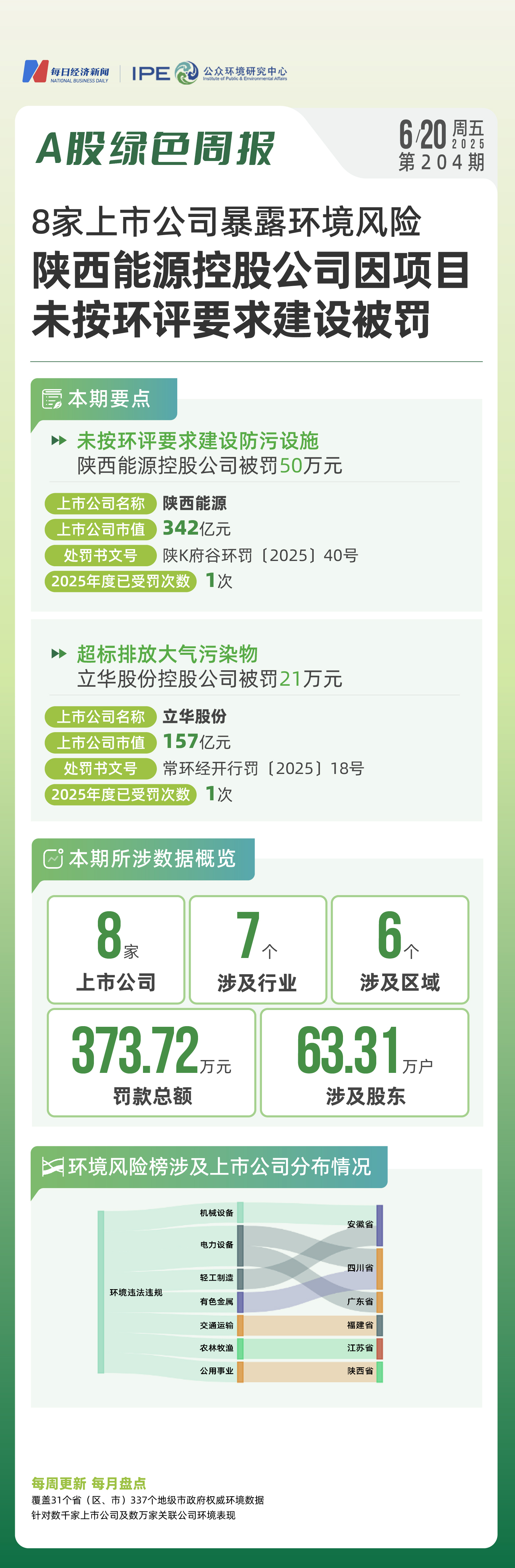
A股绿色周报|8家上市公司暴露环境风险 陕西能源控股公司项目未按环评要求建设被罚50万元
Mei Ri Jing Ji Xin Wen· 2025-06-20 11:11
Core Points - The article highlights the increasing environmental risks faced by listed companies in China, with a focus on recent penalties imposed for violations of environmental regulations [11][12][20] - A total of 8 listed companies were identified as having environmental risks, affecting approximately 633,100 shareholders [15][16] Group 1: Company Penalties - Shaanxi Energy Holdings Company was fined 500,000 yuan for failing to construct pollution prevention facilities as required by environmental assessments [17] - Lihua Co., Ltd. was penalized 210,000 yuan for exceeding emissions of air pollutants by its subsidiary [11][17] - Hualing Precision Engineering was fined 384,000 yuan for not re-evaluating environmental protection facilities after significant changes in production processes [18] Group 2: Regulatory Context - The article discusses the importance of environmental risk management as a critical aspect of corporate governance, alongside financial and operational factors [12][20] - It emphasizes the role of environmental information transparency in the capital market, facilitated by the collection and analysis of data from various government sources [11][20] Group 3: Broader Implications - The increasing focus on ESG (Environmental, Social, and Governance) factors among investors highlights the need for companies to prioritize sustainable development [20] - The article notes that the public's right to access environmental information is supported by legal frameworks, enhancing accountability for companies [20][21]