
建材

Search documents
股指月报:宏观利多预期褪去,经济在弱现实中缓慢回升-20250804
Zheng Xin Qi Huo· 2025-08-04 11:58
Report Industry Investment Rating - Not provided in the content Core Views - Short - term macro expectations have adjustment pressure after being fulfilled, but the medium - and long - term policy guidance remains bullish [4] - The domestic economy will maintain a weak reality. Pay attention to the improvement opportunities of cyclical industries that reverse deflation [4] - Domestic and overseas liquidity is expected to be loose, and the domestic stock market will receive incremental funds, but there are also some unfavorable factors such as the increase in the pressure of equity financing and the marginal increase in the pressure of share unlocking [4] - After a short - term sharp rise, the valuations of various indices have entered the neutral to high level in history, and the attractiveness of allocation funds is average [4] - In August, it is recommended to reduce long positions or conduct short - term shorting of IC and IM during rebounds, and go long on IF and IH during sharp drops. Also, use out - of - the - money put options to protect against adjustment risks [4] Summary by Directory 1. Market Review - **Stock Market Performance**: In the past month, A - shares led the rise, and the Nasdaq led the decline. The growth rate rankings of various indices are as follows: ChiNext > CSI 500 > Dow Jones > FTSE Emerging Markets > Hang Seng Index > Nikkei 225 > FTSE Europe > Nasdaq Composite. In terms of industries, steel led the rise, and comprehensive finance led the decline [7][8][12] - **Futures Basis and Spread**: The basis rates of the four major stock index futures (IH, IF, IC, and IM) changed by 0.7%, 0.45%, 0.12%, and 0.35% respectively, and the discounts of each futures contract significantly narrowed. The inter - period spread rates of the four major stock index futures (current month and next month) and (next quarter and current month) also changed, with different trends for different contracts [20] 2. Fund Flow - **Margin Trading and Stabilization Funds**: In July, margin trading funds flowed in 134.35 billion yuan to reach 1.98 trillion yuan, and the proportion of margin trading balance in the market value of tradable shares in the Shanghai and Shenzhen stock markets increased by 0.07% to 2.33%. The scale of passive stock ETF funds exceeded 3 trillion yuan, an increase of 78.13 billion yuan from the previous month, but the share decreased by 11.65 billion shares [23] - **Industrial Capital**: In July, equity financing was 46.49 billion yuan, and the scale of equity financing significantly declined to a low level. The market value of share unlocking was 288.39 billion yuan, a month - on - month increase of 69.89 billion yuan, and the marginal increase continued [26] 3. Liquidity - **Money Supply**: In July, the central bank's OMO reverse repurchase had a net withdrawal of 36.43 billion yuan, and the MLF had a net injection of 10 billion yuan. The overall liquidity supply was neutral to loose [28] - **Money Demand**: In July, the net demand for money in the bond market was 208.386 billion yuan, maintaining a high level, driven by the debt financing needs of national bonds, local government bonds, and enterprises [31] - **Fund Price**: In July, DR007, R001, and SHIBOR overnight rates changed by - 49.1bp, - 73.1bp, and - 10.7bp respectively, and the issuance rates of inter - bank certificates of deposit also decreased. The overall fund price rebounded slightly at a low level [34] - **Term Structure**: In July, the yield term structure of bonds flattened slightly, and the credit spread between national bonds and policy - bank bonds widened at the long - end [38] - **Sino - US Interest Rate Spread**: In July, the Sino - US interest rate spread inverted degree narrowed, the offshore RMB depreciated by 0.5%, and the US dollar against the RMB oscillated at the central level of the nearly three - year range [41] 4. Macroeconomic Fundamentals - **Real Estate Demand**: As of July 31, the weekly transaction area of commercial housing in 30 large - and medium - sized cities seasonally rebounded but was at a relatively low level in the same period. The second - hand housing sales seasonally declined. The real estate market was generally weak, but rigid demand supported the lower limit [44] - **Service Industry Activities**: As of August 1, the subway passenger volume in 28 large - and medium - sized cities remained high, and the service industry economic activities were at a high level. The traffic congestion delay index in 100 cities decreased, and the service industry economic activities tended to grow naturally and stably [48] - **Manufacturing Tracking**: In July, the capacity utilization rates of the manufacturing industry were differentiated. The overall internal and external demand of the manufacturing industry was still under pressure [52] - **Goods Flow**: The goods flow and passenger flow remained at a relatively high level, but the growth in some fields cooled down weekly. The highway and railway transportation were relatively weak, and there was a seasonal decline after August [57] - **Import and Export**: The export rush after the Sino - US trade talks ended, and the export was expected to be under pressure from August to September [59] - **Overseas Situation**: In the US in July, the employment market was mixed, the ISM manufacturing PMI dropped to the lowest level in the year, and the market's expectation of the Fed's interest rate cut increased [62][66] 5. Other Analyses - **Valuation**: In the past month, the risk premium of the stock - bond market decreased, and the foreign capital risk premium index also decreased. The relative valuation levels of major indices were not low, and the attractiveness of small - cap stocks decreased significantly [69][74] - **Quantitative Diagnosis**: According to the seasonal law, the stock market is in a period of seasonal shock decline and structural differentiation from August to September. It is recommended to pay attention to the trading and arbitrage opportunities of different index futures [77]
每日报告精选-20250804
GUOTAI HAITONG SECURITIES· 2025-08-04 11:45
Macroeconomic Insights - The US GDP growth rate for Q2 2025 increased significantly to 3% due to a rebound in personal consumption income and expenditure, with disposable income rising by 4.3% year-on-year and expenditure by 4.75%[8] - The core PCE price index showed a year-on-year increase of 2.79% in June, indicating persistent inflationary pressures[8] - The US non-farm payrolls added only 73,000 jobs in July, with significant downward revisions to previous months' data, raising concerns about the labor market's strength[23] Market Trends - Major global stock indices experienced declines, with the Shanghai Composite Index down 0.9%, Nikkei 225 down 1.6%, S&P 500 down 2.4%, and Hang Seng Index down 3.5%[7] - Commodity prices showed mixed results, with IPE Brent crude oil futures up 1.7% and COMEX copper down 20.2% due to policy impacts[7] - The dollar index rose by 1% over the week, reflecting a recovery after a rapid decline[7] Investment Strategies - The report emphasizes a focus on long-term investment opportunities in low-inflation environments, particularly in bond assets and high-dividend equities[20] - The ongoing transformation of the Chinese economy is expected to create new investment opportunities, especially in technology and new consumption sectors[42] - The report suggests that the decline in risk-free rates, with long-term government bond yields falling below 2%, will further enhance the attractiveness of equities over fixed-income products[44]





城市更新呵护需求,反内卷加快供给出清
Huafu Securities· 2025-08-04 05:23
行 华福证券 建筑材料 2025 年 08 月 04 日 业 研 究 建筑材料 城市更新呵护需求,反内卷加快供给出清 投资要点: 行 业 定 期 报 告 中共中央政治局 7 月 30 日召开会议,会议指出要落实落细更加积极的 财政政策和适度宽松的货币政策,落实好中央城市工作会议精神,高质量 开展城市更新;上海加快推进"两旧一村"改造,今年计划启动 25 个城中 村改造;深圳规划 2026 年前建成深汕通用机场,提升 eVTOL 服务保障能 力;重庆今年滚动实施城中村改造项目 150 个;广州 7 月二手住宅网签 8962 套,同比下降 10.7%;山东将数字家庭纳入"好房子"建设内容,对个人 购置智能家居予以补贴;沈阳 2025 年度住房公积金缴存基数上限调整为 29523 元;哈尔滨发布公积金新政,以旧换新贷款额度,最高上浮 20%; 广州从化推出"以旧换新""房票"等房地产健康发展七项措施;贵州 2025 年计划改造城中村 6268 户,调整土地增值税预征率;成都发布 2025 年城 市更新片区 12 个项目机会清单,涉及城市有机更新、危旧房改造、自主改 造等多个方面,总投资额高达数百亿元。中长期来看:1 ...
AH股市场周度观察(8月第1周)-20250804
ZHONGTAI SECURITIES· 2025-08-04 05:17
A-Share Market Overview - The A-share market experienced an overall decline in the first week of August, with small-cap growth sectors showing smaller declines compared to large-cap growth sectors. The CSI 2000 index fell by 0.01%, while the ChiNext index decreased by 0.74%. In contrast, the Northbound 50 index dropped by 2.70% [5] - The decline in the market was largely driven by significant drops in upstream resource products, with non-ferrous metals down by 4.69%, coal down by 4.56%, and building materials down by 3.32%. The political bureau meeting at the end of July adjusted its stance on "anti-involution," leading to a relative cooling of the policy's intensity, which contributed to the pullback in the upstream resource sector [5] - Looking ahead, the political bureau meeting's outcomes were in line with expectations, maintaining a steady overall policy stance. The report anticipates that the A-share market will continue to experience structural upward fluctuations driven by valuation recovery under a dual easing environment of fiscal and monetary policy [5] Hong Kong Market Overview - The Hong Kong market also saw a significant pullback in the first week of August, with the Hang Seng Index declining by 3.47% and the Hang Seng Tech Index falling by 4.94%. The materials and information technology sectors experienced the largest declines, while healthcare and telecommunications sectors rose against the trend [6] - The pullback in the Hong Kong market was influenced by the fading sentiment around "anti-involution," which affected previously high-performing upstream resource stocks. Additionally, weakened sales expectations in the home appliance sector led to significant declines in consumer discretionary stocks like Midea. The internet and social services sector in Hong Kong also faced declines due to weakened consumption expectations [6] - The report suggests that while market sentiment has cooled, the internet and social services sector in Hong Kong is currently at a low valuation, indicating potential for upward movement. Furthermore, with rising AI capital expenditures and increased support for technological innovation policies, leading companies in the Hang Seng Tech sector are expected to have medium to long-term growth potential [6]
国家统计局发布7月下旬流通领域重要生产资料市场价格变动情况
Yang Shi Wang· 2025-08-04 02:01
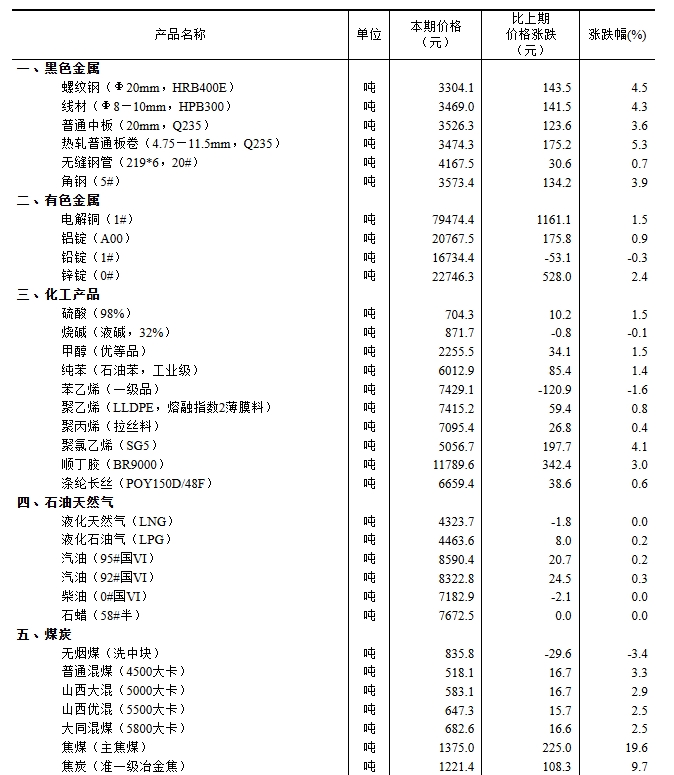
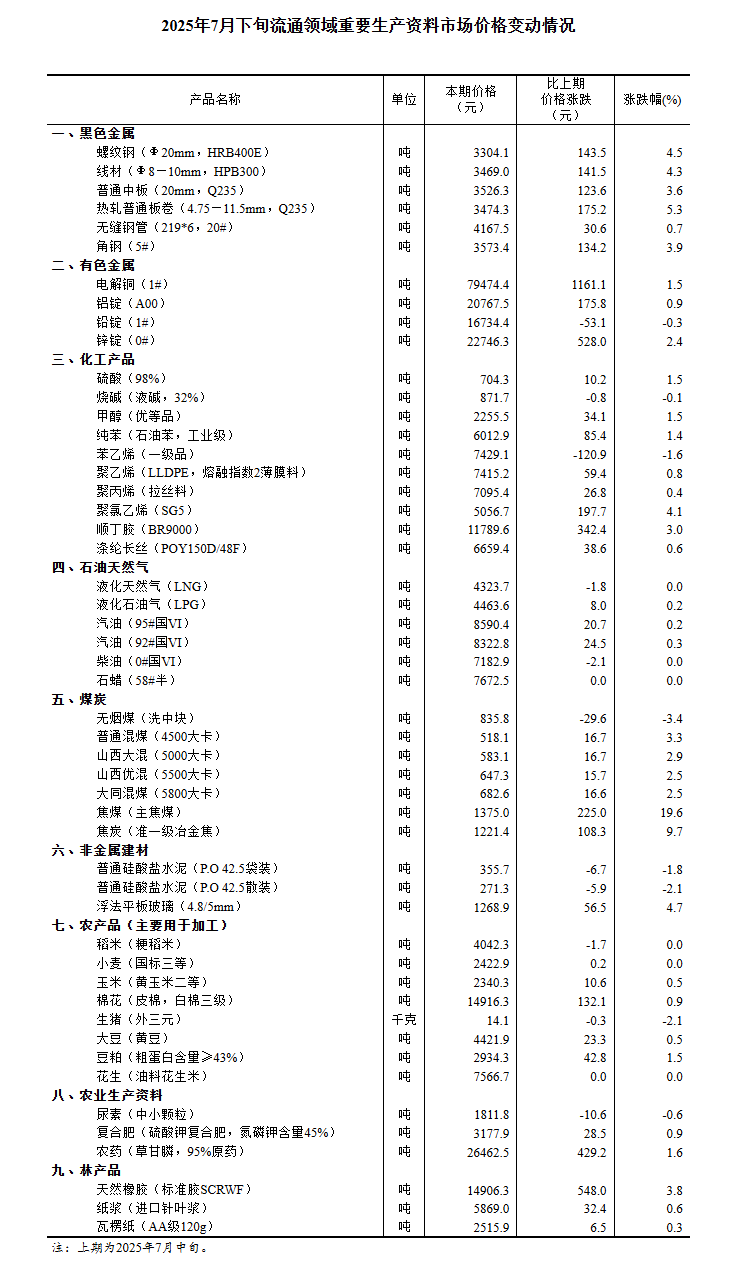
Core Viewpoint - The monitoring of market prices for 50 important production materials across nine categories indicates a general upward trend in prices, with 36 products experiencing price increases, 8 products seeing declines, and 6 remaining stable in late July 2025 compared to mid-July 2025 [1][2]. Group 1: Price Changes Overview - In the black metal category, notable price increases include rebar (up 143.5 yuan, 4.5%) and hot-rolled ordinary plates (up 175.2 yuan, 5.3%) [3]. - In the non-ferrous metal category, electrolytic copper rose by 1161.1 yuan (1.5%), while lead ingot decreased by 53.1 yuan (-0.3%) [3]. - Chemical products showed mixed results, with sulfuric acid increasing by 10.2 yuan (1.5%) and styrene decreasing by 120.9 yuan (-1.6%) [3]. Group 2: Specific Product Price Movements - In the petroleum and natural gas sector, liquefied natural gas prices remained stable, while gasoline (95) increased by 20.7 yuan (0.2%) [4]. - Coal prices varied, with coking coal rising significantly by 225.0 yuan (19.6%) and anthracite coal decreasing by 29.6 yuan (-3.4%) [4]. - In the agricultural products category, cotton prices increased by 132.1 yuan (0.9%), while the price of live pigs fell by 0.3 yuan (-2.1%) [4]. Group 3: Monitoring Methodology - The price monitoring encompasses a wide range of products across 31 provinces, involving over 2000 wholesalers and dealers [8][9]. - The methodology includes on-site price collection, phone inquiries, and electronic communications to ensure accurate data [9][10].

国家统计局:7月下旬生猪(外三元)价格跌2.1%
news flash· 2025-08-04 01:34
Group 1 - The core point of the article is that the price of live pigs (external three yuan) has decreased by 2.1% in late July compared to mid-July, with the current price at 14.1 yuan per kilogram [1][3]. - A total of 36 products saw price increases, while 8 products experienced price declines, and 6 products remained stable during the same period [1]. - The monitoring covered 50 important production materials across 9 categories in the national circulation market [1]. Group 2 - Among the products, rebar (Φ20mm, HRB400E) increased by 4.5% to 3304.1 yuan, and wire rod (Φ8-10mm, HPB300) rose by 4.3% to 3469.0 yuan [2]. - In the non-ferrous metals category, copper (1) was priced at 79474.4 yuan, reflecting a 1.5% increase, while aluminum ingot (A00) rose by 0.9% to 20767.5 yuan [2]. - Chemical products showed mixed results, with sulfuric acid (98%) increasing by 1.5% to 704.3 yuan, while caustic soda (liquid, 32%) decreased slightly by 0.1% to 871.7 yuan [2].
8月策略观点:波动放大如何应对?-20250803
Guoxin Securities· 2025-08-03 13:58
Core Insights - The market experienced its smoothest main upward phase since the beginning of the year in July, with a 3.74% increase and a maximum drawdown of 1.18% [3][6] - The "anti-involution" policies and the emphasis on stabilizing growth in key industries contributed to market acceleration and improved profit-making effects [3][6] - Small-cap, growth, and loss-making stocks outperformed in July, with sectors like steel, pharmaceuticals, building materials, and communications leading the gains [3][10] Market Performance Summary - In July, the market saw a significant increase, with the main index rising 3.74% and achieving the highest monthly Sharpe and Calmar ratios of the year [6][8] - The average number of stocks hitting the daily limit dropped from over 70 to around 50 by the end of July, indicating a slight easing in profit-making effects [3][43] - The small-cap index outperformed the large-cap index, with small-cap stocks rising 5.54% compared to 3.48% for large-cap stocks [10] Industry Analysis - The report highlights the importance of identifying companies that only incur losses in profits but maintain positive cash flow, particularly in the cement and chemical sectors [3][98] - The "anti-involution" theme is expected to drive excess returns, with a projected initial pulse of around 20 percentage points, particularly benefiting small-cap stocks [3][91] - Industries experiencing supply contraction and rising demand include upstream coking coal, midstream engineering machinery, and downstream white goods and pharmaceuticals [3][115] Thematic Investment Focus - The report emphasizes the significance of the "14th Five-Year Plan" and the industries benefiting from childbirth subsidies, including maternal and infant products, children's healthcare, and early education services [3][118] - Key areas of focus include digital transformation in industries and consumption services, particularly in regions like the Beijing-Tianjin-Hebei area and the Yangtze River Delta [3][120]
国泰海通 · 晨报0804|宏观、策略、海外策略
国泰海通证券研究· 2025-08-03 13:50
Macro Analysis - The US non-farm payroll data for July fell short of expectations, with significant downward revisions for May and June, raising concerns about data quality and indicating a weakening private sector job market [4] - There is a divergence between the non-farm payroll data and the unemployment rate, attributed to the impact of immigration policies, which have reduced the proportion of foreign-born individuals in the labor market [4] - The Federal Reserve faces a dilemma between managing inflation and employment, with the July non-farm data likely insufficient to alter Powell's hawkish stance ahead of the Jackson Hole central bank meeting in August [4] Chinese Market Strategy - The Chinese stock market is characterized as a "transformation bull," with expectations for further index highs despite recent adjustments [9][10] - Key drivers of this transformation include economic shifts towards new technologies and consumption patterns, as well as systemic declines in risk-free interest rates, which lower the opportunity cost of investing in stocks [11] - Institutional reforms aimed at improving investor returns are crucial, enhancing the market's resilience and reducing risk premiums [11] Investment Themes - Emerging technologies are identified as a primary investment theme, while cyclical financial sectors are seen as potential dark horses [12] - Recommendations include stable and monopolistic sectors such as brokerage, banking, and insurance, alongside emerging growth sectors like internet, media, defense, and innovative pharmaceuticals [12] - The cyclical sector is expected to improve as competition dynamics evolve, with recommendations for materials like non-ferrous metals, chemicals, and construction materials [12] Hong Kong Market Insights - The Hong Kong new consumption sector is currently in a phase of heat digestion after significant gains earlier in the year, with consumer preferences shifting towards experiential and social consumption [17][18] - Historical parallels with Japan suggest that the transformation in consumer behavior towards personalized and rational consumption will continue to evolve in China [18] - The Hong Kong market offers a more balanced exposure to new consumption compared to the A-share market, which is dominated by traditional sectors [19]

A股策略周报20250803:当所有预期都回摆的时候-20250803
SINOLINK SECURITIES· 2025-08-03 07:31
Group 1 - The report emphasizes that the current market rally may be perceived as a "water buffalo" driven by liquidity, potentially overlooking the crucial theme of profit recovery [3][15][26] - Historical data shows that since 2000, there have been four instances of a trend reversal in ROE for the entire A-share non-financial sector, occurring in 2006 Q2, 2009 Q3, 2016 Q3, and 2020 Q2 [3][15] - The report draws parallels between the current anti-involution policies and the supply-side reforms of 2016, noting that the focus has shifted from traditional industries like steel and coal to emerging manufacturing sectors such as photovoltaics [3][25] Group 2 - The conditions for interest rate cuts in the U.S. are maturing, with recent employment data indicating a weakening economy, although this does not equate to a full-blown recession [4][40] - The report highlights that the recent adjustments in the market reflect a retraction in trading scales rather than a change in the long-term trend of improving corporate profits in China [6][49] - Recommendations for investment include focusing on upstream resource products and capital goods that benefit from both overseas manufacturing recovery and domestic anti-involution policies [6][49] Group 3 - Trade issues between China and the U.S. are identified as potential market disturbances, but their impact is expected to be less severe than in April due to lower tariff rates announced in July [5][46][47] - The report notes that the recent fluctuations in the market are more about the retraction of previous gains rather than a fundamental shift in the long-term outlook for supply clearing [3][26] - The report suggests that the focus of domestic policies will revolve around "people's livelihood," recommending attention to dividend-type consumption sectors such as food and beverages, as well as certain service industries [6][49]
投资策略周报:坚守自我,科技为先-20250803
KAIYUAN SECURITIES· 2025-08-03 03:11
Group 1 - The market has experienced a slight pause after five consecutive weeks of growth, with new capital's marginal profit effect weakening. The financing balance growth rate in the Shanghai and Shenzhen markets is slowing down, indicating a neutral oscillation range of 7%-10% [2][12][13] - The report emphasizes that the current market structure is increasingly clear, driven by two main lines: the "anti-involution" leading to a cyclical and pro-cyclical trading PPI recovery, and the strong elasticity provided by global technology collaboration [2][12][58] Group 2 - The report identifies that despite the current low PPI levels, there is potential for marginal improvement due to a loose liquidity environment, which may accelerate valuation recovery. This is supported by two signals: the credit transmission providing leading signals for PPI recovery and the structural divergence between CRB and PPI [3][14][17] - The "anti-involution" policy has catalyzed a shift towards PPI trading, with core assets in cyclical consumption likely to experience valuation recovery, thus supporting the index [3][21][25] Group 3 - The TMT sector is highlighted as a core area for institutional long-term allocation, driven by a "fan effect" that attracts consensus among funds. The sector has shown significant trading activity, particularly in the communication sub-sector, which has gained traction as other sectors have seen a decline in trading volume [4][37][38] - The semiconductor industry is entering an upward phase, with conditions for transitioning from "expectation recovery" to "economic verification" being met. The report notes that the current semiconductor cycle is characterized by strong demand driven by AI and high-performance computing needs [4][47][49] Group 4 - The report suggests a strategic allocation in the current market environment, recommending a focus on technology, military, anti-involution, PPI diffusion directions, and stable dividends. Specific sectors include AI, robotics, semiconductors, and cyclical sectors like insurance and real estate, which are expected to benefit from PPI recovery [5][58]