
原油

Search documents
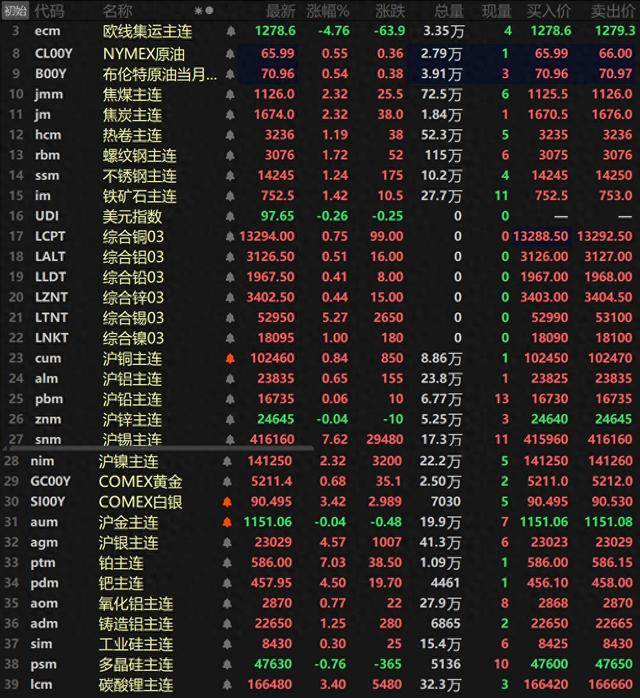
金属近全线上涨 沪锡、铂主连涨逾7% 伦锡、沪银、钯涨超4%
Sou Hu Cai Jing· 2026-02-25 09:32
Metal Market - Domestic base metals generally rose, with the exception of zinc, which fell by 0.04%. Tin led the gains with a 7.62% increase, followed by nickel at 2.32%. Other metals had gains of less than 1% [1] - In the black metal sector, all commodities saw increases of over 1%, with iron ore up 1.42%, stainless steel up 1.24%, rebar up 1.72%, and hot-rolled coil up 1.19%. Both coking coal and coke rose by 2.32% [1] - On the external market, base metals also showed an upward trend, with tin leading at 5.27% and nickel up by 1%. Other metals had gains of less than 1% [1] - Precious metals saw COMEX gold rise by 0.68% and silver by 3.42%. In the domestic market, Shanghai gold fell by 0.04%, while silver rose by 4.57% [1] Additional Metals - Platinum rose by 7.03%, and palladium increased by 4.5% [2] Macro Environment - The Shanghai Municipal Housing and Urban-Rural Development Committee and other departments issued a notice to optimize real estate policies, effective from February 26, 2026, aimed at meeting housing demand and promoting market stability [5][6] - The People's Bank of China conducted a 7-day reverse repurchase operation of 4.095 billion yuan at an interest rate of 1.40% [6] Oil Market - As of 15:04, both WTI and Brent crude oil prices increased, with WTI up 0.55% and Brent up 0.54%. Traders are preparing for upcoming US-Iran talks [9] - The API reported a crude oil inventory of 11.427 million barrels for the week ending February 20, against an expectation of 1.25 million barrels [9]

国金证券:市场担忧美伊冲突一触即发 原油地缘风险溢价急速上升
智通财经网· 2026-02-25 07:07
智通财经APP获悉,国金证券发布研报称,原油市场当前脱离供需,转为地缘政治风险驱动。预计未来 一个月内价格的高波动率将不可避免。在美伊局势尚未明朗化前,原油价格处于易涨难跌的状态。短期 原油价格如因地缘问题继续上行,建议关注拥有油气资源的上游企业以及长期受益于行业高景气度的海 上油气服务工程板块。另一方面,油价上涨可能带动化工品涨价预期,而如果地缘风险溢价回落则行业 成本压力下降,考虑到国内未来产业反内卷的政策方向,有利于化工产业的长期格局优化及高质量发 展。 国金证券主要观点如下: 美伊战争风险快速上升,原油地缘风险溢价急速上升 2月18日以来由于海外市场对于美国与伊朗开战的预期快速上升,原油市场担忧已经进入战争倒计时阶 段因而地缘风险溢价快速上升。Polymarket网站押注美国将于3月31日前袭击伊朗的概率自17日的38%升 至18日的48%,并于19日升至65%。19日据CBS新闻援引知情人士透露,美国高级国家安全官员已告知 特朗普,军方最快可能于周六对伊朗发动打击。20日报道称,特朗普正权衡对伊朗进行初步、有限的军 事打击,以迫使其达成核协议。 2月22日新闻报道,如果美国谈判代表在未来48小时内收 ...

FPG财盛国际:金价暴跌近83美元 特朗普即将发表重磅演讲
Sou Hu Cai Jing· 2026-02-25 04:26
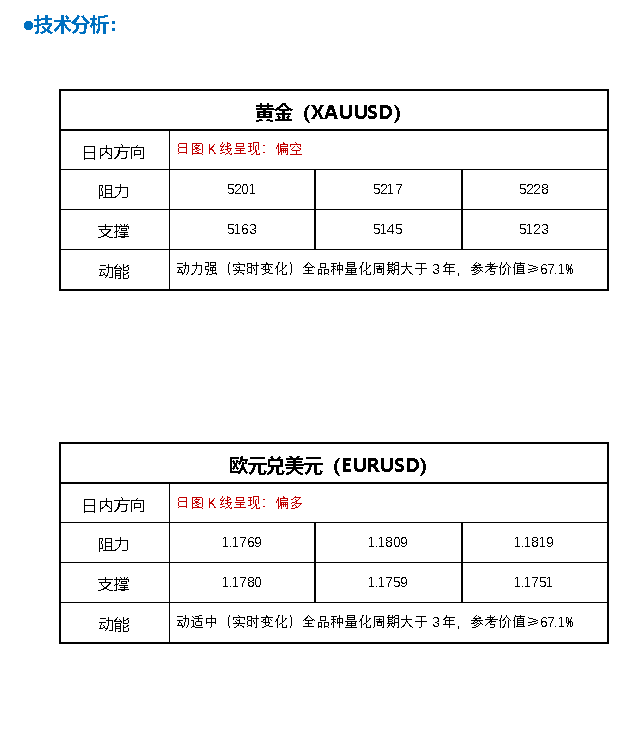
●FPG最新市场脱水消息: | | 黄金 (XAUUSD) | | | | --- | --- | --- | --- | | 日图 K 线呈现: 偏空 日内方向 | | | | | 5201 阻力 | | 521 7 | 5228 | | 支撑 5163 | | ਟੀਥੇਟ | STS3 | | 动能 | 动力强(实时变化)全品种量化周期大于3年,参考价值≥67.1% | | | 1. ADP数据显示,过去一周美国民间就业新增12.8万人,高于前值。此外,美国2月消费者信心指数为 91.2,优于市场预期。 2. 据彭博社报道,波士顿联储主席柯林斯周二表示,鉴于近期经济数据表明劳动力市场有所改善,但通 胀风险仍在,利率"可能在一段时间内维持不变"。 3. 美国总统特朗普将于当地时间2月24日晚间9点左右在国会山向两院议员发表2026年度国情咨文,这是 2026年中期选举前的一次重要政治演讲。 ●FPG fortune prime global分析师观点: FPG特约分析师(Felix)观点: 在金价触及数周高位后,交易员开始获利了结,令黄金承压走低。此外,美联储官员偏鹰派的言论支撑 了美元,并拖累以美元计价的 ...
中信期货晨报:国内商品期市收盘多数上涨,贵金属涨幅居前-20260225
Zhong Xin Qi Huo· 2026-02-25 02:16
1. Report Industry Investment Rating - No information provided in the given content. 2. Core Viewpoints of the Report - Domestic commodity futures markets closed mostly higher, with precious metals leading the gains [1]. - Domestic macroeconomic situation shows a differentiated performance during the Spring Festival, with strong travel and consumption but weak real - estate sales. The start of social financing in January was stable, with government financing being strong and private financing in line with expectations [13]. - Overseas, the US economy shows a slowdown in overall expansion and structural differentiation in multiple fields. The GDP growth rate in the fourth quarter slowed down significantly, with personal consumption being the main drag, and inflation stickiness still exists [13]. - In the short - term, overseas economy may suppress base metals, but copper, aluminum, tin, and nickel with tight supply are expected to maintain a slightly stronger oscillating trend. Tariff disturbances may support the prices of gold and silver. A - shares are expected to continue a mild upward trend, while crude oil, black commodities, and the domestic bond market should be treated with an oscillating mindset [13]. 3. Summary by Relevant Catalogs 3.1 Financial Market Fluctuations - **Stock Index Futures**: On February 24, 2026, the CSI 300 futures price was 4683.4, with a daily increase of 1.06%, a weekly increase of 1.22%, a monthly decrease of 0.59%, a quarterly increase of 1.82%, and an annual increase of 1.82%. Other stock index futures also had different degrees of fluctuations [2]. - **Treasury Bond Futures**: The 2 - year, 5 - year, 10 - year, and 30 - year treasury bond futures all had certain price increases and fluctuations in different time periods [2]. - **Foreign Exchange**: The US dollar index was 97.7425, with a monthly increase of 0.65% and an annual decrease of 0.54%. The US dollar middle - price had a significant decline [2]. - **Interest Rates**: The 7 - day inter - bank pledged repo rate increased by 23.34bp, and the 10 - year Chinese government bond yield increased by 1.24bp [2]. 3.2 Fluctuations of Popular Industries - On February 24, 2026, industries such as non - ferrous metals, building materials, and petroleum and petrochemicals had relatively large daily and quarterly increases, while industries such as consumer services, computer, and non - bank finance had declines [5]. 3.3 Fluctuations of Overseas Commodities - On February 23, 2026, precious metals such as COMEX gold and silver had significant increases, while energy products such as NYMEX natural gas had significant declines [8]. 3.4 Fluctuations of Domestic Commodities - On February 24, 2026, products such as crude oil, low - sulfur fuel oil, and silver had relatively large daily increases, while products such as iron ore, coke, and coking coal had declines [11]. 3.5 Macro Summary - **Domestic Macro**: During the Spring Festival, travel and consumption were strong, but real - estate sales were weak. Social financing in January started stably, with government financing being strong and private financing in line with expectations [13]. - **Overseas Macro**: The US economy shows a slowdown in overall expansion and structural differentiation. The GDP growth rate in the fourth quarter slowed down, and inflation stickiness still exists [13]. - **Large - scale Assets**: Short - term overseas economy may suppress base metals, but copper, aluminum, tin, and nickel with tight supply are expected to maintain a slightly stronger oscillating trend. Tariff disturbances may support the prices of gold and silver. A - shares are expected to continue a mild upward trend, while crude oil, black commodities, and the domestic bond market should be treated with an oscillating mindset [13]. 3.6 Viewpoint Highlights - **Financial Sector**: After the Spring Festival, stocks and bonds both rose. Stock index futures are expected to be slightly stronger in an oscillating manner, stock index options are expected to oscillate, and treasury bond futures are also expected to oscillate [14]. - **Precious Metals**: Gold and silver prices are expected to be slightly stronger in an oscillating manner due to positive impacts of tariff policy changes [14]. - **Shipping**: The spot price of container shipping to Europe is expected to oscillate, and steel and iron ore prices are also expected to oscillate [14]. - **Black Building Materials**: The real - world situation and expectations are not good, and the prices of products such as coke, coking coal, and glass are expected to oscillate [14]. - **Non - ferrous Metals and New Materials**: Base metals are expected to oscillate and sort out. Products such as copper, aluminum, and nickel are expected to be slightly stronger in an oscillating manner [14]. - **Energy and Chemicals**: Due to the tense relationship between the US and Iran, oil prices are boosted. Products such as crude oil, LPG, and asphalt are expected to oscillate [16]. - **Agriculture**: After the Spring Festival, most agricultural products rose on the first day. Products such as natural rubber, cotton, and corn are expected to be slightly stronger in an oscillating manner, while products such as pigs and sugar are expected to be weaker in an oscillating manner [16].
品种晨会纪要:宝城期货原油早报-2026-02-25-20260225
Bao Cheng Qi Huo· 2026-02-25 01:54
Group 1: Investment Rating - There is no information about the report's industry investment rating in the provided content. Group 2: Core View - The report believes that the short - term and intraday view of crude oil 2604 is bullish, and the medium - term view is oscillating. The overall view is bullish, driven by geopolitical risk premium, tight supply - demand balance, and domestic resumption of work demand [1][5]. Group 3: Summary by Relevant Content Price and Performance - After the Spring Festival, the domestic crude oil futures 2604 contract rose 6.18% to 493.3 yuan/barrel [5]. Core Driving Factors - Geopolitical factors: The repeated situation in the Middle East is the core variable of oil price fluctuations. The limited progress of the US - Iran nuclear agreement negotiation, the US troop increase in the Middle East, and Iran's military exercise in the Strait of Hormuz during the Spring Festival have increased market concerns about supply interruption. The Strait of Hormuz, through which about 20% of the world's seaborne crude oil passes, any tension escalation may increase the risk premium of oil prices. The continuous disturbance of Red Sea shipping has also pushed up transportation costs and magnified the transmission effect of geopolitical risks on oil prices [5]. - Supply - demand relationship: The supply is in a tight - balance state, and the demand from domestic resumption of work also drives the oil price [5]. Market Characteristics and Risks - In the short term, oil prices are dominated by geopolitics and supported by fundamentals, with obvious characteristics of high - level and high - volatility. Attention should be paid to events and data rhythms, and the callback pressure caused by the ebb of risk premium should be guarded against [5].
贵金属早报-20260225
Yong An Qi Huo· 2026-02-25 00:57
Group 1: Price Performance - London Gold's latest price is 5191.40 with a change of 196.45 [1] - London Silver's latest price is 86.94 with a change of 9.59 [1] - London Palladium's latest price is 2058.00 with a change of -51.00 [1] - WTI Crude's latest price is 66.31 with a change of 3.42 [1] - LME Copper's latest price is 13061.50 with a change of 167.00 [1] - US Dollar Index's latest value is 97.74 with a change of 0.88 [1] - Euro to US Dollar's latest rate is 1.18 with a change of -0.01 [1] - British Pound to US Dollar's latest rate is 1.35 with a change of -0.02 [1] - US Dollar to Japanese Yen's latest rate is 154.67 with a change of 1.97 [1] - US 10 - year TIPS's latest value is 1.77 with a change of 0.00 [1] Group 2: Trading Data - COMEX Silver's value is 11321.76 with a change of -386.68 [1] - SHFE Silver's value is 349.88 with a change of -3.68 [1] - Gold ETF's value is 1086.47 with a change of 0.00 [1] - Silver ETF's value is 15830.38 with a change of 0.00 [1] - SGE Silver's value is 493.67 with a change of 9.44 [1] - SGE Gold's value is 1 with a change of 0.00 [1] - Another SGE Silver's value is 2 with a change not clearly presented [1]
能源化工日报-20260225
Wu Kuang Qi Huo· 2026-02-25 00:54
1. Report Industry Investment Rating No information provided in the given content. 2. Core Viewpoints of the Report - For crude oil, the current oil price has risen and priced in a high geopolitical premium. In the short - term, there is still a supply gap due to Iran's supply cut. Considering the expected over - performance of Venezuela's production increase and OPEC's subsequent production recovery, the main operation idea is to make a mid - term layout, but wait for the end of the geopolitical event to eliminate tail risks [1]. - For methanol, the downward momentum still exists, but the negative factors have weakened marginally, so the downward space is limited. The main idea is to go long on dips in the mid - term [1]. - For urea, the current situation of the internal - external price difference has opened the import window. Coupled with the expected improvement in production at the end of January, negative expectations for the fundamentals of urea are coming, so short positions are recommended [2]. - For rubber, there is no substantial industry - specific positive news, and the increase is judged to be driven by macro and capital factors. Attention should be paid to the trends of Hainan Rubber and long - position opportunities [3]. - For PVC, the comprehensive profit of enterprises is at a neutral level, but the reduction in supply is small, and production is at a historical high. Domestic demand is in the off - season, and the demand side is under pressure. The cancellation of export tax rebates has spurred short - term export rush, which is the only short - term support. The overall situation is that supply is strong and demand is weak, and attention should be paid to changes in production capacity and production start - up [7]. - For pure benzene and styrene, the spot and futures prices of pure benzene are rising, and the basis is narrowing. The spot price of styrene is falling, and the futures price is rising, and the basis is weakening. The non - integrated profit of styrene is moderately high, and the upward repair space of valuation is narrowing. The non - integrated profit of styrene can be gradually taken profit [11]. - For polyethylene, OPEC+ plans to suspend production growth in Q1 2026, and the crude oil price may have bottomed out. The spot price of polyethylene is falling, and the downward space of PE valuation still exists. The supply pressure is relieved, and the demand side is in the off - season [14]. - For polypropylene, the EIA monthly report predicts a slight reduction in global oil inventories, and the supply surplus may be alleviated. There is no production capacity expansion plan in H1 2026, and the demand side's production start - up rate fluctuates seasonally. In the context of weak supply and demand, the overall inventory pressure is high. It is recommended to go long on the PP5 - 9 spread on dips [16]. - For PX, the PX load remains high, and downstream PTA has many maintenance operations, with a low overall load center. It is expected to maintain an inventory - accumulation pattern before the maintenance season. The mid - term situation is good, and attention should be paid to the opportunity of going long on dips following the crude oil price [18]. - For PTA, the supply side will maintain high - level maintenance in the short - term, and the demand side of polyester and chemical fiber is expected to recover after the off - season. The inventory - accumulation cycle is about to end. The processing fee is expected to remain stable at a high level, and there is still room for valuation increase after the Spring Festival. Attention should be paid to the opportunity of going long on dips [20]. - For ethylene glycol, the overall load is still relatively high, and the port inventory - accumulation pressure is large. There is an expectation of further profit compression and production reduction. The valuation is currently moderately low year - on - year, and there is a risk of rebound [23]. 3. Summary According to Related Catalogs Crude Oil - **Market Information**: On February 25, 2026, the INE main crude oil futures closed up 28.70 yuan/barrel, a 6.18% increase, at 493.30 yuan/barrel. The high - sulfur fuel oil of related refined oil main futures closed up 79.00 yuan/ton, a 2.76% increase, at 2942.00 yuan/ton; the low - sulfur fuel oil closed up 192.00 yuan/ton, a 5.84% increase, at 3478.00 yuan/ton [1]. - **Strategy Viewpoint**: The current oil price has priced in a high geopolitical premium. In the short - term, there is an Iranian supply gap, but considering the expected over - performance of Venezuela's production increase and OPEC's subsequent production recovery, the main operation idea is mid - term layout, waiting for the end of the geopolitical event to eliminate tail risks [1]. Methanol - **Market Information**: On February 25, 2026, the main contract of methanol changed by 67.00 yuan/ton, reporting 2285 yuan/ton [1]. - **Strategy Viewpoint**: The downward momentum still exists, but the negative factors have weakened marginally, so the downward space is limited. The main idea is to go long on dips in the mid - term [1]. Urea - **Market Information**: On February 25, 2026, the regional spot prices in Shandong, Hebei, Hubei, and Jiangsu changed by 10 yuan/ton, while those in Henan, Shanxi, and Northeast China remained unchanged. The overall basis was reported at - 65 yuan/ton. The main contract of futures changed by 22 yuan/ton, reporting 1855 yuan/ton [2]. - **Strategy Viewpoint**: The current situation of the internal - external price difference has opened the import window. Coupled with the expected improvement in production at the end of January, negative expectations for the fundamentals of urea are coming, so short positions are recommended [2]. Rubber - **Market Information**: On February 25, 2026, due to the sharp rise in crude oil and chemicals, rubber increased in position. There was no substantial positive news in the industry, and it was judged to be driven by macro and capital factors. The price of Thai standard mixed rubber was 15800 (+550) yuan, STR20 was reported at 2040 (+80) US dollars, and STR20 mixed was 2040 (+80) US dollars. The price of butadiene in Jiangsu and Zhejiang was 10300 (0) yuan, and the price of cis - butadiene rubber in North China was 12200 - 12600 (+150) yuan. The raw material purchase prices in the mainstream Thai market were: raw rubber sheets 64.05, up 1.05 from the previous day; smoked rubber sheets 68.79, up 1.62; glue 67, up 1.0; cup rubber 58, up 0.5 [3]. - **Strategy Viewpoint**: Attention should be paid to the trends of Hainan Rubber and long - position opportunities. For arbitrage, it is recommended to go long on RU2701 and short on RU2609 with a spread of 635 (-30), and go long on the NR main contract and short on RU2609. When the spread expands to over 3150, add positions to buy NR and sell RU2609 [3][4]. PVC - **Market Information**: On February 25, 2026, the PVC05 contract rose 43 yuan, reporting 4948 yuan. The spot price of Changzhou SG - 5 was 4720 (-30) yuan/ton, the basis was - 228 (-73) yuan/ton, and the 5 - 9 spread was - 124 (-2) yuan/ton. The cost - side calcium carbide price in Wuhai was 2350 (-200) yuan/ton, the medium - grade semi - coke price was 785 (0) yuan/ton, the ethylene price was 705 (0) US dollars/ton, and the caustic soda spot price was 618 (+16) yuan/ton. The overall PVC production start - up rate was 80.1%, a 0.8% month - on - month increase; among them, the calcium carbide method was 81.6%, a 0.8% month - on - month increase; the ethylene method was 76.5%, a 1% month - on - month increase. The overall downstream production start - up rate was 13%, a 28.5% month - on - month decrease. The in - factory inventory was 31.2 million tons (+2.4), and the social inventory was 125.4 million tons (+2.7) [6]. - **Strategy Viewpoint**: The comprehensive profit of enterprises is at a neutral level, but the reduction in supply is small, and production is at a historical high. Domestic demand is in the off - season, and the demand side is under pressure. The cancellation of export tax rebates has spurred short - term export rush, which is the only short - term support. The overall situation is that supply is strong and demand is weak, and attention should be paid to changes in production capacity and production start - up [7]. Pure Benzene and Styrene - **Market Information**: On February 25, 2026, the cost - side East China pure benzene price was 6103 yuan/ton, up 87.5 yuan/ton; the closing price of the pure benzene active contract was 6124 yuan/ton, up 87.5 yuan/ton; the pure benzene basis was - 21.5 yuan/ton, narrowing by 2.5 yuan/ton. The spot price of styrene was 7550 yuan/ton, down 150 yuan/ton; the closing price of the styrene active contract was 7497 yuan/ton, up 24 yuan/ton; the basis was 53 yuan/ton, weakening by 174 yuan/ton. The BZN spread was 153.62 yuan/ton, down 12.5 yuan/ton; the non - integrated device profit of EB was - 213.975 yuan/ton, down 44.125 yuan/ton; the EB consecutive 1 - consecutive 2 spread was 69 yuan/ton, narrowing by 19 yuan/ton. The upstream production start - up rate was 69.96%, up 0.68%; the Jiangsu port inventory was 10.86 million tons, with an inventory increase of 0.80 million tons. The weighted production start - up rate of three S was 40.79%, up 0.23%; the PS production start - up rate was 55.20%, down 0.40%; the EPS production start - up rate was 56.24%, up 2.98%; the ABS production start - up rate was 64.40%, down 1.70% [9][10]. - **Strategy Viewpoint**: The spot and futures prices of pure benzene are rising, and the basis is narrowing. The spot price of styrene is falling, and the futures price is rising, and the basis is weakening. The non - integrated profit of styrene is moderately high, and the upward repair space of valuation is narrowing. The non - integrated profit of styrene can be gradually taken profit [11]. Polyethylene - **Market Information**: On February 25, 2026, from a fundamental perspective, the closing price of the main contract was 6787 yuan/ton, up 12 yuan/ton, the spot price was 6585 yuan/ton, down 90 yuan/ton, and the basis was - 202 yuan/ton, weakening by 102 yuan/ton. The upstream production start - up rate was 87.03%, a 0.27% month - on - month decrease. In terms of weekly inventory, the production enterprise inventory was 37.97 million tons, with a month - on - month inventory increase of 5.67 million tons, and the trader inventory was 2.32 million tons, with a month - on - month inventory decrease of 0.23 million tons. The downstream average production start - up rate was 33.73%, a 4.03% month - on - month decrease. The LL5 - 9 spread was - 49 yuan/ton, a 2 - yuan month - on - month expansion [13]. - **Strategy Viewpoint**: OPEC+ plans to suspend production growth in Q1 2026, and the crude oil price may have bottomed out. The spot price of polyethylene is falling, and the downward space of PE valuation still exists. The supply pressure is relieved, and the demand side is in the off - season [14]. Polypropylene - **Market Information**: On February 25, 2026, from a fundamental perspective, the closing price of the main contract was 6693 yuan/ton, up 5 yuan/ton, the spot price was 6675 yuan/ton, unchanged, and the basis was - 18 yuan/ton, weakening by 5 yuan/ton. The upstream production start - up rate was 74.9%, a 0.01% month - on - month decrease. In terms of weekly inventory, the production enterprise inventory was 41.58 million tons, with a month - on - month inventory increase of 1.49 million tons, the trader inventory was 18.32 million tons, with a month - on - month inventory decrease of 0.02 million tons, and the port inventory was 6.37 million tons, with a month - on - month inventory decrease of 0.03 million tons. The downstream average production start - up rate was 49.84%, a 2.24% month - on - month decrease. The LL - PP spread was 94 yuan/ton, a 7 - yuan month - on - month expansion. The PP5 - 9 spread was - 28 yuan/ton, a 9 - yuan month - on - month narrowing [15]. - **Strategy Viewpoint**: The EIA monthly report predicts a slight reduction in global oil inventories, and the supply surplus may be alleviated. There is no production capacity expansion plan in H1 2026, and the demand side's production start - up rate fluctuates seasonally. In the context of weak supply and demand, the overall inventory pressure is high. It is recommended to go long on the PP5 - 9 spread on dips [16]. PX - **Market Information**: On February 25, 2026, the PX05 contract rose 242 yuan, reporting 7478 yuan, the PX CFR rose 33 US dollars, reporting 933 US dollars. Converted according to the RMB central parity rate, the basis was - 13 yuan (+24), and the 5 - 7 spread was 16 yuan (+4). In terms of PX load, the Chinese load was 92%, a 2.5% month - on - month increase; the Asian load was 83.7%, a 1.3% month - on - month increase. In terms of devices, Sinochem Quanzhou restarted, and Zhejiang Petrochemical increased its load. The PTA load was 74.8%, a 2.8% month - on - month decrease. In terms of devices, Dushan Energy had maintenance. In terms of imports, South Korea exported 33.9 million tons of PX to China in the first and middle ten - days of February, a year - on - year increase of 12.4 million tons. In terms of inventory, the inventory at the end of December was 465 million tons, with a month - on - month inventory increase of 19 million tons. In terms of valuation and cost, PXN was 306 US dollars (+8), South Korea's PX - MX was 149 US dollars (+2), and the naphtha crack spread was 97 US dollars (-10) [17]. - **Strategy Viewpoint**: The PX load remains high, and downstream PTA has many maintenance operations, with a low overall load center. It is expected to maintain an inventory - accumulation pattern before the maintenance season. The mid - term situation is good, and attention should be paid to the opportunity of going long on dips following the crude oil price [18]. PTA - **Market Information**: On February 25, 2026, the PTA05 contract rose 148 yuan, reporting 5352 yuan, the East China spot price rose 155 yuan, reporting 5285 yuan, the basis was - 62 yuan (+11), and the 5 - 9 spread was 32 yuan (0). The PTA load was 74.8%, a 2.8% month - on - month decrease. In terms of devices, Dushan Energy had maintenance. The downstream load was 77.6%, a 0.6% month - on - month decrease. In terms of devices, Chenghuijin's 200,000 - ton slicing, Jingwei's 200,000 - ton staple fiber, Jiangnan's 300,000 - ton staple fiber, and Xiangyang's 150,000 - ton staple fiber had maintenance, Huahong's 290,000 - ton staple fiber was shut down, and Yisheng's 500,000 - ton bottle chip restarted. The terminal texturing load decreased by 12% to 5%, and the loom load decreased by 9% to 0%. In terms of inventory,
橡胶甲醇原油:多头力量主导,能化强势运行
Bao Cheng Qi Huo· 2026-02-24 09:30
1. Report Industry Investment Rating - No relevant content provided 2. Core Viewpoints of the Report - **Rubber**: On Tuesday, the domestic Shanghai rubber futures contract 2605 showed a trend of increasing volume and open interest, strong operation, and a significant rise. The closing price increased by 3.90% to 17,030 yuan/ton, and the premium of the 5 - 9 spread widened to 200 yuan/ton. The rubber market has re - entered a bullish trend, and it is expected that the Shanghai rubber futures may maintain a volatile and upward - biased trend in the future [6]. - **Methanol**: On Tuesday, the domestic methanol futures contract 2605 showed a trend of increasing volume and open interest, volatile and upward - biased, and a significant rise. The futures price reached a maximum of 2,297 yuan/ton and a minimum of 2,222 yuan/ton, and the closing price increased by 3.02% to 2,285 yuan/ton. The discount of the 5 - 9 spread narrowed to 19 yuan/ton. The escalating geopolitical risks in the Middle East have enhanced the methanol premium, driving the methanol price to stabilize and strengthen. It is expected that the methanol futures may maintain a volatile and upward - biased trend in the future [7]. - **Crude Oil**: On Tuesday, the domestic crude oil futures contract 2604 showed a trend of decreasing volume and increasing open interest, gapping up, and strong operation. The futures price reached a maximum of 495.0 yuan/barrel and a minimum of 484.3 yuan/barrel, and the closing price increased by 6.18% to 493.3 yuan/barrel. As the geopolitical risks in the Middle East have escalated again, the crude oil premium has significantly increased. It is expected that the oil price may maintain a high - level and upward - biased posture in the future [7]. 3. Summary by Relevant Catalogs 3.1 Industry Dynamics 3.1.1 Rubber - As of February 8, 2026, the total inventory of natural rubber in bonded and general trade in Qingdao was 606,800 tons, a month - on - month increase of 15,100 tons or 2.55%. Bonded area inventory was 99,000 tons, an increase of 1.38%; general trade inventory was 507,800 tons, an increase of 2.78%. The inbound rate of Qingdao's natural rubber sample bonded warehouses decreased by 0.58 percentage points, and the outbound rate increased by 0.15 percentage points; the inbound rate of general trade warehouses increased by 1.24 percentage points, and the outbound rate decreased by 0.47 percentage points [9]. - As of February 13, 2026, the capacity utilization rate of China's semi - steel tire sample enterprises was 56.40%, a month - on - month decrease of 15.69 percentage points and a year - on - year decrease of 8.88 percentage points; the capacity utilization rate of all - steel tire sample enterprises was 40.55%, a month - on - month decrease of 19.90 percentage points and a year - on - year decrease of 13.74 percentage points. During the Spring Festival holiday, most tire enterprises shut down, and the overall capacity utilization rate of sample enterprises will be at a low point for the year [9]. - In January 2026, China's automobile production and sales were 2.45 million and 2.346 million respectively. Production increased by 0.01% year - on - year, sales decreased by 3.2% year - on - year, and both decreased by 25.7% and 28.3% month - on - month respectively. The passenger car market declined, while the commercial vehicle market continued to improve. In January, the LPI was 51.2%, a slight month - on - month decline of 1.2 percentage points but still in the expansion range. The heavy - truck market sold about 100,000 vehicles in January, a significant year - on - year increase of about 39%, and it is expected that the wholesale sales of the heavy - truck industry in the first quarter of this year will increase slightly year - on - year [10]. 3.1.2 Methanol - As of the week of February 13, 2026, the average domestic methanol operating rate was maintained at 87.30%, a slight week - on - week decrease of 0.68%, a slight month - on - month increase of 0.50%, and a significant year - on - year increase of 6.11%. The average weekly methanol output in China reached 2.0568 million tons, a slight week - on - week decrease of 4,300 tons, a small month - on - month increase of 21,400 tons, and a small increase of 80,600 tons compared with 1.9762 million tons in the same period last year [11]. - As of the week of February 13, 2026, the operating rates of domestic formaldehyde, dimethyl ether, acetic acid, and MTBE all decreased slightly week - on - week. The average operating load of domestic coal (methanol) to olefin plants increased by 1.21 percentage points week - on - week and 1.62% month - on - month. The futures market profit of domestic methanol to olefin was - 71 yuan/ton, a slight week - on - week decline of 30 yuan/ton and a significant month - on - month recovery of 173 yuan/ton [11]. - As of the week of February 13, 2026, the methanol inventory in ports in East and South China was maintained at 942,700 tons, a small week - on - week decrease of 18,700 tons, a significant month - on - month decrease of 101,800 tons, and a small year - on - year increase of 43,600 tons. As of the week of February 12, 2026, the total inland methanol inventory in China was 340,300 tons, a small week - on - week decrease of 28,100 tons, a significant month - on - month decrease of 110,600 tons, and a significant year - on - year decrease of 159,800 tons compared with 500,100 tons in the same period last year [12]. 3.1.3 Crude Oil - As of the week of February 6, 2026, the number of active US oil drilling rigs was 412, a small week - on - week increase of 1 and a decrease of 68 compared with the same period last year. The average daily US crude oil production was 13.713 million barrels, a significant week - on - week increase of 498,000 barrels per day and a small year - on - year increase of 219,000 barrels per day, at a historical high [12]. - As of the week of February 6, 2026, the US commercial crude oil inventory (excluding strategic petroleum reserves) reached 428.8 million barrels, a significant week - on - week increase of 8.53 million barrels and a small year - on - year increase of 969,000 barrels. The crude oil inventory in Cushing, Oklahoma, reached 25.113 million barrels, a small week - on - week increase of 1.071 million barrels; the US Strategic Petroleum Reserve (SPR) inventory reached 415.212 million barrels, a slight week - on - week decrease of 100,000 barrels. The US refinery operating rate was maintained at 89.4%, a small week - on - week decrease of 1.1 percentage points, a small month - on - month decrease of 5.9 percentage points, and a small year - on - year increase of 4.4 percentage points [13]. - As of February 17, 2026, the average non - commercial net long positions in WTI crude oil were maintained at 141,343 contracts, a significant week - on - week increase of 23,529 contracts and a significant increase of 68,529 contracts compared with the January average of 72,814 contracts, with an increase of 94.12%. As of February 17, 2026, the average net long positions of Brent crude oil futures funds were maintained at 250,016 contracts, a slight week - on - week decrease of 526 contracts and a significant increase of 65,570 contracts compared with the January average of 184,446 contracts, with an increase of 35.55% [13]. 3.2 Spot Price Table | Variety | Spot Price | Change from Previous Day | Futures Main Contract | Change from Previous Day | Basis | Change in Basis | | ---- | ---- | ---- | ---- | ---- | ---- | ---- | | Shanghai Rubber | 16,950 yuan/ton | +700 yuan/ton | 17,030 yuan/ton | +715 yuan/ton | - 80 yuan/ton | - 15 yuan/ton | | Methanol | 2,300 yuan/ton | +98 yuan/ton | 2,285 yuan/ton | +97 yuan/ton | +15 yuan/ton | +1 yuan/ton | | Crude Oil | 464.1 yuan/barrel | +23.4 yuan/barrel | 493.3 yuan/barrel | +32.6 yuan/barrel | - 29.2 yuan/barrel | - 9.2 yuan/barrel | [15] 3.3 Relevant Charts - **Rubber**: The report includes charts such as the rubber basis, 5 - 9 spread,上期所 rubber futures inventory, Qingdao bonded area rubber inventory, all - steel tire operating rate trend, and semi - steel tire operating rate trend [16][17][23]. - **Methanol**: The report contains charts of the methanol basis, 5 - 9 spread, domestic port inventory, inland social inventory, methanol to olefin operating rate change, and coal - to - methanol cost accounting [29][33][38]. - **Crude Oil**: The report has charts of the crude oil basis,上期所 crude oil futures inventory, US crude oil commercial inventory, US refinery operating rate, WTI crude oil net position change, and Brent crude oil net position change [42][48][50].
长安期货张晨:地缘局势紧张提振风险偏好,甲醇强势反弹
Xin Lang Cai Jing· 2026-02-24 09:19
Market Overview - Methanol futures experienced weak fluctuations before the Spring Festival, with geopolitical tensions in the Middle East easing, leading the market to return to fundamental trading. The last trading day before the holiday saw the main contract close at 2188 CNY/ton, the lowest since late January [5][27] - Following the holiday, methanol futures opened higher, gaining over 3% in early trading, recovering losses from the previous week [5][27] Supply Side - Domestic methanol production remained high, with January output at 9.0024 million tons, a decrease of 66,800 tons from December but still the second-highest in recent years. February production is expected to reach a new historical high [8][29] - As of February 20, domestic methanol capacity utilization was 92.75%, up 0.68 percentage points month-on-month and 3.63 percentage points year-on-year, with weekly production at 2.072 million tons, an increase of 15,200 tons [8][29] - Overseas methanol production capacity utilization increased slightly to 51.24%, but remained below the same period last year by 7.24 percentage points. Weekly production was 747,500 tons, an increase of 72,700 tons month-on-month but a decrease of 82,700 tons year-on-year [10][31] Demand Side - Demand remains weak as the market enters a seasonal lull, with downstream procurement cautious. MTO (Methanol-to-Olefin) demand has seen a slight recovery but overall remains weak, with capacity utilization at 84.08%, up 1.34 percentage points month-on-month but down 3.07 percentage points year-on-year [11][32] - The impact of the Spring Festival has led to a general decline in operating rates across various downstream industries, significantly reducing methanol demand [14][33] Inventory - Overall social inventory of methanol remains high, with 1.7726 million tons reported as of February 13, a slight decrease of 7400 tons week-on-week but an increase of 303,100 tons year-on-year [16][37] - Port inventory reached 1.4322 million tons, an increase of 21,100 tons week-on-week and 462,700 tons year-on-year, indicating ongoing accumulation due to slow downstream recovery [17][38] Cost Side - Coal-based and natural gas-based methanol production facilities are currently operating at a loss, while coke oven gas facilities are slightly profitable. Domestic thermal coal prices have risen due to reduced output from Indonesia, which has tightened supply in the Asia-Pacific region [19][40] - The average temperature across most regions during the Spring Festival was higher than usual, leading to reduced electricity demand and further impacting coal consumption [19][40] Macroeconomic Factors - International crude oil prices have shown a trend of rising volatility, with WTI crude increasing from $60.65 per barrel on February 13 to $66.29 on February 23, driven by OPEC+ decisions and geopolitical tensions [21][42] - The rise in crude oil prices has positively influenced the chemical sector, with methanol prices also experiencing upward pressure due to overall market sentiment [21][42] Geopolitical Factors - The ongoing geopolitical tensions, particularly involving Iran, have heightened market risk preferences, contributing to a rebound in methanol prices. Domestic supply remains ample, while overseas supply is constrained [23][43] - The uncertainty surrounding Iran's production and export capabilities continues to support methanol prices, although any easing of tensions could lead to price corrections [10][31][43]

宝城期货原油早报2026-02-24-20260224
Bao Cheng Qi Huo· 2026-02-24 02:52
1. Report Industry Investment Rating - Not provided in the content 2. Core View of the Report - Crude oil is expected to run strongly, with short - term trends being oscillatory and on the stronger side, medium - term trends being oscillatory, and intraday trends being strong [1][5] 3. Summary by Relevant Catalog 3.1 Time - cycle Viewpoints - Short - term (within one week) for crude oil 2604: Oscillatory and on the stronger side [1] - Medium - term (two weeks to one month) for crude oil 2604: Oscillatory [1] - Intraday for crude oil 2604: Strong [1] 3.2 Core Logic - Geopolitical risks are rising as the US has deployed military forces in the Middle East, Israel threatens to launch the harshest military strike against Iran, and the US - Iran conflict may trigger a new round of geopolitical conflicts. Although there are short - term negotiations, large differences remain and geopolitical risks still exist [5] - OPEC+ announced at the beginning of the month to maintain the decision to suspend production increases in March this year, and the drawdown of US commercial crude oil inventories exceeded expectations, so the short - term oil market supply - demand structure is acceptable [5] - During the Spring Festival holiday, international crude oil futures prices rose by about 5.80%. It is expected that domestic crude oil futures may open sharply higher on the first trading day after the holiday and maintain a relatively strong pattern [5]