
有色金属

Search documents
铜日报:利率决议凌晨落地,关注铜价的修复力度-20260319
Tong Hui Qi Huo· 2026-03-19 07:11
Copper Futures Market Data Analysis - **Main Contract and Basis**: The SHFE copper price fell slightly from 100,020 yuan/ton on March 17, 2026, to 98,720 yuan/ton on March 18, a decline of 1.3%. The LME copper price dropped from $12,918.5/ton on March 12 to $12,780/ton on March 17. In terms of basis, the premium copper discount remained stable at -60 yuan/ton on March 18, the flat copper discount strengthened from -110 yuan/ton on March 17 to -100 yuan/ton, and the wet copper discount strengthened from -175 yuan/ton to -160 yuan/ton. The LME (0-3) discount widened from -$102/ton on March 12 to -$113.47/ton on March 17, indicating overall weak basis [1][39]. - **Position and Trading Volume**: The LME position decreased from 293,259 lots on March 12 to 293,259 lots minus 8,255 lots on March 17, showing a contraction in position. After the copper price decline, the downstream buying interest picked up, and the trading volume may have increased [1][40]. Industrial Chain Supply, Demand, and Inventory Analysis - **Supply Side**: The smelting capacity was operating at full load, as seen in Defu Technology on March 16. However, the supply of recycled copper raw materials was insufficient, leading to an increase in the price of domestic含税 recycled copper raw materials. The import window remained open, and the expectation of overseas supply inflow increased. Although the social inventory was at a high level, the actual circulating supply was tight, and the release of some warehouse receipts alleviated the supply pressure. The recycling of recycled copper in the Philippines and France increased the long - term supply potential [2][41]. - **Demand Side**: In the power sector, the Mengxi - Beijing - Tianjin - Hebei UHV project started on March 17, and the State Grid of Zhejiang planned to invest 51 billion yuan in 2026. The wind power demand drove growth. In the construction and automotive sectors, projects like Guangde Hengtong Copper and Chujiang New Materials focused on new - energy applications, with stable demand. However, in the consumer electronics - related fields, air - conditioner exports were affected by the Middle - East conflict, with a reduction of over 500,000 units. The willingness of downstream enterprises to replenish inventory at low prices increased [2][42][43]. - **Inventory Side**: The LME inventory decreased from 324,289 tons on March 17 to 318,624 tons on March 18, a decrease of 1.75%. The SHFE inventory increased from 330,375 tons on March 17 to 334,100 tons on March 18, an increase of 1.13%. The COMEX inventory decreased slightly, showing a differentiated inventory trend [2][44]. Price Trend Judgment In the next one to two weeks, the copper futures price is expected to maintain a weak oscillating pattern. On the supply side, the supply of recycled copper is tight, but the import expectation increases, and the high inventory restricts the upward movement. On the demand side, power investment provides support, but some exports are frustrated. In terms of macro - sentiment, the decline in copper price stimulates inventory replenishment, but the overall attractiveness is limited. The copper price is expected to fluctuate around 98,000 - 100,000 yuan/ton [3][45].
观点与策略:国泰君安期货商品研究晨报-贵金属及基本金属-20260319
Guo Tai Jun An Qi Huo· 2026-03-19 05:22
2026年03月19日 国泰君安期货商品研究晨报-贵金属及基本金属 观点与策略 | 黄金:地缘政治冲突爆发 | 2 | | --- | --- | | 白银:跌落震荡平台 | 2 | | 铜:美元大涨,施压价格 | 4 | | 锌:区间震荡 | 6 | | 铅:国内库存减少,限制价格回落 | 8 | | 锡:宏观情绪偏弱 | 9 | | 铝:高位震荡 | 10 | | 氧化铝:偏强运行 | 10 | | 铸造铝合金:跟随电解铝 | 10 | | 铂:跟随黄金白银回撤 | 12 | | 钯:持续承压 | 12 | | 镍:冶炼累库与宏观情绪共振,矿端紧缺托底下方 | 14 | | 不锈钢:基本面与宏观施压,现实成本支撑 | 14 | 泰 君 安 期 货 研 究 所 请务必阅读正文之后的免责条款部分 1 期货研究 商 品 研 究 国 商 品 研 究 2026 年 3 月 19 日 黄金:地缘政治冲突爆发 白银:跌落震荡平台 刘雨萱 投资咨询从业资格号:Z0020476 liuyuxuan023982@gtjas.com 【基本面跟踪】 贵金属基本面数据 | | | 昨日收盘价 | 日涨幅 | 昨日夜盘收盘价 | ...
电力板块逆势走强,多股涨停
财联社· 2026-03-19 03:45
Market Overview - The A-share market experienced a volatile adjustment, with the Shanghai Composite Index down nearly 1% and the Shenzhen Component Index down over 1% [1] - The total trading volume in the Shanghai and Shenzhen markets reached 1.3 trillion yuan, an increase of 649 billion yuan compared to the previous trading day [1] - By the close, the Shanghai Composite Index fell by 0.95%, the Shenzhen Component Index by 1.11%, and the ChiNext Index by 0.11% [1] Sector Performance - The green energy and computing power synergy concepts showed resilience, with stocks such as Jinkai New Energy, Dongfang New Energy, Guangdong Power A, Shaaneng Co., Guang'an Aizhong, and Huadian Liaoning Energy hitting the daily limit, while Jiawei New Energy reached a 20% limit up [3] - The computing hardware sector rebounded, with Yuanjie Technology rising over 8% to reach a historical high, and Changguang Huaxin increasing by over 10% [3] - The computing power leasing concept remained active, with Meiliyun achieving two consecutive limit-ups, and stocks like Guiguan Network, Tongniu Information, and Litong Electronics hitting the daily limit [3] Declining Sectors - The non-ferrous metals sector faced significant declines, with companies such as Weiling Co., Shanjin International, Zhongjin Gold, and Baowu Magnesium Industry experiencing notable drops [4]


A股有色金属股集体下挫,洛阳钼业、兴业银锡跌超6%
Ge Long Hui A P P· 2026-03-19 03:44
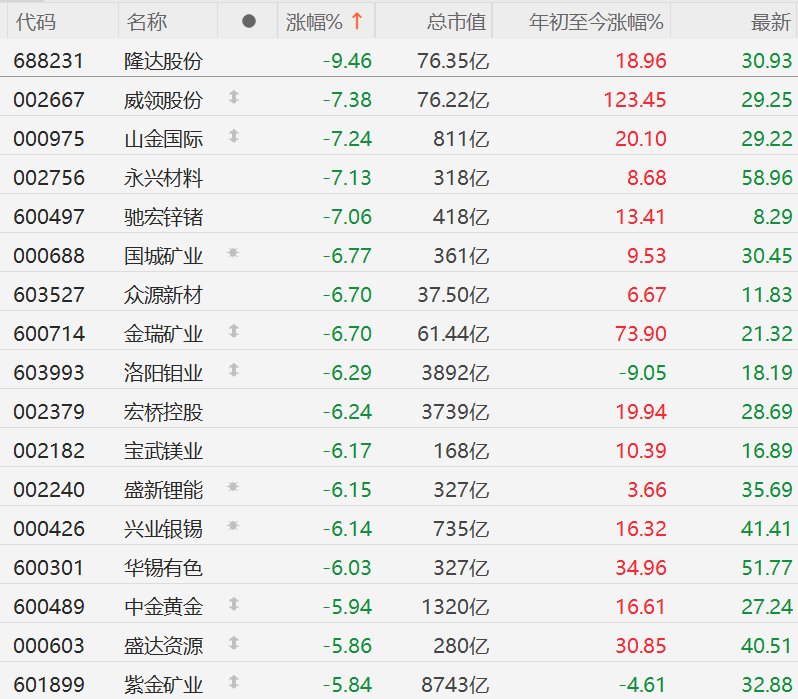
Group 1 - Precious metals prices, including gold and silver, experienced a significant decline, leading to a collective drop in the A-share market's non-ferrous metal stocks [1] - By midday, several companies saw substantial losses, with 隆达股份 down over 9%, 威领股份, 山金国际, and 永兴材料 each falling more than 7% [1] - Other notable declines included 国城矿业, 众源新材, and 金瑞矿业, which dropped over 6%, while 中金黄金 and 盛达资源 fell more than 5% [1] Group 2 - 隆达股份 reported a decline of 9.46%, with a total market capitalization of 76.35 billion and a year-to-date increase of 18.96% [2] - 威领股份 decreased by 7.38%, with a market cap of 76.22 billion and a year-to-date increase of 123.45% [2] - 山金国际 saw a drop of 7.24%, with a market cap of 811 billion and a year-to-date increase of 20.10% [2] - 永兴材料 fell by 7.13%, with a market cap of 318 billion and a year-to-date increase of 8.68% [2] - 驰宏锌锗 decreased by 7.06%, with a market cap of 418 billion and a year-to-date increase of 13.41% [2] - 国城矿业 dropped by 6.77%, with a market cap of 361 billion and a year-to-date increase of 9.53% [2] - 众源新材 fell by 6.70%, with a market cap of 37.50 billion and a year-to-date increase of 6.67% [2] - 洛阳钼业 decreased by 6.29%, with a market cap of 389.2 billion and a year-to-date decrease of 9.05% [2] - 宏桥控股 dropped by 6.24%, with a market cap of 373.9 billion and a year-to-date increase of 19.94% [2] - 宝武镁业 saw a decline of 6.17%, with a market cap of 168 billion and a year-to-date increase of 10.39% [2] - 兴业银锡 decreased by 6.14%, with a market cap of 735 billion and a year-to-date increase of 16.32% [2] - 华锡有色 fell by 6.03%, with a market cap of 327 billion and a year-to-date increase of 34.96% [2] - 中金黄金 decreased by 5.94%, with a market cap of 1320 billion and a year-to-date increase of 16.61% [2] - 盛达资源 saw a decline of 5.86%, with a market cap of 280 billion and a year-to-date increase of 30.85% [2]



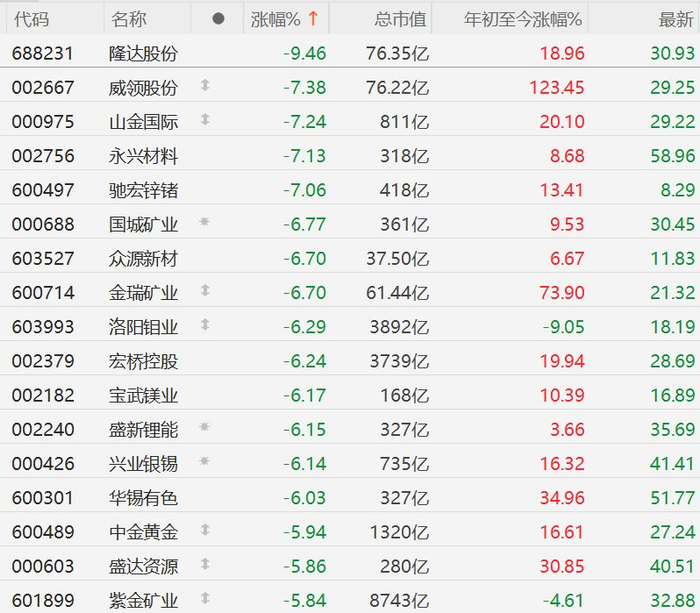
有色金属股集体下挫,洛阳钼业、兴业银锡跌超6%
Ge Long Hui· 2026-03-19 03:40
Group 1 - The overnight prices of gold and silver experienced a significant decline, leading to a collective drop in the A-share market for non-ferrous metal stocks [1] - By midday closing, several companies saw substantial declines, with Longda Co., Ltd. falling over 9%, and others like Weiling Co., Ltd., Shanjin International, and Yongxing Materials dropping more than 7% [1] - Other companies such as Guocheng Mining, Zhongyuan New Materials, and Jincheng Mining also faced declines exceeding 6%, indicating a widespread downturn in the sector [1] Group 2 - Longda Co., Ltd. reported a drop of 9.46%, with a total market value of 7.635 billion [2] - Weiling Co., Ltd. decreased by 7.38%, maintaining a market value of 7.622 billion, while its year-to-date increase stands at 123.45% [2] - Shanjin International saw a decline of 7.24%, with a market capitalization of 81.1 billion and a year-to-date increase of 20.10% [2]

宁证期货今日早评-20260319
Ning Zheng Qi Huo· 2026-03-19 02:49
Group 1: Investment Ratings - No investment ratings are provided in the report. Group 2: Core Views - In the short - term, gold and silver are expected to remain in high - level oscillations. Gold is affected by rising inflation expectations and suppressed interest - rate cut expectations due to the deepening Middle - East conflict [1][7]. - Methanol is expected to be in a short - term oscillation with a slightly upward trend, as domestic methanol production is at a high level, downstream demand is recovering, and inventories are decreasing [2]. - Iron ore is expected to oscillate in the short - term and show a weakening trend in the medium - term due to supply and geopolitical disturbances and high inventory pressure [4]. - For coking coal, if the geopolitical conflict persists, it may follow the strong performance of crude oil prices; if the conflict eases, it is expected to maintain an oscillating operation [4]. - The price of hot - rolled coils may face pressure after a rebound, as geopolitical conflicts and trade investigations bring uncertainties to steel exports, and the inventory is relatively high [5]. - Thirty - year treasury bonds are in a triangular oscillating convergence, and short - term bond prices are under pressure due to the economic recovery and the potential rebound of the stock market [6]. - The short - term price of live pigs is weak, but the downward space for long - term futures prices is limited. Attention should be paid to the slaughter volume of the breeding end and the reduction of breeding sows [9]. - Palm oil is expected to oscillate at a high level in the short - term, with strong support at the bottom. It is recommended to go long in the short - term [10]. - For soybean meal, the short - term price is expected to oscillate at a high level. It is recommended to go long on dips [11]. - The short - term volatility of aluminum may increase, and casting aluminum alloy is expected to follow the change of aluminum prices, as geopolitical conflicts and high energy prices affect the supply and demand [12]. - Tin prices are expected to be under pressure in the short - term due to the expected supply increase and high inventory [13]. - Plastic is expected to oscillate slightly upward in the short - term, with strong cost support and cautious demand - side procurement [14]. - Soda ash is expected to oscillate slightly downward in the short - term, as the supply is high, the demand is average, and the inventory is at a high level [15]. - Crude oil is recommended to maintain a long - bias trading strategy in the medium - term before the significant resumption of navigation in the Strait of Hormuz [16]. - Polyester bottle chips are recommended to maintain a long - bias trading strategy, as the supply increases, the cost support exists, and the downstream enters the consumption peak season [17]. - Natural rubber is expected to oscillate, with a strong supply - side raw material price, a seasonal inventory increase, and a good export market in the tire industry [18]. Group 3: Summary by Commodity Gold - Middle - East energy facilities are attacked, the war deepens, inflation expectations rise, suppressing interest - rate cut expectations and precious metals. Gold is expected to oscillate at a high level in the medium - term [1]. Methanol - The market price in Jiangsu Taicang is 2925 yuan/ton, up 80 yuan/ton. Port and inland inventories are decreasing, and downstream demand is recovering. It is expected to oscillate slightly upward in the short - term [2]. Iron Ore - From March 9th to 15th, the arrival volume of iron ore at 47 ports in China decreased by 380.5 tons week - on - week. It is expected to oscillate in the short - term and weaken in the medium - term [4]. Coking Coal - The capacity utilization rate of 230 independent coking enterprises is 72.39%, up 0.1%. The impact of geopolitical conflicts on coking coal prices is significant [4]. Hot - Rolled Coils - As of the week of March 18th, the output increased by 3.84 tons week - on - week, and the total inventory increased by 1.56 tons. The price may face pressure after a rebound [5]. Thirty - Year Treasury Bonds - Fixed - asset investment has changed from a decline to an increase. The bond market is under pressure in the short - term but is unlikely to break through the key support level [6]. Silver - The Fed maintains the federal funds rate unchanged, raises inflation and economic growth expectations. Silver is expected to oscillate at a high level in the medium - term [7]. Live Pigs - The average wholesale price of pork decreased by 0.1% compared with the previous day. The short - term price is weak, and the long - term downward space is limited [9]. Palm Oil - Indonesia's palm oil inventory decreased by 25.23% in December. It is expected to oscillate at a high level in the short - term, with strong support at the bottom [10]. Soybean Meal - The spot market price is stable with a slight decline. The short - term price is expected to oscillate at a high level, and it is recommended to go long on dips [11]. Aluminum - The blockade of the Strait of Hormuz affects the aluminum supply chain. The short - term volatility may increase [12]. Casting Aluminum Alloy - The price is partially up 100 yuan/ton. It is in a situation of cost support and weak demand, and is expected to follow the change of aluminum prices [12]. Tin - Samsung's strike threat adds uncertainty to the semiconductor supply chain. Tin prices are expected to be under pressure in the short - term [13]. Plastic - The mainstream price of LLDPE in North China is 8424 yuan/ton, up 10 yuan/ton. It is expected to oscillate slightly upward in the short - term [14]. Soda Ash - The mainstream price of heavy - quality soda ash is 1253 yuan/ton, down 4 yuan/ton. It is expected to oscillate slightly downward in the short - term [15]. Crude Oil - U.S. crude oil inventory increased, and the Middle - East conflict deepens. It is recommended to maintain a long - bias trading strategy in the medium - term [16]. Polyester Bottle Chips - The capacity utilization rate is 72.50%, and the profit is 842.38 yuan/ton. It is recommended to maintain a long - bias trading strategy [17]. Natural Rubber - The raw material price in Thailand is firm, the inventory in China is seasonally increasing, and the tire export market is good. It is expected to oscillate [18].
大摩闭门会-原材料-金融行业更新
2026-03-19 02:39
Summary of Key Points from Conference Call Records Industry or Company Involved - The records primarily discuss the **financial sector** and **mining industry**, with specific references to companies such as **Ningbo Bank**, **Jiangxi Copper**, and **China Aluminum**. Additionally, the **Hong Kong Stock Exchange** and its IPO mechanisms are also covered. Core Insights and Arguments 1. **Credit Structure and Government Bonds**: The credit structure in 2026 is supported by public infrastructure, with government bond growth expected to exceed 16%[1][3]. 2. **Loan Growth Trends**: Loan growth in February 2026 was stable at 6.1% year-on-year, but retail loan demand showed signs of weakness, with a decrease of approximately 6,500 billion yuan[3][4]. 3. **Ningbo Bank's Growth Potential**: Ningbo Bank is expected to return to double-digit revenue growth, with a stable ROE of 13%-14%, supported by its deep service to private enterprises and differentiated pricing strategies[6]. 4. **Impact of Middle East Conflict on Sulfur Supply**: The conflict has disrupted sulfur supply, increasing costs for wet-process copper mines, while Jiangxi Copper benefits from rising sulfuric acid prices, which have increased by 12%-13%[1][10]. 5. **Energy Market Dynamics**: The disruption in LNG supply from Qatar may lead to increased coal demand in Japan and South Korea, supporting coal prices and leading to upgrades in ratings for companies like Shenhua and Yancoal[1][12]. 6. **Alumina Cost Increases**: Guinea's export restrictions on bauxite are expected to raise alumina costs, benefiting companies with high self-sufficiency like China Aluminum and Hongqiao[1][13]. 7. **Hong Kong IPO Mechanism Reforms**: The Hong Kong Stock Exchange is lowering the market cap threshold for IPOs to 200 billion HKD, which is expected to enhance its competitiveness and attract more innovative companies[2][7]. 8. **Trends in IPO Structures**: Both Hong Kong and A-share markets are seeing a shift towards manufacturing sectors, with 46% of Hong Kong's IPO funds directed towards manufacturing, indicating a convergence in market trends[8][9]. 9. **Copper Production and Supply Chain Concerns**: Jiangxi Copper is transitioning to a more profitable model with significant growth potential in copper production, expected to grow at a compound annual growth rate of nearly 20%[11]. 10. **Demand Recovery in Nonferrous Metals**: By late March 2026, demand for nonferrous metals is showing signs of recovery, particularly in the renewable energy sector, despite initial expectations of a slowdown[15]. Other Important but Potentially Overlooked Content 1. **Regulatory Changes in Zhejiang**: The regulatory environment is shifting towards stabilizing loan rates, with a new minimum rate for corporate loans set at 2.4%, which may lead to a more stable lending environment[4]. 2. **Market Liquidity and Investment Shifts**: February 2026 saw a rebound in household deposits to 8.8%, indicating a shift of funds from deposits to insurance, funds, and the stock market, which is expected to support A-share market liquidity[5][6]. 3. **Geopolitical Risks and Commodity Prices**: The ongoing geopolitical tensions are likely to influence commodity prices, including potential upward pressure on gold prices due to economic recession fears, despite short-term selling pressures[16]. This summary encapsulates the critical insights and trends discussed in the conference call records, providing a comprehensive overview of the financial and mining sectors' current landscape and future outlook.
金融期货早评:中东局势焦灼,美联储立场有所改变-20260319
Nan Hua Qi Huo· 2026-03-19 02:38
Group 1: Financial Futures 1. Investment Rating - Not provided 2. Core View - The US-Iran conflict may enter an irreversible escalation path, strengthening the upward support for international oil prices. The Fed's hawkish stance in the March FOMC meeting is due to inflation risks. Traditional safe - haven assets have shown abnormal performance. The risk of US stagflation is currently a small - probability event. Short - term oil prices may continue to rise, putting pressure on US stocks. Gold may not have a trend - based market in the short term, and the upward space for US Treasury yields is limited. The US dollar still has short - term safe - haven value [1]. 3. Summary by Category - **Macro**: The Fed maintained interest rates, and the dot - plot shows one more rate cut this year. Powell said the US economic outlook is "extremely uncertain". The US - Iran conflict may escalate, and the Fed is cautious about supply - side shocks. Traditional safe - haven assets have abnormal performance due to the change in the trading theme [1]. - **Renminbi Exchange Rate**: The Fed's inaction and rising inflation expectations boost the US dollar index. China's economy is growing steadily, and policy support lays the foundation for the moderate appreciation of the renminbi. Export enterprises can lock in forward exchange settlement at 6.93, and import enterprises can adopt a rolling foreign - exchange purchase strategy at 6.85 [1][2]. - **Stock Index**: The Fed's hawkish signals put pressure on A - shares. Short - term adjustment is not over, and the stock index is expected to continue to fluctuate and consolidate [2][4]. - **Treasury Bonds**: Short - term adjustment is expected to continue. The market needs to pay attention to whether it can be desensitized to oil prices [4][5]. - **Container Shipping to Europe**: The market is dominated by geopolitical conflicts, expected to open higher and may try to attack upwards, but the sustainability of the rebound is in doubt. Trend traders should be cautious about chasing highs, and arbitrage traders can consider the "long near - month, short far - month" strategy [7][8][9]. Group 2: Commodities 1. Investment Rating - Not provided 2. Core View - Different commodities are affected by various factors such as geopolitical conflicts, market supply - demand, and Fed policies, showing different trends. Some commodities face short - term risks, while others have long - term potential [11][13][26]. 3. Summary by Category - **New Energy** - **Lithium Carbonate**: The price has a short - term decline risk due to the callback of the non - ferrous metal sector [11]. - **Industrial Silicon and Polysilicon**: They are affected by the non - ferrous metal sector and have a weak fundamental situation. In the long run, the photovoltaic industry has development potential, but currently, it needs to wait for capacity clearance [12][13]. - **Non - Ferrous Metals** - **Aluminum**: Short - term trends are dominated by the war, with large fluctuations. Long - term low - cost futures bulls or call options can be held, and positive arbitrage can be considered [15]. - **Alumina**: The fundamentals are mixed, and selling deep - out - of - the - money put options is recommended [16]. - **Cast Aluminum Alloy**: It has a strong follow - up to aluminum, and attention can be paid to the spread between aluminum alloy and aluminum [15][16]. - **Copper**: After the FOMC resolution, the sentiment is released, and it may rebound. A volatility recovery strategy can be constructed [16][18]. - **Zinc**: It is in a panic bottom - hunting stage, and the upward pressure is large in the short term, maintaining a weak and volatile trend [18]. - **Nickel - Stainless Steel**: It is affected by the non - ferrous metal market and the macro environment. It is weak in the short term and is expected to be strong in the medium term [18][20]. - **Tin**: It is in a downward trend in the short term and has an upward trend in the long term [21]. - **Lead**: It is expected to fluctuate in a range [21]. - **Oils and Fats, Feed** - **Oilseeds**: The Brazilian shipment situation disturbs the market. In the short term, the spot price is firm, but the medium - term supply is large. The spread between soybean and rapeseed meal is expected to be repaired, and a small - position positive spread strategy can be tried [23]. - **Oils and Fats**: They follow the trend of crude oil. The biodiesel policies of Indonesia and the US support the market. Selling put options can be considered [23][24]. - **Energy and Oil and Gas** - **SC**: Geopolitical situations dominate the pricing logic, and the risk premium of crude oil rises. Short - term upward - driving factors exist [26]. - **Fuel Oil**: It is in a high - level fluctuation, and the short - term trend is difficult to reverse. The Asian market is generally strong [27][28]. - **Asphalt**: Affected by geopolitical disturbances, the price continues to rise. Attention should be paid to position control and combination strategies [28][29]. - **Precious Metals** - **Platinum and Palladium**: They have a long - term bullish foundation but face short - term adjustment risks due to the delay of rate - cut expectations. Buying on dips can be considered [30][31]. - **Gold and Silver**: They are under pressure in the short term but are strategically bullish in the long term. Buying on dips is recommended [31][33]. - **Chemicals** - **Pulp - Offset Paper**: The spot price of pulp drops, pulling down the futures price. The offset paper futures fluctuate in a range [34][35]. - **Pure Benzene - Styrene**: They are driven by the cost side due to the Middle East conflict and are expected to be volatile and strong in the short term [35][36][37]. - **LPG**: It is driven by geopolitical risks, and the price center moves up. Long positions can be held with dynamic stop - profit, and a bullish spread strategy can be considered [38][39]. - **Methanol**: It is affected by the US - Iran situation, with large fluctuations. The 5 - 9 spread can be positively arbitraged at a low level [40][41]. - **PP and Propylene**: They are expected to be volatile and strong before the geopolitical risks are eliminated. The focus is on the Middle East situation and the navigation of the Strait of Hormuz [41][43]. - **Plastic**: It is expected to be strong if the Middle East conflict continues. The supply is expected to shrink, and the 5 - 9 spread may strengthen [44][45]. - **Rubber**: Synthetic rubber may be volatile and strong, while natural rubber is under pressure in the short term and is expected to stabilize in the long term. Corresponding trading strategies are provided [46][51][52]. - **Glass and Soda Ash**: Soda ash supply is under pressure, and glass is restricted by supply recovery expectations and high intermediate inventory [53][54]. - **Black Metals** - **Rebar and Hot - Rolled Coil**: The cost of raw materials supports the price of steel, but the high inventory of hot - rolled coils limits the upward space. The short - term rebound is limited [55][56]. - **Iron Ore**: The price is short - term strong but the supply - demand situation is not fundamentally improved. It is recommended to take profits on long positions at high prices [56][57]. - **Silicon Iron and Silicon Manganese**: The cost provides support, but the upward space is limited due to weak downstream demand [57][58]. Group 3: Agricultural and Soft Commodities 1. Investment Rating - Not provided 2. Core View - Different agricultural and soft commodities have different supply - demand situations and price trends, which are affected by factors such as geopolitical situations, policies, and seasons [59][76][77]. 3. Summary by Category - **Hogs**: The futures price continues to decline sharply, and the slaughter volume of slaughtering enterprises has a limited increase due to weak demand [59]. - **Cotton**: The supply - demand situation is expected to tighten, and the cotton price has a support at the bottom. Although there may be a short - term correction, the downward space is limited [60][61][62]. - **Sugar**: The short - term oil price may be volatile, and the 2 - month sugar import increases year - on - year [62][63]. - **Eggs**: The supply is sufficient, but the demand is recovering. The egg price may be weakly stable in the short term and show an upward trend in the long term. Selling call options on the main contract is recommended [64][65][66]. - **Apples**: The futures price is strong, driven by fundamentals and delivery logic. The 05 contract has strong short - term support [76]. - **Jujubes**: The demand is weak, and the price is under pressure, showing a low - level shock and bottom - building trend [77]. - **Logs**: The inventory pressure is reduced, and the price is relatively stable. Short - term observation or range - trading strategies can be adopted, and long positions can be considered in the long term [78].
研究所晨会观点精萃-20260319
Dong Hai Qi Huo· 2026-03-19 02:35
1. Report Industry Investment Rating No information provided in the given content. 2. Core Viewpoints of the Report - Overseas, the threat from the Iranian Revolutionary Guard to attack multiple energy facilities in the Middle East led to a sharp rise in crude oil prices and inflation pressure; the US PPI data exceeded expectations, and the Fed's interest - rate meeting had a hawkish tone, causing the US dollar index and US Treasury yields to rise and global risk appetite to cool significantly. Domestically, China's economy rebounded better than expected from January to February, with exports far exceeding expectations and inflation continuing to recover. The government's work report set the main development targets and fiscal and monetary policies for 2026, with overall targets and policy intensity lower than in 2025. In the short term, the stock index will fluctuate, and attention should be paid to changes in the geopolitical situation in the Middle East, the implementation of the Two Sessions policies, and market sentiment [2]. - Different asset classes have different trends: the stock index and government bonds will fluctuate in the short term, with a cautious wait - and - see attitude; among commodity sectors, black metals will have a short - term oscillating rebound, non - ferrous metals will oscillate in the short term, energy and chemical products will be oscillating and strong in the short term, and precious metals will oscillate in the short term, all requiring a cautious approach [2]. 3. Summary by Directory 3.1 Macro - finance - Overseas, the threat to energy facilities and the hawkish Fed led to a rise in inflation and a decline in risk appetite. Domestically, the economy and inflation were better than expected, but policy targets and intensity were lower than in 2025. The stock index will oscillate in the short term, and attention should be paid to geopolitical and policy changes. Assets such as stocks, bonds, and commodities will have different short - term trends [2]. 3.2 Stock Index - Driven by sectors like communication services, AI, and semiconductors, the domestic stock market rose slightly. The economy and inflation were better than expected from January to February, but due to geopolitical shocks and the hawkish Fed, the stock index will oscillate in the short term. It is advisable to wait and see in the short term [3]. 3.3 Precious Metals - On Wednesday night, the precious metals market fell sharply. Due to the threat to energy facilities, rising inflation expectations, and the hawkish Fed, the US dollar index strengthened, and precious metal prices weakened. They will oscillate in the short term, and a cautious wait - and - see attitude is recommended [4]. 3.4 Black Metals - **Steel**: The spot market rebounded slightly, and the futures price rose and then fell. The decline in crude oil prices led to a slowdown in the rise of steel prices. Demand was weak but improving, and supply would remain high. It is recommended to treat it with an oscillating mindset and beware of the risk of a fall after a rise [6]. - **Iron Ore**: The futures and spot prices fell slightly. The daily average pig iron output decreased, but there was an expectation of resumption of production after the Two Sessions. The global iron ore arrival volume decreased, and the shipping volume increased. The short - term upward space of iron ore prices may be limited, and attention should be paid to the risk of a fall after a rise [6]. - **Silicon Manganese/Silicon Iron**: The spot prices rebounded slightly, and the futures prices fell. The manganese ore spot was firm. The supply of silicon manganese had a slight change in production capacity utilization, and the downstream demand was recovering. The prices of silicon iron and silicon manganese are recommended to be treated with an oscillating mindset [7]. 3.5 Non - ferrous Metals and New Energy - **Copper**: Since 2026, copper prices have been oscillating at a high level. The core contradiction lies in the mine end, but the probability of extreme shortage is low. Refined copper production has a high growth rate, and downstream demand is suppressed, with inventories accumulating [8]. - **Aluminum**: The non - ferrous sector was weak. Domestic aluminum supply was high, and inventories were accumulating. Overseas supply was tight due to the Middle East situation, resulting in a large price difference between domestic and overseas [8]. - **Zinc**: The zinc ore processing fee in some regions rebounded, and the import ore TC decreased. Domestic smelting production was at a relatively high level, and overseas production will recover in 2026. Demand was not optimistic, and inventories were accumulating [9]. - **Lead**: The production of primary and secondary lead increased seasonally, and demand entered the off - season. LME and domestic lead inventories were at high levels [10]. - **Nickel**: The cost supported the MHP price, and the RKAB quota in Indonesia decreased. Nickel prices had strong support below but limited upward momentum. Inventories at home and abroad were at high levels [11]. - **Tin**: The supply of tin increased as the resumption of production in Myanmar accelerated and smelting enterprises resumed work. Demand was differentiated, and inventories increased [12]. - **Lithium Carbonate**: The futures price of lithium carbonate fell. The price of lithium ore decreased, and the social inventory was de - stocked. It is expected to oscillate at a high level, and it is not advisable to chase the rise [13]. - **Industrial Silicon**: The futures price of industrial silicon fell. It was priced close to the cost, and attention should be paid to the cost support [14]. - **Polysilicon**: The futures price of polysilicon fell. The inventory was at a high level, and the price was expected to be weakly oscillating [14]. 3.6 Energy and Chemicals - **Crude Oil**: Iranian oil and gas facilities were attacked, causing the oil price to rise significantly. The short - term oil price will remain strong and volatile [15]. - **Asphalt**: The asphalt price followed the rise in oil price. The inventory was low, and the supply was low. The short - term absolute price will fluctuate with the oil price [15]. - **PX**: The PX price was high due to the shortage of naphtha. Although there were some factors suppressing the upward trend, the oil price was the main logic [16]. - **PTA**: The PTA price followed the rise in PX, and the inventory pressure decreased. However, the profit of the middle and lower reaches was suppressed, and attention should be paid to the negative feedback [16]. - **Ethylene Glycol**: The price of ethylene glycol rose, but the inventory was high. If exports are used for de - stocking, the price may rise [17]. - **Short - fiber**: The short - fiber price followed the energy and chemical sector to be strongly oscillating. The downstream profit was suppressed, and the inventory increased [17]. - **Methanol**: The inland methanol market was strong, and the port market had a weakening basis. The supply was worried due to the conflict, and the inventory decreased. The overall pattern was strong [18]. - **PP**: The PP price was sorted out in a small range. The supply decreased, and the price was supported. Attention should be paid to the navigation situation in the Strait of Hormuz [18]. - **LLDPE**: The price of LLDPE was adjusted. The downstream demand was increasing, but the profit was compressed. The supply was tight, and the price was firm [19]. - **Urea**: The domestic urea market was weakly adjusted. The daily output was high, and the price was expected to return to an oscillating range [19][20]. 3.7 Agricultural Products - **US Soybeans**: The overnight soybean price rose. The rise in oil price and the expected biofuel policy supported the price. Attention should be paid to the estimated planting area at the end of the month [21]. - **Soybean and Rapeseed Meal**: The import of soybeans decreased seasonally, and the soybean and soybean meal inventories decreased, supporting the soybean meal basis. The supply of rapeseed was expected to be loose, suppressing the market sentiment [21]. - **Oils and Fats**: The international oil price and biofuel policy supported the performance of oils and fats. The palm oil price was supported by increased exports and decreased production. The soybean oil basis was stable, and the rapeseed oil basis was slightly down [22]. - **Corn**: The corn price oscillated, and the bullish sentiment slowed down. The increase in imported barley and the release of grain sources limited the upward risk preference [22]. - **Pigs**: The pig industry was in a period of capacity adjustment. The demand was improving marginally but still in the off - season. The price had a sign of stopping falling, and the futures price was expected to oscillate weakly in a range [23].
所长早读-20260319
Guo Tai Jun An Qi Huo· 2026-03-19 02:14
请务必阅读正文之后的免责条款部分 1 期货研究 所长 早读 国泰君安期货 2026-03-19 期 期货研究 2026-03-19 所长 早读 相互攻击能源设施,局面更加复杂 观点分享: 美以对伊军事行动进入第 19 天,中东能源设施遭袭风险骤然升级。据央视新闻,以色 列国防军当地时间 18 日袭击了位于伊朗南部布什尔省的南帕尔斯气田相关设施,以色列官 员称该设施处理伊朗约 40%的天然气,并表示此次袭击系与美国协调实施。重要气田遭袭 后,伊朗称,将美国相关石油设施与美军基地同等对待,将全力打击。另外列明对沙特、阿 联酋和卡塔尔能源设施打击目标。之后伊朗打击了沙特利雅得炼油厂美方专属区域,引发大 火。卡塔尔拉斯拉凡工业城遭导弹袭击。卡塔尔称伊导弹击中 LNG 枢纽造成严重破坏。报道 称特朗普提前获悉并支持以色列袭击伊朗气田,目前反对继续袭击能源设施。伊拉克称伊朗 供应的天然气完全中断。自以色列攻击伊朗天然气设施之后,之前对能源设施不予破坏的克 制灰飞烟灭,而生产设施的破坏很可能对产能和供给产生更加持久的损失,从而对原油天然 气及化工品产生更为持久的影响。 所 长 首 推 | 板块 | 关注指数 | | --- ...